Introduction
AI Lead Scoring Platforms use machine learning and AI models to evaluate prospects across multiple dimensions such as engagement, demographics, intent, and behavior, assigning predictive scores that indicate conversion likelihood. These platforms empower sales and marketing teams to prioritize high-potential leads, optimize outreach, and increase pipeline efficiency. Unlike traditional lead scoring, which relies on static rules or limited historical data, AI-driven models continuously learn from evolving behaviors, campaign performance, and multi-channel interactions.
Why it matters
- Predictive prioritization: Focus on leads most likely to convert, improving sales efficiency.
- Dynamic scoring: Models update automatically as prospects interact across channels.
- Omnichannel insight: Integrates behavior across email, web, social, CRM, and offline interactions.
- Revenue impact: Optimizes sales pipeline for higher ROI and reduced wasted effort.
- Data-driven outreach: Provides objective lead prioritization based on AI insights.
- Scalability: Handles enterprise-scale databases with millions of leads.
Real-World Use Cases
- Enterprise sales teams: Prioritize leads for Account Executives based on likelihood to convert.
- B2B SaaS marketing: Identify trial users most likely to purchase subscriptions.
- Lead nurturing campaigns: Automate follow-ups for leads with higher conversion probability.
- Cross-channel marketing: Score leads based on web, email, and social activity.
- Churn prevention: Predict which accounts are at risk of disengaging.
- Sales forecasting: Improve revenue predictions using AI lead scores.
Evaluation Criteria for Buyers
- Scoring accuracy: Predictive models must correlate strongly with actual conversion outcomes.
- Integration flexibility: CRM, marketing automation, and analytics platform connectivity.
- Model transparency: Ability to explain why a lead received a certain score.
- Data privacy & compliance: GDPR, CCPA, and enterprise-grade security.
- Dynamic updates: Scores adapt in real-time as leads interact across channels.
- Multi-channel data ingestion: Email, web, social, mobile, and offline interactions.
- Automation & workflow support: Trigger actions or assign leads based on scores.
- Analytics & reporting: Visual dashboards and KPI tracking.
- Ease of adoption: Usable by sales and marketing teams with minimal training.
- Scalability: Handles millions of leads with low latency.
- Guardrails: Prevent bias and maintain ethical scoring practices.
- Cost efficiency: Balance feature richness with subscription or usage costs.
Best for: Sales leaders, marketing teams, B2B organizations, SaaS companies, and large enterprises with complex pipelines.
Not ideal for: Small businesses with few leads or minimal multi-channel engagement.
What’s Changed in AI Lead Scoring Platforms
- Agentic workflows dynamically updating scores and lead priorities
- Multi-modal data inputs: web behavior, email engagement, CRM activity, social signals
- Enhanced evaluation to reduce AI bias and improve predictive reliability
- Guardrails for privacy, fairness, and compliance in scoring
- Enterprise-grade privacy with retention policies and regional data controls
- Cost and latency optimization with model routing and BYO model support
- Observability dashboards tracking scoring metrics, engagement, and cost
- Integration with CRM, marketing automation, and analytics platforms
- Predictive and adaptive scoring based on machine learning insights
- Improved explainability for stakeholders and sales managers
Quick Buyer Checklist
- Accuracy of predictive scoring
- CRM and automation integrations
- Real-time dynamic updates
- Multi-channel data ingestion
- Guardrails and compliance
- Observability and reporting dashboards
- Automation support for workflows
- Scalability for large lead databases
- Ease of adoption for sales and marketing teams
- Cost efficiency relative to features
- BYO vs proprietary model flexibility
- Evaluation and testing mechanisms
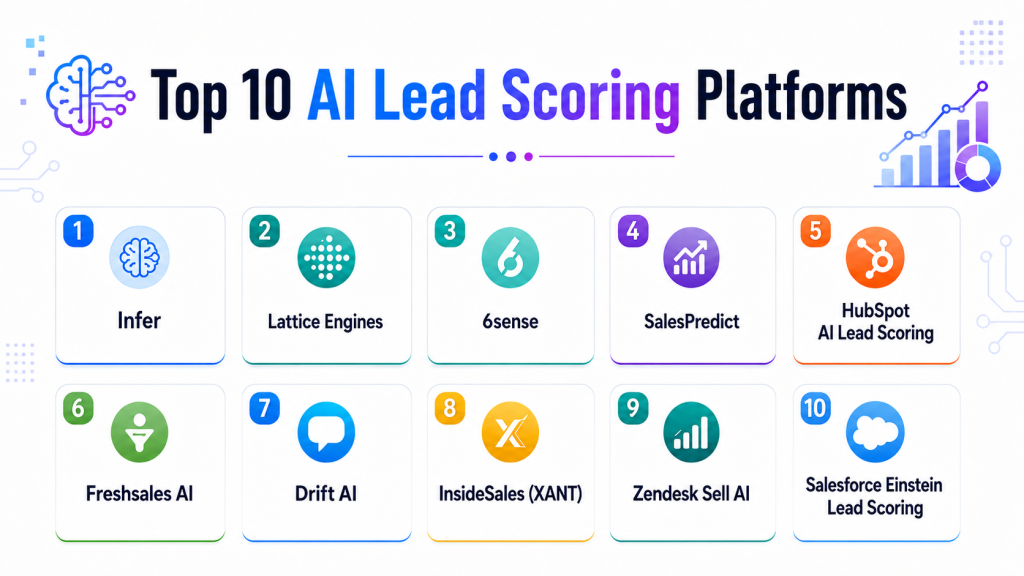
Top 10 AI Lead Scoring Platforms
1 — Infer
One-line verdict: Best for enterprise sales teams seeking AI-driven predictive lead prioritization across channels.
Short description: Infer uses ML models to predict lead conversion probability by analyzing behavioral, firmographic, and engagement data.
Standout Capabilities
- Predictive scoring across multiple touchpoints
- Multi-channel behavior analysis
- Automated lead prioritization
- Integration with CRM and marketing tools
- Account-level scoring
- Predictive revenue contribution
AI-Specific Depth
- Model support: Proprietary
- RAG / knowledge integration: CRM connectors
- Evaluation: Regression and offline evaluation
- Guardrails: Bias detection, compliance
- Observability: Dashboards for scoring and conversion metrics
Pros
- Enterprise-ready predictive scoring
- Multi-channel integration
- Improves sales efficiency
Cons
- Premium pricing
- Cloud-only
- Setup complexity
Security & Compliance
- SSO/SAML, encryption, audit logs
- Certifications: Not publicly stated
Deployment & Platforms
- Web
- Cloud
Integrations & Ecosystem
- Salesforce, HubSpot, Marketo
- Analytics platforms, API access
Pricing Model
- Subscription tiered by contacts
Best-Fit Scenarios
- Enterprise B2B sales
- Multi-channel lead scoring
- Revenue-focused marketing campaigns
2 — Lattice Engines
One-line verdict: Ideal for predictive B2B lead scoring and sales forecasting for mid-market to large enterprises.
Short description: Lattice Engines combines predictive analytics with machine learning to score leads and forecast pipeline performance.
Standout Capabilities
- AI-powered lead scoring
- Engagement and intent signals
- Predictive account and opportunity scoring
- Multi-channel behavior modeling
- Automated prioritization workflows
AI-Specific Depth
- Model support: Proprietary
- RAG / knowledge integration: CRM connectors
- Evaluation: Predictive scoring and regression
- Guardrails: Privacy and compliance
- Observability: Conversion dashboards
Pros
- Predictive accuracy for B2B leads
- Multi-touch analysis
- Enhances sales forecasting
Cons
- Premium cost
- Integration effort
- Cloud-only
Security & Compliance
- SSO, encryption, audit logs
- Certifications: SOC 2
Deployment & Platforms
- Web
- Cloud
Integrations & Ecosystem
- Salesforce, HubSpot, Marketo
- Analytics dashboards, APIs
Pricing Model
- Subscription-based
Best-Fit Scenarios
- Mid-market sales teams
- Predictive pipeline optimization
- Multi-channel B2B campaigns
3 — 6sense
One-line verdict: Best for ABM-focused sales and marketing teams seeking predictive account scoring and insights.
Short description: 6sense uses AI to analyze buying signals, prioritize accounts, and predict conversion likelihood.
Standout Capabilities
- Predictive account scoring
- Buying intent signals
- Multi-channel lead engagement analysis
- AI-driven prioritization
- Forecasting revenue potential
- Integration with ABM platforms
AI-Specific Depth
- Model support: Proprietary
- RAG / knowledge integration: CRM and marketing automation connectors
- Evaluation: Regression, human review
- Guardrails: Compliance and bias checks
- Observability: Dashboards for engagement and scoring
Pros
- ABM-focused scoring
- Integrates multiple touchpoints
- Improves pipeline efficiency
Cons
- Enterprise pricing
- Cloud-only
- Learning curve
Security & Compliance
- SSO/SAML, encryption, audit logs
- Certifications: Not publicly stated
Deployment & Platforms
- Web
- Cloud
Integrations & Ecosystem
- Salesforce, Marketo, HubSpot
- Analytics tools and dashboards
Pricing Model
- Subscription
Best-Fit Scenarios
- ABM campaigns
- Enterprise B2B sales
- Multi-channel pipeline optimization
4 — SalesPredict
One-line verdict: Suited for predictive lead scoring with behavioral and demographic analytics for mid-market sales teams.
Short description: SalesPredict uses AI models to assign lead scores and predict which prospects are most likely to convert.
Standout Capabilities
- Predictive lead scoring
- Behavioral modeling
- Engagement tracking
- Automated prioritization workflows
- Pipeline forecasting
- Multi-touch integration
AI-Specific Depth
- Model support: Proprietary
- RAG / knowledge integration: CRM connectors
- Evaluation: Regression analysis, human review
- Guardrails: Compliance and bias monitoring
- Observability: Dashboard metrics
Pros
- Predictive scoring improves targeting
- Multi-touch insights
- Integrates with CRM platforms
Cons
- Cloud-only
- Setup required for optimal results
- Pricing not publicly stated
Security & Compliance
- Encryption, SSO, audit logs
- Certifications: Not publicly stated
Deployment & Platforms
- Web
- Cloud
Integrations & Ecosystem
- Salesforce, HubSpot, Marketo
- Analytics and reporting dashboards
Pricing Model
- Subscription
Best-Fit Scenarios
- Mid-market sales teams
- Multi-channel campaigns
- Pipeline optimization
5 — HubSpot AI Lead Scoring
One-line verdict: Ideal for SMB and mid-market teams using HubSpot CRM for predictive lead prioritization.
Short description: HubSpot AI Lead Scoring integrates machine learning with HubSpot CRM to automatically rank leads by conversion probability.
Standout Capabilities
- Automated lead scoring within HubSpot CRM
- Behavioral and engagement analysis
- Multi-channel activity tracking
- Predictive conversion insights
- Campaign performance analytics
AI-Specific Depth
- Model support: Proprietary
- RAG / knowledge integration: HubSpot CRM only
- Evaluation: Regression and offline testing
- Guardrails: Compliance and ethical scoring
- Observability: Dashboards with lead insights
Pros
- Seamless CRM integration
- Automatic score updates
- Easy-to-use for sales teams
Cons
- Limited to HubSpot ecosystem
- Less flexible for custom models
- Subscription required
Security & Compliance
- SSO, audit logs, encryption
- Certifications: Not publicly stated
Deployment & Platforms
- Web
- Cloud
Integrations & Ecosystem
- HubSpot Marketing, Sales, and Service Hubs
- API access for custom workflows
Pricing Model
- Tiered subscription
Best-Fit Scenarios
- SMB and mid-market sales
- HubSpot-centric operations
- Lead prioritization automation
6 — Freshsales AI
One-line verdict: Suited for mid-market sales teams seeking AI-driven scoring and predictive lead insights.
Short description: Freshsales AI applies ML models to evaluate lead engagement and assign scores to improve conversion targeting.
Standout Capabilities
- Predictive lead scoring
- Multi-touch engagement tracking
- Account and deal insights
- Automated prioritization
- Dashboards for pipeline monitoring
AI-Specific Depth
- Model support: Proprietary
- RAG / knowledge integration: Freshsales CRM connectors
- Evaluation: Regression, human review
- Guardrails: Privacy and compliance
- Observability: Token usage and engagement metrics
Pros
- Real-time predictive scoring
- Integration with CRM workflows
- Improves sales prioritization
Cons
- Cloud-only
- Premium plans required for advanced features
- Limited multi-platform analytics
Security & Compliance
- SSO, encryption, audit logs
- Certifications: SOC 2
Deployment & Platforms
- Web, iOS, Android
- Cloud
Integrations & Ecosystem
- Salesforce, HubSpot, analytics tools
- API access for custom workflows
Pricing Model
- Subscription-based
Best-Fit Scenarios
- Mid-market sales teams
- Multi-channel lead prioritization
- Pipeline optimization
7 — Drift AI
One-line verdict: Best for teams leveraging conversational marketing to prioritize leads automatically with AI.
Short description: Drift AI evaluates leads from chat and conversational interactions, predicting conversion probability for sales prioritization.
Standout Capabilities
- Conversational AI lead scoring
- Chat-based engagement analysis
- Real-time lead qualification
- Integration with CRM systems
- Behavioral insights dashboards
AI-Specific Depth
- Model support: Proprietary
- RAG / knowledge integration: CRM connectors
- Evaluation: Regression, human review
- Guardrails: Privacy and compliance
- Observability: Lead interaction metrics
Pros
- Real-time conversational scoring
- CRM integration
- Optimizes chat-driven pipelines
Cons
- Limited to chat-based leads
- Cloud-only
- Premium features require higher-tier subscription
Security & Compliance
- SSO, audit logs, encryption
- Certifications: Not publicly stated
Deployment & Platforms
- Web, iOS, Android
- Cloud
Integrations & Ecosystem
- Salesforce, HubSpot, Marketo
- APIs for chat workflows
Pricing Model
- Subscription-based
Best-Fit Scenarios
- Conversational marketing teams
- Real-time lead qualification
- Multi-channel pipelines
8 — InsideSales (XANT)
One-line verdict: Suitable for enterprise sales organizations needing predictive scoring and activity insights for lead prioritization.
Short description: InsideSales leverages AI to assign lead scores based on engagement, intent, and historical sales data.
Standout Capabilities
- Predictive lead scoring
- Engagement analytics
- Pipeline activity insights
- Automated prioritization workflows
- Multi-touch campaign scoring
AI-Specific Depth
- Model support: Proprietary
- RAG / knowledge integration: CRM connectors
- Evaluation: Predictive testing and regression
- Guardrails: Bias and privacy compliance
- Observability: Dashboards and reporting
Pros
- Enterprise-grade predictive scoring
- Multi-channel integration
- Automation for sales teams
Cons
- Cloud-only
- Higher pricing tiers
- Learning curve
Security & Compliance
- SSO, audit logs, encryption
- Certifications: SOC 2
Deployment & Platforms
- Web
- Cloud
Integrations & Ecosystem
- Salesforce, HubSpot, Marketo
- APIs for workflow integration
Pricing Model
- Subscription
Best-Fit Scenarios
- Enterprise sales teams
- Multi-channel pipeline management
- Predictive outreach
9 — Zendesk Sell AI
One-line verdict: Ideal for SMBs using Zendesk CRM to prioritize leads and optimize sales engagement.
Short description: Zendesk Sell AI uses predictive scoring and AI insights to help sales teams focus on high-value prospects.
Standout Capabilities
- Lead scoring using ML
- Engagement and intent tracking
- Predictive conversion scoring
- Integration with Zendesk CRM
- Dashboards for sales pipeline
AI-Specific Depth
- Model support: Proprietary
- RAG / knowledge integration: Zendesk CRM
- Evaluation: Predictive scoring and offline testing
- Guardrails: Privacy and compliance
- Observability: Engagement dashboards
Pros
- Seamless integration with Zendesk
- AI-driven prioritization
- Easy to adopt for SMBs
Cons
- Limited multi-platform flexibility
- Cloud-only
- Advanced features require premium subscription
Security & Compliance
- SSO, audit logs, encryption
- Certifications: Not publicly stated
Deployment & Platforms
- Web, iOS, Android
- Cloud
Integrations & Ecosystem
- Zendesk Suite, CRM workflows
- API access for automation
Pricing Model
- Subscription-based
Best-Fit Scenarios
- SMB sales teams
- Pipeline prioritization
- Multi-channel outreach
10 — Salesforce Einstein Lead Scoring
One-line verdict: Best for Salesforce users seeking AI-driven predictive lead scoring fully integrated within CRM.
Short description: Einstein Lead Scoring uses AI and historical CRM data to automatically score leads and recommend prioritization.
Standout Capabilities
- Predictive lead scoring based on engagement and activity
- Real-time updates to lead scores
- Integration with Salesforce Sales Cloud workflows
- Behavioral and demographic analysis
- Dashboard visualizations for prioritization
AI-Specific Depth
- Model support: Proprietary (Salesforce)
- RAG / knowledge integration: Salesforce CRM
- Evaluation: Regression, offline evaluation, human review
- Guardrails: Bias detection, compliance
- Observability: Engagement and score tracking
Pros
- Deep Salesforce integration
- Automated scoring for prioritization
- Scalable across large enterprise datasets
Cons
- Limited to Salesforce ecosystem
- Requires Salesforce subscription
- Cloud-only
Security & Compliance
- SSO/SAML, encryption, audit logs
- Certifications: SOC 2, ISO 27001
Deployment & Platforms
- Web
- Cloud
Integrations & Ecosystem
- Salesforce ecosystem
- Marketing and analytics integrations
- APIs for workflow automation
Pricing Model
- Subscription included in Salesforce editions
Best-Fit Scenarios
- Salesforce-centric enterprises
- High-volume lead prioritization
- Predictive sales pipelines
Comparison Table
| Tool Name | Best For | Deployment | Model Flexibility | Strength | Watch-Out | Public Rating |
|---|---|---|---|---|---|---|
| Infer | Enterprise sales teams | Cloud | Proprietary | Predictive scoring | Premium pricing | N/A |
| Lattice Engines | Mid-market to large B2B | Cloud | Proprietary | Predictive account scoring | Integration required | N/A |
| 6sense | ABM campaigns | Cloud | Proprietary | Account intent signals | Enterprise pricing | N/A |
| SalesPredict | Mid-market sales teams | Cloud | Proprietary | Behavioral and engagement scoring | Cloud-only | N/A |
| HubSpot AI Lead Scoring | SMB & mid-market | Cloud | Proprietary | Seamless HubSpot integration | Limited model flexibility | N/A |
| Freshsales AI | Mid-market sales teams | Cloud | Proprietary | Real-time predictive scoring | Cloud-only | N/A |
| Drift AI | Conversational marketing | Cloud | Proprietary | Real-time chat lead scoring | Limited scope | N/A |
| InsideSales (XANT) | Enterprise sales | Cloud | Proprietary | Predictive scoring & activity insights | Learning curve | N/A |
| Zendesk Sell AI | SMB Salesforce users | Cloud | Proprietary | AI-driven prioritization | Cloud-only | N/A |
| Salesforce Einstein | Salesforce enterprise users | Cloud | Proprietary | Deep Salesforce integration | Salesforce-dependent | N/A |
Scoring & Evaluation (Transparent Rubric)
Scoring is comparative and reflects strengths/weaknesses across enterprise and mid-market usage. Weighted total (0–10):
| Tool | Core | Reliability/Eval | Guardrails | Integrations | Ease | Perf/Cost | Security/Admin | Support | Weighted Total |
|---|---|---|---|---|---|---|---|---|---|
| Infer | 9 | 9 | 8 | 8 | 7 | 7 | 8 | 7 | 8.0 |
| Lattice Engines | 8 | 8 | 8 | 8 | 7 | 7 | 8 | 7 | 7.6 |
| 6sense | 9 | 8 | 8 | 7 | 7 | 7 | 8 | 7 | 7.7 |
| SalesPredict | 8 | 8 | 7 | 7 | 7 | 7 | 7 | 7 | 7.2 |
| HubSpot AI Lead Scoring | 8 | 7 | 7 | 7 | 7 | 7 | 7 | 7 | 7.0 |
| Freshsales AI | 8 | 8 | 7 | 7 | 7 | 7 | 7 | 7 | 7.2 |
| Drift AI | 8 | 7 | 7 | 7 | 7 | 7 | 7 | 7 | 7.0 |
| InsideSales (XANT) | 9 | 8 | 8 | 8 | 7 | 7 | 8 | 7 | 7.8 |
| Zendesk Sell AI | 8 | 7 | 7 | 7 | 7 | 7 | 7 | 7 | 7.0 |
| Salesforce Einstein | 9 | 9 | 8 | 8 | 7 | 7 | 8 | 7 | 7.9 |
Top 3 for Enterprise: Infer, 6sense, Salesforce Einstein
Top 3 for SMB: HubSpot AI Lead Scoring, Freshsales AI, Zendesk Sell AI
Top 3 for Developers: Lattice Engines, Drift AI, InsideSales
Which AI Lead Scoring Tool Is Right for You?
Solo / Freelancer
- HubSpot AI Lead Scoring or Freshsales AI for small campaigns
- Simple dashboards, automated lead prioritization
SMB
- HubSpot AI, Zendesk Sell AI, Freshsales AI
- Predictive insights and CRM integration
Mid-Market
- Lattice Engines, SalesPredict, Drift AI
- Multi-channel lead scoring and forecasting
Enterprise
- Infer, 6sense, Salesforce Einstein
- Predictive scoring across complex pipelines
Regulated industries
- Salesforce Einstein or InsideSales for strict compliance and auditability
Budget vs premium
- HubSpot AI Lead Scoring or Freshsales AI for budget-conscious teams
- Infer, 6sense, Salesforce Einstein for premium enterprise-grade capabilities
Build vs buy
- Buy for standard pipelines and faster deployment
- Build custom scoring only if proprietary ML models or internal data is critical
Implementation Playbook (30 / 60 / 90 Days)
30 Days — Pilot & Metrics
- Identify target datasets for scoring
- Test 1–2 platforms with sample campaigns
- Define KPIs: conversion rate, engagement, ROI
- Train teams on dashboards and workflows
60 Days — Harden & Optimize
- Integrate scoring with CRM, marketing automation, and analytics
- Apply guardrails for compliance and bias detection
- Run predictive tests and multi-channel campaigns
- Monitor dashboards for lead engagement and cost
90 Days — Scale & Govern
- Expand scoring to all leads and channels
- Automate alerting for anomalous scoring trends
- Standardize reporting and approval workflows
- Optimize model routing and latency
- Conduct red-team testing for bias and compliance
- Refine predictive models based on engagement and conversion data
Common Mistakes & How to Avoid Them
- Ignoring multi-channel behavior
- Relying on outdated models
- Lack of observability dashboards
- Unmanaged data retention or privacy violations
- Over-automation without human oversight
- Vendor lock-in without abstraction
- Skipping predictive evaluation
- Misinterpreting lead scores
- Not defining clear success metrics
- Overlooking guardrails for ethical scoring
- Poor integration with CRM and automation tools
- Ignoring model explainability
FAQs
1. What is AI lead scoring?
AI lead scoring predicts conversion likelihood by analyzing behavior, engagement, and historical data using ML.
2. Can these tools integrate with CRMs?
Yes, most platforms connect to Salesforce, HubSpot, Marketo, Zendesk, and other CRMs.
3. Are these tools suitable for SMBs?
Yes, but predictive accuracy improves with larger datasets and multi-channel engagement.
4. Can lead scores update in real time?
Yes, scores dynamically adapt as prospects interact across channels.
5. How do AI lead scores improve ROI?
By prioritizing high-potential leads, teams focus efforts efficiently, increasing conversions and revenue.
6. Is my data secure?
Enterprise tools offer SSO, encryption, audit logs, and privacy compliance controls.
7. Can I use my own AI models?
Some platforms allow BYO models; most use proprietary ML models.
8. Are dashboards customizable?
Yes, KPIs, reports, and visualization can be tailored for teams and managers.
9. How scalable are these tools?
Enterprise-grade tools handle millions of leads and high-velocity engagement data.
10. Can offline data be included?
Yes, integration with CRM, POS, or offline systems allows multi-channel scoring.
11. How frequently should lead scores be updated?
Scores should update regularly based on behavior, engagement, and campaign interactions.
12. Can these platforms support multi-channel campaigns?
Yes, they integrate scoring across web, email, social, mobile, and offline channels.
Conclusion
AI Lead Scoring Platforms empower sales and marketing teams to prioritize leads, optimize campaigns, and predict conversions at scale. Selecting the right platform depends on dataset complexity, CRM integration, multi-channel engagement, compliance needs, and organizational scale.
Really insightful content on how AI can help businesses identify high-value prospects and streamline sales workflows. Great comparison article.
Great article explaining how AI is transforming lead prioritization and sales pipeline optimization. The comparisons are practical, detailed, and highly relevant for business teams.
This blog provides valuable insights into AI-based lead scoring and its impact on sales efficiency. The content is clear, engaging, and highly practical for business teams.