Introduction
The rapid shift to cloud-native architectures has brought immense agility, but it has also introduced significant financial complexity. This guide explores the Certified FinOps Manager, a critical credential for professionals looking to master the art of cloud financial management. It is designed to help engineers and managers bridge the gap between technical operations and business value. You can find the official curriculum for this program at Certified FinOps Manager and learn more about the ecosystem at Finopsschool. As organizations move toward platform engineering, the ability to control variable spending while maintaining high-performance infrastructure has become a top priority for leadership teams globally.
What is the Certified FinOps Manager?
The Certified FinOps Manager represents a professional standard for individuals who manage the intersection of cloud services, finance, and engineering teams. It exists to solve the problem of “bill shock” by creating a culture of accountability where every engineer understands the financial impact of their architectural choices. This program focuses on practical, production-ready strategies rather than purely theoretical accounting principles.
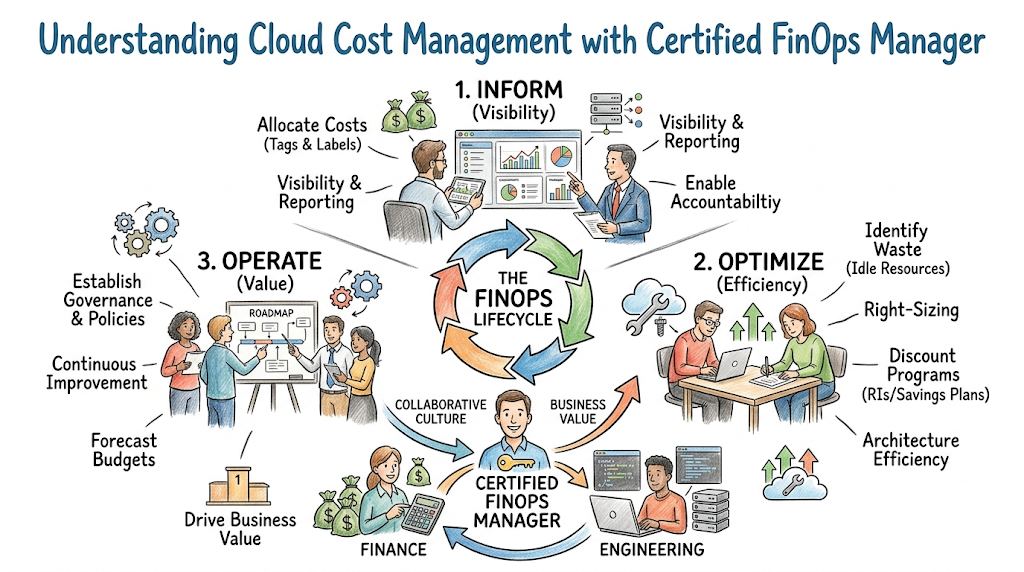
By aligning with modern enterprise practices, this certification ensures that practitioners can navigate complex billing data across multi-cloud environments. It emphasizes the implementation of the FinOps lifecycle—Inform, Optimize, and Operate—within a real-world engineering workflow. This ensures that cloud spending is treated as a strategic asset that drives growth, rather than a runaway operational expense.
Who Should Pursue Certified FinOps Manager?
This program is designed for a broad range of professionals, from SREs and DevOps engineers to cloud architects and finance managers. It is particularly valuable for those moving into leadership roles where budget oversight is as important as technical uptime. Engineering managers and technical leads will find the framework essential for reporting cloud value to executive stakeholders.
In the global market, including the growing tech sector in India, there is a massive demand for “bridge” professionals who can speak both code and finance. Beginners can use this track to find a specialized niche, while experienced engineers can use it to pivot into platform engineering or cloud governance. Even data and security professionals benefit, as cost management is now deeply integrated into those domains.
Why Certified FinOps Manager is Valuable and Beyond
The longevity of this certification is rooted in the permanent shift toward consumption-based cloud models. Enterprises are moving away from traditional data center procurement and toward dynamic cloud ecosystems where costs change by the minute. Understanding how to manage this volatility makes a professional indispensable to any modern organization.
Furthermore, as cloud providers introduce increasingly complex services like serverless and specialized AI hardware, the need for fiscal oversight will only grow. This certification provides a return on investment by positioning the professional as a strategic leader who can directly impact the company’s bottom line. It helps you stay relevant by focusing on principles that apply to any cloud provider, ensuring your skills are transferable and future-proof.
Certified FinOps Manager Certification Overview
The certification program is delivered through a structured digital learning platform and hosted on the specialized training site. It utilizes a rigorous assessment approach that includes multiple-choice questions, case study analysis, and practical simulations of billing environments. The ownership of the learning process is designed to be flexible, allowing working professionals to progress at their own pace.
The certification is structured to cover key domains such as cost allocation, budgeting, forecasting, and the cultural transformation required for FinOps success. Unlike generic vendor certifications, this program provides a vendor-neutral perspective that is applicable across AWS, Azure, and Google Cloud. It ensures that the practitioner has a holistic understanding of how cloud finance operates at an enterprise scale.
Certified FinOps Manager Certification Tracks & Levels
The certification is organized into three distinct levels: Foundation, Professional, and Advanced. The Foundation level provides a baseline understanding of the FinOps framework and is suitable for everyone in the organization, including HR and procurement. It covers the basic terminology and the general roles of different stakeholders in a cost-aware culture.
The Professional level dives into deeper technical specializations, such as FinOps for DevOps or FinOps for SRE teams. This level is where engineers learn the specific mechanics of cost optimization and automated governance. The Advanced level is reserved for those aiming for leadership positions, focusing on high-level strategy, policy creation, and managing a Cloud Center of Excellence.
Complete Certified FinOps Manager Certification Table
| Track | Level | Who it’s for | Prerequisites | Skills Covered | Recommended Order |
| Core FinOps | Foundation | Beginners, Finance, HR | Basic Cloud Knowledge | Lifecycle, Terminology | First |
| Engineering | Professional | SREs, DevOps Engineers | Foundation Level | Optimization, Labeling | Second |
| Management | Professional | Lead Engineers, Managers | Foundation Level | Budgeting, Forecasting | Second |
| Leadership | Advanced | CTOs, FinOps Leads | Professional Level | Strategy, Governance | Third |
Detailed Guide for Each Certified FinOps Manager Certification
Certified FinOps Manager – Foundation
What it is
This certification validates a foundational understanding of the FinOps framework and why it is necessary for modern cloud environments. It covers the core principles that drive collaboration between finance and engineering teams.
Who should take it
It is ideal for junior cloud engineers, procurement officers, and business stakeholders who need to understand the impact of cloud spending on the organization’s financial health.
Skills you’ll gain
- Mastery of the FinOps lifecycle phases.
- Understanding of variable cloud pricing models.
- Ability to identify key stakeholders in a FinOps team.
- Basic knowledge of cost allocation and tagging.
Real-world projects you should be able to do
- Create a high-level monthly cloud spend report for leadership.
- Identify and explain the different cloud billing cycles.
- Map cloud resources to specific departments or projects.
Preparation plan
- 7-14 Days: Review official glossary and framework documentation.
- 30 Days: Complete a structured online foundational course.
- 60 Days: Participate in internal cost-review meetings to see theory in practice.
Common mistakes
- Focusing only on the technical tools while ignoring the cultural shift.
- Neglecting the finance-side terminology which is essential for communication.
Best next certification after this
- Same-track option: Certified FinOps Manager Professional
- Cross-track option: Cloud Practitioner (AWS/Azure)
- Leadership option: Project Management Professional
Certified FinOps Manager – Professional
What it is
This level validates the ability to technically implement and manage FinOps strategies in complex, high-traffic production environments. It focuses on automation, data analysis, and deep optimization techniques.
Who should take it
Senior DevOps engineers, SREs, and dedicated FinOps practitioners who are responsible for managing significant cloud budgets and infrastructure.
Skills you’ll gain
- Advanced data analysis using SQL or BI tools for billing.
- Implementation of commitment-based discount strategies.
- Automation of cost-guardrails and alerting systems.
- Unit economics analysis for specific product features.
Real-world projects you should be able to do
- Build an automated dashboard that tracks cost-per-transaction for a microservice.
- Execute a cleanup of orphaned cloud resources across multiple accounts.
- Design a tagging policy that ensures 100% cost allocation.
Preparation plan
- 7-14 Days: Deep dive into complex billing datasets and CSV exports.
- 30 Days: Hands-on implementation of savings plans and reserved instances.
- 60 Days: Lead a cross-departmental cost-optimization sprint.
Common mistakes
- Over-optimizing small costs while ignoring large, strategic architectural waste.
- Failing to automate the reporting process, leading to stale data.
Best next certification after this
- Same-track option: Certified FinOps Manager Advanced
- Cross-track option: Certified Kubernetes Administrator (CKA)
- Leadership option: MBA or Leadership Development Program
Choose Your Learning Path
DevOps Path
The DevOps path focuses on making cost a standard part of the delivery pipeline. Engineers learn to treat cost as a performance metric, ensuring that every deployment is financially efficient. This involves using infrastructure-as-code to enforce tagging and utilizing CI/CD hooks to alert teams of expensive architectural changes before they reach production. It is the ideal path for those who want to build lean, automated delivery systems.
DevSecOps Path
This path integrates financial management with security and compliance. It focuses on identifying how insecure or unoptimized configurations—such as unencrypted abandoned snapshots—create both risk and waste. Professionals learn to use policy-as-code tools to maintain budget guardrails while ensuring the environment remains secure. This ensures that the organization’s financial health and its security posture are improved simultaneously.
SRE Path
Site Reliability Engineers use this path to balance system performance with financial efficiency. They learn to evaluate the cost of reliability, determining when over-provisioning for uptime becomes a case of diminishing returns. The focus is on correlating technical metrics like latency and CPU usage with actual dollar spend. This path is essential for managing the scalability of large systems without allowing costs to spiral out of control.
AIOps Path
In the AIOps path, professionals focus on using artificial intelligence to manage the massive scale of modern cloud billing. They learn to implement machine learning models that can predict future spending and detect anomalies in real-time. This path is for those who want to automate the analysis of millions of billing line items that a human analyst could never process. It represents the future of automated, intelligent cloud financial governance.
MLOps Path
The MLOps path is specialized for managing the extremely high compute costs associated with machine learning. Professionals learn how to optimize GPU utilization and manage the expensive data egress fees typical of large-scale ML models. This path provides the specific controls needed to move experimental research into a profitable production environment. It ensures that ML projects remain financially viable throughout their entire lifecycle.
DataOps Path
DataOps focuses on the financial management of massive data lakes and processing platforms. Professionals learn to optimize storage tiers and manage query costs in serverless data environments like BigQuery or Snowflake. As data volumes grow, this path ensures that the cost of insights does not exceed the value they provide to the business. It is vital for any organization that relies heavily on big data for its decision-making processes.
FinOps Path
This is the pure-play track for those who want to lead a Cloud Center of Excellence. It focuses on the business strategy, procurement, and organizational change required to make FinOps a success. Professionals learn how to communicate cloud value to the board and build a culture of financial accountability across the entire company. It is the definitive path for those aiming to be the primary financial architect of a cloud-first organization.
Role → Recommended Certified FinOps Manager Certifications
| Role | Recommended Certifications |
| DevOps Engineer | Foundation + Professional (Engineering Focus) |
| SRE | Foundation + Professional (SRE Focus) |
| Platform Engineer | Foundation + Professional + Advanced |
| Cloud Engineer | Foundation + Professional |
| Security Engineer | Foundation + DevSecOps Specialization |
| Data Engineer | Foundation + DataOps Specialization |
| FinOps Practitioner | Full Track (Foundation to Advanced) |
| Engineering Manager | Foundation + Management Track |
Next Certifications to Take After Certified FinOps Manager
Same Track Progression
Once you have mastered the manager level, you should look toward deep specialization in specific cloud platforms. Earning an AWS Certified Solutions Architect Professional or Google Cloud Architect certification allows you to apply FinOps principles to the specific services of those providers. This makes you an expert not just in the framework, but in the actual buttons and levers of the cloud environment.
Cross-Track Expansion
Expanding into Kubernetes (CKA) or Cloud Security (CCSP) will make you a much more versatile cloud leader. Understanding the underlying technology at a deep level allows you to spot optimization opportunities that a non-technical manager might miss. This cross-pollination of skills is what defines a top-tier platform engineer or cloud strategist in the current market.
Leadership & Management Track
For those looking to enter the executive suite, certifications like the PMP (Project Management Professional) or an Executive MBA are excellent next steps. These credentials, combined with your FinOps expertise, prove that you can manage both the technology and the people. This combination is essential for roles like CTO or Head of Cloud Operations in global enterprises.
Training & Certification Support Providers for Certified FinOps Manager
DevOpsSchool
DevOpsSchool is a leading provider of technical training, offering a comprehensive and lab-driven approach to cloud financial management. Their curriculum is designed for working professionals who need to gain practical, hands-on skills that can be applied immediately in a production environment. With a focus on real-world scenarios and tool-based learning, they ensure that students understand the “how” as much as the “why.” Their global reach and experienced instructors make them a top choice for those looking to advance their careers in DevOps and FinOps. They provide extensive support through live sessions and interactive community forums.
Cotocus
Cotocus specializes in enterprise-grade training, focusing on the high-level strategies required for large-scale cloud transformations. Their training for the manager certification is known for its depth and its focus on architectural efficiency. They bring together instructors with years of industrial experience to provide insights that go beyond the standard textbook definitions. Cotocus is an excellent option for senior architects and technical leaders who need to understand the strategic impact of cloud finance. Their personalized coaching and focus on unit economics help professionals build a robust business case for their engineering decisions.
Scmgalaxy
Scmgalaxy is a vast community platform that offers a wealth of resources for anyone interested in configuration management and cloud operations. Their training programs are deeply integrated with their community blogs and open-source projects, providing a unique peer-to-peer learning experience. They focus on the practical automation of FinOps, teaching students how to use scripts and tools to manage infrastructure costs. Scmgalaxy is ideal for those who want to stay connected with the latest industry trends and learn from a massive network of global practitioners. Their resources are often cited as essential reading for anyone preparing for cloud certifications.
BestDevOps
BestDevOps focuses on streamlined, high-impact learning paths that help professionals get certified quickly and efficiently. Their courses are designed to be concise yet thorough, covering the most critical aspects of the FinOps framework. They offer a variety of learning modes, from intensive bootcamps to self-paced digital modules, making it easy for busy engineers to fit training into their schedules. The trainers at BestDevOps are typically active consultants who bring fresh, real-world problems into the classroom. This ensures that the learning is always relevant to the current challenges faced by modern tech organizations.
Devsecopsschool.com
Devsecopsschool.com provides a unique perspective on FinOps by integrating it with security and compliance. Their training emphasizes that a secure cloud is often a more cost-effective cloud, teaching students how to identify waste that also poses a security risk. They offer specialized modules on using security tools to audit cloud costs and enforce financial policies. This is the premier destination for security professionals who want to expand their influence into the financial domain. Their approach helps organizations build infrastructure that is not only lean but also resilient and fully compliant with global standards.
Sreschool.com
Sreschool.com approaches cloud financial management through the lens of reliability and system performance. Their curriculum focuses on the concept of the “cost-error budget,” helping SREs determine the financial cost of their uptime targets. The training is highly technical, involving deep dives into cloud-native observability and how it can be used to track spend. Sreschool.com is perfect for engineers who want to build high-scale, cost-optimized platforms using Kubernetes and other cloud-native technologies. They provide a rigorous learning environment that challenges students to think about cost as a core engineering metric.
Aiopsschool.com
Aiopsschool.com is at the cutting edge of the industry, focusing on the intersection of AI, machine learning, and cloud operations. Their FinOps training is centered on the future of automated cost management, teaching students how to use AI to handle the complexity of multi-cloud billing. They provide hands-on experience with advanced anomaly detection and predictive forecasting tools. This school is the ideal choice for data-driven professionals who want to stay ahead of the curve in a rapidly evolving market. Their courses prepare you to lead the next generation of intelligent, self-governing cloud environments.
Dataopsschool.com
Dataopsschool.com addresses the specific and often massive costs associated with big data and analytics in the cloud. Their training covers everything from storage tiering to the financial optimization of large-scale data pipelines and warehouses. They provide specialized guidance for managing costs in data-heavy environments, ensuring that the business value of data remains higher than the cost of processing it. This is a critical training ground for data engineers and analysts who are responsible for the company’s data infrastructure. Their focus on the entire data lifecycle ensures that cost is managed from ingestion to archival.
Finopsschool.com is the primary host and a dedicated specialist in this certification track, providing the most direct and comprehensive path to mastery. Their platform serves as a central hub for the FinOps community, offering everything from foundational training to executive-level strategy workshops. They are deeply committed to the cultural and organizational change aspects of the framework, ensuring that students can actually drive transformation. By focusing exclusively on the FinOps domain, they provide an unparalleled level of depth and expertise. It is the go-to resource for anyone serious about making cloud financial management their primary professional focus.
Frequently Asked Questions (General)
1. Is the Certified FinOps Manager exam difficult?
The exam is designed to be a professional-level assessment, meaning it requires both a solid understanding of the theory and the ability to apply it to real-world scenarios. It is not just about memorizing facts; it is about demonstrating the ability to manage cloud finance effectively.
2. How long does it take to prepare for this certification?
Most candidates find that 30 to 60 days of focused study is sufficient, depending on their prior experience with cloud billing. Those already working in a DevOps or Finance role may find some parts of the curriculum easier to grasp.
3. Do I need an accounting degree to pass this?
No, an accounting degree is not required. While the certification covers financial concepts, it does so through the lens of cloud technology and engineering operations.
4. Is this certification vendor-neutral?
Yes, the Certified FinOps Manager is a vendor-neutral program. It teaches principles and frameworks that are applicable across all major cloud providers like AWS, Azure, and Google Cloud.
5. How much can a Certified FinOps Manager expect to earn?
While salaries vary by region and experience, professionals with these specialized skills are in high demand and typically command a premium salary compared to general cloud engineers.
6. Does the certification focus more on finance or engineering?
It is a true hybrid. The goal of the program is to teach engineers enough about finance and finance professionals enough about engineering to allow them to collaborate effectively.
7. Are there any hands-on labs in the training?
Yes, most training providers include practical labs where you will work with real billing data and practice optimizing cloud resources in a simulated environment.
8. Can this certification help me in a management career?
Absolutely. This credential proves you can handle the financial responsibilities of a senior leadership role, which is a key requirement for moving into management.
9. Is this relevant for small companies or only large enterprises?
While large enterprises see the most immediate benefits, any company using the cloud can benefit from the cost-saving and efficiency principles taught in this program.
10. What is the format of the certification exam?
The exam typically consists of multiple-choice questions, but it also includes scenario-based questions that test your ability to make decisions in complex situations.
11. How does FinOps differ from traditional IT cost management?
Traditional management was about fixed budgets and long-term procurement, while FinOps is about managing variable, real-time spending in a dynamic cloud environment.
12. Can I take the exam online?
Yes, the certification is designed to be accessible globally, with online proctoring options available through the official hosting platform.
FAQs on Certified FinOps Manager
1. What is the specific role of a FinOps Manager in a DevOps team?
A FinOps Manager acts as the liaison between the finance department and the engineering team. They help translate technical usage into financial impact and work with engineers to find the most cost-effective ways to build and run their applications.
2. How does the certification handle the concept of “Unit Economics”?
The certification teaches you how to move from looking at total cloud spend to looking at the cost per business unit, such as cost per customer or cost per transaction. This allows the business to understand the true profitability of its products.
3. Will I learn about commitment-based discounts like Reserved Instances?
Yes, a major part of the professional track is dedicated to understanding and managing commitment-based discounts. You will learn how to calculate the risks and rewards of different discount models across various cloud providers.
4. Does the program cover automated cost governance?
Yes, the curriculum emphasizes the importance of automation. You will learn how to use tools and policies to automatically prevent over-spending and ensure that resources are tagged correctly from the moment they are created.
5. How does this certification help with cloud migration projects?
By learning FinOps early, you can build cost-awareness into your migration strategy. This helps prevent the common problem of moving “messy” and expensive legacy systems directly into the cloud without optimization.
6. Is there a focus on multi-cloud cost management?
Yes, the certification is designed for a multi-cloud world. It teaches you how to normalize billing data from different providers so you can have a single, clear view of your organization’s total cloud spend.
7. How do I communicate FinOps value to non-technical executives?
The program provides frameworks for reporting and data visualization that make it easy to show leadership how cloud efficiency is driving business growth and saving the company money.
8. Can I use the skills from this cert to manage private cloud costs?
While the focus is on public cloud, the principles of accountability, showback, and optimization are equally applicable to managing large private cloud or on-premise virtualized environments.
Final Thoughts
In the current professional landscape, the ability to prove your value through financial efficiency is one of the most powerful ways to advance your career. The Certified FinOps Manager isn’t just about saving money; it’s about making sure every dollar spent in the cloud is driving the highest possible value for the business. It is a credential that speaks to your maturity as a professional and your ability to lead in a complex, data-driven environment.
As a mentor, I see this certification as a vital step for anyone who wants to move beyond just “keeping the lights on” and into a role where they are a strategic partner to the business. The skills you learn here are practical, immediate, and highly sought after. If you are ready to take ownership of your cloud environment’s financial health, this is the path for you. Focus on the principles, embrace the collaboration, and you will see your career impact grow significantly.
This article provides a clear explanation of how cloud cost management supports better financial visibility and operational efficiency.The connection between FinOps principles and real-world cloud governance is explained very effectively.
Great content for understanding enterprise cloud cost management. The blog simplifies complex FinOps governance frameworks into an easy-to-follow and professional roadmap.