Introduction
AI SEO Content Optimization Tools are platforms that leverage artificial intelligence to enhance the visibility, relevance, and performance of digital content on search engines. These tools go beyond simple keyword suggestions, enabling marketers and SEO specialists to optimize content structure, readability, metadata, internal linking, and semantic relevance. They often incorporate AI-driven insights, competitor analysis, and predictive performance metrics to guide content strategies.
Why it matters
- Enhanced search rankings: AI identifies high-impact keywords, intent, and semantic clusters to improve organic traffic.
- Automated content recommendations: Tools suggest structure, headings, and optimization opportunities, saving significant time.
- Competitive intelligence: AI analyzes competitor content to reveal gaps and opportunities.
- Scalable optimization: Large websites can maintain SEO consistency across thousands of pages efficiently.
- Real-time performance insights: Track and adjust content strategies dynamically using AI analytics.
- Multilingual SEO support: Optimize content for global audiences with localized insights.
Real‑World Use Cases
- Global eCommerce Expansion:
An online retailer uses AI to optimize product category pages for localized search intent across multiple countries, increasing organic sessions by prioritizing region‑specific keywords. - Content Hub Optimization:
A major publisher uses AI to audit and restructure hundreds of existing blog posts, revealing content gaps and semantic clusters that improved average time‑on‑page and search visibility. - SEO Roadmap Automation:
A SaaS company applies predictive scoring tools to prioritize pages with the highest opportunity lift, aligning developers and content teams on focused optimization tasks each quarter. - Enterprise Knowledge SEO:
A technology enterprise integrates internal knowledge with AI to generate topic clusters and long‑tail content briefs that outperformed benchmarks in targeted niche searches. - Multilingual Market Penetration:
A multinational brand uses AI tools to tailor content for regional search intent and language nuances, reducing manual translation errors and lifting local search rankings. - Technical SEO Monitoring:
A digital agency implements real‑time SEO auditing tools to catch regressions triggered by CMS updates, preventing drops in keyword positions before they impact traffic.
Evaluation Criteria for Buyers
- Content quality and readability optimization: How well AI suggestions improve semantic structure, clarity, and user engagement.
- Keyword research and intent analysis: Accuracy of keyword relevance and competition assessment.
- Content scoring and predictive ranking: AI-driven evaluation of how content will perform in search engines.
- Integration with CMS and SEO platforms: Workflow automation with WordPress, HubSpot, or custom CMS.
- Semantic and entity recognition: Support for LSI keywords, related topics, and structured data suggestions.
- Guardrails and compliance: Prevention of over-optimization, keyword stuffing, or incorrect metadata usage.
- Evaluation tools: A/B testing, regression analysis, and human-in-the-loop review support.
- Observability and reporting: Dashboards tracking optimization impact, traffic changes, and keyword performance.
- Deployment flexibility: Cloud, hybrid, or on-premise options for sensitive data.
- Cost efficiency: Token usage, subscription pricing, and scaling considerations.
- Multilingual and regional SEO capabilities: Support for multiple languages and localized content strategies.
- Ease of use and team adoption: Intuitive interface, collaboration features, and actionable recommendations.
Best for: SEO teams, digital marketing agencies, content marketers, eCommerce platforms, and enterprises with large-scale content operations.
Not ideal for: Organizations with minimal content volume, non-digital businesses, or those prioritizing creative over optimization, where traditional SEO consulting may suffice.
What’s Changed in AI SEO Content Optimization Tools
- AI agents can autonomously audit, optimize, and update content based on search trends.
- Multimodal content evaluation integrating text, images, and structured data.
- Guardrails for prompt injection, over-optimization, and metadata errors.
- Predictive content scoring and intent-driven keyword prioritization.
- BYO model support and dynamic model routing for specialized SEO workflows.
- Enhanced privacy and data residency controls for enterprise deployments.
- Observability with detailed metrics on cost, token usage, and latency.
- Integrated RAG capabilities for connecting internal knowledge and analytics data.
- Improved multilingual and regional SEO analysis for global campaigns.
- Real-time competitor benchmarking and gap analysis.
- Automated A/B testing of content optimizations to measure impact.
Quick Buyer Checklist
- Data privacy, retention, and regional compliance
- Model support: Proprietary, BYO, open-source
- RAG or knowledge integration for content analytics
- Evaluation and predictive scoring
- Guardrails for content and metadata safety
- Cost, latency, and token usage controls
- Auditability, reporting, and admin controls
- Vendor lock-in risk assessment
- Multilingual and regional SEO support
- CMS, analytics, and workflow integration compatibility
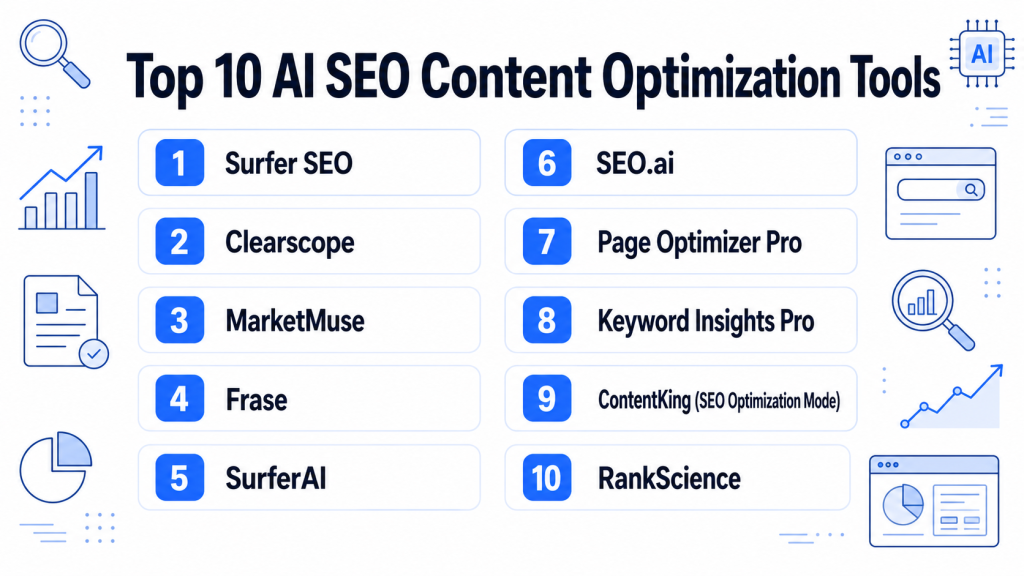
Top 10 AI SEO Content Optimization Tools
1 — Surfer SEO
One-line verdict: Ideal for marketers seeking structured, data-driven recommendations for higher SERP rankings.
Short description: Surfer SEO analyzes top-ranking pages to guide content optimization, keyword density, and structure for improved SEO.
Standout Capabilities
- Page audit and content editor suggestions
- SERP analyzer for competitors
- NLP-driven keyword recommendations
- Content scoring and gap analysis
- Internal linking suggestions
- Historical performance tracking
- Collaboration tools
- Multilingual optimization support
AI-Specific Depth
- Model support: Proprietary
- RAG / knowledge integration: N/A
- Evaluation: Human review, regression analysis
- Guardrails: Content scoring thresholds
- Observability: Traffic and keyword tracking dashboards
Pros
- Actionable recommendations for SEO improvement
- Easy integration with content workflows
- Supports large-scale content optimization
Cons
- Limited long-form content AI generation
- Mainly text-focused
- Premium plans required for advanced analytics
Security & Compliance
- SSO, encryption, audit logs
- Certifications: Not publicly stated
Deployment & Platforms
- Web
- Cloud
Integrations & Ecosystem
Supports CMS and marketing tools:
- WordPress, HubSpot, Google Search Console, Zapier
Pricing Model
- Subscription-based tiered plans
Best-Fit Scenarios
- Mid-market SEO teams
- Agencies optimizing multiple client websites
- Large content-driven blogs
2 — Clearscope
One-line verdict: Best for content teams needing precise semantic keyword optimization and content relevance scoring.
Short description: Clearscope provides keyword analysis, content grading, and optimization recommendations for high-performing SEO content.
Standout Capabilities
- Content grading by relevance and search intent
- Keyword suggestions with density recommendations
- Competitor content benchmarking
- Integration with Google Docs and CMS
- Real-time optimization scoring
- Multilingual content support
AI-Specific Depth
- Model support: Proprietary
- RAG / knowledge integration: N/A
- Evaluation: Predictive scoring, human review
- Guardrails: Prevents keyword stuffing
- Observability: Keyword impact and ranking tracking
Pros
- High accuracy in semantic optimization
- Supports data-driven content decisions
- Streamlines SEO workflow
Cons
- Limited content creation assistance
- Cloud-only deployment
- Requires training to interpret scores effectively
Security & Compliance
- SSO, encryption
- Certifications: Not publicly stated
Deployment & Platforms
- Web
- Cloud
Integrations & Ecosystem
- Google Docs, WordPress, HubSpot, Zapier
Pricing Model
- Subscription-based
Best-Fit Scenarios
- Agencies optimizing multiple client websites
- Enterprise SEO teams
- Writers producing data-backed SEO content
3 — MarketMuse
One-line verdict: Designed for enterprises seeking AI-driven content strategy with topic modeling and competitive insights.
Short description: MarketMuse uses AI to recommend topics, optimize content depth, and guide content strategies for improved SERPs.
Standout Capabilities
- Topic modeling and content briefs
- Content scoring and optimization recommendations
- Keyword and intent analysis
- Competitive gap analysis
- Multi-language support
- Editorial workflow management
- Content performance tracking
AI-Specific Depth
- Model support: Proprietary + BYO model options
- RAG / knowledge integration: Internal analytics connector
- Evaluation: Predictive content scoring, human review
- Guardrails: Optimization and content safety
- Observability: Performance metrics dashboards
Pros
- Supports strategic content planning
- Data-driven optimization
- Scales across enterprise websites
Cons
- Premium pricing
- Learning curve for teams
- Limited real-time content creation
Security & Compliance
- SSO/SAML, encryption, audit logs
- Certifications: Not publicly stated
Deployment & Platforms
- Web
- Cloud / Hybrid
Integrations & Ecosystem
- CMS connectors, analytics dashboards, collaboration tools:
- WordPress, HubSpot, Google Analytics
Pricing Model
- Enterprise subscription, tiered usage
Best-Fit Scenarios
- Enterprise content strategy teams
- Agencies managing multiple clients
- Large content-driven websites
4 — Frase
One-line verdict: Best for teams seeking AI-generated content briefs and automated content optimization suggestions.
Short description: Frase combines AI content creation, SEO research, and optimization recommendations for writers and marketers.
Standout Capabilities
- AI-generated content briefs
- SEO research tools and insights
- Optimization suggestions for headings, keywords, and metadata
- Content scoring and readability analysis
- Question research for FAQs and snippets
- Multilingual content support
AI-Specific Depth
- Model support: Proprietary
- RAG / knowledge integration: N/A
- Evaluation: Human review, content scoring
- Guardrails: Tone and SEO guidelines
- Observability: Traffic impact and content metrics
Pros
- Speeds up content planning
- AI-assisted SEO recommendations
- Integrates with writing workflow
Cons
- Limited advanced analytics
- Cloud-only deployment
- Premium required for large-scale use
Security & Compliance
- Encryption, SSO
- Certifications: Not publicly stated
Deployment & Platforms
- Web
- Cloud
Integrations & Ecosystem
- Google Docs, WordPress, HubSpot, Zapier
Pricing Model
- Subscription-based
Best-Fit Scenarios
- Mid-market SEO teams
- Content agencies
- Writers generating optimized blog posts
5 — SurferAI
One-line verdict: Optimized for marketers needing AI-generated SEO content with real-time on-page recommendations.
Short description: SurferAI combines AI writing with SEO audit tools to generate and optimize content aligned with target keywords.
Standout Capabilities
- AI-assisted content generation
- Real-time on-page SEO suggestions
- Keyword intent and semantic analysis
- Content grading and scoring
- Multilingual support
AI-Specific Depth
- Model support: Proprietary
- RAG / knowledge integration: N/A
- Evaluation: Content scoring, human review
- Guardrails: SEO and content safety
- Observability: Keyword tracking and performance
Pros
- Integrates AI generation and optimization
- Real-time suggestions for SEO improvement
- User-friendly interface
Cons
- Cloud-only
- Limited competitor analytics
- Not ideal for complex long-form content
Security & Compliance
- Encryption, SSO
- Certifications: Not publicly stated
Deployment & Platforms
- Web
- Cloud
Integrations & Ecosystem
- CMS, Google Docs, HubSpot, analytics dashboards
Pricing Model
- Subscription, usage tiers
Best-Fit Scenarios
- Content teams needing fast optimization
- Small-to-mid marketing agencies
- SEO-driven content campaigns
6 — SEO.ai
One-line verdict: Balanced SEO content optimization and AI‑assisted content creation for growth‑oriented teams.
Short description: SEO.ai uses AI to generate on‑page optimized text, suggest keyword opportunities, and provide real‑time scoring and performance insights.
Standout Capabilities
- AI‑assisted SEO copy generation
- Keyword intent and semantic clustering
- Real‑time content scoring
- Topic expansion and suggestion lists
- Competitor insights
- Metadata optimization suggestions
- Optimization task prioritization
- AI‑guided content briefs
AI‑Specific Depth
- Model support: Proprietary
- RAG / knowledge integration: N/A
- Evaluation: Content scoring, regression checks
- Guardrails: Keyword stuffing prevention, SEO threshold norms
- Observability: Score trends, optimization impact metrics
Pros
- Combines creation and optimization
- Easy scoring and guidance
- Helps reduce manual SEO guesswork
Cons
- Cloud‑only deployment
- Not as deep for enterprise analytics
- Limited integration ecosystem
Security & Compliance
- Encryption at rest/in transit
- Not publicly stated
Deployment & Platforms
- Web
- Cloud
Integrations & Ecosystem
Supports CMS and editorial workflows:
- WordPress, Google Docs, HubSpot, analytics dashboards
Pricing Model
Subscription tiers based on feature sets and usage
Best‑Fit Scenarios
- Growth startups optimizing content SEA
- Small to mid marketing teams
- Writers needing quick optimization feedback
7 — Page Optimizer Pro
One‑line verdict: Focused on precise page‑level recommendations for keyword and competitive optimization.
Short description: Page Optimizer Pro (POP) delivers AI‑assisted page scoring and optimization instructions rooted in competitor analysis.
Standout Capabilities
- Page‑level optimization recommendations
- Competitor scoring and KPI comparison
- On‑page element guidance (headings, metadata, keywords)
- Local SEO influence signals
- Optimization prioritization
AI‑Specific Depth
- Model support: Proprietary
- RAG / knowledge integration: N/A
- Evaluation: Page scoring vs. competitors
- Guardrails: Semantic coverage thresholds
- Observability: Scoring dashboards
Pros
- Highly specific optimization direction
- Useful for technical SEO focus areas
- Actionable, concise outputs
Cons
- Not built for long‑form content creation
- Fewer integrations
- Learning curve for SEO novices
Security & Compliance
- Encryption
- Not publicly stated
Deployment & Platforms
- Web
- Cloud
Integrations & Ecosystem
Integrates with editorial tools and reporting systems:
- CMS connectors and exportable scorecards
Pricing Model
Tiered subscription
Best‑Fit Scenarios
- SEO specialists refining individual pages
- Technical SEO audits
- Manual content quality workflows
8 — Keyword Insights Pro
One‑line verdict: Best choice for deep keyword intent, semantic expansion, and content topic mapping.
Short description: Keyword Insights Pro uses AI to analyze search intent clusters, topical relevance, and semantic keyword landscapes.
Standout Capabilities
- Deep intent clustering
- Semantic topic expansion
- Regional language insights
- Trending intent signals
- Gap analysis vs. competitors
- Dashboard‑based insights
AI‑Specific Depth
- Model support: Proprietary
- RAG / knowledge integration: Analytics connectors
- Evaluation: Keyword performance prediction
- Guardrails: Intent safety checks
- Observability: Regional performance tracking
Pros
- Excellent depth on keyword and semantic mapping
- Helps writers target intent better
- Useful for multilingual SEO
Cons
- Not a content editor
- More research‑focused than optimization‑focused
- Steeper learning curve
Security & Compliance
- Encryption
- Not publicly stated
Deployment & Platforms
- Web
- Cloud
Integrations & Ecosystem
API support for analytics and editorial alignment
Pricing Model
Subscription with usage tiers
Best‑Fit Scenarios
- Keyword research teams
- Enterprise SEO Strategy
- Multi‑region content optimization
9 — ContentKing (SEO Optimization Mode)
One‑line verdict: Excellent for real‑time site auditing and content optimization feedback at scale.
Short description: ContentKing’s live auditing tracks SEO signals, content changes, and AI‑driven recommendations for ongoing optimization.
Standout Capabilities
- Real‑time content health and SEO change tracking
- Alerts for issues affecting SEO signals
- Metadata and schema recommendations
- Performance impact signals
- Historic trend tracking
AI‑Specific Depth
- Model support: Proprietary
- RAG / knowledge integration: Analytics connectors
- Evaluation: Live site diagnostics, rule‑based inference
- Guardrails: Automated rule checks (e.g., missing title, broken canonical)
- Observability: Issue dashboards, trend reports
Pros
- Always‑on SEO quality control
- Useful for large, dynamic sites
- Immediate alerts for regressions
Cons
- Not focused on writing guidance
- Needs analytics data connected
- Reports can be technical
Security & Compliance
- RBAC, encryption
- Not publicly stated
Deployment & Platforms
- Web, Cloud
Integrations & Ecosystem
CMS, analytics, and data reporting pipelines
Pricing Model
Subscription
Best‑Fit Scenarios
- Media sites updating content frequently
- Enterprise content operations
- SEO monitoring teams
10 — RankScience
One‑line verdict: Great for teams wanting AI‑powered A/B tests for content changes to influence ranking outcomes.
Short description: RankScience uses AI to propose content modifications and then A/B tests them to understand SEO impact.
Standout Capabilities
- A/B testing of page elements
- AI‑suggested variant generation
- Search signal comparison
- Automated performance tracking
- Conversion and ranking metrics
AI‑Specific Depth
- Model support: Proprietary
- RAG / knowledge integration: Analytics integration
- Evaluation: Experimental results, regression tracking
- Guardrails: Safe test limits
- Observability: Experiment dashboards
Pros
- Data‑driven optimization validation
- Helps prove what changes work
- Aligns content with performance goals
Cons
- Requires robust analytics
- Less about content creation
- Setup needs coordination
Security & Compliance
- Encryption, audit logs
- Not publicly stated
Deployment & Platforms
- Web, Cloud
Integrations & Ecosystem
SEO tools, analytics platforms, CMS
Pricing Model
Tiered subscription
Best‑Fit Scenarios
- Data‑driven SEO teams
- Marketing orgs with experimentation culture
- Enterprises with large traffic
Comparison Table
| Tool Name | Best For | Deployment | Model Flexibility | Strength | Watch‑Out | Public Rating |
|---|---|---|---|---|---|---|
| Surfer SEO | Mid‑market SEO teams | Cloud | Hosted | Actionable page recommendations | Not a content writer | N/A |
| Clearscope | Semantic scoring specialists | Cloud | Hosted | Strong semantic insights | Limited creation support | N/A |
| MarketMuse | Enterprise strategy teams | Cloud/Hybrid | Hosted/BYO | Strategic topic modeling | Premium pricing | N/A |
| Frase | Content briefs & optimization | Cloud | Hosted | Fast briefs and suggestions | Shallow advanced analytics | N/A |
| SurferAI | Combined generation + SEO | Cloud | Hosted | On‑page real‑time SEO | Limited competitor analysis | N/A |
| SEO.ai | Growth teams | Cloud | Hosted | Balances creation + optimization | Fewer integrations | N/A |
| Page Optimizer Pro | Technical SEO specialists | Cloud | Hosted | Page‑level precision | Not for long‑form | N/A |
| Keyword Insights Pro | Keyword/intent strategists | Cloud | Hosted | Deep intent mapping | Not a content editor | N/A |
| ContentKing | Real‑time auditors | Cloud | Hosted | Always‑on site monitoring | Not a writing tool | N/A |
| RankScience | Experiment‑driven teams | Cloud | Hosted | A/B SEO validation | Requires analytics infrastructure | N/A |
Scoring & Evaluation (Transparent Rubric)
The scoring below uses a comparative approach (not absolute). Tools are scored from 1 to 10 against key categories.
| Tool | Core | Reliability/Eval | Guardrails | Integrations | Ease | Perf/Cost | Security/Admin | Support | Weighted Total |
|---|---|---|---|---|---|---|---|---|---|
| Surfer SEO | 9 | 8 | 8 | 7 | 8 | 7 | 8 | 7 | 8.0 |
| Clearscope | 8 | 9 | 8 | 7 | 7 | 7 | 7 | 6 | 7.6 |
| MarketMuse | 9 | 8 | 9 | 8 | 7 | 7 | 8 | 7 | 8.2 |
| Frase | 8 | 7 | 7 | 7 | 8 | 7 | 7 | 6 | 7.4 |
| SurferAI | 8 | 8 | 8 | 7 | 8 | 7 | 7 | 7 | 7.6 |
| SEO.ai | 8 | 7 | 7 | 6 | 8 | 7 | 7 | 6 | 7.2 |
| Page Optimizer Pro | 7 | 7 | 8 | 5 | 6 | 7 | 7 | 6 | 6.7 |
| Keyword Insights Pro | 8 | 8 | 7 | 6 | 6 | 7 | 7 | 6 | 7.1 |
| ContentKing | 7 | 9 | 9 | 7 | 7 | 7 | 8 | 7 | 7.8 |
| RankScience | 8 | 9 | 8 | 7 | 7 | 7 | 8 | 7 | 8.0 |
Top 3 for Enterprise: MarketMuse, Surfer SEO, RankScience
Top 3 for SMB: SurferAI, Surfer SEO, Frase
Top 3 for Developers / Technical SEO: ContentKing, Clearscope, RankScience
Which AI SEO Content Optimization Tool Is Right for You?
Solo / Freelancer
Tools like SurferAI and Frase offer strong guidance with easy interfaces and lower complexity.
SMB
Surfer SEO and SurferAI balance optimization guidance with usability and growth needs.
Mid‑Market
MarketMuse and Clearscope provide deeper topic modeling and semantic scoring for broader content strategies.
Enterprise
MarketMuse, ContentKing, and RankScience offer governance, site‑wide oversight, A/B testing, and content strategy alignment at scale.
Regulated industries
MarketMuse with hybrid deployment and audit logs supports compliance needs. ContentKing enables continuous quality monitoring.
Budget vs premium
Smaller teams benefit from Frase and SurferAI, while premium or enterprise budgets justify MarketMuse and RankScience.
Build vs buy
Buy when speed, usability, and integrated analytics are priorities; build custom solutions only when specialized internal data and workflows require bespoke AI.
Implementation Playbook (30 / 60 / 90 Days)
30 Days — Pilot & Baseline
- Identify SEO priorities (keyword gaps, underperforming pages).
- Pilot 1–2 tools; set baseline metrics (traffic, rankings, engagement).
- Train content teams on AI scoring, brief generation, and threshold norms.
- Conduct initial audits and create AI‑generated content briefs.
60 Days — Harden & Rollout
- Integrate tools with CMS workflows and analytics.
- Establish guardrails for keyword usage and metadata standards.
- Start controlled A/B SEO experiments on priority content.
- Build observable dashboards for keyword tracking and optimization impact.
90 Days — Optimize & Scale
- Expand optimization to all priority content clusters.
- Automate alerts for regressions (ContentKing).
- Standardize SEO playbooks based on AI insights.
- Review cost/latency trade‑offs; optimize model usage.
- Conduct quarterly red‑teaming for prompt safety and intent alignment.
Common Mistakes & How to Avoid Them
- Over‑relying on AI without human review
- Ignoring guardrails and semantic safety checks
- Failing to track optimization impact over time
- Unmanaged data retention or analytics drift
- Lack of observability into token use and latency
- Treating tool scores as absolute truth
- Over‑optimization or keyword stuffing
- Not integrating tools with CMS/analytics
- Vendor lock‑in without abstraction
- Insufficient A/B testing of optimizations
- Ignoring localized SEO signals
- Neglecting multilingual UX
FAQs
1. What data privacy measures are common in SEO optimization tools?
Most tools encrypt data and support role‑based access, though certifications are often not publicly stated.
2. Can I use AI SEO tools with my own content models?
A few platforms offer BYO model capabilities; most rely on proprietary AI.
3. Do these tools generate content or just optimize?
Some (e.g., SurferAI) provide generation plus optimization; others focus on scoring and recommendations.
4. Are keyword suggestions reliable?
AI can enhance keyword insights, but human validation is recommended to align with user intent.
5. How do tools avoid over‑optimization?
Effective tools include guardrails that prevent keyword stuffing and flag unnatural adjustments.
6. Can SEO AI tools work for multilingual sites?
Yes, many support semantic and keyword insights across languages.
7. What’s the difference between optimization scoring and predictive ranking?
Scoring suggests how well content follows SEO best practices; predictive ranking estimates likely search performance based on signals.
8. How do I measure ROI from these tools?
Track organic traffic, position changes, and engagement before and after optimization cycles.
9. Do SEO tools integrate with CMS?
Most integrate with common CMS platforms or provide APIs for workflow connections.
10. Is AI safe for content optimization?
Guardrails and human oversight reduce risks like prompt injection and inaccurate changes.
11. Can these tools automate metadata changes?
Some provide suggestions; final publishing typically remains manual for control.
12. How frequently should I re‑optimize content?
Re‑optimize whenever rankings drop, SERP intent shifts, or algorithm changes occur.
Conclusion
AI SEO Content Optimization Tools have matured into essential assets for modern content and search strategies. They help teams understand intent, optimize structure, and validate changes through experimentation. Enterprises benefit from analytical depth, while SMBs gain efficiency and strategic advantage with tools tuned to both creation and optimization. The right choice depends on scale, workflow integration, and the balance between automation and human expertise. By shortlisting tools based on your SEO priorities, piloting with clear metrics, and enforcing guardrails and evaluation criteria, you can harness AI to elevate content visibility and search performance while managing cost and operational risk.
Next Steps:
- Identify your highest‑impact SEO challenges and shortlist tools accordingly
- Pilot with real content and measure baseline vs improved performance
- Validate security, evaluation, and governance practices before scaling
This was an excellent guide to understanding modern AI SEO content optimization platforms and their impact on digital marketing strategies.