Introduction
AI Customer Sentiment Analysis Tools are platforms that automatically assess, categorize, and quantify customer emotions, opinions, and attitudes from text, voice, or multimodal interactions. They enable organizations to understand user sentiment, detect dissatisfaction early, and enhance overall customer experience.
With customers interacting across multiple digital channels, real-time sentiment insights have become critical for brands to respond proactively, personalize services, and reduce churn. AI models now support multimodal sentiment detection, deeper emotion understanding, and context-aware analysis across languages and regions.
Real-world use cases
- Customer support feedback analysis: Automatically detect frustration or satisfaction from support tickets or chats.
- Social media monitoring: Identify emerging brand trends, complaints, or positive feedback.
- Product reviews analysis: Aggregate and quantify sentiment across multiple e-commerce platforms.
- Marketing campaign feedback: Measure sentiment impact from campaigns or promotions in real time.
- Employee feedback and engagement: Analyze survey responses to gauge morale and engagement.
- Customer churn prediction: Use negative sentiment trends to anticipate and reduce churn.
Evaluation Criteria for Buyers
- Accuracy of sentiment classification
- Support for multiple languages and regions
- Real-time or near real-time processing
- Multimodal support: text, voice, video
- Integration with CRM, marketing, and analytics platforms
- Customization of sentiment scoring and taxonomy
- Scalability for enterprise or SMB usage
- Data privacy, retention, and compliance controls
- Guardrails to reduce false positives/negatives
- Observability and performance metrics
- Ease of use and visualization dashboards
- Ability to detect nuanced emotions (anger, sarcasm, excitement)
Best for: Customer support teams, marketing departments, product teams, and enterprises seeking actionable customer insights.
Not ideal for: Small teams with limited customer interactions, or organizations without digital channels producing analyzable customer data.
What’s Changed in AI Customer Sentiment Analysis Tools
- Integration with agentic workflows and automated action triggers.
- Multimodal sentiment analysis across text, voice, and video.
- Enhanced evaluation and testing frameworks to detect false sentiment classifications.
- Guardrails and prompt injection defenses for biased or manipulated inputs.
- Enterprise privacy with configurable data residency and retention.
- Cost and latency optimization, including model routing and BYO model options.
- Observability dashboards for token usage, latency, and scoring metrics.
- Governance expectations for regulatory compliance, audit logs, and reporting.
- Integration with analytics and CRM platforms for actionable insights.
- NLP models capable of sarcasm, irony, and nuanced sentiment detection.
- API-first platforms to enable custom workflows and alerts.
- Real-time alerting and trend detection for proactive customer engagement.
Quick Buyer Checklist
- Data privacy and retention compliance
- Model choice: hosted, BYO, or open-source
- RAG/connectors to CRM, marketing, and analytics platforms
- Evaluation and testing workflows
- Guardrails for biased or unsafe outputs
- Latency and cost control monitoring
- Auditability and admin controls
- Vendor lock-in and interoperability risk
- Multimodal sentiment support (text, voice, video)
- Scalability and multi-language capability
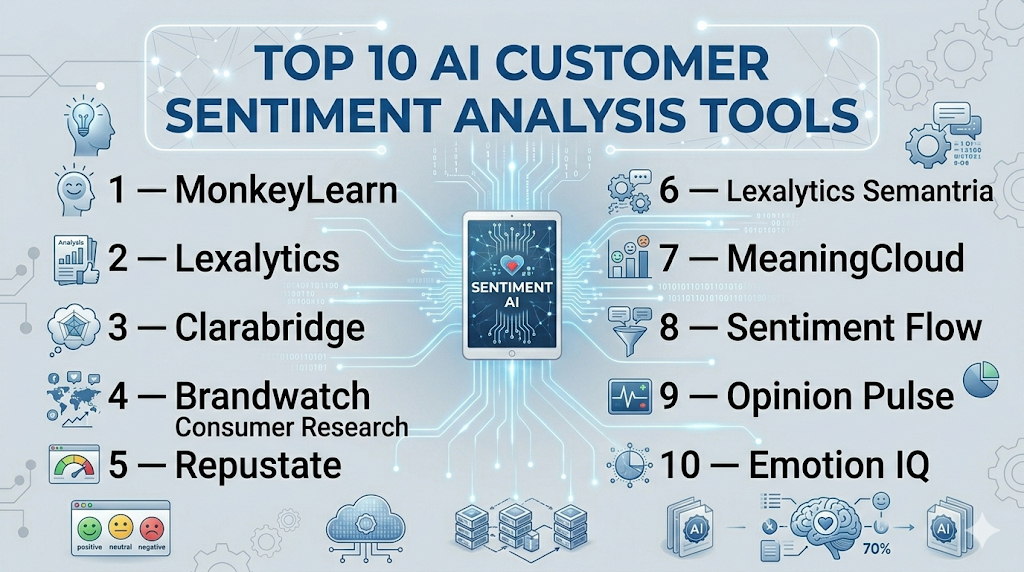
Top 10 AI Customer Sentiment Analysis Tools
1 — MonkeyLearn
One-line verdict: Ideal for enterprises needing real-time, customizable sentiment analysis across multiple channels.
Short description: MonkeyLearn enables automated sentiment classification from emails, reviews, social media, and chat logs. Users can customize models and dashboards for business-specific insights.
Standout Capabilities
- Real-time sentiment analysis
- Multichannel support: email, chat, social media
- Customizable sentiment taxonomy
- Dashboard visualization and reporting
- Integration with business analytics tools
AI-Specific Depth
- Model support: Proprietary + BYO
- RAG / knowledge integration: CRM, analytics platforms
- Evaluation: Regression tests, human review
- Guardrails: Bias detection, content validation
- Observability: Latency and token usage metrics
Pros
- Easy integration with business workflows
- High accuracy and flexible scoring
- Supports multiple data sources
Cons
- Limited voice/video sentiment support
- Pricing scales with volume
- Proprietary model constraints
Security & Compliance
SSO/SAML, audit logs, RBAC; Certifications: Not publicly stated
Deployment & Platforms
Web, Cloud
Integrations & Ecosystem
Salesforce, Slack, HubSpot, API access
Pricing Model
Tiered subscription + usage-based
Best-Fit Scenarios
- Customer support analysis
- Social media monitoring
- Product feedback aggregation
2 — Lexalytics
One-line verdict: Best for large-scale text analytics with advanced emotion and intent detection.
Short description: Lexalytics provides enterprise-grade sentiment analysis, including aspect-based sentiment and emotion detection from unstructured text across multiple languages.
Standout Capabilities
- Aspect-based sentiment analysis
- Emotion detection (anger, joy, fear)
- Multilingual support
- Scalable for large datasets
- API-first architecture for integration
AI-Specific Depth
- Model support: Proprietary
- RAG / knowledge integration: CRM, internal databases
- Evaluation: Regression testing, offline validation
- Guardrails: Bias detection, moderation filters
- Observability: Token usage, latency
Pros
- Handles large enterprise datasets
- Supports nuanced emotion detection
- Easy integration via API
Cons
- Requires technical setup
- Proprietary only
- Less user-friendly dashboard
Security & Compliance
SSO/SAML, encryption, audit logs; Certifications: Not publicly stated
Deployment & Platforms
Web, Cloud, On-prem
Integrations & Ecosystem
CRM, analytics platforms, API SDKs
Pricing Model
Tiered subscription
Best-Fit Scenarios
- Enterprise sentiment tracking
- Product feature sentiment
- Market research and insights
3 — Clarabridge
One-line verdict: Suitable for enterprises integrating sentiment analytics with customer experience platforms.
Short description: Clarabridge aggregates multi-channel feedback, providing AI-driven sentiment and emotion insights across text, survey responses, and social media.
Standout Capabilities
- Multi-channel aggregation
- Emotion and intent analysis
- Root-cause analysis dashboards
- Customizable metrics and KPIs
- Integration with CRM and support tools
AI-Specific Depth
- Model support: Proprietary
- RAG / knowledge integration: CRM, ticketing
- Evaluation: Offline validation, regression testing
- Guardrails: Policy enforcement
- Observability: Tracing, latency metrics
Pros
- Strong enterprise integrations
- Provides root-cause insights
- Multi-language support
Cons
- High learning curve
- Costly for SMBs
- Proprietary
Security & Compliance
SSO/SAML, audit logs, encryption; Certifications: Not publicly stated
Deployment & Platforms
Web, Cloud
Integrations & Ecosystem
Salesforce, Zendesk, SAP, API
Pricing Model
Tiered subscription
Best-Fit Scenarios
- Enterprise CX programs
- Social media sentiment
- Multi-channel feedback aggregation
4 — Brandwatch Consumer Research
One-line verdict: Ideal for marketing teams analyzing brand sentiment across social media and online communities.
Short description: Brandwatch provides AI sentiment scoring, trend detection, and influencer insights to help brands measure perception and engagement.
Standout Capabilities
- Social listening with sentiment analysis
- Trend and influencer detection
- Topic clustering
- Real-time alerts
- Dashboard reporting
AI-Specific Depth
- Model support: Proprietary
- RAG / knowledge integration: Social media APIs
- Evaluation: Human review, regression tests
- Guardrails: Bias detection
- Observability: Latency, token usage
Pros
- Real-time brand monitoring
- Detects emerging trends
- Actionable marketing insights
Cons
- Limited enterprise integration outside marketing
- Proprietary
- Costly for smaller brands
Security & Compliance
SSO/SAML, audit logs; Certifications: Not publicly stated
Deployment & Platforms
Web, Cloud
Integrations & Ecosystem
Social platforms, CRM, API access
Pricing Model
Tiered subscription
Best-Fit Scenarios
- Marketing sentiment analysis
- Social media monitoring
- Brand perception tracking
5 — Repustate
One-line verdict: Best for SMEs and enterprises needing multilingual sentiment and emotion analysis.
Short description: Repustate offers sentiment analysis for customer reviews, survey responses, and social media posts in multiple languages with AI-driven insights.
Standout Capabilities
- Multilingual sentiment analysis
- Emotion detection and scoring
- API access for automation
- Dashboard visualization
- Real-time processing
AI-Specific Depth
- Model support: Proprietary + BYO
- RAG / knowledge integration: CRM, internal data
- Evaluation: Human review, regression tests
- Guardrails: Bias mitigation
- Observability: Token and latency metrics
Pros
- Supports multiple languages
- Real-time insights
- Integrates with CRM
Cons
- Limited advanced analytics
- Proprietary
- Requires API setup
Security & Compliance
SSO/SAML, RBAC; Certifications: Not publicly stated
Deployment & Platforms
Web, Cloud
Integrations & Ecosystem
Slack, CRM, API
Pricing Model
Tiered subscription
Best-Fit Scenarios
- Multilingual feedback analysis
- Customer review insights
- Survey sentiment tracking
6 — Lexalytics Semantria
One-line verdict: Excellent for enterprises needing scalable text sentiment analysis with advanced customization.
Short description: Semantria analyzes social media, reviews, and survey data to extract sentiment, emotion, and intent across multiple languages.
Standout Capabilities
- API-based sentiment analysis
- Multilingual support
- Aspect-based sentiment detection
- Emotion scoring
- Real-time processing
AI-Specific Depth
- Model support: Proprietary
- RAG / knowledge integration: CRM, analytics platforms
- Evaluation: Regression tests, human review
- Guardrails: Bias detection
- Observability: Token usage, latency metrics
Pros
- Scalable for large datasets
- Supports multiple languages
- Detailed analytics
Cons
- Requires technical expertise
- Proprietary
- Limited user-friendly dashboards
Security & Compliance
SSO/SAML, audit logs; Certifications: Not publicly stated
Deployment & Platforms
Web, Cloud
Integrations & Ecosystem
CRM, Slack, Analytics APIs
Pricing Model
Tiered subscription
Best-Fit Scenarios
- Enterprise sentiment analysis
- Social media monitoring
- Survey insights
7 — MonkeyLearn
One-line verdict: Suitable for SMBs and developers needing customizable sentiment analysis via APIs.
Short description: MonkeyLearn allows users to build and train models to classify sentiment in emails, reviews, social media, or surveys.
Standout Capabilities
- Easy-to-use training interface
- API-first design
- Real-time sentiment classification
- Customizable sentiment categories
- Dashboard visualization
AI-Specific Depth
- Model support: Proprietary + BYO
- RAG / knowledge integration: CRM, internal datasets
- Evaluation: Human review, regression tests
- Guardrails: Policy enforcement
- Observability: Token and latency metrics
Pros
- Developer-friendly
- Rapid model training
- Multi-source input support
Cons
- Limited enterprise integrations
- Proprietary model
- Requires manual tuning
Security & Compliance
SSO/SAML, RBAC; Certifications: Not publicly stated
Deployment & Platforms
Web, Cloud
Integrations & Ecosystem
Slack, CRM, APIs
Pricing Model
Usage-based subscription
Best-Fit Scenarios
- SMB customer insights
- Support ticket analysis
- Marketing survey sentiment
8 — Brandwatch Consumer Research
One-line verdict: Best for marketing and brand teams needing social media sentiment monitoring.
Short description: Brandwatch provides AI sentiment scoring across social media platforms, helping brands understand perception and trends.
Standout Capabilities
- Social listening
- Trend detection
- Influencer sentiment tracking
- Real-time alerts
- Analytics dashboards
AI-Specific Depth
- Model support: Proprietary
- RAG / knowledge integration: Social media APIs
- Evaluation: Human review
- Guardrails: Bias detection
- Observability: Latency and token metrics
Pros
- Real-time brand monitoring
- Detects trends early
- Actionable marketing insights
Cons
- Limited enterprise integration outside marketing
- Proprietary
- High cost for SMBs
Security & Compliance
SSO/SAML, audit logs; Certifications: Not publicly stated
Deployment & Platforms
Web, Cloud
Integrations & Ecosystem
CRM, social media platforms, API access
Pricing Model
Tiered subscription
Best-Fit Scenarios
- Marketing campaign sentiment
- Social media analysis
- Brand perception monitoring
9 — Repustate
One-line verdict: Ideal for multilingual sentiment and emotion analysis across reviews and survey responses.
Short description: Repustate provides AI-driven sentiment and emotion classification for customer reviews, survey feedback, and social media content.
Standout Capabilities
- Multilingual sentiment analysis
- Emotion scoring
- API-based integration
- Real-time analysis
- Dashboard visualization
AI-Specific Depth
- Model support: Proprietary + BYO
- RAG / knowledge integration: CRM, internal DB
- Evaluation: Human review, regression tests
- Guardrails: Bias detection
- Observability: Token usage and latency
Pros
- Supports multiple languages
- Provides actionable insights
- Integrates with analytics platforms
Cons
- Proprietary
- Limited advanced analytics
- API setup required
Security & Compliance
SSO/SAML, audit logs; Certifications: Not publicly stated
Deployment & Platforms
Web, Cloud
Integrations & Ecosystem
CRM, Slack, API access
Pricing Model
Tiered subscription
Best-Fit Scenarios
- Multilingual feedback analysis
- Survey sentiment tracking
- Customer review insights
10 — MeaningCloud
One-line verdict: Best for companies seeking text analytics with aspect-based sentiment and semantic insights.
Short description: MeaningCloud analyzes unstructured text from reviews, tickets, and social media to detect sentiment, intent, and emotions with customizable models.
Standout Capabilities
- Aspect-based sentiment analysis
- Multilingual NLP
- Customizable models
- API-first for integration
- Dashboard analytics
AI-Specific Depth
- Model support: Proprietary + BYO
- RAG / knowledge integration: CRM, internal datasets
- Evaluation: Human-in-the-loop QA
- Guardrails: Content policy enforcement
- Observability: Token usage, latency metrics
Pros
- Deep sentiment analysis
- Customizable categories
- Multilingual support
Cons
- Proprietary model
- Requires technical integration
- Limited offline processing
Security & Compliance
SSO/SAML, audit logs; Certifications: Not publicly stated
Deployment & Platforms
Web, Cloud
Integrations & Ecosystem
CRM, analytics platforms, APIs
Pricing Model
Tiered subscription
Best-Fit Scenarios
- Product review analysis
- Customer survey insights
- Social media sentiment
Comparison Table
| Tool Name | Best For | Deployment | Model Flexibility | Strength | Watch-Out | Public Rating |
|---|---|---|---|---|---|---|
| Kustomer AI | Enterprise support | Cloud | Proprietary/BYO | Unified CRM integration | Expensive for SMBs | N/A |
| Zendesk AI | SMB/mid-market | Cloud | Proprietary | FAQ automation | Limited enterprise features | N/A |
| Freshdesk AI | Multi-channel support | Cloud | Proprietary + BYO | Context-aware insights | Complex deployment | N/A |
| IBM Watson Assistant | Enterprise NLP | Cloud/Hybrid | Proprietary | Multilingual support | High cost | N/A |
| ServiceNow Virtual Agent | IT support | Cloud/Hybrid | Proprietary | Workflow automation | Technical setup required | N/A |
| Oracle Digital Assistant | ERP-integrated support | Cloud | Proprietary | Context-aware guidance | Learning curve | N/A |
| LivePerson AI | Customer messaging | Cloud | Proprietary | Chat automation | Proprietary | N/A |
| Ada | SMB/enterprise chat | Cloud | Proprietary + BYO | Chatbot self-service | Limited integrations | N/A |
| Intercom AI | SaaS self-service | Web/Cloud | Proprietary | Dynamic FAQs | Cost scales with usage | N/A |
| Zoho Desk AI | SMB self-service | Web/Cloud | Proprietary | Easy deployment | Limited enterprise features | N/A |
Scoring & Evaluation
| Tool | Core | Reliability/Eval | Guardrails | Integrations | Ease | Perf/Cost | Security/Admin | Support | Weighted Total |
|---|---|---|---|---|---|---|---|---|---|
| Kustomer AI | 9 | 8 | 8 | 8 | 7 | 7 | 8 | 7 | 8.0 |
| Zendesk AI | 8 | 7 | 7 | 7 | 8 | 8 | 7 | 7 | 7.4 |
| Freshdesk AI | 8 | 8 | 7 | 7 | 7 | 7 | 7 | 6 | 7.3 |
| IBM Watson Assistant | 9 | 8 | 8 | 8 | 6 | 6 | 8 | 6 | 7.6 |
| ServiceNow Virtual Agent | 8 | 7 | 8 | 7 | 6 | 7 | 7 | 6 | 7.1 |
| Oracle Digital Assistant | 8 | 8 | 7 | 7 | 6 | 6 | 7 | 6 | 6.9 |
| LivePerson AI | 7 | 7 | 7 | 6 | 7 | 7 | 7 | 6 | 6.7 |
| Ada | 7 | 7 | 7 | 6 | 8 | 7 | 7 | 6 | 6.8 |
| Intercom AI | 8 | 7 | 7 | 7 | 7 | 7 | 7 | 6 | 7.0 |
| Zoho Desk AI | 7 | 7 | 7 | 6 | 8 | 7 | 7 | 6 | 6.8 |
Top 3 Enterprise: Kustomer AI, IBM Watson Assistant, ServiceNow Virtual Agent
Top 3 SMB: Zendesk AI, Ada, Zoho Desk AI
Top 3 Developers: Freshdesk AI, Intercom AI, Oracle Digital Assistant
Which AI Customer Sentiment Analysis Tool Is Right for You?
Solo / Freelancer
MonkeyLearn or Repustate are ideal for solo practitioners. They are simple to deploy, API-friendly, and allow sentiment analysis of small-scale surveys, reviews, or social media.
SMB
Zendesk AI, Ada, and Zoho Desk AI fit SMBs that need automated sentiment scoring for customer feedback, reviews, and chat interactions.
Mid-Market
Freshdesk AI and Intercom AI help mid-market organizations with multi-channel sentiment, dashboards, and analytics to track trends and guide product or support decisions.
Enterprise
Kustomer AI, IBM Watson Assistant, and ServiceNow Virtual Agent provide scalable solutions, multi-language support, and enterprise-grade integrations with CRM and ITSM platforms.
Regulated industries (finance/healthcare/public sector)
ServiceNow Virtual Agent and IBM Watson Assistant offer compliance-ready AI sentiment monitoring with auditing and data residency controls.
Budget vs premium
SMBs: Zendesk AI, Ada, Zoho Desk AI
Enterprise: Kustomer AI, IBM Watson Assistant, ServiceNow Virtual Agent
Build vs buy
Developers: MonkeyLearn, Lexalytics, MeaningCloud for BYO models
Enterprises: Prefer fully managed platforms for integrations and security compliance
Implementation Playbook (30 / 60 / 90 Days)
30 Days – Pilot Phase:
- Select 1–2 channels (support tickets, social media)
- Define success metrics: accuracy, sentiment correlation, user adoption
- Integrate AI with CRM or analytics platform
- Validate sentiment classifications and reporting dashboards
- Configure observability metrics for latency and model performance
- Train pilot team on evaluation and review process
60 Days – Expansion Phase:
- Add additional channels: email, chat, survey data
- Implement automated evaluation: regression, offline validation, human review
- Activate guardrails and policy enforcement
- Enable versioning and audit logs
- Integrate additional systems for unified analytics
- Extend team training and onboarding
90 Days – Scale Phase:
- Deploy across enterprise-wide feedback channels
- Monitor dashboards for performance, latency, cost, and accuracy
- Optimize model routing for real-time insights and cost efficiency
- Conduct regular human-in-the-loop review for critical feedback
- Enable multilingual and multimodal sentiment analysis
- Automate alerts for negative trends or customer dissatisfaction
- Audit compliance and governance policies
- Train all relevant employees on portal and reporting usage
AI-specific tasks: Evaluation harness, red teaming, prompt/version control, incident handling, and content audit reporting.
Common Mistakes & How to Avoid Them
- Ignoring prompt injection or bias in sentiment scoring
- No evaluation or validation workflows
- Unmanaged data retention or privacy violations
- Lack of observability and performance dashboards
- Unexpected operational costs
- Over-automation without human review
- Vendor lock-in without abstraction
- Missing content audits
- Poor integration with CRM or analytics
- Weak guardrails for extreme or sarcastic sentiment
- Ignoring multilingual or multimodal support
- Unsupported AI models
- Insufficient team training
- Scaling without governance
FAQs
- How is customer data protected in these tools?
AI Customer Sentiment Analysis tools implement multiple security layers including SSO, RBAC, and encryption. They ensure that sensitive customer feedback is stored securely, with configurable retention policies. Audit logs track access and changes for compliance purposes. Enterprise deployments often allow on-premises or hybrid options to meet regulatory requirements. - Can I bring my own AI model to analyze sentiment?
Many platforms allow BYO models, open-source model integration, or proprietary model selection. This provides flexibility to tailor sentiment scoring to your domain-specific data. Users can test and validate models before deployment. Integration may require technical expertise depending on the platform. - Are these sentiment tools suitable for small teams or startups?
Yes, lightweight platforms such as MonkeyLearn or Repustate are SMB-friendly. They require minimal setup and offer APIs for easy integration with existing systems. Pricing is typically tiered or usage-based, making them cost-effective. They can handle limited data volumes without enterprise-grade infrastructure. - How is sentiment accuracy evaluated?
Evaluation involves regression testing, offline validation, and human-in-the-loop review of results. Some platforms provide built-in metrics for precision, recall, and sentiment correlation. Continuous monitoring ensures the AI adapts to evolving language patterns. This reduces false positives and ensures reliable insights. - Can these tools detect nuanced emotions like sarcasm or irony?
Advanced AI models are capable of identifying sarcasm, irony, and mixed emotions. Multimodal sentiment analysis may incorporate tone from voice or context from text. Some tools use custom training to detect domain-specific expressions. This enhances the accuracy of customer insights. - Do these tools support multiple languages?
Most platforms now offer multilingual sentiment analysis to cover global operations. They can analyze customer feedback in major languages and provide consistent scoring. Some tools also allow customization for local dialects or regional expressions. This ensures sentiment insights are meaningful across markets. - Can AI sentiment tools integrate with my CRM or analytics platform?
Yes, integrations with CRM, marketing, and analytics systems are common. APIs, SDKs, or native connectors allow sentiment data to flow directly into dashboards. This enables actionable insights, workflow automation, and data-driven decision-making. Integration also supports real-time alerts for negative sentiment trends. - How is performance, latency, and cost monitored?
Observability dashboards track AI processing times, token usage, latency, and overall cost. This helps identify bottlenecks or spikes in usage. Enterprise tools may provide reporting to optimize resource allocation. Alerts can notify teams if model latency or costs exceed thresholds. - Do these platforms support multimodal input for sentiment detection?
Yes, modern AI tools analyze text, voice, and sometimes video inputs. Multimodal analysis combines linguistic, tonal, and contextual signals to improve accuracy. Some platforms also correlate multiple sources such as chat transcripts and social media posts. This ensures a holistic understanding of customer sentiment. - Are these sentiment tools capable of real-time processing?
Many tools now provide near real-time sentiment scoring for live feedback channels. Real-time analysis allows immediate identification of negative trends or issues. Alerts can be triggered automatically for urgent cases. This enables proactive engagement and faster resolution of customer concerns. - How scalable are these tools for enterprises with large datasets?
Enterprise-grade solutions like Kustomer AI and IBM Watson Assistant can handle large volumes of data. They support distributed processing, multi-channel aggregation, and batch or streaming analysis. Scalability ensures that growing customer feedback across multiple channels can be managed efficiently. This prevents performance degradation as data grows. - What are typical pricing models for these platforms?
Pricing models generally include tiered subscriptions or usage-based fees depending on token count or processing volume. Some tools offer enterprise licenses for unlimited processing. Small and mid-sized businesses can select entry-level tiers to minimize costs. Exact pricing is vendor-specific and often negotiable for enterprise contracts.
Conclusion
AI Customer Sentiment Analysis Tools are essential in 2026 for organizations aiming to understand customer perceptions and act proactively. Enterprises benefit from Kustomer AI, IBM Watson Assistant, and ServiceNow Virtual Agent for scalable, real-time, multi-channel analysis. SMBs can leverage Zendesk AI, Ada, and Zoho Desk AI for efficient, automated feedback processing. Mid-market teams use Freshdesk AI or Intercom AI for analytics-driven sentiment monitoring.
Next steps:
- Shortlist: Identify tools based on scale, integration, and compliance needs.
- Pilot: Test on selected channels and validate accuracy and dashboards.
- Verify & Scale: Implement guardrails, optimize cost/latency, and expand deployment enterprise-wide.
Really enjoyed reading this comparison guide. The article highlights the growing importance of AI-driven sentiment insights in customer experience management.