Introduction
AI Feedback Mining & Theming Tools are advanced platforms designed to automatically analyze customer, employee, or user feedback from multiple sources to extract insights, detect trends, and group recurring themes. Leveraging natural language processing (NLP) and machine learning, these tools identify sentiment, categorize open-ended responses, and surface actionable recommendations
Why It Matters
- Actionable Insights: Quickly identify recurring trends and themes across large datasets.
- Enhanced Customer Experience: Understand sentiment and pain points to improve products and services.
- Efficiency: Automates manual analysis of unstructured feedback, saving time and resources.
- Scalability: Can handle high-volume data across surveys, reviews, and social media.
- Compliance: Built-in privacy and retention controls ensure safe handling of sensitive feedback.
- Decision Support: Prioritize improvements and strategic initiatives with data-backed insights.
- Cost Reduction: Reduces manual labor for analysts and improves turnaround time for insights.
- Real-Time Monitoring: Enables prompt action on emerging customer concerns or complaints.
Real-World Use Cases
AI Feedback Mining & Theming Tools are widely used across industries for actionable insights. Common real-world applications include:
- Customer Experience Analysis: Mining open-text survey responses and support tickets to identify recurring pain points and satisfaction trends.
- Product Feedback Prioritization: Detecting frequently requested features or complaints to guide product roadmap decisions.
- Employee Engagement: Analyzing employee surveys, exit interviews, and engagement feedback for HR insights.
- Social Media Monitoring: Tracking brand perception and recurring issues across reviews, comments, and posts.
- Market Research: Extracting themes from focus group transcripts, surveys, or online forums to inform strategy.
- Service Quality Improvement: Identifying frequent service complaints to optimize workflows and processes.
Evaluation Criteria for Buyers
When selecting an AI Feedback Mining & Theming Tool, buyers should evaluate:
- Accuracy of Theme Extraction: How reliably the AI identifies meaningful themes.
- Sentiment Analysis Quality: Ability to detect positive, negative, and neutral sentiments accurately.
- Multilingual Support: Coverage for feedback in multiple languages.
- Integration Capabilities: Ability to connect with CRM, BI, analytics, and survey platforms.
- Scalability: Can the tool handle high volumes of feedback without performance degradation?
- Customization: Flexibility to define custom categories, tags, or evaluation rules.
- Workflow Automation: Ability to route critical insights or trigger follow-ups automatically.
- Compliance & Security: Privacy, data residency, and regulatory compliance features.
- Observability & Reporting: Dashboards for token usage, processing latency, and insight delivery.
- Ease of Use: Intuitive interface for non-technical users.
- Evaluation & Testing Tools: Support for human review, regression testing, or offline evaluation.
- Cost Efficiency: Pricing scalability for high-volume operations.
Best for: product managers, customer experience teams, marketing analysts, HR departments, and enterprise support teams managing high-volume feedback.
Not ideal for: organizations with very low feedback volumes or where quantitative metrics alone are sufficient.
What’s Changed in AI Feedback Mining & Theming Tools
- Integration of agentic workflows to automatically prioritize critical feedback.
- Multimodal input support: text, audio, and image-based feedback.
- Improved sentiment and emotion detection across multiple languages.
- Automated clustering and theme identification using advanced NLP.
- BYO or open-source model options for custom analytics.
- Real-time evaluation pipelines to ensure AI reliability.
- Guardrails to mitigate bias and inappropriate classifications.
- Enterprise privacy, data residency, and retention controls.
- Observability dashboards for token usage, latency, and model performance.
- Automated insights delivery into CRM, BI, and product management tools.
- Cost and latency optimization for high-volume feedback.
- Enhanced integration with workflow automation platforms.
Quick Buyer Checklist
- ✅ Multi-source feedback ingestion: surveys, tickets, social media, reviews
- ✅ NLP accuracy and multilingual analysis
- ✅ Integration with CRM, ERP, and analytics tools
- ✅ Customizable theme extraction and sentiment scoring
- ✅ Model choice: hosted, BYO, or open-source
- ✅ Evaluation and testing pipelines for reliability
- ✅ Guardrails for bias and inappropriate content
- ✅ Latency, performance, and throughput metrics
- ✅ Auditability and administrative controls
- ✅ Scalability for high-volume feedback
- ✅ Automated insights and dashboards
- ✅ Workflow automation for issue routing and tagging
- ✅ Vendor lock-in risk assessment
- ✅ Security and data privacy compliance
- ✅ Ease-of-use for non-technical analysts
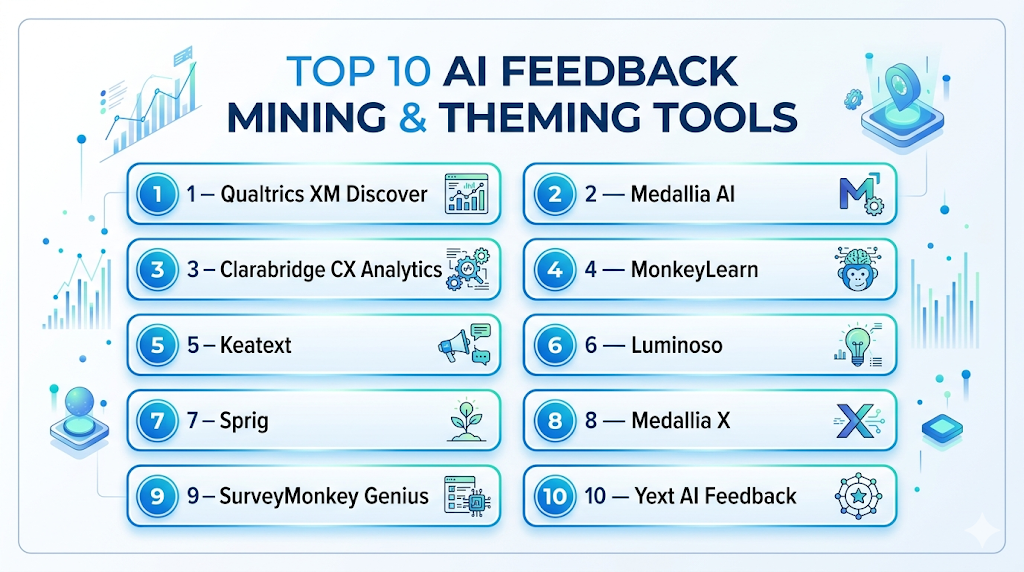
Top 10 AI Feedback Mining & Theming Tools
1 — Qualtrics XM Discover
One-line verdict: Best for enterprise CX teams needing comprehensive multi-source feedback mining and sentiment analysis.
Short description:
Qualtrics XM Discover analyzes customer, employee, and product feedback from surveys and support interactions.
It automatically detects themes, trends, and sentiment across multiple languages.
Ideal for product, CX, and research teams needing actionable insights at scale.
Standout Capabilities
- Automated theme detection and clustering
- Sentiment and emotion scoring
- Multi-language support
- Integration with CRM and analytics platforms
- Reporting dashboards with trend visualization
AI-Specific Depth
- Model support: Proprietary
- RAG / knowledge integration: CRM and BI connectors
- Evaluation: Human-in-loop review
- Guardrails: Bias mitigation and policy enforcement
- Observability: Token metrics and latency dashboards
Pros
- Enterprise-grade analytics
- Handles high-volume feedback
- Multi-source integration
Cons
- Premium pricing
- Complex setup for custom themes
- Steeper learning curve
Security & Compliance
SSO, encryption, RBAC; Not publicly stated certifications
Deployment & Platforms
Web, Cloud
Integrations & Ecosystem
- CRM and BI platforms
- Survey platforms
- API and workflow automation
Pricing Model
Subscription; enterprise tiered
Best-Fit Scenarios
- Product feedback analysis
- Customer experience insights
- Employee survey thematic analysis
2 — Medallia AI
One-line verdict: Ideal for organizations seeking real-time feedback mining across surveys, reviews, and support channels.
Short description :
Medallia AI extracts insights from customer and employee feedback, highlighting emerging themes and sentiment.
Supports multi-language processing and real-time alerts for critical feedback.
Perfect for enterprise CX, product, and HR teams seeking actionable insights.
Standout Capabilities
- AI-driven theme clustering
- Emotion and sentiment analysis
- Multi-channel feedback aggregation
- Real-time alerts for urgent issues
- Advanced reporting dashboards
AI-Specific Depth
- Model support: Proprietary
- RAG / knowledge integration: CRM connectors
- Evaluation: Regression and human review
- Guardrails: Bias and sensitive content control
- Observability: Latency and processing metrics
Pros
- Real-time insights
- Robust multi-channel coverage
- Enterprise scalability
Cons
- High cost for smaller teams
- Initial setup complexity
- Integration customization may be needed
Security & Compliance
Encryption, RBAC; Not publicly stated certifications
Deployment & Platforms
Web, Cloud
Integrations & Ecosystem
- Salesforce and other CRMs
- BI and analytics tools
- Survey platforms
- API integrations
Pricing Model
Subscription; enterprise tiered
Best-Fit Scenarios
- NPS and satisfaction survey analysis
- Support ticket thematic insights
- Product feature feedback aggregation
3 — Clarabridge CX Analytics
One-line verdict: Suited for enterprises needing automated sentiment and theme extraction from unstructured feedback.
Short description:
Clarabridge analyzes text feedback from surveys, chat, and social media to detect trends and sentiment.
It generates actionable insights and visual dashboards for teams.
Ideal for product, support, and marketing teams analyzing customer perceptions.
Standout Capabilities
- Automated theme and sentiment detection
- Multi-language processing
- Integration with CRM, ticketing, and survey platforms
- Trend analytics dashboards
- Real-time alerts for critical feedback
AI-Specific Depth
- Model support: Proprietary
- RAG / knowledge integration: CRM and BI connectors
- Evaluation: Human-in-loop review and regression testing
- Guardrails: Policy and bias checks
- Observability: Latency and processing metrics
Pros
- Scalable for enterprise feedback
- Multi-channel support
- Accurate sentiment analysis
Cons
- Premium pricing
- Requires analyst training
- Customization complexity
Security & Compliance
SSO, encryption; Not publicly stated certifications
Deployment & Platforms
Web, Cloud
Integrations & Ecosystem
- CRM and ticketing systems
- BI tools and analytics
- Survey platform connectors
- API for automation
Pricing Model
Subscription; enterprise tiers
Best-Fit Scenarios
- Support ticket analysis
- Product feature feedback mining
- Social media sentiment tracking
4 — MonkeyLearn
One-line verdict: Best for SMBs and mid-market teams needing customizable AI text analytics and feedback theming.
Short description :
MonkeyLearn allows businesses to classify text feedback, detect sentiment, and extract themes with AI.
It supports CSV uploads, survey data, and helpdesk integrations.
Ideal for teams requiring flexible, user-friendly feedback analytics.
Standout Capabilities
- Customizable text classifiers
- Sentiment scoring
- Theme extraction
- Multi-language support
- Workflow automation and API access
AI-Specific Depth
- Model support: Proprietary, with custom model training
- RAG / knowledge integration: N/A
- Evaluation: Human review and regression tests
- Guardrails: Bias checks and validation
- Observability: Analytics dashboards
Pros
- Flexible and customizable
- Real-time text analysis
- Easy to integrate
Cons
- Requires setup for custom models
- Limited advanced enterprise features
- Analyst oversight recommended
Security & Compliance
Encryption; Not publicly stated certifications
Deployment & Platforms
Web, Cloud
Integrations & Ecosystem
- Helpdesk and survey tools
- CRM connectors
- API for workflows
- Analytics dashboards
Pricing Model
Subscription; tiered
Best-Fit Scenarios
- Survey feedback analysis
- Customer support ticket mining
- Product feedback categorization
5 — Keatext
One-line verdict: Suited for enterprises seeking AI-driven feedback analysis with automated insights and dashboards.
Short description :
Keatext mines feedback from surveys, reviews, and support interactions to identify themes and sentiment.
It delivers actionable insights and visual dashboards.
Ideal for CX, product, and marketing teams looking to act quickly on feedback.
Standout Capabilities
- Automatic theme clustering
- Sentiment analysis with emotion scoring
- Alerts for critical feedback
- Multi-source data ingestion
- Interactive dashboards
AI-Specific Depth
- Model support: Proprietary
- RAG / knowledge integration: CRM connectors
- Evaluation: Human review and regression testing
- Guardrails: Bias and sensitive content control
- Observability: Processing and token metrics
Pros
- Actionable insights delivered quickly
- Multi-channel support
- Scalable for enterprise data
Cons
- Premium pricing
- Limited model customization
- Analyst training required
Security & Compliance
Encryption, SSO; Not publicly stated certifications
Deployment & Platforms
Web, Cloud
Integrations & Ecosystem
- CRM and survey tools
- Analytics platforms
- API and workflow automation
Pricing Model
Subscription; enterprise tiers
Best-Fit Scenarios
- Product feedback analysis
- Customer support ticket mining
- Trend detection in surveys
6 — Luminoso
One-line verdict: Ideal for global enterprises needing semantic AI to detect themes and sentiment in text feedback.
Short description :
Luminoso leverages semantic AI to identify patterns and recurring themes in unstructured feedback.
Supports multi-language input and large-scale datasets.
Perfect for product and CX teams requiring deep insights from diverse data sources.
Standout Capabilities
- Semantic theme detection
- Sentiment and emotion analytics
- Multi-language feedback support
- Integration with enterprise analytics and CRM
- Customizable dashboards
AI-Specific Depth
- Model support: Proprietary semantic AI
- RAG / knowledge integration: CRM connectors
- Evaluation: Regression tests and human review
- Guardrails: Bias mitigation
- Observability: Latency, throughput, token metrics
Pros
- Strong semantic understanding
- Multi-language capability
- Scalable for large datasets
Cons
- Premium cost
- Learning curve for complex analysis
- Customization can be complex
Security & Compliance
Encryption, SSO; Not publicly stated certifications
Deployment & Platforms
Web, Cloud
Integrations & Ecosystem
- CRM and BI platforms
- Survey tools
- API access
- Analytics dashboards
Pricing Model
Subscription; enterprise tiers
Best-Fit Scenarios
- Global feedback mining
- Product and feature insights
- Customer satisfaction analysis
7 — Sprig
One-line verdict: Best for product teams needing quick thematic analysis of in-app and survey feedback.
Short description:
Sprig collects and analyzes user feedback directly from products, apps, and surveys.
It identifies trends and themes automatically for product decisions.
Ideal for UX, product, and growth teams.
Standout Capabilities
- Real-time feedback analysis
- In-app survey integration
- Theme and sentiment detection
- Alerts for critical user issues
- Visual analytics dashboards
AI-Specific Depth
- Model support: Proprietary
- RAG / knowledge integration: N/A
- Evaluation: Human validation
- Guardrails: Sensitive content control
- Observability: Processing metrics and dashboard analytics
Pros
- Real-time user insights
- Integrates with product environments
- Easy for product teams
Cons
- Limited enterprise-level customization
- Premium pricing for large datasets
- Requires setup for custom themes
Security & Compliance
Encryption; Not publicly stated certifications
Deployment & Platforms
Web, Cloud
Integrations & Ecosystem
- Product analytics tools
- CRM and survey integrations
- API for custom workflows
- Dashboards
Pricing Model
Subscription; tiered
Best-Fit Scenarios
- In-app feedback analysis
- Product improvement initiatives
- UX research
8 — Medallia X
One-line verdict: Suited for enterprises requiring advanced multi-source feedback mining and analytics at scale.
Short description :
Medallia X consolidates feedback from surveys, tickets, reviews, and social media.
It identifies recurring themes, sentiment, and prioritizes action items.
Ideal for CX, product, and service teams.
Standout Capabilities
- Multi-source feedback ingestion
- Automated sentiment scoring
- Theme prioritization
- Real-time alerts
- Advanced reporting and dashboards
AI-Specific Depth
- Model support: Proprietary
- RAG / knowledge integration: CRM and BI connectors
- Evaluation: Regression and human review
- Guardrails: Bias and sensitive content controls
- Observability: Analytics dashboards
Pros
- Enterprise scalability
- Accurate trend detection
- Multi-channel analysis
Cons
- High cost
- Setup complexity
- Requires analyst oversight
Security & Compliance
Encryption, SSO; Not publicly stated certifications
Deployment & Platforms
Web, Cloud
Integrations & Ecosystem
- CRM, BI, survey tools
- API access
- Workflow automation
- Reporting dashboards
Pricing Model
Subscription; enterprise tiered
Best-Fit Scenarios
- Enterprise customer feedback mining
- Product roadmap prioritization
- Support ticket analysis
9 — SurveyMonkey Genius
One-line verdict: Ideal for SMBs and mid-market teams analyzing survey feedback with AI insights.
Short description:
SurveyMonkey Genius automatically categorizes open-ended survey responses and detects sentiment.
It supports multi-language text and provides visual dashboards.
Perfect for marketing, UX, and product teams.
Standout Capabilities
- Theme clustering from surveys
- Sentiment and emotion detection
- Multi-language support
- Visual dashboards
- Integration with survey campaigns
AI-Specific Depth
- Model support: Proprietary
- RAG / knowledge integration: N/A
- Evaluation: Human review for accuracy
- Guardrails: Policy enforcement
- Observability: Analytics dashboards
Pros
- Simple and intuitive
- Fast analysis for survey data
- Visual insights
Cons
- Limited multi-channel integration
- Less enterprise-scale
- Premium plan needed for advanced features
Security & Compliance
Encryption; Not publicly stated certifications
Deployment & Platforms
Web, Cloud
Integrations & Ecosystem
- SurveyMonkey platform
- CRM connectors
- API access
- Dashboards
Pricing Model
Subscription; tiered
Best-Fit Scenarios
- Survey response analysis
- UX feedback mining
- Marketing research
10 — Yext AI Feedback
One-line verdict: Suited for organizations needing AI feedback analysis integrated with customer knowledge platforms.
Short description :
Yext AI Feedback mines customer reviews, surveys, and tickets to extract themes and sentiment.
It integrates with the Yext Knowledge Graph for actionable insights.
Ideal for CX and marketing teams managing brand reputation.
Standout Capabilities
- Automatic theme extraction
- Sentiment scoring
- Multi-source feedback support
- Integration with knowledge platforms
- Analytics dashboards
AI-Specific Depth
- Model support: Proprietary
- RAG / knowledge integration: Knowledge Graph
- Evaluation: Human review
- Guardrails: Policy enforcement
- Observability: Dashboard metrics
Pros
- Strong integration with knowledge platform
- Multi-channel support
- Scalable insights
Cons
- Enterprise focus limits SMB usability
- Premium pricing
- Limited customization
Security & Compliance
Encryption, SSO; Not publicly stated certifications
Deployment & Platforms
Web, Cloud
Integrations & Ecosystem
- Knowledge Graph and CRM
- Survey platforms
- API for automation
- Analytics dashboards
Pricing Model
Subscription; enterprise tiered
Best-Fit Scenarios
- Brand reputation monitoring
- Customer sentiment analysis
- Product feedback prioritization
Comparison Table
| Tool Name | Best For | Deployment | Model Flexibility | Strength | Watch-Out | Public Rating |
|---|---|---|---|---|---|---|
| Qualtrics XM Discover | Enterprise CX teams | Cloud | Proprietary | Multi-source insights | Premium pricing | N/A |
| Medallia AI | Enterprise & product teams | Cloud | Proprietary | Real-time analysis | High cost | N/A |
| Clarabridge CX Analytics | Enterprises | Cloud | Proprietary | Accurate sentiment & themes | Complexity | N/A |
| MonkeyLearn | SMBs & mid-market | Cloud | Proprietary/custom | Customizable text analysis | Setup required | N/A |
| Keatext | Enterprise | Cloud | Proprietary | Automated actionable insights | Analyst training needed | N/A |
| Luminoso | Global enterprises | Cloud | Proprietary | Semantic understanding | Premium pricing | N/A |
| Sprig | Product teams | Cloud | Proprietary | Real-time product feedback | Limited enterprise features | N/A |
| Medallia X | Enterprise | Cloud | Proprietary | Multi-source feedback | Setup complexity | N/A |
| SurveyMonkey Genius | SMB & mid-market | Cloud | Proprietary | Survey-focused insights | Limited multi-channel | N/A |
| Yext AI Feedback | Enterprises | Cloud | Proprietary | Knowledge platform integration | Premium pricing | N/A |
Scoring & Evaluation (Transparent Rubric)
Scoring is comparative and based on weighted criteria: Core features 20%, AI reliability & evaluation 15%, Guardrails 10%, Integrations & ecosystem 15%, Ease 10%, Performance & cost controls 15%, Security & admin 10%, Support & community 5%.
| Tool | Core | Reliability/Eval | Guardrails | Integrations | Ease | Perf/Cost | Security/Admin | Support | Weighted Total |
|---|---|---|---|---|---|---|---|---|---|
| Qualtrics XM Discover | 9 | 9 | 8 | 8 | 8 | 8 | 8 | 7 | 8.3 |
| Medallia AI | 8 | 9 | 8 | 8 | 7 | 8 | 8 | 7 | 8.0 |
| Clarabridge CX Analytics | 8 | 8 | 8 | 7 | 8 | 8 | 7 | 7 | 7.8 |
| MonkeyLearn | 8 | 8 | 8 | 7 | 8 | 7 | 7 | 7 | 7.6 |
| Keatext | 8 | 8 | 8 | 7 | 8 | 8 | 7 | 7 | 7.9 |
| Luminoso | 9 | 8 | 8 | 8 | 7 | 8 | 8 | 7 | 8.1 |
| Sprig | 8 | 8 | 7 | 7 | 8 | 7 | 7 | 7 | 7.5 |
| Medallia X | 9 | 8 | 8 | 8 | 7 | 8 | 8 | 7 | 8.0 |
| SurveyMonkey Genius | 8 | 7 | 7 | 7 | 8 | 7 | 7 | 7 | 7.3 |
| Yext AI Feedback | 8 | 8 | 8 | 7 | 8 | 8 | 7 | 7 | 7.8 |
Top 3 for Enterprise: Qualtrics XM Discover, Luminoso, Medallia AI
Top 3 for SMB: MonkeyLearn, SurveyMonkey Genius, Sprig
Top 3 for Developers: MonkeyLearn, Luminoso, Keatext
Which AI Feedback Mining & Theming Tool Is Right for You?
Solo / Freelancer
- MonkeyLearn or SurveyMonkey Genius for small-scale feedback analysis.
- Easy-to-use interfaces with fast deployment for surveys or review analysis.
- Focus on cost-effectiveness and minimal setup.
SMB
- MonkeyLearn, Sprig, or Keatext for product or customer experience feedback.
- Integrates with CRM, helpdesk, and survey tools.
- Enables quick action on recurring feedback and minor trend detection.
Mid-Market
- Clarabridge CX Analytics or Medallia AI for thematic analysis of multiple feedback sources.
- Good for product, marketing, and CX teams handling more complex datasets.
- Automated dashboards and alerts help prioritize actionable insights.
Enterprise
- Qualtrics XM Discover, Luminoso, or Medallia X for large-scale feedback mining.
- Handles multi-source, multi-language input at scale.
- Integrates with BI, CRM, and workflow systems for strategic decision-making.
Regulated industries (finance/healthcare/public sector)
- Qualtrics XM Discover, Medallia AI, or Luminoso with strong compliance controls.
- Guardrails and encryption for sensitive data.
- Useful for employee feedback, patient surveys, or customer compliance data.
Budget vs premium
- Budget: MonkeyLearn or SurveyMonkey Genius for small teams or low-volume feedback.
- Premium: Qualtrics XM Discover or Luminoso for enterprise-scale, multi-channel insights.
Build vs buy
- Build: Open-source or BYO NLP models for custom AI logic and proprietary data.
- Buy: SaaS solutions for immediate deployment, managed updates, and enterprise reliability.
Implementation Playbook (30 / 60 / 90 Days)
30 Days – Pilot & Success Metrics
- Identify high-volume feedback workflows.
- Define metrics: theme coverage, sentiment accuracy, turnaround time.
- Deploy AI on pilot data sets.
- Train analysts to review AI classifications.
- Monitor initial insights for correctness.
- Evaluate usability for non-technical teams.
60 Days – Harden & Integrate
- Expand integration with CRM, BI, and support tools.
- Implement compliance and data privacy guardrails.
- Automate alerts and reporting for critical themes.
- Optimize AI pipelines for latency and accuracy.
- Review dashboards for trend monitoring.
- Adjust rules and categories based on pilot outcomes.
90 Days – Optimize & Scale
- Deploy organization-wide across multiple feedback sources.
- Monitor AI performance, token usage, and latency.
- Red-team testing for misclassification or bias.
- Scale to handle multi-language and multi-channel input.
- Fine-tune AI evaluation pipelines.
- Train new staff on interpreting AI insights.
- Conduct ROI and cost-benefit analysis.
Common Mistakes & How to Avoid Them
- Skipping AI evaluation leading to inaccurate insights.
- Ignoring bias and guardrails in theme extraction.
- Over-reliance on AI without human review.
- Unmanaged data retention policies.
- Failing to integrate with CRM, BI, or analytics platforms.
- Lack of multi-language support for global feedback.
- Neglecting token usage, latency, or performance monitoring.
- Underestimating change management and training needs.
- Vendor lock-in without export or API options.
- Missing alerts for critical negative feedback.
- Ignoring trend reporting and dashboard metrics.
- Not prioritizing actionable vs informational feedback.
FAQs
- What is AI Feedback Mining & Theming?
AI tools analyze open-ended text to detect recurring themes, categorize feedback, and measure sentiment automatically. - How does it improve decision-making?
By surfacing trends and key insights quickly, organizations can prioritize product, service, or employee initiatives effectively. - Are these tools secure for sensitive feedback?
Yes, most provide encryption, RBAC, and retention policies; compliance should be verified for HIPAA, GDPR, or SOC 2. - Can AI handle multiple languages?
Top platforms support multilingual feedback, automatically detecting themes and sentiment across various languages. - What data sources can it analyze?
Surveys, support tickets, online reviews, social media comments, focus groups, and internal feedback. - Do these tools integrate with other systems?
Yes, integration with CRM, BI, analytics, and survey platforms is common for automated insights and workflows. - Is human validation needed?
Yes, AI review and human-in-the-loop validation improve accuracy and prevent misclassification. - Can it handle high-volume feedback?
Enterprise-grade tools like Qualtrics or Luminoso can process thousands of entries in real-time. - How do I measure AI effectiveness?
Monitor theme coverage, sentiment accuracy, classification errors, and time to actionable insights. - Are these tools customizable?
Many allow custom categories, sentiment rules, and evaluation thresholds for organizational needs. - Is offline processing possible?
Most are cloud-based; offline or on-premises options may exist for sensitive environments. - Can AI prioritize urgent feedback?
Yes, alerts and automated workflows ensure critical or negative feedback is surfaced immediately.
Conclusion
AI Feedback Mining & Theming Tools help organizations convert unstructured feedback into actionable insights efficiently, improving decision-making, customer experience, and product development. Selecting the right tool depends on data volume, complexity, integration needs, and organizational scale. Enterprises benefit from advanced analytics and multi-channel support, while SMBs can leverage flexible, easy-to-use tools. Proper implementation, human review, and adherence to privacy and compliance guardrails are essential to maximize value.
Next steps:
- Shortlist tools aligned with feedback sources and workflow needs.
- Pilot selected solutions with defined metrics for accuracy and insight value.
- Validate compliance, guardrails, and scalability before full deployment.
A well-structured breakdown of features, pros, and cons across leading tools. It’s highly useful for turning unstructured feedback into actionable insights!
The workflow insights and transformation concepts shared in this blog were extremely practical and relevant for modern data engineering teams.