Introduction
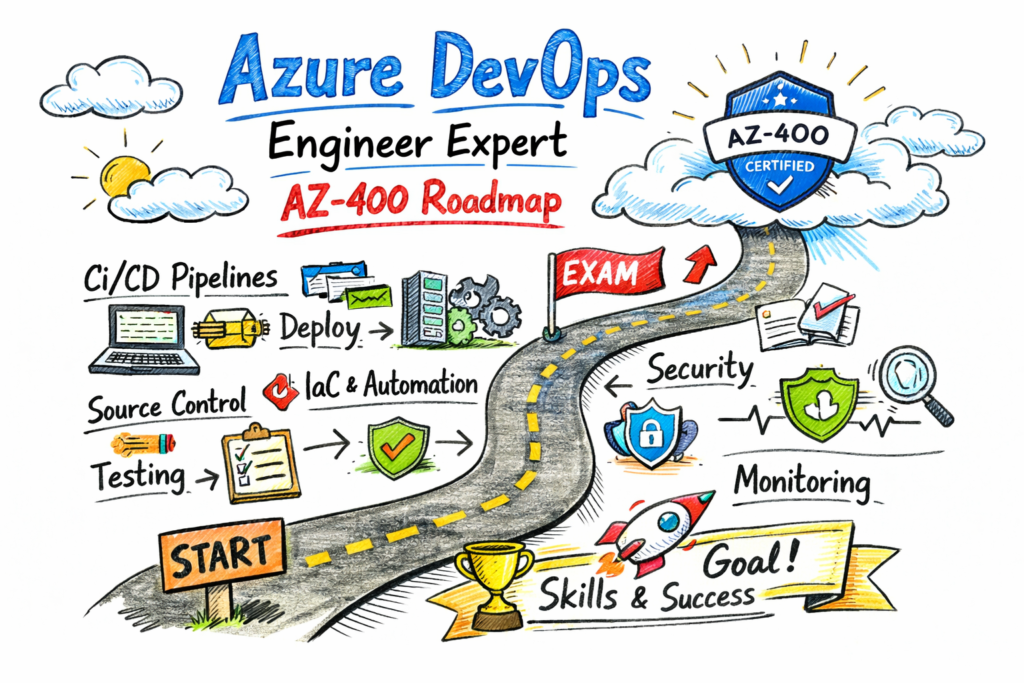
Releasing software is not only about writing code. Teams also need to build it, test it, deploy it, and keep it running. If any step is weak, releases become slow, risky, and stressful. That is why DevOps is important. DevOps helps teams deliver changes faster with fewer failures and better control. Azure DevOps Engineer Expert (AZ-400) is a certification that teaches and validates these real skills. It focuses on CI/CD pipelines, source control, testing, security checks, infrastructure automation, and monitoring. This guide explains what AZ-400 is, who should take it, what you will learn, and how to prepare with a clear plan that fits working professionals.
What is Azure DevOps Engineer Expert (AZ-400)?
Azure DevOps Engineer Expert (AZ-400) validates your ability to design and implement DevOps practices using Azure-friendly methods and tools. It focuses on the full lifecycle: planning, source control, build pipelines, release pipelines, testing, security checks, and monitoring. In daily work terms, it proves you can take a change from commit to production in a controlled way, with quality gates, audit trails, and reliable feedback. It is less about “one tool” and more about building a delivery system that teams can trust.
Who should pursue AZ-400?
This certification is best for professionals who already touch delivery pipelines or who want to move into DevOps, platform, or reliability roles. It fits both hands-on engineers and managers who need strong delivery governance and visibility.
If you often collaborate across dev, QA, security, and ops, AZ-400 helps you create a shared process that reduces confusion. It is also helpful if your organization is scaling teams and needs repeatable standards across projects.
Good fit roles include:
- DevOps Engineers managing CI/CD and releases
- SREs and Platform Engineers standardizing delivery and operations
- Cloud Engineers automating environments and deployments
- Software Engineers owning deployments and reliability outcomes
- Engineering Managers driving delivery transformation and metrics
What you will be able to do after AZ-400
AZ-400 preparation is valuable when it changes how you build and run delivery pipelines. You learn to remove manual steps without increasing risk, and you learn how to measure delivery quality in a practical way.
After strong preparation, you should be able to explain pipeline choices clearly, like you are presenting in a design review. You should also be able to troubleshoot real delivery issues, not just build “happy path” pipelines.
You should be able to:
- Build end-to-end CI/CD pipelines that are stable and observable
- Add quality gates (tests, scans, approvals) without slowing teams
- Automate Infrastructure as Code and consistent environments
- Reduce deployment risk with staged rollout and rollback patterns
- Tie monitoring signals to releases and reduce incident time
- Improve delivery metrics like lead time, change failure rate, and MTTR
Certification Table
| Track | Level | Certification | Who it’s for | Prerequisites | Skills covered | Recommended order |
|---|---|---|---|---|---|---|
| DevOps | Expert | Azure DevOps Engineer Expert (AZ-400) | DevOps/SRE/Platform/Cloud/Software Engineers, Managers | Azure basics + CI/CD basics + Git fundamentals | CI/CD, Git, build/release, IaC, testing, security, monitoring | 1 |
Azure DevOps Engineer Expert (AZ-400) — Mini Sections
What it is
AZ-400 is an expert-level certification focused on building and improving DevOps practices for modern software delivery. It combines CI/CD design, testing strategy, security integration, and monitoring into one continuous workflow.
It also pushes you to think like an engineer who owns outcomes, not just tasks. That mindset is what most employers value in DevOps and platform roles.
Who should take it
- Engineers responsible for pipelines, deployments, and release governance
- Platform teams building reusable templates and shared delivery standards
- Cloud engineers automating provisioning and application releases
- Developers who want ownership from code to production
- Managers who want better control, metrics, and predictable releases
This is especially useful when your organization has multiple teams and needs consistent delivery patterns.
Skills you’ll gain
- Designing CI pipelines with clean build → test → artifact flow
- Designing CD pipelines with approvals, gates, and release strategies
- Source control strategy (branching, PR policies, trunk-based thinking)
- Infrastructure as Code basics and environment consistency practices
- Quality engineering integration (unit, integration, smoke, end-to-end tests)
- Security controls inside pipelines (secrets handling, scans, access control)
- Observability mindset and feedback loops to reduce production risk
These skills are practical and reusable, even if your organization changes tools later.
Real-world projects you should be able to do after it
- Build a full CI/CD pipeline for an API or web app with staged deployments
- Create reusable pipeline templates for multiple repositories and teams
- Implement a release process with approvals, audit logs, and rollback strategy
- Add scanning steps (code checks, dependency checks, secret checks) into CI
- Provision dev/test/stage/prod environments using IaC-style workflows
- Create deployment dashboards and alerts tied directly to release events
- Reduce failures by introducing quality gates and safe rollout patterns
If you can do these projects, you are job-ready for most DevOps delivery work.
Preparation plan
7–14 days (fast revision plan)
Focus on key concepts and one complete project. Build a pipeline end-to-end: commit to build, test, artifact, and deploy to at least two environments. Spend time on common failure points like secrets, approvals, artifacts, and environment config drift.
This plan works best if you already work daily with CI/CD and want structured revision.
30 days (balanced plan for working professionals)
Week 1: Git strategy, build pipelines, artifacts, basic tests and build quality.
Week 2: Multi-stage releases, environments, approvals, and deployment strategies.
Week 3: IaC mindset, configuration handling, secrets, and security steps.
Week 4: Monitoring feedback, governance, metrics, and full mock project review.
This plan gives you steady progress without burnout, and it builds confidence through practice.
60 days (deep mastery plan)
Go beyond basics: reusable templates, multi-repo workflows, promotion policies, and better troubleshooting skills. Build 2–3 realistic projects (API, web app, infra provisioning) and deliberately break things to learn recovery.
Use this plan if you want stronger long-term capability for platform engineering, SRE collaboration, and enterprise delivery governance.
Common mistakes
- Building pipelines that work once but cannot be reused across teams
- Skipping test strategy, or relying too much on manual testing
- Hardcoding secrets, tokens, or credentials into scripts and variables
- No rollout safety (no staging, no canary, no rollback planning)
- Treating monitoring as “after deployment” instead of part of delivery
- Over-complicating branching and slowing down integration and reviews
- Not learning troubleshooting basics for failed builds and failed releases
Most of these mistakes are solved by building a repeatable pipeline template and adding simple governance.
Best next certification after this
If you want deeper cloud delivery and platform readiness, continue in the DevOps and automation direction. If you want to reduce risk further, move into security integration and compliance practices. If your role is production-heavy, expand into reliability and observability depth.
You do not need to pick everything at once. Pick the next step based on the role you want in the next 6–12 months.
Why AZ-400 is valuable for teams
AZ-400 is valuable because it teaches you to view delivery as a connected system. Many production issues happen not because code is bad, but because the process around code is weak: missing tests, unclear approvals, environment drift, or poor monitoring.
When teams apply these practices, they often get fewer release failures, less downtime, and faster recovery when issues happen. It also improves collaboration because developers, QA, security, and operations work with shared gates and shared visibility.
For managers, it creates predictable delivery and measurable progress. Instead of arguments and opinions, you can track outcomes like release frequency, failure rate, and time to recover.
Choose Your Path: 6 Learning Paths
Different roles need different depth. Use these paths to decide what to learn right after you understand the AZ-400 core workflow. Each path keeps the same foundation: source control, CI/CD, quality, security, and monitoring.
1) DevOps Path
Focus: CI/CD design, release governance, pipeline templates, automation basics.
This path is best if you want to become the person who standardizes delivery across teams. You will build repeatable pipelines, remove manual steps, and improve speed without risking stability.
A strong DevOps path also trains you to communicate clearly with developers and operations, which is critical in real projects.
2) DevSecOps Path
Focus: secure pipelines, secrets, identity, access control, scanning, and audit readiness.
This path is best if your organization is regulated or if security reviews slow down releases. You learn to add security checks early so issues are found before production.
The goal is not to block teams, but to build safe defaults that reduce risk automatically.
3) SRE Path
Focus: reliability, observability, incident response, automation, and operational excellence.
This path is best if you handle production systems, on-call, or reliability KPIs. You learn to connect deployments with monitoring signals and reduce alert noise.
You also learn how to design releases that are safer for uptime, not just faster.
4) AIOps/MLOps Path
Focus: smarter monitoring, anomaly detection, automation workflows, and operational learning.
This path is best if you support large environments with too many alerts and too little signal. You learn how to improve event handling and reduce repetitive manual work.
It also helps if you work with ML teams or want to build automation based on telemetry.
5) DataOps Path
Focus: reliable data pipeline delivery, data quality checks, orchestration, and governance.
This path is best for data engineers and analytics teams who need predictable pipeline runs. You apply DevOps ideas to data workflows and reduce silent failures in reporting.
It helps you deliver data like a product, with testing and repeatability.
6) FinOps Path
Focus: cost visibility, tagging discipline, budget controls, and optimization habits.
This path is best if your cloud spend is growing fast and teams need shared ownership. You learn how automation and governance reduce waste and improve accountability.
It also supports engineering managers who need to balance delivery goals with cost constraints.
Role → Recommended Certifications Mapping
This mapping helps you connect roles to learning direction. It is written in a practical way: what you should focus on first, and what to expand into next for stronger career outcomes.
| Role | Primary focus | Recommended certifications (directional) |
|---|---|---|
| DevOps Engineer | CI/CD, automation, release stability | Start with AZ-400, then deepen pipeline templates, IaC basics, and governance |
| SRE | reliability, monitoring, incident response | AZ-400 + observability depth + reliability practices and incident automation |
| Platform Engineer | shared tooling, templates, standards | AZ-400 + platform patterns + IaC workflows + developer experience improvements |
| Cloud Engineer | Azure services, operations, automation | Azure operational skills + AZ-400 to improve delivery automation and safety |
| Security Engineer | secure SDLC, compliance, policy | DevSecOps path + secure CI/CD integration practices aligned to AZ-400 |
| Data Engineer | pipelines, orchestration, quality | DataOps path + delivery automation mindset + testing discipline from DevOps |
| FinOps Practitioner | cost governance, optimization | FinOps path + automation habits + tagging and policy discipline in pipelines |
| Engineering Manager | delivery governance, metrics, quality | AZ-400 concepts + delivery metrics + cross-team standardization and controls |
If you are unsure, pick the role you want next and follow the matching path section above.
Next Certifications to Take (3 Options)
Option 1: Same Track (go deeper in DevOps delivery)
Choose this when your job is heavily focused on CI/CD, platform tooling, and release governance. This path helps you become the person who designs standards that multiple teams can reuse.
It is best for DevOps Engineers and Platform Engineers who want to lead delivery maturity across products, not just maintain pipelines.
Option 2: Cross-Track (expand into security, reliability, or data)
Choose this if your team expects you to support more than delivery, such as security gates, compliance, reliability goals, or data pipeline stability. This path is useful because real-world DevOps work touches these areas daily.
It is best for engineers moving into DevSecOps, SRE collaboration, DataOps workflows, or cloud governance responsibilities.
Option 3: Leadership Track (manage delivery outcomes)
Choose this if you lead teams, delivery programs, or platform initiatives. The focus here is metrics, governance, process design, and enabling teams to move faster with fewer failures.
It is best for Engineering Managers and Tech Leads who want predictable releases, strong audit readiness, and stable operations across teams.
How to Study AZ-400 in a Busy Schedule
A common mistake is studying in random chunks without building anything. A better approach is to study around a small project, because projects force you to connect concepts like artifacts, environments, approvals, and monitoring.
Use a routine that fits real life. Consistency beats intensity. Even 60–90 minutes daily can work if you build steadily and revise weekly.
A simple weekly routine
- Weekdays: 60–90 minutes focused learning and small labs
- Weekends: 3–5 hours project work and revision
- Every week: one deliverable (pipeline stage, test integration, release policy, dashboard)
Learn by building
- One CI pipeline that builds, tests, and creates artifacts
- One CD pipeline that deploys to stage and production with approvals
- A secrets approach that is safe and repeatable
- Monitoring that shows deployment impact and error signals
Common AZ-400 Topics You Must Be Comfortable With
Source control and collaboration
You should understand how teams manage changes safely, including pull requests, reviews, merge policies, and branching strategy. The goal is fast integration without chaos, and clear ownership for changes.
You should also understand how teams reduce merge conflicts and keep releases predictable, especially when multiple teams ship to the same systems.
Build and release pipelines
You should know how builds create artifacts, and how releases promote those artifacts through environments. You should also understand approvals, gates, staged rollouts, and why multi-stage pipelines reduce risk.
In real organizations, this is where most delivery friction happens, so clarity here gives you strong career advantage.
Testing and quality engineering
You should understand test types, where they fit in pipelines, and how to keep tests reliable. Flaky tests slow teams and break trust, so learning how to manage them matters a lot.
You should also know how to design quality gates that protect production without blocking developer productivity.
Infrastructure and configuration
You should be comfortable with the idea of environment consistency and drift control. Infrastructure as Code reduces surprises and makes environments repeatable.
You should also understand safe config handling: separating environment config, reducing manual edits, and avoiding “works on my machine” deployments.
Security and compliance in pipelines
You should know how security checks fit inside delivery: secrets safety, access control, least privilege, and audit trails. This is crucial because most security incidents are process failures, not just code failures.
You should aim to build pipelines that are secure by default, so teams do not depend on late-stage manual reviews.
Monitoring and feedback loops
You should understand how telemetry helps you detect issues early and how to connect releases to production signals. Monitoring is not only about alerts; it is about learning what changed and why.
A good DevOps engineer can quickly answer: “Did the last deployment cause errors?” That skill is highly valued.
Training + Certification Support: Institutions That Help
DevOpsSchool
DevOpsSchool focuses on job-ready training with hands-on practice and project-style learning. It is helpful if you want structured coverage that connects exam topics to real delivery work. It also supports learning patterns like reusable pipelines, release governance, and production readiness.
If you prefer a guided path with practical outcomes, this option fits well for working professionals.
Cotocus
Cotocus supports learners who want mentoring and applied learning rather than only reading. It works well when you want to build confidence through guided practice and feedback. The support is useful for keeping your preparation steady across weeks.
It is a good choice if you prefer step-by-step learning with practical checkpoints.
Scmgalaxy
Scmgalaxy is helpful for learners who want a structured learning path across DevOps practices and tooling. It supports steady progress and revision-friendly learning, which is useful when you balance job work and study.
It can be a good match if you want a consistent pace and clear topic sequencing.
BestDevOps
BestDevOps is useful if you prefer hands-on skill building aligned to modern enterprise delivery needs. It supports learning through realistic exercises and common pipeline patterns used in organizations.
It can be a good fit if your goal is job outcomes like pipeline ownership and release improvement.
devsecopsschool.com
This is a strong choice if you want to combine delivery with security practices and compliance thinking. It helps you learn security checks inside pipelines and build safer defaults.
It is useful for teams that handle regulated workloads or want to reduce security bottlenecks.
sreschool.com
This is best for professionals targeting reliability roles or on-call responsibilities. It helps you connect deployment practices with monitoring, incident response, and reliability metrics.
It is a good option if your next step is SRE or platform reliability ownership.
aiopsschool.com
This is useful if you want to reduce alert fatigue and build smarter operational automation. It helps you think about signals, event correlation, and automation tied to telemetry.
It is a good match for large environments where manual operations do not scale.
dataopsschool.com
This is a strong fit for data engineers and analytics teams who want reliable data delivery. It helps connect DevOps ideas with orchestration, data quality, and repeatable pipelines.
It is useful when business teams depend on data freshness and accuracy.
finopsschool.com
This is best for teams focused on cloud cost governance and accountability. It helps you build habits that connect engineering work with cost impact and optimization.
It fits well if your organization wants cost controls without slowing down delivery.
Testimonials
Ankit S. (DevOps Engineer)
“After building a full CI/CD pipeline project during preparation, my day-to-day work became easier. I finally understood approvals, artifacts, and how to reduce deployment failures. It also helped me explain pipeline changes clearly during team reviews.”
Meera K. (Platform Engineer)
“The structured approach helped me design reusable pipeline templates for multiple teams. My confidence in release governance improved a lot because I could connect policies to real risks. It also helped me reduce duplicate pipeline work across projects.”
Rohit P. (Engineering Manager)
“This helped me ask better questions about delivery metrics and quality gates. It made release discussions more objective and less reactive, and it improved collaboration across dev and ops. The biggest value was building a shared language for delivery health.”
FAQs — Difficulty, Time, Prerequisites, Value, Outcomes
1) Is AZ-400 difficult?
It can feel difficult if you only read theory. If you build pipelines and understand why each gate exists, it becomes much easier. Practical work turns topics into patterns you can reuse.
2) How much time do I need to prepare?
Most working professionals can prepare in 30–60 days with steady practice. If you already work daily with CI/CD, a focused 7–14 day revision plan can work. The key is building at least one end-to-end pipeline project.
3) What are the prerequisites?
You should know basic Azure concepts, Git fundamentals, and CI/CD basics. You do not need to be perfect at everything, but you must understand delivery flow end-to-end. Comfort with troubleshooting scripts and pipeline logs helps a lot.
4) Can a software engineer take AZ-400?
Yes, and it often helps developers become stronger owners of delivery. It improves your ability to ship safely, reduce production risk, and collaborate with platform teams. Many employers value developers who understand deployment workflows.
5) Is AZ-400 useful for managers?
Yes, especially if you manage delivery outcomes and want predictable releases. It gives you a practical view of quality gates, approvals, metrics, and governance. It helps you lead improvements without guessing.
6) What sequence should I follow if I’m new to DevOps?
Start with Git and collaboration basics, then CI pipeline basics, then artifacts and CD concepts. After that, add environments, approvals, and testing strategy. Finally, add security checks and monitoring feedback.
7) What real outcomes should I expect after AZ-400?
You should be able to design and improve CI/CD pipelines and reduce failed releases. You should also be able to standardize delivery across teams with templates and policies. Most importantly, you should improve visibility and confidence in releases.
8) What are the most common reasons people struggle?
The biggest reasons are lack of hands-on practice and weak clarity on artifacts, environments, and approvals. Flaky tests and poor secrets handling also create confusion. Many learners also skip monitoring topics, which are important in real work.
9) Does AZ-400 help with cloud roles outside DevOps?
Yes, because cloud work depends on automation and safe delivery. Cloud engineers benefit from consistent releases and environment management. Platform teams benefit from standardization and governance patterns.
10) How does AZ-400 support DevSecOps?
It gives you a framework to add security checks early in the pipeline. You learn to handle secrets safely, restrict access, and create audit-friendly logs. This reduces late-stage security surprises and improves compliance readiness.
11) What is the best next step after passing AZ-400?
Pick one direction based on your target role: deeper delivery, security integration, reliability depth, or leadership outcomes. The “Choose your path” and “Next certifications” sections make this decision easier. The best next step is the one that matches your job goal.
12) Is AZ-400 valuable in India and globally?
Yes, because companies everywhere want safer releases, faster recovery, and stable pipelines. AZ-400 maps well to modern delivery expectations in product companies, services firms, and enterprise IT. It also helps in interviews because you can explain pipeline design clearly.
FAQs — AZ-400 Focus Set
1) What should I build as my main project for AZ-400?
Build one CI/CD pipeline for a small app or API that includes tests, artifacts, staging deployment, and production deployment with approvals. Add one security check and one monitoring dashboard. This single project covers the core workflow and proves real readiness.
2) What is the most important concept to master?
Master the idea of promotion through environments using the same artifact. This avoids “it worked in staging but failed in production” caused by rebuilding different outputs. It also improves traceability and audit control.
3) How do I avoid pipeline complexity?
Start with a simple pipeline that works, then convert repeated steps into reusable templates. Keep naming clear, keep stages consistent, and avoid too many custom scripts early. Complexity should be added only when it solves a real problem.
4) What is a practical way to handle secrets?
Never store secrets in code or plain pipeline files. Use safe secret storage and inject secrets at runtime with least privilege. Also log carefully so secrets never appear in console output.
5) How do I handle flaky tests during preparation?
Treat flaky tests as a real-world problem and learn to reduce them. Add retries only when necessary, isolate unstable tests, and improve test data setup. Stable tests build trust in your pipeline.
6) What release strategy should I learn first?
Learn staged deployment first: dev → test → stage → prod with approvals. Then learn safer patterns like canary or controlled rollout. Always plan for rollback because failures happen in real systems.
7) What monitoring outcome should I be able to show?
You should be able to show a dashboard that answers: “Did the last deployment increase errors or latency?” Also show an alert that triggers on real symptoms, not just CPU usage. This is practical DevOps maturity.
8) What is a strong interview story after AZ-400?
Explain how you improved delivery by adding quality gates, standardizing pipelines, and reducing failures. Use a simple before-and-after story: fewer manual steps, clearer approvals, better traceability, faster recovery. This shows real impact, not just certification.
Conclusion
AZ-400 works best when you treat it as a job skill upgrade, not just an exam goal. The real value comes from building a delivery workflow you can explain, reuse, and improve over time. Focus on one complete CI/CD project that includes artifacts, staged environments, approvals, testing strategy, safe secret handling, and monitoring feedback. This gives you the confidence to own releases and reduce production risk. After you complete AZ-400, choose a direction that matches your role goals: deepen delivery, expand into security or reliability, or move toward leadership outcomes. That is how you turn certification learning into long-term career growth and stronger results for your team.