Introduction
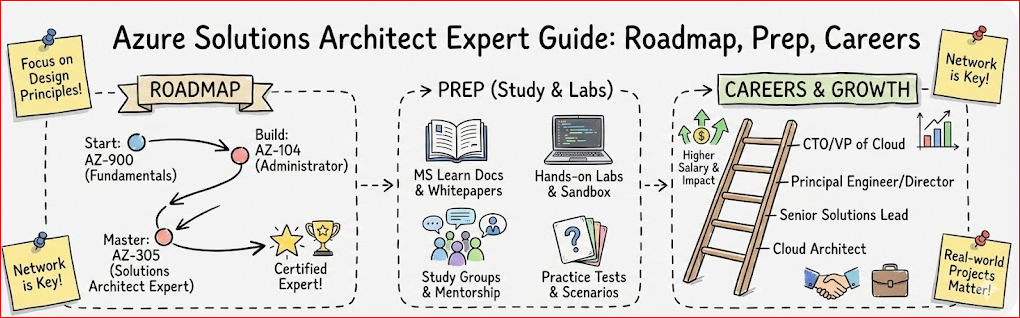
Azure Solutions Architect Expert is for professionals who want to design complete, reliable, and secure solutions on Microsoft Azure. It helps you move beyond “deploying services” and start thinking like an architect who balances real business needs such as cost, performance, compliance, and uptime. In most organizations, the architect is the person who connects teams, removes design confusion, and makes sure solutions can scale without breaking in production. This certification path is valuable for cloud engineers, DevOps and platform engineers, SREs, security engineers, and engineering managers who take part in architecture decisions. As you prepare, you will learn how to design identity and access properly, build governance guardrails, plan networking and connectivity, choose the right compute and storage patterns, and create a strong monitoring and disaster recovery strategy. In simple terms, it trains you to design systems that teams can build faster, operate safely, and improve over time.
Why this certification matters for engineers and managers
For engineers, this certification builds confidence to design systems, not just deploy services. You learn how to choose the right architecture patterns for scaling, resilience, security, and operations. For managers, it improves your ability to review architecture proposals, question risks early, and plan budgets more realistically. Most importantly, it helps teams reduce rework because architecture decisions become clearer and better documented.
What “Azure Solutions Architect Expert” actually means
An Azure Solutions Architect designs end-to-end cloud solutions across identity, networking, compute, storage, data, monitoring, and continuity planning. The role requires you to understand how different Azure services work together as a single system. You are expected to explain trade-offs with clarity, not just pick services by name. In real projects, this also means writing clean architecture notes and guiding teams on implementation standards.
Who should aim for this certification
This is best for engineers who already touch Azure regularly and want ownership of solution design. Cloud engineers, platform engineers, DevOps engineers, SREs, and security engineers often gain the most because they already work near production realities. It is also valuable for engineering managers who want stronger cloud decision-making skills. If you are brand new to cloud, start with fundamentals and administration skills first to avoid frustration.
Certification roadmap table
This table lists the most practical certifications around the Azure Solutions Architect Expert journey. The Link column uses only the two links you provided.
| Track | Level | Certification | Who it’s for | Prerequisites | Skills covered | Recommended order |
|---|---|---|---|---|---|---|
| Azure Fundamentals | Beginner | Azure Fundamentals | New to cloud / Azure | None | Cloud basics, key Azure services, pricing basics, governance basics | 1 |
| Azure Administration | Intermediate | Azure Administrator | Cloud / ops engineers | Basic Azure knowledge | Identity basics, compute, storage, network, monitoring, day-to-day operations | 2 |
| Azure Architecture | Expert | Azure Solutions Architect Expert | Architects, senior cloud/platform leads | Strong Azure admin + hands-on project exposure | End-to-end architecture design, governance, BC/DR, secure foundations | 3 |
| App Engineering | Intermediate | Azure Developer | Developers building on Azure | Development experience | App services, functions, container basics, messaging concepts, identity usage | Optional (parallel) |
| Cloud Security | Intermediate | Azure Security Engineer | Security + cloud engineers | Azure basics | IAM patterns, security controls, monitoring security signals, governance guardrails | Optional (parallel) |
| Networking | Intermediate | Azure Network Engineer | Network + cloud engineers | Azure network basics | VNet design, hybrid connectivity patterns, segmentation, routing thinking | Optional (parallel) |
| Delivery / DevOps | Advanced | Azure DevOps Engineer | DevOps/platform/SRE | Dev + ops basics | CI/CD, release strategy, IaC mindset, reliability practices in delivery | Cross-track |
Azure Solutions Architect Expert (core guide)
What it is
Azure Solutions Architect Expert validates your ability to design secure, reliable, and scalable Azure solutions. It focuses on architecture decisions across identity, governance, networking, storage, compute, monitoring, and continuity planning. It is designed for real-world scenario thinking, where trade-offs matter more than memorizing features.
Who should take it
Take it if you already work on Azure projects and want to lead solution design confidently. It is ideal if you review architectures, design landing zones, decide network models, plan DR, and set governance standards. It also fits platform and DevOps/SRE roles where you influence how teams build and run systems. If you want a “senior” cloud profile, this certification supports that goal.
Skills you’ll gain
- You learn how to design identity and access with least privilege and controlled admin access.
- You build strong governance thinking using policies, standard patterns, and subscription structures.
- You gain practical design skills for networking, compute choices, storage strategy, and data protection.
- You improve monitoring, alert design, and resiliency planning for real production systems.
Real-world projects you should be able to do after it
- Design an Azure landing zone that supports multiple teams with clear RBAC and policy guardrails.
- Create a hub-spoke network plan with segmentation, hybrid connectivity, and secure traffic flow.
- Build a high availability design for an application with scaling, failover, and recovery testing.
- Deliver an observability blueprint with dashboards, alert rules, and escalation patterns.
Preparation plan (7–14 days / 30 days / 60 days)
7–14 days (fast-track)
This is only recommended if you already work daily on Azure architecture or platform tasks. Focus on your weakest areas first, then do architecture case studies every day. Spend time writing your own architecture notes and comparing decisions against constraints like cost, compliance, and RTO/RPO. Finish with repeated practice tests and targeted revision of the topics you miss.
30 days (balanced plan)
This is the best plan for most working engineers. You build steady coverage across identity, governance, networking, storage, compute, monitoring, and BC/DR. Every week should include hands-on labs plus at least two architecture scenarios written in your own words. By the end, you should be able to explain trade-offs clearly and defend your design choices.
60 days (career switch or deeper foundation)
Use this if you are new to Azure or coming from another cloud. Month one should focus on practical administration skills so services stop feeling confusing. Month two should focus on architecture scenarios, documentation, failure-mode thinking, and cost planning. This longer plan gives better long-term retention and stronger interview confidence.
Common mistakes
- Studying service lists without practicing full end-to-end architecture scenarios.
- Weak identity design, leading to over-permissioning and unclear admin boundaries.
- Ignoring cost and assuming budgets will “work out later,” which is risky in real projects.
- Not designing for failures, recovery testing, and operational monitoring from day one.
Best next certification after this
A strong next step depends on your job direction and your biggest skill gap. If you want deeper architecture foundations, go toward security or networking depth. If you want faster delivery ownership, go toward DevOps and release engineering practices. If your goal is leadership, focus on governance, standards, and cross-team platform strategy.
Choose your path (6 learning paths)
DevOps path
This path is for people who want to combine architecture with fast and safe delivery. You focus on release design, infrastructure automation, environment strategy, and platform templates. You also learn how to reduce deployment risk using approvals, rollbacks, and clear change control. The end goal is “repeatable delivery” with good speed and safety.
DevSecOps path
This path is for engineers who want security built into the architecture, not added later. You focus on identity guardrails, privileged access control, secure networking patterns, and compliance-friendly governance. You also learn how to add security checks into CI/CD without slowing teams down too much. The outcome is secure-by-default platforms that scale.
SRE path
This path focuses on reliability and operational excellence. You learn to design systems that fail gracefully and recover quickly, with clear monitoring signals and alert quality. You build habits around incident readiness, post-incident improvements, and service health measurement. The result is architecture that supports stable production operations.
AIOps / MLOps path
This path is for people who want to use automation and intelligence in operations and ML workloads. You focus on monitoring patterns that go beyond CPU/memory and include pipeline health, drift signals, and system anomalies. You also learn how to reduce noise and improve triage using structured signals and automated responses. The goal is smarter operations with fewer surprises.
DataOps path
This path is for data-heavy Azure environments where pipelines must be trusted. You focus on storage and data platform choices, security and governance, and operational reliability of pipelines. You also build thinking around data quality checks, lineage awareness, and consistent environments. The outcome is data systems that are stable, auditable, and easier to maintain.
FinOps path
This path is for architects who must design within cost constraints. You focus on cost-aware service selection, scaling strategy, storage tiering, tagging, and budgeting guardrails. You learn how to measure usage patterns and prevent waste through governance and visibility. The result is architecture that is both technically strong and financially responsible.
Role → Recommended certifications mapping
| Role | Recommended certifications (order) |
|---|---|
| DevOps Engineer | Azure Fundamentals → Azure Administrator → Azure Solutions Architect Expert → Azure DevOps Engineer |
| SRE | Azure Fundamentals → Azure Administrator → Azure Solutions Architect Expert → Azure Network Engineer |
| Platform Engineer | Azure Fundamentals → Azure Administrator → Azure Solutions Architect Expert → Azure DevOps Engineer |
| Cloud Engineer | Azure Fundamentals → Azure Administrator → Azure Solutions Architect Expert |
| Security Engineer | Azure Fundamentals → Azure Administrator → Azure Security Engineer → Azure Solutions Architect Expert |
| Data Engineer | Azure Fundamentals → Azure Administrator → Azure Solutions Architect Expert → Data platform specialization |
| FinOps Practitioner | Azure Fundamentals → Azure Administrator → Azure Solutions Architect Expert (cost-focused designs) |
| Engineering Manager | Azure Fundamentals → Azure Administrator (concept level) → Azure Solutions Architect Expert |
Next certifications to take (3 options)
Same track (architecture depth)
After this certification, deepen your foundation so your designs become stronger under real constraints. Security and networking depth are common missing pieces for many architects. This option makes you the person who designs safe and scalable Azure foundations. It is ideal for large enterprises and regulated environments.
Cross-track (delivery + architecture)
If you want to build and run what you design, cross-track learning is powerful. Pair architecture with DevOps delivery and platform automation so architecture decisions become repeatable platforms. This improves speed, reduces rework, and improves reliability. It also helps in senior platform and DevOps leadership roles.
Leadership track (strategy and governance)
If your goal is to lead programs and not just projects, focus on governance and standardization. You learn to create reference architectures, review patterns, and enforce guardrails without slowing teams down. This option builds influence across multiple teams and product lines. It also connects architecture to business goals more clearly.
Training + certification support institutions
DevOpsSchool
DevOpsSchool supports structured learning plans that help working professionals stay consistent. It is useful when you want clear outcomes, practical examples, and project-style preparation. It also fits learners who want guidance on both certification readiness and job-ready skills.
Cotocus
Cotocus is helpful for applied learning with real-world engineering context. It supports learners who prefer practical mentoring and scenario-based discussion. It can be useful when you want help translating exam topics into project execution. It is also a good option for steady learning with support.
Scmgalaxy
Scmgalaxy works well for people who want a step-by-step learning structure. It supports repeated practice and consistent revision, which matters for busy working schedules. It can also be suitable for teams learning together. The focus is often on building confidence through practice.
BestDevOps
BestDevOps is suited for learners who want job-focused preparation with practical direction. It helps connect cloud topics to real work outcomes like design decisions and production readiness. It is useful if you want a clear path from learning to interviews. The focus stays on usable skills, not only theory.
devsecopsschool.com
This is a good fit if your goal is to combine architecture with security thinking. It supports building guardrails, identity discipline, and compliance-friendly patterns. It is helpful for people who want secure-by-default design habits. It also strengthens how you review risks in designs.
sreschool.com
SRESchool supports reliability-led learning, which is important for architects designing production systems. It helps you build observability thinking, failure planning, and incident readiness habits. It also improves your ability to design systems that recover well. This is valuable for platform and SRE-heavy environments.
aiopsschool.com
AIOpsSchool helps when you want to improve operations using automation and smarter signal handling. It supports thinking around event noise reduction, detection, and faster triage. It also connects monitoring signals to action, which reduces manual effort. This is useful for mature operations teams.
dataopsschool.com
DataOpsSchool supports the skills needed to build reliable data pipelines and platforms. It helps you think about data quality, governance, lifecycle, and operational consistency. It also strengthens how you design data platforms for trust and stability. This is valuable for data-driven businesses.
finopsschool.com
FinOpsSchool is useful for learning cost governance habits that architects must understand. It supports budgeting controls, optimization thinking, and better visibility practices. It helps connect technical decisions to financial outcomes. This is valuable when cost pressure is high.
FAQs (minimum 12) focused on difficulty, time, prerequisites, sequence, value, career outcomes
1) How difficult is Azure Solutions Architect Expert?
It is challenging because it tests design thinking, not only service knowledge. You must learn to compare options and choose the best fit for a scenario. If you practice case studies regularly, the difficulty becomes manageable. Real project exposure makes preparation much easier.
2) How much time is enough to prepare?
Most working engineers do well with a 30-day plan with steady daily effort. If you already design Azure solutions, 7–14 days can work with focused revision and practice. If you are new to Azure, 60 days is safer and reduces stress. The right plan depends on your hands-on level.
3) What prerequisites should I have?
You should be comfortable with core Azure services and day-to-day operations concepts. Identity, networking, storage, monitoring, and governance basics must feel familiar. You don’t need to know every service, but you must know how to design a complete system. If these basics are weak, start with fundamentals first.
4) What sequence should I follow if I am starting today?
Start with cloud fundamentals, then move to Azure administration skills, then shift to architecture design. This sequence reduces confusion because services stop feeling abstract. Once you have admin confidence, architecture scenarios become much clearer. It also improves long-term retention.
5) Is this certification worth it for DevOps engineers?
Yes, because DevOps engineers often influence platform design decisions. This certification improves your ability to design landing zones, reliability patterns, and governance standards. It also strengthens communication in architecture reviews. Many DevOps roles become more senior when architecture thinking improves.
6) Is it valuable for SRE roles?
Yes, because reliability is strongly tied to architecture quality. You learn how to design for failure, create monitoring and alert strategies, and plan recovery. This reduces incident frequency and improves recovery speed. It also helps you influence architecture improvements across teams.
7) Will it help me get better job offers?
It can help you get shortlisted, but interviews focus on what you can explain and design. The biggest value comes from being able to discuss real architecture case studies. If you build a portfolio of designs, your interviews become much stronger. The certification supports your credibility.
8) What kind of projects should I be able to explain after preparation?
You should be able to explain a landing zone design, a secure network design, and an HA/DR plan. You should also explain monitoring strategy and cost trade-offs. Interviewers like clear reasoning and simple diagrams. Strong documentation stories often impress more than service lists.
9) Do I need coding skills?
Deep coding is not required, but you should understand how apps are deployed and operated. Basic scripting knowledge and infrastructure automation awareness help. You should also understand configuration, identity usage, and monitoring signals. This makes architecture decisions more realistic.
10) What are the most common reasons people fail?
They focus on memorizing services and skip scenario practice. They also avoid weak areas like identity and networking. Some people ignore cost and DR topics, which are common in architecture discussions. The fastest fix is structured case studies with written explanations.
11) How should managers use this knowledge?
Managers can use it to review designs, question risks early, and align architecture with budgets and timelines. It helps you understand why teams choose certain patterns and what risks they accept. It also improves planning for security, compliance, and reliability. This leads to fewer late-stage surprises.
12) What is the best final-week strategy?
Revise identity, governance, monitoring, networking patterns, and BC/DR decisions. Do full-length scenario practice and write your trade-offs clearly. Review mistakes and re-run labs for weak topics. Keep your revision simple and focused rather than learning new topics late.
FAQs on Azure Solutions Architect Expert
Q1) What does this certification prove in real life?
It proves you can design complete Azure solutions that teams can build and operate. It also shows you can reason about cost, security, and reliability together. This is what senior engineers are expected to do in design reviews. It supports your transition into architecture ownership.
Q2) What is the fastest way to improve architecture thinking?
Do case studies repeatedly and write your design decisions in simple English. Then compare your design against constraints like budget, RTO/RPO, and compliance. This practice builds clarity fast. It also improves your interview answers.
Q3) What topics should I never skip?
Identity, governance, networking, monitoring, and BC/DR are must-know areas. These topics create the foundation of safe and stable cloud platforms. Weakness here causes real production issues. Strong foundations make everything else easier.
Q4) How do I know I am ready?
You are ready when you can design a full solution and explain why each part was chosen. You should also be able to explain “what can go wrong” and how the design recovers. If you can do that clearly, you are close. Practice tests should confirm consistency.
Q5) Can platform engineers benefit more than app engineers?
Often yes, because platform engineers shape shared foundations used by many teams. Architecture knowledge helps you build standards that reduce risk and speed up delivery. It also improves governance and cost control. This increases your impact in large organizations.
Q6) Is it helpful for consulting and freelancing?
Yes, because clients want confidence in design decisions and risk management. Strong documentation and trade-off explanation matter a lot in consulting. If you can present clear architecture notes, your value increases. The certification supports trust, but delivery skill completes the picture.
Q7) How do I retain knowledge after the exam?
Maintain a personal architecture playbook with patterns, checklists, and common decisions. Apply it in projects and update it after incidents and reviews. Teach others in your team because teaching improves retention. This turns certification learning into career growth.
Q8) What should I do if I fail once?
Treat it as feedback, not as failure. Identify weak areas from your results and do targeted labs and scenarios. Repeat practice tests only after you improve fundamentals. Most people pass once they shift from memorization to scenario thinking.
Testimonials
Ravi (Cloud Engineer):
“I used to deploy services quickly but struggled to explain why one design was better than another. After preparing, my architecture notes became clearer and my decisions became more confident. In interviews, I could explain trade-offs instead of listing services.”
Meera (Platform Engineer):
“This preparation helped me lead architecture reviews without fear. I became stronger in identity and networking, which improved our platform stability. My team also trusted my recommendations more because they were structured and documented.”
Arjun (Engineering Manager):
“I could finally review architecture proposals with better questions. It improved planning and reduced rework because risks were identified earlier. Budget and reliability discussions also became more practical and less opinion-based.”
Conclusion
Azure Solutions Architect Expert is one of the best learning journeys if you want to move from implementation work to design ownership on Azure. The real value is not the exam alone, but the ability to design secure foundations, choose scalable patterns, plan recovery, and guide teams with clear documentation. If you follow a steady plan, practice architecture scenarios, and strengthen identity, networking, monitoring, and BC/DR thinking, your skills will noticeably level up. Start with the roadmap, pick the learning path that matches your role, and build a small portfolio of architecture case studies you can explain confidently in interviews and real projects.
Excellent Azure Solutions Architect guide! Clear roadmap, practical insights, and very helpful for structured certification and career preparation.