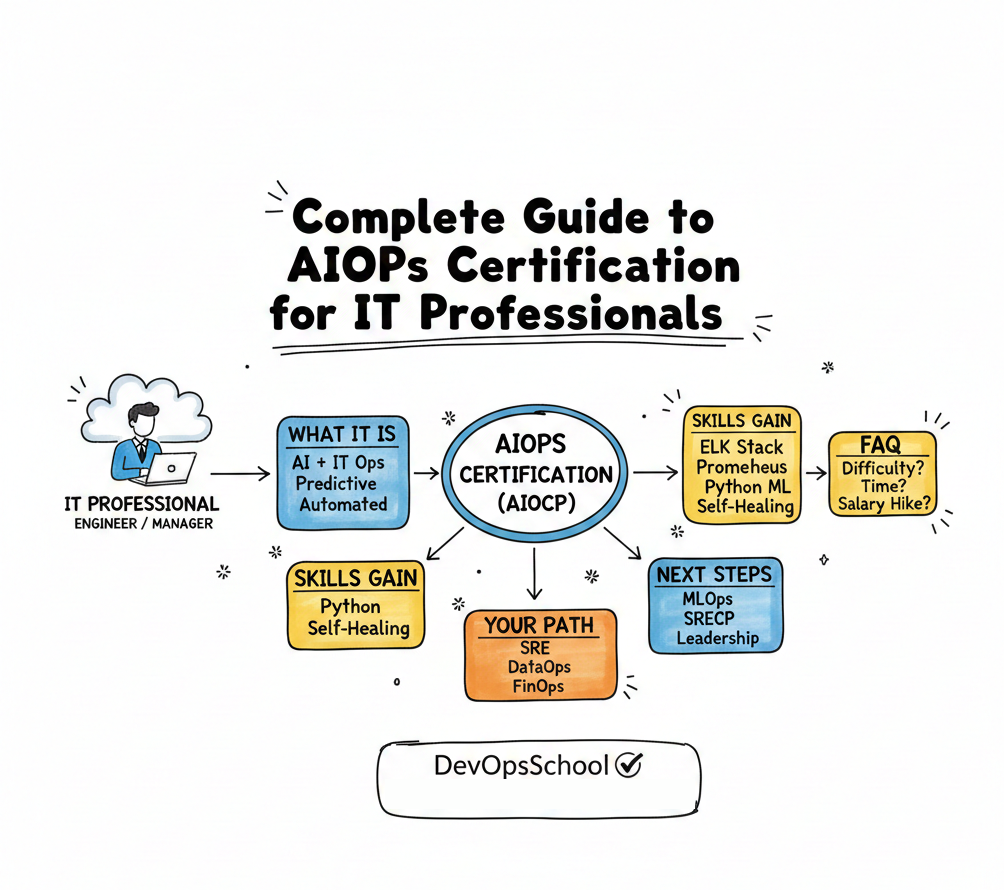
Introduction
Modern software systems have become incredibly complex. We no longer manage just one or two servers; we manage thousands of tiny services spread across different clouds. This produces a massive mountain of data every second. For an engineer, trying to read every log and fix every error manually is like trying to empty the ocean with a spoon. Having spent a long time in the industry, I have seen how we moved from simple hardware to virtualization, and now to automated clouds. The next big step is AIOps (Artificial Intelligence for IT Operations). It is the use of “intelligence” to help us manage these huge systems. If you want to stay ahead in the tech world, the AiOps Certified Professional (AIOCP) is the most important step you can take today.
Why Every Engineer Needs AIOps
The old way of working was “reactive.” Something would break, an alarm would ring, and we would rush to fix it. Today, that doesn’t work because there are too many alarms.
AIOps uses Machine Learning to solve this by:
- Grouping Events: It sees 100 different errors and realizes they all come from one single problem.
- Early Warning: It notices small changes in server behavior and warns you before the system actually crashes.
- Smart Automation: It doesn’t just run a script; it decides which script to run based on the data it sees.
Complete Certification Master Table
To help you plan your journey, here is a breakdown of the top professional certifications provided by DevOpsSchool.
| Track | Certification | Level | Who it’s for | Prerequisites | Skills Covered | Recommended Order |
| AIOps | AIOCP | Professional | SREs, Managers, Engineers | Basic IT knowledge | ML in Ops, ELK, Prometheus | 1st in AIOps |
| DevOps | CDP | Professional | Software Engineers | Basic Coding | Jenkins, Docker, CI/CD | 1st in DevOps |
| DevSecOps | DSOCP | Professional | Security Engineers | DevOps Basics | Pipeline Security, Vault | After DevOps |
| SRE | SRECP | Professional | Platform Engineers | Admin & Coding | SLOs, Error Budgets | After AIOCP |
| MLOps | MLOCP | Professional | Data Scientists | Python Basics | ML Pipelines, Kubeflow | After AIOCP |
| DataOps | DOCP | Professional | Data Engineers | SQL Basics | Data Quality, Governance | 1st in Data |
| FinOps | FOCP | Professional | Managers | Cloud Basics | Cloud Cost, Savings | After Cloud |
Deep Dive: AiOps Certified Professional (AIOCP)
The AiOps Certified Professional (AIOCP) is a special program that turns you into an expert who can combine data science with IT operations.
What it is
The AiOps Certified Professional (AIOCP) is a professional-level certification program designed to validate your expertise in using Artificial Intelligence and Machine Learning to automate and enhance IT operations. It is not just a tool-based course; it is a comprehensive framework for modernizing how we monitor, manage, and fix complex software systems. At its core, the AIOCP teaches you how to move from Reactive Operations (fixing things after they break) to Proactive Operations (using data to prevent breaks before they happen). It bridges the gap between traditional system administration and modern data science.
Who should take it
1. Software Engineers & Developers
If you build applications, you need to know how they behave in the “wild” (production).
- The Goal: Move from just writing code to understanding Intelligent Observability.
- Why take it: It helps you write “AI-ready” code that is easier to monitor and troubleshoot, making you a much more valuable “Full-Stack” engineer.
2. SREs (Site Reliability Engineers)
SREs are already focused on stability, but as systems scale, humans can’t keep up.
- The Goal: Master Predictive Maintenance.
- Why take it: AIOps is the “brain” for SRE. Instead of manually setting alert thresholds, you will learn to build systems that learn those thresholds automatically, protecting your SLOs (Service Level Objectives) without the stress.
3. DevOps & Platform Engineers
You are the ones building the pipelines. AIOps is the next level of the DevOps evolution.
- The Goal: Implement Closed-Loop Automation.
- Why take it: It allows you to move beyond simple CI/CD into “Smart Delivery,” where the system can automatically roll back a bad release based on AI-detected anomalies.
4. IT & Engineering Managers
As a leader, you need to know which technologies will actually save your company money and which are just “hype.”
- The Goal: Understand Strategy & ROI of AI in Operations.
- Why take it: It gives you the technical depth to lead your team through a “Digital Transformation” and helps you make better decisions about hiring and tool budgets.
5. Data Engineers & MLOps Aspiring Pros
Since AIOps is built on data, those who already understand data pipelines have a massive head start.
- The Goal: Apply Data Science to Infrastructure.
- Why take it: It provides a perfect bridge to move into the high-paying world of MLOps and AI Infrastructure management.
Skills you’ll gain
1. Intelligent Observability & Monitoring
Traditional monitoring tells you when a “heartbeat” stops. Intelligent observability tells you why the “heart” is failing.
- High-Cardinality Analysis: You will learn to handle millions of unique data points using tools like Prometheus.
- Visualization: Mastering Grafana to create dashboards that don’t just show lines, but show meaningful business health.
- Tracing: Learning to follow a single user request through 50 different microservices to find where the lag is happening.
2. Big Data & Log Analytics
In the modern world, logs are like a system’s diary. You will learn how to read thousands of diaries at once.
- The ELK Stack: Mastering Elasticsearch, Logstash, and Kibana to ingest, search, and visualize massive log volumes.
- Pattern Discovery: Learning how to use AI to find “hidden” error patterns in logs that a human would never notice.
- Data Normalization: Skills to clean and structure “messy” data so it can be used by machine learning models.
3. Machine Learning for Operations (ML for Ops)
You don’t need to be a PhD in Mathematics, but you will learn how to apply ML to solve real-world uptime problems.
- Anomaly Detection: Building models that learn what “normal” looks like, so they can alert you the moment something looks “strange.”
- Time-Series Forecasting: Learning how to predict future resource needs (like CPU or RAM) based on historical traffic patterns.
- Event Correlation: Mastering algorithms that group hundreds of related alerts into one single incident to stop “alert fatigue.”
4. Advanced Automation & Self-Healing
If a problem can be fixed by a human, it can be fixed by a script. You will learn to build systems that fix themselves.
- Infrastructure as Code (IaC): Using Terraform and Ansible to build and repair servers automatically.
- Closed-Loop Automation: Creating systems where the AI detects a problem and automatically triggers a script to fix it without human help.
- Kubernetes Management: Learning how to manage and monitor containerized apps at scale.
5. Strategy & Incident Management
Tech is only half the battle. The other half is how you handle the “heat” when things break.
- Root Cause Analysis (RCA): Using AI to instantly find the “patient zero” in a massive system failure.
- Predictive Maintenance: Learning how to fix things before they break, moving from reactive to proactive work.
- FinOps Basics: Understanding how to use AI to keep cloud costs low while keeping performance high.
Real-world projects you should be able to do
- Noise Reduction System: A tool that stops “useless” alarms from bothering engineers.
- Automatic Root Cause Finder: A system that tells you exactly why a website is slow.
- Self-Healing App: An application that restarts itself if the AI detects a memory leak.
- Traffic Predictor: An AI model that scales your servers up before a big sale starts.
Preparation Plan
1. The “Fast Track” (7–14 Days)
Best for those who are already working with DevOps tools.
- Week 1: Learn the core AIOps logic and set up your lab environment.
- Week 2: Practice building ML models for log data and take the final exam.
2. The “Steady Learner” (30 Days)
The most popular choice for working professionals.
- Week 1: Master Monitoring and Linux foundations.
- Week 2: Learn how to move and store data with Kafka and ELK.
- Week 3: Deep dive into Python for AI and Machine Learning.
- Week 4: Build your final project and review practice questions.
3. The “Foundation Path” (60 Days)
For those who are new to the field or moving from a different domain.
- Month 1: Learn the basics of Cloud (AWS/Azure) and simple automation.
- Month 2: Follow the 30-day plan above to learn advanced AIOps.
Common Mistakes to Avoid
1. The “Garbage In, Garbage Out” Trap
This is the most frequent mistake. Engineers often feed raw, messy data into an AI model and expect it to work perfectly.
- The Reality: AI is only as smart as the data you give it. If your logs are missing fields or your metrics are inconsistent, the AI will give you “hallucinated” or incorrect alerts.
- How to fix it: Spend time on Data Hygiene. Clean your data, standardize your log formats, and ensure your time-series metrics are synchronized before you even turn on the AI features.
2. Trying to “Boil the Ocean” (Starting Too Big)
Many teams try to automate their entire infrastructure on day one. They want the AI to handle everything from security to database scaling.
- The Reality: AIOps is a journey, not a single jump. Starting too big leads to complexity that no one can manage, causing the project to fail.
- How to fix it: Start with a Single Use Case. Pick one painful problem—like “Alert Noise”—and solve it first. Once you prove the AI works there, move to the next area.
3. Tool Obsession vs. Strategy
It is easy to get excited about a shiny new dashboard or a fancy AI platform.
- The Reality: A tool is just a tool. If you don’t have a clear strategy for why you are using it, it will just become another “shelf-ware” product that no one uses.
- How to fix it: Always start with the Business Outcome. Ask yourself: “How will this reduce our downtime?” or “How will this save us money?” If you can’t answer that, the tool doesn’t matter.
4. Ignoring the “Human in the Loop”
There is a fear that AI will replace engineers, leading some teams to push for “Full Autonomy” too quickly.
- The Reality: AI is great at spotting patterns, but it lacks the creative “gut feeling” of an experienced engineer. Total automation without human oversight can lead to “cascading failures” where the AI makes a mistake that makes a problem worse.
- How to fix it: Use Human-in-the-Loop automation. Let the AI provide the recommendation, but let a human hit the “Apply” button until you are 100% sure the model is accurate.
5. The “Silo” Mentality
Some teams implement AIOps only for the “Ops” team, ignoring the “Dev” and “Security” teams.
- The Reality: Modern systems are interconnected. If the DevOps team doesn’t know what the AIOps model is doing, they might release code that breaks the AI’s learning logic.
- How to fix it: Make AIOps a Cross-Functional Goal. Share the insights, dashboards, and models with everyone involved in the software lifecycle.
Best next certification
1. Same Track: MLOps Certified Professional (MLOCP)
If you loved the Machine Learning side of AIOps, this is your natural next step. While AIOps focuses on using AI to run systems, MLOps focuses on the lifecycle of the AI models themselves.
- What it is: A deep dive into how to build, deploy, and monitor machine learning models at scale. It covers how to move a model from a data scientist’s laptop to a real production environment.
- Who should take it: Engineers who want to become specialists in “AI Infrastructure” and help data science teams work faster.
- Skills you’ll gain: Model versioning, automated retraining, and managing “Data Drift” (when AI starts giving wrong answers because the world changed).
- Real-world projects: Building a fully automated pipeline that retrains an AI model every time new data arrives.
- Preparation plan: 30–45 days if you already know the AIOps basics.
- Common mistakes: Thinking MLOps is just “DevOps with a different name.” It requires much more focus on data quality.
- Next step: Master in MLOps Engineering.
2. Cross-Track: Site Reliability Engineering Certified Professional (SRECP)
AIOps and SRE go hand-in-hand. While AIOCP gives you the “brain,” SRE gives you the “body” or the framework to keep systems stable.
- What it is: A program focused on the engineering side of operations. It teaches you how to use code to replace manual work and how to measure exactly how “reliable” a system is.
- Who should take it: Professionals who want to work for high-scale companies (like Google or Amazon) where system uptime is the number one priority.
- Skills you’ll gain: SLIs/SLOs (Service Level Objectives), Error Budgets, and Chaos Engineering (breaking things on purpose to see if they stay up).
- Real-world projects: Designing a “Self-Healing” system that uses your AIOps knowledge to fix errors before the Error Budget is spent.
- Preparation plan: 30 days of focused study.
- Common mistakes: Focusing only on tools and forgetting the SRE “culture” of shared responsibility.
- Next step: Site Reliability Architect.
3. Leadership: Certified DevOps Manager (CDM)
If you find that you enjoy planning, strategy, and helping teams work better together, the leadership track is for you. Having technical knowledge from AIOCP makes you a much better manager.
- What it is: A management-level certification that focuses on the strategy behind DevOps and AIOps. It teaches you how to hire the right people and choose the right tools for a big company.
- Who should take it: Senior engineers or team leads who want to move into Director or VP of Engineering roles.
- Skills you’ll gain: Team building, budget management (FinOps basics), and leading a “Digital Transformation” in a large organization.
- Real-world projects: Creating a 12-month roadmap for a company to move from old-fashioned manual operations to a fully automated AIOps model.
- Preparation plan: 14–30 days focusing on business outcomes and case studies.
- Common mistakes: Trying to do all the technical work yourself instead of empowering your team to use the tools.
- Next step: CTO or VP of Infrastructure.
Choose Your Path: 6 Learning Roads
Every engineer is different. Pick the path that fits your goals:
1. The DevOps Path (Focus: Velocity & Delivery)
This road is for those who love the “Fast and Furious” side of software. Your goal is to make sure code moves from a developer’s laptop to the live website as quickly and safely as possible.
- What you do: Build CI/CD pipelines, manage containers (Docker), and orchestrate environments (Kubernetes).
- AIOps Integration: Use AI to predict if a new code deployment will cause a system crash before it actually happens.
- Key Certifications: Certified DevOps Professional (CDP).
2. The DevSecOps Path (Focus: Security & Trust)
If you enjoy playing “defense” and protecting systems from hackers, this is your path. In the modern world, security cannot be an afterthought; it must be part of the code from day one.
- What you do: Automate security scans, manage digital keys (Vault), and ensure compliance across the cloud.
- AIOps Integration: Use AI to detect “strange” user behavior that might indicate a cyber-attack or a data breach in real-time.
- Key Certifications: DevSecOps Certified Professional (DSOCP).
3. The SRE Path (Focus: Stability & Uptime)
Site Reliability Engineering (SRE) is for those who treat operations like a software problem. Your primary mission is to ensure that the website is always “up” and performing perfectly for the user.
- What you do: Set up SLOs (Service Level Objectives), manage “Error Budgets,” and reduce manual toil through coding.
- AIOps Integration: Implement self-healing scripts that automatically fix common server errors without a human being paged at 2 AM.
- Key Certifications: Site Reliability Engineering Certified Professional (SRECP).
4. The AIOps & MLOps Path (Focus: Intelligence & Scale)
This is the “Brain” path. You are responsible for building the intelligent layer that watches over all other systems. You bridge the gap between Data Science and System Operations.
- What you do: Deploy Machine Learning models, manage data lakes, and build event correlation engines.
- AIOps Integration: This is the core of AIOps. You create the models that help the rest of the organization stay stable and efficient.
- Key Certifications: AiOps Certified Professional (AIOCP) and MLOps Certified Professional (MLOCP).
5. The DataOps Path (Focus: Quality & Flow)
In the age of AI, data is the new oil. But raw data is messy. DataOps experts ensure that the data flowing through the company is clean, accurate, and arrives on time.
- What you do: Build data pipelines (Airflow), manage databases, and ensure data privacy and governance.
- AIOps Integration: Use AI to automatically find and fix “bad data” or “missing values” in your pipelines before they reach the business reports.
- Key Certifications: DataOps Certified Professional (DOCP).
6. The FinOps Path (Focus: Value & Optimization)
Cloud costs can spiral out of control very quickly. FinOps is for those who want to bridge the gap between the Engineering team and the Finance office.
- What you do: Monitor cloud spending, optimize resource usage, and ensure every dollar spent on AWS/Azure drives profit.
- AIOps Integration: Use AI to forecast monthly bills and automatically turn off “zombie” servers that are costing money but doing no work.
- Key Certifications: FinOps Certified Professional (FOCP).
Role → Recommended Certifications
| If you are a… | You should take… |
| DevOps Engineer | CDP → AIOCP → DSOCP |
| SRE | SRECP → AIOCP → FinOps |
| Cloud Engineer | CDE → AIOCP |
| Data Engineer | DOCP → AIOCP |
| Security Engineer | DSOCP → AIOCP |
| Engineering Manager | CDM → AIOCP → FinOps |
Top Training Institutions for AIOCP
Choosing the right place to learn is very important. These institutions are the best for AIOps:
Primary Training Providers
- DevOpsSchool As a primary leader in the industry, DevOpsSchool provides a deep-dive curriculum for AIOCP that balances theory with intensive lab work. They offer lifetime access to their Learning Management System (LMS), 24/7 technical support, and projects based on real-world production environments. Their trainers are veterans who focus on practical implementation, ensuring you can “do” the work, not just pass the exam.
- Cotocus Cotocus is highly regarded for its “learning by doing” philosophy, focusing heavily on lab-intensive modules for AIOps. They provide specialized environments where students can practice setting up ELK stacks and training ML models on live data. Their sessions are designed for working professionals who need to solve specific architectural challenges in their current jobs.
- Scmgalaxy More than just a training site, Scmgalaxy is a massive community hub that offers thousands of free tutorials, videos, and documentation. It serves as an excellent resource for AIOCP candidates to troubleshoot common errors and learn about the latest updates in SCM and AIOps tools. Their forums connect you with thousands of other engineers globally for peer-to-peer learning.
- BestDevOps BestDevOps specializes in career-focused coaching, helping engineers move from mid-level roles to senior leadership in AIOps. They provide tailored interview preparation, resume-building kits, and one-on-one mentorship to ensure you can translate your AIOCP certification into a high-paying job. Their curriculum is frequently updated to include the latest cloud-native technologies.
Domain-Specific Schools
These institutions offer specialized tracks that complement the AIOCP certification, allowing you to build a multi-dimensional career:
- AiOpsSchool This is a dedicated platform focusing exclusively on the intersection of Machine Learning and IT operations. They provide the most granular training on building anomaly detection models and event correlation engines, making it the perfect home for those who want to specialize purely in the “intelligence” layer of operations.
- DevSecOpsSchool Since security is critical in automated systems, DevSecOpsSchool teaches you how to keep your AI models and data pipelines safe. They focus on integrating security checks into the AIOps lifecycle, ensuring that your self-healing scripts don’t accidentally create security vulnerabilities.
- SRESchool SRESchool focuses on the “Reliability” aspect of the AIOCP certification. They teach you how to use AI to meet strict Service Level Objectives (SLOs) and manage error budgets. This is the best place to learn how AIOps acts as the intelligent foundation for a modern Site Reliability Engineering team.
- DataOpsSchool AIOps is nothing without high-quality data. DataOpsSchool provides training on building the robust data pipelines required to feed AIOps models. They teach you how to ensure data quality, governance, and speed, which are the prerequisites for any successful AI implementation.
- FinOpsSchool This institution focuses on the financial side of operations. They teach you how to use AI to predict cloud spending and automatically optimize resources to save money. For managers, this is a vital skill to combine with AIOCP to show the business value of your technical work.
Frequently Asked Questions (FAQs)
1. How difficult is the AIOCP certification for a beginner?
The AIOCP is a professional-level certification, so it is designed to be challenging. However, it is built logically. If you have a basic understanding of IT operations, you will find the step-by-step approach—from data collection to AI modeling—very manageable. It is more about “logic” than “complex math.”
2. How much time should I set aside for preparation?
For a working professional, the “Steady Learner” path of 30 days is ideal. This usually requires about 10–12 hours of study per week. If you are already working in a DevOps or SRE role, you could potentially complete the curriculum in 14 days by focusing on the AI-specific modules.
3. Are there any strict prerequisites to enroll?
There are no formal degree requirements. However, you will get the most out of the course if you are familiar with the Linux command line and have a basic understanding of how servers communicate. Knowing a bit of Python is a “superpower” here, but the course often covers the basics you need.
4. In what sequence should I take these certifications?
The best path is to start with a foundation in DevOps (CDP), move to AIOps (AIOCP) to learn intelligent management, and then specialize in SRE (SRECP) for stability or MLOps (MLOCP) for model deployment.
5. What is the real-world value of being “AIOps Certified”?
In an era of massive data, companies are desperate for people who can “tame the noise.” Being certified proves you can reduce operational costs and system downtime using modern tools. It moves you from being a “technician” to a “strategic asset.”
6. What are the typical career outcomes after AIOCP?
Graduates often move into high-impact roles such as AIOps Engineer, Site Reliability Engineer, or Cloud Architect. It also prepares senior engineers for leadership roles like DevOps Manager or Platform Lead.
7. Does this certification help with salary growth in India and globally?
Absolutely. AIOps is one of the highest-paying niches in the tech market. In India, professionals with these skills often see significant jumps in compensation, frequently commanding a premium of 30% or more over traditional operations roles due to the specialized nature of the work.
8. Is the exam practical or theory-based?
It is a mix. While the exam has multiple-choice questions to test your knowledge, the training itself is heavily focused on projects. You are expected to demonstrate that you can actually build anomaly detection models and configure monitoring stacks.
9. Why is Python recommended for this course?
Python is the “language of AI.” Most AIOps tools and machine learning libraries (like TensorFlow or Scikit-learn) are built for Python. It is also the best language for writing the automation scripts that allow your infrastructure to “heal itself.”
10. How does AIOCP differ from MLOps?
AIOps is about using AI to manage IT systems (fixing servers, reading logs). MLOps is about the process of deploying and managing the AI models themselves. They are cousins, but AIOps is more focused on infrastructure health.
11. Is Generative AI included in the curriculum?
Yes, modern programs now include how LLMs (Large Language Models) can be used to summarize thousands of error logs into a single paragraph or help engineers write automation code faster.
12. Why choose DevOpsSchool for this certification?
DevOpsSchool is a leader because they provide lifetime access to their learning materials and offer 24/7 technical support. Their focus on real-world projects means you graduate with a portfolio, not just a certificate.
Frequently Asked Questions: AiOps Certified Professional (AIOCP)
1. What is the core objective of the AIOCP certification?
The primary goal is to move beyond traditional monitoring and learn how to implement “Intelligent Operations.” The certification validates your ability to use AI and Machine Learning to automate noise reduction, perform automated root cause analysis, and build self-healing infrastructure.
2. Do I need a background in Data Science to pass the AIOCP?
No. While you will work with Machine Learning, the AIOCP is designed for IT professionals. It focuses on the application of ML tools (like anomaly detection and forecasting) to IT data, rather than the deep mathematical theory of AI.
3. Which tools are covered in the AIOCP training?
The curriculum is hands-on and covers the industry’s most popular open-source and enterprise tools. You will gain experience with the ELK Stack (Elasticsearch, Logstash, Kibana) for log analytics, Prometheus and Grafana for observability, and Python for building automation scripts and ML models.
4. How does AIOCP differ from a standard DevOps certification?
Standard DevOps focuses on the “plumbing”—CI/CD pipelines and infrastructure automation. AIOCP focuses on the “brain”—using data to make those pipelines and infrastructures smarter, more stable, and capable of fixing themselves when things go wrong.
5. Is there a practical project required for certification?
Yes. To earn the professional-level certificate from DevOpsSchool, you must complete real-world projects. These typically include building an anomaly detection engine and setting up an automated incident response system that triggers based on AI alerts.
6. What are the prerequisites for joining the AIOCP program?
There are no strict barriers, but you will find the course much easier if you have a basic understanding of Linux, some familiarity with Cloud platforms (AWS/Azure), and a basic grasp of Python or a similar scripting language.
7. How long does it take to get certified?
For a working professional spending 1–2 hours a day, the journey typically takes 30 to 45 days. If you choose the “Fast Track” and already have strong DevOps experience, you can complete the requirements in about two weeks.
8. Will this certification help me get a higher salary?
Yes. AIOps is a specialized niche. Companies are currently struggling to find engineers who understand both operations and AI. Certified AIOCP professionals often see a significant increase in their market value, often commanding a 20-30% higher salary than traditional sysadmins.
Testimonials
“Before I started the AIOCP program at DevOpsSchool, our NOC (Network Operations Center) was drowning in over 1,000 alerts every single day. Most were ‘noise’—small issues that didn’t need a human. After applying the event correlation and noise reduction techniques I learned, we cut our active incident list by 85%. I finally have my weekends back, and our system uptime has never been better.”
— Rahul Sharma, Senior Site Reliability Engineer (Bangalore, India)
“As an Engineering Manager, I was skeptical about how AI could actually help our existing DevOps pipeline. This certification changed my perspective entirely. It didn’t just teach me about tools; it taught me how to restructure our team’s workflow to be proactive rather than reactive. We saved nearly 20% on our cloud costs in the first quarter by using the predictive scaling models I developed during my training.”
— Sarah Jenkins, Engineering Manager (London, UK)
“I came from a traditional System Admin background and was worried that the industry was leaving me behind. The AIOCP preparation plan was easy to follow, and the hands-on labs with the ELK Stack and Prometheus were game-changers. I moved from a basic admin role to an AIOps Specialist within six months of getting certified. It was the best career investment I’ve made.”
— Arjun V., AIOps Specialist (Hyderabad, India)
“The most valuable part of the AIOCP was the focus on ‘Self-Healing Infrastructure.’ I implemented an automated root cause analysis system based on the projects in this course. Now, when a service fails, our AI identifies the source and restarts the specific microservice before our customers even notice a lag. The ROI on this training was immediate.”
— Michael Chen, Cloud Architect (San Francisco, USA)
“Working with DevOpsSchool and their community through Scmgalaxy made a huge difference. The trainers have real experience and don’t just teach theory. They helped me understand the ‘why’ behind Machine Learning in operations, which helped me pass the exam and lead our company’s digital transformation project.”
— Priya Nair, DevOps Lead (Pune, India)
Conclusion
The future of IT operations is not found in a larger team, but in a smarter one. As systems continue to scale and become more complex, our old ways of working—staring at dashboards and waiting for things to break—will no longer suffice. The gap between those who use AI and those who don’t will only widen. The AiOps Certified Professional (AIOCP) is more than just a certificate on your LinkedIn profile; it is your ticket to a better job and a more exciting career. It is a commitment to mastering the most advanced tools available to our industry today. Whether you are an engineer looking to level up or a manager aiming to modernize your department, the path is clear.
The breakdown of the certification paths by role is incredibly helpful here. Often, engineers get confused between sticking to a pure DevOps track versus branching into AIOps or MLOps, so seeing the specific progression from SRECP to AIOCP makes the career trajectory much clearer. The emphasis on ‘Data Hygiene’ as a prerequisite before even attempting AI implementations is also spot on—garbage in, garbage out is still the biggest hurdle in these projects.
This guide does a great job of showing that AIOps certification is about much more than earning another credential. I liked that it connects the learning path with real industry challenges like incident management, observability, automation, and predictive operations. As IT environments become more complex, gaining practical AIOps skills can help professionals move from reactive troubleshooting to building smarter, more resilient systems, making this a valuable roadmap for anyone planning a career in modern IT operations.