Introduction
Multimodal Model Platforms are advanced AI systems capable of processing and generating multiple types of data such as text, images, audio, video, and structured inputs within a unified framework. Unlike traditional AI systems that focus on a single modality like text or vision, multimodal platforms combine perception and reasoning across formats.
This shift is critical because modern applications are no longer single-input systems. Businesses now expect AI to read documents, interpret charts, analyze images, respond to voice, and generate multimedia outputs in a single workflow. Multimodal platforms enable this convergence.
They are becoming foundational for building AI copilots, intelligent automation systems, creative tools, and enterprise-grade decision support systems.
Common real-world use cases
- AI assistants that understand voice, text, and screen content together
- Automated document + image + PDF analysis systems
- Video summarization and content generation tools
- Healthcare systems combining medical imaging and reports
- Customer support with screenshots, chat, and voice input
- Enterprise analytics copilots
- Robotics perception and control systems
What to evaluate when choosing a platform
- Supported modalities (text, image, audio, video)
- Real-time responsiveness
- Model flexibility (single vs multi-model systems)
- Context handling capability
- Integration with external knowledge (RAG support)
- Evaluation and testing tools
- Safety guardrails and filtering systems
- Cost efficiency at scale
- Deployment options (cloud, hybrid, self-hosted)
- Governance and audit capabilities
Best for: AI engineers, product teams, enterprise architects, and organizations building intelligent multi-input systems.
Not ideal for: Simple chatbots, single-purpose automation, or lightweight text-only use cases.
What’s Changed in Multimodal Model Platforms
- Shift toward agent-based systems that combine perception, reasoning, and action
- Integration of real-time voice and vision interfaces
- Expansion of long-context processing capabilities
- Emergence of model routing (choosing best model per task dynamically)
- Increased use of retrieval-augmented generation pipelines
- Strong focus on safety against prompt injection across modalities
- Better observability with tracing and cost analytics
- Growth of open-source multimodal ecosystems
- Enterprise demand for privacy-first and on-prem deployments
- Improved multimodal evaluation benchmarks
- Cost optimization using hybrid model strategies
- Stronger governance and compliance requirements
Quick Buyer Checklist
- Does it support all required data types (text, image, audio, video)?
- Can it integrate with your internal systems and databases?
- Is it locked to one model or flexible across multiple models?
- Are evaluation tools built-in or external?
- Does it include safety and content moderation systems?
- Can it handle real-time workloads?
- What deployment options are available?
- Are costs predictable and controllable?
- How strong is logging and observability?
- Does it support retrieval-augmented workflows?
- What is the risk of vendor lock-in?
- How mature is its ecosystem?
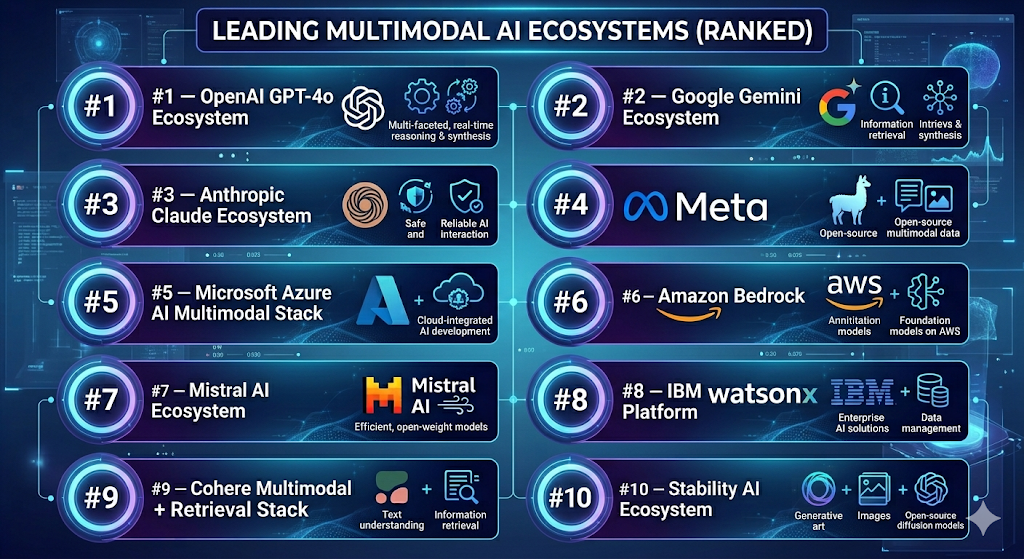
Top 10 Multimodal Model Platforms
#1 — OpenAI GPT-4o Ecosystem
One-line verdict: Best general-purpose multimodal platform for real-time intelligent applications.
Short description:
A powerful multimodal system that handles text, images, and audio in a unified interface, widely used for assistants, copilots, and automation systems.
Standout Capabilities
- Real-time voice and vision interaction
- Strong cross-modal reasoning
- Unified multimodal architecture
- High-quality image understanding
- Fast conversational performance
- Tool/function calling support
- Wide ecosystem adoption
AI-Specific Depth
- Model support: Proprietary
- RAG integration: Supported via APIs
- Evaluation: External tooling required
- Guardrails: Built-in moderation systems
- Observability: Basic usage tracking
Pros
- Extremely versatile
- Strong real-time performance
- Mature ecosystem
Cons
- Closed system
- Limited customization
- Vendor dependency risk
Security & Compliance
- Enterprise controls available depending on plan
- Data handling features vary by tier
Deployment & Platforms
- Cloud-only API access
Integrations & Ecosystem
- APIs and SDKs
- Strong third-party integrations
- Compatible with agent frameworks
Pricing Model
Usage-based with enterprise agreements available
Best-Fit Scenarios
- AI copilots
- Real-time assistants
- Multimodal automation systems
#2 — Google Gemini Ecosystem
One-line verdict: Best for long-context multimodal reasoning and enterprise cloud integration.
Standout Capabilities
- Extremely large context handling
- Strong document and video understanding
- Deep cloud integration
- Multimodal reasoning workflows
- Enterprise-scale infrastructure
AI-Specific Depth
- Model support: Proprietary
- RAG integration: Native cloud support
- Evaluation: Partial tooling
- Guardrails: Cloud safety systems
- Observability: Cloud monitoring tools
Pros
- Excellent long-context ability
- Strong enterprise integration
- Scalable infrastructure
Cons
- Complex setup
- Feature variation across environments
Security & Compliance
- Enterprise-grade controls available
Deployment & Platforms
- Cloud-based
Integrations & Ecosystem
- Cloud data services
- Enterprise tools ecosystem
Pricing Model
Usage-based cloud pricing
Best-Fit Scenarios
- Document-heavy workflows
- Enterprise analytics
- Video + data processing systems
#3 — Anthropic Claude Ecosystem
One-line verdict: Best for safe reasoning and structured enterprise document intelligence.
Standout Capabilities
- Strong structured reasoning
- High-quality document analysis
- Safety-first design
- Large context handling
- API-first architecture
AI-Specific Depth
- Model support: Proprietary
- RAG integration: API-based
- Evaluation: External tools required
- Guardrails: Strong alignment systems
- Observability: Basic metrics
Pros
- Very reliable outputs
- Strong safety focus
- Ideal for enterprise documentation
Cons
- Limited real-time multimodal features
- Less creative flexibility
Security & Compliance
- Enterprise controls available
Deployment & Platforms
- Cloud API
Integrations & Ecosystem
- Workflow and API integrations
Pricing Model
Usage-based
Best-Fit Scenarios
- Legal workflows
- Compliance systems
- Knowledge-heavy applications
#4 — Meta Llama Multimodal Ecosystem
One-line verdict: Best open-source foundation for fully customizable multimodal systems.
Standout Capabilities
- Open-source flexibility
- Custom fine-tuning
- Self-hosting support
- Strong research ecosystem
- Modular architecture
AI-Specific Depth
- Model support: Open-source
- RAG integration: Fully customizable
- Evaluation: User-defined
- Guardrails: Implementation-based
- Observability: External tooling
Pros
- Full control
- No vendor lock-in
- Highly flexible
Cons
- Requires engineering effort
- No native enterprise features
Security & Compliance
- Depends on deployment
Deployment & Platforms
- Cloud, hybrid, or self-hosted
Integrations & Ecosystem
- Open-source AI tools
- Custom pipelines
Pricing Model
Free; infrastructure costs apply
Best-Fit Scenarios
- Custom AI systems
- Research environments
- Privacy-sensitive deployments
#5 — Microsoft Azure AI Multimodal Stack
One-line verdict: Best for enterprise-grade hybrid AI deployments and integrations.
Standout Capabilities
- Enterprise cloud integration
- Multimodal orchestration
- Strong security features
- Hybrid deployment support
- Model flexibility
AI-Specific Depth
- Model support: Multi-model ecosystem
- RAG integration: Strong native support
- Evaluation: Partial tools
- Guardrails: Enterprise safety layers
- Observability: Advanced monitoring
Pros
- Strong enterprise adoption
- Flexible architecture
- Deep system integration
Cons
- Complex pricing
- Setup overhead
Security & Compliance
- Enterprise-grade security
Deployment & Platforms
- Cloud and hybrid
Integrations & Ecosystem
- Enterprise software ecosystem
Pricing Model
Tiered usage-based
Best-Fit Scenarios
- Enterprise AI transformation
- Hybrid infrastructure systems
#6 — Amazon Bedrock
One-line verdict: Best for multi-model orchestration and flexible AI stack building.
Standout Capabilities
- Access to multiple foundation models
- Strong orchestration layer
- Scalable cloud infrastructure
- Integration with AWS ecosystem
- Flexible model switching
AI-Specific Depth
- Model support: Multi-provider
- RAG integration: Strong support
- Evaluation: External tools
- Guardrails: AWS safety tools
- Observability: Cloud monitoring
Pros
- High flexibility
- Strong infrastructure
- Multi-model access
Cons
- Learning curve
- AWS dependency
Security & Compliance
- Enterprise-grade AWS controls
Deployment & Platforms
- Cloud-only
Integrations & Ecosystem
- AWS services ecosystem
Pricing Model
Usage-based
Best-Fit Scenarios
- Scalable AI systems
- Multi-model experimentation
#7 — Mistral AI Ecosystem
One-line verdict: Best lightweight, high-performance multimodal-adjacent models.
Standout Capabilities
- Efficient model design
- Open and hosted options
- Fast inference performance
- Developer-friendly APIs
AI-Specific Depth
- Model support: Open + hosted
- RAG integration: Supported
- Evaluation: External
- Guardrails: Basic
- Observability: Limited
Pros
- Fast and efficient
- Flexible deployment
- Cost-effective
Cons
- Smaller ecosystem
- Limited enterprise tooling
Security & Compliance
- Varies by deployment
Deployment & Platforms
- Cloud and self-hosted
Integrations & Ecosystem
- Developer APIs
Pricing Model
Usage-based or open-source
Best-Fit Scenarios
- Lightweight AI apps
- Cost-sensitive systems
#8 — IBM watsonx Platform
One-line verdict: Best for governance-heavy and regulated enterprise environments.
Standout Capabilities
- Strong governance tools
- Enterprise compliance focus
- Structured AI workflows
- Hybrid deployment support
AI-Specific Depth
- Model support: Mixed
- RAG integration: Supported
- Evaluation: Built-in tools
- Guardrails: Strong compliance layer
- Observability: Enterprise monitoring
Pros
- Strong governance
- Enterprise trust focus
- Compliance-friendly
Cons
- Slower innovation cycle
- Complex setup
Security & Compliance
- Strong enterprise compliance tools
Deployment & Platforms
- Cloud and hybrid
Integrations & Ecosystem
- Enterprise IT systems
Pricing Model
Enterprise contracts
Best-Fit Scenarios
- Regulated industries
- Government systems
#9 — Cohere Multimodal + Retrieval Stack
One-line verdict: Best for retrieval-heavy enterprise AI systems.
Standout Capabilities
- Strong RAG performance
- Enterprise NLP focus
- Scalable APIs
- Efficient embedding systems
AI-Specific Depth
- Model support: Hosted
- RAG integration: Strong
- Evaluation: External
- Guardrails: Basic
- Observability: API metrics
Pros
- Excellent retrieval systems
- Enterprise-ready APIs
- Strong performance in text-heavy tasks
Cons
- Limited vision capabilities
- Smaller ecosystem
Security & Compliance
- Enterprise options available
Deployment & Platforms
- Cloud API
Integrations & Ecosystem
- Knowledge systems and search stacks
Pricing Model
Usage-based
Best-Fit Scenarios
- Enterprise search
- Knowledge assistants
#10 — Stability AI Ecosystem
One-line verdict: Best for generative multimodal content creation.
Standout Capabilities
- Strong image generation
- Video generation capabilities
- Open ecosystem options
- Creative AI tools
AI-Specific Depth
- Model support: Open + hosted
- RAG integration: Limited
- Evaluation: External
- Guardrails: Basic
- Observability: Limited
Pros
- High creative output
- Open flexibility
- Strong generative media focus
Cons
- Inconsistent outputs
- Limited enterprise tooling
Security & Compliance
- Depends on deployment
Deployment & Platforms
- Cloud and self-hosted
Integrations & Ecosystem
- Creative tooling ecosystem
Pricing Model
Usage-based or open-source
Best-Fit Scenarios
- Media generation
- Creative workflows
Comparison Table
| Tool | Best For | Deployment | Model Flexibility | Strength | Watch-Out | Rating |
|---|---|---|---|---|---|---|
| GPT-4o | Real-time AI | Cloud | Hosted | Versatility | Lock-in | N/A |
| Gemini | Long context | Cloud | Hosted | Scale | Complexity | N/A |
| Claude | Safe reasoning | Cloud | Hosted | Reliability | Limited multimodal | N/A |
| Llama | Custom systems | Self/Cloud | Open | Control | Setup effort | N/A |
| Azure AI | Enterprise | Hybrid | Multi-model | Integration | Complexity | N/A |
| Bedrock | Orchestration | Cloud | Multi-model | Flexibility | Learning curve | N/A |
| Mistral | Efficiency | Self/Cloud | Open | Speed | Ecosystem size | N/A |
| watsonx | Governance | Hybrid | Mixed | Compliance | Slow updates | N/A |
| Cohere | Retrieval | Cloud | Hosted | RAG strength | Limited vision | N/A |
| Stability AI | Media gen | Self/Cloud | Open | Creativity | Consistency | N/A |
Conclusion
Multimodal Model Platforms are reshaping how AI systems interact with the world by combining text, vision, audio, and structured data into unified intelligent systems.
The best platform depends on your needs:
- Real-time assistants → GPT-style systems
- Enterprise-scale workflows → cloud enterprise stacks
- Safe structured reasoning → alignment-focused systems
- Custom AI systems → open-source ecosystems
- Creative generation → media-focused platforms
The right approach is not choosing one “best” tool, but selecting a combination that matches your