Introduction
AI Waste Sorting Computer Vision uses cameras, computer vision, machine learning, and automation to identify and classify waste materials as they move through recycling and sorting systems. AI models can analyze images or video to distinguish materials such as plastic, paper, cardboard, metal, glass, organic waste, and packaging components, helping sorting facilities improve recovery and reduce contamination.
Modern systems can combine cameras with robotic arms, conveyors, sensors, robotic vision, and analytics software. Typical applications include automated recycling facilities, material recovery facilities, construction-waste sorting, plastic classification, food-waste separation, e-waste processing, and quality Recycling companies, material recovery facilities, waste-management operators, municipalities, manufacturers, logistics organizations, and industrial facilities processing significant waste volu Small organizations producing limited waste volumes where manual sorting, conventional mechanical separation, or outsourced recycling is more economical.
What’s Changed in AI Waste Sorting Computer Vision
- AI vision models are becoming better at distinguishing visually similar waste materials.
- Edge AI enables image analysis closer to cameras and sorting equipment.
- Computer vision can increasingly operate continuously on high-speed conveyor systems.
- Multimodal sensing can combine RGB cameras with depth, hyperspectral, infrared, or other sensor data.
- Object detection can identify individual waste objects rather than simply classifying an entire image.
- AI can help identify contamination and misplaced materials.
- Robotic sorting systems can connect vision models directly to automated picking equipment.
- Machine-learning models can be retrained for facility-specific waste streams.
- Synthetic and augmented training data can help address rare waste categories.
- Model monitoring is becoming more important as packaging designs and waste composition change.
- Edge processing can reduce latency between object detection and robotic action.
- AI analytics can provide information about material composition and sorting performance.
- Facilities can use historical vision data to identify recurring contamination patterns.
- Human-in-the-loop workflows remain important for unusual or ambiguous objects.
- Privacy-aware processing can be valuable when cameras operate in public or employee-accessible areas.
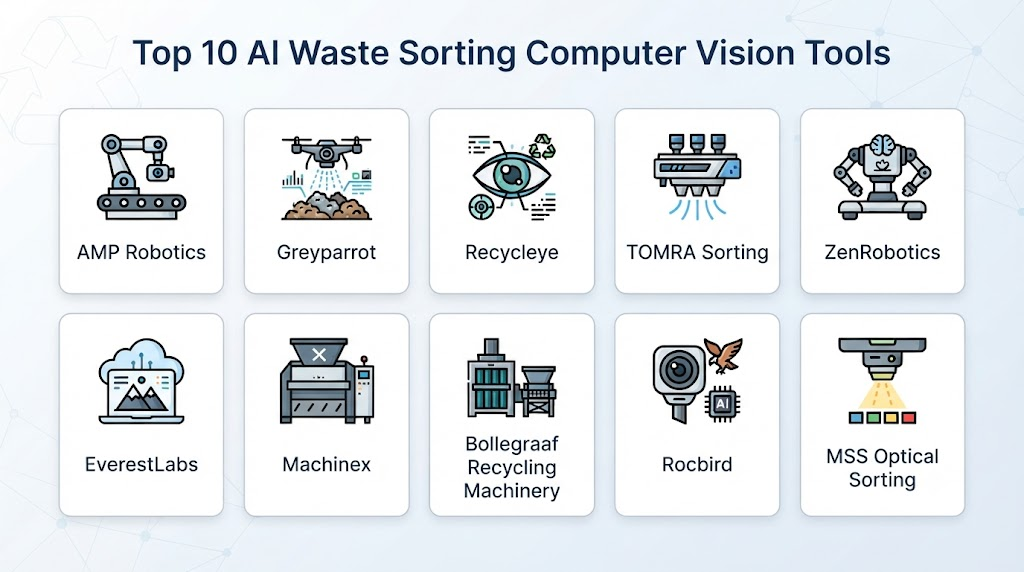
Top 10 AI Waste Sorting Computer Vision Tools
1 — AMP Robotics
One-line verdict: Best for large recycling operations seeking AI-powered robotic identification and sorting of diverse waste streams.
Short description:
AMP Robotics develops AI-powered systems designed to identify and sort recyclable materials. Its technology combines computer vision, robotics, and machine learning to automate material recovery processes.
Standout Capabilities
- AI-powered material recognition
- Robotic sorting
- Computer vision
- Conveyor-based sorting
- Material classification
- Recycling automation
- Facility analytics
- Sorting optimization
AI-Specific Depth
- Model support: Proprietary computer-vision and machine-learning technology.
- RAG / knowledge integration: N/A.
- Evaluation: Operational sorting performance and material-recognition evaluation.
- Guardrails: Industrial safety controls are separate from AI model functionality.
- Observability: Operational and sorting analytics vary by deployment.
Pros
- Strong specialization in recycling automation.
- Combines AI vision with physical sorting.
- Designed for industrial-scale waste streams.
Cons
- Primarily suited to commercial and industrial operations.
- Requires integration with physical sorting infrastructure.
- Deployment complexity can be significant.
Security & Compliance
Security and administrative capabilities vary by deployment. Specific certifications and data-retention controls should be verified for the proposed installation.
Deployment & Platforms
- Deployment: Industrial/on-site.
- Cloud: Supporting analytics may vary.
- Edge: Relevant to real-time sorting.
- Self-hosted: Industrial deployment.
- Mobile: N/A.
Integrations & Ecosystem
AMP’s ecosystem is centered around recycling and material-recovery operations.
- Robotic systems
- Conveyor systems
- Cameras
- Computer vision
- Sorting equipment
- Facility analytics
- Industrial controls
Pricing Model
Commercial/enterprise pricing; exact pricing is not publicly standardized.
Best-Fit Scenarios
- Material recovery facilities
- Large recycling operations
- Automated sorting lines
2 — EverestLabs
One-line verdict: Best for recycling facilities combining AI vision, robotics, and operational intelligence to improve material recovery.
Short description:
EverestLabs develops AI-enabled recycling solutions that use computer vision, robotics, and data analytics to identify recyclable materials and automate sorting processes.
Standout Capabilities
- Computer vision
- Robotic recycling
- AI material recognition
- Sorting automation
- Recycling analytics
- Quality monitoring
- Material identification
- Facility optimization
AI-Specific Depth
- Model support: Proprietary AI/computer vision.
- RAG / knowledge integration: N/A.
- Evaluation: Sorting and recognition performance.
- Guardrails: Industrial safety and operational controls vary.
- Observability: Facility and sorting analytics.
Pros
- Focused specifically on recycling.
- Combines software and robotics.
- Can provide operational intelligence alongside sorting.
Cons
- Best suited to organizations with substantial sorting operations.
- Physical installation is required for automated sorting.
- Commercial terms vary.
Security & Compliance
Specific enterprise controls and certifications should be verified for the selected deployment.
Deployment & Platforms
- Deployment: Industrial/on-site.
- Edge: Relevant for machine vision.
- Cloud: Analytics capabilities vary.
- Hybrid: Possible depending on architecture.
- Mobile: N/A.
Integrations & Ecosystem
- Cameras
- Robotics
- Conveyors
- Recycling equipment
- Computer vision
- Facility-management systems
- Analytics
Pricing Model
Commercial/enterprise; exact pricing is not publicly standardized.
Best-Fit Scenarios
- Automated recycling facilities
- Material recovery
- High-volume sorting
3 — Recycleye
One-line verdict: Best for recycling operators looking for AI vision integrated with robotic waste-picking systems.
Short description:
Recycleye develops AI and robotics technologies for waste sorting. Its systems use computer vision to recognize waste materials and support automated robotic picking.
Standout Capabilities
- AI waste recognition
- Robotic picking
- Computer vision
- Conveyor sorting
- Material classification
- Recycling automation
- Sorting analytics
- Industrial deployment
AI-Specific Depth
- Model support: Proprietary AI vision.
- RAG / knowledge integration: N/A.
- Evaluation: Waste-recognition and sorting performance.
- Guardrails: Operational and robotic safety controls vary.
- Observability: Sorting analytics vary by deployment.
Pros
- Specialized in waste-sorting robotics.
- Combines vision and robotic action.
- Designed around real-world recycling operations.
Cons
- Physical infrastructure is required.
- Deployment requires integration work.
- Not intended for simple image-classification projects.
Security & Compliance
Security controls vary by deployment. Specific certifications should be confirmed during procurement.
Deployment & Platforms
- Deployment: Industrial/on-site.
- Edge: Suitable for real-time machine vision.
- Cloud: Supporting systems vary.
- Hybrid: Varies.
- Mobile: N/A.
Integrations & Ecosystem
- Robotic arms
- Conveyor belts
- Cameras
- Sorting systems
- AI vision
- Industrial controls
- Recycling facilities
Pricing Model
Commercial enterprise model; exact pricing is not publicly standardized.
Best-Fit Scenarios
- Recycling plants
- Automated picking
- High-throughput waste sorting
4 — Glacier
One-line verdict: Best for recycling organizations seeking AI-powered waste intelligence and detailed material identification.
Short description:
Glacier develops AI-powered recycling technology focused on identifying materials and improving recycling operations. Its computer-vision systems can provide information about waste composition and sorting performance.
Standout Capabilities
- AI computer vision
- Waste identification
- Material classification
- Recycling analytics
- Contamination detection
- Waste-stream analysis
- Facility intelligence
- Data-driven optimization
AI-Specific Depth
- Model support: Proprietary computer vision.
- RAG / knowledge integration: N/A.
- Evaluation: Model and operational performance evaluation.
- Guardrails: N/A for conventional AI safety controls.
- Observability: Analytics and monitoring capabilities vary.
Pros
- Strong recycling focus.
- Useful for understanding waste composition.
- Can support data-driven facility improvements.
Cons
- Exact functionality varies by deployment.
- Physical and operational integration may be required.
- Enterprise pricing is not publicly standardized.
Security & Compliance
Specific security and compliance capabilities should be verified for each deployment.
Deployment & Platforms
- Deployment: Industrial.
- Edge: Relevant to camera-based detection.
- Cloud: Analytics capabilities vary.
- Hybrid: Varies.
- Mobile: N/A.
Integrations & Ecosystem
- Cameras
- Recycling equipment
- Waste-management systems
- Analytics
- Computer vision
- Facility operations
Pricing Model
Commercial pricing; exact pricing is not publicly standardized.
Best-Fit Scenarios
- Waste characterization
- Recycling analytics
- Sorting optimization
5 — Greyparrot
One-line verdict: Best for waste facilities wanting AI-powered waste analytics, material tracking, and operational visibility.
Short description:
Greyparrot develops AI-based waste analytics systems designed to analyze material flows in waste and recycling facilities. Its technology uses computer vision to identify and quantify materials moving through facilities.
Standout Capabilities
- Waste recognition
- Computer vision
- Material classification
- Waste analytics
- Facility monitoring
- Material-flow analysis
- Contamination insights
- Recycling intelligence
AI-Specific Depth
- Model support: Proprietary AI vision.
- RAG / knowledge integration: N/A.
- Evaluation: Recognition and operational analytics.
- Guardrails: N/A for conventional generative-AI controls.
- Observability: Waste-stream analytics and monitoring.
Pros
- Strong focus on waste intelligence.
- Useful for measuring material flows.
- Can support operational decision-making.
Cons
- Analytics and robotic sorting are different use cases.
- Requires camera installation and facility integration.
- Exact capabilities vary by deployment.
Security & Compliance
Security and data-management capabilities should be verified during procurement.
Deployment & Platforms
- Deployment: Industrial/on-site.
- Edge: Relevant to camera processing.
- Cloud: Analytics may use cloud infrastructure.
- Hybrid: Varies.
- Mobile: N/A.
Integrations & Ecosystem
- Industrial cameras
- Waste-management systems
- Recycling equipment
- Analytics
- Computer vision
- Facility data
Pricing Model
Commercial/enterprise; exact pricing is not publicly standardized.
Best-Fit Scenarios
- Waste analytics
- Material-flow monitoring
- Recycling optimization
6 — Recycleye Vision
One-line verdict: Best for facilities needing AI vision specifically designed to identify waste objects before automated sorting.
Short description:
Recycleye Vision is focused on computer-vision-based waste recognition. It can identify objects and materials on conveyor systems and provide the intelligence required for automated waste sorting.
Standout Capabilities
- Object detection
- Material classification
- Conveyor vision
- Waste recognition
- AI-powered sorting
- Robotic integration
- Real-time analysis
- Facility-specific recognition
AI-Specific Depth
- Model support: Specialized proprietary computer vision.
- RAG / knowledge integration: N/A.
- Evaluation: Waste-classification performance.
- Guardrails: Industrial controls rather than generative-AI guardrails.
- Observability: Operational monitoring varies.
Pros
- Purpose-built for waste.
- Designed for real-time sorting.
- Can work as part of automated recycling workflows.
Cons
- Requires industrial deployment.
- Integration can require specialist support.
- Not a general computer-vision platform.
Security & Compliance
Deployment-specific security information should be verified.
Deployment & Platforms
- Deployment: Industrial/on-site.
- Edge: Suitable for real-time vision.
- Cloud: Varies.
- Hybrid: Varies.
- Mobile: N/A.
Integrations & Ecosystem
- Robotic sorting
- Cameras
- Conveyor systems
- Waste-management equipment
- AI vision
- Industrial controls
Pricing Model
Commercial enterprise pricing; exact pricing is not publicly standardized.
Best-Fit Scenarios
- Conveyor sorting
- Robotic recycling
- Automated material classification
7 — TOMRA Sorting Recycling
One-line verdict: Best for established recycling facilities combining advanced sorting equipment with sensor-based material identification.
Short description:
TOMRA Sorting Recycling provides automated sorting systems for recycling applications. Its technologies combine sensors, sorting equipment, software, and automation to separate materials across different waste streams.
Standout Capabilities
- Automated sorting
- Sensor-based classification
- Recycling equipment
- Optical sorting
- Material separation
- Waste processing
- Industrial automation
- Sorting optimization
AI-Specific Depth
- Model support: Sensor and software technologies vary by system.
- RAG / knowledge integration: N/A.
- Evaluation: Industrial sorting performance.
- Guardrails: Machine and operational safety controls.
- Observability: Equipment and process monitoring vary.
Pros
- Established recycling equipment ecosystem.
- Broad sorting applications.
- Combines physical sorting with sensing technology.
Cons
- Can involve substantial capital investment.
- Equipment integration is more complex than software-only solutions.
- AI capabilities vary across products.
Security & Compliance
Specific security, certifications, and controls depend on the equipment and deployment.
Deployment & Platforms
- Deployment: Industrial/on-site.
- Edge: Common for sorting applications.
- Cloud: Varies.
- Hybrid: Varies.
- Mobile: N/A.
Integrations & Ecosystem
- Optical sorting
- Sensors
- Conveyors
- Recycling equipment
- Industrial automation
- Analytics
- Waste-management systems
Pricing Model
Commercial equipment and enterprise model; exact pricing varies by installation.
Best-Fit Scenarios
- Large recycling facilities
- Automated sorting lines
- Industrial material recovery
8 — ZenRobotics
One-line verdict: Best for automated sorting of challenging waste streams using AI-powered robotic systems.
Short description:
ZenRobotics develops robotic waste-sorting systems that use AI and sensors to identify and pick materials. The technology is particularly relevant to applications such as construction and demolition waste.
Standout Capabilities
- AI robotic sorting
- Waste recognition
- Construction-waste sorting
- Robotic picking
- Sensor fusion
- Automated material recovery
- Industrial automation
- Waste classification
AI-Specific Depth
- Model support: Proprietary AI and sensor-processing technologies.
- RAG / knowledge integration: N/A.
- Evaluation: Operational sorting performance.
- Guardrails: Industrial safety controls.
- Observability: Equipment and sorting monitoring vary.
Pros
- Strong robotics capability.
- Useful for difficult waste streams.
- Suitable for industrial environments.
Cons
- Requires physical installation.
- Capital and integration requirements can be substantial.
- Not designed for simple image analysis.
Security & Compliance
Specific security and certification information should be confirmed for the deployment.
Deployment & Platforms
- Deployment: Industrial.
- Edge: Relevant to robotic decision-making.
- Cloud: Varies.
- Hybrid: Varies.
- Mobile: N/A.
Integrations & Ecosystem
- Robotic arms
- Sensors
- Cameras
- Conveyors
- Waste-processing equipment
- Industrial controls
Pricing Model
Commercial enterprise equipment; exact pricing is not publicly standardized.
Best-Fit Scenarios
- Construction waste
- Industrial recycling
- Automated material recovery
9 — Recycleye Robotics
One-line verdict: Best for recycling operators wanting AI-guided robotic picking integrated directly into material-sorting operations.
Short description:
Recycleye Robotics combines computer vision and robotic systems to automate the identification and picking of recyclable materials. It is designed for industrial sorting environments rather than standalone image analysis.
Standout Capabilities
- Robotic sorting
- Computer vision
- AI classification
- Automated picking
- Conveyor integration
- Material recovery
- Real-time decisions
- Industrial automation
AI-Specific Depth
- Model support: Proprietary AI vision.
- RAG / knowledge integration: N/A.
- Evaluation: Sorting performance and object-recognition evaluation.
- Guardrails: Industrial safety systems.
- Observability: Operational monitoring varies.
Pros
- Integrated AI and robotics.
- Designed for recycling environments.
- Can reduce dependence on manual sorting.
Cons
- Hardware deployment is required.
- Integration complexity can be high.
- Economics depend heavily on facility throughput.
Security & Compliance
Deployment-specific security controls should be evaluated.
Deployment & Platforms
- Deployment: On-site industrial.
- Edge: Relevant to real-time control.
- Cloud: Supporting analytics vary.
- Hybrid: Varies.
- Mobile: N/A.
Integrations & Ecosystem
- Cameras
- Robotic arms
- Conveyors
- AI vision
- Sorting equipment
- Industrial controls
- Recycling systems
Pricing Model
Commercial enterprise pricing; exact pricing is not publicly standardized.
Best-Fit Scenarios
- Automated recycling
- High-volume sorting
- Robotic material recovery
10 — FANUC iRVision
One-line verdict: Best for manufacturers building customized robotic vision systems for industrial waste and material-handling applications.
Short description:
FANUC iRVision provides machine-vision capabilities integrated with industrial robotics. Although it is not exclusively a waste-sorting product, organizations can use industrial robot vision for customized material identification and handling applications.
Standout Capabilities
- Industrial machine vision
- Robotic guidance
- Object recognition
- Automated picking
- Industrial robotics
- Inspection
- Manufacturing integration
- Custom automation
AI-Specific Depth
- Model support: Vision and robotics capabilities vary by configuration.
- RAG / knowledge integration: N/A.
- Evaluation: Industrial vision performance testing.
- Guardrails: Industrial safety systems.
- Observability: Robot and equipment monitoring varies.
Pros
- Strong industrial robotics ecosystem.
- Suitable for customized automation.
- Useful beyond recycling applications.
Cons
- Requires system-integration expertise.
- Not specifically designed as a recycling analytics platform.
- Total project cost depends heavily on hardware and integration.
Security & Compliance
Industrial security and safety capabilities vary by system configuration.
Deployment & Platforms
- Deployment: On-premises industrial.
- Edge: Supported for robotic applications.
- Cloud: Not required for core robotic operation.
- Hybrid: Possible.
- Mobile: N/A.
Integrations & Ecosystem
- Industrial robots
- Cameras
- Machine vision
- PLCs
- Conveyor systems
- Manufacturing systems
- Automation controllers
Pricing Model
Commercial hardware and enterprise integration pricing; exact pricing varies.
Best-Fit Scenarios
- Custom waste automation
- Robotic material handling
- Industrial vision projects
Comparison Table
| Tool | Best For | Deployment | Model Flexibility | Strength | Watch-Out | Public Rating |
|---|---|---|---|---|---|---|
| AMP Robotics | Recycling automation | On-site/Hybrid | Proprietary AI | AI robotic sorting | Industrial integration | N/A |
| EverestLabs | Recycling intelligence | On-site/Hybrid | Proprietary AI | Vision + robotics | Deployment complexity | N/A |
| Recycleye | Automated waste sorting | On-site | Proprietary AI | AI robotic picking | Hardware required | N/A |
| Glacier | Waste analytics | On-site/Cloud | Proprietary AI | Material intelligence | Analytics focus | N/A |
| Greyparrot | Waste-flow analytics | On-site/Cloud | Proprietary AI | Material tracking | Not primarily robotics | N/A |
| Recycleye Vision | Conveyor recognition | On-site/Edge | Proprietary AI | Waste detection | Industrial setup | N/A |
| TOMRA Sorting Recycling | Large sorting plants | On-site/Hybrid | Proprietary/Sensor | Industrial sorting | Capital investment | N/A |
| ZenRobotics | Construction waste | On-site | Proprietary AI | Robotic sorting | Hardware investment | N/A |
| Recycleye Robotics | Robotic picking | On-site | Proprietary AI | Integrated robotics | Integration requirements | N/A |
| FANUC iRVision | Custom automation | On-site | Configurable | Industrial robotics | Requires integration | N/A |
Scoring & Evaluation
The following scoring is a comparative buyer-oriented assessment rather than an official vendor ranking. Scores reflect suitability for AI-enabled waste sorting and should be adjusted for facility type, material stream, throughput, and automation requirements.
| Tool | Core | Reliability/Eval | Guardrails | Integrations | Ease | Perf/Cost | Security/Admin | Support | Weighted Total |
|---|---|---|---|---|---|---|---|---|---|
| AMP Robotics | 10 | 9 | 8 | 10 | 8 | 8 | 8 | 9 | 8.85 |
| EverestLabs | 9 | 9 | 8 | 9 | 8 | 8 | 8 | 9 | 8.55 |
| Recycleye | 10 | 9 | 8 | 9 | 8 | 8 | 8 | 9 | 8.70 |
| Glacier | 9 | 9 | 8 | 8 | 9 | 9 | 8 | 8 | 8.60 |
| Greyparrot | 9 | 9 | 8 | 9 | 9 | 9 | 8 | 9 | 8.85 |
| Recycleye Vision | 9 | 9 | 8 | 9 | 8 | 8 | 8 | 9 | 8.55 |
| TOMRA Sorting | 10 | 9 | 9 | 10 | 7 | 8 | 9 | 10 | 8.95 |
| ZenRobotics | 9 | 9 | 9 | 9 | 7 | 8 | 9 | 9 | 8.65 |
| Recycleye Robotics | 10 | 9 | 8 | 9 | 8 | 8 | 8 | 9 | 8.70 |
| FANUC iRVision | 8 | 9 | 9 | 10 | 7 | 7 | 9 | 10 | 8.50 |
Top 3 for Enterprise
- TOMRA Sorting Recycling
- AMP Robotics
- Greyparrot
Top 3 for SMB
- Greyparrot
- Glacier
- EverestLabs
Top 3 for Developers
- FANUC iRVision
- Recycleye Vision
- EverestLabs
Which AI Waste Sorting Computer Vision Tool Is Right for You?
Solo / Freelancer
Most individuals do not need a full industrial sorting platform. For prototyping, focus on general computer-vision frameworks and affordable camera hardware.
A custom prototype can use:
- Object detection
- Image classification
- Edge AI
- Open-source computer-vision frameworks
- Small labeled waste datasets
This is appropriate for research, educational projects, or proof-of-concept systems.
SMB
SMBs should first determine whether the primary need is analytics or physical sorting.
Choose an analytics-oriented solution when you need to understand:
- Waste composition
- Contamination
- Material flows
- Recycling performance
Choose robotic automation when throughput and labor economics justify physical sorting equipment.
Mid-Market
Mid-market facilities should prioritize integration with existing conveyors and sorting infrastructure.
Important considerations include:
- Camera placement
- Conveyor speed
- Lighting
- Material overlap
- Detection accuracy
- Robotic picking speed
- Maintenance
- Model retraining
- Equipment downtime
Enterprise
Large recycling operators should evaluate the complete system rather than choosing software independently.
The architecture may include:
Cameras → Edge AI → Object Detection → Material Classification → Sorting Decision → Robot/Actuator → Conveyor → Analytics
Enterprise buyers should also evaluate fleet management, cybersecurity, data governance, predictive maintenance, and integration with facility-management systems.
Regulated Industries
Waste operations involving public infrastructure, municipal systems, or sensitive industrial environments should prioritize:
- Access control
- Auditability
- Data retention
- Network security
- Equipment safety
- Human override
- Incident management
- Vendor support
- System reliability
Budget vs Premium
Lower-cost projects can begin with cameras and software-based computer vision.
Premium systems become more attractive when:
- Throughput is high.
- Labor costs are significant.
- Material value justifies automation.
- Sorting accuracy directly affects revenue.
- Facility downtime is expensive.
- Robotic automation is required.
Build vs Buy
Buy when you need proven industrial hardware, robotics, support, and integration.
Build when you have specialized waste categories, strong machine-learning expertise, or unique requirements that commercial systems do not address.
A hybrid approach can be effective: use commercial robotics and conveyors while developing custom computer-vision models for facility-specific waste streams.
Implementation Playbook
30 Days: Pilot + Success Metrics
- Define waste categories.
- Select a representative conveyor section.
- Install or evaluate camera hardware.
- Collect representative images.
- Label waste objects.
- Measure baseline manual-sorting performance.
- Define AI accuracy targets.
- Test detection under different lighting conditions.
- Establish false-positive and false-negative metrics.
- Identify safety requirements.
Track:
- Detection accuracy
- Classification accuracy
- Contamination rate
- Recovery rate
- Throughput
- False detections
- Manual intervention
- System uptime
60 Days: Harden Security + Evaluation + Rollout
- Create a facility-specific evaluation dataset.
- Test rare waste categories.
- Test overlapping objects.
- Test damaged packaging.
- Test dirty and partially obscured materials.
- Validate edge latency.
- Test camera failure scenarios.
- Establish model-version control.
- Add human review for uncertain classifications.
- Integrate industrial controls.
- Test cybersecurity protections.
90 Days: Optimize Cost + Latency + Governance
- Optimize camera placement.
- Improve lighting.
- Retrain models with facility-specific data.
- Optimize edge inference.
- Reduce unnecessary cloud processing.
- Connect analytics to facility dashboards.
- Monitor model drift.
- Track changes in packaging.
- Establish maintenance procedures.
- Expand to additional waste streams.
- Create AI incident-response procedures.
Common Mistakes & How to Avoid Them
- Using generic datasets: Facility-specific waste can differ dramatically from public datasets.
- Ignoring lighting: Changing illumination can reduce vision accuracy.
- Ignoring conveyor speed: A model can be accurate but still fail if inference is too slow.
- Training only on clean objects: Real waste is often dirty, damaged, folded, crushed, or partially hidden.
- Ignoring object overlap: Multiple objects can appear as a single visual region.
- No model evaluation: Establish a representative test dataset before deployment.
- No retraining strategy: Packaging and waste composition change over time.
- Ignoring false negatives: Missed recyclable materials can reduce recovery rates.
- Ignoring false positives: Incorrect sorting can contaminate recovered materials.
- Over-automating: Keep appropriate human intervention and emergency controls.
- Ignoring edge latency: Cloud-only inference may not be suitable for fast robotic sorting.
- Underestimating integration: Cameras alone do not create an automated sorting system.
- Ignoring maintenance: Cameras, sensors, robots, and conveyors require ongoing maintenance.
- Poor data governance: Establish appropriate retention and access policies for camera data.
- Ignoring economics: Measure recovered-material value against equipment, maintenance, energy, and integration costs.
FAQs
What is AI waste sorting computer vision?
It is the use of cameras and AI models to identify, classify, and track waste materials so they can be analyzed or automatically separated.
How does AI identify recyclable materials?
Computer-vision models analyze visual characteristics such as shape, color, texture, labels, packaging structure, and other learned features to classify objects.
Can AI sort plastic automatically?
Yes. AI vision can identify different plastic objects or categories when the system has suitable training data and sensing capabilities.
Can computer vision identify dirty waste?
It can, but performance depends on training data, camera quality, lighting, object visibility, and the specific waste stream.
Does AI waste sorting require robots?
No. Computer vision can be used purely for monitoring and analytics. Robots can be added when the objective is automated physical sorting.
Can these systems work in real time?
Yes. Industrial systems can use edge computing and optimized vision models for low-latency detection.
What is edge AI in waste sorting?
Edge AI processes camera data close to the sorting equipment instead of sending every frame to a remote cloud service. This can reduce latency and bandwidth requirements.
Can AI identify multiple waste objects at once?
Object-detection and segmentation models can identify multiple objects in a single image, although overlapping objects can make detection more difficult.
Can AI detect contamination?
Yes. Computer vision can identify unwanted materials or objects within particular waste streams, depending on the trained categories.
How accurate are AI waste-sorting systems?
There is no single universal accuracy figure. Performance varies by waste type, camera setup, lighting, conveyor speed, object overlap, training data, and deployment conditions.
Can companies train models using their own waste images?
Some platforms support facility-specific customization, while custom computer-vision systems can be trained directly on proprietary datasets.
Can AI work with existing recycling equipment?
Potentially. Integration depends on the equipment, conveyor design, sensors, control systems, robotic interfaces, and available industrial communication protocols.
Does AI eliminate human waste sorters?
Not necessarily. AI can automate repetitive identification and picking tasks while humans remain important for maintenance, exception handling, quality control, and system supervision.
Is cloud processing necessary?
No. Real-time sorting can often benefit from edge processing. Cloud systems may still be useful for analytics, model management, reporting, and centralized monitoring.
What sensors can complement computer vision?
Depending on the application, systems can combine RGB cameras with depth, infrared, hyperspectral, electromagnetic, or other sensing technologies.
How much does AI waste sorting cost?
Costs vary substantially based on cameras, robots, conveyors, sensors, software, installation, integration, maintenance, and facility size. Exact pricing should be obtained from vendors.
What are alternatives to AI waste sorting?
Alternatives include manual sorting, mechanical separation, optical sorting, magnetic separation, eddy-current separation, density-based separation, and other conventional recycling technologies.
Should a facility build or buy an AI sorting system?
Buying is generally more practical for facilities requiring industrial reliability and robotics. Building may make sense for research, specialized waste categories, or organizations with strong engineering teams.
How should AI waste sorting be evaluated?
Evaluate detection accuracy, recovery rate, contamination rate, throughput, latency, uptime, false-positive rate, false-negative rate, maintenance requirements, and total operating cost.
Conclusion
AI Waste Sorting Computer Vision is becoming an important technology for improving recycling efficiency, reducing contamination, and automating material recovery. The strongest solutions do more than recognize objects: they connect computer vision with conveyors, sensors, robotics, analytics, and facility operations.AMP Robotics, EverestLabs, Recycleye, Glacier, and Greyparrot are particularly relevant to AI-driven recycling applications, while TOMRA Sorting Recycling and ZenRobotics demonstrate how intelligent sensing and robotics can be integrated into larger industrial sorting environments. For customized automation, industrial machine-vision technologies such as FANUC iRVision can provide another route.The right solution depends heavily on the waste stream, facility size, conveyor speed, material value, existing equipment, and desired level of automation.