Introduction
AI Scientific Data Cleaning Tools help researchers prepare messy scientific datasets for analysis, modeling, simulation, and machine learning. They can identify missing values, duplicate records, inconsistent units, outliers, formatting problems, impossible measurements, corrupted entries, and other data-quality issues.
Scientific datasets are particularly challenging because cleaning is not simply about making values look consistent. A value that appears to be an outlier may represent a genuine physical phenomenon, while an unusual measurement may indicate an instrument problem. AI can therefore be useful for detecting suspicious patterns and suggesting corrections while leaving final scientific decisions to researchers.
Best for: Research teams, data scientists, laboratories, universities, pharmaceutical R&D, engineering organizations, environmental researchers, and scientific computing teams.
Not ideal for: Very small datasets that can be cleaned manually, highly specialized datasets requiring domain-specific interpretation, or safety-critical workflows where automated corrections cannot be independently validated.
What to Evaluate
- Automated anomaly detection.
- Missing-value handling.
- Duplicate detection.
- Schema validation.
- Unit normalization.
- Outlier detection.
- Data-type inference.
- Statistical profiling.
- Metadata preservation.
- Provenance and lineage.
- Reproducibility.
- Human review.
- AI model flexibility.
- Privacy controls.
- Integration with scientific databases.
- API and automation support.
- Cost and processing performance.
What’s Changed in AI Scientific Data Cleaning Tools
- AI-assisted anomaly detection is becoming more contextual: Modern systems can consider relationships between multiple variables rather than simply flagging values outside a fixed range.
- Natural-language data cleaning is becoming more accessible: Researchers can describe cleaning requirements in plain language and generate repeatable transformation workflows.
- Multimodal scientific data is gaining importance: Scientific workflows increasingly combine tables with images, documents, sensor streams, laboratory notes, and instrument outputs.
- Metadata is becoming a first-class concern: Cleaning tools need to preserve measurement units, timestamps, provenance, sample identifiers, and experimental context.
- AI agents can orchestrate multiple cleaning steps: An agent may profile data, identify problems, propose transformations, validate the result, and create a cleaning report.
- Human approval remains critical: Scientific anomalies should not automatically be deleted or modified merely because an AI model considers them unusual.
- Data provenance is increasingly important: Researchers need to know exactly what changed, why it changed, and which version of the dataset was used.
- LLM-based cleaning requires stronger validation: Generative systems can misunderstand domain-specific terminology or infer incorrect transformations.
- Privacy requirements are increasing: Biomedical, proprietary industrial, and sensitive research datasets require appropriate access and retention controls.
- Synthetic-data workflows are expanding: AI can help identify gaps and generate test or synthetic data, but synthetic observations should never be confused with real measurements.
- Data quality is becoming part of the ML lifecycle: Poorly cleaned scientific data can propagate errors into training datasets and downstream models.
- Cost and latency matter at scale: Large scientific datasets may require distributed processing rather than repeated LLM calls.
Quick Buyer Checklist
- Can the tool automatically profile scientific datasets?
- Does it detect missing and duplicate records?
- Can it identify anomalous measurements?
- Can researchers configure domain-specific validation rules?
- Does it understand units and data types?
- Can it preserve scientific metadata?
- Does it provide data lineage?
- Can every transformation be reviewed?
- Does it maintain an audit trail?
- Can users reverse or reproduce transformations?
- Does it support Python, SQL, R, or APIs?
- Can it process large datasets efficiently?
- Does it support multimodal data where needed?
- Can it integrate with databases and cloud storage?
- Does it support hosted and/or self-managed deployment?
- Can sensitive data be kept within approved environments?
- Does it support AI models from multiple providers?
- Can teams build automated quality checks?
- Does it provide validation after cleaning?
- Is vendor lock-in manageable?
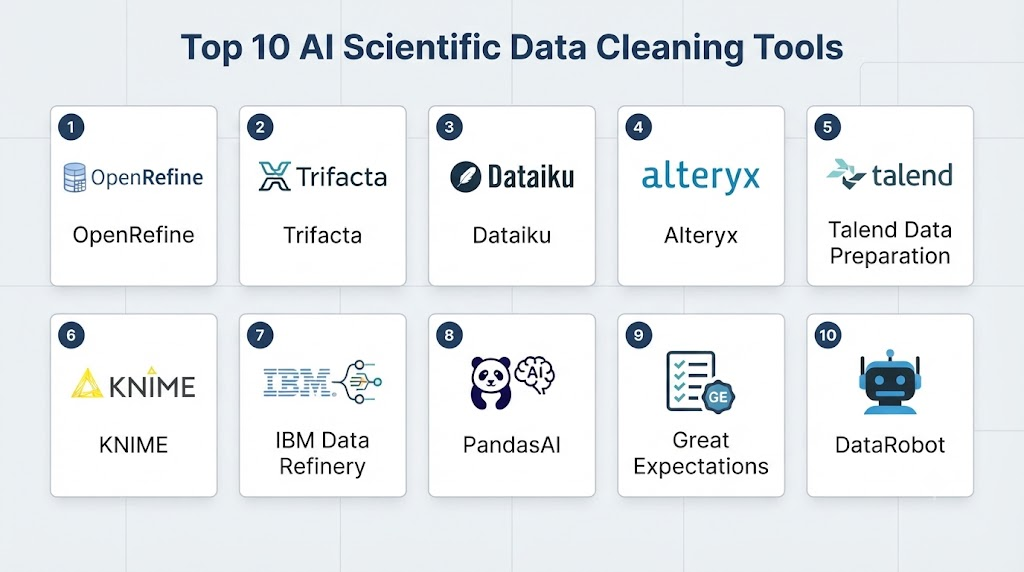
Top 10 AI Scientific Data Cleaning Tools
1. OpenRefine
One-line verdict: Best for researchers who need transparent, repeatable, and highly customizable cleaning of messy structured scientific datasets.
Short description:
OpenRefine is a powerful open-source data-cleaning environment for exploring, transforming, clustering, and reconciling messy datasets. Although it is not primarily an AI platform, it is highly relevant to scientific data preparation because researchers can inspect and transform datasets interactively while maintaining a more transparent cleaning process.
Standout Capabilities
- Interactive data profiling.
- Faceted exploration.
- Duplicate and clustering workflows.
- Text normalization.
- Transformation expressions.
- Data reconciliation.
- Repeatable transformations.
- Large-scale spreadsheet cleanup.
AI-Specific Depth
- Model support: AI is not its primary function; AI-assisted workflows can be built around it.
- RAG / knowledge integration: N/A as a core capability.
- Evaluation: Transformation results can be manually inspected and validated.
- Guardrails: User-controlled transformations provide strong procedural control.
- Observability: Cleaning operations and transformation history improve transparency.
Pros
- Open-source and highly customizable.
- Excellent for messy tabular data.
- Strong transparency compared with black-box cleaning.
Cons
- Not an AI-native cleaning assistant.
- Advanced scientific automation requires additional tooling.
- Users need to understand data transformations.
Security & Compliance
Security depends largely on how it is deployed and operated. Specific certifications are Not publicly stated.
Deployment & Platforms
- Desktop/browser-based workflows.
- Self-managed.
- Local deployment possible.
Integrations & Ecosystem
OpenRefine can work with common tabular formats and external reconciliation or data-processing workflows.
- CSV.
- TSV.
- Spreadsheet-style datasets.
- Reconciliation services.
- Data transformation workflows.
- APIs and external tooling.
Pricing Model
Open-source.
Best-Fit Scenarios
- Cleaning laboratory spreadsheets.
- Standardizing research datasets.
- Preparing structured data for analysis.
2. Pandas
One-line verdict: Best for developers and researchers who want programmable, reproducible scientific data-cleaning pipelines.
Short description:
Pandas is one of the most widely used Python libraries for manipulating structured data. It is not itself an AI cleaning platform, but it forms the foundation of many AI-assisted scientific data-cleaning pipelines.
Standout Capabilities
- Missing-value handling.
- Data-type conversion.
- Duplicate detection.
- Filtering.
- Grouping.
- Data transformation.
- Statistical summaries.
- Integration with machine-learning workflows.
AI-Specific Depth
- Model support: N/A directly; can be combined with AI and ML models.
- RAG / knowledge integration: N/A.
- Evaluation: Users can create automated data-quality tests.
- Guardrails: Explicit code-based transformations provide control.
- Observability: Logs, tests, and pipeline outputs can document cleaning.
Pros
- Extremely flexible.
- Excellent Python ecosystem.
- Highly reproducible.
Cons
- Requires programming.
- Not a conversational AI cleaner.
- Large-scale processing may require complementary technologies.
Security & Compliance
Security depends on the environment where the code executes. Specific certifications are Not publicly stated.
Deployment & Platforms
- Windows.
- macOS.
- Linux.
- Cloud.
- Self-hosted.
Integrations & Ecosystem
- Python.
- NumPy.
- Scikit-learn.
- Jupyter.
- Databases.
- Cloud storage.
- Machine-learning pipelines.
Pricing Model
Open-source.
Best-Fit Scenarios
- Reproducible scientific pipelines.
- Machine-learning datasets.
- Automated research data processing.
3. Great Expectations
One-line verdict: Best for enforcing repeatable data-quality rules before scientific data reaches analytics or machine-learning systems.
Short description:
Great Expectations focuses on data validation rather than automatically correcting every problem. Researchers and engineering teams can define expectations about what valid data should look like and automatically test datasets against those requirements.
Standout Capabilities
- Data validation.
- Schema checks.
- Statistical expectations.
- Automated testing.
- Data-quality documentation.
- Pipeline integration.
- Validation reporting.
- Repeatable quality controls.
AI-Specific Depth
- Model support: Primarily a data-quality framework rather than an AI model platform.
- RAG / knowledge integration: N/A as a core function.
- Evaluation: Strong automated validation capabilities.
- Guardrails: Data-quality rules act as pipeline guardrails.
- Observability: Validation results provide visibility into data quality.
Pros
- Excellent for reproducibility.
- Strong validation framework.
- Useful for production data pipelines.
Cons
- More focused on validation than automatic cleaning.
- Requires rule definition.
- Advanced users may need engineering skills.
Security & Compliance
Specific certifications are Not publicly stated.
Deployment & Platforms
- Cloud.
- Self-managed.
- Python environments.
Integrations & Ecosystem
- Python.
- Data pipelines.
- Databases.
- Data warehouses.
- Orchestration systems.
- Analytics workflows.
Pricing Model
Open-source and commercial offerings may vary.
Best-Fit Scenarios
- Research data validation.
- ML data pipelines.
- Enterprise scientific data governance.
4. Dataiku
One-line verdict: Best for organizations building collaborative, governed data-cleaning and AI workflows across research teams.
Short description:
Dataiku provides a collaborative data and AI environment that can help teams profile, transform, prepare, validate, and analyze datasets. Its visual and programmable workflows make it useful for organizations where researchers and technical teams need to work together.
Standout Capabilities
- Visual data preparation.
- Data quality workflows.
- Machine learning.
- Automated transformations.
- Collaboration.
- Workflow automation.
- Model development.
- Enterprise governance.
AI-Specific Depth
- Model support: Multiple AI and ML approaches depending on configuration.
- RAG / knowledge integration: AI and data integrations vary by deployment.
- Evaluation: Supports model and data evaluation workflows.
- Guardrails: Governance and workflow controls can help manage AI use.
- Observability: Data and model workflows provide monitoring capabilities.
Pros
- Strong enterprise collaboration.
- Combines data preparation and AI.
- Good governance potential.
Cons
- Can be complex for small research teams.
- Enterprise deployment requires planning.
- Pricing is organization-specific.
Security & Compliance
Security and governance capabilities vary by configuration. Specific certifications should be verified for the intended deployment.
Deployment & Platforms
- Cloud.
- Self-managed.
- Hybrid options vary.
Integrations & Ecosystem
- Databases.
- Cloud storage.
- Python.
- R.
- Machine-learning platforms.
- BI systems.
- APIs.
Pricing Model
Enterprise/commercial pricing; exact pricing is Not publicly stated.
Best-Fit Scenarios
- Enterprise research data.
- Cross-functional scientific teams.
- Governed AI pipelines.
5. KNIME
One-line verdict: Best for visual scientific data preparation, transformation, machine learning, and repeatable analytical workflows.
Short description:
KNIME provides a visual workflow environment where researchers can connect data sources, clean datasets, transform variables, perform statistical analysis, and build machine-learning workflows. AI capabilities can be added through available integrations.
Standout Capabilities
- Visual data cleaning.
- Data transformation.
- Workflow automation.
- Statistical analysis.
- Machine learning.
- Data integration.
- Reproducibility.
- Low-code experimentation.
AI-Specific Depth
- Model support: Multiple AI and ML approaches depending on installed integrations.
- RAG / knowledge integration: External data and AI services can be incorporated.
- Evaluation: Supports model and data-quality evaluation.
- Guardrails: Workflow-based processing provides control.
- Observability: Visual workflows make transformation stages inspectable.
Pros
- Low-code interface.
- Strong data integration.
- Useful for reproducible pipelines.
Cons
- Complex workflows can become difficult to manage.
- AI capabilities depend on configuration.
- Not specifically designed for scientific datasets.
Security & Compliance
Specific certifications are Not publicly stated.
Deployment & Platforms
- Desktop.
- Server/cloud options vary.
- Enterprise deployment available depending on configuration.
Integrations & Ecosystem
- Python.
- R.
- Databases.
- APIs.
- Cloud services.
- Machine-learning frameworks.
- Data warehouses.
Pricing Model
Community and commercial offerings vary.
Best-Fit Scenarios
- Scientific analytics.
- Low-code data preparation.
- Research ML pipelines.
6. Alteryx
One-line verdict: Best for teams needing automated, repeatable data preparation and analytics workflows with limited programming.
Short description:
Alteryx provides data preparation, workflow automation, analytics, and AI-related capabilities. It can be useful for scientific organizations that need to standardize cleaning procedures across large numbers of datasets and users.
Standout Capabilities
- Data preparation.
- Workflow automation.
- Data blending.
- Analytics.
- Predictive modeling.
- Repeatable transformations.
- Data profiling.
- Enterprise collaboration.
AI-Specific Depth
- Model support: AI and machine-learning capabilities vary by product.
- RAG / knowledge integration: Depends on available integrations.
- Evaluation: Analytical validation and workflow testing capabilities vary.
- Guardrails: Workflow and governance controls can constrain transformations.
- Observability: Workflow results and execution information provide visibility.
Pros
- Strong workflow automation.
- Good for non-programmers.
- Useful for repeatable data operations.
Cons
- Commercial cost can be significant.
- Less specialized for scientific datasets.
- Advanced AI workflows may require additional configuration.
Security & Compliance
Security capabilities vary by deployment. Specific certifications should be verified for the relevant product.
Deployment & Platforms
- Desktop.
- Cloud.
- Enterprise environments.
Integrations & Ecosystem
- Databases.
- Cloud platforms.
- APIs.
- Data warehouses.
- Analytics tools.
- Python and external models.
Pricing Model
Commercial and enterprise pricing; exact pricing is Not publicly stated.
Best-Fit Scenarios
- Large research organizations.
- Automated data preparation.
- Cross-team data workflows.
7. Data Wrangler
One-line verdict: Best for interactive data exploration and transformation within modern Python and notebook-based scientific workflows.
Short description:
Data Wrangler-style environments are useful for visually exploring datasets and generating transformation steps. They can complement AI-assisted research workflows by making cleaning operations easier to inspect before exporting reproducible code.
Standout Capabilities
- Visual data exploration.
- Transformation generation.
- Missing-data inspection.
- Column profiling.
- Filtering.
- Grouping.
- Data-type handling.
- Code generation.
AI-Specific Depth
- Model support: AI functionality depends on the surrounding development environment.
- RAG / knowledge integration: N/A as a core function.
- Evaluation: Researchers can validate generated transformations using code.
- Guardrails: Human inspection before execution.
- Observability: Generated transformation steps provide visibility.
Pros
- Accessible to data scientists.
- Helps visualize cleaning operations.
- Works well with coding workflows.
Cons
- Not a standalone scientific AI platform.
- Advanced automation requires additional tools.
- Features can depend on the host environment.
Security & Compliance
Specific certifications are Not publicly stated.
Deployment & Platforms
- Desktop development environments.
- Python workflows.
- Cloud environments vary.
Integrations & Ecosystem
- Python.
- Pandas.
- Notebooks.
- Machine-learning workflows.
- Data-science environments.
Pricing Model
Availability and pricing depend on the surrounding platform.
Best-Fit Scenarios
- Interactive research data cleaning.
- Python-based analysis.
- Exploratory datasets.
8. Cleanlab
One-line verdict: Best for detecting label errors, anomalous records, and quality problems in machine-learning and research datasets.
Short description:
Cleanlab focuses on data-centric AI and identifying problematic examples in datasets. It is particularly useful when researchers need to identify mislabeled, ambiguous, inconsistent, or low-quality observations before training machine-learning models.
Standout Capabilities
- Label-error detection.
- Dataset quality assessment.
- Outlier identification.
- Ambiguous-example detection.
- ML dataset analysis.
- Data-centric AI workflows.
- Automated quality scoring.
- Model-assisted data cleaning.
AI-Specific Depth
- Model support: Designed around machine-learning model outputs and data-quality analysis.
- RAG / knowledge integration: N/A as a primary capability.
- Evaluation: Dataset-quality evaluation is a core strength.
- Guardrails: Helps prevent poor-quality training data from entering ML pipelines.
- Observability: Data-quality scores and issue detection provide visibility.
Pros
- Strong for ML dataset quality.
- Useful for finding hidden label problems.
- Supports data-centric AI practices.
Cons
- More specialized than general data-cleaning platforms.
- Requires ML context for maximum value.
- Not a general laboratory-data cleaning suite.
Security & Compliance
Specific certifications are Not publicly stated.
Deployment & Platforms
- Python.
- Cloud and deployment options vary.
Integrations & Ecosystem
- Python.
- Machine-learning frameworks.
- Dataset pipelines.
- Model outputs.
- Data-quality workflows.
Pricing Model
Open-source and commercial offerings may vary.
Best-Fit Scenarios
- Scientific ML datasets.
- Image or classification datasets.
- Training-data quality improvement.
9. Great Expectations / GX
One-line verdict: Best for research organizations that need explicit, testable rules protecting scientific datasets from quality regressions.
Short description:
GX-style data-quality workflows focus on defining and executing expectations about datasets. Rather than asking AI to make uncontrolled corrections, researchers can combine automated profiling with explicit validation rules.
Standout Capabilities
- Data-quality tests.
- Schema validation.
- Distribution checks.
- Automated validation.
- Data documentation.
- Pipeline integration.
- Quality reporting.
- Regression detection.
AI-Specific Depth
- Model support: Primarily validation-oriented rather than model-centric.
- RAG / knowledge integration: N/A.
- Evaluation: Strong expectation-based evaluation.
- Guardrails: Validation rules provide data-pipeline guardrails.
- Observability: Quality reports expose dataset changes.
Pros
- Strong reproducibility.
- Good for production-grade data pipelines.
- Explicit quality rules.
Cons
- Does not automatically understand every scientific anomaly.
- Requires domain-specific expectations.
- Better for validation than generative cleaning.
Security & Compliance
Specific certifications are Not publicly stated.
Deployment & Platforms
- Cloud.
- Self-managed.
- Python environments.
Integrations & Ecosystem
- Databases.
- Data warehouses.
- Python.
- Pipeline orchestration.
- Data engineering platforms.
Pricing Model
Open-source and commercial offerings may vary.
Best-Fit Scenarios
- Automated research data validation.
- Production ML pipelines.
- Data-quality governance.
10. DataPrep / Python AI-Assisted Cleaning Workflows
One-line verdict: Best for Python-focused teams building customizable AI-assisted data-cleaning pipelines around scientific datasets.
Short description:
Python-based data-preparation ecosystems allow researchers to combine data-cleaning libraries with machine-learning models and AI assistants. This approach is particularly useful for organizations that need custom scientific transformations rather than a single packaged cleaning application.
Standout Capabilities
- Automated data profiling.
- Data transformation.
- Missing-value handling.
- Feature engineering.
- Custom validation.
- Python integration.
- ML pipeline integration.
- Reproducible scripts.
AI-Specific Depth
- Model support: Depends on selected AI and ML libraries.
- RAG / knowledge integration: Can be implemented using external retrieval systems.
- Evaluation: Custom tests and benchmark datasets can be created.
- Guardrails: Developers control transformations and validation rules.
- Observability: Logging and experiment-tracking tools can provide visibility.
Pros
- Highly customizable.
- Excellent for specialized research data.
- Strong integration with scientific Python.
Cons
- Requires engineering expertise.
- More maintenance than an off-the-shelf platform.
- AI quality depends on implementation.
Security & Compliance
Security depends on the deployment architecture and selected components. Certifications are Not publicly stated.
Deployment & Platforms
- Windows.
- macOS.
- Linux.
- Cloud.
- Self-hosted.
Integrations & Ecosystem
- Python.
- Pandas.
- NumPy.
- Scikit-learn.
- Jupyter.
- Databases.
- AI APIs.
Pricing Model
Many underlying Python tools are open-source; external AI services may use usage-based pricing.
Best-Fit Scenarios
- Custom scientific datasets.
- Private research infrastructure.
- Advanced ML data pipelines.
Comparison Table
| Tool | Best For | Deployment | Model Flexibility | Strength | Watch-Out | Public Rating |
|---|---|---|---|---|---|---|
| OpenRefine | Structured data cleanup | Self-hosted/Desktop | Open-source extensible | Transparent transformations | Limited native AI | N/A |
| Pandas | Programmable cleaning | Self-hosted/Cloud | Open-source extensible | Python flexibility | Requires coding | N/A |
| Great Expectations | Data validation | Cloud/Self-hosted | Framework-based | Quality testing | Needs defined rules | N/A |
| Dataiku | Enterprise data workflows | Cloud/Hybrid | Multi-model | Governance | Enterprise complexity | N/A |
| KNIME | Visual data workflows | Desktop/Cloud | Multi-model | Low-code | Workflow complexity | N/A |
| Alteryx | Automated preparation | Cloud/Desktop | Multi-model | Workflow automation | Commercial cost | N/A |
| Data Wrangler | Interactive cleaning | Desktop/Cloud | Extensible | Visual transformations | Not standalone AI | N/A |
| Cleanlab | ML data quality | Cloud/Self-hosted varies | ML-based | Label-error detection | ML-focused | N/A |
| GX | Data-quality governance | Cloud/Self-hosted | Framework-based | Validation | Less automated correction | N/A |
| Python AI Workflows | Custom scientific pipelines | Any | Hosted/BYO/Open-source | Maximum flexibility | Engineering overhead | N/A |
Scoring & Evaluation
The following scoring is comparative rather than an absolute quality ranking. Scientific data cleaning varies substantially between laboratory, sensor, biomedical, engineering, and ML datasets. The scores emphasize flexibility, validation, reproducibility, scientific data handling, integrations, and AI-assisted workflows.
| Tool | Core | Reliability/Eval | Guardrails | Integrations | Ease | Perf/Cost | Security/Admin | Support | Weighted Total |
|---|---|---|---|---|---|---|---|---|---|
| OpenRefine | 9 | 9 | 9 | 8.5 | 8.5 | 9 | 8 | 8.5 | 8.8 |
| Pandas | 9.5 | 9.5 | 9.5 | 10 | 7.5 | 9.5 | 8.5 | 9.5 | 9.2 |
| Great Expectations | 9 | 9.5 | 9.5 | 9 | 7.5 | 9 | 9 | 9 | 8.9 |
| Dataiku | 9.5 | 9 | 9 | 9.5 | 8.5 | 8 | 9.5 | 9 | 9.0 |
| KNIME | 9 | 9 | 9 | 9.5 | 8.5 | 8.5 | 9 | 9 | 8.9 |
| Alteryx | 9 | 8.5 | 8.5 | 9.5 | 9 | 8 | 9 | 9 | 8.8 |
| Data Wrangler | 8.5 | 8.5 | 8.5 | 9 | 9 | 9 | 8 | 8.5 | 8.7 |
| Cleanlab | 9 | 9.5 | 9 | 8.5 | 8 | 8.5 | 8.5 | 9 | 8.8 |
| GX | 9 | 9.5 | 9.5 | 9 | 7.5 | 9 | 9 | 9 | 8.9 |
| Python AI Workflows | 9.5 | 9.5 | 9.5 | 10 | 6.5 | 9 | 8.5 | 9.5 | 9.0 |
Top 3 for Enterprise
- Dataiku
- Alteryx
- Great Expectations
Top 3 for SMB
- KNIME
- OpenRefine
- Data Wrangler
Top 3 for Developers
- Pandas
- Python AI Workflows
- Cleanlab
Which AI Scientific Data Cleaning Tool Is Right for You?
Solo / Freelancer
Individual researchers should focus on flexibility and low infrastructure requirements.
OpenRefine, Pandas, and Data Wrangler are practical starting points. Researchers can add AI assistants for anomaly explanations, transformation suggestions, and documentation while keeping actual data transformations under their control.
SMB
SMBs should prioritize repeatability.
A practical architecture is:
Data Ingestion → Profiling → AI Anomaly Detection → Human Review → Cleaning → Validation → Analysis
KNIME is particularly useful for teams that want visual workflows, while OpenRefine works well for interactive structured-data cleanup.
Mid-Market
Mid-market organizations should establish centralized data-quality standards.
Define:
- Required fields.
- Valid ranges.
- Unit standards.
- Allowed categorical values.
- Timestamp rules.
- Duplicate rules.
- Missing-data thresholds.
- Outlier-review procedures.
Combine AI-assisted anomaly detection with explicit validation rules.
Enterprise
Enterprise research organizations need more than a cleaning interface.
Prioritize:
- Data lineage.
- Access controls.
- Auditability.
- Centralized quality policies.
- Reproducible pipelines.
- Model governance.
- Data retention controls.
- Integration with data warehouses.
- Scientific metadata preservation.
Dataiku, Alteryx, and validation frameworks can be appropriate depending on architecture.
Regulated Industries
Healthcare, pharmaceutical, public-sector, and other regulated environments should avoid silent automated modifications.
A safer process is:
Detect → Explain → Review → Approve → Transform → Validate → Record
Every material change should be traceable.
Budget vs Premium
Open-source tools such as Pandas and OpenRefine can provide substantial capability at low software cost.
Premium platforms become attractive when organizations need:
- Centralized governance.
- Enterprise administration.
- Collaboration.
- Large-scale automation.
- Support.
- Integrated AI.
- Data-quality monitoring.
The real cost should include infrastructure, engineering, AI usage, maintenance, validation, and researcher time.
Build vs Buy
Build when:
- Scientific data has unusual structures.
- Domain-specific cleaning rules are essential.
- You require private AI models.
- Your organization has strong Python or data-engineering expertise.
- You need integration with laboratory systems.
Buy when:
- Standardized data preparation is sufficient.
- Multiple teams need a common platform.
- You need enterprise governance.
- You want faster deployment.
Implementation Playbook
First 30 Days: Pilot + Success Metrics
Select three representative datasets.
Include:
- Clean datasets.
- Messy datasets.
- Known problematic datasets.
Measure:
- Number of issues detected.
- False-positive rate.
- False-negative rate.
- Manual review time.
- Transformation accuracy.
- Reproducibility.
- Processing cost.
- Processing latency.
Do not measure success only by how many records the AI changes.
Days 31–60: Security + Evaluation + Workflow
Create an evaluation dataset containing known quality problems.
Test:
- Missing values.
- Duplicates.
- Invalid units.
- Outliers.
- Incorrect labels.
- Impossible measurements.
- Schema changes.
- Corrupted records.
Create an AI evaluation harness that measures detection and correction accuracy.
Add red-team testing for prompts that could cause the system to:
- Delete valid measurements.
- Modify scientific values without evidence.
- Ignore metadata.
- Reveal sensitive information.
- Apply inappropriate transformations.
Days 61–90: Scale + Governance
Move validated pipelines into production.
Implement:
- Dataset versioning.
- Transformation versioning.
- Model versioning.
- Data lineage.
- Quality dashboards.
- Approval workflows.
- Automated validation.
- Cost monitoring.
- Incident handling.
For agentic systems, require approval before irreversible data changes.
Common Mistakes & How to Avoid Them
- Deleting outliers automatically: An unusual scientific observation may be legitimate.
- Using AI without validation: Every automated transformation should be tested.
- Ignoring units: Mixing measurement units can create serious scientific errors.
- Overwriting original data: Always preserve the raw dataset.
- Removing missing values blindly: Missingness can itself contain scientific information.
- Treating anomalies as errors: Validate against domain knowledge.
- Ignoring metadata: Sample IDs, timestamps, instruments, and units can be essential.
- Failing to track transformations: Researchers should know what changed.
- Using LLMs for every record: Large-scale deterministic processing is often cheaper and more reliable with conventional tools.
- Ignoring cost: AI-based cleaning can become expensive on very large datasets.
- Skipping evaluation: Test the system against known data-quality problems.
- Overusing automatic correction: Detection and recommendation can be safer than autonomous modification.
- Ignoring privacy: Sensitive research data should not automatically be sent to external AI services.
- Not versioning datasets: A cleaned dataset without provenance is difficult to reproduce.
- Failing to monitor pipeline drift: Data formats and distributions can change over time.
- Confusing synthetic data with real measurements: Generated records should be clearly labeled.
- Allowing prompt injection through data: Text fields may contain instructions designed to manipulate an AI cleaning agent.
- Ignoring human review: Critical scientific transformations should have expert oversight.
FAQs
What are AI Scientific Data Cleaning Tools?
They are tools that use AI, machine learning, automation, or AI-assisted workflows to identify and resolve problems in scientific datasets.
Can AI automatically clean scientific data?
Yes, but fully automatic cleaning is risky. A safer approach is to let AI detect and explain potential issues while requiring validation or approval for important transformations.
Can AI detect scientific outliers?
Yes. Machine-learning and statistical methods can identify unusual observations. However, an outlier is not automatically an error.
Can AI correct missing values?
AI can suggest or perform imputation, but the appropriate method depends on why data is missing and the scientific context.
Can AI standardize scientific units?
AI can help identify inconsistent units and recommend conversions. Unit transformations should be validated because incorrect conversions can introduce major errors.
Should raw scientific data be modified?
Generally, the original raw dataset should be preserved. Cleaning should produce a separate version with documented transformations.
Can AI clean laboratory data?
Yes. AI can help identify formatting problems, duplicates, missing values, inconsistent measurements, and unusual records in laboratory datasets.
Can AI clean sensor data?
Yes. AI and statistical methods can identify missing readings, spikes, drift, duplicate measurements, and other sensor-data problems.
Can AI clean biomedical research data?
Potentially, but sensitive biomedical data requires careful privacy, access, retention, and governance controls.
Is an LLM enough for scientific data cleaning?
Usually not. LLMs are useful for reasoning, explanations, and workflow generation, while deterministic data-processing and statistical tools are generally better for repeatable transformations.
Can AI detect incorrect labels in datasets?
Yes. Specialized tools such as Cleanlab can help identify potentially incorrect or ambiguous labels in machine-learning datasets.
What is the best tool for Python-based scientific data cleaning?
Pandas is a strong foundation for Python-based cleaning. Teams can combine it with validation frameworks, machine learning, and AI assistants for more advanced workflows.
What is the best tool for low-code data cleaning?
KNIME and similar visual workflow platforms are useful for teams that want to build repeatable cleaning pipelines without writing every transformation manually.
Is open-source scientific data cleaning secure?
Security depends on how the software is deployed, configured, updated, and integrated. Open-source does not automatically mean secure or insecure.
Can scientific data cleaning be automated?
Yes. Profiling, validation, duplicate detection, schema checking, and many transformations can be automated. High-impact corrections should generally have review mechanisms.
How should AI cleaning quality be evaluated?
Use known datasets with deliberately introduced errors and measure detection accuracy, false positives, false negatives, correction accuracy, reproducibility, and processing cost.
Can AI cleaning introduce new errors?
Yes. An AI system may incorrectly interpret a scientific measurement, modify a valid outlier, infer the wrong unit, or apply an inappropriate transformation.
How can researchers prevent AI from changing valid scientific observations?
Use explicit validation rules, preserve raw data, require human review for significant changes, and record the reasoning and transformation behind each modification.
What is data provenance and why does it matter?
Data provenance records where data came from and how it changed. It is essential for reproducibility, scientific auditing, and trustworthy research.
Can AI agents clean data automatically?
They can orchestrate profiling, detection, validation, and transformation workflows. However, irreversible or scientifically consequential changes should require appropriate controls.
Should organizations use hosted AI or self-hosted models?
The choice depends on privacy, data sensitivity, cost, performance, governance, and infrastructure requirements. Sensitive research environments may prefer greater control over data processing.
Conclusion
AI Scientific Data Cleaning Tools can significantly reduce the time researchers spend finding and investigating data-quality problems. Their greatest value is not simply deleting bad records. It is helping teams understand data quality, identify suspicious observations, standardize information, enforce validation rules, and create reproducible cleaning workflows.For flexible programming workflows, Pandas remains an important foundation. OpenRefine is useful for interactive structured-data cleanup, while Great Expectations and GX are valuable for validation and quality controls. KNIME, Dataiku, and Alteryx provide broader visual and enterprise workflows. Cleanlab is particularly useful for machine-learning dataset quality.The strongest architecture is usually hybrid:Raw Data → Profiling → AI-Assisted Detection → Domain Review → Controlled Transformation → Validation → Versioned Dataset → AnalysisThe goal should not be to let AI silently rewrite scientific data. The goal is to create a system where AI makes data-quality work faster while researchers retain control over scientific meaning.