Introduction
AI Literature Review Assistants are research tools that use artificial intelligence to help researchers discover, organize, analyze, summarize, and compare academic literature. Instead of manually searching hundreds of papers and maintaining complicated notes and citation spreadsheets, researchers can use these platforms to accelerate literature discovery and identify relationships between studies.
Modern tools can help with semantic search, citation discovery, paper summarization, research mapping, evidence extraction, related-paper recommendations, and question answering across academic literature. Some are designed for systematic-review workflows, while others focus on exploratory research and knowledge discovery.
Best for: Researchers, PhD students, academics, medical and scientific professionals, research teams, librarians, analysts, and organizations conducting evidence-based research.
Not ideal for: Users who only need basic citation management, researchers working with a very small number of papers, or projects where AI-generated summaries cannot be independently verified. AI literature tools should support—not replace—critical reading and methodological judgment.
What to Evaluate
- Academic database coverage.
- Semantic search quality.
- Citation discovery.
- Full-text availability.
- Paper summarization.
- Evidence extraction.
- Research mapping.
- Systematic-review support.
- Citation accuracy.
- AI hallucination controls.
- Search transparency.
- Export options.
- Reference-manager integration.
- Collaboration.
- Privacy and data retention.
- Cost and usage limits.
- Multilingual research support.
- Duplicate detection.
- Screening workflows.
- API availability.
What’s Changed in AI Literature Review Assistants
- Semantic search is becoming more useful: Researchers can increasingly search by concepts and research questions rather than relying only on exact keywords.
- AI summaries are becoming more contextual: Modern tools can help summarize papers according to a research question instead of producing only generic abstracts.
- Citation discovery is increasingly automated: AI can identify related work, citation chains, influential papers, and newer research.
- Research mapping is becoming mainstream: Visual maps can help researchers understand clusters, authors, topics, and citation relationships.
- Systematic-review workflows are becoming more automated: Screening and evidence organization can be accelerated, although human verification remains essential.
- Multimodal research is gaining importance: Research workflows increasingly involve text, figures, tables, PDFs, supplementary material, and structured data.
- AI-generated answers need stronger evidence grounding: Researchers increasingly expect claims to be traceable to specific papers or passages.
- Research reproducibility matters more: Search strategies, screening decisions, prompts, and AI-assisted extraction should be documented.
- Privacy is becoming a bigger consideration: Researchers handling unpublished manuscripts, proprietary studies, or sensitive research data need stronger controls.
- Model choice is becoming more flexible: Some platforms increasingly combine proprietary AI models with specialized retrieval systems.
- Evaluation is becoming critical: Researchers need to distinguish between a fluent summary and a scientifically reliable one.
- Research agents are emerging: AI systems can increasingly perform multi-step tasks such as searching, filtering, comparing, and synthesizing literature.
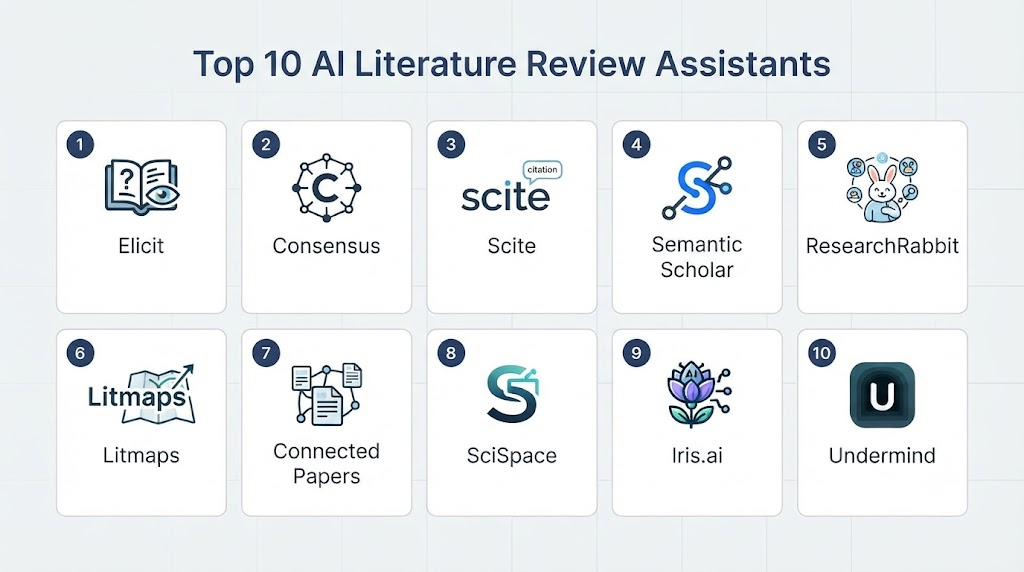
Top 10 AI Literature Review Assistants
1. Elicit
One-line verdict: Best for researchers who want AI-assisted literature discovery, screening, extraction, and evidence synthesis.
Short description:
Elicit is an AI research assistant designed to help researchers discover academic papers and extract useful information from them. It is particularly relevant to literature-review workflows where researchers need to move from a research question toward structured evidence.
Standout Capabilities
- Semantic academic search.
- Research-question-oriented discovery.
- AI-generated paper summaries.
- Structured information extraction.
- Literature-review workflows.
- Paper comparison.
- Research evidence organization.
- Screening assistance.
AI-Specific Depth
- Model support: Proprietary AI workflow; exact underlying model configuration can vary.
- RAG / knowledge integration: Uses academic literature as the research knowledge base.
- Evaluation: Human verification remains important; specific evaluation methodology varies.
- Guardrails: Source-grounded research workflows help reduce unsupported answers, but researchers should verify claims.
- Observability: Research outputs can be inspected against papers; detailed AI telemetry varies.
Pros
- Strong focus on literature-review workflows.
- Useful structured extraction capabilities.
- Can significantly reduce initial research time.
Cons
- AI-generated extraction requires verification.
- Coverage can vary by research field.
- Advanced workflows may require a paid plan.
Security & Compliance
Specific enterprise security and certification details should be verified for the current plan and deployment. Certifications: Not publicly stated.
Deployment & Platforms
- Web-based.
- Cloud-based.
- Browser-accessible research workflow.
Integrations & Ecosystem
Elicit is primarily designed as an AI research workflow rather than a traditional reference manager.
- Academic literature search.
- Structured extraction.
- Literature-review workflows.
- Research tables.
- Export capabilities.
Pricing Model
Tiered model with free and paid options; exact limits and pricing can vary.
Best-Fit Scenarios
- PhD literature reviews.
- Evidence synthesis.
- Research question exploration.
2. Consensus
One-line verdict: Best for quickly finding research-backed answers to focused academic questions.
Short description:
Consensus is an AI-powered academic search platform designed to help users find and synthesize evidence from scientific research. It is particularly useful when a researcher wants an evidence-oriented answer rather than a conventional keyword search.
Standout Capabilities
- AI-powered academic search.
- Research question answering.
- Evidence synthesis.
- Scientific-paper discovery.
- Citation-backed responses.
- Paper summaries.
- Consensus-oriented research exploration.
AI-Specific Depth
- Model support: Proprietary AI workflow.
- RAG / knowledge integration: Academic literature retrieval.
- Evaluation: Source inspection and human verification are important.
- Guardrails: Evidence-oriented responses reduce unsupported generation, but no AI system should be treated as infallible.
- Observability: Source citations provide evidence traceability; detailed runtime metrics are not a core user feature.
Pros
- Easy for non-specialist researchers.
- Strong question-driven workflow.
- Useful for quickly exploring evidence.
Cons
- Less suitable for highly specialized systematic-review workflows.
- AI synthesis still requires source verification.
- Coverage varies by topic.
Security & Compliance
Specific certifications and enterprise controls should be verified with the current offering. Certifications: Not publicly stated.
Deployment & Platforms
- Web.
- Cloud-based.
Integrations & Ecosystem
- Academic search.
- Research summaries.
- Citation-backed answers.
- Literature discovery.
Pricing Model
Freemium/tiered model; exact pricing and usage limits may vary.
Best-Fit Scenarios
- Fast evidence discovery.
- Initial literature exploration.
- Research question validation.
3. Semantic Scholar
One-line verdict: Best for broad academic discovery, citation exploration, and AI-assisted research navigation.
Short description:
Semantic Scholar is an academic research discovery platform that uses machine learning to help researchers find relevant scientific literature. It provides paper discovery, citation relationships, author information, and research recommendations.
Standout Capabilities
- Semantic paper search.
- Citation graph exploration.
- Paper recommendations.
- Author discovery.
- Research feeds.
- Academic metadata.
- Paper summaries.
- Large research corpus.
AI-Specific Depth
- Model support: Machine-learning and AI-powered search systems.
- RAG / knowledge integration: Academic paper corpus.
- Evaluation: Search and recommendation quality are continuously developed.
- Guardrails: Source-oriented academic discovery rather than unrestricted generative answers.
- Observability: Citation and paper metadata provide useful research traceability.
Pros
- Broad academic discovery.
- Excellent citation exploration.
- Useful for finding related work.
Cons
- Not a complete systematic-review platform.
- Full-text availability depends on the paper.
- AI synthesis is less central than in dedicated AI research assistants.
Security & Compliance
Security and privacy details depend on the service architecture. Certifications: Not publicly stated.
Deployment & Platforms
- Web.
- API access for supported use cases.
Integrations & Ecosystem
- Academic metadata.
- Citation graphs.
- APIs.
- Research discovery.
- Paper recommendations.
Pricing Model
Core research discovery services are generally available without traditional enterprise seat pricing; API and service terms may vary.
Best-Fit Scenarios
- Academic discovery.
- Citation-chain research.
- Finding related papers.
4. scite
One-line verdict: Best for evaluating how published research is cited and whether citations support or challenge previous claims.
Short description:
scite focuses on citation context and research discovery. Its distinguishing capability is helping researchers inspect how papers have been cited, including whether citation contexts support, contrast with, or simply mention earlier research.
Standout Capabilities
- Smart citation analysis.
- Citation context.
- Research discovery.
- Citation statements.
- Paper search.
- Literature analysis.
- Research evaluation.
- Citation-based exploration.
AI-Specific Depth
- Model support: AI-assisted citation analysis.
- RAG / knowledge integration: Academic papers and citation contexts.
- Evaluation: Citation-context analysis provides an evidence-oriented workflow.
- Guardrails: Source-based citation analysis; human interpretation remains necessary.
- Observability: Citation context provides useful traceability.
Pros
- Excellent for citation verification.
- Useful for identifying conflicting evidence.
- Helps researchers understand research impact.
Cons
- Citation classification is not a substitute for reading the underlying study.
- Less focused on full systematic-review automation.
- Advanced features may require paid access.
Security & Compliance
Specific enterprise certifications and security controls should be verified for the current plan. Certifications: Not publicly stated.
Deployment & Platforms
- Web.
- Cloud-based.
Integrations & Ecosystem
- Academic databases.
- Citation analysis.
- Research discovery.
- Reference workflows.
- API capabilities may vary.
Pricing Model
Tiered subscription model; exact pricing varies.
Best-Fit Scenarios
- Citation checking.
- Research credibility assessment.
- Finding contradictory literature.
5. ResearchRabbit
One-line verdict: Best for visually exploring citation networks, related papers, authors, and research communities.
Short description:
ResearchRabbit is a literature discovery and visualization platform focused on helping researchers navigate academic networks. It is particularly useful for moving beyond keyword searches and discovering connected research.
Standout Capabilities
- Citation-network exploration.
- Paper recommendations.
- Author discovery.
- Research collections.
- Visual research mapping.
- Related-paper discovery.
- Literature organization.
AI-Specific Depth
- Model support: Recommendation and discovery algorithms; exact model architecture varies.
- RAG / knowledge integration: Academic research metadata and citation relationships.
- Evaluation: User-driven discovery and recommendation; independent verification remains necessary.
- Guardrails: Primarily source-oriented discovery rather than unrestricted generation.
- Observability: Citation relationships and research maps provide useful transparency.
Pros
- Excellent visual research exploration.
- Useful for discovering adjacent literature.
- Helps identify important authors and research clusters.
Cons
- Less focused on automated evidence extraction.
- Visualization can become complex with broad topics.
- Requires researcher judgment to determine relevance.
Security & Compliance
Specific certifications are Not publicly stated.
Deployment & Platforms
- Web.
- Cloud-based.
Integrations & Ecosystem
- Academic papers.
- Citation networks.
- Author networks.
- Research collections.
- Reference workflows.
Pricing Model
Free and paid offerings may be available; exact pricing can vary.
Best-Fit Scenarios
- Exploratory literature reviews.
- Research mapping.
- Finding related authors and papers.
6. Connected Papers
One-line verdict: Best for quickly visualizing relationships between papers around a specific research topic or foundational study.
Short description:
Connected Papers provides visual graphs that help researchers explore related academic papers. It is particularly useful when a researcher has found one important paper and wants to understand the surrounding literature.
Standout Capabilities
- Visual paper graphs.
- Related-paper discovery.
- Prior-work exploration.
- Derivative-work discovery.
- Citation relationships.
- Research landscape visualization.
AI-Specific Depth
- Model support: Algorithmic literature similarity and graph generation.
- RAG / knowledge integration: Academic paper metadata and relationships.
- Evaluation: Human interpretation required.
- Guardrails: Source-oriented discovery.
- Observability: Graph relationships make the discovery process relatively transparent.
Pros
- Extremely simple research exploration.
- Excellent starting-point discovery.
- Useful for identifying foundational work.
Cons
- Not a complete AI literature-review workflow.
- Limited evidence extraction compared with specialized tools.
- Requires complementary research tools for systematic reviews.
Security & Compliance
Specific enterprise certifications are Not publicly stated.
Deployment & Platforms
- Web.
- Cloud-based.
Integrations & Ecosystem
- Academic literature.
- Citation relationships.
- Paper metadata.
- Research graphs.
Pricing Model
Usage-based or subscription options may apply depending on the current offering.
Best-Fit Scenarios
- Initial literature discovery.
- Citation exploration.
- Research landscape mapping.
7. Litmaps
One-line verdict: Best for monitoring literature networks and discovering new papers connected to an existing research collection.
Short description:
Litmaps helps researchers discover academic literature through citation relationships and research maps. It is especially useful when a literature review is ongoing and new papers need to be identified over time.
Standout Capabilities
- Citation mapping.
- Literature discovery.
- Research collections.
- New-paper monitoring.
- Visual literature maps.
- Related-paper discovery.
- Research organization.
AI-Specific Depth
- Model support: Algorithmic recommendation and literature mapping.
- RAG / knowledge integration: Academic literature metadata and citation networks.
- Evaluation: Researcher review remains necessary.
- Guardrails: Source-based discovery.
- Observability: Citation relationships provide transparency into recommendations.
Pros
- Strong literature-monitoring capabilities.
- Useful for maintaining an active review.
- Good visual discovery workflow.
Cons
- Not primarily an AI-generated synthesis tool.
- Requires human interpretation.
- Advanced features may require a subscription.
Security & Compliance
Specific certifications are Not publicly stated.
Deployment & Platforms
- Web.
- Cloud-based.
Integrations & Ecosystem
- Academic databases.
- Citation networks.
- Research collections.
- Alerts.
- Literature maps.
Pricing Model
Freemium/subscription model; exact pricing varies.
Best-Fit Scenarios
- Long-running literature reviews.
- Citation monitoring.
- Research discovery.
8. Rayyan
One-line verdict: Best for systematic-review teams that need collaborative screening, organization, and AI-assisted literature-review workflows.
Short description:
Rayyan is designed around systematic-review and evidence-synthesis workflows. It helps research teams organize references, screen studies, collaborate, and manage review decisions.
Standout Capabilities
- Systematic-review screening.
- Collaborative workflows.
- Study organization.
- AI-assisted screening features.
- Duplicate management.
- Review decision tracking.
- Research-team collaboration.
AI-Specific Depth
- Model support: AI-assisted research workflow; exact underlying models may vary.
- RAG / knowledge integration: Imported research collections.
- Evaluation: Human screening remains a central component.
- Guardrails: Workflow controls and researcher review.
- Observability: Screening decisions and review workflow provide traceability.
Pros
- Strong systematic-review orientation.
- Useful for research teams.
- Structured screening workflows.
Cons
- More specialized than general-purpose research assistants.
- AI assistance does not eliminate human screening.
- Some capabilities depend on subscription level.
Security & Compliance
Security controls and certifications vary by offering. Certifications: Not publicly stated.
Deployment & Platforms
- Web.
- Cloud-based.
- Mobile support may vary by current offering.
Integrations & Ecosystem
- Reference imports.
- Systematic-review workflows.
- Team collaboration.
- Screening.
- Research databases.
- Export capabilities.
Pricing Model
Tiered subscription model with different capabilities depending on plan.
Best-Fit Scenarios
- Systematic reviews.
- Evidence-synthesis teams.
- Collaborative research screening.
9. Scholarcy
One-line verdict: Best for quickly converting dense academic papers into structured summaries and review-friendly research notes.
Short description:
Scholarcy uses AI to summarize research papers and create structured representations of academic documents. It is particularly useful when researchers need to process a large number of papers quickly.
Standout Capabilities
- Academic paper summarization.
- Structured research summaries.
- Key-point extraction.
- Flashcard-style research notes.
- Document processing.
- Literature triage.
- Research organization.
AI-Specific Depth
- Model support: AI-based document analysis; exact underlying model configuration varies.
- RAG / knowledge integration: Document-based processing.
- Evaluation: Human verification required.
- Guardrails: Source-document grounding helps but does not eliminate hallucination risk.
- Observability: Source text and extracted sections can be reviewed.
Pros
- Fast paper summarization.
- Useful for literature triage.
- Helps reduce reading overhead.
Cons
- Summaries can omit methodological nuance.
- Researchers should verify important claims.
- Large-scale systematic-review workflows may require additional tools.
Security & Compliance
Specific certifications are Not publicly stated.
Deployment & Platforms
- Web.
- Browser-based workflows.
- Document-processing environment.
Integrations & Ecosystem
- Academic PDFs.
- Research documents.
- Reference workflows.
- Export capabilities.
Pricing Model
Free and paid tiers may be available; exact limits vary.
Best-Fit Scenarios
- Paper triage.
- Fast academic summaries.
- Research note creation.
10. Perplexity
One-line verdict: Best for broad research exploration when users need fast AI-assisted search across academic and general information sources.
Short description:
Perplexity is a general-purpose AI search and answer platform rather than a dedicated academic literature-review system. Its research capabilities can nevertheless help users explore topics, identify papers, compare information, and formulate follow-up research questions.
Standout Capabilities
- AI-powered search.
- Source-backed answers.
- Research exploration.
- Multi-source synthesis.
- Follow-up questioning.
- Document analysis in supported workflows.
- Research-oriented modes.
- Rapid information discovery.
AI-Specific Depth
- Model support: Multi-model capabilities depending on plan and product configuration.
- RAG / knowledge integration: Web and connected research sources.
- Evaluation: Source citations enable verification, but researchers must assess source quality.
- Guardrails: AI safety and answer-generation controls; no system eliminates hallucinations.
- Observability: Citations and source inspection provide answer traceability.
Pros
- Extremely fast exploratory research.
- Flexible question-answering.
- Useful outside purely academic databases.
Cons
- Not a dedicated systematic-review platform.
- Source quality can vary.
- Researchers need to distinguish scholarly evidence from general web information.
Security & Compliance
Enterprise controls may vary by plan. Specific certifications should be verified for the applicable product offering.
Deployment & Platforms
- Web.
- Desktop/browser environments.
- Mobile applications.
Integrations & Ecosystem
- Web search.
- Academic sources.
- Documents.
- AI models.
- Research workflows.
Pricing Model
Free and paid subscription tiers; exact features and limits vary.
Best-Fit Scenarios
- Early-stage research.
- Cross-domain exploration.
- Rapid research questions.
Comparison Table
| Tool | Best For | Deployment | Model Flexibility | Strength | Watch-Out | Public Rating |
|---|---|---|---|---|---|---|
| Elicit | AI literature reviews | Cloud | Hosted AI | Evidence extraction | Verify AI outputs | N/A |
| Consensus | Research-backed questions | Cloud | Hosted AI | Evidence synthesis | Coverage varies | N/A |
| Semantic Scholar | Academic discovery | Cloud | Algorithmic/AI | Research discovery | Not full systematic-review software | N/A |
| scite | Citation analysis | Cloud | Hosted AI | Citation context | Classification needs review | N/A |
| ResearchRabbit | Research mapping | Cloud | Algorithmic/AI | Visual discovery | Limited extraction | N/A |
| Connected Papers | Paper relationships | Cloud | Algorithmic | Visual graphs | Not a complete review platform | N/A |
| Litmaps | Literature monitoring | Cloud | Algorithmic/AI | Citation mapping | Less synthesis-focused | N/A |
| Rayyan | Systematic reviews | Cloud | Hosted AI | Screening | Human review required | N/A |
| Scholarcy | Paper summaries | Cloud | Hosted AI | Fast summarization | Nuance can be lost | N/A |
| Perplexity | Broad research | Cloud / Mobile | Multi-model | Fast exploration | Not academic-only | N/A |
Scoring & Evaluation
The scoring below is comparative rather than absolute. A tool can score highly for exploratory research while being less suitable for systematic reviews. Scores consider literature-review functionality, AI reliability, workflow depth, integrations, usability, performance, administration, and ecosystem maturity.
| Tool | Core | Reliability/Eval | Guardrails | Integrations | Ease | Perf/Cost | Security/Admin | Support | Weighted Total |
|---|---|---|---|---|---|---|---|---|---|
| Elicit | 9.5 | 9 | 8.5 | 8.5 | 9 | 8.5 | 8.5 | 8.5 | 8.9 |
| Consensus | 9 | 9 | 8.5 | 8 | 9.5 | 8.5 | 8 | 8.5 | 8.7 |
| Semantic Scholar | 9.5 | 9 | 8.5 | 9 | 9 | 9.5 | 8.5 | 9.5 | 9.0 |
| scite | 9.5 | 9.5 | 9 | 8.5 | 8.5 | 8 | 8.5 | 9 | 8.9 |
| ResearchRabbit | 9 | 8.5 | 8.5 | 8 | 9.5 | 9 | 8 | 9 | 8.8 |
| Connected Papers | 8.5 | 8.5 | 8.5 | 7.5 | 9.5 | 9 | 8 | 8.5 | 8.5 |
| Litmaps | 9 | 8.5 | 8.5 | 8 | 9 | 8.5 | 8 | 9 | 8.6 |
| Rayyan | 9.5 | 9 | 9 | 9 | 8.5 | 8 | 9 | 9 | 8.9 |
| Scholarcy | 8.5 | 8 | 8 | 8 | 9.5 | 8.5 | 8 | 8.5 | 8.4 |
| Perplexity | 8.5 | 8 | 8 | 9.5 | 9.5 | 8.5 | 8 | 9 | 8.6 |
Top 3 for Enterprise
- Elicit
- Rayyan
- scite
Top 3 for SMB
- Elicit
- Consensus
- Semantic Scholar
Top 3 for Developers
- Semantic Scholar
- scite
- Perplexity
Which AI Literature Review Assistant Is Right for You?
Solo / Freelancer
Individual researchers should prioritize ease of use, search quality, paper coverage, and affordability.
Elicit is a strong choice for structured literature exploration, while Consensus works well for quickly investigating research-backed questions.
For researchers who want to explore relationships between papers, ResearchRabbit and Connected Papers can be particularly useful.
SMB
Small research organizations should consider collaboration, document organization, export, and repeatable workflows.
A practical combination can include:
- Elicit for literature discovery.
- Semantic Scholar for broader academic search.
- scite for citation analysis.
- Rayyan for structured screening.
Mid-Market
Mid-market research teams should establish a standardized workflow:
Research Question → Search → Screening → Extraction → Evidence Verification → Synthesis → Citation Management
The important point is to avoid using a single AI tool for every stage when specialized tools provide better controls.
Enterprise
Large research organizations should prioritize:
- Data governance.
- User permissions.
- Auditability.
- Research reproducibility.
- Source traceability.
- Collaboration.
- Enterprise integrations.
- Privacy.
- Retention policies.
- Review workflows.
For systematic evidence workflows, Rayyan deserves consideration. For AI-assisted evidence extraction, Elicit can be useful. For citation intelligence, scite is particularly valuable.
Regulated Industries
Healthcare, pharmaceuticals, finance, public-sector research, and other regulated environments should be particularly cautious about AI-generated research conclusions.
Organizations should require:
- Original-source verification.
- Citation traceability.
- Human review.
- Data-retention controls.
- Appropriate access management.
- Documentation of AI-assisted research steps.
- Reproducible search strategies.
An AI summary should never become the only evidence supporting a high-impact decision.
Budget vs Premium
Budget-conscious researchers can start with Semantic Scholar, Connected Papers, ResearchRabbit, and free tiers of other platforms.
Premium tools become more attractive when researchers need:
- High-volume screening.
- Structured extraction.
- Collaboration.
- Advanced citation analysis.
- Continuous literature monitoring.
- Large-scale document processing.
Build vs Buy
Build your own research workflow when:
- You have specialized databases.
- You require custom extraction schemas.
- You need a private research environment.
- You have strong internal engineering resources.
- Your research process is highly specialized.
Use existing platforms when:
- You need immediate productivity.
- Your research sources are already supported.
- Your team does not want to maintain AI infrastructure.
- You need a mature user interface.
- You need established literature-discovery workflows.
Implementation Playbook
First 30 Days: Pilot + Success Metrics
Select one real literature-review project.
Define measurable targets:
- Search time.
- Number of relevant papers discovered.
- Screening time.
- Duplicate rate.
- Extraction accuracy.
- Citation accuracy.
- Summary accuracy.
- Researcher verification time.
Test at least two AI research assistants against the same research question.
Create a small evaluation set of papers that researchers have already reviewed manually.
Days 31–60: Security + Evaluation + Workflow
Build a repeatable evaluation process.
Test:
- Incorrect citations.
- Hallucinated findings.
- Misinterpreted study conclusions.
- Incorrect sample sizes.
- Incorrect statistical claims.
- Missing limitations.
- Conflicting evidence.
- Poor-quality sources.
For every important AI-generated statement, require researchers to verify the original paper.
Establish prompt and workflow version control where appropriate.
Days 61–90: Scale + Governance
Move toward a structured research workflow:
Search → Screen → Extract → Verify → Synthesize → Cite → Review
Track:
- Search strategy.
- AI tool used.
- Date of search.
- Papers included.
- Papers excluded.
- Screening rationale.
- AI-generated extraction.
- Human corrections.
- Final evidence.
This makes the research process much easier to audit and reproduce.
Common Mistakes & How to Avoid Them
- Treating AI summaries as primary evidence: Always inspect the original paper.
- Accepting hallucinated citations: Open and verify important references.
- Ignoring study quality: A relevant paper is not necessarily a high-quality paper.
- Searching only with natural-language AI: Combine semantic search with precise database queries.
- Ignoring contradictory studies: Look specifically for disagreement and replication evidence.
- Failing to document search strategy: Reproducibility requires a record of how literature was found.
- Over-relying on citation counts: Citation volume does not automatically indicate scientific quality.
- Ignoring publication dates: Older foundational research and newer evidence serve different purposes.
- Using one AI tool for every task: Discovery, screening, extraction, and citation analysis can require different tools.
- Skipping duplicate management: Multiple databases can produce overlapping records.
- Failing to verify extracted numbers: Sample sizes, effect sizes, confidence intervals, and statistical results need careful checking.
- Ignoring negative findings: AI recommendations can overemphasize highly visible or frequently cited research.
- Uploading sensitive unpublished research without checking privacy policies: Understand data retention and training practices first.
- Not testing multilingual literature: Important research can be missed when searches are restricted to one language.
- Assuming AI understands methodology: AI may summarize a study without correctly interpreting its design limitations.
- Ignoring prompt injection in papers: Adversarial or unusual text inside documents can potentially influence document-processing AI systems.
- Skipping human review: AI should accelerate research, not remove scientific judgment.
- Failing to preserve the original evidence: Keep access to the papers supporting important conclusions.
FAQs
What is an AI Literature Review Assistant?
It is an AI-powered research tool that helps discover, summarize, organize, screen, compare, or analyze academic literature. Different platforms specialize in different stages of the research process.
Can AI completely automate a literature review?
No. AI can accelerate discovery, screening, extraction, and synthesis, but researchers still need to verify sources, assess study quality, interpret methodology, and make final decisions.
Which tool is best for literature reviews?
Elicit is particularly well suited to structured AI-assisted literature-review workflows. However, researchers conducting systematic reviews may prefer specialized screening platforms such as Rayyan.
Are AI literature-review summaries reliable?
They can be useful but should not be assumed to be perfectly reliable. Important claims should always be checked against the original paper.
Can these tools find research gaps?
They can help identify underexplored topics, contradictory findings, sparse evidence, and research clusters. However, determining whether a genuine research gap exists requires expert interpretation.
Can AI tools read full research papers?
Some tools can analyze full-text documents when the content is available or uploaded. Coverage varies, and not every platform has access to every paper.
Can AI search academic databases?
Yes, many AI research assistants search academic literature collections or scholarly indexes. The exact database coverage varies by platform and subject area.
Can I use AI literature tools for systematic reviews?
Yes, some tools specifically support systematic-review workflows. However, systematic-review methodology requires transparent search, screening, extraction, and quality-assessment procedures.
Do AI literature tools replace reference managers?
Usually not. Some platforms provide organization and export capabilities, but dedicated reference managers may remain better for bibliography management, citation styles, and long-term reference organization.
Can these tools detect contradictory research?
Some tools, particularly citation-analysis platforms, can help identify papers that challenge or support previous findings. Researchers should still read the relevant evidence.
Can I upload confidential research papers?
Potentially, but privacy policies and retention practices vary. Before uploading confidential or unpublished documents, verify how the provider stores, processes, and uses submitted data.
Do AI literature assistants train their models on my documents?
This depends on the provider and plan. Never assume that uploaded documents are excluded from model training or retention. Review the applicable data-use terms before uploading sensitive material.
Do these platforms support BYO models?
Most consumer-oriented literature assistants primarily provide their own AI workflows. BYO-model support varies and is often limited compared with developer-focused AI platforms.
Can I self-host an AI literature-review assistant?
Some components of a research workflow can be self-hosted, including open-source models, document processing, vector databases, and retrieval systems. Fully self-hosted equivalents of commercial literature platforms may require substantial engineering.
What is RAG in an AI literature-review system?
RAG, or retrieval-augmented generation, combines information retrieval with AI generation. In research workflows, it can allow a model to generate answers using retrieved academic documents rather than relying only on its internal knowledge.
How can I reduce hallucinations?
Use source-grounded workflows, require citations, inspect the underlying passages, maintain an evaluation set, and verify important claims against original research.
What should I evaluate before choosing a tool?
Evaluate database coverage, search quality, citation accuracy, full-text handling, extraction quality, systematic-review support, privacy, collaboration, export options, cost, and reproducibility.
Can AI literature assistants analyze medical research?
Yes, they can assist with medical literature discovery and synthesis. However, medical research requires particularly careful source verification and methodological evaluation.
Can AI literature tools find the latest research?
Many platforms can discover newer papers, but indexing delays and database coverage vary. Researchers should confirm that the tool covers the sources and publication dates relevant to their project.
Should I use multiple AI research tools?
Often, yes. One tool may excel at discovery, another at citation analysis, and another at systematic screening. Combining specialized tools can produce a stronger workflow.
Are free AI literature-review tools good enough?
Free tools can be very useful for discovery and exploratory research. Larger reviews may require paid capabilities for advanced screening, extraction, collaboration, or higher usage limits.
Can AI literature tools be used by students?
Yes. Students can use them for topic exploration, paper discovery, summaries, and research organization. They should still learn how to evaluate original academic sources independently.
Can these tools help with research writing?
Many can provide summaries or structured notes that support writing. Researchers should avoid treating AI-generated text as a substitute for reading, citation verification, and original scholarly analysis.
Conclusion
AI Literature Review Assistants are changing how researchers discover and organize academic evidence. The strongest platforms do more than generate summaries: they help researchers navigate large bodies of literature, uncover related studies, inspect citation relationships, extract structured evidence, and maintain a more organized research workflow.There is no universal winner. Elicit is a strong choice for structured AI-assisted literature reviews, Consensus is useful for research-backed questions, Semantic Scholar excels at broad academic discovery, scite is valuable for citation context and evidence evaluation, while ResearchRabbit, Connected Papers, and Litmaps are especially useful for visual and citation-based literature exploration. Rayyan is better suited to systematic-review workflows, while Scholarcy focuses strongly on rapid paper summarization.The most important principle is simple: use AI to accelerate research, not to outsource scientific judgment.