Introduction
AI safety monitoring for robots refers to software, platforms, and engineering frameworks used to observe, evaluate, and control the behavior of robots that use artificial intelligence. These systems help teams detect unsafe decisions, unexpected movements, perception failures, sensor anomalies, model errors, communication problems, and other conditions that could create operational risk.
As robots become more autonomous, safety monitoring is no longer limited to checking whether motors and sensors are working. Modern systems may need to monitor AI perception, navigation, planning, manipulation, human-robot interaction, model confidence, system state, and environmental conditions simultaneously.
Best for: Robotics engineers, AI engineers, automation teams, safety engineers, manufacturers, warehouse operators, robotics researchers, and enterprises deploying autonomous or semi-autonomous robots.
Not ideal for: Simple fixed automation systems with deterministic behavior, basic robotic arms without AI, or small projects where conventional PLC safety systems already provide sufficient protection.
What to Evaluate
- Real-time monitoring.
- AI model monitoring.
- Sensor anomaly detection.
- Collision detection.
- Safety-zone enforcement.
- Human detection.
- Emergency-stop integration.
- Runtime observability.
- Event logging.
- Robot-state monitoring.
- AI confidence monitoring.
- Simulation support.
- ROS/ROS 2 compatibility.
- Hardware integration.
- Edge processing.
- Fleet monitoring.
- Alerting.
- Auditability.
- Cybersecurity.
- Data retention.
- Model evaluation.
- Failure recovery.
- Human override.
What’s Changed in AI Safety Monitoring for Robots
- AI behavior monitoring is becoming broader: Teams increasingly monitor not only hardware faults but also AI perception, planning, and decision-making.
- Runtime safety checks are becoming layered: Safety architectures increasingly combine deterministic controls with AI-based monitoring rather than trusting one model.
- Edge processing is increasingly important: Safety-critical decisions often need low-latency local processing instead of depending on cloud infrastructure.
- Multimodal perception is expanding: Cameras, LiDAR, depth sensors, force sensors, IMUs, and other inputs may be combined to identify unsafe situations.
- Simulation-based safety testing is becoming standard practice: Developers can test unusual conditions without putting people or expensive robots at risk.
- AI evaluation is becoming continuous: Teams increasingly test models against edge cases, sensor degradation, environmental changes, and unexpected inputs.
- Human oversight remains important: Highly autonomous robots still need clearly defined escalation and intervention mechanisms.
- Observability is moving to the fleet level: Organizations need to understand incidents across individual robots as well as entire deployments.
- Model and software version tracking is more important: Safety incidents need to be traceable to the exact firmware, model, configuration, and environment involved.
- Cybersecurity is part of robot safety: Compromised software or communication channels can affect physical systems.
- Digital twins are becoming more useful: Simulated environments can help reproduce incidents and validate safety improvements.
- Governance requirements are increasing: Organizations need documented safety procedures, testing evidence, incident handling, and operational controls.
Quick Buyer Checklist
- Supports your robot hardware.
- Supports ROS or ROS 2 if required.
- Can monitor sensors in real time.
- Can detect anomalous behavior.
- Supports safety zones.
- Supports human detection.
- Supports collision monitoring.
- Provides emergency-stop integration where applicable.
- Supports edge inference.
- Supports AI model monitoring.
- Supports evaluation and regression testing.
- Provides logs and audit trails.
- Supports fleet-level monitoring.
- Provides alerting.
- Supports simulation.
- Supports replay of incidents.
- Provides access controls.
- Supports secure communications.
- Provides model/version tracking.
- Provides configurable data-retention policies.
- Supports human override.
- Minimizes vendor lock-in.
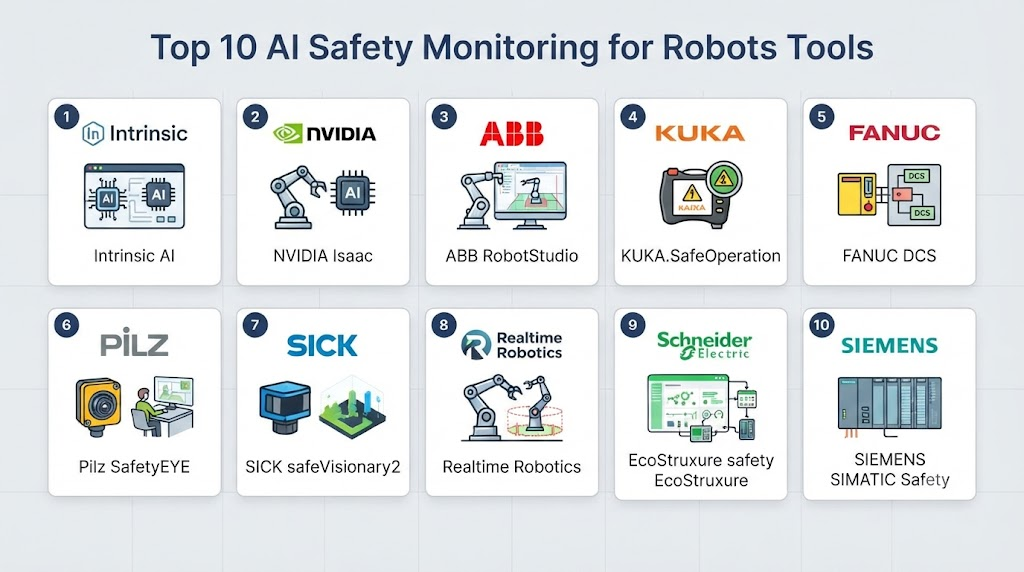
Top 10 AI Safety Monitoring for Robots Tools
1. NVIDIA Isaac ROS
One-line verdict: Best for AI-enabled robots requiring accelerated perception, sensor processing, and real-time edge robotics capabilities.
Short description:
NVIDIA Isaac ROS provides robotics software components designed for ROS 2 and accelerated computing. It can support safety-monitoring architectures through perception, sensor processing, localization, object detection, and other AI-enabled robotics functions.
Standout Capabilities
- GPU-accelerated robotics workloads.
- Computer vision.
- Sensor processing.
- Localization.
- Object detection.
- ROS 2 integration.
- Edge AI.
- Robotics acceleration.
AI-Specific Depth
- Model support: Supports AI workflows compatible with the NVIDIA robotics ecosystem.
- RAG / knowledge integration: N/A.
- Evaluation: Simulation, robotics testing, and application-level evaluation can be incorporated.
- Guardrails: Safety logic must be implemented at the system level.
- Observability: ROS 2 tooling and system-performance monitoring.
Pros
- Strong edge-AI performance.
- Useful for real-time perception.
- Integrates with modern robotics architectures.
Cons
- Hardware ecosystem considerations.
- Requires robotics expertise.
- Not a complete safety-management platform by itself.
Security & Compliance
Security depends on the complete deployment architecture, operating system, network, hardware, and application configuration. Specific certifications should be verified for the intended product configuration.
Deployment & Platforms
- Linux.
- Edge.
- Embedded systems.
- ROS 2-compatible robotics platforms.
Integrations & Ecosystem
- ROS 2.
- NVIDIA Jetson.
- Cameras.
- LiDAR.
- Depth sensors.
- AI models.
- Simulation environments.
Pricing Model
Varies by software component and hardware configuration.
Best-Fit Scenarios
- AI-powered industrial robots.
- Autonomous mobile robots.
- Edge safety perception.
2. ROS 2
One-line verdict: Best for robotics teams building custom safety-monitoring architectures around distributed sensors, AI models, and robot-control systems.
Short description:
ROS 2 provides middleware and development infrastructure for robotics applications. It can connect perception, monitoring, navigation, diagnostics, safety logic, AI models, and robot controllers into a distributed architecture.
Standout Capabilities
- Distributed communication.
- Sensor integration.
- Robot-state monitoring.
- Diagnostics.
- AI integration.
- Navigation.
- Lifecycle management.
- Modular architecture.
AI-Specific Depth
- Model support: External AI and machine-learning frameworks can be integrated.
- RAG / knowledge integration: Possible at the application layer but not a core safety feature.
- Evaluation: Testing, simulation, logging, and replay can support evaluation.
- Guardrails: Must be designed into the application.
- Observability: Logs, diagnostics, telemetry, and distributed monitoring.
Pros
- Highly flexible.
- Strong robotics ecosystem.
- Suitable for custom safety architectures.
Cons
- Requires significant engineering.
- Safety implementation is application-specific.
- Not an out-of-the-box safety certification solution.
Security & Compliance
ROS 2 security capabilities depend on the DDS implementation and system configuration. Certification depends on the complete deployed system.
Deployment & Platforms
- Linux.
- Edge.
- Embedded.
- Industrial computers.
- Cloud-connected systems.
Integrations & Ecosystem
- Cameras.
- LiDAR.
- IMUs.
- Robot controllers.
- Navigation systems.
- AI frameworks.
- Simulation platforms.
Pricing Model
Open-source.
Best-Fit Scenarios
- Custom robot safety monitoring.
- Research robotics.
- Multi-sensor autonomous systems.
3. Gazebo
One-line verdict: Best for testing robot safety behavior in simulation before exposing physical robots to dangerous edge cases.
Short description:
Gazebo provides robotics simulation capabilities that allow teams to model robots, sensors, environments, and physical interactions. It is particularly valuable for safety testing because unusual or dangerous scenarios can be reproduced virtually.
Standout Capabilities
- Physics simulation.
- Robot simulation.
- Sensor simulation.
- 3D environments.
- ROS 2 integration.
- Failure testing.
- Autonomous-system testing.
- Scenario generation.
AI-Specific Depth
- Model support: External AI models can be integrated.
- RAG / knowledge integration: N/A.
- Evaluation: Strong simulation-based evaluation capabilities.
- Guardrails: Provides a safe test environment but does not replace physical safety mechanisms.
- Observability: Simulation logs and robotics telemetry.
Pros
- Reduces physical testing risk.
- Useful for edge-case testing.
- Supports repeatable experiments.
Cons
- Simulation cannot reproduce every real-world condition.
- Requires configuration and engineering.
- Sim-to-real differences can affect conclusions.
Security & Compliance
Primarily dependent on the development environment and system architecture.
Deployment & Platforms
- Desktop.
- Linux.
- Simulation environments.
- Cloud-based simulation is possible depending on infrastructure.
Integrations & Ecosystem
- ROS 2.
- PX4.
- Robot platforms.
- Sensors.
- AI models.
- Physics engines.
Pricing Model
Open-source.
Best-Fit Scenarios
- Safety validation.
- Failure simulation.
- Autonomous robot testing.
4. NVIDIA Isaac Sim
One-line verdict: Best for advanced robot safety testing using photorealistic simulation, synthetic data, and complex AI perception scenarios.
Short description:
NVIDIA Isaac Sim is a robotics simulation platform that can be used to test autonomous systems, sensors, perception models, navigation, and robot behavior in simulated environments.
Standout Capabilities
- High-fidelity simulation.
- Synthetic data generation.
- Sensor simulation.
- AI perception testing.
- Robotics environments.
- Digital-twin workflows.
- ROS 2 integration.
- Scenario testing.
AI-Specific Depth
- Model support: Supports AI and robotics model workflows within its ecosystem.
- RAG / knowledge integration: N/A.
- Evaluation: Strong support for simulation-driven testing.
- Guardrails: Supports scenario-level safety testing; physical safety requires additional controls.
- Observability: Simulation metrics and robotics telemetry.
Pros
- Powerful simulation environment.
- Useful for AI perception testing.
- Supports complex scenarios.
Cons
- Computational requirements can be substantial.
- Complex environments require engineering.
- Simulation still needs physical validation.
Security & Compliance
Depends on the deployment environment and complete robotics architecture.
Deployment & Platforms
- Workstation.
- Linux.
- GPU-accelerated environments.
- Cloud infrastructure where supported.
Integrations & Ecosystem
- ROS 2.
- NVIDIA hardware.
- Cameras.
- LiDAR.
- Robot models.
- AI systems.
- Digital-twin workflows.
Pricing Model
Varies by deployment and NVIDIA software ecosystem.
Best-Fit Scenarios
- Industrial robotics.
- AI safety testing.
- Digital-twin validation.
5. MoveIt 2
One-line verdict: Best for monitoring and validating motion-planning behavior in ROS 2-based robotic manipulation systems.
Short description:
MoveIt 2 is a robotics software framework focused on manipulation and motion planning. Although it is not a complete AI safety-monitoring platform, it can contribute important motion-planning and collision-checking capabilities to a robot safety architecture.
Standout Capabilities
- Motion planning.
- Collision checking.
- Robot manipulation.
- Trajectory generation.
- ROS 2 integration.
- Kinematics.
- Planning-scene monitoring.
AI-Specific Depth
- Model support: External AI planners and perception systems can be integrated.
- RAG / knowledge integration: N/A.
- Evaluation: Planning and simulation-based testing.
- Guardrails: Collision checking and planning constraints.
- Observability: Robot state and planning information.
Pros
- Strong manipulation ecosystem.
- Useful for collision-aware planning.
- Integrates well with ROS 2.
Cons
- Focused on manipulation rather than overall AI safety.
- Requires integration with other monitoring systems.
- Safety certification depends on the complete robot system.
Security & Compliance
Application-specific.
Deployment & Platforms
- Linux.
- ROS 2.
- Industrial computers.
- Robot controllers through integration.
Integrations & Ecosystem
- ROS 2.
- Robot arms.
- Motion planners.
- Cameras.
- Depth sensors.
- Simulation.
Pricing Model
Open-source.
Best-Fit Scenarios
- Robotic arms.
- Manipulation safety.
- Collision-aware motion planning.
6. OpenRMF
One-line verdict: Best for coordinating and monitoring fleets of autonomous robots operating within shared facilities.
Short description:
OpenRMF provides an open framework for managing fleets of robots and coordinating their interactions with shared infrastructure. It is particularly useful for environments where multiple autonomous robots need to share spaces, doors, elevators, and other resources.
Standout Capabilities
- Robot fleet coordination.
- Traffic management.
- Shared-resource management.
- Building integration.
- Multi-robot operations.
- ROS 2 architecture.
- Fleet adapters.
AI-Specific Depth
- Model support: External AI systems can be integrated.
- RAG / knowledge integration: N/A.
- Evaluation: Simulation and operational testing.
- Guardrails: Resource and traffic coordination provide system-level controls.
- Observability: Robot and fleet state monitoring.
Pros
- Strong multi-robot focus.
- Useful for indoor environments.
- Open architecture.
Cons
- Not a general-purpose AI safety platform.
- Requires integration with individual robot systems.
- Safety depends on the broader architecture.
Security & Compliance
Depends on implementation and deployment environment.
Deployment & Platforms
- Linux.
- Edge.
- Facility infrastructure.
- ROS 2.
Integrations & Ecosystem
- Autonomous mobile robots.
- Building-management systems.
- Elevators.
- Doors.
- Traffic-management systems.
- ROS 2.
Pricing Model
Open-source.
Best-Fit Scenarios
- Warehouse robots.
- Hospital robots.
- Multi-robot facilities.
7. Webots
One-line verdict: Best for accessible robot simulation and repeatable testing of autonomous behaviors and safety scenarios.
Short description:
Webots is a robotics simulator used for developing and testing robots in virtual environments. It can help teams evaluate navigation, sensors, control logic, and AI behavior before physical deployment.
Standout Capabilities
- Robot simulation.
- Sensor simulation.
- Physics.
- 3D environments.
- Autonomous navigation.
- Multi-robot scenarios.
- Controller development.
AI-Specific Depth
- Model support: External AI frameworks can be connected.
- RAG / knowledge integration: N/A.
- Evaluation: Simulation-based testing.
- Guardrails: Supports virtual safety scenarios; physical safety remains separate.
- Observability: Simulation data and logs.
Pros
- Accessible simulation environment.
- Useful for repeatable experiments.
- Supports multiple robot types.
Cons
- Simulation differs from physical environments.
- Complex scenarios require engineering.
- Not a production safety monitor by itself.
Security & Compliance
Depends on the application and development environment.
Deployment & Platforms
- Windows.
- Linux.
- macOS.
- Simulation environments.
Integrations & Ecosystem
- ROS 2.
- Robot controllers.
- Sensors.
- Python.
- C/C++.
- AI systems.
Pricing Model
Open-source and commercial licensing options may vary by use case.
Best-Fit Scenarios
- Robotics development.
- Safety simulations.
- Education and research.
8. NVIDIA DeepStream
One-line verdict: Best for real-time camera-based safety monitoring around robots, workers, vehicles, and industrial environments.
Short description:
NVIDIA DeepStream is a software toolkit for building real-time video analytics pipelines. It can support robot safety systems that need to detect people, objects, zones, vehicles, and other visual events around autonomous machines.
Standout Capabilities
- Real-time video analytics.
- Multi-camera processing.
- Object detection.
- Object tracking.
- Edge AI.
- GPU acceleration.
- Video pipelines.
- Event processing.
AI-Specific Depth
- Model support: Supports multiple AI inference workflows.
- RAG / knowledge integration: N/A.
- Evaluation: Application-specific model evaluation.
- Guardrails: Safety policies must be implemented by the application.
- Observability: Video analytics and pipeline metrics.
Pros
- Strong real-time performance.
- Useful for visual safety monitoring.
- Supports multi-camera environments.
Cons
- Primarily a video analytics toolkit.
- Requires application-level safety logic.
- NVIDIA hardware considerations apply.
Security & Compliance
Depends on system deployment and configuration.
Deployment & Platforms
- Edge.
- Linux.
- NVIDIA GPU systems.
- Embedded NVIDIA platforms.
Integrations & Ecosystem
- Cameras.
- AI models.
- ROS.
- ROS 2.
- MQTT.
- Video-management systems.
- Edge hardware.
Pricing Model
Varies by NVIDIA software and hardware deployment.
Best-Fit Scenarios
- Worker-robot monitoring.
- Industrial vision safety.
- Multi-camera robot environments.
9. TensorRT
One-line verdict: Best for optimizing AI safety and perception models when low-latency inference is critical on NVIDIA hardware.
Short description:
TensorRT is an inference optimization and runtime technology for NVIDIA hardware. It can help deploy computer-vision and machine-learning models with lower latency and improved efficiency, which can be valuable in real-time robotic monitoring.
Standout Capabilities
- AI inference optimization.
- GPU acceleration.
- Low-latency inference.
- Model optimization.
- Edge deployment.
- Computer-vision workloads.
- Runtime execution.
AI-Specific Depth
- Model support: Supports models compatible with its supported deployment ecosystem.
- RAG / knowledge integration: N/A.
- Evaluation: Performance benchmarking and model validation must be incorporated into the application workflow.
- Guardrails: Not a safety-policy framework.
- Observability: Application-level inference metrics can be collected.
Pros
- High-performance inference.
- Useful for real-time safety perception.
- Strong NVIDIA ecosystem.
Cons
- NVIDIA hardware dependency.
- Not a robot safety platform.
- Requires engineering expertise.
Security & Compliance
Depends on the complete application and deployment environment.
Deployment & Platforms
- Edge.
- Embedded.
- NVIDIA GPUs.
- Linux environments.
Integrations & Ecosystem
- NVIDIA Jetson.
- NVIDIA GPUs.
- Computer-vision models.
- DeepStream.
- ROS.
- ROS 2.
Pricing Model
Varies by deployment and associated NVIDIA hardware/software.
Best-Fit Scenarios
- Real-time robot perception.
- Edge safety AI.
- Vision-based anomaly detection.
10. PyTorch
One-line verdict: Best for robotics teams developing custom AI models for anomaly detection, perception, safety classification, and predictive monitoring.
Short description:
PyTorch is a machine-learning framework that can be used to build AI models for robotics safety applications. It can support perception, anomaly detection, classification, predictive maintenance, and other machine-learning workloads that become components of a broader safety architecture.
Standout Capabilities
- Deep learning.
- Computer vision.
- Model training.
- Anomaly detection.
- Custom model development.
- GPU acceleration.
- Research ecosystem.
AI-Specific Depth
- Model support: Broad machine-learning model development.
- RAG / knowledge integration: Possible through external application components.
- Evaluation: Extensive model-testing capabilities through the broader ML ecosystem.
- Guardrails: Must be implemented at the application level.
- Observability: Training and inference metrics through surrounding tooling.
Pros
- Highly flexible.
- Large AI ecosystem.
- Strong research adoption.
Cons
- Not a robot safety platform.
- Requires substantial ML engineering.
- Production safety requires additional deterministic controls.
Security & Compliance
Depends on the complete deployment architecture.
Deployment & Platforms
- Linux.
- Windows.
- macOS.
- Edge.
- Cloud.
- Embedded through appropriate deployment approaches.
Integrations & Ecosystem
- Computer vision.
- Robotics frameworks.
- NVIDIA GPUs.
- ROS 2.
- Data pipelines.
- Model-serving systems.
Pricing Model
Open-source.
Best-Fit Scenarios
- Custom anomaly detection.
- AI perception.
- Predictive robot monitoring.
Comparison Table
| Tool | Best For | Deployment | Model Flexibility | Strength | Watch-Out | Public Rating |
|---|---|---|---|---|---|---|
| NVIDIA Isaac ROS | AI robotics perception | Edge / Embedded | Multi-model | Accelerated robotics | Requires NVIDIA ecosystem | N/A |
| ROS 2 | Custom safety architectures | Edge / Embedded | Multi-model | Flexible robotics middleware | Engineering required | N/A |
| Gazebo | Safety simulation | Desktop / Cloud | Multi-model | Repeatable testing | Sim-to-real gap | N/A |
| NVIDIA Isaac Sim | Advanced simulation | Workstation / Cloud | Multi-model | High-fidelity environments | Computational requirements | N/A |
| MoveIt 2 | Manipulation safety | Edge / Embedded | Multi-model | Motion planning | Narrower scope | N/A |
| OpenRMF | Robot fleet monitoring | Edge / Facility | Multi-model | Multi-robot coordination | Integration required | N/A |
| Webots | Accessible simulation | Desktop | Multi-model | Easy experimentation | Not production safety monitoring | N/A |
| NVIDIA DeepStream | Vision safety | Edge | Multi-model | Real-time video analytics | Vision-focused | N/A |
| TensorRT | Fast AI inference | Edge / Embedded | Multi-model | Low-latency inference | NVIDIA dependency | N/A |
| PyTorch | Custom safety AI | Edge / Cloud | Multi-model | Model development | Requires complete safety layer | N/A |
Scoring & Evaluation
The scoring below is a comparative assessment of suitability for AI-enabled robot safety monitoring, not a certification or vendor ranking.
| Tool | Core | Reliability/Eval | Guardrails | Integrations | Ease | Perf/Cost | Security/Admin | Support | Weighted Total |
|---|---|---|---|---|---|---|---|---|---|
| NVIDIA Isaac ROS | 9.5 | 9 | 8.5 | 9.5 | 7.5 | 9.5 | 8.5 | 9.5 | 9.0 |
| ROS 2 | 9.5 | 9.5 | 8.5 | 10 | 7 | 9 | 8 | 9.5 | 9.0 |
| Gazebo | 9 | 10 | 8 | 9.5 | 7.5 | 8.5 | 7.5 | 9 | 8.8 |
| NVIDIA Isaac Sim | 9.5 | 10 | 8.5 | 9.5 | 7 | 8 | 8.5 | 9.5 | 8.9 |
| MoveIt 2 | 8.5 | 9 | 9 | 9.5 | 7.5 | 8.5 | 8 | 9 | 8.7 |
| OpenRMF | 9 | 9 | 9 | 9.5 | 7.5 | 8.5 | 8 | 8.5 | 8.8 |
| Webots | 8 | 9 | 8 | 9 | 8.5 | 8.5 | 7.5 | 8.5 | 8.4 |
| NVIDIA DeepStream | 8.5 | 9 | 7.5 | 9 | 8 | 9.5 | 8 | 9.5 | 8.7 |
| TensorRT | 8 | 9 | 7 | 8.5 | 7.5 | 10 | 8 | 9.5 | 8.5 |
| PyTorch | 8.5 | 9.5 | 7 | 10 | 7.5 | 9 | 7.5 | 10 | 8.8 |
Top 3 for Enterprise
- NVIDIA Isaac ROS
- ROS 2
- NVIDIA Isaac Sim
Top 3 for SMB
- Webots
- ROS 2
- Gazebo
Top 3 for Developers
- ROS 2
- PyTorch
- Gazebo
Which AI Safety Monitoring for Robots Tool Is Right for You?
Solo / Freelancer
For individual developers, start with open-source tools rather than attempting to build a large safety platform immediately.
Good choices include:
- ROS 2.
- Gazebo.
- Webots.
- PyTorch.
Use simulation to reproduce failures before testing physical hardware.
SMB
SMBs should prioritize simplicity and integration.
A practical stack could combine:
- ROS 2 for robotics middleware.
- Gazebo or Webots for simulation.
- A perception model for detecting people and obstacles.
- Deterministic robot-control safety mechanisms.
- Centralized logging and alerts.
Avoid depending entirely on an AI model for safety-critical decisions.
Mid-Market
Mid-market organizations should build layered safety monitoring.
A useful architecture includes:
- Sensors.
- Sensor fusion.
- AI perception.
- Anomaly detection.
- Safety-policy engine.
- Motion monitoring.
- Robot controller.
- Fleet monitoring.
- Event logging.
- Human intervention.
AI should provide additional intelligence while deterministic safety mechanisms handle predictable physical constraints.
Enterprise
Enterprise robotics deployments need stronger governance.
Focus on:
- Fleet-wide observability.
- Robot identity.
- Access control.
- Model versioning.
- Software version management.
- Safety-policy management.
- Incident investigation.
- Secure communications.
- Data retention.
- Human escalation.
- Controlled updates.
- Regression testing.
Every safety incident should be traceable to the robot, software version, AI model, configuration, environment, and relevant sensor data.
Regulated Industries
Healthcare, public-sector, manufacturing, transportation, and other regulated environments may require additional documentation and validation.
Teams should identify applicable regulations and standards before selecting technology.
Important records can include:
- Safety-test results.
- Model versions.
- Software versions.
- Configuration changes.
- Incident reports.
- Robot logs.
- Operator actions.
- Validation evidence.
Budget vs Premium
Open-source tools can reduce licensing costs but shift more responsibility to internal engineering teams.
Commercial and enterprise ecosystems may reduce integration effort but can introduce licensing, hardware, and vendor-dependency considerations.
Total cost should include:
- Hardware.
- Engineering.
- Simulation.
- Testing.
- Maintenance.
- Monitoring infrastructure.
- AI inference.
- Support.
- Security.
- Compliance work.
Build vs Buy
Build when:
- Robot behavior is highly specialized.
- You need custom AI models.
- Your team has strong robotics expertise.
- Existing platforms do not support your sensors or hardware.
- You need complete control over safety logic.
Buy when:
- You need deployment quickly.
- Fleet monitoring is a priority.
- Your organization lacks robotics infrastructure expertise.
- You need commercial support.
- Your robots use standardized hardware.
Implementation Playbook
First 30 Days: Pilot + Baseline
Start with one or a small number of robots.
Establish baseline metrics for:
- Collision events.
- Near misses.
- Emergency stops.
- Sensor failures.
- AI false positives.
- AI false negatives.
- Detection latency.
- Model confidence.
- CPU/GPU utilization.
- Network latency.
- Human interventions.
Build an initial simulation environment and reproduce known failure scenarios.
Days 31–60: Security + Evaluation + Controlled Deployment
Develop an AI evaluation harness.
Test:
- Poor lighting.
- Occlusions.
- Reflective surfaces.
- Sensor dropout.
- Camera failure.
- LiDAR degradation.
- Unexpected objects.
- Human movement.
- Communication loss.
- Model uncertainty.
Introduce:
- Model version control.
- Prompt/version control where applicable.
- Red-team testing.
- Access controls.
- Secure update processes.
- Incident-response procedures.
Days 61–90: Optimization + Governance
After validating safety behavior:
- Optimize inference latency.
- Reduce unnecessary AI processing.
- Improve sensor-fusion efficiency.
- Tune alert thresholds.
- Establish fleet-wide dashboards.
- Automate incident collection.
- Implement model rollback.
- Establish governance reviews.
- Document safety procedures.
- Expand controlled deployment.
Common Mistakes & How to Avoid Them
- Treating AI as the only safety mechanism: Combine AI with deterministic controls.
- Skipping simulation: Test dangerous scenarios virtually first.
- Ignoring false negatives: A missed person or obstacle can be more serious than a false alert.
- Ignoring false positives: Excessive alerts can cause operators to ignore warnings.
- No evaluation harness: Continuously test AI behavior against known edge cases.
- Uncontrolled model updates: Validate every new model before deployment.
- No observability: Record enough information to reconstruct incidents.
- Poor data retention: Keep relevant logs according to operational and privacy requirements.
- No human override: Maintain appropriate intervention mechanisms.
- Ignoring latency: A safety decision that arrives too late may be useless.
- No sensor-failure testing: Test individual and combined sensor failures.
- Overlooking cybersecurity: Protect robot communication and software infrastructure.
- No fleet-level monitoring: A problem affecting one robot may indicate a systemic issue.
- Vendor lock-in: Maintain abstraction layers where practical.
- Testing only normal conditions: Include unusual, degraded, and adversarial scenarios.
FAQs
What is AI safety monitoring for robots?
It is the use of software, sensors, AI models, and safety mechanisms to detect and respond to unsafe robot behavior or environmental conditions.
Does AI safety monitoring replace emergency stops?
No. AI monitoring should generally complement established physical and deterministic safety mechanisms rather than replace them.
Can ROS 2 be used for robot safety monitoring?
Yes. ROS 2 can connect sensors, diagnostics, AI models, monitoring systems, and robot controllers, but the actual safety architecture must be designed and validated for the application.
Can AI detect unsafe robot behavior?
AI can identify patterns such as people, obstacles, unusual movements, or sensor anomalies. However, AI predictions should be combined with deterministic safety controls where appropriate.
Why is simulation important for robot safety?
Simulation allows teams to test dangerous and rare conditions without exposing people or expensive hardware to those conditions.
What should a robot safety-monitoring system record?
Useful records can include robot state, sensor events, AI outputs, model versions, software versions, alerts, operator interventions, and incident information.
Can safety AI run entirely on the cloud?
Cloud systems can be useful for analytics and fleet management, but latency-sensitive safety functions generally benefit from local or edge processing.
What is model drift in robotics?
Model drift occurs when real-world conditions change enough that an AI model’s performance decreases. Lighting, environments, objects, sensors, and operating conditions can all contribute.
How should AI models be evaluated for robot safety?
Use representative datasets, simulation, controlled physical tests, edge-case scenarios, regression tests, failure injection, and human review where appropriate.
What are AI guardrails in robotics?
Guardrails are restrictions and controls that prevent AI systems from producing or executing unsafe actions. They can include policy checks, action constraints, confidence thresholds, and deterministic limits.
Can one platform monitor an entire robot fleet?
Some fleet platforms can provide centralized monitoring, while custom architectures may combine fleet management with robotics middleware, AI monitoring, and observability systems.
How can organizations reduce false alarms?
Use better sensor fusion, calibrated thresholds, contextual rules, improved models, temporal filtering, and human feedback to distinguish meaningful events from harmless anomalies.
Is open-source software suitable for safety-critical robotics?
Open-source software can be part of sophisticated robotics systems, but suitability depends on the complete architecture, validation process, hardware, applicable standards, and operational requirements.
What is the biggest challenge in AI robot safety?
The biggest challenge is managing uncertainty. Robots operate in physical environments where sensors can fail, conditions can change, and AI predictions can be imperfect.
Should robot safety monitoring use multiple AI models?
It can. Different models may handle perception, anomaly detection, prediction, or classification. However, additional models also increase complexity and require careful evaluation.
Conclusion
AI safety monitoring is becoming an essential layer in autonomous robotics as machines move from predictable automation toward perception-driven and AI-assisted decision-making.The strongest architectures do not depend on a single AI model. Instead, they combine sensors, deterministic safety controls, AI perception, anomaly detection, simulation, observability, human oversight, and secure software infrastructure.ROS 2 is particularly useful for building flexible monitoring architectures, while NVIDIA Isaac ROS can provide accelerated AI capabilities at the edge. Gazebo, Isaac Sim, and Webots are valuable for safety testing and simulation. For specific applications, MoveIt 2, OpenRMF, DeepStream, TensorRT, and PyTorch can provide important components of a broader robot safety stack.The best solution depends on robot type, AI complexity, operating environment, safety requirements, fleet size, and engineering resources