Introduction
AI Materials Informatics Platforms combine machine learning, materials science, simulation, experimental data, and optimization to help researchers discover, characterize, and develop materials faster. Instead of relying entirely on trial-and-error experimentation, these platforms can analyze large materials datasets, predict properties, identify promising candidates, recommend experiments, and connect computational predictions with laboratory workflows.
They are increasingly useful in battery materials, semiconductors, polymers, catalysts, metals, composites, pharmaceuticals, coatings, and advanced manufacturing. Modern platforms can combine machine learning with molecular or crystal representations, simulation results, experimental measurements, scientific literature, and laboratory data.
Best for: Materials scientists, computational chemists, R&D teams, battery companies, semiconductor organizations, chemical manufacturers, universities, advanced-materials startups, and enterprises running large experimental or simulation programs.
Not ideal for: Small materials projects with limited datasets, organizations without domain expertise, or teams that only need basic spreadsheet analysis rather than predictive modeling and materials-specific workflows.
When evaluating a platform, consider materials coverage, data ingestion, scientific representations, model selection, uncertainty estimation, simulation integration, experiment planning, active learning, explainability, scalability, security, deployment options, APIs, and integration with laboratory systems.
What’s Changed in AI Materials Informatics Platforms
- AI-assisted materials discovery is moving beyond simple property prediction: Modern workflows increasingly combine prediction, candidate generation, ranking, and experimental validation.
- Generative AI is becoming relevant: Models can propose new molecules, compositions, structures, and formulations subject to scientific constraints.
- Foundation models are emerging in materials science: Models trained on large scientific datasets can provide reusable representations for downstream materials tasks.
- Active learning is increasingly important: AI can identify which experiment or simulation should be performed next.
- Autonomous experimentation is expanding: Materials informatics is increasingly connected to robotic laboratories and automated synthesis systems.
- Multimodal scientific data is becoming standard: Platforms may need to combine numerical measurements, structures, microscopy images, spectra, text, and simulation results.
- Physics-informed machine learning is gaining importance: Materials models increasingly incorporate physical relationships rather than relying exclusively on statistical patterns.
- Uncertainty estimation matters more: Researchers need to know when a model is confident and when additional experiments are necessary.
- Data provenance is becoming critical: Materials teams need traceability from source data through preprocessing, model training, prediction, and experimental validation.
- AI-assisted literature mining is expanding: Scientific publications and patents can provide valuable information for materials discovery workflows.
- Compute efficiency is increasingly important: Large scientific models can require substantial computational resources, making model selection and inference optimization important.
- Human-in-the-loop discovery remains essential: AI recommendations still require materials expertise and experimental validation.
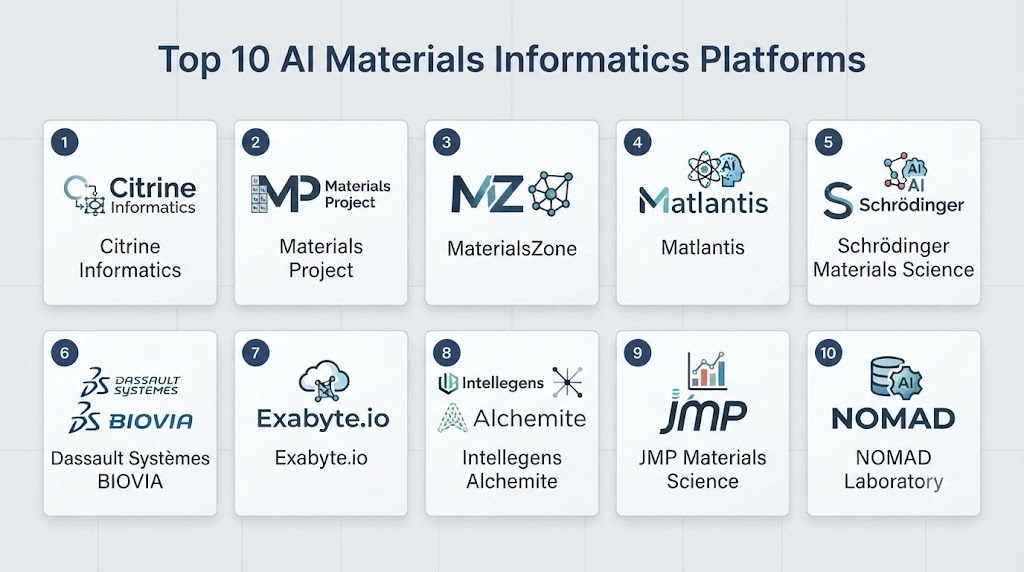
Top 10 AI Materials Informatics Platforms
1. Citrine Informatics
One-line verdict: Best for industrial materials R&D teams seeking AI-driven materials discovery, optimization, and experimental learning.
Short description:
Citrine Informatics provides materials informatics capabilities designed to help organizations use data and machine learning for materials development. Its approach focuses on connecting materials data, predictive models, optimization, and experimentation.
Standout Capabilities
- Materials property prediction.
- Materials data management.
- AI-assisted materials discovery.
- Experimental optimization.
- Design-space exploration.
- Active-learning-oriented workflows.
- Materials knowledge management.
- Industrial R&D support.
AI-Specific Depth
- Model support: Materials-focused machine-learning models; exact model options vary by workflow.
- RAG / knowledge integration: Materials and scientific data integration rather than conventional enterprise RAG.
- Evaluation: Model validation and comparison workflows.
- Guardrails: Domain constraints and user-defined materials requirements.
- Observability: Model and experiment tracking capabilities vary by deployment.
Pros
- Strong materials-science focus.
- Designed around industrial R&D workflows.
- Useful for connecting predictions with experiments.
Cons
- Enterprise-oriented implementation may require substantial setup.
- Exact capabilities vary by deployment.
- Pricing is not publicly stated as a universal standard.
Security & Compliance
Enterprise security capabilities depend on deployment. Specific certifications are Not publicly stated where not independently verified.
Deployment & Platforms
- Cloud.
- Enterprise environments.
- Deployment details vary.
Integrations & Ecosystem
Citrine is designed to connect materials datasets, machine-learning workflows, and experimental processes.
- Materials databases.
- Experimental datasets.
- Simulation outputs.
- APIs.
- Internal R&D systems.
- Materials workflows.
Pricing Model
Enterprise-oriented pricing. Not publicly stated.
Best-Fit Scenarios
- Industrial materials discovery.
- Formulation optimization.
- Data-driven experimental R&D.
2. Materials Project
One-line verdict: Best for researchers using large-scale computational materials data as a foundation for AI-driven materials discovery.
Short description:
Materials Project is a major open scientific resource containing computational materials data. Although it is not a conventional commercial AI platform, its datasets can serve as an important foundation for materials machine learning, property prediction, screening, and scientific model development.
Standout Capabilities
- Large computational materials datasets.
- Crystal-structure information.
- Calculated material properties.
- Materials screening.
- Open scientific access.
- Programmatic data access.
- Research-oriented workflows.
- AI dataset development.
AI-Specific Depth
- Model support: N/A as a dedicated platform; datasets can support custom ML models.
- RAG / knowledge integration: Materials data can be incorporated into scientific knowledge workflows.
- Evaluation: Researchers perform their own model evaluation.
- Guardrails: Scientific constraints depend on the downstream model.
- Observability: Depends on the user’s ML stack.
Pros
- Highly valuable materials dataset resource.
- Strong academic ecosystem.
- Useful for building custom AI models.
Cons
- Not a complete enterprise materials informatics platform.
- Experimental data coverage differs from computational data.
- Users need their own modeling infrastructure for many AI workflows.
Security & Compliance
Specific enterprise certifications are Not publicly stated.
Deployment & Platforms
- Web.
- APIs.
- Research computing environments.
Integrations & Ecosystem
- Materials datasets.
- Python workflows.
- Scientific computing.
- Machine learning.
- Computational materials research.
- External databases.
Pricing Model
Public research resource.
Best-Fit Scenarios
- Materials ML research.
- Dataset development.
- Computational materials screening.
3. OQMD
One-line verdict: Best for researchers developing materials prediction models from large computational databases of inorganic compounds.
Short description:
The Open Quantum Materials Database provides computational materials data that can be used for materials discovery and machine-learning research. It is particularly relevant for researchers working with inorganic compounds and computational property datasets.
Standout Capabilities
- Computational materials data.
- Compound screening.
- Structure-property research.
- Materials discovery.
- Database-driven analysis.
- Machine-learning dataset creation.
- High-throughput computational research.
AI-Specific Depth
- Model support: N/A as a dedicated ML platform.
- RAG / knowledge integration: Data can support scientific knowledge workflows.
- Evaluation: User-defined.
- Guardrails: Scientific constraints depend on downstream models.
- Observability: User-defined.
Pros
- Useful computational materials dataset.
- Valuable for research.
- Supports large-scale screening approaches.
Cons
- Requires ML development for advanced AI workflows.
- Primarily computational rather than experimental.
- Not an end-to-end commercial R&D platform.
Security & Compliance
Specific certifications are Not publicly stated.
Deployment & Platforms
- Web.
- Data access tools.
- Research environments.
Integrations & Ecosystem
- Materials research.
- Python.
- Machine learning.
- Computational chemistry.
- Scientific databases.
- Custom analytics.
Pricing Model
Public research database.
Best-Fit Scenarios
- Inorganic materials discovery.
- ML dataset creation.
- Computational screening.
4. NOMAD
One-line verdict: Best for research organizations working with computational materials data, simulation results, and machine-learning-ready scientific datasets.
Short description:
NOMAD provides infrastructure for managing and accessing computational materials data. Its ecosystem is relevant to AI materials informatics because standardized computational data can be used to train models and compare materials simulations.
Standout Capabilities
- Computational materials data management.
- Simulation data.
- Materials metadata.
- Data standardization.
- Research collaboration.
- Machine-learning data preparation.
- Materials discovery support.
AI-Specific Depth
- Model support: N/A as a dedicated AI platform.
- RAG / knowledge integration: Scientific data and metadata can support knowledge systems.
- Evaluation: User-defined.
- Guardrails: Data and scientific constraints depend on implementation.
- Observability: Depends on downstream ML tooling.
Pros
- Strong scientific-data infrastructure.
- Useful for computational materials research.
- Supports reproducible scientific workflows.
Cons
- Not a turnkey AI discovery platform.
- Requires additional ML tooling.
- Best suited to technically capable research teams.
Security & Compliance
Specific certifications are Not publicly stated.
Deployment & Platforms
- Web.
- Research infrastructure.
- Cloud-oriented scientific data services.
Integrations & Ecosystem
- Computational simulations.
- Materials datasets.
- APIs.
- Scientific software.
- ML pipelines.
- Research environments.
Pricing Model
Research-oriented infrastructure. Not publicly stated as a commercial standard.
Best-Fit Scenarios
- Computational materials research.
- AI dataset preparation.
- Simulation-data management.
5. Matminer
One-line verdict: Best for developers and researchers transforming materials data into machine-learning features and predictive modeling pipelines.
Short description:
Matminer is an open-source Python library for materials data mining and feature generation. It is particularly useful for preparing materials datasets for machine-learning models.
Standout Capabilities
- Materials featurization.
- Data preprocessing.
- Composition-based features.
- Structure-based features.
- Machine-learning dataset preparation.
- Python integration.
- Materials science workflows.
- Integration with scientific Python tools.
AI-Specific Depth
- Model support: Primarily feature engineering; downstream models depend on the user’s ML framework.
- RAG / knowledge integration: N/A.
- Evaluation: User-defined.
- Guardrails: Materials-specific feature transformations.
- Observability: External ML tools required.
Pros
- Open-source.
- Strong Python ecosystem.
- Excellent for materials ML preprocessing.
Cons
- Not a complete discovery platform.
- Requires programming expertise.
- Users must build downstream ML workflows.
Security & Compliance
Specific certifications are Not publicly stated.
Deployment & Platforms
- Windows.
- macOS.
- Linux.
- Cloud.
- Self-hosted.
Integrations & Ecosystem
- Python.
- Pymatgen.
- scikit-learn.
- Materials Project data.
- Jupyter.
- Scientific ML pipelines.
Pricing Model
Open-source.
Best-Fit Scenarios
- Materials ML development.
- Feature engineering.
- Research data pipelines.
6. Pymatgen
One-line verdict: Best for computational materials researchers building custom structure-aware AI and materials data pipelines.
Short description:
Pymatgen is a Python library for materials analysis and structure manipulation. It provides foundational capabilities for working with crystal structures, compositions, phase information, and computational materials data.
Standout Capabilities
- Crystal structure manipulation.
- Materials analysis.
- Composition handling.
- Phase-related workflows.
- Simulation-data processing.
- Python integration.
- Materials feature generation.
- Research automation.
AI-Specific Depth
- Model support: N/A as a dedicated AI platform.
- RAG / knowledge integration: N/A.
- Evaluation: User-defined.
- Guardrails: Materials structure validation and domain logic.
- Observability: External tools required.
Pros
- Highly established materials Python ecosystem.
- Flexible.
- Excellent foundation for custom AI systems.
Cons
- Requires programming.
- Not an end-to-end AI platform.
- AI modeling requires additional frameworks.
Security & Compliance
Specific certifications are Not publicly stated.
Deployment & Platforms
- Windows.
- macOS.
- Linux.
- Cloud.
- Self-hosted.
Integrations & Ecosystem
- Python.
- Matminer.
- Materials Project.
- Computational chemistry.
- Machine learning.
- Scientific workflows.
Pricing Model
Open-source.
Best-Fit Scenarios
- Custom materials AI.
- Crystal-structure modeling.
- Computational research pipelines.
7. DeepChem
One-line verdict: Best for developers building machine-learning workflows across chemistry, molecules, materials-related data, and scientific discovery.
Short description:
DeepChem is an open-source scientific machine-learning framework with tools for molecular and chemical machine learning. It can provide useful infrastructure for materials-adjacent discovery workflows involving molecular representations and predictive modeling.
Standout Capabilities
- Molecular machine learning.
- Graph-based modeling.
- Scientific datasets.
- Property prediction.
- Deep learning.
- Model experimentation.
- Chemistry-focused workflows.
- Python integration.
AI-Specific Depth
- Model support: Multiple machine-learning and deep-learning approaches.
- RAG / knowledge integration: N/A.
- Evaluation: Standard ML evaluation workflows.
- Guardrails: Domain-specific validation depends on implementation.
- Observability: External tools can be integrated.
Pros
- Open-source.
- Strong scientific ML ecosystem.
- Useful for chemistry-related materials research.
Cons
- Not exclusively focused on materials science.
- Requires technical expertise.
- Production deployment requires additional infrastructure.
Security & Compliance
Specific certifications are Not publicly stated.
Deployment & Platforms
- Windows.
- macOS.
- Linux.
- Cloud.
- Self-hosted.
Integrations & Ecosystem
- Python.
- PyTorch.
- TensorFlow.
- Chemistry datasets.
- Graph models.
- Scientific ML.
Pricing Model
Open-source.
Best-Fit Scenarios
- Molecular materials research.
- Scientific ML.
- Chemistry-materials workflows.
8. ASE — Atomic Simulation Environment
One-line verdict: Best for computational materials teams connecting atomistic simulations with custom machine-learning and optimization workflows.
Short description:
The Atomic Simulation Environment provides Python tools for setting up, running, manipulating, and analyzing atomistic simulations. It can serve as infrastructure around AI-driven materials modeling and computational experiments.
Standout Capabilities
- Atomistic simulations.
- Structure manipulation.
- Simulation automation.
- Materials optimization.
- Python workflows.
- Calculator integration.
- Computational experiments.
- ML-assisted simulation workflows.
AI-Specific Depth
- Model support: Depends on integrated machine-learning tools.
- RAG / knowledge integration: N/A.
- Evaluation: Simulation-based validation.
- Guardrails: Physical simulation constraints.
- Observability: User-managed.
Pros
- Flexible atomistic simulation infrastructure.
- Strong Python integration.
- Useful for automated computational experiments.
Cons
- Not a turnkey AI platform.
- Requires scientific programming.
- ML capabilities depend on external tools.
Security & Compliance
Specific certifications are Not publicly stated.
Deployment & Platforms
- Windows.
- macOS.
- Linux.
- Cloud.
- HPC.
Integrations & Ecosystem
- Python.
- Computational chemistry.
- Molecular dynamics.
- Machine learning.
- HPC.
- Scientific optimization.
Pricing Model
Open-source.
Best-Fit Scenarios
- Atomistic AI workflows.
- Automated simulations.
- Materials research.
9. AiiDA
One-line verdict: Best for research teams requiring reproducible computational materials workflows and provenance-aware scientific data management.
Short description:
AiiDA is an open-source workflow engine designed for computational science. It focuses strongly on provenance and reproducibility, making it valuable for materials informatics pipelines where simulations, data transformations, and AI models need to remain traceable.
Standout Capabilities
- Computational workflows.
- Provenance tracking.
- Workflow automation.
- Scientific data management.
- Reproducibility.
- Simulation integration.
- Materials research.
- High-throughput calculations.
AI-Specific Depth
- Model support: AI capabilities depend on integrated ML frameworks.
- RAG / knowledge integration: Scientific data provenance rather than conventional RAG.
- Evaluation: Can integrate model evaluation into workflows.
- Guardrails: Workflow and provenance controls.
- Observability: Workflow provenance and process tracking.
Pros
- Strong reproducibility.
- Excellent provenance capabilities.
- Useful for high-throughput research.
Cons
- Requires technical expertise.
- Not a dedicated AI modeling environment.
- Integration work may be required.
Security & Compliance
Specific certifications are Not publicly stated.
Deployment & Platforms
- Linux.
- Cloud.
- Self-hosted.
- HPC.
Integrations & Ecosystem
- Computational materials codes.
- Python.
- HPC.
- Scientific workflows.
- Databases.
- ML pipelines.
Pricing Model
Open-source.
Best-Fit Scenarios
- Reproducible materials research.
- High-throughput simulation.
- Scientific AI workflows.
10. Custom Materials AI Discovery Stack
One-line verdict: Best for advanced R&D organizations building proprietary AI systems around unique materials data and laboratory workflows.
Short description:
Large materials organizations may build a custom stack combining scientific databases, machine-learning frameworks, simulation software, laboratory information, experiment automation, and optimization algorithms.
This approach provides maximum control but requires significant technical and scientific investment.
Standout Capabilities
- Custom materials prediction.
- Generative materials design.
- Active learning.
- Experiment optimization.
- Simulation integration.
- Laboratory automation.
- Proprietary knowledge integration.
- Custom model deployment.
AI-Specific Depth
- Model support: Hosted, open-source, proprietary, or custom models.
- RAG / knowledge integration: Can integrate internal research databases, literature, patents, and experimental records.
- Evaluation: Fully customizable.
- Guardrails: Scientific constraints, validation rules, and human approval workflows.
- Observability: Custom experiment and model monitoring.
Pros
- Maximum customization.
- Strong control over proprietary data.
- Can integrate the complete R&D lifecycle.
Cons
- High development cost.
- Requires multidisciplinary expertise.
- Long-term maintenance becomes an internal responsibility.
Security & Compliance
Depends entirely on the architecture. Certifications are Not publicly stated.
Deployment & Platforms
- Cloud.
- Self-hosted.
- Hybrid.
- HPC.
- Laboratory environments.
Integrations & Ecosystem
- LIMS.
- ELN systems.
- Simulation software.
- Python.
- ML frameworks.
- Laboratory robotics.
- Internal databases.
Pricing Model
Typically a combination of infrastructure, software, and engineering costs.
Best-Fit Scenarios
- Proprietary materials discovery.
- Automated R&D laboratories.
- Large enterprise materials programs.
Comparison Table
| Tool | Best For | Deployment | Model Flexibility | Strength | Watch-Out | Public Rating |
|---|---|---|---|---|---|---|
| Citrine Informatics | Industrial materials R&D | Cloud/Enterprise | Multi-model/BYO varies | Materials optimization | Enterprise setup | N/A |
| Materials Project | Materials research data | Web/API | Dataset foundation | Large materials dataset | Not turnkey AI | N/A |
| OQMD | Computational materials research | Web/Data | Dataset foundation | Inorganic materials data | Limited experimental focus | N/A |
| NOMAD | Scientific data infrastructure | Cloud/Research | Dataset foundation | Data management | Requires ML layer | N/A |
| Matminer | Materials ML development | Self-hosted/Cloud | Open-source/BYO | Feature engineering | Developer-oriented | N/A |
| Pymatgen | Structure-aware AI | Self-hosted/Cloud | Open-source/BYO | Materials analysis | Requires development | N/A |
| DeepChem | Scientific ML | Self-hosted/Cloud | Open-source/BYO | Molecular ML | Not materials-only | N/A |
| ASE | Atomistic workflows | Self-hosted/HPC | Open-source/BYO | Simulation automation | Requires integration | N/A |
| AiiDA | Reproducible research | Self-hosted/HPC | Open-source/BYO | Provenance | Technical complexity | N/A |
| Custom Materials AI Stack | Enterprise R&D | Hybrid | Multi-model/BYO | Maximum control | High engineering cost | N/A |
Scoring & Evaluation
The following scores are comparative rather than official vendor ratings. They emphasize usefulness for AI-driven materials informatics, scientific flexibility, ecosystem strength, data workflows, and production potential.
A platform with a lower score can still be the better choice for a specific research problem, particularly when its scientific domain matches the organization’s needs.
| Tool | Core | Reliability/Eval | Guardrails | Integrations | Ease | Perf/Cost | Security/Admin | Support | Weighted Total |
|---|---|---|---|---|---|---|---|---|---|
| Citrine Informatics | 9.5 | 9 | 9 | 9.5 | 8.5 | 8.5 | 9 | 9 | 9.0 |
| Materials Project | 9 | 9.5 | 8.5 | 9.5 | 8 | 9 | 8 | 10 | 9.0 |
| OQMD | 8.5 | 9 | 8.5 | 8.5 | 8 | 9 | 8 | 9 | 8.6 |
| NOMAD | 9 | 9 | 9 | 9.5 | 7.5 | 8.5 | 8.5 | 9 | 8.8 |
| Matminer | 9 | 9 | 9 | 9.5 | 8 | 9.5 | 7.5 | 9.5 | 8.9 |
| Pymatgen | 9.5 | 9 | 9 | 10 | 7.5 | 9.5 | 8 | 10 | 9.1 |
| DeepChem | 8.5 | 9 | 8.5 | 9.5 | 8 | 9 | 7.5 | 9.5 | 8.7 |
| ASE | 9 | 9.5 | 9 | 9.5 | 7 | 9 | 8 | 9.5 | 8.9 |
| AiiDA | 9 | 9.5 | 9.5 | 9.5 | 7 | 8.5 | 8.5 | 9.5 | 8.9 |
| Custom Materials AI Stack | 10 | 10 | 10 | 10 | 5.5 | 8 | 10 | 8.5 | 9.2 |
Top 3 for Enterprise
- Citrine Informatics
- Custom Materials AI Discovery Stack
- AiiDA
Top 3 for SMB
- Matminer
- Pymatgen
- DeepChem
Top 3 for Developers
- Pymatgen
- Matminer
- DeepChem
Which AI Materials Informatics Platform Is Right for You?
Solo / Freelancer
Researchers and independent developers should start with open-source scientific tools rather than expensive enterprise platforms.
A practical stack can combine:
Pymatgen → Matminer → ML Framework → Materials Dataset → Validation
This approach offers considerable flexibility while keeping infrastructure manageable.
SMB
SMBs should focus on one measurable materials problem.
Good starting points include:
- Property prediction.
- Formulation optimization.
- Materials screening.
- Composition optimization.
- Experimental-condition prediction.
Do not attempt to build a complete autonomous materials laboratory before proving the value of predictive modeling.
Mid-Market
Mid-market R&D organizations should build reusable data and modeling infrastructure.
Prioritize:
- Centralized materials data.
- Standardized structures.
- Experiment tracking.
- Model versioning.
- Uncertainty estimation.
- Active learning.
- Simulation integration.
- Automated reporting.
Enterprise
Large materials organizations can benefit from a full materials informatics platform connecting:
Research Data → Simulation → AI Models → Experiment Planning → Laboratory → Results → Model Retraining
Enterprise deployments should emphasize data governance, intellectual-property protection, provenance, model validation, and integration with existing R&D systems.
Regulated Industries
For pharmaceutical, medical-device, energy, aerospace, semiconductor, and other highly controlled environments, predictions should remain traceable.
Important capabilities include:
- Data provenance.
- Model versioning.
- Experimental validation.
- Access control.
- Audit trails.
- Reproducible workflows.
- Human approval.
- Uncertainty estimation.
Budget vs Premium
Open-source tools can dramatically reduce software licensing costs, but they do not eliminate engineering costs.
Consider the total cost of:
- Data engineering.
- Simulation.
- GPU computing.
- Storage.
- Model development.
- Laboratory integration.
- Validation.
- Maintenance.
Build vs Buy
Build a custom platform when proprietary data, specialized materials, or unique experimental processes create a strong competitive advantage.
Choose an established platform when the organization wants:
- Faster implementation.
- Less infrastructure development.
- Existing materials workflows.
- Enterprise support.
- Integrated optimization.
Implementation Playbook
First 30 Days: Pilot + Success Metrics
Select one narrowly defined materials problem.
Examples:
- Predict conductivity.
- Predict mechanical strength.
- Rank candidate materials.
- Optimize formulation.
- Predict thermal stability.
Create a clean baseline dataset.
Track:
- Dataset size.
- Missing values.
- Measurement uncertainty.
- Material representations.
- Experimental conditions.
- Prediction accuracy.
- Experimental cost.
Create separate training, validation, and test datasets to prevent misleading results.
Days 31–60: Harden Security + Evaluation
Create an evaluation harness that tests:
- Standard test cases.
- Unseen material compositions.
- Unseen structures.
- Different experimental conditions.
- Out-of-distribution samples.
- Noisy measurements.
- Data leakage.
Add:
- Dataset versioning.
- Model versioning.
- Experiment tracking.
- Provenance.
- Access controls.
- Reproducibility procedures.
Use uncertainty estimation where possible.
Days 61–90: Optimize + Govern + Scale
Move from prediction to decision support.
Add:
- Active learning.
- Candidate ranking.
- Experiment recommendations.
- Optimization.
- Automated simulation.
- Laboratory integration.
- Cost-aware experiment selection.
The goal should be a closed-loop workflow:
Predict → Rank → Experiment → Measure → Learn → Predict Again
Common Mistakes & How to Avoid Them
- Using poor-quality experimental data: Clean and standardize measurements before training.
- Ignoring measurement uncertainty: Treat scientific measurements as imperfect observations.
- Data leakage: Ensure information from validation experiments does not enter training.
- Random train/test splitting when structures are related: Use scientifically appropriate validation strategies.
- Ignoring out-of-distribution predictions: Detect unfamiliar materials before making strong recommendations.
- Optimizing only prediction accuracy: Measure actual R&D value and experimental savings.
- Ignoring failed experiments: Negative results can contain valuable information.
- Using AI without domain constraints: Incorporate chemistry, physics, or manufacturing constraints where appropriate.
- Overusing generative AI: Generated candidates still require scientific validation.
- No uncertainty estimation: Researchers need to know when predictions are unreliable.
- Ignoring provenance: Track where every dataset and prediction originated.
- Building isolated AI models: Connect models to experimental and simulation workflows.
- Ignoring intellectual property: Protect proprietary compositions, formulations, and experimental results.
- No model versioning: Preserve the exact model used for important decisions.
- Ignoring reproducibility: Ensure experiments and predictions can be recreated.
- Automating experiments too quickly: Introduce human review before fully autonomous operation.
- Underestimating integration costs: Laboratory and enterprise integrations can be harder than model development.
- Ignoring model drift: New materials and experimental conditions can change model behavior.
- Using one model for everything: Different material classes may require different representations and algorithms.
- Confusing correlation with scientific causation: Predictive performance does not automatically establish a physical mechanism.
FAQs
What are AI Materials Informatics Platforms?
They combine materials data, machine learning, simulation, and experimentation to help researchers predict properties, discover materials, and optimize R&D decisions.
What types of materials can AI models analyze?
Depending on the platform, workflows can cover metals, ceramics, polymers, composites, battery materials, catalysts, semiconductors, molecular materials, and many other classes.
Can AI discover completely new materials?
AI can generate or identify promising candidates, but a computational prediction does not establish that a material is experimentally stable, manufacturable, or useful.
What is materials informatics?
Materials informatics applies data science and machine learning to materials research, connecting composition, structure, processing, properties, simulations, and experiments.
Can these platforms use experimental data?
Yes. Experimental measurements can be used for supervised learning, model validation, active learning, and optimization when the platform supports the relevant workflow.
Can materials informatics platforms use simulation data?
Yes. Computational datasets are widely used to train predictive models and screen large numbers of candidate materials.
What is active learning in materials discovery?
Active learning allows an AI system to identify which material or experiment would provide the most useful new information and prioritize it for testing.
Can AI recommend experiments?
Some materials informatics workflows can recommend promising candidates or experimental conditions. The exact level of automated experiment planning varies by platform.
Are generative AI models useful for materials science?
They can be useful for proposing candidate structures, compositions, or formulations, but generated candidates require scientific and experimental validation.
Can materials AI models predict physical properties?
Yes. Depending on the dataset and model, researchers can predict properties such as mechanical, thermal, electrical, chemical, or structural characteristics.
How important is uncertainty estimation?
It is extremely important. A prediction with high apparent accuracy can still fail on materials that differ significantly from the training dataset.
Can these platforms work with laboratory automation?
Some enterprise workflows can connect materials models with experimental systems. The exact integration depends on the laboratory infrastructure and platform capabilities.
Are open-source materials informatics tools good enough for research?
Yes. Tools such as Pymatgen, Matminer, ASE, AiiDA, and scientific ML frameworks can support sophisticated research when configured by experienced teams.
Should companies use cloud or self-hosted deployment?
The choice depends on data sensitivity, infrastructure, computational requirements, collaboration needs, and organizational security policies.
Can companies bring their own machine-learning models?
Some platforms and custom architectures support this, but capabilities vary. Verify model import, API, and deployment requirements before selecting a platform.
How expensive are materials informatics platforms?
Pricing varies considerably. Open-source tools can be used without software licensing fees, while enterprise platforms generally use commercial pricing that is often not publicly stated.
Can AI replace materials scientists?
No. AI can automate data analysis and candidate prioritization, but materials scientists remain essential for defining objectives, interpreting results, designing experiments, and validating discoveries.
What is the biggest challenge in materials AI?
Data quality and representativeness are among the biggest challenges. A sophisticated model cannot reliably compensate for insufficient or biased training data.
Can AI materials models use scientific literature?
Yes. Literature, patents, reports, and internal documents can potentially be incorporated into knowledge workflows, but the extraction and validation process must be carefully designed.
What is the difference between materials informatics and computational materials science?
Computational materials science often focuses on physics-based simulations, while materials informatics emphasizes data-driven analysis. Modern workflows increasingly combine both.
Is a commercial platform always better than open source?
No. Commercial platforms can reduce integration and operational effort, while open-source tools provide greater customization. The best option depends on the team’s capabilities and requirements.
Conclusion
AI Materials Informatics Platforms are becoming an important part of modern materials R&D because they can connect large scientific datasets with machine learning, simulation, experimentation, and optimization.Citrine Informatics is a strong option for industrial materials organizations looking for an integrated data-driven approach. Materials Project, OQMD, and NOMAD provide valuable scientific data infrastructure, while Pymatgen, Matminer, ASE, and AiiDA offer powerful building blocks for custom materials AI workflows. DeepChem can be useful when molecular and chemistry-focused machine learning overlaps with materials discovery.There is no universal best platform. The right choice depends on the materials being studied, the availability and quality of experimental data, simulation requirements, laboratory infrastructure, security requirements, and the organization’s ability to build and maintain AI systems.