Introduction
AI Time-Series Forecasting Platforms help organizations predict future values from data collected over time. Unlike ordinary predictive analytics, time-series forecasting specifically considers temporal patterns such as trends, seasonality, cycles, lag relationships, changing demand, and historical dependencies.
Modern platforms combine traditional statistical methods with machine learning and deep-learning approaches. Depending on the platform, users may work with models such as ARIMA, exponential smoothing, gradient-boosted trees, recurrent neural networks, temporal convolutional networks, transformers, and automated forecasting ensembles.
Best for: Data scientists, ML engineers, business analysts, operations teams, supply-chain teams, energy companies, financial organizations, retailers, manufacturers, and enterprises managing large volumes of sequential data.
Not ideal for: Very small datasets with no meaningful temporal structure, one-off predictions that do not depend on historical patterns, or situations where a simple statistical model is sufficient.
When evaluating a platform, consider forecasting accuracy, supported models, multivariate forecasting, automated feature engineering, backtesting, uncertainty intervals, anomaly handling, scalability, explainability, integrations, deployment options, model monitoring, governance, and total cost.
What’s Changed in AI Time-Series Forecasting Platforms
- Foundation models are entering forecasting: General-purpose and specialized time-series foundation models can provide forecasting capabilities without requiring users to build every model from scratch.
- Multivariate forecasting is becoming standard: Modern systems increasingly model relationships between multiple variables instead of forecasting each series independently.
- Automated model selection is improving: Platforms can compare statistical, machine-learning, and deep-learning approaches and select suitable models based on validation performance.
- Probabilistic forecasting is receiving more attention: Businesses increasingly need prediction ranges rather than a single number.
- Long-horizon forecasting is becoming more important: Supply chains, energy systems, financial planning, and infrastructure operations often require forecasts weeks or months into the future.
- Real-time forecasting is expanding: Streaming sensor and operational data can be used to continuously update predictions.
- Transformers and attention-based architectures are increasingly relevant: These architectures can capture complex temporal dependencies in some forecasting workloads.
- Explainability matters more: Forecasting platforms increasingly need to show which variables, historical periods, or external signals influenced predictions.
- Forecasting is becoming more multimodal: Some workflows combine numerical time series with text, events, weather, images, documents, or operational metadata.
- AI agents can automate forecasting workflows: Agents can potentially select data, run experiments, compare models, generate forecasts, and summarize changes.
- Model evaluation is becoming more rigorous: Rolling-window backtesting and time-aware validation are increasingly important because random train/test splits can produce misleading results.
- Cost and latency optimization matter: Large foundation models can be powerful but may not be economically appropriate for every forecasting workload.
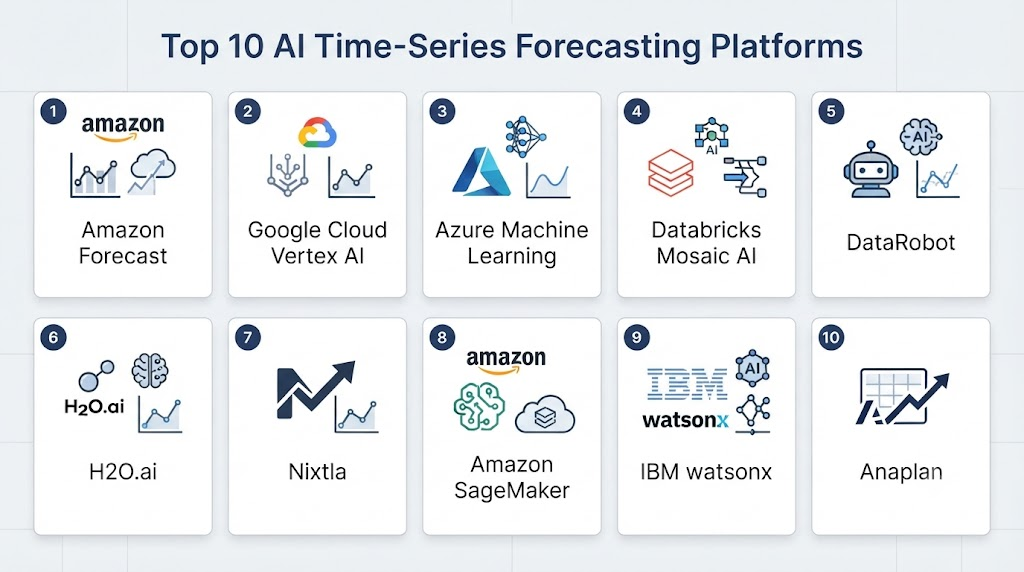
Top 10 AI Time-Series Forecasting Platforms
1. Amazon Forecast
One-line verdict: Best for organizations wanting managed forecasting infrastructure integrated with a large cloud and data ecosystem.
Short description:
Amazon Forecast is a managed forecasting service designed for time-series prediction without requiring organizations to build forecasting infrastructure themselves. It is particularly relevant to businesses already operating within AWS environments and forecasting demand, inventory, resource utilization, or other operational metrics.
Standout Capabilities
- Managed forecasting infrastructure.
- Automated forecasting workflows.
- Multivariate forecasting capabilities.
- Integration with AWS data services.
- Scalable forecasting workflows.
- Support for operational forecasting use cases.
- API-based automation.
- Enterprise cloud integration.
AI-Specific Depth
- Model support: Managed forecasting approaches; exact available models depend on the current service configuration.
- RAG / knowledge integration: Not a core forecasting requirement.
- Evaluation: Forecast accuracy evaluation and backtesting capabilities are available within forecasting workflows.
- Guardrails: IAM and AWS governance mechanisms can control access and operations.
- Observability: AWS monitoring and operational tooling can be used alongside forecasting workloads.
Pros
- Strong AWS ecosystem integration.
- Managed infrastructure reduces operational burden.
- Suitable for large-scale business forecasting.
Cons
- Primarily attractive to AWS-oriented organizations.
- Cloud architecture can create ecosystem dependency.
- Advanced customization may require additional ML tooling.
Security & Compliance
AWS provides extensive cloud security and identity capabilities, but specific controls depend on the architecture and services used. Certification applicability should be verified for the exact deployment.
Deployment & Platforms
- Cloud.
- AWS-managed infrastructure.
- API-based workflows.
Integrations & Ecosystem
Amazon Forecast can be incorporated into broader AWS data and ML architectures.
- AWS storage.
- AWS analytics services.
- AWS machine-learning services.
- APIs.
- Cloud data pipelines.
- Monitoring services.
Pricing Model
Usage-based cloud pricing; exact costs depend on workload and configuration.
Best-Fit Scenarios
- Enterprise demand forecasting.
- AWS-native analytics.
- Large-scale operational forecasting.
2. Google Vertex AI Forecasting
One-line verdict: Best for teams wanting forecasting integrated with Google Cloud machine learning and broader enterprise AI workflows.
Short description:
Vertex AI provides forecasting capabilities within Google’s broader managed AI platform. It is useful for organizations that want forecasting combined with data engineering, machine learning, model deployment, and enterprise AI services.
Standout Capabilities
- Managed forecasting workflows.
- Automated machine-learning capabilities.
- Multivariate forecasting.
- Feature engineering support.
- Large-scale cloud infrastructure.
- Model evaluation.
- Integration with enterprise data platforms.
- Production deployment capabilities.
AI-Specific Depth
- Model support: Managed Google forecasting models and configurable ML workflows.
- RAG / knowledge integration: External data integration is possible, but RAG is not a core forecasting requirement.
- Evaluation: Time-aware evaluation and model assessment are supported.
- Guardrails: Cloud IAM, governance, and AI controls can support controlled deployment.
- Observability: Google Cloud monitoring and model-management capabilities can support production workloads.
Pros
- Strong enterprise ML ecosystem.
- Good integration with cloud data services.
- Suitable for production forecasting.
Cons
- Can be complex for small teams.
- Costs depend heavily on cloud usage.
- Best value often comes from broader Google Cloud adoption.
Security & Compliance
Security features depend on the selected Google Cloud architecture and services. Specific certification applicability should be verified for the deployment.
Deployment & Platforms
- Cloud.
- Managed infrastructure.
- APIs and ML pipelines.
Integrations & Ecosystem
- BigQuery.
- Vertex AI.
- Cloud storage.
- Data pipelines.
- Python-based ML workflows.
- APIs.
Pricing Model
Usage-based cloud and managed-service pricing.
Best-Fit Scenarios
- Enterprise forecasting.
- Google Cloud data environments.
- Large-scale ML operations.
3. Microsoft Azure Machine Learning
One-line verdict: Best for enterprises requiring customizable forecasting workflows inside Microsoft’s broader machine-learning and cloud ecosystem.
Short description:
Azure Machine Learning provides infrastructure for developing, training, evaluating, deploying, and monitoring forecasting models. It is especially suitable when forecasting is part of a broader ML platform rather than a standalone forecasting application.
Standout Capabilities
- Custom forecasting models.
- Automated machine learning.
- Experiment tracking.
- Model deployment.
- ML pipelines.
- Model monitoring.
- Enterprise data integration.
- Python-based development.
AI-Specific Depth
- Model support: Statistical, machine-learning, and deep-learning models can be implemented depending on the workflow.
- RAG / knowledge integration: Available through broader Azure AI capabilities rather than being intrinsic to forecasting.
- Evaluation: Strong support for experiment comparison and time-aware evaluation through custom workflows.
- Guardrails: Identity, permissions, policies, and deployment controls.
- Observability: Experiment tracking and production monitoring capabilities.
Pros
- Highly customizable.
- Strong enterprise integration.
- Suitable for complex ML teams.
Cons
- Requires more technical expertise than specialized forecasting software.
- Infrastructure configuration can be complex.
- Cloud costs require careful management.
Security & Compliance
Azure provides extensive enterprise security and governance capabilities. Exact controls and certifications depend on the deployed services and region.
Deployment & Platforms
- Cloud.
- Hybrid architectures.
- Self-managed components can be incorporated into broader workflows.
Integrations & Ecosystem
- Azure data services.
- Python.
- ML frameworks.
- APIs.
- Data warehouses.
- Monitoring tools.
- MLOps systems.
Pricing Model
Usage-based cloud pricing.
Best-Fit Scenarios
- Enterprise ML forecasting.
- Custom forecasting systems.
- Microsoft-centric organizations.
4. Databricks
One-line verdict: Best for data teams building large-scale forecasting pipelines alongside lakehouse analytics and machine-learning workloads.
Short description:
Databricks provides a unified data and AI environment where teams can prepare time-series data, train forecasting models, evaluate experiments, and operationalize predictions. Its flexibility makes it especially useful for organizations with substantial data-engineering and ML requirements.
Standout Capabilities
- Large-scale data processing.
- ML experimentation.
- Feature engineering.
- Distributed computing.
- Model lifecycle management.
- Forecasting pipeline development.
- Data and AI integration.
- Collaborative notebooks.
AI-Specific Depth
- Model support: Broad flexibility across statistical, ML, deep-learning, and external models.
- RAG / knowledge integration: Strong data and AI integration, although RAG is not inherently required for forecasting.
- Evaluation: Custom backtesting and experiment evaluation can be implemented.
- Guardrails: Enterprise governance and access controls can support AI workflows.
- Observability: Experiment tracking and ML lifecycle tooling support monitoring.
Pros
- Excellent for large datasets.
- Strong data-engineering ecosystem.
- Highly customizable.
Cons
- Requires technical expertise.
- Can be more infrastructure-heavy than specialized forecasting tools.
- Cost optimization requires careful architecture.
Security & Compliance
Enterprise security and governance capabilities are available, with exact controls depending on configuration.
Deployment & Platforms
- Cloud.
- Managed lakehouse.
- Hybrid architectures vary.
Integrations & Ecosystem
- Spark.
- Python.
- SQL.
- MLflow.
- Data warehouses.
- Cloud storage.
- Machine-learning frameworks.
Pricing Model
Usage-based and enterprise cloud pricing.
Best-Fit Scenarios
- Large-scale forecasting.
- Data-heavy organizations.
- Custom AI forecasting pipelines.
5. DataRobot
One-line verdict: Best for organizations seeking automated machine learning and forecasting with less manual model-development work.
Short description:
DataRobot provides automated machine-learning capabilities designed to accelerate model development and deployment. Its forecasting capabilities can help teams compare approaches, automate parts of model development, and operationalize predictive systems.
Standout Capabilities
- Automated machine learning.
- Time-series forecasting.
- Model comparison.
- Feature engineering.
- Model deployment.
- Monitoring.
- Experiment management.
- Enterprise AI workflows.
AI-Specific Depth
- Model support: Multiple machine-learning approaches.
- RAG / knowledge integration: Not central to forecasting.
- Evaluation: Automated model evaluation and time-series validation capabilities.
- Guardrails: Enterprise governance and model-management controls.
- Observability: Model monitoring and performance tracking.
Pros
- Reduces manual ML development.
- Strong model experimentation.
- Suitable for enterprise teams.
Cons
- Commercial platform.
- Advanced customization may still require ML expertise.
- Pricing can be substantial for smaller organizations.
Security & Compliance
Enterprise security and governance features vary by product and deployment. Specific certifications should be verified directly for the intended configuration.
Deployment & Platforms
- Cloud.
- Enterprise environments.
- Deployment options vary.
Integrations & Ecosystem
- APIs.
- Python.
- Data warehouses.
- Cloud platforms.
- ML pipelines.
- Enterprise applications.
Pricing Model
Commercial/enterprise pricing; exact pricing is not publicly stated consistently across configurations.
Best-Fit Scenarios
- Automated forecasting.
- Enterprise ML teams.
- Organizations reducing model-development effort.
6. Nixtla
One-line verdict: Best for developers and data scientists seeking modern open-source forecasting models and scalable time-series experimentation.
Short description:
Nixtla provides open-source and commercial time-series forecasting technologies focused specifically on forecasting. Its ecosystem is particularly attractive to technical teams that want direct access to modern forecasting models and Python-based workflows.
Standout Capabilities
- Specialized time-series models.
- Statistical forecasting.
- Machine-learning forecasting.
- Deep-learning approaches.
- Probabilistic forecasting.
- Large-scale forecasting.
- Python ecosystem.
- Developer-focused workflows.
AI-Specific Depth
- Model support: Statistical, ML, deep-learning, and modern forecasting approaches depending on the selected component.
- RAG / knowledge integration: N/A as a core forecasting feature.
- Evaluation: Backtesting and forecasting evaluation are important parts of the ecosystem.
- Guardrails: Primarily implemented through application-level controls.
- Observability: Forecast metrics and experiment tooling can be integrated into pipelines.
Pros
- Strong forecasting specialization.
- Developer-friendly.
- Useful for large-scale forecasting experiments.
Cons
- More technical than low-code platforms.
- Requires Python/data-science expertise.
- Enterprise capabilities depend on the selected offering.
Security & Compliance
Specific certifications are Not publicly stated across all offerings.
Deployment & Platforms
- Python.
- Cloud.
- Self-managed workflows.
- APIs depending on the offering.
Integrations & Ecosystem
- Python.
- Pandas.
- NumPy.
- ML frameworks.
- Cloud environments.
- Forecasting pipelines.
Pricing Model
Open-source components plus commercial offerings.
Best-Fit Scenarios
- Developer-led forecasting.
- Large-scale time-series experimentation.
- Research and advanced forecasting.
7. Amazon SageMaker
One-line verdict: Best for ML engineering teams that need complete control over custom forecasting models and production deployment.
Short description:
Amazon SageMaker provides a broad machine-learning environment rather than a forecasting-only product. Teams can use it to develop, train, evaluate, deploy, and monitor customized time-series forecasting solutions.
Standout Capabilities
- Custom ML development.
- Model training.
- Feature engineering.
- Distributed training.
- Model deployment.
- Experiment management.
- Monitoring.
- Integration with AWS infrastructure.
AI-Specific Depth
- Model support: Broad, including custom open-source and proprietary models.
- RAG / knowledge integration: Available through broader AWS AI architecture.
- Evaluation: Custom forecasting evaluation and backtesting can be implemented.
- Guardrails: AWS identity and governance controls.
- Observability: Monitoring and experiment tracking through AWS tooling.
Pros
- Extremely flexible.
- Strong production capabilities.
- Excellent for custom forecasting architectures.
Cons
- Higher engineering requirements.
- More infrastructure decisions.
- Not as simple as a dedicated forecasting interface.
Security & Compliance
AWS security and governance capabilities depend on architecture, services, and configuration.
Deployment & Platforms
- Cloud.
- AWS infrastructure.
- Custom containers and ML environments.
Integrations & Ecosystem
- AWS storage.
- Databases.
- Python.
- ML frameworks.
- APIs.
- Monitoring.
- Data pipelines.
Pricing Model
Usage-based cloud pricing.
Best-Fit Scenarios
- Custom enterprise forecasting.
- Advanced ML engineering.
- Large-scale production systems.
8. H2O.ai
One-line verdict: Best for organizations wanting automated machine learning capabilities that can be applied to forecasting and predictive analytics.
Short description:
H2O.ai provides automated machine-learning and AI technologies for enterprise predictive analytics. Depending on the selected components, teams can build forecasting workflows while benefiting from automated model development and broader ML capabilities.
Standout Capabilities
- Automated machine learning.
- Predictive analytics.
- Model comparison.
- Feature engineering.
- Model deployment.
- Enterprise ML.
- Python integration.
- Scalable workflows.
AI-Specific Depth
- Model support: Multiple ML approaches depending on the selected platform.
- RAG / knowledge integration: Not a core time-series requirement.
- Evaluation: Model validation and comparison capabilities.
- Guardrails: Enterprise ML governance capabilities vary.
- Observability: Model-management and monitoring capabilities vary by deployment.
Pros
- Strong AutoML orientation.
- Broad predictive analytics.
- Useful for enterprise ML teams.
Cons
- Forecasting may require more configuration than dedicated forecasting platforms.
- Commercial capabilities vary.
- Technical expertise may still be necessary.
Security & Compliance
Specific certifications are Not publicly stated unless verified for the exact offering.
Deployment & Platforms
- Cloud.
- Enterprise.
- Self-managed options vary.
Integrations & Ecosystem
- Python.
- R.
- APIs.
- Data platforms.
- ML pipelines.
- Enterprise systems.
Pricing Model
Commercial and open-source components may coexist; exact enterprise pricing is Not publicly stated.
Best-Fit Scenarios
- AutoML forecasting.
- Enterprise predictive analytics.
- Mixed ML workloads.
9. Forecast Pro
One-line verdict: Best for forecasting professionals who prioritize practical forecasting workflows and business-oriented model evaluation.
Short description:
Forecast Pro is a forecasting-focused software environment designed for professional forecasting and planning. It is particularly relevant to organizations that need repeatable business forecasting rather than building every model through custom machine-learning code.
Standout Capabilities
- Time-series forecasting.
- Forecast automation.
- Model comparison.
- Business forecasting workflows.
- Forecast review.
- Statistical methods.
- Forecast management.
- Planning-oriented workflows.
AI-Specific Depth
- Model support: Statistical and automated forecasting methods; exact AI/model availability varies by product version.
- RAG / knowledge integration: N/A.
- Evaluation: Forecast accuracy evaluation and model comparison.
- Guardrails: User review and forecasting workflow controls.
- Observability: Forecast accuracy and historical performance can be monitored through workflow features.
Pros
- Forecasting-specific software.
- Practical for business users.
- Less engineering-heavy than building from scratch.
Cons
- Less flexible than developer-first platforms.
- AI capabilities may be narrower than newer AI-native systems.
- Specialized workflows may require complementary tools.
Security & Compliance
Specific certifications are Not publicly stated.
Deployment & Platforms
- Desktop and enterprise options vary.
- Deployment depends on product configuration.
Integrations & Ecosystem
- Business data.
- Spreadsheets.
- Databases.
- Forecasting workflows.
- Reporting systems.
Pricing Model
Commercial licensing; exact pricing is Not publicly stated.
Best-Fit Scenarios
- Business forecasting teams.
- Demand planning.
- Professional forecasting workflows.
10. Darts
One-line verdict: Best for developers and researchers who want an open-source Python framework for experimenting with diverse forecasting models.
Short description:
Darts is an open-source Python framework for time-series forecasting. It provides a unified interface for working with multiple forecasting approaches and is useful for experimentation, benchmarking, and custom forecasting applications.
Standout Capabilities
- Unified forecasting API.
- Statistical models.
- Machine-learning models.
- Deep-learning models.
- Backtesting.
- Forecast visualization.
- Multivariate time series.
- Probabilistic forecasting.
AI-Specific Depth
- Model support: Broad range of statistical, ML, and deep-learning approaches.
- RAG / knowledge integration: N/A.
- Evaluation: Backtesting and forecasting metrics.
- Guardrails: Developer-controlled validation and workflow logic.
- Observability: Metrics and experiment-tracking tools can be added.
Pros
- Open-source.
- Excellent for experimentation.
- Broad model selection.
Cons
- Requires Python knowledge.
- Production deployment requires additional infrastructure.
- Governance is largely application-dependent.
Security & Compliance
Specific certifications are Not publicly stated.
Deployment & Platforms
- Windows.
- macOS.
- Linux.
- Cloud.
- Self-hosted.
Integrations & Ecosystem
- Python.
- PyTorch.
- Scikit-learn.
- Pandas.
- NumPy.
- Jupyter.
- ML pipelines.
Pricing Model
Open-source.
Best-Fit Scenarios
- Forecasting research.
- Developer experimentation.
- Custom forecasting applications.
Comparison Table
| Tool | Best For | Deployment | Model Flexibility | Strength | Watch-Out | Public Rating |
|---|---|---|---|---|---|---|
| Amazon Forecast | Managed enterprise forecasting | Cloud | Hosted/Managed | AWS integration | AWS dependency | N/A |
| Vertex AI Forecasting | Google Cloud ML teams | Cloud | Hosted/Custom | Enterprise ML ecosystem | Cloud complexity | N/A |
| Azure Machine Learning | Custom enterprise ML | Cloud/Hybrid | Hosted/BYO/Open-source | Flexibility | Engineering overhead | N/A |
| Databricks | Large-scale data + AI | Cloud/Hybrid | Hosted/BYO/Open-source | Data and ML integration | Platform complexity | N/A |
| DataRobot | Automated ML forecasting | Cloud/Enterprise | Multi-model | Automation | Commercial cost | N/A |
| Nixtla | Modern developer forecasting | Cloud/Self-hosted | Open-source/Multi-model | Forecasting specialization | Technical learning curve | N/A |
| Amazon SageMaker | Custom production ML | Cloud | Hosted/BYO/Open-source | Maximum AWS flexibility | Requires expertise | N/A |
| H2O.ai | AutoML forecasting | Cloud/Enterprise | Multi-model | Automated ML | Configuration complexity | N/A |
| Forecast Pro | Professional forecasting | Desktop/Enterprise | Statistical/Automated | Business forecasting | Less developer flexibility | N/A |
| Darts | Research and development | Self-hosted/Cloud | Open-source/Multi-model | Model experimentation | Production needs extra tooling | N/A |
Scoring & Evaluation
The scoring below is comparative rather than an absolute measure of forecasting quality. Forecasting performance depends heavily on dataset characteristics, forecast horizon, seasonality, external variables, data volume, and evaluation methodology.
Scores emphasize platform capabilities, forecasting flexibility, AI evaluation, production readiness, integrations, and cost control.
| Tool | Core | Reliability/Eval | Guardrails | Integrations | Ease | Perf/Cost | Security/Admin | Support | Weighted Total |
|---|---|---|---|---|---|---|---|---|---|
| Amazon Forecast | 9 | 9 | 9 | 9.5 | 8.5 | 8.5 | 9 | 9 | 8.9 |
| Vertex AI Forecasting | 9.5 | 9 | 9 | 9.5 | 8 | 8.5 | 9.5 | 9 | 8.9 |
| Azure ML | 9.5 | 9.5 | 9.5 | 9.5 | 7.5 | 8.5 | 9.5 | 9 | 9.0 |
| Databricks | 9.5 | 9.5 | 9 | 10 | 7.5 | 9 | 9.5 | 9 | 9.2 |
| DataRobot | 9.5 | 9 | 9 | 9 | 9 | 8 | 9 | 9 | 8.9 |
| Nixtla | 9.5 | 9.5 | 8.5 | 8.5 | 8 | 9 | 8 | 8.5 | 8.8 |
| SageMaker | 9.5 | 9.5 | 9.5 | 9.5 | 7 | 8.5 | 9.5 | 9 | 8.9 |
| H2O.ai | 9 | 9 | 9 | 9 | 8.5 | 8.5 | 9 | 9 | 8.8 |
| Forecast Pro | 9 | 8.5 | 8.5 | 8 | 9 | 8 | 8 | 8.5 | 8.5 |
| Darts | 9 | 9 | 8.5 | 9 | 7.5 | 9 | 7.5 | 8.5 | 8.5 |
Top 3 for Enterprise
- Databricks
- Azure Machine Learning
- Vertex AI Forecasting
Top 3 for SMB
- DataRobot
- Forecast Pro
- Nixtla
Top 3 for Developers
- Darts
- Nixtla
- Azure Machine Learning
Which AI Time-Series Forecasting Platform Is Right for You?
Solo / Freelancer
Individual developers and analysts should avoid unnecessarily complex infrastructure.
Darts and Nixtla are attractive for technical users who want control over forecasting models. For business users who prefer a dedicated forecasting environment, a specialized commercial product can reduce development time.
Prioritize:
- Low setup complexity.
- Python support.
- Clear documentation.
- Backtesting.
- Affordable experimentation.
- Easy data import.
SMB
Small and medium businesses should prioritize ease of use and forecasting automation.
A good architecture is:
Historical Data → Data Cleaning → Forecasting → Backtesting → Human Review → Forecast Delivery
Automated platforms can reduce the amount of custom model development required.
Mid-Market
Mid-market organizations should focus on repeatability.
Use standardized forecasting pipelines and evaluate models using rolling historical windows rather than a single random split.
Important capabilities include:
- Forecast versioning.
- Automated retraining.
- External variables.
- Forecast monitoring.
- Scenario analysis.
- Error tracking.
- Business-user review.
Enterprise
Large enterprises typically require more than accurate predictions.
They should evaluate:
- Multi-team governance.
- Data access controls.
- Model lineage.
- Automated retraining.
- Model monitoring.
- API integration.
- Cloud architecture.
- Cost controls.
- Disaster recovery.
- Security.
- Explainability.
Databricks, Azure Machine Learning, Vertex AI, and SageMaker are particularly relevant when forecasting is part of a broader enterprise ML architecture.
Regulated Industries
Financial services, healthcare, energy, and public-sector organizations should pay particular attention to:
- Data residency.
- Access controls.
- Audit trails.
- Model documentation.
- Human approval.
- Forecast explainability.
- Model validation.
- Retention policies.
Automated forecasts should not be treated as unquestionable decisions.
Budget vs Premium
Open-source frameworks such as Darts and components of the Nixtla ecosystem can be cost-effective when a technical team is available.
Managed platforms may cost more but can reduce engineering and infrastructure requirements.
The correct comparison should include:
Software + Cloud + Engineering + Monitoring + Data + AI Inference + Maintenance
rather than license cost alone.
Build vs Buy
Build when:
- You require highly specialized models.
- Your data has unusual temporal structures.
- You need complete model control.
- You have a strong ML engineering team.
- Forecasting is a core competitive capability.
Buy when:
- Forecasting is primarily an operational requirement.
- You need faster deployment.
- Your team has limited ML expertise.
- Governance and support are important.
- Standard forecasting methods are sufficient.
Implementation Playbook
First 30 Days: Pilot + Success Metrics
Start with one or two high-value forecasting problems.
Define:
- Forecast horizon.
- Forecast frequency.
- Required accuracy.
- Business cost of errors.
- Data availability.
- Retraining frequency.
Create a baseline using a simple forecasting method before testing advanced AI.
Measure:
- MAE.
- RMSE.
- MAPE where appropriate.
- Weighted error.
- Bias.
- Prediction-interval coverage.
- Inference cost.
- Latency.
The baseline matters because a complicated AI model is not automatically better than a simple seasonal model.
Days 31–60: Harden Security + Evaluation
Create a rolling-window evaluation framework.
Test the model across:
- Normal periods.
- Seasonal peaks.
- Demand shocks.
- Missing-data periods.
- Structural changes.
- Outlier events.
Compare multiple models rather than relying on one training run.
For AI-based systems, also evaluate:
- Data leakage.
- Prompt manipulation if natural-language interfaces are used.
- Incorrect feature interpretation.
- Unexpected model behavior.
- Model drift.
- Forecast instability.
Maintain version control for:
- Data.
- Features.
- Models.
- Prompts.
- Forecast configurations.
- Evaluation datasets.
Days 61–90: Optimize + Govern + Scale
Once accuracy and reliability are established, optimize the production system.
Focus on:
- Model routing.
- Batch versus real-time inference.
- Caching.
- Retraining schedules.
- Hardware utilization.
- Forecast monitoring.
- Cost monitoring.
- Alert thresholds.
- Governance.
- Automated rollback.
For large forecasting systems, not every series needs the same model. Model routing can assign simpler models to easy series and more advanced models to difficult ones.
Common Mistakes & How to Avoid Them
- Using random train/test splits: Time-series data requires temporal validation.
- Ignoring seasonality: Weekly, monthly, annual, and holiday effects can materially affect forecasts.
- Data leakage: Future information must not accidentally enter training features.
- Overusing deep learning: Complex models do not guarantee better forecasts.
- Ignoring simple baselines: Always compare against naïve and statistical methods.
- Forecasting without uncertainty: A single number hides prediction risk.
- Ignoring external variables: Weather, promotions, prices, holidays, and economic conditions may matter.
- Using MAPE blindly: MAPE can behave poorly around zero or very small actual values.
- Ignoring forecast bias: Consistent overprediction or underprediction can be operationally expensive.
- Failing to monitor drift: Historical relationships can change.
- Retraining too frequently: Constant retraining can increase cost without improving accuracy.
- Retraining too rarely: Models can become stale.
- Ignoring data quality: Forecasting cannot compensate for systematically corrupted input data.
- No human review for critical decisions: Forecasts should support decision-making rather than eliminate appropriate oversight.
- Ignoring latency: Real-time applications may require lightweight models.
- Ignoring inference cost: Advanced AI models can be expensive at high forecast volumes.
- No model versioning: Teams should be able to identify exactly which model generated a forecast.
- Ignoring prediction intervals: Decision-makers need to understand uncertainty.
- Using one model for every series: Different time series may require different approaches.
- Building without business metrics: Statistical accuracy does not always equal business value.
FAQs
What are AI Time-Series Forecasting Platforms?
They are software platforms that use statistical models, machine learning, deep learning, or AI foundation models to predict future values from historical time-dependent data.
What is the difference between time-series forecasting and ordinary machine learning?
Time-series forecasting explicitly accounts for temporal ordering and historical dependencies. Standard machine-learning workflows may not properly handle time-dependent relationships unless specifically designed to do so.
Can AI forecasting predict multiple variables?
Yes. Multivariate forecasting models can use multiple related variables to predict one or more future series.
Are AI forecasting models better than ARIMA?
Not necessarily. Advanced AI models can outperform traditional methods on some datasets, while simpler statistical models may perform better on others. Proper backtesting is essential.
What is backtesting?
Backtesting evaluates a forecasting model on historical periods as though those periods were in the future. It provides a more realistic assessment of expected forecasting performance.
Why is rolling-window validation important?
It preserves temporal order and tests how a model performs repeatedly across different historical periods.
Can AI forecasting handle missing data?
Many platforms can handle or preprocess missing values, but the appropriate treatment depends on why values are missing and how the missingness affects the underlying process.
Can forecasting platforms use external variables?
Yes. Many forecasting systems can incorporate variables such as prices, promotions, weather, holidays, economic indicators, inventory levels, or operational metrics.
What is probabilistic forecasting?
Probabilistic forecasting provides a range or distribution of possible future outcomes instead of only one predicted value.
Why are prediction intervals important?
They help decision-makers understand uncertainty and plan for different possible outcomes.
Can AI forecasting work with real-time data?
Yes. Some platforms can support streaming or frequent updates, although real-time forecasting may require specialized architecture.
Can I use open-source forecasting models?
Yes. Frameworks such as Darts and open-source forecasting ecosystems provide developers with substantial flexibility.
Can I bring my own model?
Platforms such as Databricks, Azure Machine Learning, SageMaker, and developer-focused frameworks provide significant opportunities for custom models, although the exact integration process varies.
Should forecasting models use generative AI?
Not necessarily. Generative AI can be useful for workflow automation, explanation, natural-language interfaces, and some forecasting architectures, but conventional statistical and ML models remain highly relevant.
Can AI agents automate forecasting?
Yes. An AI agent can potentially coordinate data preparation, model selection, evaluation, forecasting, reporting, and monitoring. Critical workflows should still include appropriate validation and controls.
How much historical data is required?
There is no universal number. Requirements depend on sampling frequency, seasonality, forecast horizon, noise, model complexity, and the stability of the underlying process.
How do I choose the best forecasting platform?
Start with your data size, forecast horizon, accuracy requirements, deployment model, technical skills, integrations, security requirements, and budget. Then test shortlisted platforms against your own historical data.
Is cloud forecasting secure?
Cloud forecasting can be secure when properly configured, but security depends on architecture, identity controls, data handling, network configuration, retention, and organizational policies.
Should sensitive forecasting data be sent to external AI models?
Not automatically. Sensitive information should only be processed through AI services that meet the organization’s security, privacy, contractual, and regulatory requirements.
How can forecasting costs be controlled?
Use appropriate model sizes, batch inference where possible, caching, model routing, efficient retraining schedules, and simpler models for easy forecasting problems.
What is model drift in forecasting?
Model drift occurs when the relationship between historical inputs and future outcomes changes enough that previous model behavior becomes less reliable.
How often should forecasting models be retrained?
There is no universal schedule. Retraining should be driven by data frequency, model stability, business changes, drift, and measured forecasting performance.
Conclusion
AI Time-Series Forecasting Platforms are becoming increasingly important as organizations collect more operational, financial, sensor, customer, and supply-chain data. The strongest platforms combine forecasting models with automated evaluation, scalable infrastructure, monitoring, uncertainty estimation, and practical deployment workflows.
There is no universal best platform.For cloud-native enterprises, Amazon Forecast, Vertex AI, Azure Machine Learning, and SageMaker can provide managed infrastructure and broader ML ecosystems. Databricks is particularly attractive when forecasting is closely connected to large-scale data engineering and lakehouse workloads. DataRobot focuses more heavily on automated machine learning, while Nixtla and Darts are strong options for developers and researchers who want forecasting flexibility.The most important principle is to evaluate forecasting systems using your own historical data and realistic future scenarios. A sophisticated model that performs poorly under temporal backtesting is less useful than a simpler model that consistently produces reliable forecasts.