ntroduction
AI Runtime Platforms for WASM/WASI provide the execution layer needed to run machine-learning models and AI workloads inside WebAssembly and WASI environments. Instead of depending entirely on traditional native runtimes, developers can package AI inference into portable WebAssembly modules that can execute across browsers, servers, edge devices, plugins, gateways, and other sandboxed environments.
This approach is increasingly useful for AI applications that need portability, lightweight deployment, isolation, fast startup, and predictable execution. WASM-based AI inference can also complement conventional cloud and container infrastructure, particularly when developers need to move models between different environments without rebuilding an entire native application stack.
Common use cases include:
- Running AI inference inside edge applications.
- Executing computer-vision models in browser environments.
- Embedding AI into SaaS applications.
- Running models inside serverless or sandboxed workloads.
- Deploying AI inference to IoT and edge systems.
- Building portable AI plugins.
- Running privacy-sensitive inference locally.
- Integrating AI into WebAssembly-based application architectures.
Best for: AI engineers, edge developers, platform engineers, browser developers, SaaS teams, embedded developers, and organizations building portable inference applications.
Not ideal for: Teams requiring maximum hardware acceleration from highly specialized native runtimes, extremely large training workloads, or applications that depend heavily on native GPU-specific capabilities unavailable through their selected WASM environment.
What to Evaluate
- WASM and WASI compatibility.
- Supported model formats.
- ONNX support.
- WebAssembly SIMD.
- WASI-NN support.
- WASI Preview 2/component-model compatibility.
- CPU inference performance.
- GPU and accelerator support.
- Browser compatibility.
- Server-side execution.
- Edge-device compatibility.
- Memory requirements.
- Startup latency.
- Model size.
- Multi-threading.
- Security isolation.
- JavaScript interoperability.
- Rust/C/C++/Python integration.
- Container and serverless compatibility.
- Open-source availability.
- Vendor lock-in.
What’s Changed in AI Runtime Platforms for WASM/WASI
- WASI is becoming more than a browser-adjacent technology: Modern WASI development increasingly targets servers, edge environments, plugins, and portable application components.
- The Component Model matters more: Developers are moving toward composable WebAssembly components rather than treating WASM as only a compiled binary format.
- AI inference is moving closer to the application: Instead of calling a remote AI service for every inference request, applications can execute smaller models locally.
- Browser AI is expanding: WebAssembly can provide a portable execution layer for models that need to run directly on client devices.
- SIMD optimization is increasingly important: Vectorized execution can materially improve CPU inference performance for suitable models.
- WASI-NN provides an important abstraction: Neural-network inference can be exposed through a standardized interface instead of tying applications completely to one native runtime.
- Model portability is improving: ONNX and other portable model formats can help separate model development from deployment environments.
- Security isolation is a major advantage: WASM sandboxing can make AI components easier to isolate from the host application.
- Server-side WASM is becoming more relevant: AI inference can be embedded into lightweight server-side workloads instead of requiring full containers.
- Edge inference benefits from small footprints: Smaller models can be particularly attractive in resource-constrained environments.
- AI and WebAssembly are converging: AI inference can become a component inside larger WASM applications rather than a standalone service.
- Hardware acceleration remains the challenge: CPU portability is relatively straightforward, while consistent access to GPUs, NPUs, and specialized accelerators remains more fragmented.
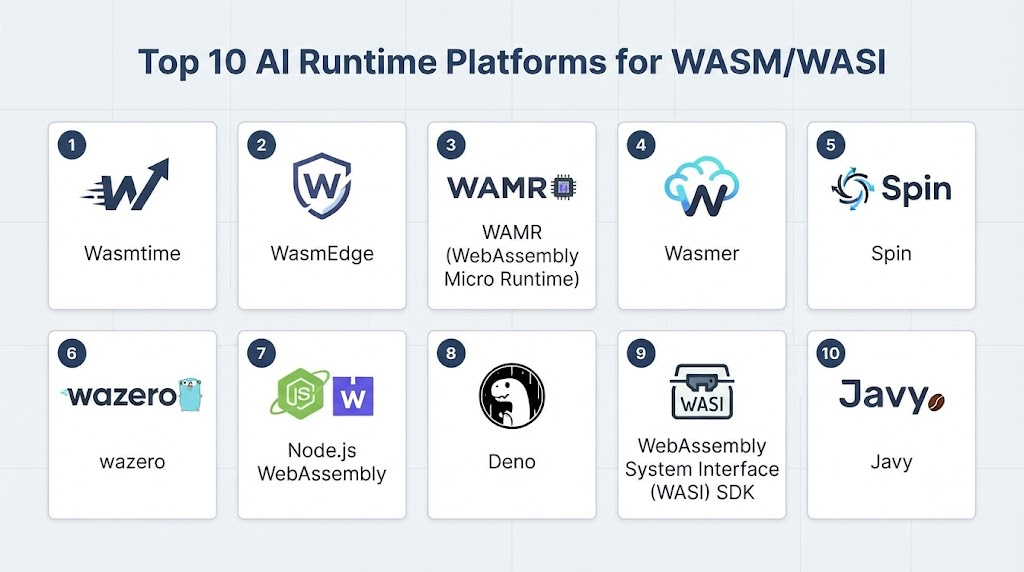
Top 10 AI Runtime Platforms for WASM/WASI
1. WasmEdge
One-line verdict: Best for developers building portable AI inference applications across cloud, server, edge, and WebAssembly environments.
Short description:
WasmEdge is a WebAssembly runtime designed for server-side and edge workloads. Its ecosystem includes capabilities for AI inference, allowing developers to execute machine-learning workloads within a lightweight WebAssembly-oriented runtime.
Standout Capabilities
- WebAssembly runtime execution.
- WASI support.
- Server-side WebAssembly.
- Edge computing.
- AI inference support.
- Container integration.
- WebAssembly SIMD.
- Extensible runtime architecture.
AI-Specific Depth
- Model support: Supports AI inference through integrated and external model-runtime approaches, depending on workload.
- RAG / knowledge integration: Application-dependent.
- Evaluation: External evaluation frameworks are generally required.
- Guardrails: Runtime isolation and application controls rather than model-specific guardrails.
- Observability: Runtime and application telemetry can be integrated with external systems.
Pros
- Strong server-side WASM ecosystem.
- Well suited to edge AI experimentation.
- Lightweight execution model.
Cons
- Advanced AI acceleration can require additional configuration.
- WASM-specific expertise is useful.
- Native AI runtimes may still outperform it for some specialized workloads.
Security & Compliance
WasmEdge benefits from WebAssembly’s sandbox-oriented execution model. Specific enterprise certifications and compliance claims should be verified for the deployment configuration.
Deployment & Platforms
- Linux.
- Cloud.
- Edge servers.
- Containers.
- Embedded environments.
- WebAssembly-compatible infrastructure.
Integrations & Ecosystem
WasmEdge can be incorporated into broader cloud-native and WebAssembly architectures.
- WASI.
- Containers.
- Kubernetes-oriented environments.
- Rust.
- C/C++.
- AI inference systems.
- Edge platforms.
Pricing Model
Open-source runtime with commercial ecosystem options depending on the implementation and services used.
Best-Fit Scenarios
- Server-side AI inference.
- Edge AI.
- Portable AI components.
2. Wasmtime
One-line verdict: Best for developers who need a standards-focused WebAssembly and WASI runtime for building secure portable AI components.
Short description:
Wasmtime is a WebAssembly runtime developed around the WASI and Component Model ecosystem. It is useful as a foundation for applications that want to execute AI-related WebAssembly components in a controlled runtime.
Standout Capabilities
- WebAssembly execution.
- WASI support.
- Component Model support.
- Strong Rust ecosystem.
- Sandboxed execution.
- Server-side execution.
- Extensible runtime.
- Portable deployment.
AI-Specific Depth
- Model support: Depends on the AI runtime compiled or integrated into WebAssembly.
- RAG / knowledge integration: N/A as a native capability.
- Evaluation: External.
- Guardrails: WASM sandboxing and host capabilities provide isolation; AI-specific guardrails require additional components.
- Observability: Runtime instrumentation and external observability tools can be used.
Pros
- Strong WASI foundation.
- Excellent for standards-oriented WASM development.
- Good component architecture.
Cons
- Not an all-in-one AI inference platform.
- AI model integration requires engineering.
- Hardware acceleration depends on the chosen architecture.
Security & Compliance
The sandboxed runtime model can help isolate WebAssembly workloads. Specific enterprise compliance depends on the overall implementation.
Deployment & Platforms
- Linux.
- macOS.
- Windows.
- Servers.
- Edge systems.
- Embedded environments.
Integrations & Ecosystem
- Rust.
- WASI.
- Component Model.
- WebAssembly tooling.
- Server applications.
- Edge infrastructure.
Pricing Model
Open-source runtime.
Best-Fit Scenarios
- Portable AI components.
- Secure server-side inference.
- WASI experimentation.
3. WebAssembly Micro Runtime
One-line verdict: Best for embedded and resource-constrained environments where compact WebAssembly execution is a primary requirement.
Short description:
WebAssembly Micro Runtime is designed for embedded and resource-constrained environments. It can provide a foundation for running compact AI inference components on devices where traditional runtimes may introduce excessive overhead.
Standout Capabilities
- Lightweight runtime.
- Embedded-device support.
- WASM execution.
- Resource-constrained deployment.
- Small runtime footprint.
- IoT compatibility.
- Portable execution.
- C-based architecture.
AI-Specific Depth
- Model support: Depends on the AI inference engine integrated into the runtime.
- RAG / knowledge integration: N/A.
- Evaluation: External.
- Guardrails: Runtime isolation; application-specific AI controls.
- Observability: Depends on the embedded integration.
Pros
- Designed for constrained environments.
- Strong embedded focus.
- Lightweight architecture.
Cons
- AI capabilities require additional integration.
- Not intended as a complete enterprise AI platform.
- Hardware acceleration depends heavily on the target device.
Security & Compliance
WebAssembly isolation can provide useful security boundaries, but complete security depends on device configuration and host integration.
Deployment & Platforms
- Microcontrollers.
- IoT devices.
- Embedded systems.
- Linux.
- RTOS-oriented environments.
Integrations & Ecosystem
- C/C++.
- Embedded firmware.
- IoT platforms.
- WASI-related technologies.
- Hardware-specific inference libraries.
Pricing Model
Open-source runtime.
Best-Fit Scenarios
- TinyML.
- Embedded AI.
- Resource-constrained inference.
4. WAMR + WASI-NN
One-line verdict: Best for embedded developers exploring standardized neural-network execution through WebAssembly and WASI interfaces.
Short description:
WebAssembly Micro Runtime combined with WASI-NN can provide a practical architecture for AI inference in embedded and edge environments. WASI-NN defines an interface intended to expose neural-network inference capabilities to WebAssembly applications.
Standout Capabilities
- WASM execution.
- WASI integration.
- Neural-network interface.
- Embedded deployment.
- Hardware abstraction.
- Lightweight runtime.
- Portable AI applications.
- Edge inference.
AI-Specific Depth
- Model support: Depends on the backend and supported graph/model format.
- RAG / knowledge integration: N/A.
- Evaluation: External.
- Guardrails: Runtime isolation; model safety is application-specific.
- Observability: Backend-dependent.
Pros
- Standards-oriented AI integration.
- Useful abstraction for edge inference.
- Suitable for embedded experimentation.
Cons
- Ecosystem is less mature than mainstream native AI runtimes.
- Hardware backend availability varies.
- Requires systems-level knowledge.
Security & Compliance
WASM sandboxing provides an isolation layer. Specific compliance depends on the deployment architecture.
Deployment & Platforms
- Embedded.
- IoT.
- Edge.
- Linux.
- Resource-constrained systems.
Integrations & Ecosystem
- WASI-NN.
- WAMR.
- Embedded C/C++.
- Neural-network backends.
- Edge hardware.
Pricing Model
Open-source technologies.
Best-Fit Scenarios
- Embedded inference.
- WASI-NN experimentation.
- Portable edge AI.
5. ONNX Runtime Web
One-line verdict: Best for browser-based AI inference where portable ONNX models and WebAssembly execution are key requirements.
Short description:
ONNX Runtime Web provides a browser-oriented inference environment for ONNX models. Depending on the execution backend, it can use WebAssembly for CPU inference and other browser capabilities for acceleration.
Standout Capabilities
- ONNX model execution.
- Browser inference.
- WebAssembly backend.
- JavaScript integration.
- Client-side AI.
- Multiple execution backends.
- Local inference.
- Web application integration.
AI-Specific Depth
- Model support: ONNX.
- RAG / knowledge integration: Application-dependent.
- Evaluation: External or application-specific.
- Guardrails: Application-level controls.
- Observability: Application instrumentation can capture performance metrics.
Pros
- Strong browser integration.
- Mature ONNX ecosystem.
- Useful for private client-side inference.
Cons
- Browser constraints affect performance.
- Model size matters.
- Advanced hardware acceleration depends on browser and device capabilities.
Security & Compliance
Running inference locally can reduce the need to transmit inference data to a server. Overall security depends on application architecture and model protection.
Deployment & Platforms
- Web browsers.
- Desktop web applications.
- Client-side applications.
Integrations & Ecosystem
- JavaScript.
- TypeScript.
- ONNX.
- WebAssembly.
- Web applications.
- Browser APIs.
Pricing Model
Open-source runtime technology.
Best-Fit Scenarios
- Browser AI.
- Client-side computer vision.
- Privacy-oriented local inference.
6. TensorFlow.js
One-line verdict: Best for JavaScript developers building browser and Node.js AI applications with WebAssembly-based execution options.
Short description:
TensorFlow.js enables machine-learning models to run in JavaScript environments. Its ecosystem includes WebAssembly execution capabilities that can provide CPU-based inference where WebGL or other acceleration paths are not appropriate.
Standout Capabilities
- JavaScript-first AI.
- Browser inference.
- Node.js support.
- WebAssembly backend.
- Client-side ML.
- TensorFlow model compatibility.
- Web application integration.
- Local inference.
AI-Specific Depth
- Model support: TensorFlow.js formats and supported conversion paths.
- RAG / knowledge integration: Application-dependent.
- Evaluation: External.
- Guardrails: Application-specific.
- Observability: JavaScript performance monitoring can be integrated.
Pros
- Excellent JavaScript ecosystem.
- Browser-friendly.
- Strong developer accessibility.
Cons
- Model conversion may be required.
- Browser performance varies.
- Large models can be challenging to deploy client-side.
Security & Compliance
Local inference can keep some input data on the client. However, model artifacts are generally exposed to the client environment and should not be treated as secret.
Deployment & Platforms
- Browsers.
- Node.js.
- Desktop applications using web technologies.
Integrations & Ecosystem
- JavaScript.
- TypeScript.
- TensorFlow.
- WebAssembly.
- Browser APIs.
- Node.js.
Pricing Model
Open-source framework.
Best-Fit Scenarios
- JavaScript AI applications.
- Browser inference.
- Lightweight client-side ML.
7. WasmEdge + llama.cpp
One-line verdict: Best for developers experimenting with portable local LLM inference in WebAssembly-oriented server and edge environments.
Short description:
Combining a WebAssembly runtime with a lightweight LLM inference engine can create portable local-generation architectures. This approach is particularly relevant to developers interested in running smaller language models close to users or applications.
Standout Capabilities
- Local LLM inference.
- WebAssembly execution.
- Edge AI.
- Portable deployment.
- CPU-oriented inference.
- Local data processing.
- Server-side execution.
- Container compatibility.
AI-Specific Depth
- Model support: Depends on the integrated inference backend and model format.
- RAG / knowledge integration: Can be implemented at the application layer.
- Evaluation: External.
- Guardrails: Application-level.
- Observability: Requires runtime/application instrumentation.
Pros
- Useful for local LLM experiments.
- Can reduce dependence on remote inference.
- Strong edge-oriented architecture.
Cons
- Performance depends heavily on hardware.
- Not a single integrated platform.
- Large models may not be practical in constrained WASM environments.
Security & Compliance
Local inference can help reduce data transmission. Security depends on how models, prompts, and application data are handled.
Deployment & Platforms
- Linux.
- Edge servers.
- Local development environments.
- WebAssembly runtimes.
Integrations & Ecosystem
- WasmEdge.
- llama.cpp.
- WASM.
- LLM model formats.
- Edge applications.
Pricing Model
Primarily open-source components.
Best-Fit Scenarios
- Local LLM inference.
- Edge assistants.
- WASM-based AI experimentation.
8. Fermyon Spin
One-line verdict: Best for developers building lightweight serverless AI components using WebAssembly and WASI-oriented application architectures.
Short description:
Fermyon Spin is a WebAssembly-based application framework designed for serverless workloads. It can provide an environment for AI-enabled components where low startup overhead and portable execution are important.
Standout Capabilities
- WebAssembly applications.
- Serverless execution.
- WASI-oriented development.
- Fast startup.
- Event-driven applications.
- Edge deployment.
- Component-oriented architecture.
- Developer-focused tooling.
AI-Specific Depth
- Model support: Application-dependent.
- RAG / knowledge integration: Can be integrated through application services.
- Evaluation: External.
- Guardrails: Application-specific.
- Observability: Platform and application telemetry can be integrated.
Pros
- Strong WASM developer experience.
- Useful for lightweight AI services.
- Good fit for event-driven workloads.
Cons
- Not a dedicated AI runtime.
- Large model inference can be impractical.
- Advanced AI acceleration requires additional architecture.
Security & Compliance
WebAssembly provides sandboxing and controlled execution. Specific enterprise requirements should be evaluated against the complete deployment.
Deployment & Platforms
- Cloud.
- Edge.
- WebAssembly environments.
- Serverless infrastructure.
Integrations & Ecosystem
- WASI.
- WebAssembly Components.
- Rust.
- JavaScript/TypeScript.
- HTTP services.
- Event-driven applications.
Pricing Model
Commercial hosting and open-source development components may be available depending on deployment.
Best-Fit Scenarios
- AI-enabled serverless functions.
- Edge AI APIs.
- Lightweight inference components.
9. Wasm3
One-line verdict: Best for extremely lightweight WebAssembly execution on embedded systems where minimal runtime overhead matters.
Short description:
Wasm3 is a lightweight WebAssembly interpreter designed for constrained environments. It can serve as a foundation for executing compact AI-related WebAssembly applications where runtime size and portability are more important than maximum inference performance.
Standout Capabilities
- Small runtime footprint.
- Embedded execution.
- WebAssembly support.
- Portable architecture.
- Low-resource environments.
- C-based implementation.
- IoT suitability.
AI-Specific Depth
- Model support: Depends on the application and integrated AI implementation.
- RAG / knowledge integration: N/A.
- Evaluation: External.
- Guardrails: Runtime isolation rather than AI-specific controls.
- Observability: Application-specific.
Pros
- Very lightweight.
- Useful for constrained devices.
- Simple embedded architecture.
Cons
- Interpreter-based execution can limit performance.
- Not a full AI platform.
- Hardware acceleration requires additional work.
Security & Compliance
WebAssembly sandboxing can provide an isolation mechanism. Complete security depends on the host application and device architecture.
Deployment & Platforms
- Microcontrollers.
- IoT.
- Embedded systems.
- Resource-constrained hardware.
Integrations & Ecosystem
- C.
- Embedded firmware.
- IoT systems.
- WebAssembly modules.
- Custom AI runtimes.
Pricing Model
Open-source runtime.
Best-Fit Scenarios
- TinyML experimentation.
- IoT AI.
- Extremely constrained devices.
10. Wasmer
One-line verdict: Best for teams wanting a flexible WebAssembly runtime platform for server, edge, plugin, and portable AI workloads.
Short description:
Wasmer provides WebAssembly runtimes and tooling for running WASM applications across different environments. Its portability and embedding capabilities can make it useful for AI systems where inference needs to operate inside sandboxed application components.
Standout Capabilities
- WebAssembly execution.
- WASI support.
- Runtime embedding.
- Server-side execution.
- Edge deployment.
- Plugin architectures.
- Portable applications.
- Multiple language integrations.
AI-Specific Depth
- Model support: Depends on the integrated AI inference engine.
- RAG / knowledge integration: Application-dependent.
- Evaluation: External.
- Guardrails: WASM sandboxing and host permissions.
- Observability: Requires application or runtime instrumentation.
Pros
- Flexible runtime architecture.
- Strong portability.
- Useful for embedding WASM into applications.
Cons
- Not an AI-specific platform.
- Model integration requires development work.
- Hardware acceleration varies.
Security & Compliance
Sandboxed WASM execution can help isolate untrusted or third-party components. Specific compliance depends on the complete application architecture.
Deployment & Platforms
- Linux.
- Windows.
- macOS.
- Servers.
- Edge environments.
- Embedded applications.
Integrations & Ecosystem
- Rust.
- WebAssembly.
- WASI.
- Application plugins.
- Server applications.
- Edge systems.
Pricing Model
Open-source runtime technology with commercial options depending on the product and service.
Best-Fit Scenarios
- Portable AI components.
- WASM plugin systems.
- Server-side inference.
Comparison Table
| Tool | Best For | Deployment | Model Flexibility | Strength | Watch-Out | Public Rating |
|---|---|---|---|---|---|---|
| WasmEdge | Server and edge AI | Cloud / Edge / Hybrid | BYO / Multi-runtime | AI-oriented WASM runtime | Hardware acceleration varies | N/A |
| Wasmtime | WASI applications | Server / Edge | BYO | Standards-focused runtime | Requires AI integration | N/A |
| WAMR | Embedded AI | Edge / Embedded | BYO | Lightweight runtime | AI backend required | N/A |
| WAMR + WASI-NN | Portable neural inference | Edge / Embedded | BYO | WASI-NN integration | Backend availability varies | N/A |
| ONNX Runtime Web | Browser AI | Browser | ONNX | Portable ONNX inference | Browser limitations | N/A |
| TensorFlow.js | JavaScript AI | Browser / Node.js | TensorFlow / Converted | JS ecosystem | Model conversion | N/A |
| WasmEdge + llama.cpp | Local LLMs | Edge / Server | Open models / BYO | Local generation | Hardware dependent | N/A |
| Fermyon Spin | WASM serverless AI | Cloud / Edge | BYO | Lightweight components | Not AI-specific | N/A |
| Wasm3 | Tiny embedded AI | Embedded | BYO | Minimal footprint | Performance limitations | N/A |
| Wasmer | Portable WASM apps | Cloud / Edge / Embedded | BYO | Runtime embedding | AI integration required | N/A |
Scoring & Evaluation
The following scoring is comparative rather than absolute. A WASM runtime is not automatically an AI platform, so the evaluation considers both WebAssembly capabilities and practical AI-inference suitability. Scores should be validated against the exact model, hardware, WASI version, and deployment environment before production selection.
| Tool | Core | Reliability/Eval | Guardrails | Integrations | Ease | Perf/Cost | Security/Admin | Support | Weighted Total |
|---|---|---|---|---|---|---|---|---|---|
| WasmEdge | 9.5 | 8 | 8.5 | 9.5 | 8.5 | 9 | 9 | 9 | 8.9 |
| Wasmtime | 9.5 | 8 | 9 | 9.5 | 8 | 9 | 9.5 | 9.5 | 8.9 |
| WAMR | 9 | 7.5 | 8.5 | 9 | 8 | 9.5 | 9 | 9 | 8.7 |
| WAMR + WASI-NN | 9 | 8 | 8.5 | 8.5 | 7.5 | 8.5 | 9 | 8.5 | 8.4 |
| ONNX Runtime Web | 9.5 | 9 | 8 | 9.5 | 9 | 8.5 | 8.5 | 9.5 | 8.9 |
| TensorFlow.js | 9 | 8.5 | 8 | 9.5 | 9.5 | 8 | 8.5 | 9.5 | 8.7 |
| WasmEdge + llama.cpp | 8.5 | 8 | 8 | 8.5 | 7.5 | 8.5 | 8.5 | 8.5 | 8.2 |
| Fermyon Spin | 8.5 | 7.5 | 8.5 | 9 | 9 | 9 | 8.5 | 8.5 | 8.6 |
| Wasm3 | 8.5 | 7 | 8.5 | 8 | 8 | 8 | 8.5 | 8 | 8.0 |
| Wasmer | 9 | 7.5 | 9 | 9 | 8.5 | 8.5 | 9 | 9 | 8.6 |
Top 3 for Enterprise
- Wasmtime
- WasmEdge
- ONNX Runtime Web
Top 3 for SMB
- ONNX Runtime Web
- TensorFlow.js
- WasmEdge
Top 3 for Developers
- Wasmtime
- WasmEdge
- ONNX Runtime Web
Which AI Runtime Platform for WASM/WASI Is Right for You?
Solo / Freelancer
For individual developers, simplicity matters more than enterprise fleet management.
If you are building browser-based AI, ONNX Runtime Web or TensorFlow.js are strong starting points.
If your goal is server-side WASI development, Wasmtime is a better foundation.
If you are experimenting with local LLM execution, a WasmEdge-based architecture can be worth exploring.
SMB
SMBs should prioritize:
- Easy deployment.
- Model portability.
- Low infrastructure overhead.
- Strong documentation.
- Browser or server compatibility.
- Reasonable inference performance.
- Low vendor lock-in.
ONNX Runtime Web, TensorFlow.js, WasmEdge, and Wasmtime are practical candidates depending on the workload.
Mid-Market
Mid-market teams should establish a clear boundary between:
Model → Model Format → WASM Module → Runtime → Host Application → Hardware
This architecture makes it easier to replace the model without rewriting the entire application.
For example, an ONNX model could be evaluated independently before being packaged into a WebAssembly-oriented deployment pipeline.
Enterprise
Enterprise teams should focus on:
- WASI version compatibility.
- Component Model support.
- Runtime lifecycle.
- Security isolation.
- Software supply chain.
- Model provenance.
- Model signing.
- Hardware acceleration.
- Observability.
- Governance.
- Deployment portability.
- Long-term maintenance.
Wasmtime and WasmEdge are particularly relevant for broader server-side and edge architectures.
Regulated Industries
WASM can provide useful isolation characteristics, but it does not automatically make an AI application compliant.
Regulated organizations should examine:
- Where inference occurs.
- Where models are stored.
- Whether input data leaves the device.
- Model artifact protection.
- Runtime permissions.
- Audit logging.
- Access controls.
- Data retention.
- Encryption.
- Model provenance.
Local WASM inference can be attractive when privacy is important, but organizations still need to protect the model and application environment.
Budget vs Premium
WASM has an important cost advantage in some architectures because lightweight runtimes can reduce infrastructure overhead.
Potential savings can come from:
- Smaller deployment artifacts.
- Local inference.
- Reduced server calls.
- Reduced container overhead.
- Lower startup latency.
- Edge execution.
However, engineering costs can increase when integrating unsupported models, accelerators, or custom AI runtimes.
Build vs Buy
Build your own WASM AI runtime integration when:
- Your model requirements are unusual.
- You need specialized hardware.
- You already have a mature WASM infrastructure.
- You require custom host interfaces.
- You have strong systems-programming expertise.
Use established runtimes when:
- Portability is important.
- You need reliable WASI support.
- You want standard runtime behavior.
- Your team does not want to maintain a custom runtime.
- You need to deploy across multiple environments.
Implementation Playbook
First 30 Days: Prototype + Benchmark
Start with one representative model.
Measure:
- Model size.
- WASM module size.
- Startup time.
- Memory usage.
- Inference latency.
- Throughput.
- CPU utilization.
- Accuracy.
- Cold-start performance.
- Browser/server differences.
Test at least two runtimes where practical.
Create an evaluation harness that compares native and WASM execution.
Days 31–60: Security + Optimization + Evaluation
Add:
- Model validation.
- Artifact signing.
- Runtime permission restrictions.
- Input validation.
- Model versioning.
- Regression tests.
- Performance benchmarks.
- Failure handling.
- Runtime monitoring.
Test adversarial inputs where relevant.
For LLM applications, evaluate:
- Prompt injection.
- Malicious documents.
- Tool misuse.
- Output validation.
- Context manipulation.
For computer vision, evaluate:
- Poor lighting.
- Blur.
- Occlusion.
- Unexpected objects.
- Distribution shifts.
Days 61–90: Production + Governance + Scale
Move from a development model to production model management.
Create:
Model Registry → Evaluation → WASM Build → Security Scan → Deployment → Monitoring → Rollback
Track:
- Runtime version.
- WASI version.
- Component version.
- Model version.
- Hardware.
- OS.
- Compiler/toolchain.
- Inference backend.
- Performance metrics.
This metadata becomes extremely important when troubleshooting production AI behavior.
Common Mistakes & How to Avoid Them
- Assuming every WASM runtime is an AI runtime: Many runtimes only provide execution infrastructure.
- Ignoring WASI compatibility: WASI versions and APIs can affect portability.
- Ignoring the Component Model: New WASM architectures increasingly depend on components and interfaces.
- Using oversized models: Large models can defeat the benefits of lightweight WASM deployment.
- Ignoring memory limits: WASM environments can have practical memory constraints.
- Skipping native-vs-WASM benchmarking: Always compare actual workloads.
- Assuming browser and server performance are identical: They are not.
- Ignoring hardware acceleration: CPU inference may not satisfy real-time requirements.
- No model optimization: Quantization and model simplification can substantially improve deployment feasibility.
- No evaluation harness: Model portability does not guarantee model reliability.
- Ignoring model security: A WebAssembly sandbox does not automatically protect model artifacts.
- No observability: Track runtime failures, latency, memory, and inference outcomes.
- Ignoring cold-start behavior: Serverless and edge workloads can be sensitive to initialization time.
- Hard-coding runtime dependencies: Keep model, runtime, and application interfaces clearly separated.
- Assuming WASM eliminates vendor lock-in: Hardware backends and proprietary extensions can still create dependencies.
- Ignoring supply-chain security: WASM modules, model files, libraries, and dependencies should be verified.
- No fallback strategy: Production AI systems should define what happens when model execution fails.
- Treating sandboxing as complete security: Host permissions and application logic remain important attack surfaces.
FAQs
What is an AI runtime platform for WASM/WASI?
It is a runtime or runtime ecosystem that allows AI inference workloads to execute inside WebAssembly and WASI environments. Some platforms provide AI-specific functionality, while others provide the execution foundation.
Why use WebAssembly for AI inference?
WebAssembly can provide portability, sandboxing, lightweight deployment, and fast startup. It is especially attractive for browser, serverless, plugin, and edge applications.
Can AI models run directly inside WASM?
Yes, provided the model runtime or inference engine can be compiled or integrated for WebAssembly. Model format and runtime compatibility are important considerations.
Can ONNX models run with WebAssembly?
Yes. ONNX-oriented runtimes can provide WebAssembly-based inference in appropriate environments, including browser applications.
What is WASI-NN?
WASI-NN is a proposed standardized interface for exposing neural-network inference functionality to WebAssembly applications. It aims to separate application code from specific inference backends.
Is WASI the same as WebAssembly?
No. WebAssembly is the execution format and instruction architecture, while WASI provides standardized interfaces that allow WebAssembly applications to interact with system capabilities.
Can WASM AI runtimes use GPUs?
Some environments can use GPU or other acceleration technologies, but support varies significantly by runtime, browser, operating system, and hardware. CPU-based execution remains the most portable option.
Is WASM suitable for large language models?
It can be suitable for smaller or optimized language models, particularly for local or edge inference. Large models may require substantial memory and compute resources that make WASM deployment impractical in some environments.
Can WASM AI inference run offline?
Yes. If the model and runtime are available locally, inference can operate without a network connection. This can be useful for privacy-sensitive and disconnected environments.
Is WASM more secure than native execution?
WASM provides a sandboxing mechanism that can reduce certain classes of risk. However, overall application security still depends on host permissions, dependencies, input validation, model handling, and system architecture.
Can WASM replace Docker for AI inference?
Not universally. WASM and containers solve overlapping but different problems. WASM can provide a smaller and more sandboxed execution model, while containers often provide broader compatibility with existing native AI libraries.
Can WASM AI runtimes run on edge devices?
Yes. Lightweight WASM runtimes can run on servers, gateways, embedded devices, and other edge environments. Hardware capability remains an important factor.
Can WASM be used for computer vision?
Yes. Browser and edge applications can execute computer-vision models using WASM-based inference. Performance depends on model size, input resolution, runtime, and hardware.
Can WASM support multimodal AI?
Potentially. Multimodal applications can combine multiple inference components, but the practical feasibility depends on the size and runtime requirements of the individual models.
Can WASM AI systems use RAG?
Yes. WASM can execute parts of a RAG application, but vector databases, document storage, retrieval services, and model inference may still run outside the WASM runtime.
Can WASM run AI agents?
Yes, particularly when an agent consists of lightweight inference and tool-calling components. However, external tools, model APIs, databases, and permissions must still be integrated through appropriate interfaces.
What should developers benchmark before production?
At minimum, benchmark accuracy, latency, memory, CPU utilization, startup time, throughput, model size, and failure behavior across representative hardware.
Which WASM runtime is best for server-side AI?
Wasmtime and WasmEdge are strong candidates to evaluate. The better choice depends on AI backend compatibility, WASI requirements, hardware acceleration, deployment environment, and application architecture.
Which platform is best for browser AI?
ONNX Runtime Web and TensorFlow.js are strong options for browser-based AI. The choice depends on model format, JavaScript ecosystem requirements, and available browser execution backends.
Which platform is best for embedded AI?
WAMR and other lightweight WebAssembly runtimes are worth evaluating for embedded systems. The final choice should be based on memory footprint, hardware acceleration, model size, and runtime requirements.
Does WASM eliminate cloud AI costs?
Not automatically. Local inference can reduce API calls and server-side compute, but it shifts compute requirements to client or edge hardware.
How should WASM AI models be secured?
Use signed artifacts, controlled distribution, dependency scanning, secure build pipelines, restricted runtime permissions, version control, and appropriate host isolation.
Conclusion
AI Runtime Platforms for WASM/WASI are becoming increasingly relevant as developers look for portable, lightweight, secure, and flexible ways to execute AI closer to applications and users.The ecosystem is broader than a simple list of AI runtimes. WasmEdge is particularly interesting for server-side and edge AI, while Wasmtime provides a strong standards-oriented foundation for WASI and component-based architectures. WAMR and lightweight runtimes are useful for embedded environments. ONNX Runtime Web and TensorFlow.js are strong choices for browser-based inference. WASI-NN adds an important abstraction for neural-network execution, while WasmEdge-based LLM architectures demonstrate how WebAssembly can participate in local generative AI.The most important consideration is not simply whether a platform supports WebAssembly. The real question is whether the complete combination of model format, inference backend, WASI environment, hardware, acceleration, memory requirements, security architecture, and application framework works reliably for the intended workload.