Introduction
AI Shopping Assistants are intelligent tools that help consumers discover, compare, evaluate, and purchase products with less manual research. Instead of browsing dozens of websites, shoppers can describe what they need in natural language and receive recommendations based on preferences such as budget, product type, specifications, use case, brand preferences, and reviews.
Modern AI shopping assistants can do much more than simple product search. Depending on the platform, they can compare products, summarize specifications, analyze customer reviews, identify alternatives, create shopping lists, track prices, provide gift recommendations, and help users make purchasing decisions.
The category is becoming increasingly useful as online marketplaces continue to expand and product choices become more complicated. AI can reduce information overload by turning large amounts of product information into shorter, more understandable recommendations.
Common use cases include finding products within a budget, comparing competing products, discovering alternatives, researching technical specifications, buying gifts, planning purchases, finding deals, summarizing reviews, creating shopping lists, and receiving personalized recommendations.When evaluating an AI Shopping Assistant, buyers should consider product coverage, recommendation quality, personalization, price accuracy, retailer availability, review analysis, comparison capabilities, shopping integrations, privacy, transparency, affiliate relationships, and ease o Consumers, families, gift shoppers, busy professionals, technology buyers, deal hunters, online shoppers, and anyone who wants to reduce the time required for product rese Shoppers who already know exactly what product they want, purchases requiring highly specialized professional advice, or situations where the assistant does not have access to current inventory, pricing, or product specifications.
What’s Changed in AI Shopping Assistants
- Natural-language shopping is becoming a mainstream alternative to traditional keyword search.
- AI assistants can understand requirements expressed as complete sentences instead of requiring exact product names.
- Product comparison is increasingly automated, allowing shoppers to evaluate specifications, features, prices, and trade-offs.
- AI can summarize large numbers of customer reviews into useful themes.
- Multimodal shopping enables users to search using images, screenshots, product photos, and visual references.
- Personalized recommendations can take budget, preferences, previous interactions, and intended use into account.
- Conversational shopping allows users to refine recommendations through follow-up questions.
- AI agents are increasingly capable of performing multi-step shopping research rather than simply returning search results.
- Price and availability information can change quickly, making freshness and data accuracy important evaluation criteria.
- AI-generated product summaries require careful verification because incorrect specifications can lead to poor purchasing decisions.
- Privacy is becoming more important as shopping assistants potentially process preferences, purchase history, location, and other behavioral information.
- Retailers and marketplaces are increasingly integrating AI into discovery, recommendation, customer support, and product comparison workflows.
- Shopping assistants are becoming useful for complicated buying decisions where shoppers need to balance multiple requirements rather than simply find the cheapest item.
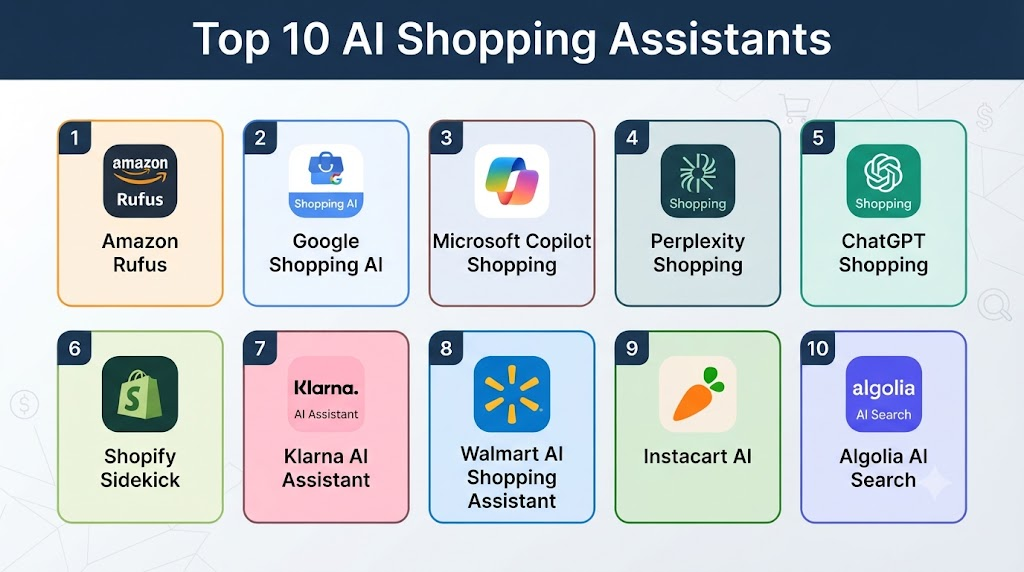
Top 10 AI Shopping Assistants
1. Amazon Rufus
One-line verdict: Best for Amazon shoppers who want conversational product research, comparisons, recommendations, and shopping guidance.
Short description:
Amazon Rufus is an AI shopping assistant integrated into the Amazon shopping experience. It is designed to answer product questions, help shoppers research categories, compare options, and make purchasing decisions using information available within Amazon’s shopping ecosystem.
Standout Capabilities
- Conversational product discovery
- Product comparisons
- Product-specific questions
- Shopping recommendations
- Category research
- Review-related insights
- Follow-up questions
- Integration with Amazon’s shopping environment
AI-Specific Depth
- Model support: Proprietary AI technology; specific underlying model configuration may vary.
- RAG / knowledge integration: Integrates shopping and product information available through Amazon’s ecosystem.
- Evaluation: Internal product-quality and recommendation evaluation; detailed methodology is not publicly stated.
- Guardrails: Product and shopping-context controls; detailed AI safety architecture is not publicly stated.
- Observability: User-facing product and recommendation context; internal model observability is not publicly stated.
Pros
- Deep integration with a major shopping marketplace
- Convenient conversational shopping experience
- Useful for researching products already available through the marketplace
Cons
- Strongly tied to Amazon’s shopping ecosystem
- Recommendations may not represent the entire market
- Product availability and pricing can change quickly
Security & Compliance
Amazon provides account and platform security controls. Exact AI data-retention and model-processing policies can vary and should be reviewed according to the relevant service terms.
Deployment & Platforms
- Web
- Mobile shopping experience
- Integrated marketplace experience
- Cloud-based
Integrations & Ecosystem
Rufus benefits from Amazon’s extensive product and shopping ecosystem.
- Product catalog
- Customer reviews
- Shopping accounts
- Orders
- Product information
- Marketplace inventory
Pricing Model
Generally included within the applicable Amazon shopping experience; availability may vary by market and account.
Best-Fit Scenarios
- Amazon shoppers
- Everyday product research
- Comparing products available on Amazon
2. Google Shopping with AI Features
One-line verdict: Best for shoppers who want broad product discovery across retailers with AI-assisted research and comparisons.
Short description:
Google Shopping combines product discovery with search, product information, retailer listings, pricing information, and increasingly AI-assisted shopping experiences. Its strength is the breadth of products and retailers that can be discovered through Google’s search ecosystem.
Standout Capabilities
- Broad product discovery
- Retailer comparison
- Natural-language search
- Product research
- Product comparisons
- Shopping recommendations
- Product information aggregation
- AI-assisted shopping research
AI-Specific Depth
- Model support: Google’s proprietary AI systems; exact model availability varies by feature.
- RAG / knowledge integration: Product listings, retailer information, search information, and other shopping data.
- Evaluation: Google evaluates search and recommendation quality; detailed shopping-specific evaluation methodology is not publicly stated.
- Guardrails: Search and shopping safety systems; detailed implementation is not publicly stated.
- Observability: User-facing search and product information; internal AI observability is not publicly stated.
Pros
- Very broad product discovery
- Can compare products across retailers
- Useful for early-stage shopping research
Cons
- Product information can vary by retailer
- Pricing and inventory can change
- Users may still need to verify final product details
Security & Compliance
Google provides platform-level privacy and security controls. Specific AI processing and personalization settings vary by service and region.
Deployment & Platforms
- Web
- Mobile
- Search-integrated shopping
- Cloud-based
Integrations & Ecosystem
- Retailers
- Product feeds
- Google Search
- Merchant listings
- Shopping data
- Product reviews
Pricing Model
Shopping search is generally free to consumers. Retailer participation and commercial relationships vary.
Best-Fit Scenarios
- Comparing retailers
- Broad product research
- Finding products across multiple stores
3. Microsoft Copilot
One-line verdict: Best for conversational shopping research integrated with Microsoft’s broader AI assistant ecosystem.
Short description:
Microsoft Copilot can assist with product research, comparisons, recommendations, and general shopping-related questions. Its conversational interface makes it useful for shoppers who want to describe their requirements and progressively refine their choices.
Standout Capabilities
- Conversational product research
- Product comparisons
- Recommendation assistance
- Natural-language questions
- Research summaries
- Shopping guidance
- General-purpose AI assistance
- Follow-up conversations
AI-Specific Depth
- Model support: Microsoft’s AI infrastructure and models; exact model availability can vary.
- RAG / knowledge integration: Can use web and other information sources depending on the Copilot experience.
- Evaluation: Microsoft performs AI quality and safety evaluation; detailed shopping-specific methodology is not publicly stated.
- Guardrails: Enterprise and consumer AI safety controls; exact shopping-specific guardrails are not publicly stated.
- Observability: User-facing conversational context; detailed internal model telemetry is not publicly stated.
Pros
- Flexible conversational experience
- Useful beyond shopping
- Good for research-heavy purchasing decisions
Cons
- Shopping capabilities may vary by experience
- Product information should be verified before purchase
- Not a dedicated marketplace
Security & Compliance
Microsoft provides security and privacy controls across its AI services. Exact controls depend on the Copilot product and account type.
Deployment & Platforms
- Web
- Windows
- Mobile
- Cloud-based
Integrations & Ecosystem
- Web search
- Microsoft ecosystem
- Product information
- Retail information
- General AI capabilities
Pricing Model
Availability depends on the specific Copilot experience and subscription.
Best-Fit Scenarios
- Research-heavy purchases
- Product comparisons
- Users already using Microsoft’s ecosystem
4. Perplexity
One-line verdict: Best for shoppers who want research-oriented product comparisons supported by conversational web-based answers.
Short description:
Perplexity is a conversational AI search and research platform that can help shoppers research products, compare alternatives, understand specifications, and investigate purchasing decisions. Its research-oriented approach is particularly useful when shoppers want more context than a traditional product listing provides.
Standout Capabilities
- Conversational research
- Product comparison
- Web-based product research
- Natural-language questions
- Research summaries
- Follow-up questions
- Alternative discovery
- Source-oriented answers
AI-Specific Depth
- Model support: Multi-model architecture depending on plan and feature.
- RAG / knowledge integration: Web retrieval is a major part of the experience.
- Evaluation: AI answer quality and retrieval evaluation are performed internally; detailed shopping-specific methodology is not publicly stated.
- Guardrails: General AI safety and content controls.
- Observability: Search and answer context are visible to users; detailed internal AI observability is not publicly stated.
Pros
- Excellent for research-heavy shopping
- Useful for comparing alternatives
- Conversational research is easy to refine
Cons
- Not primarily a traditional retail marketplace
- Product availability and prices should be independently verified
- Answers can depend on retrieved web information
Security & Compliance
Privacy and security controls vary by product and account type. Users should review applicable data policies before submitting sensitive information.
Deployment & Platforms
- Web
- Mobile
- Cloud-based
Integrations & Ecosystem
- Web search
- Product websites
- Retailers
- Reviews
- Online publications
- Search sources
Pricing Model
Free and paid plans are available; shopping-specific pricing is not generally separated.
Best-Fit Scenarios
- Detailed product research
- Comparing competing products
- Technical purchases
5. ChatGPT
One-line verdict: Best for conversational product research, personalized comparisons, buying guidance, and multi-step shopping decisions.
Short description:
ChatGPT can function as a flexible shopping research assistant by helping users define requirements, compare products, understand specifications, evaluate trade-offs, and narrow down choices. Depending on available shopping and web capabilities, it can also help users explore current products and purchasing options.
Standout Capabilities
- Conversational product research
- Product comparisons
- Personalized buying guidance
- Natural-language requirements
- Multi-step decision support
- Product explanation
- Alternative discovery
- Follow-up shopping questions
AI-Specific Depth
- Model support: OpenAI models; exact model availability depends on the ChatGPT experience.
- RAG / knowledge integration: Can use web and other connected information sources when available.
- Evaluation: AI evaluation and safety testing are part of the broader platform; shopping-specific methodology is not publicly stated.
- Guardrails: General AI safety and privacy controls; exact shopping-specific guardrails vary by feature.
- Observability: Conversation context and available product information are visible to users; internal model telemetry is not generally exposed.
Pros
- Highly flexible shopping conversations
- Excellent for explaining product trade-offs
- Useful for complicated purchasing decisions
Cons
- Product and price information can change
- Users should verify specifications before buying
- Exact shopping capabilities can depend on the available experience
Security & Compliance
Security and privacy controls depend on the ChatGPT plan and feature being used. Users should avoid sharing unnecessary sensitive personal or financial information.
Deployment & Platforms
- Web
- Desktop
- Mobile
- Cloud-based
Integrations & Ecosystem
- Web information
- Product information
- Shopping research
- Connected services where available
- General-purpose AI capabilities
Pricing Model
Free and paid ChatGPT plans are available; shopping functionality may vary by experience.
Best-Fit Scenarios
- Personalized shopping research
- Product comparisons
- Complex purchase decisions
6. Klarna AI Shopping Assistant
One-line verdict: Best for shoppers wanting AI-powered product discovery and recommendations integrated with a shopping and payments ecosystem.
Short description:
Klarna’s AI shopping capabilities are designed to help consumers discover products, compare options, and navigate shopping decisions within its broader commerce platform.
Standout Capabilities
- Product discovery
- Personalized recommendations
- Product comparisons
- Shopping search
- Commerce integration
- Consumer-oriented recommendations
- Shopping assistance
- Payment ecosystem integration
AI-Specific Depth
- Model support: Proprietary AI and third-party model technologies may be used depending on feature.
- RAG / knowledge integration: Product and retailer information.
- Evaluation: Recommendation and shopping experience evaluation; detailed methodology is not publicly stated.
- Guardrails: Platform safety and shopping controls; detailed AI guardrail architecture is not publicly stated.
- Observability: User-facing shopping results; internal AI telemetry is not publicly stated.
Pros
- Designed specifically around commerce
- Strong shopping workflow integration
- Useful for product discovery
Cons
- Availability can vary by region
- Product coverage depends on participating commerce sources
- Some features are tied to Klarna’s ecosystem
Security & Compliance
Klarna provides security and privacy controls for its commerce and financial services. Exact AI processing controls should be reviewed for the applicable feature.
Deployment & Platforms
- Web
- Mobile
- Cloud-based
Integrations & Ecosystem
- Retailers
- Product catalogs
- Shopping services
- Payments
- Merchant ecosystem
Pricing Model
Generally consumer-facing; exact shopping-assistant pricing is not separately stated.
Best-Fit Scenarios
- Product discovery
- Shopping comparisons
- Consumers using Klarna services
7. Shop.app AI Shopping Features
One-line verdict: Best for shoppers exploring products across Shopify-powered merchants and commerce experiences.
Short description:
Shop is Shopify’s consumer shopping application and marketplace environment. Its commerce ecosystem can help shoppers discover products from merchants and increasingly incorporates AI-assisted shopping functionality.
Standout Capabilities
- Product discovery
- Merchant discovery
- Personalized shopping
- Product recommendations
- Order-related shopping information
- Shopify merchant ecosystem
- Shopping search
- Commerce integration
AI-Specific Depth
- Model support: Proprietary AI technologies; exact model architecture is not publicly stated.
- RAG / knowledge integration: Shopify merchant and product information.
- Evaluation: Recommendation and shopping-quality evaluation; detailed AI evaluation methodology is not publicly stated.
- Guardrails: Commerce and platform controls; detailed AI guardrails are not publicly stated.
- Observability: Shopping and order context; internal model observability is not publicly stated.
Pros
- Large merchant ecosystem
- Strong commerce integration
- Useful for discovering products from independent merchants
Cons
- Coverage depends on participating merchants
- Product quality varies by merchant
- AI-specific capabilities can change over time
Security & Compliance
Shopify provides security and privacy controls for its commerce ecosystem. Exact AI processing practices should be evaluated according to the applicable service.
Deployment & Platforms
- Web
- Mobile
- Cloud-based
Integrations & Ecosystem
- Shopify merchants
- Product catalogs
- Payments
- Order systems
- Merchant data
- Shopping services
Pricing Model
Generally consumer-facing with no separate shopping-assistant fee publicly stated.
Best-Fit Scenarios
- Discovering independent brands
- Shopping across Shopify merchants
- Consumers already using Shop
8. ShopSavvy
One-line verdict: Best for price comparison, product discovery, deal research, and finding purchasing options across retailers.
Short description:
ShopSavvy is a shopping comparison service designed to help users find products, compare prices, discover deals, and make purchasing decisions. Its shopping-oriented approach makes it particularly useful for consumers who care about comparing retailer offers.
Standout Capabilities
- Price comparison
- Product discovery
- Deal discovery
- Retailer comparison
- Product search
- Price tracking
- Shopping alerts
- Barcode and product lookup capabilities
AI-Specific Depth
- Model support: AI-assisted shopping functionality may vary; exact underlying models are not publicly stated.
- RAG / knowledge integration: Retailer and product information.
- Evaluation: Recommendation quality is not publicly stated in detail.
- Guardrails: Standard shopping and platform controls; detailed AI guardrails are not publicly stated.
- Observability: Product and price information is presented to users; internal AI telemetry is not publicly stated.
Pros
- Strong price-comparison orientation
- Useful for deal hunters
- Focused on shopping rather than general-purpose AI
Cons
- Retailer coverage can vary
- Prices and availability can change
- Not intended for every type of complex research
Security & Compliance
Specific AI security and compliance certifications are not publicly stated.
Deployment & Platforms
- Web
- Mobile
- Cloud-based
Integrations & Ecosystem
- Retailers
- Product databases
- Price information
- Shopping feeds
- Product identifiers
Pricing Model
Consumer shopping functionality is generally available without a separately stated AI-assistant fee.
Best-Fit Scenarios
- Price-conscious shoppers
- Deal hunters
- Comparing retailers
9. Shop by Shopify
One-line verdict: Best for shoppers discovering products and brands through Shopify’s broader commerce ecosystem.
Short description:
Shop’s broader Shopify ecosystem connects consumers with merchants and product catalogs. AI-assisted discovery can help simplify product exploration and recommendations while maintaining the convenience of a commerce-focused environment.
Standout Capabilities
- Product discovery
- Brand discovery
- Personalized shopping
- Merchant recommendations
- Product browsing
- Commerce integration
- Order management
- Shopping personalization
AI-Specific Depth
- Model support: Proprietary AI capabilities; exact models are not publicly stated.
- RAG / knowledge integration: Merchant, catalog, and product information.
- Evaluation: Recommendation-quality evaluation is performed internally; detailed methodology is not publicly stated.
- Guardrails: Commerce and platform-level controls.
- Observability: Shopping context and product information; internal AI telemetry is not publicly stated.
Pros
- Large merchant ecosystem
- Strong shopping integration
- Useful for brand discovery
Cons
- Merchant availability varies
- Product information depends on individual sellers
- AI capabilities may evolve rapidly
Security & Compliance
Security controls are provided at the Shopify platform level. Exact AI data-handling practices should be reviewed for the applicable experience.
Deployment & Platforms
- Web
- Mobile
- Cloud-based
Integrations & Ecosystem
- Shopify merchants
- Product catalogs
- Payment systems
- Orders
- Merchant services
Pricing Model
Consumer shopping access is generally not separately priced.
Best-Fit Scenarios
- Brand discovery
- Independent retailers
- Shopify-focused shopping
10. You.com
One-line verdict: Best for shoppers who want conversational AI research combined with web search and product comparison capabilities.
Short description:
You.com provides an AI-powered search and research experience that can help users investigate products, compare alternatives, summarize information, and narrow down purchasing decisions. Its conversational approach is useful when shopping requires research beyond a simple product listing.
Standout Capabilities
- Conversational search
- Product research
- Comparison assistance
- Web-based discovery
- Research summaries
- Natural-language questions
- Alternative discovery
- Multi-step research
AI-Specific Depth
- Model support: Multiple AI models may be available depending on the service and plan.
- RAG / knowledge integration: Web search and retrieved information.
- Evaluation: General AI and search evaluation; detailed shopping-specific methodology is not publicly stated.
- Guardrails: General AI safety and search controls.
- Observability: Search results and conversational context; internal model telemetry is not publicly stated.
Pros
- Strong research orientation
- Useful for comparing products
- Flexible conversational experience
Cons
- Not primarily a retailer
- Product pricing and availability should be verified
- Search-derived information can vary in quality
Security & Compliance
Security and privacy capabilities vary by account and service configuration. Specific AI certifications are not publicly stated.
Deployment & Platforms
- Web
- Mobile
- Cloud-based
Integrations & Ecosystem
- Web search
- Product websites
- Retailers
- Online reviews
- Search sources
- AI research tools
Pricing Model
Free and paid options may be available depending on the service.
Best-Fit Scenarios
- Product research
- Comparing alternatives
- Research-intensive purchases
Comparison Table
| Tool Name | Best For | Deployment | Model Flexibility | Strength | Watch-Out | Public Rating |
|---|---|---|---|---|---|---|
| Amazon Rufus | Amazon shoppers | Cloud / Web / Mobile | Proprietary AI | Marketplace integration | Amazon-focused | N/A |
| Google Shopping | Broad product discovery | Cloud / Web / Mobile | Proprietary AI | Retailer comparison | Data changes quickly | N/A |
| Microsoft Copilot | Conversational shopping research | Cloud / Web / Mobile | Multi-model ecosystem | General AI assistance | Shopping features vary | N/A |
| Perplexity | Research-heavy shopping | Cloud / Web / Mobile | Multi-model | Web research | Not a traditional marketplace | N/A |
| ChatGPT | Personalized shopping research | Cloud / Web / Desktop / Mobile | Multi-model ecosystem | Flexible conversations | Verify product data | N/A |
| Klarna AI Shopping | Commerce-focused shopping | Cloud / Web / Mobile | Proprietary + AI models | Shopping integration | Regional availability | N/A |
| Shop | Shopify ecosystem shopping | Cloud / Web / Mobile | Proprietary AI | Merchant discovery | Seller-dependent information | N/A |
| ShopSavvy | Price comparison | Cloud / Web / Mobile | AI capabilities vary | Deal research | Retailer coverage varies | N/A |
| Shopify Shopping | Brand discovery | Cloud / Web / Mobile | Proprietary AI | Merchant ecosystem | Seller-dependent data | N/A |
| You.com | AI product research | Cloud / Web / Mobile | Multi-model | Conversational search | Verify product details | N/A |
Scoring & Evaluation
The following scores are a comparative buying framework rather than an objective measurement of product quality. AI shopping assistants differ considerably in their underlying purpose, data sources, retailer coverage, and available features. Buyers should test shortlisted tools using real shopping scenarios before choosing one.
The evaluation uses:
- Core features – 20%
- AI reliability & evaluation – 15%
- Guardrails & safety – 10%
- Integrations & ecosystem – 15%
- Ease of use – 10%
- Performance & cost controls – 15%
- Security & admin – 10%
- Support & community – 5%
| Tool | Core | Reliability/Eval | Guardrails | Integrations | Ease | Perf/Cost | Security/Admin | Support | Weighted Total |
|---|---|---|---|---|---|---|---|---|---|
| Amazon Rufus | 9 | 8 | 8 | 10 | 9 | 9 | 9 | 9 | 8.90 |
| Google Shopping | 10 | 9 | 9 | 10 | 9 | 9 | 9 | 10 | 9.30 |
| Microsoft Copilot | 9 | 9 | 9 | 10 | 9 | 9 | 9 | 10 | 9.20 |
| Perplexity | 9 | 9 | 8 | 9 | 9 | 8 | 8 | 9 | 8.70 |
| ChatGPT | 9 | 9 | 9 | 9 | 10 | 9 | 9 | 10 | 9.25 |
| Klarna AI Shopping | 9 | 8 | 8 | 9 | 9 | 9 | 9 | 9 | 8.75 |
| Shop | 8 | 8 | 8 | 10 | 9 | 9 | 9 | 9 | 8.70 |
| ShopSavvy | 8 | 8 | 8 | 9 | 9 | 9 | 8 | 8 | 8.45 |
| Shopify Shopping | 8 | 8 | 8 | 10 | 9 | 9 | 9 | 9 | 8.70 |
| You.com | 8 | 8 | 8 | 8 | 9 | 8 | 8 | 8 | 8.05 |
Top 3 for Enterprise
- Google Shopping
- Microsoft Copilot
- Amazon Rufus
These platforms are particularly relevant to organizations operating at significant commerce or digital-shopping scale.
Top 3 for SMB
- Google Shopping
- ChatGPT
- Shopify Shopping
SMBs can benefit from AI-assisted research, product discovery, content creation, customer support, and commerce workflows.
Top 3 for Developers
- ChatGPT
- Microsoft Copilot
- Perplexity
These options are useful for developers who want flexible AI-assisted research and broader conversational capabilities rather than a shopping-only interface.
Which AI Shopping Assistant Is Right for You?
Solo / Freelancer
For individual shoppers, the best assistant is usually the one that makes product research faster without adding unnecessary complexity.
ChatGPT, Perplexity, Google Shopping, and Amazon Rufus are strong options for different shopping workflows.
Use a general AI assistant when you need help understanding technical products or comparing complex trade-offs. Use marketplace-focused assistants when you already know where you intend to purchase.
SMB
Small businesses can use AI shopping assistants for both purchasing and customer-facing commerce activities.
Useful applications include:
- Product research
- Competitor comparison
- Supplier research
- Product discovery
- Customer recommendations
- Market research
- Shopping trend analysis
Google Shopping and Shopify’s ecosystem are particularly relevant for commerce-focused SMBs.
Mid-Market
Mid-market organizations should focus on integrations, product data quality, personalization, analytics, and scalability.
Consider:
- Product catalog integration
- Customer data controls
- Recommendation quality
- Search performance
- Retailer integrations
- Personalization
- Analytics
- Cost management
Enterprise
Large retailers should evaluate AI shopping assistants as part of their broader commerce architecture.
Important considerations include:
- Product information management
- Search and discovery
- Recommendation engines
- Customer identity
- Personalization
- AI governance
- Data privacy
- Retailer integrations
- Observability
- Human escalation
Large enterprises may combine multiple AI systems rather than relying on a single assistant.
Regulated Industries
Organizations operating in regulated environments should pay particular attention to privacy, financial information, consumer profiling, advertising transparency, and data retention.
AI recommendations should not make unsupported claims, particularly when products involve health, finance, safety, or other high-impact decisions.
Budget vs Premium
Free AI shopping tools can be highly useful for simple product research.
Premium solutions become more valuable when users need:
- Advanced research
- Larger usage limits
- More capable models
- Business integrations
- Enterprise administration
- Enhanced privacy controls
- Advanced analytics
The right choice depends on shopping frequency and complexity rather than simply selecting the most expensive option.
Build vs Buy
Businesses with highly specialized commerce requirements may consider building their own shopping assistant.
Build when you need:
- Proprietary product catalogs
- Specialized recommendation logic
- Deep customer-data integration
- Custom pricing logic
- Unique purchasing workflows
- Complete control over AI behavior
Buy when speed, simplicity, maintenance, and access to existing shopping ecosystems are more important.
Implementation Playbook
First 30 Days: Pilot + Success Metrics
- Define the shopping use cases.
- Select representative product categories.
- Identify target customers.
- Establish recommendation-quality metrics.
- Measure search-to-purchase conversion where applicable.
- Test product comparison accuracy.
- Test price and availability freshness.
- Evaluate AI-generated product summaries.
- Identify hallucination risks.
- Define privacy requirements.
- Establish human escalation procedures.
Days 31–60: Security + Evaluation + Rollout
- Establish data-access policies.
- Review retention settings.
- Test personalization controls.
- Evaluate product recommendation quality.
- Create an evaluation dataset.
- Test misleading product information.
- Test adversarial prompts.
- Validate product specifications.
- Test sponsored-product disclosure.
- Establish prompt and model version control.
- Monitor user feedback.
- Create incident-handling procedures.
Days 61–90: Optimization + Governance + Scale
- Optimize recommendation latency.
- Reduce unnecessary model calls.
- Monitor AI infrastructure costs.
- Improve product-data freshness.
- Expand product coverage.
- Monitor recommendation quality.
- Establish regular AI evaluations.
- Monitor hallucination rates.
- Review privacy controls.
- Establish AI governance.
- Analyze conversion and customer satisfaction.
- Create fallback workflows for AI failures.
Common Mistakes & How to Avoid Them
- Trusting AI-generated product specifications without verification.
- Assuming the cheapest recommendation is automatically the best.
- Ignoring retailer availability.
- Failing to distinguish sponsored recommendations from organic recommendations.
- Providing excessive personal information to shopping assistants.
- Ignoring data-retention policies.
- Using outdated product information.
- Assuming every product recommendation is unbiased.
- Failing to compare multiple retailers.
- Ignoring total ownership cost.
- Relying on customer-review summaries without checking important individual reviews.
- Using AI recommendations for high-risk products without additional verification.
- Allowing AI to make purchasing decisions without appropriate user confirmation.
- Ignoring hallucinated product features.
- Failing to test recommendation quality across different user profiles.
- Not providing a fallback when AI cannot confidently answer.
- Creating vendor lock-in around product and customer data.
FAQs
What is an AI Shopping Assistant?
An AI Shopping Assistant is software that uses artificial intelligence to help consumers discover, compare, research, and select products.
How does an AI Shopping Assistant work?
It typically combines language models, product information, search systems, recommendation algorithms, retailer data, and conversational interfaces to understand what a shopper wants and suggest relevant products.
Can AI Shopping Assistants compare prices?
Some can compare prices across retailers or marketplaces. However, prices and availability can change quickly, so users should verify the final price before purchasing.
Can AI Shopping Assistants find products within a budget?
Yes. Budget can be included as a requirement, allowing the assistant to filter or recommend products that fit the desired price range.
Can AI analyze customer reviews?
Some assistants can summarize review themes and identify common advantages or complaints. Users should still inspect important reviews directly when making significant purchases.
Are AI Shopping Assistants free?
Many consumer shopping assistants offer free access, while some general-purpose AI tools have paid plans. Business and enterprise solutions may have separate commercial pricing.
Can I use my own product catalog with an AI Shopping Assistant?
This depends on the platform. Enterprise commerce systems may support product feeds, APIs, catalog integrations, or custom AI implementations.
Are AI Shopping Assistants accurate?
They can be highly useful, but accuracy is not guaranteed. Product specifications, pricing, availability, compatibility, and recommendations should be verified before important purchases.
Can AI Shopping Assistants track prices?
Some shopping-focused tools provide price tracking or deal-alert functionality. Availability depends on the platform and retailer coverage.
Can AI recommend gifts?
Yes. Gift recommendations are one of the most useful applications because users can describe the recipient, occasion, interests, budget, and preferences conversationally.
Can AI Shopping Assistants search using images?
Some platforms support visual or multimodal shopping experiences. Users may be able to upload an image and search for similar products, styles, or categories.
Are AI shopping recommendations personalized?
Some platforms personalize recommendations using preferences, shopping activity, product interactions, or account information. The degree of personalization varies considerably.
Do AI Shopping Assistants receive commissions?
Some shopping platforms and retailers may use affiliate or commercial relationships. Users should look for appropriate disclosure when recommendations involve commercial relationships.
Are AI Shopping Assistants safe for expensive purchases?
They can assist with research, but expensive purchases should receive additional verification. Check specifications, warranty information, return policies, compatibility, seller reputation, and final pricing independently.
Can businesses build their own AI Shopping Assistant?
Yes. Businesses can combine product catalogs, search, recommendation systems, language models, customer data, and commerce APIs to create customized shopping assistants.
What is the biggest advantage of AI Shopping Assistants?
The biggest advantage is reducing the time and effort required to research products. Instead of manually comparing dozens of pages, shoppers can describe their requirements conversationally.
What is the biggest limitation?
The biggest limitation is information accuracy. AI can misunderstand requirements or produce outdated or incorrect product information, particularly when inventory, prices, specifications, or product availability change frequently.
How should businesses evaluate an AI Shopping Assistant?
Businesses should evaluate recommendation quality, product-data accuracy, conversion impact, latency, cost, privacy, security, integration capabilities, explainability, and customer satisfaction using realistic shopping scenarios.
What are alternatives to AI Shopping Assistants?
Alternatives include traditional search engines, marketplace search, comparison-shopping websites, retailer recommendation engines, human shopping consultants, product-review websites, and manually researching products.
Conclusion
AI Shopping Assistants are changing how consumers discover and evaluate products. Instead of relying entirely on traditional keyword search and manually opening dozens of product pages, shoppers can increasingly describe their needs in natural language and receive personalized research, comparisons, explanations, and recommendations.The strongest shopping assistants combine conversational AI with reliable product data, retailer information, personalization, price information, review analysis, and easy purchasing workflows. However, AI should support purchasing decisions rather than replace sensible verification.Amazon Rufus is particularly useful for Amazon-focused shoppers, Google Shopping provides broad product discovery, Microsoft Copilot and ChatGPT offer flexible conversational research, Perplexity is strong for research-intensive comparisons, Klarna focuses on commerce-oriented experiences, Shop and Shopify provide access to merchant ecosystems, ShopSavvy is useful for price comparison, and You.com offers conversational product research.