Introduction
AI Travel Planning Assistants are intelligent tools that help travelers research destinations, build itineraries, discover attractions, compare travel options, organize activities, and adapt plans to personal preferences. Instead of manually searching across travel websites, maps, blogs, booking platforms, and review pages, travelers can describe what they want in natural language and receive a structured travel plan.
These assistants are particularly useful when a trip has multiple constraints, such as a fixed budget, limited vacation time, specific interests, family requirements, accessibility needs, or several destinations. AI can quickly turn these requirements into a draft itinerary and help refine it through follow-up questions.
Common use cases include destination discovery, itinerary generation, hotel research, activity planning, restaurant discovery, road-trip planning, family vacations, business travel, budget travel, and multi-city trips.When evaluating an AI Travel Planning Assistant, consider itinerary quality, destination coverage, real-time information, maps and navigation, hotel and activity integrations, personalization, budget handling, travel-time calculations, mobile access, privacy, reliability, and the ability to update plans when circumstances ch Frequent travelers, families, couples, solo travelers, business travelers, digital nomads, travel planners, and people organizing complicated multi-destination tri Travelers who already have a detailed itinerary, highly specialized expeditions requiring professional local expertise, or situations where current availability and operational information must be independently confirmed.
What’s Changed in AI Travel Planning Assistants
- Natural-language trip planning has become easier, allowing travelers to describe an entire vacation instead of entering individual searches.
- AI can combine multiple requirements such as budget, interests, trip duration, transportation preferences, and travel companions.
- Multimodal travel planning allows travelers to use photos, maps, screenshots, and other visual information in some AI experiences.
- Conversational itinerary refinement allows travelers to change plans without rebuilding the entire itinerary.
- AI can increasingly personalize recommendations according to interests such as food, history, nature, shopping, nightlife, museums, or adventure.
- Real-time information is becoming more important because flights, hotel availability, opening hours, weather, transportation, and local conditions can change.
- AI-generated itineraries increasingly need verification because an attractive itinerary is not necessarily operationally realistic.
- Travel assistants can help optimize routes by grouping nearby attractions and reducing unnecessary travel time.
- AI is increasingly useful for road trips, where route planning, stops, attractions, accommodation, and timing must work together.
- Travelers are using AI to create alternative itineraries for different budgets and trip styles.
- Privacy matters when assistants process passport information, travel dates, locations, booking information, or personal preferences.
- AI agents are moving toward multi-step travel workflows that can research, compare, organize, and potentially assist with bookings.
- Human oversight remains important for expensive, international, complicated, or high-risk travel arrangements.
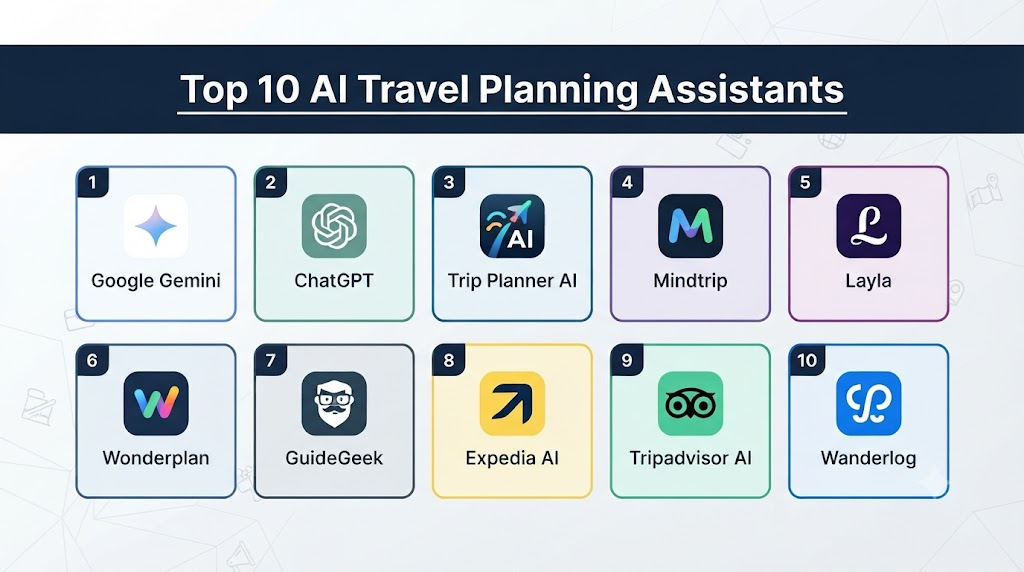
Top 10 AI Travel Planning Assistants
1. Google Gemini
One-line verdict: Best for flexible trip research that combines conversational AI, destination information, maps, and Google’s broader ecosystem.
Short description:
Google Gemini can help travelers research destinations, generate itineraries, compare travel ideas, discover attractions, and organize trip plans through natural-language conversations. Its usefulness increases when travel planning involves multiple research questions that need to be handled together.
Standout Capabilities
- Conversational trip planning
- Destination research
- Itinerary generation
- Activity discovery
- Restaurant research
- Travel brainstorming
- Multi-step travel conversations
- Integration with Google’s broader information ecosystem
AI-Specific Depth
- Model support: Google’s proprietary AI models; exact model availability varies by product and account.
- RAG / knowledge integration: Can use web and Google ecosystem information depending on the experience.
- Evaluation: General AI quality and safety evaluation; detailed travel-specific methodology is not publicly stated.
- Guardrails: General AI safety systems; detailed travel-specific guardrails are not publicly stated.
- Observability: User-facing conversational context is available; internal model telemetry is not publicly stated.
Pros
- Flexible for complex travel research
- Strong conversational planning experience
- Useful for combining multiple travel requirements
Cons
- Generated information should be verified
- Exact capabilities vary across Gemini experiences
- Not every recommendation represents confirmed availability
Security & Compliance
Google provides privacy and security controls across its services. Exact data handling depends on the Gemini product and connected services being used.
Deployment & Platforms
- Web
- Mobile
- Cloud-based
Integrations & Ecosystem
Gemini benefits from Google’s broader search, maps, travel, and information ecosystem.
- Google Search
- Google Maps
- Travel information
- Places information
- Calendar-related workflows where supported
- Other Google services where available
Pricing Model
Free and paid Gemini options may be available depending on the product and account.
Best-Fit Scenarios
- Destination research
- Multi-day itinerary planning
- Travelers already using Google’s ecosystem
2. ChatGPT
One-line verdict: Best for highly personalized travel planning, itinerary refinement, destination research, and conversational trip design.
Short description:
ChatGPT can act as a flexible travel-planning partner by turning traveler preferences into detailed itineraries and refining them through conversation. It is particularly useful when travelers have unusual requirements or want to explore several possible versions of a trip.
Standout Capabilities
- Personalized itinerary generation
- Destination research
- Budget-oriented planning
- Multi-city planning
- Restaurant and activity research
- Road-trip planning
- Packing and preparation assistance
- Conversational itinerary refinement
AI-Specific Depth
- Model support: OpenAI models; available models depend on the ChatGPT experience.
- RAG / knowledge integration: Can use web and connected information sources where available.
- Evaluation: General AI evaluation and safety testing; detailed travel-specific evaluation methodology is not publicly stated.
- Guardrails: General AI safety controls; travel-specific guardrail architecture is not publicly stated.
- Observability: Conversation context is visible to the user; internal model telemetry is not generally exposed.
Pros
- Highly customizable travel planning
- Excellent for complicated travel requirements
- Can help with many parts of trip preparation
Cons
- Travelers should verify current operational information
- Generated travel times may require confirmation
- Booking availability should not be assumed from recommendations
Security & Compliance
Privacy and security controls depend on the applicable ChatGPT plan and features. Travelers should avoid providing unnecessary sensitive information.
Deployment & Platforms
- Web
- Desktop
- Mobile
- Cloud-based
Integrations & Ecosystem
- Web research
- Maps and destination information where available
- Travel information
- Connected services where supported
- General-purpose AI capabilities
Pricing Model
Free and paid plans are available, with capabilities varying by plan and experience.
Best-Fit Scenarios
- Personalized vacations
- Complex itineraries
- Road trips and multi-city travel
3. Tripadvisor AI Travel Planner
One-line verdict: Best for travelers who want AI-assisted itinerary ideas connected to destination reviews, attractions, restaurants, and travel content.
Short description:
Tripadvisor’s travel ecosystem provides extensive traveler-generated information about hotels, restaurants, attractions, and destinations. Its AI-assisted planning capabilities can help turn this information into more personalized trip ideas.
Standout Capabilities
- Destination discovery
- AI-assisted itinerary planning
- Attraction recommendations
- Restaurant discovery
- Hotel research
- Traveler review information
- Destination inspiration
- Travel planning
AI-Specific Depth
- Model support: AI technologies used by Tripadvisor; exact model architecture is not publicly stated.
- RAG / knowledge integration: Tripadvisor’s travel content, reviews, attractions, restaurants, and destination information.
- Evaluation: Recommendation quality is evaluated internally; detailed AI-specific methodology is not publicly stated.
- Guardrails: Platform-level content and safety systems; detailed AI guardrails are not publicly stated.
- Observability: User-facing recommendations and travel information; internal AI observability is not publicly stated.
Pros
- Strong travel-focused information ecosystem
- Useful traveler reviews
- Good for discovering attractions and restaurants
Cons
- User-generated information varies in quality
- Availability and operating hours can change
- Recommendations should be checked before booking
Security & Compliance
Specific AI security certifications and detailed AI processing controls are not publicly stated.
Deployment & Platforms
- Web
- Mobile
- Cloud-based
Integrations & Ecosystem
- Hotels
- Restaurants
- Attractions
- Traveler reviews
- Destination information
- Travel experiences
Pricing Model
Travel planning is generally consumer-facing; specific AI functionality pricing is not separately stated.
Best-Fit Scenarios
- Destination discovery
- Attraction research
- Restaurant and hotel planning
4. Expedia
One-line verdict: Best for travelers who want AI-assisted trip planning connected to a broader travel booking ecosystem.
Short description:
Expedia combines travel search and booking capabilities with AI-assisted experiences designed to help travelers research destinations, discover accommodations and activities, and organize travel decisions.
Standout Capabilities
- Trip research
- Hotel discovery
- Destination planning
- Activity discovery
- Travel recommendations
- Conversational travel assistance
- Booking ecosystem integration
- Personalized travel experiences
AI-Specific Depth
- Model support: Proprietary AI systems and technologies; exact model configuration varies.
- RAG / knowledge integration: Travel inventory and information available through Expedia’s ecosystem.
- Evaluation: Travel recommendation and AI quality evaluation; detailed methodology is not publicly stated.
- Guardrails: Platform and booking safeguards; detailed AI-specific guardrails are not publicly stated.
- Observability: Travel and booking information is surfaced to users; internal AI telemetry is not publicly stated.
Pros
- Connected to a major travel ecosystem
- Useful for research and booking workflows
- Strong accommodation and travel inventory
Cons
- Availability and pricing change frequently
- Recommendations should be compared before booking
- Some AI features may vary by market or product
Security & Compliance
Expedia provides platform security and privacy controls. Exact AI data-handling practices depend on the applicable service.
Deployment & Platforms
- Web
- Mobile
- Cloud-based
Integrations & Ecosystem
- Hotels
- Flights
- Activities
- Travel inventory
- Loyalty services
- Booking systems
Pricing Model
Travel planning functionality is generally consumer-facing; booking prices vary according to the selected travel product.
Best-Fit Scenarios
- Hotel planning
- Complete vacation research
- Travelers who want planning and booking in one ecosystem
5. Booking.com AI Trip Planner
One-line verdict: Best for accommodation-focused travel planning with AI assistance across destinations, stays, and travel activities.
Short description:
Booking.com provides extensive accommodation and travel inventory, while its AI-assisted travel features can help users discover destinations, research properties, and build travel plans.
Standout Capabilities
- Accommodation discovery
- Destination recommendations
- AI-assisted travel planning
- Property comparisons
- Trip inspiration
- Activity discovery
- Travel search
- Booking integration
AI-Specific Depth
- Model support: Proprietary AI systems; exact models are not publicly stated.
- RAG / knowledge integration: Booking.com travel inventory, property information, and destination content.
- Evaluation: Internal recommendation and AI quality evaluation; detailed methodology is not publicly stated.
- Guardrails: Platform-level safety and booking controls.
- Observability: User-facing recommendations and booking information; detailed AI observability is not publicly stated.
Pros
- Large accommodation ecosystem
- Convenient planning-to-booking workflow
- Strong property discovery
Cons
- Primarily connected to Booking.com’s ecosystem
- Availability and prices change
- Travelers should verify property details
Security & Compliance
Platform security and privacy controls are provided, while detailed AI-specific compliance information is not publicly stated.
Deployment & Platforms
- Web
- Mobile
- Cloud-based
Integrations & Ecosystem
- Hotels
- Vacation properties
- Attractions
- Transportation-related services
- Booking systems
- Destination information
Pricing Model
Travelers generally pay for the selected travel products rather than for a separate AI-planning fee.
Best-Fit Scenarios
- Hotel-heavy vacations
- Destination planning
- Travelers who prefer integrated booking workflows
6. Wonderplan
One-line verdict: Best for travelers who want an itinerary-focused planning experience built around destinations, activities, preferences, and trip duration.
Short description:
Wonderplan is designed around AI-assisted itinerary generation. It can help transform destination, travel dates, interests, and preferences into organized travel plans.
Standout Capabilities
- AI itinerary generation
- Destination planning
- Activity recommendations
- Trip-duration planning
- Personalized itineraries
- Day-by-day organization
- Travel inspiration
- Itinerary customization
AI-Specific Depth
- Model support: Specific underlying model configuration is not publicly stated.
- RAG / knowledge integration: Travel and destination information; exact connector architecture is not publicly stated.
- Evaluation: Detailed evaluation methodology is not publicly stated.
- Guardrails: Detailed AI guardrail implementation is not publicly stated.
- Observability: Detailed AI observability capabilities are not publicly stated.
Pros
- Focused specifically on itinerary generation
- Simple approach to trip planning
- Useful for travelers who want a starting itinerary quickly
Cons
- Current availability should be independently checked
- Detailed AI infrastructure is not publicly stated
- Generated itineraries may require manual optimization
Security & Compliance
Specific certifications and detailed AI security controls are not publicly stated.
Deployment & Platforms
- Web
- Cloud-based
- Other platforms: Varies / N/A
Integrations & Ecosystem
- Destination information
- Activities
- Itinerary planning
- Travel recommendations
Specific API and enterprise integrations are not publicly stated.
Pricing Model
Not publicly stated / varies by service offering.
Best-Fit Scenarios
- First-time itinerary creation
- Leisure vacations
- Travelers who want structured day-by-day plans
7. GuideGeek
One-line verdict: Best for travelers seeking conversational destination advice, itinerary ideas, and practical travel recommendations.
Short description:
GuideGeek is an AI travel assistant designed to provide conversational travel planning and destination assistance. Travelers can ask questions about destinations, activities, transportation, accommodations, and itinerary ideas.
Standout Capabilities
- Conversational travel advice
- Destination recommendations
- Itinerary planning
- Activity suggestions
- Travel questions
- Personalized recommendations
- Travel inspiration
- Messaging-oriented interaction
AI-Specific Depth
- Model support: Underlying model configuration is not publicly stated in detail.
- RAG / knowledge integration: Travel information and external information sources may be used depending on the experience.
- Evaluation: Detailed travel-specific evaluation methodology is not publicly stated.
- Guardrails: General AI safety controls; detailed travel-specific guardrails are not publicly stated.
- Observability: Internal AI observability is not publicly stated.
Pros
- Convenient conversational travel experience
- Useful for destination questions
- Good for itinerary brainstorming
Cons
- Recommendations require verification
- Current availability is not guaranteed
- Detailed enterprise capabilities are limited compared with large travel platforms
Security & Compliance
Specific AI certifications and detailed enterprise security controls are not publicly stated.
Deployment & Platforms
- Messaging-based interfaces
- Web-related travel experiences
- Cloud-based
Integrations & Ecosystem
- Travel information
- Destination research
- Messaging
- Travel recommendations
- External information sources
Pricing Model
Not publicly stated / varies by service.
Best-Fit Scenarios
- Destination questions
- Itinerary brainstorming
- Travelers who prefer conversational planning
8. Mindtrip
One-line verdict: Best for travelers who want collaborative AI itinerary planning with destination discovery and organized trip information.
Short description:
Mindtrip focuses on AI-powered travel discovery and itinerary planning. It helps users explore destinations, organize places of interest, and create travel plans through an interactive interface.
Standout Capabilities
- AI itinerary planning
- Destination discovery
- Trip organization
- Place recommendations
- Collaborative travel planning
- Personalized suggestions
- Travel inspiration
- Structured trip information
AI-Specific Depth
- Model support: Specific model architecture is not publicly stated.
- RAG / knowledge integration: Travel and place information; exact retrieval infrastructure is not publicly stated.
- Evaluation: Detailed AI evaluation methodology is not publicly stated.
- Guardrails: Detailed AI guardrail architecture is not publicly stated.
- Observability: Detailed internal observability is not publicly stated.
Pros
- Travel-specific user experience
- Useful for organizing destinations and activities
- Suitable for itinerary development
Cons
- Current information should be verified
- Exact AI architecture is not publicly stated
- Some capabilities may depend on available travel data
Security & Compliance
Specific certifications and detailed AI compliance information are not publicly stated.
Deployment & Platforms
- Web
- Mobile or mobile-related experiences may vary
- Cloud-based
Integrations & Ecosystem
- Places
- Destinations
- Travel activities
- Itinerary planning
- Collaborative travel information
Pricing Model
Not publicly stated / varies by available offering.
Best-Fit Scenarios
- Group travel planning
- Destination discovery
- Detailed itinerary organization
9. Vacay
One-line verdict: Best for conversational itinerary creation and personalized destination recommendations based on traveler preferences.
Short description:
Vacay provides AI-assisted travel planning designed to help travelers create personalized itineraries and discover destinations, activities, and travel ideas.
Standout Capabilities
- Personalized itineraries
- Destination discovery
- Activity recommendations
- Conversational planning
- Trip customization
- Travel inspiration
- Travel preference handling
- Itinerary refinement
AI-Specific Depth
- Model support: Exact underlying model configuration is not publicly stated.
- RAG / knowledge integration: Travel information and destination data; specific infrastructure is not publicly stated.
- Evaluation: Detailed evaluation methodology is not publicly stated.
- Guardrails: Detailed AI safety implementation is not publicly stated.
- Observability: Detailed AI observability is not publicly stated.
Pros
- Simple AI-oriented travel planning
- Useful for personalized itineraries
- Convenient for early-stage trip planning
Cons
- Recommendations require verification
- Detailed technical architecture is not publicly stated
- Travel inventory may vary
Security & Compliance
Specific security certifications and AI compliance details are not publicly stated.
Deployment & Platforms
- Web
- Cloud-based
- Other platforms: Varies / N/A
Integrations & Ecosystem
- Travel destinations
- Activities
- Travel recommendations
- Itinerary planning
Specific API and enterprise integration details are not publicly stated.
Pricing Model
Not publicly stated / varies.
Best-Fit Scenarios
- Leisure trips
- Personalized itinerary creation
- Destination inspiration
10. Trip Planner AI
One-line verdict: Best for travelers who want AI-generated itineraries with organized destinations, attractions, and daily travel schedules.
Short description:
Trip Planner AI focuses on helping users create structured travel itineraries. It can organize destinations, activities, and travel plans into a format that is easier to review and modify.
Standout Capabilities
- AI itinerary generation
- Day-by-day travel plans
- Destination organization
- Activity discovery
- Trip customization
- Route planning
- Travel schedule management
- Itinerary visualization
AI-Specific Depth
- Model support: Exact underlying models are not publicly stated.
- RAG / knowledge integration: Travel and destination information; detailed connector architecture is not publicly stated.
- Evaluation: Detailed evaluation methodology is not publicly stated.
- Guardrails: Detailed AI guardrail implementation is not publicly stated.
- Observability: Detailed AI observability is not publicly stated.
Pros
- Focused itinerary workflow
- Useful for organizing multi-day trips
- Can reduce manual itinerary-building work
Cons
- AI-generated plans still require verification
- Current travel conditions can change
- Detailed enterprise capabilities are limited or not publicly stated
Security & Compliance
Specific certifications and detailed AI compliance controls are not publicly stated.
Deployment & Platforms
- Web
- Cloud-based
- Other platforms: Varies / N/A
Integrations & Ecosystem
- Attractions
- Destinations
- Travel planning
- Itinerary organization
- Route information
Specific enterprise APIs and integrations are not publicly stated.
Pricing Model
Not publicly stated / varies by offering.
Best-Fit Scenarios
- Multi-day vacations
- Destination itineraries
- Travelers who want organized daily schedules
Comparison Table
| Tool Name | Best For | Deployment | Model Flexibility | Strength | Watch-Out | Public Rating |
|---|---|---|---|---|---|---|
| Google Gemini | Flexible AI travel research | Cloud / Web / Mobile | Proprietary AI | Broad ecosystem | Verify generated information | N/A |
| ChatGPT | Personalized trip planning | Cloud / Web / Desktop / Mobile | Multi-model ecosystem | Flexible planning | Verify current details | N/A |
| Tripadvisor | Reviews and destination discovery | Cloud / Web / Mobile | Proprietary AI | Travel content | User-generated information varies | N/A |
| Expedia | Planning and booking | Cloud / Web / Mobile | Proprietary AI | Travel inventory | Prices change | N/A |
| Booking.com | Accommodation-focused planning | Cloud / Web / Mobile | Proprietary AI | Property ecosystem | Availability changes | N/A |
| Wonderplan | AI itinerary generation | Cloud / Web | AI model configuration not publicly stated | Itinerary focus | Verify itinerary details | N/A |
| GuideGeek | Conversational travel advice | Cloud / Messaging | AI model configuration not publicly stated | Travel conversation | Current information needs checking | N/A |
| Mindtrip | Collaborative itinerary planning | Cloud / Web / Mobile | AI model configuration not publicly stated | Trip organization | Data freshness varies | N/A |
| Vacay | Personalized travel planning | Cloud / Web | AI model configuration not publicly stated | Custom itineraries | Verify recommendations | N/A |
| Trip Planner AI | Structured itinerary planning | Cloud / Web | AI model configuration not publicly stated | Day-by-day planning | Manual verification needed | N/A |
Scoring & Evaluation
The scoring below is a comparative buying framework rather than an absolute ranking. Travel assistants have different purposes, so a tool optimized for hotel bookings may not outperform a general-purpose AI assistant for road-trip planning. Scores should be treated as directional and validated through real-world testing.
The weighting is based on:
- Core features – 20%
- AI reliability & evaluation – 15%
- Guardrails & safety – 10%
- Integrations & ecosystem – 15%
- Ease of use – 10%
- Performance & cost controls – 15%
- Security & admin – 10%
- Support & community – 5%
| Tool | Core | Reliability/Eval | Guardrails | Integrations | Ease | Perf/Cost | Security/Admin | Support | Weighted Total |
|---|---|---|---|---|---|---|---|---|---|
| Google Gemini | 9 | 9 | 9 | 10 | 9 | 9 | 9 | 10 | 9.25 |
| ChatGPT | 9 | 9 | 9 | 9 | 10 | 9 | 9 | 10 | 9.20 |
| Tripadvisor | 9 | 8 | 8 | 10 | 9 | 8 | 8 | 9 | 8.65 |
| Expedia | 9 | 8 | 8 | 10 | 9 | 8 | 9 | 9 | 8.80 |
| Booking.com | 9 | 8 | 8 | 10 | 9 | 8 | 9 | 9 | 8.80 |
| Wonderplan | 8 | 7 | 7 | 7 | 9 | 8 | 7 | 7 | 7.55 |
| GuideGeek | 8 | 7 | 7 | 7 | 9 | 8 | 7 | 8 | 7.65 |
| Mindtrip | 9 | 8 | 8 | 8 | 9 | 8 | 8 | 8 | 8.30 |
| Vacay | 8 | 7 | 7 | 7 | 9 | 8 | 7 | 7 | 7.55 |
| Trip Planner AI | 8 | 7 | 7 | 7 | 9 | 8 | 7 | 7 | 7.55 |
Top 3 for Enterprise
- Google Gemini
- ChatGPT
- Expedia
These options are particularly useful when travel planning needs to connect with broader information, research, travel inventory, or organizational workflows.
Top 3 for SMB
- Google Gemini
- ChatGPT
- Tripadvisor
These tools provide a practical balance between research capabilities, ease of use, and travel information.
Top 3 for Developers
- ChatGPT
- Google Gemini
- Perplexity-style research workflows
Developers and technical users often benefit most from flexible conversational systems that can handle research, structured planning, data transformation, and iterative refinement.
Which AI Travel Planning Assistant Is Right for You?
Solo / Freelancer
Solo travelers generally need flexibility rather than complex travel infrastructure.
ChatGPT and Google Gemini are strong choices when you want to describe your ideal trip and refine the itinerary interactively. Dedicated itinerary platforms can be preferable when you want a visually organized travel schedule.
SMB
Small businesses can use AI travel assistants for employee travel research, client trips, event planning, and business travel preparation.
Look for:
- Easy itinerary sharing
- Multiple destination support
- Budget planning
- Accommodation research
- Transportation planning
- Calendar compatibility
- Mobile access
Mid-Market
Mid-market organizations should focus on travel policy, employee workflows, security, booking integrations, and administrative control.
Important evaluation areas include:
- Travel booking integrations
- Approval workflows
- Expense management
- Traveler profiles
- Privacy
- Reporting
- Corporate travel policies
Enterprise
Enterprise buyers should treat AI travel planning as part of a broader travel-management ecosystem.
Prioritize:
- Enterprise identity
- Access controls
- Auditability
- Data governance
- Travel policy enforcement
- Booking integrations
- Expense systems
- Employee privacy
- Reliability
- Human travel support
Regulated Industries
Travel assistants may process sensitive information such as employee locations, travel schedules, passport details, and business trip information.
Organizations should minimize sensitive data sent to general-purpose AI tools and establish clear policies around retention, access, and third-party processing.
Budget vs Premium
Free AI assistants can be sufficient for basic vacation planning.
Premium services may become more useful when travelers need advanced research, higher usage limits, integrated booking workflows, specialized travel data, or additional collaboration features.
The most expensive tool is not necessarily the best option for a simple vacation.
Build vs Buy
Building a custom travel assistant can make sense for travel companies, corporate travel departments, airlines, hotels, and large tourism platforms with proprietary data.
Build when you need:
- Proprietary travel inventory
- Custom booking workflows
- Enterprise traveler profiles
- Internal travel policies
- Specialized recommendation logic
- Deep CRM integration
- Custom AI governance
Buy when you need quick deployment and general travel-planning functionality.
Implementation Playbook
First 30 Days: Pilot + Success Metrics
- Define the main travel-planning use cases.
- Choose representative destinations.
- Create sample traveler profiles.
- Define itinerary-quality metrics.
- Test different trip durations.
- Test budget constraints.
- Evaluate travel-time estimates.
- Test attraction recommendations.
- Measure itinerary completeness.
- Identify hallucination risks.
- Establish a verification process.
Days 31–60: Security + Evaluation + Rollout
- Review privacy requirements.
- Establish data-retention policies.
- Create an evaluation dataset.
- Test destination accuracy.
- Test opening-hour information.
- Test travel-time calculations.
- Test hotel and activity recommendations.
- Perform prompt-injection testing.
- Test adversarial travel questions.
- Establish prompt and model version control.
- Create incident-handling procedures.
- Add human review for important travel decisions.
Days 61–90: Optimization + Governance + Scale
- Improve itinerary generation.
- Optimize model usage.
- Reduce unnecessary AI calls.
- Monitor latency.
- Track travel-planning costs.
- Improve data freshness.
- Add alternative itineraries.
- Establish regular evaluations.
- Monitor recommendation quality.
- Create governance procedures.
- Expand destination coverage.
- Introduce fallback workflows.
Common Mistakes & How to Avoid Them
- Assuming AI-generated travel information is always current.
- Booking immediately without verifying important details.
- Ignoring travel time between attractions.
- Creating unrealistic daily schedules.
- Failing to account for opening days and operating hours.
- Ignoring seasonal conditions.
- Treating estimated prices as confirmed prices.
- Sharing passport or financial information unnecessarily.
- Ignoring hotel cancellation policies.
- Relying on a single AI assistant for expensive travel decisions.
- Failing to test alternative routes.
- Forgetting transportation between destinations.
- Overloading itineraries with too many activities.
- Ignoring traveler accessibility requirements.
- Failing to account for children or elderly travelers.
- Assuming visa requirements are accurate without checking official information.
- Ignoring weather and local conditions.
- Allowing AI to make bookings without human confirmation.
- Failing to maintain a fallback plan when AI recommendations are unavailable.
- Not checking whether attractions actually exist or operate as described.
FAQs
What is an AI Travel Planning Assistant?
An AI Travel Planning Assistant uses artificial intelligence to help travelers research destinations, build itineraries, discover activities, organize trips, and answer travel questions.
Can AI create a complete travel itinerary?
Yes. Many AI travel assistants can create day-by-day itineraries based on destinations, dates, interests, budget, and travel preferences.
Can AI plan a multi-city trip?
Yes. Multi-city planning is a useful application of AI because the assistant can organize destinations, activities, transportation, and travel time into a single plan.
Can AI plan a road trip?
Yes. AI can suggest routes, stops, attractions, restaurants, accommodations, and approximate schedules. Travelers should verify road conditions and actual travel times.
Can AI help with travel budgets?
Yes. Travelers can provide a total budget or daily spending limit and ask the assistant to prioritize affordable transportation, accommodations, food, and activities.
Can AI book flights or hotels?
Some travel platforms integrate AI with booking workflows. However, an AI-generated recommendation should not be treated as a confirmed booking unless the booking has actually been completed.
Are AI travel itineraries accurate?
They can be useful but are not guaranteed to be accurate. Opening hours, transportation schedules, prices, weather, availability, and local conditions can change.
Can AI recommend hotels?
Yes. Travel assistants can help identify hotels based on location, budget, amenities, reviews, and traveler preferences, depending on their available travel data.
Can AI plan family vacations?
Yes. AI can create family-friendly itineraries by considering children’s ages, activity preferences, accommodation requirements, transportation, and pacing.
Can AI help with international travel?
Yes, but international travelers should independently verify visas, entry requirements, passport rules, travel advisories, insurance requirements, and other official requirements.
Can AI use my travel preferences?
Some systems can personalize recommendations based on information you provide during the conversation or through supported account features. The extent of personalization varies.
Is it safe to give AI my passport information?
Avoid sharing sensitive identity information unless it is genuinely required by a trusted service. For general itinerary planning, passport numbers and other highly sensitive details are usually unnecessary.
Can AI travel assistants work offline?
Many AI travel-planning systems rely on cloud services, so offline functionality varies. Travelers should download important reservations, maps, tickets, and emergency information before traveling.
Can AI help when travel plans change?
Yes. One major advantage of conversational AI is the ability to regenerate an itinerary when flights, weather, accommodation, or traveler preferences change.
Can AI optimize an itinerary geographically?
Some tools can help group attractions and activities by location. However, travelers should verify actual travel times, traffic, public transportation schedules, and local conditions.
Can AI recommend restaurants?
Yes. AI can suggest restaurants based on cuisine, location, budget, dietary preferences, and traveler interests. Current opening hours and availability should be verified.
What is the biggest advantage of AI Travel Planning Assistants?
The biggest advantage is speed. AI can turn many travel requirements into a structured itinerary much faster than manually researching each component.
What is the biggest limitation?
The biggest limitation is reliability. An AI may produce an attractive itinerary containing outdated, inaccurate, or impractical information.
Can businesses build their own AI Travel Planning Assistant?
Yes. Travel businesses can combine language models with destination databases, hotel inventory, flight data, maps, booking APIs, customer profiles, and recommendation systems.
What are alternatives to AI Travel Planning Assistants?
Alternatives include traditional search engines, travel agencies, human travel advisors, destination websites, booking platforms, maps, travel guidebooks, and manual itinerary planning.
Conclusion
AI Travel Planning Assistants can significantly reduce the time required to research and organize a trip. They are especially valuable when a traveler has multiple constraints involving budget, dates, destinations, activities, transportation, accommodation, and personal interests.General-purpose assistants such as Google Gemini and ChatGPT are useful for flexible, conversational planning. Tripadvisor is valuable for traveler-generated destination information, while Expedia and Booking.com connect planning more closely with travel inventory and booking ecosystems. Dedicated platforms such as Wonderplan, Mindtrip, Vacay, GuideGeek, and Trip Planner AI focus more heavily on itinerary creation and travel organization.The best AI Travel Planning Assistant depends on the type of trip being planned. A simple weekend vacation may require only a general AI assistant, while a complex international trip may benefit from specialized travel platforms combined with direct verification from airlines, hotels, transportation providers, and official government sources.