Introduction
AI Personal Finance Advisors are software platforms that use artificial intelligence, machine learning, automation, financial-data analysis, and conversational interfaces to help people understand and manage their money. Instead of manually reviewing spreadsheets, users can connect financial accounts and receive automated insights about spending, budgeting, cash flow, savings, investments, subscriptions, net worth, and financial goals.
The category is evolving from simple budgeting automation toward conversational and agentic financial assistance. Modern platforms can answer questions about personal financial data, generate summaries, identify unusual spending, categorize transactions, and in some cases help users take action on subscriptions or bills. Some platforms are also moving toward broader AI-assisted financial planning that combines budgeting, investing, taxes, retirement, and long-term scena Individuals, families, professionals, freelancers, investors, and financially engaged users who want automated financial insights and a more convenient way to organize their mo People who need complex tax, estate, investment, or retirement advice that requires a qualified professional, or users who are uncomfortable connecting sensitive financial accounts to third-party software.
When evaluating these tools, buyers should consider account connectivity, financial-data accuracy, AI reliability, privacy, security, budgeting capabilities, forecasting, investment functionality, human-advisor availability, automation, integrations, cost, data portability, and the level of human oversight available.
What’s Changed in AI Personal Finance Advisors
- Conversational finance is becoming more practical: Users can increasingly ask questions about their actual spending and financial activity using ordinary language rather than navigating multiple reports.
- AI is moving beyond dashboards: Instead of simply showing transactions, modern systems can explain spending changes, summarize financial activity, identify patterns, and suggest areas that deserve attention.
- Agentic workflows are emerging: Some platforms are beginning to move from answering questions toward helping users complete financial tasks, such as managing subscriptions or taking other authorized actions.
- AI-assisted financial planning is expanding: More sophisticated platforms are combining budgeting, investments, taxes, retirement planning, net worth, and long-term financial scenarios.
- Financial data is becoming the foundation of personalization: The quality of AI recommendations depends heavily on accurate account connections, transaction categorization, balances, income information, and user-provided goals.
- Transaction categorization is becoming smarter: Machine-learning systems can learn from corrections and improve their understanding of recurring merchants and spending behavior.
- Proactive financial insights are replacing passive reporting: Instead of requiring users to inspect charts, AI can surface important changes in spending, cash flow, recurring expenses, or net worth.
- Privacy is becoming a competitive factor: Financial platforms handle highly sensitive information, making data retention, account access, encryption, permissions, and AI data usage increasingly important.
- AI evaluation matters more than chatbot quality: A finance assistant can sound intelligent while producing an incorrect calculation. Buyers should test it using realistic financial scenarios.
- Human oversight remains important: AI can support financial decisions, but complex investment, tax, retirement, and estate decisions may still require qualified professional review.
- AI features are becoming configurable: Some platforms allow users to use optional AI assistants while continuing to use traditional budgeting and financial-management features.
- The distinction between financial management and financial advice is increasingly important: A tool that explains transactions is not necessarily a regulated financial advisor.
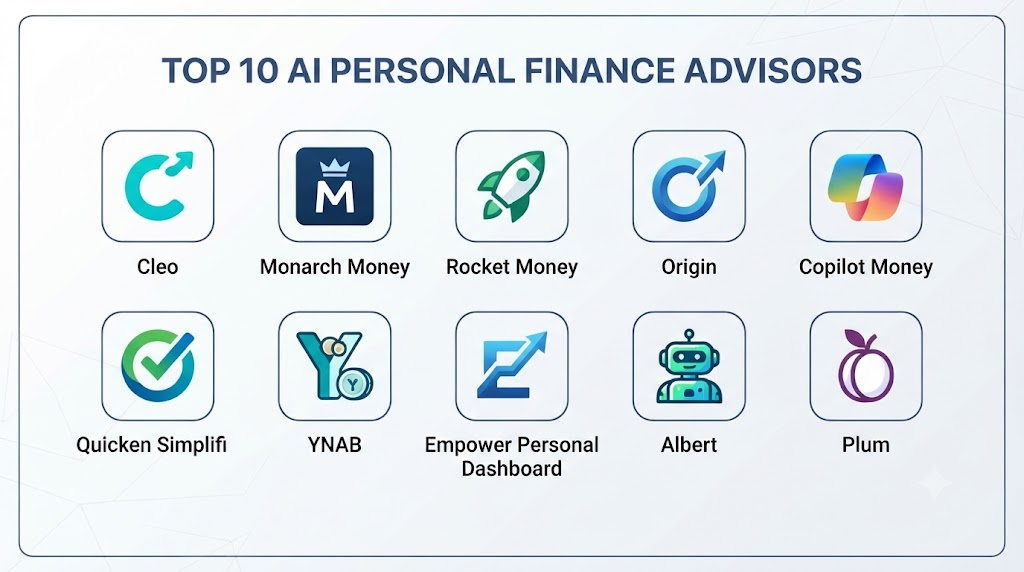
Top 10 AI Personal Finance Advisors
1. Origin
One-line verdict: Best for users wanting comprehensive AI-assisted financial planning across spending, investing, taxes, retirement, and long-term goals.
Short description
Origin is positioned as a comprehensive financial-planning platform rather than simply a budgeting application. Its AI Advisor is designed to work with a user’s financial information across multiple areas, including budgeting, investments, net worth, taxes, and longer-term planning.
Origin describes its AI Advisor as a multi-agent system with deterministic financial calculations rather than relying solely on language-model estimation.
Standout Capabilities
- AI-assisted financial planning
- Budgeting
- Investment analysis
- Net-worth tracking
- Retirement planning
- Tax-related planning
- Financial scenario analysis
- Multi-agent financial reasoning
AI-Specific Depth
- Model support: Provider-managed AI with a multi-agent architecture.
- RAG / knowledge integration: Uses financial information and financial-planning context; detailed connector architecture is not publicly stated.
- Evaluation: Origin has publicly described benchmarking its AI Advisor against CFP examination questions.
- Guardrails: Financial-planning controls and compliance-oriented checks are described by the provider.
- Observability: Detailed model-level tracing and token-cost metrics are not publicly stated.
Pros
- Broad financial-planning coverage.
- AI works with actual financial information.
- More comprehensive than basic budgeting assistants.
Cons
- May be more sophisticated than necessary for simple budgeting.
- Users should verify high-impact recommendations.
- Availability of individual features can depend on plan and location.
Security & Compliance
Origin operates as a financial-services platform and describes compliance and security controls around its AI functionality. Exact certifications and detailed retention configurations should be verified directly with the provider.
Certifications: Not publicly stated here.
Deployment & Platforms
- Web
- Mobile
- Cloud
Integrations & Ecosystem
Origin is designed to consolidate financial information into a broader planning environment.
- Bank accounts
- Investment accounts
- Net-worth tracking
- Retirement planning
- Tax-related planning
- Financial goals
- Financial scenarios
Pricing Model
Subscription-based. Exact pricing can vary by plan and promotion.
Best-Fit Scenarios
- Comprehensive financial planning
- Investment and retirement planning
- Users with complex household finances
2. Monarch Money
One-line verdict: Best for households that want comprehensive financial tracking, budgeting, collaboration, and conversational AI insights.
Short description
Monarch Money combines budgeting, account aggregation, investment tracking, net-worth monitoring, and household financial management. Its AI features include an AI Assistant, AI-powered Insights, and Weekly Recap.
The AI Assistant can answer questions about spending, cash flow, net worth, and other financial information using the user’s connected financial data.
Standout Capabilities
- AI financial assistant
- AI-powered financial insights
- Weekly financial recaps
- Budgeting
- Investment tracking
- Net-worth tracking
- Cash-flow analysis
- Household collaboration
AI-Specific Depth
- Model support: Combination of third-party large language models and in-house modeling.
- RAG / knowledge integration: Uses connected financial information and application context.
- Evaluation: Detailed independent AI benchmark is not publicly stated.
- Guardrails: Provider-managed financial and application controls.
- Observability: User-facing financial insights are available; detailed model-level tracing is not publicly stated.
Pros
- Strong all-around financial management.
- Excellent fit for households.
- AI is connected to real financial information.
Cons
- AI is primarily an enhancement rather than the entire product.
- Not a replacement for a comprehensive human financial planner.
- Some advanced financial decisions still require independent analysis.
Security & Compliance
Monarch states that privacy and security are central to its AI implementation and provides controls for certain AI features.
Certifications: Not publicly stated here.
Deployment & Platforms
- Web
- iOS
- Android
- Cloud
Integrations & Ecosystem
Monarch focuses on consolidating household financial information and turning it into actionable insights.
- Bank accounts
- Credit cards
- Investment accounts
- Transactions
- Budgets
- Net worth
- Household financial information
Pricing Model
Subscription-based.
Best-Fit Scenarios
- Couples and families
- Complete financial tracking
- Users wanting conversational financial insights
3. Copilot Money
One-line verdict: Best for users seeking intelligent financial organization, automated categorization, spending insights, and a polished personal-finance experience.
Short description
Copilot Money focuses on spending, budgeting, subscriptions, investments, cash flow, and net-worth tracking. Its Copilot Intelligence system automatically categorizes financial transactions and learns from spending patterns.
The platform also offers a conversational Money Assistant designed to answer questions about a user’s own financial information.
Standout Capabilities
- Intelligent transaction categorization
- Spending analysis
- Smart budgeting
- Subscription monitoring
- Cash-flow visualization
- Investment tracking
- Net-worth tracking
- Conversational financial assistant
AI-Specific Depth
- Model support: Provider-managed AI and machine-learning systems.
- RAG / knowledge integration: Connected financial accounts and personal financial data.
- Evaluation: Detailed formal AI evaluation methodology is not publicly stated.
- Guardrails: Provider-managed financial and application controls.
- Observability: Financial dashboards and alerts; detailed AI tracing is not publicly stated.
Pros
- Strong automated categorization.
- Excellent financial-data organization.
- Useful combination of spending, investment, and net-worth tracking.
Cons
- Strongly oriented toward its supported ecosystem.
- Not a full replacement for a professional financial advisor.
- Advanced planning capabilities are narrower than dedicated financial-planning platforms.
Security & Compliance
Copilot describes its financial connections as secure and read-only integrations.
Certifications: Not publicly stated here.
Deployment & Platforms
- Web
- iPhone
- iPad
- Mac
- Cloud
Integrations & Ecosystem
Copilot is built around consolidating personal financial accounts into one interface.
- Bank accounts
- Credit cards
- Investments
- Transactions
- Subscriptions
- Savings goals
- Net worth
Pricing Model
Subscription-based with monthly and annual options.
Best-Fit Scenarios
- Day-to-day financial tracking
- Automated transaction organization
- Users who want a modern personal-finance interface
4. Cleo
One-line verdict: Best for conversational financial coaching, spending awareness, budgeting habits, and users who prefer a chat-based experience.
Short description
Cleo takes a conversational approach to money management. Instead of relying entirely on conventional financial dashboards, it emphasizes interaction with an AI-powered financial assistant.
The platform is particularly attractive to users who want financial information presented in an accessible and engaging way.
Standout Capabilities
- Conversational financial assistant
- Spending analysis
- Budgeting
- Savings support
- Financial coaching
- Personalized money conversations
- Spending behavior insights
- Financial habit support
AI-Specific Depth
- Model support: Provider-managed AI.
- RAG / knowledge integration: Financial-account information and user context where supported.
- Evaluation: Detailed independent AI evaluation is not publicly stated.
- Guardrails: Provider-managed financial and conversational controls.
- Observability: User-facing insights; detailed model-level observability is not publicly stated.
Pros
- Highly conversational experience.
- Makes financial management approachable.
- Useful for developing better spending habits.
Cons
- Less suitable for advanced wealth planning.
- Investment and retirement capabilities are not its primary strength.
- Availability of features varies by market and plan.
Security & Compliance
Security and financial-data practices depend on the specific product and account connections.
Certifications: Not publicly stated here.
Deployment & Platforms
- Mobile
- Cloud
Integrations & Ecosystem
Cleo focuses on combining financial data with conversational coaching.
- Bank accounts
- Spending information
- Budgeting
- Savings
- Financial coaching
- AI conversations
Pricing Model
Freemium and subscription-based features may be available depending on the offering.
Best-Fit Scenarios
- Beginners
- Financial habit building
- Conversational money coaching
5. Rocket Money
One-line verdict: Best for subscription management, recurring expenses, bill optimization, and proactive financial notifications.
Short description
Rocket Money focuses heavily on subscription management, recurring expenses, bill-related services, spending visibility, and financial organization. Its AI assistant, Rowan, adds a conversational layer to the platform and can provide proactive financial summaries and alerts.
This makes Rocket Money particularly useful for users whose biggest financial problem is recurring spending rather than sophisticated investment planning.
Standout Capabilities
- Subscription detection
- Subscription management
- Bill management
- Spending summaries
- Financial alerts
- AI assistant
- Recurring-expense analysis
- Financial task assistance
AI-Specific Depth
- Model support: Provider-managed AI.
- RAG / knowledge integration: User financial information and Rocket Money account context.
- Evaluation: Detailed independent AI evaluation is not publicly stated.
- Guardrails: Platform-level controls and user authorization.
- Observability: Financial summaries and notifications; model-level tracing is not publicly stated.
Pros
- Excellent subscription-management focus.
- Proactive financial alerts.
- AI is connected to practical money-management workflows.
Cons
- Not a complete wealth-management solution.
- Some advanced services require paid plans.
- Automated actions should be monitored carefully.
Security & Compliance
Security practices vary according to account connections and service features.
Certifications: Not publicly stated here.
Deployment & Platforms
- Web
- iOS
- Android
- Cloud
Integrations & Ecosystem
Rocket Money focuses on recurring expenses and household financial activity.
- Bank accounts
- Credit cards
- Subscriptions
- Bills
- Spending
- Financial alerts
- AI assistant
Pricing Model
Freemium and subscription-based.
Best-Fit Scenarios
- Subscription cleanup
- Recurring expense management
- Users wanting proactive financial alerts
6. Empower
One-line verdict: Best for investors wanting net-worth tracking, portfolio analysis, retirement planning, and broader wealth-management capabilities.
Short description
Empower combines personal financial dashboards with investment and wealth-management capabilities. It is particularly useful for people who care about investment portfolios, retirement readiness, asset allocation, and overall net worth.
Its value is more closely associated with financial analytics and wealth management than with a chatbot-first AI experience.
Standout Capabilities
- Net-worth tracking
- Investment tracking
- Portfolio analysis
- Retirement planning
- Cash-flow monitoring
- Financial dashboards
- Wealth-management services
- Financial planning tools
AI-Specific Depth
- Model support: Provider-managed analytics and AI where applicable.
- RAG / knowledge integration: Connected financial-account data.
- Evaluation: Detailed AI evaluation is not publicly stated.
- Guardrails: Financial-platform controls.
- Observability: Portfolio analytics are available; detailed model-level tracing is not publicly stated.
Pros
- Strong investment focus.
- Useful retirement-planning capabilities.
- Good for users with multiple financial assets.
Cons
- Less AI-centric than conversational finance platforms.
- Wealth-management services can involve different requirements from free financial tools.
- Users should distinguish analytics from individualized regulated advice.
Security & Compliance
Empower operates within a financial-services environment. Exact certifications and current security controls should be verified for the relevant product.
Certifications: Not publicly stated here.
Deployment & Platforms
- Web
- iOS
- Android
- Cloud
Integrations & Ecosystem
- Bank accounts
- Investment accounts
- Retirement accounts
- Portfolio analytics
- Net worth
- Financial planning
Pricing Model
Free financial-management functionality is available, with separate wealth-management services.
Best-Fit Scenarios
- Investment tracking
- Retirement planning
- High-net-worth financial organization
7. YNAB
One-line verdict: Best for users who want disciplined budgeting and structured financial decision-making rather than fully automated AI advice.
Short description
YNAB is fundamentally a budgeting platform built around a structured methodology. Its main strength is helping users actively assign money to spending priorities and financial goals.
Unlike AI-first finance platforms, YNAB’s core value does not depend on a conversational AI advisor.
Standout Capabilities
- Structured budgeting methodology
- Spending planning
- Goal management
- Transaction management
- Account synchronization
- Budget reports
- Financial organization
- Automated budget workflows
AI-Specific Depth
- Model support: Provider-managed automation and AI features where applicable.
- RAG / knowledge integration: User budget and financial-account information.
- Evaluation: Detailed AI evaluation is not publicly stated.
- Guardrails: Application-level controls.
- Observability: Budget reports and financial dashboards; model-level observability is not publicly stated.
Pros
- Strong budgeting methodology.
- Encourages active financial decisions.
- Useful for users who want spending discipline.
Cons
- Not primarily an AI financial advisor.
- Requires user participation.
- Investment analysis is not the core focus.
Security & Compliance
Security details should be reviewed against the current product documentation.
Certifications: Not publicly stated here.
Deployment & Platforms
- Web
- iOS
- Android
- Cloud
Integrations & Ecosystem
- Bank accounts
- Transactions
- Budgets
- Financial goals
- Reports
- Household budgeting
Pricing Model
Subscription-based.
Best-Fit Scenarios
- Zero-based budgeting
- Debt reduction
- Financial goal planning
8. Quicken Simplifi
One-line verdict: Best for straightforward financial tracking, spending plans, bills, and users wanting a simpler alternative to complex financial-management software.
Short description
Quicken Simplifi is designed to help users organize spending, income, bills, savings goals, and account information in a relatively straightforward interface.
It is better viewed as an intelligent personal-finance management platform than a fully AI-native financial advisor.
Standout Capabilities
- Spending plans
- Expense tracking
- Bill tracking
- Savings goals
- Account aggregation
- Financial reports
- Cash-flow visibility
- Automated transaction management
AI-Specific Depth
- Model support: Provider-managed automation/AI where applicable.
- RAG / knowledge integration: Connected financial-account data.
- Evaluation: Not publicly stated.
- Guardrails: Application-level controls.
- Observability: Financial reports and insights; model-level tracing is not publicly stated.
Pros
- Straightforward financial organization.
- Useful spending-plan features.
- Suitable for everyday financial tracking.
Cons
- AI depth is lower than dedicated AI-first platforms.
- Advanced wealth planning may require another solution.
- Users looking for conversational AI may find it less comprehensive.
Security & Compliance
Security and data-handling practices should be checked against the current product documentation.
Certifications: Not publicly stated here.
Deployment & Platforms
- Web
- iOS
- Android
- Cloud
Integrations & Ecosystem
- Bank accounts
- Credit cards
- Transactions
- Bills
- Savings goals
- Spending plans
- Financial reports
Pricing Model
Subscription-based.
Best-Fit Scenarios
- Everyday financial tracking
- Simple spending management
- Users wanting a familiar personal-finance platform
9. INDmoney
One-line verdict: Best for Indian users wanting consolidated investment tracking, net-worth visibility, and multi-asset financial management.
Short description
INDmoney is a financial platform with strong relevance to Indian investors and users who want a consolidated view of investments and financial assets.
Its primary value is financial aggregation and investment management rather than purely conversational AI coaching.
Standout Capabilities
- Investment tracking
- Mutual-fund tracking
- Stock tracking
- Net-worth monitoring
- Portfolio analysis
- Financial-account aggregation
- Family financial tracking
- Multi-asset visibility
AI-Specific Depth
- Model support: Provider-managed AI/ML where applicable.
- RAG / knowledge integration: Portfolio and financial-account data.
- Evaluation: Detailed AI evaluation is not publicly stated.
- Guardrails: Financial-platform controls.
- Observability: Portfolio analytics; detailed model-level tracing is not publicly stated.
Pros
- Strong Indian-market focus.
- Broad investment coverage.
- Useful consolidated financial picture.
Cons
- More investment-oriented than general-purpose financial coaching.
- Investment-related recommendations require careful review.
- Features may vary depending on user account and market.
Security & Compliance
Financial and regulatory controls depend on the particular service and product.
Certifications: Not publicly stated here.
Deployment & Platforms
- Web
- iOS
- Android
- Cloud
Integrations & Ecosystem
- Indian stocks
- Mutual funds
- Bank accounts
- Fixed deposits
- International assets
- Net-worth tracking
- Portfolio analytics
Pricing Model
Free and paid services may vary by feature.
Best-Fit Scenarios
- Indian investors
- Multi-asset portfolio tracking
- Family financial management
10. ET Money
One-line verdict: Best for Indian investors seeking mutual-fund management, portfolio insights, financial planning, and investment-focused automation.
Short description
ET Money is an Indian financial platform focused on investments, mutual funds, insurance, and financial planning. Its investment-oriented features make it particularly relevant to users who want help analyzing and managing portfolios.
The platform is more investment-focused than general conversational financial assistants.
Standout Capabilities
- Mutual-fund investing
- SIP management
- Portfolio analysis
- Investment tracking
- Financial planning
- Insurance-related services
- Investment insights
- Portfolio-management tools
AI-Specific Depth
- Model support: Provider-managed AI/ML where applicable.
- RAG / knowledge integration: Investment and portfolio data.
- Evaluation: Detailed AI evaluation methodology is not publicly stated.
- Guardrails: Platform-level financial controls.
- Observability: Portfolio analytics and investment insights.
Pros
- Strong Indian investment ecosystem.
- Useful for mutual-fund investors.
- Combines investments with financial-management features.
Cons
- More investment-focused than general AI financial coaching.
- Users should independently review investment recommendations.
- Feature availability can vary by service.
Security & Compliance
Financial-service controls and regulatory requirements depend on the specific offering.
Certifications: Not publicly stated here.
Deployment & Platforms
- Web
- iOS
- Android
- Cloud
Integrations & Ecosystem
- Mutual funds
- SIPs
- Investments
- Portfolio analytics
- Insurance
- Financial planning
- Investment insights
Pricing Model
Free and paid services may vary by product.
Best-Fit Scenarios
- Indian mutual-fund investors
- SIP investors
- Portfolio analysis
Comparison Table
| Tool Name | Best For | Deployment | Model Flexibility | Strength | Watch-Out | Public Rating |
|---|---|---|---|---|---|---|
| Origin | Comprehensive financial planning | Cloud | Hosted / Multi-agent | AI-assisted planning | Verify high-impact advice | N/A |
| Monarch Money | Families and households | Cloud | Hosted / Multi-model | Complete financial tracking | Not a human advisor replacement | N/A |
| Copilot Money | Smart financial organization | Cloud / Mobile | Hosted | Intelligent categorization | Ecosystem limitations | N/A |
| Cleo | Conversational money coaching | Mobile / Cloud | Hosted | Behavioral coaching | Limited advanced planning | N/A |
| Rocket Money | Subscriptions and bills | Cloud / Mobile | Hosted | Recurring-expense management | Some advanced features paid | N/A |
| Empower | Wealth and retirement | Cloud / Mobile | Hosted | Portfolio visibility | Wealth-focused | N/A |
| YNAB | Budget discipline | Cloud / Mobile | Hosted | Structured budgeting | Limited AI advisory depth | N/A |
| Quicken Simplifi | Everyday finance | Cloud / Mobile | Hosted | Simple financial tracking | Lower AI depth | N/A |
| INDmoney | Indian multi-asset tracking | Cloud / Mobile | Hosted | Investment aggregation | Investment-focused | N/A |
| ET Money | Indian investing | Cloud / Mobile | Hosted | Mutual-fund management | Narrower AI coaching | N/A |
Scoring & Evaluation
The scoring below is a comparative editorial framework rather than an official rating from any provider. It considers the practical usefulness of each platform across core financial management, AI capabilities, integrations, usability, performance, security, and support.
Scores should be interpreted as relative rather than absolute. A platform designed for budgeting may score lower on investment planning while still being the better choice for a budgeting-focused user.
| Tool | Core | Reliability/Eval | Guardrails | Integrations | Ease | Perf/Cost | Security/Admin | Support | Weighted Total |
|---|---|---|---|---|---|---|---|---|---|
| Origin | 9.5 | 9.3 | 9.2 | 9.1 | 8.8 | 8.5 | 9.1 | 9.0 | 9.1 |
| Monarch Money | 9.4 | 8.7 | 8.8 | 9.5 | 9.3 | 8.8 | 9.0 | 9.0 | 9.0 |
| Copilot Money | 9.0 | 8.5 | 8.5 | 9.0 | 9.5 | 8.8 | 8.7 | 8.8 | 8.8 |
| Cleo | 8.6 | 8.2 | 8.2 | 8.5 | 9.5 | 9.0 | 8.3 | 8.5 | 8.6 |
| Rocket Money | 9.0 | 8.3 | 8.5 | 9.2 | 9.2 | 8.7 | 8.7 | 8.8 | 8.8 |
| Empower | 9.2 | 8.7 | 8.8 | 9.0 | 8.8 | 8.2 | 9.0 | 9.0 | 8.8 |
| YNAB | 8.8 | 8.4 | 8.5 | 8.6 | 9.0 | 8.8 | 8.7 | 9.0 | 8.7 |
| Quicken Simplifi | 8.5 | 8.1 | 8.3 | 8.8 | 9.1 | 8.8 | 8.6 | 8.8 | 8.6 |
| INDmoney | 9.0 | 8.2 | 8.3 | 9.2 | 8.9 | 8.7 | 8.5 | 8.7 | 8.7 |
| ET Money | 8.8 | 8.2 | 8.4 | 9.0 | 8.9 | 8.8 | 8.5 | 8.8 | 8.6 |
Top 3 for Enterprise
- Origin
- Monarch Money
- Empower
Top 3 for SMB
- Monarch Money
- Copilot Money
- Rocket Money
Top 3 for Developers
- Origin
- Monarch Money
- Copilot Money
Which AI Personal Finance Advisor Is Right for You?
Solo / Freelancer
Freelancers often have irregular income, making cash-flow management more important than a simple monthly budget.
Prioritize:
- Income tracking
- Expense categorization
- Cash-flow forecasting
- Tax organization
- Emergency savings
- Investment tracking
- Recurring-expense monitoring
Copilot Money, Monarch Money, and Origin can each fit different levels of complexity.
SMB
Small-business owners should keep business accounting and personal finance management separate unless a platform explicitly supports both.
For personal finances, focus on:
- Household budgeting
- Personal cash flow
- Savings
- Retirement
- Investments
- Debt management
Dedicated accounting software is generally more appropriate for business bookkeeping, invoicing, payroll, and business tax reporting.
Mid-Market
Professionals with multiple investments, retirement accounts, loans, properties, and financial goals should prioritize platforms capable of aggregating multiple financial relationships.
Important capabilities include:
- Net-worth tracking
- Portfolio analysis
- Retirement projections
- Cash-flow forecasting
- Scenario planning
- Tax organization
Origin and Empower are particularly relevant when financial planning extends beyond everyday budgeting.
Enterprise
Organizations considering AI-powered financial wellness tools need a different evaluation framework.
Focus on:
- Privacy
- Employee consent
- Data segregation
- Security controls
- Administrative permissions
- Data retention
- Auditability
- Human support
- AI transparency
An organization should not assume that a consumer finance application automatically meets enterprise requirements.
Regulated Industries
Financial institutions, healthcare organizations, government bodies, and other regulated organizations should perform detailed vendor assessments.
Verify:
- Data residency
- Data retention
- Encryption
- Access controls
- Authentication
- Vendor data usage
- Audit capabilities
- Incident response
- Human oversight
- Regulatory responsibilities
AI-generated financial information should not automatically be considered regulated advice or compliance-approved output.
Budget vs Premium
Budget users should focus on:
- Expense tracking
- Basic budgeting
- Savings goals
- Spending insights
- Financial alerts
Premium users may benefit from:
- Investment analysis
- Retirement planning
- Tax planning
- Scenario modeling
- Advanced financial dashboards
- Human-advisor access
Build vs Buy
Building a custom AI financial assistant may make sense for banks, fintech companies, wealth-management businesses, and large organizations with proprietary financial workflows.
A custom system provides more control over:
- Financial models
- Data architecture
- AI models
- Business rules
- Integrations
- Security policies
- User experiences
For individual users, however, building an AI financial advisor is rarely practical because established platforms already provide account aggregation, financial dashboards, automation, and security infrastructure.
Implementation Playbook
30 Days: Pilot + Success Metrics
Start with one clearly defined financial problem.
Examples:
- Reduce unnecessary subscriptions
- Improve monthly savings
- Track spending
- Understand cash flow
- Increase investment consistency
- Reduce debt
- Improve retirement readiness
Define measurable outcomes before selecting the platform.
Useful metrics include:
- Monthly savings rate
- Recurring expenses
- Total debt
- Investment contributions
- Net worth
- Discretionary spending
- Emergency-fund balance
During the pilot, test the AI using real-world but controlled scenarios.
Ask questions such as:
- How much did I spend on restaurants?
- Why did my spending increase?
- Which recurring expenses changed?
- Am I on track with my budget?
- How much cash might I need next month?
- What assumptions are behind this recommendation?
60 Days: Harden Security + Evaluation
Once the platform proves useful, evaluate its AI reliability.
Test whether it:
- Correctly understands financial transactions
- Calculates numbers accurately
- Distinguishes facts from assumptions
- Explains recommendations
- Identifies missing information
- Avoids fabricated financial rules
- Communicates uncertainty
- Handles unusual transactions
- Avoids overconfident investment claims
- Escalates complex questions appropriately
For important financial decisions, independently verify AI-generated information.
Also review:
- Account permissions
- Data retention
- Privacy settings
- Connected accounts
- Authentication
- Device security
- Data-export options
90 Days: Optimize Cost + Governance + Scale
Once the platform is trusted, build a consistent financial-review process.
A practical workflow is:
- Review account balances.
- Check transaction categorization.
- Review monthly spending.
- Analyze recurring expenses.
- Review cash flow.
- Monitor savings goals.
- Review investments.
- Evaluate financial projections.
- Verify important AI recommendations.
- Adjust financial goals.
Organizations should additionally establish policies for AI usage, privacy, access control, human review, incident handling, and data retention.
Common Mistakes & How to Avoid Them
- Treating AI as a licensed financial advisor: Determine what the platform actually provides before relying on recommendations.
- Trusting AI calculations without checking: Important financial calculations should be independently verified.
- Ignoring incorrect transaction categorization: Bad data produces bad recommendations.
- Connecting unnecessary accounts: Only provide access to financial accounts required for the features you use.
- Ignoring data retention: Understand how long financial information and AI interactions are retained.
- Sharing passwords or authentication codes: Never provide sensitive authentication credentials directly to an AI assistant.
- Following investment recommendations blindly: AI-generated investment suggestions can be incomplete or inappropriate.
- Ignoring tax rules: Tax treatment varies by jurisdiction and personal circumstances.
- Over-automating financial decisions: Automated actions should require appropriate authorization and monitoring.
- Skipping AI evaluation: Test the assistant with realistic questions before trusting its outputs.
- Ignoring hallucinations: A fluent answer can still be factually wrong.
- Using outdated financial information: Rates, tax rules, contribution limits, and regulations can change.
- Failing to maintain human oversight: High-impact financial decisions deserve appropriate review.
- Ignoring vendor lock-in: Prefer services that allow reasonable data export and account portability.
FAQs
What is an AI Personal Finance Advisor?
An AI Personal Finance Advisor is software that uses AI, automation, and financial-data analysis to help users understand spending, budgeting, savings, investments, cash flow, and financial goals.
Can AI replace a human financial advisor?
Not in every situation. AI is useful for analysis and organization, but complex investments, taxes, estate planning, and retirement decisions may require qualified professionals.
Are AI financial advisors safe?
Safety depends on the platform’s security, privacy practices, account integrations, AI controls, and how users apply the recommendations. Important decisions should be independently verified.
Can an AI finance platform access my bank account?
Many platforms can connect to bank accounts using financial-data integrations. Users should understand what information is accessed and whether the connection is read-only or supports additional actions.
Can AI create a personal budget?
Yes. AI can analyze income and expenses, categorize transactions, identify recurring costs, and suggest spending limits or savings targets.
Can AI track investments?
Yes. Several platforms can aggregate investment accounts, monitor portfolio values, calculate net worth, and provide investment-related insights.
Can AI give investment advice?
Some platforms provide investment-related guidance, but users should determine whether that service constitutes regulated investment advice and whether it is suitable for their circumstances.
Can AI help with retirement planning?
Yes. AI can help model savings, spending, investment growth, and different retirement scenarios. Projections are estimates and should not be treated as guarantees.
Can AI reduce unnecessary spending?
Yes. AI can identify recurring subscriptions, unusual spending, spending patterns, and categories where users may be able to reduce costs.
Can AI help manage debt?
AI can organize debt information and compare repayment strategies. Users should verify balances, interest rates, fees, and loan terms before making decisions.
Can AI help with taxes?
AI can help organize financial information and explain general tax concepts. Tax decisions should be verified using current rules or qualified tax professionals.
Do I have to connect every financial account?
No. Connect only the accounts needed for the platform’s features you intend to use. Limiting unnecessary access can reduce data exposure.
Can AI automatically manage subscriptions?
Some platforms can identify subscriptions and assist with cancellation or bill-related tasks. Users should understand what authorization is required before enabling automated actions.
Can AI predict future expenses?
AI can estimate future expenses based on historical patterns and known recurring transactions. Forecasts are not guarantees and can be wrong when circumstances change.
Which AI finance advisor is best for budgeting?
YNAB is particularly strong for structured budgeting, while Monarch Money and Copilot Money provide broader financial tracking with automated categorization and insights.
Which platform is best for investment tracking?
Empower, Origin, INDmoney, and ET Money are stronger candidates when investment and portfolio tracking are central requirements.
Which AI finance advisor is best for families?
Monarch Money is particularly well suited to household financial management and shared financial visibility.
Which tool is best for conversational financial coaching?
Cleo is strongly focused on conversational money coaching, while Monarch Money and Origin provide more comprehensive financial-data and planning capabilities.
Can I use a general AI chatbot for personal finance?
Yes, general AI systems can help explain financial concepts, organize user-provided information, create budgets, and analyze scenarios. Current financial rules and high-impact recommendations should still be verified.
Can AI detect financial fraud?
AI can help identify unusual transaction patterns, but users should also rely on their financial institution’s fraud-detection systems and report suspicious transactions directly.
Is free AI financial advice enough?
Free tools can be useful for budgeting, education, and basic financial organization. Complex planning may justify a specialized paid platform or professional advice.
Can AI help achieve financial independence?
AI can help track spending, savings, debt, investments, and financial goals. However, financial independence ultimately depends on actual behavior, income, savings, investments, expenses, and market conditions.
Conclusion
AI Personal Finance Advisors are evolving from simple budgeting applications into more intelligent financial-management systems. The strongest platforms can now combine account aggregation, automated categorization, financial summaries, conversational questions, spending analysis, investment tracking, and financial planning.Origin stands out for users seeking broader AI-assisted financial planning. Monarch Money is a strong option for households that want comprehensive financial organization and conversational insights. Copilot Money is particularly useful for intelligent categorization and modern financial tracking, while Cleo focuses on conversational financial coaching. Rocket Money is especially valuable for subscription and recurring-expense management. Empower is more relevant to wealth and retirement planning, while YNAB remains a strong choice for structured budgeting. INDmoney and ET Money are particularly relevant to Indian investors.The most important lesson is that an AI chatbot alone does not make a finance platform valuable. The quality of the underlying financial data, accuracy of calculations, reliability of recommendations, privacy protections, account security, transparency, and appropriate human oversight matter much more.AI can make personal finance easier to understand and manage, but it should not create a false sense of certainty. Users should verify important recommendations, especially when decisions involve significant investments, retirement, taxation, debt, insurance, or estate planning.