Introduction
AI Sustainable Materials Discovery refers to the use of artificial intelligence, machine learning, generative models, simulation, and materials databases to discover or evaluate materials that can provide lower environmental impact while meeting technical and commercial requirements. Instead of testing thousands of material combinations manually, AI can help researchers identify promising candidates based on properties such as strength, durability, conductivity, thermal performance, recyclability, resource intensity, and embodied emiss Materials scientists, R&D teams, chemical companies, manufacturers, battery developers, aerospace organizations, automotive companies, universities, and technology companies developing new products or material formulatio Small teams performing simple material-selection tasks where established databases, supplier catalogs, or conventional engineering analysis can provide an answer without computational discovery.
What’s Changed in AI Sustainable Materials Discovery
- AI is moving from simple property prediction toward generative materials design.
- Foundation models are increasingly being explored for chemistry and materials applications.
- Machine learning can reduce the number of expensive laboratory experiments needed to identify promising candidates.
- Active-learning workflows can select which experiment should be performed next.
- AI can combine simulation results with experimental measurements.
- Multimodal workflows can combine chemical structures, microscopy, spectroscopy, numerical data, scientific literature, and images.
- Digital workflows increasingly connect AI predictions with computational chemistry and physics-based simulation.
- Sustainability objectives can be introduced alongside technical performance requirements.
- Multi-objective optimization can balance performance, cost, availability, toxicity, recyclability, and environmental impact.
- Autonomous laboratories are increasingly being connected to AI-driven materials discovery workflows.
- Model uncertainty is becoming increasingly important when AI predictions influence expensive experiments.
- Data provenance is critical because training data can contain inconsistent measurements and experimental conditions.
- Organizations are increasingly interested in explainable predictions rather than black-box recommendations.
- Open-source models and scientific foundation models are expanding the number of tools researchers can customize.
- Researchers are increasingly using human-in-the-loop workflows to validate AI-generated material candidates.
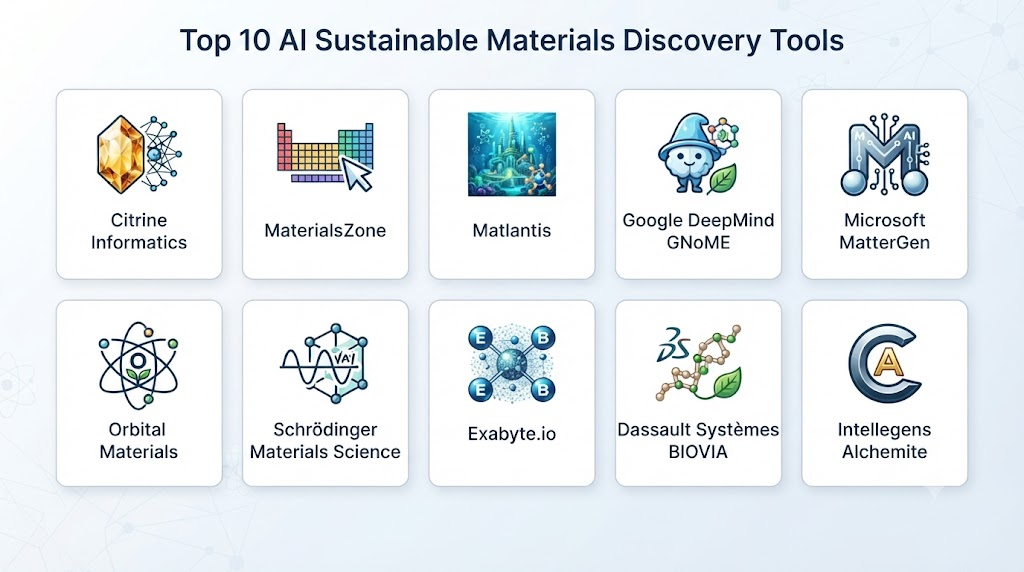
Top 10 AI Sustainable Materials Discovery Tools
1 — Materials Project
One-line verdict: Best for researchers using large-scale computational materials data to screen and understand promising material candidates.
Short description:
Materials Project is a major open materials-science data initiative providing computationally generated materials information. Researchers can use its datasets and associated tools to explore material properties and identify candidates for further investigation.
Standout Capabilities
- Large materials database
- Computational materials data
- Material-property exploration
- High-throughput calculations
- Materials screening
- Structure analysis
- Research-oriented APIs
- Open scientific ecosystem
AI-Specific Depth
- Model support: AI/ML workflows can be built using Materials Project data; it is not primarily a general-purpose AI model platform.
- RAG / knowledge integration: Not a core feature.
- Evaluation: Scientific validation depends on the specific research workflow.
- Guardrails: Not a primary platform function.
- Observability: Dataset and computational metadata are available where provided.
Pros
- Large and widely used materials dataset.
- Strong research ecosystem.
- Useful foundation for custom AI models.
Cons
- Requires materials-science expertise.
- Not a turnkey sustainable-materials discovery application.
- Computational predictions still require experimental validation.
Security & Compliance
As a scientific data resource, enterprise security controls are not the primary focus. Specific institutional requirements should be evaluated separately.
Deployment & Platforms
- Deployment: Primarily web/API-based.
- Web: Supported.
- Python: Supported through scientific tooling and APIs.
- Self-hosted: Dataset and associated tools may be used programmatically.
- Mobile: N/A.
Integrations & Ecosystem
Materials Project is designed to work with scientific-computing workflows.
- APIs
- Python
- Materials databases
- Computational chemistry
- Materials simulation
- Research pipelines
- Scientific libraries
Pricing Model
Core public materials data is generally available for research use; specific services and associated infrastructure may vary.
Best-Fit Scenarios
- Materials screening
- Academic research
- AI model development
2 — Citrine Informatics
One-line verdict: Best for industrial R&D teams using AI to accelerate materials formulation, optimization, and experimental discovery.
Short description:
Citrine Informatics provides AI-driven materials informatics capabilities for organizations developing and optimizing materials. Its platform is designed to connect experimental data, machine learning, and materials development workflows.
Standout Capabilities
- Materials informatics
- AI-assisted materials discovery
- Experimental-data management
- Materials-property prediction
- Formulation optimization
- Active learning
- Experiment planning
- Materials R&D workflows
AI-Specific Depth
- Model support: Machine-learning models and configurable workflows; exact model options vary.
- RAG / knowledge integration: Knowledge integration capabilities vary.
- Evaluation: Model evaluation and experimental validation workflows.
- Guardrails: Research workflow controls vary.
- Observability: Model and experiment tracking capabilities vary.
Pros
- Strong focus on industrial materials R&D.
- Connects AI with experimentation.
- Useful for formulation optimization.
Cons
- Enterprise-oriented.
- Requires quality experimental data.
- Exact capabilities depend on deployment and use case.
Security & Compliance
Enterprise security capabilities vary by deployment and contract. Specific certifications and data-residency options should be verified.
Deployment & Platforms
- Deployment: Cloud-based enterprise workflows.
- Web: Supported.
- Self-hosted: Varies / N/A.
- Hybrid: Varies.
- Mobile: N/A.
Integrations & Ecosystem
- Laboratory data
- Scientific databases
- APIs
- Experimental workflows
- Materials datasets
- Machine-learning pipelines
- Enterprise R&D systems
Pricing Model
Enterprise pricing; exact pricing is not publicly standardized.
Best-Fit Scenarios
- Industrial materials R&D
- Formulation optimization
- Sustainable material substitution
3 — Google DeepMind GNoME
One-line verdict: Best for researchers interested in AI-generated predictions of potentially useful new inorganic crystal structures.
Short description:
GNoME is a machine-learning research system developed to accelerate the discovery of stable inorganic crystal structures. It demonstrated how AI can significantly expand the search space for candidate materials that may warrant further computational or experimental investigation.
Standout Capabilities
- Crystal-structure prediction
- Materials discovery
- Machine-learning prediction
- Large-scale materials screening
- Stability prediction
- Computational materials research
- Scientific AI
- Candidate generation
AI-Specific Depth
- Model support: Specialized machine-learning models.
- RAG / knowledge integration: N/A.
- Evaluation: Scientific benchmarking and computational validation are central to the research.
- Guardrails: Not a commercial AI workflow platform.
- Observability: Research-specific computational validation.
Pros
- Demonstrates powerful AI-driven materials discovery.
- Useful for exploring large materials spaces.
- Strong scientific research significance.
Cons
- Not a conventional commercial materials-management platform.
- Predictions still require validation.
- Focused primarily on inorganic crystal discovery.
Security & Compliance
Not applicable as a conventional enterprise SaaS product.
Deployment & Platforms
- Deployment: Research-oriented.
- Web: Research/data resources may be available.
- Self-hosted: Specific model availability varies.
- Cloud: Varies.
- Mobile: N/A.
Integrations & Ecosystem
- Materials databases
- Computational chemistry
- Machine learning
- Scientific computing
- Materials simulation
- Research workflows
Pricing Model
Research project rather than conventional commercial software pricing.
Best-Fit Scenarios
- New crystal discovery
- Academic research
- Computational materials science
4 — Microsoft MatterGen
One-line verdict: Best for researchers exploring generative AI approaches to designing inorganic materials with targeted properties.
Short description:
MatterGen is a generative AI approach for materials design that aims to generate candidate inorganic materials according to desired properties. It represents a shift from screening known materials toward generating new candidate structures.
Standout Capabilities
- Generative materials design
- Inorganic material generation
- Property conditioning
- AI-assisted candidate discovery
- Materials structure generation
- Computational screening
- Research workflows
- Open scientific experimentation
AI-Specific Depth
- Model support: Generative AI model designed for materials discovery.
- RAG / knowledge integration: N/A.
- Evaluation: Scientific benchmarks and computational validation.
- Guardrails: Research-model constraints rather than enterprise AI guardrails.
- Observability: Research and computational evaluation workflows.
Pros
- Enables generative materials design.
- Useful for property-driven candidate generation.
- Opens new approaches to materials discovery.
Cons
- Requires technical expertise.
- Generated candidates require validation.
- Not a turnkey commercial sustainability platform.
Security & Compliance
Enterprise security controls are not the primary purpose of the research model.
Deployment & Platforms
- Deployment: Research/developer-oriented.
- Cloud: Varies.
- Self-hosted: Research implementations may be possible depending on model availability.
- Web: Not primarily a consumer web application.
- Mobile: N/A.
Integrations & Ecosystem
- Python
- Machine learning
- Materials simulation
- Scientific computing
- Materials databases
- Research pipelines
Pricing Model
Research-oriented/open-source availability varies by implementation.
Best-Fit Scenarios
- Generative materials research
- Inorganic materials
- AI-driven candidate generation
5 — Schrödinger Materials Science
One-line verdict: Best for organizations combining computational simulation, machine learning, and materials design workflows.
Short description:
Schrödinger provides computational software for chemistry and materials science. Its tools combine physics-based simulation with computational workflows that can support materials discovery and optimization.
Standout Capabilities
- Molecular simulation
- Materials modeling
- Computational chemistry
- Property prediction
- Structure analysis
- Simulation workflows
- Machine-learning applications
- High-performance computing
AI-Specific Depth
- Model support: Machine learning and computational models vary.
- RAG / knowledge integration: N/A for core materials simulation.
- Evaluation: Physics-based and computational validation workflows.
- Guardrails: Scientific workflow constraints.
- Observability: Simulation and computational workflow tracking.
Pros
- Strong computational-science foundation.
- Useful for complex materials problems.
- Combines physics and data-driven approaches.
Cons
- Requires specialized expertise.
- Licensing and infrastructure can be significant.
- Not exclusively focused on sustainability.
Security & Compliance
Enterprise security capabilities vary by deployment. Specific certifications should be verified.
Deployment & Platforms
- Deployment: Desktop, enterprise, and computational environments vary.
- Windows/Linux: Supported for applicable applications.
- Cloud: Available for applicable workflows.
- Self-hosted: Supported for relevant software.
- Hybrid: Possible depending on architecture.
Integrations & Ecosystem
- HPC
- Python
- Scientific computing
- Simulation
- Materials databases
- Laboratory workflows
- APIs
Pricing Model
Commercial licensing; exact pricing is not publicly standardized.
Best-Fit Scenarios
- Advanced materials research
- Computational chemistry
- Industrial R&D
6 — NVIDIA AI for Materials Science
One-line verdict: Best for technical teams building high-performance AI workflows for computational materials discovery and simulation.
Short description:
NVIDIA provides computing platforms, AI frameworks, and scientific-computing technologies that can accelerate materials research. Its ecosystem can support AI models, simulations, and high-performance materials workflows.
Standout Capabilities
- GPU-accelerated computing
- Scientific AI
- Simulation
- Machine learning
- Generative AI
- Materials modeling
- High-performance computing
- Research frameworks
AI-Specific Depth
- Model support: Broad AI model and framework ecosystem.
- RAG / knowledge integration: Available through broader AI tooling but not central to materials discovery.
- Evaluation: Depends on the selected model and scientific workflow.
- Guardrails: AI governance capabilities vary by software architecture.
- Observability: Compute and AI monitoring capabilities vary.
Pros
- Powerful computational infrastructure.
- Strong AI ecosystem.
- Useful for large-scale simulations.
Cons
- Requires engineering expertise.
- Hardware and compute costs can be substantial.
- Not a turnkey materials discovery application.
Security & Compliance
Enterprise security depends on the deployment architecture and software stack.
Deployment & Platforms
- Deployment: Cloud, on-premises, and hybrid.
- Linux: Widely used for scientific computing.
- Cloud: Supported through cloud providers.
- Self-hosted: Supported for relevant software.
- Edge: Available for applicable workloads.
Integrations & Ecosystem
- CUDA
- Scientific computing
- AI frameworks
- HPC
- Simulation software
- Python
- Research platforms
Pricing Model
Hardware and software pricing varies by deployment and product.
Best-Fit Scenarios
- Large-scale materials simulation
- AI research
- HPC materials workflows
7 — Materials Cloud
One-line verdict: Best for researchers needing open scientific resources and computational materials data for discovery workflows.
Short description:
Materials Cloud is a platform for sharing and accessing computational materials-science data and workflows. It supports reproducible scientific research and can provide useful resources for AI-assisted materials discovery.
Standout Capabilities
- Materials datasets
- Computational workflows
- Scientific data sharing
- Reproducibility
- Materials simulations
- Research collaboration
- Data exploration
- Open science
AI-Specific Depth
- Model support: Not primarily an AI model platform.
- RAG / knowledge integration: N/A.
- Evaluation: Scientific workflow validation.
- Guardrails: Not a primary function.
- Observability: Workflow and computational metadata vary.
Pros
- Strong open-science orientation.
- Useful for research workflows.
- Supports reproducibility.
Cons
- Not a commercial AI discovery suite.
- Requires technical expertise.
- Sustainability-specific scoring is not its primary function.
Security & Compliance
Research-platform security varies; enterprise compliance is not the central offering.
Deployment & Platforms
- Deployment: Web-based research platform.
- Web: Supported.
- Self-hosted: Components and workflows vary.
- Cloud: Research infrastructure.
- Mobile: N/A.
Integrations & Ecosystem
- Scientific workflows
- Materials databases
- Simulation tools
- APIs
- Research repositories
- Python
- Computational chemistry
Pricing Model
Research/open-science platform; specific services vary.
Best-Fit Scenarios
- Academic materials research
- Open computational workflows
- AI dataset development
8 — AiiDA
One-line verdict: Best for developers building reproducible computational materials workflows that can incorporate AI and automated experimentation.
Short description:
AiiDA is an open-source workflow engine for computational science. It helps researchers automate, track, and reproduce complex computational workflows used in materials science and related fields.
Standout Capabilities
- Workflow automation
- Provenance tracking
- Computational materials science
- Reproducibility
- Data management
- Scientific workflows
- Plugin ecosystem
- Automation
AI-Specific Depth
- Model support: Can integrate external AI/ML models.
- RAG / knowledge integration: N/A.
- Evaluation: Depends on integrated models and workflows.
- Guardrails: Workflow-level controls.
- Observability: Strong provenance and workflow tracking.
Pros
- Strong reproducibility.
- Open-source.
- Highly customizable.
Cons
- Developer-oriented.
- Requires scientific-computing knowledge.
- Not a ready-made materials-discovery application.
Security & Compliance
Security depends on the hosting environment and infrastructure.
Deployment & Platforms
- Deployment: Self-hosted.
- Linux: Common deployment environment.
- Cloud: Can be deployed in cloud environments.
- Hybrid: Possible.
- Web: Interfaces available depending on setup.
Integrations & Ecosystem
- Python
- HPC
- Materials databases
- Simulation codes
- AI/ML models
- Workflow plugins
- Scientific software
Pricing Model
Open-source.
Best-Fit Scenarios
- Computational materials research
- Reproducible AI workflows
- Custom scientific automation
9 — DeepChem
One-line verdict: Best for developers building machine-learning models for chemistry, materials, molecular properties, and scientific discovery.
Short description:
DeepChem is an open-source machine-learning framework focused on chemistry and life-science applications. Researchers can use it to develop predictive models for molecular and materials-related problems.
Standout Capabilities
- Molecular machine learning
- Property prediction
- Graph neural networks
- Scientific datasets
- Model development
- Chemistry workflows
- Custom ML
- Research experimentation
AI-Specific Depth
- Model support: Open-source ML models and frameworks.
- RAG / knowledge integration: N/A.
- Evaluation: Scientific ML evaluation tools and workflows.
- Guardrails: Not a primary feature.
- Observability: Depends on implementation.
Pros
- Open-source.
- Strong scientific ML focus.
- Highly customizable.
Cons
- Requires programming expertise.
- Not a complete commercial discovery platform.
- Materials-specific capabilities depend on the use case.
Security & Compliance
Depends on the user’s deployment environment.
Deployment & Platforms
- Deployment: Self-hosted/local/cloud.
- Python: Supported.
- Linux/macOS/Windows: Environment support varies.
- Cloud: Can be deployed in cloud environments.
- Mobile: N/A.
Integrations & Ecosystem
- Python
- PyTorch
- TensorFlow
- Scientific datasets
- Molecular databases
- ML workflows
- Jupyter
Pricing Model
Open-source.
Best-Fit Scenarios
- Custom materials ML
- Research prototypes
- Scientific AI development
10 — IBM RXN for Chemistry
One-line verdict: Best for researchers using AI-assisted chemistry prediction as part of broader sustainable-material development workflows.
Short description:
IBM RXN provides AI-assisted chemistry capabilities focused on predicting chemical reactions and supporting chemistry research. While not exclusively a materials-discovery platform, reaction prediction can contribute to the development and optimization of new sustainable materials and chemical processes.
Standout Capabilities
- Reaction prediction
- Chemistry AI
- Retrosynthesis
- Chemical informatics
- Reaction analysis
- AI-assisted research
- Chemistry workflows
- Scientific discovery
AI-Specific Depth
- Model support: Specialized AI models.
- RAG / knowledge integration: Varies / N/A.
- Evaluation: Model performance is assessed for chemistry prediction tasks.
- Guardrails: Scientific workflow constraints vary.
- Observability: Research workflow capabilities vary.
Pros
- Useful for chemistry research.
- AI-centered scientific workflow.
- Can support material-development pipelines.
Cons
- Not specifically a sustainable-materials platform.
- Requires chemistry expertise.
- Material lifecycle considerations require additional tools.
Security & Compliance
Security and data controls vary by deployment and service.
Deployment & Platforms
- Deployment: Web/API-based capabilities vary.
- Web: Supported.
- API: Available for applicable workflows.
- Self-hosted: Varies / N/A.
- Mobile: N/A.
Integrations & Ecosystem
- Chemistry datasets
- APIs
- Scientific workflows
- Chemical informatics
- Research software
- AI pipelines
Pricing Model
Availability and pricing vary by service.
Best-Fit Scenarios
- Sustainable chemistry
- Chemical research
- Material synthesis planning
Comparison Table
| Tool | Best For | Deployment | Model Flexibility | Strength | Watch-Out | Public Rating |
|---|---|---|---|---|---|---|
| Materials Project | Materials data & screening | Web/API | Open data/Custom ML | Large materials database | Requires expertise | N/A |
| Citrine Informatics | Industrial materials R&D | Cloud | Proprietary/Custom | Materials informatics | Enterprise complexity | N/A |
| GNoME | Crystal discovery | Research | Specialized AI | Candidate generation | Research-focused | N/A |
| MatterGen | Generative materials design | Research/Self-hosted varies | Generative AI | New candidate generation | Requires validation | N/A |
| Schrödinger | Computational materials | Cloud/On-prem/Hybrid | Proprietary/Custom | Simulation | Specialist skills | N/A |
| NVIDIA AI | High-performance materials AI | Cloud/On-prem/Hybrid | Multi-model/Open | Compute & AI | Infrastructure complexity | N/A |
| Materials Cloud | Scientific data | Web/Research | Open/Custom | Open science | Not turnkey | N/A |
| AiiDA | Scientific workflows | Self-hosted | Custom/Open | Reproducibility | Developer-focused | N/A |
| DeepChem | Chemistry ML | Self-hosted/Cloud | Open-source/Custom | ML flexibility | Coding required | N/A |
| IBM RXN | AI chemistry | Web/API | Proprietary AI | Reaction prediction | Not materials-specific | N/A |
Scoring & Evaluation
The following scores are comparative estimates for sustainable-materials discovery workflows, not official vendor ratings. Open research projects are evaluated differently from enterprise platforms, so users should validate the criteria against their own scientific requirements.
| Tool | Core | Reliability/Eval | Guardrails | Integrations | Ease | Perf/Cost | Security/Admin | Support | Weighted Total |
|---|---|---|---|---|---|---|---|---|---|
| Materials Project | 10 | 10 | 7 | 10 | 8 | 9 | 7 | 9 | 9.05 |
| Citrine Informatics | 10 | 9 | 9 | 9 | 8 | 8 | 9 | 9 | 8.90 |
| GNoME | 10 | 10 | 7 | 8 | 6 | 9 | 7 | 8 | 8.55 |
| MatterGen | 10 | 9 | 7 | 9 | 6 | 8 | 7 | 8 | 8.15 |
| Schrödinger | 10 | 10 | 9 | 10 | 7 | 7 | 9 | 10 | 9.00 |
| NVIDIA AI | 9 | 9 | 8 | 10 | 6 | 8 | 9 | 10 | 8.55 |
| Materials Cloud | 9 | 9 | 7 | 9 | 8 | 9 | 7 | 9 | 8.40 |
| AiiDA | 9 | 10 | 8 | 10 | 6 | 9 | 8 | 9 | 8.65 |
| DeepChem | 9 | 9 | 7 | 10 | 7 | 9 | 7 | 9 | 8.45 |
| IBM RXN | 8 | 9 | 8 | 8 | 8 | 8 | 8 | 9 | 8.25 |
Top 3 for Enterprise
- Citrine Informatics
- Schrödinger
- NVIDIA AI
Top 3 for SMB
- Materials Project
- DeepChem
- Materials Cloud
Top 3 for Developers
- AiiDA
- DeepChem
- Materials Project
Which AI Sustainable Materials Discovery Tool Is Right for You?
Solo / Freelancer
For individual researchers and consultants, open scientific resources are generally the most practical starting point.
Consider:
- Materials Project
- Materials Cloud
- DeepChem
- AiiDA
These can provide a foundation for experimentation without requiring a large enterprise software investment.
SMB
Small R&D teams should prioritize tools that reduce the amount of infrastructure they need to build themselves.
Focus on:
- Existing datasets
- Property prediction
- Experiment tracking
- Simple ML workflows
- Materials screening
- Reproducibility
If the company has proprietary formulation data, a materials-informatics platform can become more valuable.
Mid-Market
Mid-market organizations should connect AI discovery with laboratory workflows.
A practical architecture is:
Research Data → Materials Database → AI Model → Candidate Generation → Simulation → Laboratory Test → New Data → Model Update
This creates an iterative discovery loop.
Enterprise
Large R&D organizations should consider:
- Centralized materials data
- Scientific data governance
- AI model management
- Simulation infrastructure
- Laboratory automation
- Experiment tracking
- Proprietary datasets
- IP protection
- Multi-objective optimization
- Lifecycle assessment integration
The best architecture often combines AI with physics-based simulation rather than relying exclusively on a single ML model.
Regulated Industries
Organizations working in highly controlled environments should prioritize:
- Data provenance
- Reproducibility
- Experiment records
- Model versioning
- Scientific validation
- Audit trails
- Intellectual-property protection
- Access controls
- Human review
AI-generated materials should not be treated as validated simply because a model predicts favorable properties.
Budget vs Premium
Budget-conscious researchers can start with:
- Open materials databases
- Open-source ML
- Local computing
- Public scientific datasets
- Existing simulation tools
Premium solutions become attractive when organizations need:
- Enterprise R&D collaboration
- Large-scale experimentation
- Automated workflows
- Proprietary data management
- Commercial support
- High-performance computing
- Integrated laboratory systems
Build vs Buy
Buy when speed, enterprise support, laboratory integration, and mature materials-informatics workflows are priorities.
Build when your organization has proprietary datasets, specialized materials, strong computational-science expertise, and unique discovery objectives.
A hybrid approach is often the most practical: use established materials databases and scientific software while developing proprietary AI models around company-specific experimental data.
Implementation Playbook
30 Days: Pilot + Success Metrics
- Select one material class.
- Define target properties.
- Identify sustainability objectives.
- Collect historical experimental data.
- Identify suitable public materials datasets.
- Establish data-quality requirements.
- Select a baseline ML model.
- Create a candidate-ranking workflow.
- Establish scientific validation criteria.
- Define laboratory success metrics.
Useful metrics include:
- Prediction accuracy
- Candidate hit rate
- Experimental success rate
- Number of experiments avoided
- Discovery cycle time
- Material cost
- Environmental impact
- Recyclability
- Resource intensity
60 Days: Harden Security + Evaluation + Rollout
- Connect internal research datasets.
- Implement data-provenance tracking.
- Establish model-version control.
- Create an evaluation harness.
- Test models against held-out data.
- Quantify uncertainty.
- Test out-of-distribution candidates.
- Validate AI predictions experimentally.
- Add human scientific review.
- Protect proprietary formulation data.
- Establish model documentation.
90 Days: Optimize Cost + Latency + Governance
- Connect laboratory automation where appropriate.
- Introduce active learning.
- Automate candidate prioritization.
- Add simulation-based filtering.
- Add lifecycle or environmental objectives.
- Optimize compute costs.
- Monitor model performance.
- Track experimental outcomes.
- Retrain models using validated results.
- Establish research-AI governance.
Common Mistakes & How to Avoid Them
- Optimizing only for technical performance: A material can perform well while having poor environmental characteristics.
- Ignoring uncertainty: AI predictions should include appropriate confidence or uncertainty information.
- Using low-quality datasets: Inconsistent experimental conditions can undermine model accuracy.
- Treating predictions as facts: Laboratory validation remains essential.
- Ignoring sustainability boundaries: Define what “sustainable” means for the specific application.
- Optimizing one sustainability metric: Consider emissions, toxicity, resource use, recyclability, and lifecycle impacts where relevant.
- Ignoring manufacturing feasibility: A theoretically excellent material may be difficult or expensive to produce.
- Skipping data provenance: Researchers need to know where training and validation data originated.
- Ignoring distribution shift: New material families may differ substantially from training data.
- Overusing generative AI: Generated candidates still require scientific and experimental validation.
- Ignoring intellectual property: Proprietary formulations and experimental data require strong controls.
- Skipping human review: Materials decisions can have significant technical and commercial consequences.
- Ignoring laboratory integration: Discovery becomes more powerful when experiment results feed back into models.
- Failing to version models: Track the exact model used for each candidate recommendation.
- Ignoring reproducibility: A discovery workflow should be repeatable and auditable.
FAQs
What is AI sustainable materials discovery?
It is the use of AI, machine learning, simulation, and scientific datasets to identify or design materials that meet technical requirements while potentially reducing environmental impact.
How does AI discover new materials?
AI can learn relationships between material structures and properties, generate candidate structures, rank existing materials, and identify promising candidates for further simulation or laboratory testing.
Can AI create completely new materials?
Generative models can propose previously unexplored structures or compositions. However, a generated candidate is only a prediction until it is scientifically and experimentally validated.
What makes a material sustainable?
It depends on the application and lifecycle. Relevant considerations can include carbon footprint, resource availability, toxicity, durability, recyclability, manufacturing energy, and end-of-life characteristics.
Can AI optimize materials for both performance and sustainability?
Yes. Multi-objective optimization can balance technical properties with environmental or economic objectives.
What data does materials AI require?
Typical inputs include material structures, compositions, measured properties, simulation results, experimental conditions, manufacturing information, and sometimes lifecycle data.
Is Materials Project an AI platform?
Materials Project is primarily a computational materials data resource. Its datasets can be used to develop and train AI models for materials discovery.
What is generative AI in materials science?
Generative AI attempts to create new candidate material structures or compositions rather than simply ranking materials that already exist.
Does AI eliminate laboratory experiments?
No. AI can reduce the number of experiments required by prioritizing promising candidates, but laboratory validation remains essential.
Can AI discover sustainable battery materials?
Yes. AI can help screen and design battery materials based on electrochemical properties, stability, cost, resource availability, and potentially environmental criteria.
Can AI discover sustainable polymers?
Yes. Machine learning can help explore polymer compositions and predict properties such as strength, thermal stability, permeability, or other application-specific characteristics.
Can these tools use proprietary company data?
Some commercial platforms support proprietary datasets. Open-source tools can also be configured for private data, depending on the deployment architecture.
Can materials AI run locally?
Yes. Open-source frameworks and scientific software can be deployed locally or on private computing infrastructure. Commercial deployment options vary.
How should a materials AI model be evaluated?
Evaluate prediction accuracy, uncertainty, generalization, reproducibility, experimental hit rate, out-of-distribution behavior, and the practical value of generated candidates.
How expensive is AI materials discovery?
Costs vary significantly. Open-source software can reduce licensing costs, while computational infrastructure, laboratory experiments, proprietary platforms, and scientific staff can represent substantial expenses.
Can AI incorporate lifecycle assessment?
Yes, where suitable lifecycle data is available. However, AI predictions should not be confused with a complete lifecycle assessment unless the methodology supports that conclusion.
What is active learning in materials discovery?
Active learning allows a model to select the next experiments or simulations that are expected to provide the most useful information, reducing unnecessary experimentation.
Should companies build or buy materials AI?
Buy when you need mature workflows and enterprise support. Build when proprietary data and specialized discovery requirements provide a strong reason for customization.
What are alternatives to AI materials discovery tools?
Alternatives include conventional computational chemistry, physics-based simulation, materials databases, laboratory experimentation, high-throughput screening, and traditional engineering approaches.
Conclusion
AI Sustainable Materials Discovery is changing how researchers search the enormous space of possible materials. Instead of relying entirely on trial-and-error experimentation, organizations can combine machine learning, generative models, simulation, scientific databases, and laboratory results to identify promising candidates more efficiently.Materials Project and Materials Cloud provide valuable scientific resources, while Citrine Informatics is particularly relevant to industrial materials R&D. GNoME and MatterGen demonstrate how modern AI can expand the search for new materials, while Schrödinger and NVIDIA provide powerful computational foundations. Developer-focused tools such as AiiDA and DeepChem provide greater flexibility for custom research workflows.The most important point is that AI does not make a material sustainable simply because it predicts good properties. Sustainability must be defined using appropriate lifecycle, environmental, economic, technical, and manufacturing criteria.The strongest programs combine AI prediction with scientific validation, simulation, experimental evidence, and transparent data provenance.