Introduction
AI reproducibility and provenance tooling helps teams record exactly how an AI experiment, model, dataset, evaluation, or production result was created. Instead of relying on scattered notebooks, local files, command histories, and manually maintained spreadsheets, these tools capture important relationships between code, data, models, parameters, environments, experiments, and outputs.
This matters because modern AI systems increasingly depend on complex pipelines involving foundation models, agents, retrieval systems, vector databases, synthetic data, evaluation frameworks, and multiple model providers. Reproducing a result may require much more than knowing the model name. Teams may need the exact dataset version, prompt, model configuration, dependency versions, random seed, evaluator, retrieved context, and infrastructure configurAI research teams, ML engineers, data scientists, MLOps teams, AI platform engineers, enterprises, universities, and organizations where experiment traceability and model governance mat Very small projects with a few static experiments, simple prototypes that do not need historical tracking, or teams that can reliably reproduce everything through lightweight Git and configuration files.When evaluating these tools, focus on experiment tracking, dataset lineage, model versioning, artifact management, environment capture, metadata quality, reproducibility, APIs, integrations, access control, auditability, deployment flexibility, scalability, and support for modern LLM and agent workflows.
What’s Changed in AI Reproducibility & Provenance Tooling
- LLM experiments are becoming configuration-heavy: Reproducing an LLM result may require model versions, prompts, system instructions, temperature, tools, retrieval context, evaluators, and provider configuration.
- Agent provenance is becoming more important: Agentic applications can perform multiple tool calls and state transitions that must be reconstructed when debugging or auditing behavior.
- RAG provenance is moving beyond model tracking: Teams increasingly need to know which documents, chunks, embeddings, retrieval parameters, and reranking configurations influenced an answer.
- Multimodal provenance is expanding: Image, audio, video, document, and text inputs may all contribute to a model result.
- Dataset lineage is becoming a first-class requirement: Teams need to know which exact data version produced a model or benchmark result.
- Environment reproducibility is increasingly difficult: GPU drivers, CUDA versions, Python dependencies, libraries, APIs, and hosted-model versions can all influence results.
- Evaluation provenance matters: A benchmark score without the exact evaluator, prompt, dataset version, and configuration is often difficult to interpret.
- Synthetic data requires additional lineage: Teams increasingly need to track which model generated synthetic examples and what prompts or transformations were used.
- Model-provider changes can affect reproducibility: Hosted models may change behavior over time, making provider and model-version metadata important.
- AI observability and provenance are converging: Production traces can become useful evidence for reconstructing model behavior.
- Governance is expanding beyond traditional ML: Enterprises increasingly want provenance for prompts, agents, retrieval pipelines, model outputs, and evaluation results.
- Privacy is part of provenance design: Capturing every input and output can create sensitive-data retention risks.
- Reproducibility is moving toward automation: Instead of asking engineers to manually record configuration, modern tooling increasingly captures metadata automatically.
- Open and proprietary models coexist: Provenance systems increasingly need to track models from multiple providers and self-hosted deployments.
- Cost and latency are now provenance signals: For LLM systems, token usage, latency, model routing, and API costs can help explain why two runs differ.
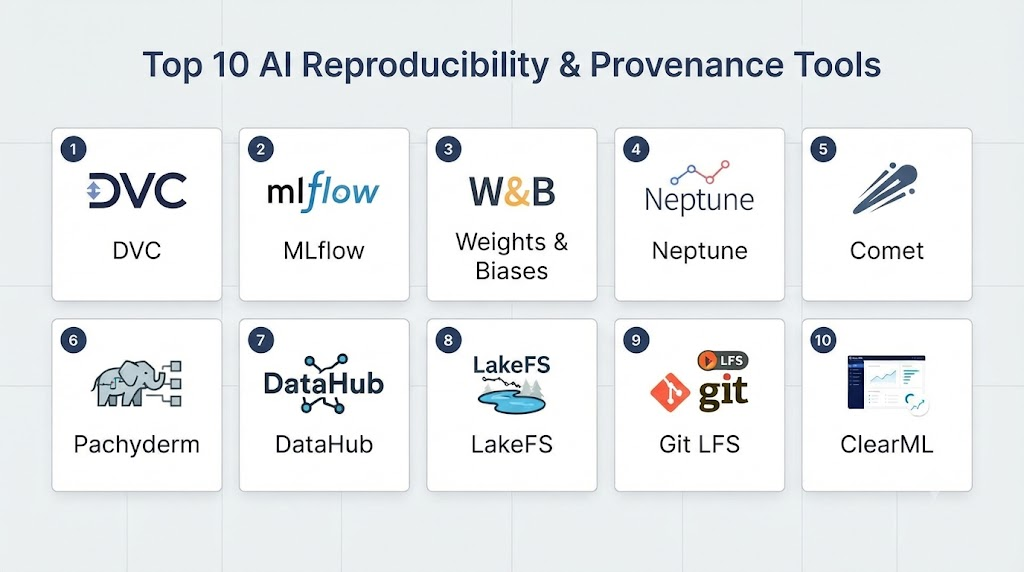
Top 10 AI Reproducibility & Provenance Tools
1. MLflow
One-line verdict: Best overall for teams that need flexible experiment tracking, model lifecycle management, artifacts, and broad ML ecosystem integration.
Short description:
MLflow is a widely used open-source machine-learning platform covering experiment tracking, model management, evaluation, deployment workflows, and related ML lifecycle capabilities. It can serve as a central record for experiments, parameters, metrics, artifacts, and model versions.
Standout Capabilities
- Experiment tracking
- Parameter and metric logging
- Artifact management
- Model packaging
- Model registry
- Evaluation workflows
- Dataset tracking
- Broad ML framework integration
AI-Specific Depth
- Model support: Broad framework and model support; hosted and open-source models can be tracked depending on implementation.
- RAG / knowledge integration: Can track RAG-related experiments and artifacts, while complete retrieval provenance depends on the surrounding pipeline.
- Evaluation: Supports model evaluation and metric tracking.
- Guardrails: Not primarily a guardrail platform; N/A for dedicated prompt-injection protection.
- Observability: Experiment and model metrics are supported; LLM tracing depends on the relevant MLflow functionality and deployment.
Pros
- Broad ecosystem compatibility.
- Strong experiment-tracking capabilities.
- Flexible open-source foundation.
Cons
- Advanced deployments require engineering.
- Teams may need additional systems for complete production observability.
- The platform can become complex as requirements grow.
Security & Compliance
Security controls depend on deployment architecture and edition. Specific certifications are Not publicly stated unless verified for the exact service and plan.
Deployment & Platforms
- Web UI
- Cloud
- Self-hosted
- Python and other development environments
Integrations & Ecosystem
MLflow can fit into a broad MLOps stack.
- Python
- Machine-learning frameworks
- Model registries
- Data pipelines
- Experiment environments
- Cloud infrastructure
- CI/CD systems
Pricing Model
Open-source capabilities are available, with commercial or managed options varying by provider and deployment.
Best-Fit Scenarios
- Enterprise MLOps
- Research reproducibility
- Multi-model AI platforms
2. Weights & Biases
One-line verdict: Best for AI research and engineering teams that need detailed experiment tracking, artifact management, collaboration, and model-development visibility.
Short description:
Weights & Biases provides experiment tracking and AI development tooling for machine-learning teams. It is particularly useful for comparing experiments, tracking datasets and artifacts, visualizing metrics, and collaborating around model development.
Standout Capabilities
- Experiment tracking
- Metrics visualization
- Artifact management
- Dataset tracking
- Model tracking
- Hyperparameter comparison
- Collaborative dashboards
- AI development workflows
AI-Specific Depth
- Model support: Broad ML ecosystem support with flexible model tracking.
- RAG / knowledge integration: Can track RAG experiments and associated artifacts; exact retrieval lineage depends on implementation.
- Evaluation: Supports experiment and evaluation tracking.
- Guardrails: Not primarily a safety platform; dedicated prompt-injection defense is N/A.
- Observability: Strong experiment metrics and tracking capabilities; production tracing depends on the specific workflow.
Pros
- Excellent experiment visualization.
- Strong collaboration features.
- Useful artifact and dataset tracking.
Cons
- Can become expensive at larger organizational scale.
- Requires careful configuration for complex provenance.
- Some teams may prefer fully self-hosted infrastructure.
Security & Compliance
Enterprise security capabilities vary by plan and deployment. Specific certifications should be verified for the selected service.
Deployment & Platforms
- Web
- Cloud
- Python
- Self-hosting options vary by offering
Integrations & Ecosystem
- Python
- ML frameworks
- Data pipelines
- Model training systems
- Artifact repositories
- CI/CD workflows
- Cloud infrastructure
Pricing Model
Commercial, tiered, and enterprise models vary. Exact pricing is Not publicly stated here.
Best-Fit Scenarios
- AI research groups
- ML engineering teams
- Collaborative model development
3. DVC
One-line verdict: Best for teams that want Git-like version control and reproducible workflows for datasets, models, experiments, and ML pipelines.
Short description:
DVC, or Data Version Control, extends version-control practices to machine-learning datasets and pipelines. It is especially useful for teams that already rely heavily on Git and want reproducible relationships between code, data, experiments, and model artifacts.
Standout Capabilities
- Dataset versioning
- Model versioning
- Pipeline versioning
- Git integration
- Experiment tracking
- Reproducible workflows
- Remote storage integration
- Data lineage
AI-Specific Depth
- Model support: Model-agnostic.
- RAG / knowledge integration: Can version documents, indexes, datasets, and pipeline components, but RAG tracing is not its primary role.
- Evaluation: Experiment tracking can capture evaluation results.
- Guardrails: N/A.
- Observability: Strong lineage and reproducibility capabilities, but not a dedicated LLM observability platform.
Pros
- Excellent Git-centered workflow.
- Strong dataset versioning.
- Useful for reproducible research.
Cons
- More developer-oriented than dashboard-oriented platforms.
- Requires Git and data-engineering discipline.
- Production observability requires additional tooling.
Security & Compliance
Security depends on repository, storage, and deployment configuration. Certification status varies and should be verified for the relevant service.
Deployment & Platforms
- Windows
- macOS
- Linux
- Cloud
- Self-hosted
Integrations & Ecosystem
- Git
- Cloud storage
- Python
- ML pipelines
- CI/CD
- Data repositories
- Experiment workflows
Pricing Model
Open-source tooling is available; commercial services and enterprise options vary.
Best-Fit Scenarios
- Research teams
- Git-centric ML teams
- Dataset-heavy projects
4. lakeFS
One-line verdict: Best for organizations requiring Git-like versioning and reproducibility for large-scale data lakes and machine-learning datasets.
Short description:
lakeFS provides version control capabilities for data stored in object-storage environments. It can help AI teams create reproducible datasets by branching, committing, and tracking changes to large data collections.
Standout Capabilities
- Data versioning
- Branching
- Commits
- Reproducible data states
- Large-scale data management
- Data-lake workflows
- Data testing
- Pipeline integration
AI-Specific Depth
- Model support: Model-agnostic.
- RAG / knowledge integration: Can version source data used by RAG systems but does not provide complete RAG tracing.
- Evaluation: Dataset versions can support reproducible evaluations.
- Guardrails: Data validation capabilities can enforce certain data policies; AI-specific safety is N/A.
- Observability: Strong data lineage and version visibility.
Pros
- Powerful dataset reproducibility.
- Excellent for large data environments.
- Git-like mental model.
Cons
- Primarily a data-versioning system.
- Requires data infrastructure expertise.
- Not an all-in-one experiment tracker.
Security & Compliance
Security depends on deployment and infrastructure. Specific certifications are Not publicly stated here.
Deployment & Platforms
- Cloud
- Self-hosted
- Data-lake environments
- Linux-oriented infrastructure
Integrations & Ecosystem
- Object storage
- Data lakes
- ML pipelines
- Spark
- Kubernetes
- Data engineering systems
Pricing Model
Open-source and commercial options vary by deployment.
Best-Fit Scenarios
- Enterprise data platforms
- Large AI datasets
- Reproducible data pipelines
5. ClearML
One-line verdict: Best for teams wanting an integrated open-source-oriented platform for experiments, datasets, pipelines, models, and ML orchestration.
Short description:
ClearML provides a broad platform covering experiment management, dataset management, model tracking, orchestration, and ML workflow automation. It is designed to connect the different pieces required to reproduce and operate machine-learning projects.
Standout Capabilities
- Experiment tracking
- Dataset management
- Model management
- Pipeline orchestration
- Remote execution
- Artifact tracking
- Hyperparameter optimization
- Reproducible experiments
AI-Specific Depth
- Model support: Broad ML framework compatibility.
- RAG / knowledge integration: Can track RAG-related artifacts and workflows, with detailed retrieval provenance depending on configuration.
- Evaluation: Experiment and evaluation metrics can be tracked.
- Guardrails: Not primarily an AI safety system.
- Observability: Strong experiment and workflow tracking.
Pros
- Broad ML lifecycle coverage.
- Open-source-oriented.
- Useful for distributed teams.
Cons
- Can require substantial setup.
- Broad feature set increases complexity.
- LLM-specific workflows may require additional tooling.
Security & Compliance
Security capabilities vary by deployment and product configuration. Specific certifications are Not publicly stated here.
Deployment & Platforms
- Cloud
- Self-hosted
- Linux
- Web interface
Integrations & Ecosystem
- Python
- ML frameworks
- Kubernetes
- Cloud infrastructure
- Data pipelines
- Model repositories
- CI/CD
Pricing Model
Open-source capabilities and commercial offerings are available; exact pricing varies.
Best-Fit Scenarios
- ML platform teams
- Enterprise experimentation
- Reproducible model pipelines
6. Pachyderm
One-line verdict: Best for teams that need data lineage, reproducible pipelines, and versioned data workflows for machine-learning systems.
Short description:
Pachyderm focuses on data versioning and reproducible data pipelines. It is particularly useful when dataset transformations and pipeline execution need to be traceable and repeatable.
Standout Capabilities
- Data versioning
- Pipeline lineage
- Reproducible processing
- Data provenance
- Containerized workflows
- Pipeline automation
- Data repositories
- ML integration
AI-Specific Depth
- Model support: Model-agnostic.
- RAG / knowledge integration: Can version and process RAG source data, but dedicated RAG provenance is Varies / N/A.
- Evaluation: Can provide reproducible data inputs for evaluations.
- Guardrails: Data-level controls rather than AI safety controls.
- Observability: Pipeline and data lineage are core strengths.
Pros
- Strong data provenance.
- Useful for repeatable pipelines.
- Good fit for data-intensive ML systems.
Cons
- Infrastructure can be complex.
- Not primarily an experiment dashboard.
- Requires Kubernetes/container knowledge for advanced usage.
Security & Compliance
Security depends on deployment and infrastructure. Specific certifications are Not publicly stated here.
Deployment & Platforms
- Cloud
- Self-hosted
- Kubernetes
- Linux
Integrations & Ecosystem
- Kubernetes
- Containers
- Data pipelines
- ML workflows
- Object storage
- CI/CD systems
Pricing Model
Commercial and deployment-dependent pricing varies.
Best-Fit Scenarios
- Data-intensive AI platforms
- Enterprise pipelines
- Dataset lineage management
7. Neptune
One-line verdict: Best for teams seeking specialized experiment tracking, metadata management, and comparison across machine-learning experiments.
Short description:
Neptune has historically focused on experiment management and metadata tracking for machine-learning teams. It can help teams organize parameters, metrics, artifacts, and experiment results.
Standout Capabilities
- Experiment tracking
- Metadata management
- Metric comparison
- Artifact tracking
- Experiment organization
- Model-development workflows
- Collaboration
- Run comparison
AI-Specific Depth
- Model support: Broad ML experiment support.
- RAG / knowledge integration: Can record metadata from RAG experiments but is not a RAG platform.
- Evaluation: Experiment and evaluation metrics can be recorded.
- Guardrails: N/A.
- Observability: Strong experiment-level observability.
Pros
- Strong metadata organization.
- Useful for comparing experiments.
- Designed around ML workflows.
Cons
- Product availability and roadmap should be verified before adoption.
- Not primarily a data-lake provenance system.
- Teams should evaluate migration and long-term platform considerations.
Security & Compliance
Current security and compliance status should be verified before procurement.
Deployment & Platforms
Varies / N/A based on current product availability and deployment model.
Integrations & Ecosystem
- Python
- ML frameworks
- Experiment pipelines
- Model training workflows
- Artifact systems
- Evaluation tools
Pricing Model
Current pricing is Not publicly stated here.
Best-Fit Scenarios
- Experiment-heavy research teams
- ML metadata tracking
- Model comparison workflows
8. Langfuse
One-line verdict: Best for LLM teams needing traces, prompts, evaluations, token metrics, and production provenance for AI applications.
Short description:
Langfuse is focused on observability and evaluation for LLM applications. It can capture traces, prompts, model interactions, costs, latency, and evaluation information, making it useful for reconstructing how an AI application produced a result.
Standout Capabilities
- LLM tracing
- Prompt management
- Evaluation
- Token usage tracking
- Latency tracking
- Cost analysis
- Session tracing
- LLM application observability
AI-Specific Depth
- Model support: Multi-model LLM workflows.
- RAG / knowledge integration: Useful for tracing retrieval and generation workflows depending on implementation.
- Evaluation: Strong LLM evaluation capabilities.
- Guardrails: Primarily observability/evaluation rather than dedicated runtime guardrails.
- Observability: One of its primary strengths, including traces, latency, and token/cost information.
Pros
- Strong LLM-focused provenance.
- Useful for debugging AI applications.
- Supports evaluation and prompt workflows.
Cons
- Not a general-purpose ML dataset versioning platform.
- Traditional ML workflows may need other tools.
- Complete provenance depends on instrumentation.
Security & Compliance
Deployment-specific controls vary. Self-hosting can provide additional infrastructure control. Specific certifications should be verified for the relevant service.
Deployment & Platforms
- Web
- Cloud
- Self-hosted
- Linux
Integrations & Ecosystem
- LLM applications
- APIs
- SDKs
- RAG systems
- Agent frameworks
- Evaluation workflows
- Model providers
Pricing Model
Open-source/self-hosted capabilities and commercial cloud options are available; exact pricing varies.
Best-Fit Scenarios
- LLM applications
- AI agents
- RAG provenance
9. Arize AI
One-line verdict: Best for organizations combining ML observability, LLM evaluation, production monitoring, and AI troubleshooting.
Short description:
Arize AI provides AI observability and evaluation capabilities for machine-learning and generative-AI systems. It can help teams understand model behavior across development and production environments.
Standout Capabilities
- ML observability
- LLM tracing
- Evaluation
- Model monitoring
- Drift detection
- AI troubleshooting
- Production analysis
- Performance monitoring
AI-Specific Depth
- Model support: Supports a broad range of ML and LLM systems.
- RAG / knowledge integration: Can support tracing and evaluation of retrieval-based applications.
- Evaluation: Strong focus on AI and LLM evaluation.
- Guardrails: Monitoring and evaluation rather than primary runtime guardrails.
- Observability: Strong production and LLM observability capabilities.
Pros
- Strong enterprise observability.
- Useful for production AI systems.
- Combines monitoring and evaluation.
Cons
- More focused on observability than dataset version control.
- Enterprise deployments may require significant planning.
- Cost may be less attractive for small projects.
Security & Compliance
Security capabilities vary by product and deployment. Specific certifications are Not publicly stated here without verification of the exact current offering.
Deployment & Platforms
- Cloud
- Enterprise environments
- Deployment options vary
Integrations & Ecosystem
- ML frameworks
- LLM applications
- APIs
- Evaluation systems
- Data pipelines
- Production infrastructure
Pricing Model
Commercial and enterprise pricing varies. Exact pricing is Not publicly stated.
Best-Fit Scenarios
- Enterprise AI observability
- Production LLM systems
- Model governance
10. Comet
One-line verdict: Best for AI teams wanting experiment tracking, model evaluation, dataset management, and reproducible ML development workflows.
Short description:
Comet provides tools for tracking machine-learning experiments, models, datasets, and evaluation workflows. It is designed to help teams compare experiments and maintain visibility into the development lifecycle.
Standout Capabilities
- Experiment tracking
- Model tracking
- Dataset tracking
- Visualization
- Evaluation workflows
- Artifact management
- Collaboration
- ML lifecycle tracking
AI-Specific Depth
- Model support: Broad ML and AI workflows.
- RAG / knowledge integration: Can track artifacts and experiments related to RAG applications.
- Evaluation: Supports model and experiment evaluation workflows.
- Guardrails: Dedicated AI safety guardrails are N/A.
- Observability: Strong experiment tracking; production observability depends on configuration.
Pros
- Comprehensive experiment tracking.
- Useful visualization capabilities.
- Supports reproducible AI development.
Cons
- Requires integration into development workflows.
- Not a dedicated data-lake versioning system.
- Enterprise capabilities vary by plan.
Security & Compliance
Security and compliance capabilities vary by offering. Specific certifications should be verified before procurement.
Deployment & Platforms
- Web
- Cloud
- Python
- Deployment options vary
Integrations & Ecosystem
- Python
- ML frameworks
- Experiment pipelines
- Model evaluation
- Dataset workflows
- CI/CD
Pricing Model
Commercial and tiered pricing varies. Exact pricing is Not publicly stated.
Best-Fit Scenarios
- AI research teams
- Experiment-heavy development
- Model evaluation workflows
Comparison Table
| Tool Name | Best For | Deployment | Model Flexibility | Strength | Watch-Out | Public Rating |
|---|---|---|---|---|---|---|
| MLflow | General ML lifecycle | Cloud/Self-hosted | Hosted/BYO/Multi-model | Broad ecosystem | Can require engineering | N/A |
| Weights & Biases | Experiment collaboration | Cloud | Hosted/BYO/Multi-model | Experiment visibility | Cost at scale | N/A |
| DVC | Data and model versioning | Local/Cloud/Self-hosted | Model-agnostic | Git integration | Developer-heavy | N/A |
| lakeFS | Data-lake provenance | Cloud/Self-hosted | Model-agnostic | Data versioning | Infrastructure complexity | N/A |
| ClearML | Integrated ML workflows | Cloud/Self-hosted | Multi-model | Broad ML lifecycle | Setup complexity | N/A |
| Pachyderm | Data pipeline lineage | Cloud/Self-hosted | Model-agnostic | Reproducible pipelines | Infrastructure requirements | N/A |
| Neptune | Experiment metadata | Cloud/Varies | Multi-model | Metadata tracking | Product status should be checked | N/A |
| Langfuse | LLM provenance | Cloud/Self-hosted | Multi-model | LLM tracing | Less suited to classic ML | N/A |
| Arize AI | AI observability | Cloud/Enterprise | Multi-model | Production monitoring | Enterprise complexity | N/A |
| Comet | Experiment tracking | Cloud | Multi-model | ML experimentation | Requires instrumentation | N/A |
Scoring & Evaluation
The following scores are comparative editorial estimates based on the capabilities relevant to reproducibility and provenance rather than official vendor rankings.
A tool can score highly while still being a poor fit for a particular architecture. For example, LLM observability platforms and dataset-versioning systems solve different parts of the provenance problem.
| Tool | Core | Reliability/Eval | Guardrails | Integrations | Ease | Perf/Cost | Security/Admin | Support | Weighted Total |
|---|---|---|---|---|---|---|---|---|---|
| MLflow | 9.5 | 9.0 | 8.0 | 9.5 | 8.0 | 9.0 | 8.5 | 9.0 | 8.9 |
| Weights & Biases | 9.5 | 9.0 | 8.0 | 9.5 | 9.0 | 8.0 | 9.0 | 9.0 | 9.0 |
| DVC | 9.0 | 8.5 | 7.5 | 9.0 | 8.0 | 9.0 | 8.0 | 8.5 | 8.6 |
| lakeFS | 9.0 | 8.5 | 7.5 | 8.5 | 7.5 | 9.0 | 8.5 | 8.5 | 8.5 |
| ClearML | 9.0 | 8.5 | 8.0 | 9.0 | 7.5 | 8.5 | 8.5 | 8.5 | 8.5 |
| Pachyderm | 8.5 | 8.5 | 7.5 | 8.5 | 7.0 | 8.5 | 8.5 | 8.0 | 8.2 |
| Neptune | 8.5 | 8.5 | 7.5 | 8.5 | 8.5 | 8.0 | 8.0 | 8.0 | 8.2 |
| Langfuse | 8.5 | 9.5 | 8.0 | 9.5 | 9.0 | 8.5 | 8.5 | 8.5 | 8.8 |
| Arize AI | 9.0 | 9.5 | 8.5 | 9.0 | 8.5 | 8.0 | 9.0 | 9.0 | 8.8 |
| Comet | 8.5 | 9.0 | 7.5 | 9.0 | 8.5 | 8.0 | 8.5 | 8.5 | 8.5 |
Top 3 for Enterprise
- MLflow
- Weights & Biases
- Arize AI
Top 3 for SMB
- MLflow
- DVC
- ClearML
Top 3 for Developers
- DVC
- MLflow
- Langfuse
Which AI Reproducibility & Provenance Tool Is Right for You?
Solo / Freelancer
A solo developer usually does not need a large enterprise provenance platform.
A lightweight architecture based on Git, DVC, MLflow, or a specialized LLM tracing platform can provide strong reproducibility without excessive infrastructure.
Prioritize:
- Low setup complexity
- Local development
- Dataset versioning
- Configuration tracking
- Experiment comparison
- Easy export
SMB
SMBs should establish reproducibility before AI projects multiply.
MLflow, DVC, ClearML, and Comet can provide useful foundations.
The most important goal is ensuring that another engineer can answer:
- Which code produced this model?
- Which dataset was used?
- Which configuration was active?
- Which model version generated the result?
- Which evaluation produced the score?
Mid-Market
Mid-market organizations should combine experiment tracking with dataset and production lineage.
A useful architecture may include:
Git → Data Versioning → Experiment Tracking → Model Registry → Evaluation → Production Observability
For LLM applications, add prompt and trace management.
Enterprise
Large enterprises should build a formal provenance architecture rather than relying on a single application.
Track:
- Code
- Data
- Models
- Prompts
- Model providers
- Retrieval sources
- Tool calls
- Evaluators
- Infrastructure
- Dependencies
- Security policies
- Human approvals
- Production outputs
MLflow and Weights & Biases can serve broad ML workflows, while specialized systems such as Langfuse or Arize AI can provide additional LLM and production observability.
Regulated Industries
For regulated environments, provenance should be designed around auditability.
Important questions include:
- Who changed the model?
- Who approved the dataset?
- Which version generated this output?
- What data influenced the decision?
- Which evaluator produced the reported score?
- How long are traces retained?
- Who can access sensitive inputs and outputs?
Do not assume that an observability platform automatically satisfies regulatory requirements. Validate the specific deployment, controls, and contractual commitments.
Budget vs Premium
An economical provenance stack can be built with:
- Git
- DVC
- MLflow
- Open-source tracing tools
- Object storage
- CI/CD
Premium platforms may provide better collaboration, managed infrastructure, enterprise administration, support, and integrated dashboards.
The real cost is not only software licensing. Consider engineering time, storage, observability volume, trace retention, compute, and operational maintenance.
Build vs Buy
Build when:
- Your provenance requirements are highly specialized.
- You need complete control.
- Your organization has platform-engineering resources.
- Your data architecture is unusual.
- You have strict internal infrastructure requirements.
Buy when:
- You need rapid implementation.
- Many teams must use the system.
- You need polished collaboration and dashboards.
- You need managed infrastructure.
- You require enterprise support.
For many organizations, the best answer is hybrid: use open standards and version-control systems as the foundation while adding specialized commercial services where they provide meaningful operational value.
Implementation Playbook
First 30 Days: Pilot + Success Metrics
Select one representative AI project.
Record:
- Code version
- Dataset version
- Model version
- Parameters
- Prompt version
- Environment
- Dependencies
- Evaluation configuration
- Output artifacts
Create a simple provenance standard that every experiment must follow.
Define success metrics such as:
- Reproduction success rate
- Missing metadata rate
- Experiment discovery time
- Dataset lineage completeness
- Evaluation repeatability
Days 31–60: Security + Evaluation
Expand the provenance model.
Add:
- Dataset lineage
- Model registry
- Artifact tracking
- Access controls
- Retention rules
- Evaluation versioning
- Prompt versioning
- Environment capture
- Dependency locking
For LLM systems, record:
- Model provider
- Model identifier
- System prompt
- User prompt
- Retrieved context
- Tool calls
- Generation parameters
- Token usage
- Latency
- Evaluator
- Evaluation result
Build an evaluation harness and test whether the same experiment can be reconstructed from stored metadata.
Days 61–90: Governance + Scale
Move from project-level tracking to organizational governance.
Standardize:
- Experiment naming
- Dataset versions
- Model versions
- Metadata schemas
- Retention policies
- Access controls
- Audit processes
- Incident procedures
- Evaluation requirements
Connect provenance to CI/CD so important metadata is captured automatically.
For production AI systems, establish a policy for preserving enough information to reconstruct important decisions without unnecessarily retaining sensitive user data.
Common Mistakes & How to Avoid Them
- Tracking only model versions: Also track datasets, code, configuration, prompts, and environments.
- Ignoring data provenance: A model cannot be reproduced reliably without knowing the exact data used.
- Not versioning prompts: Prompt changes can significantly affect LLM behavior.
- Ignoring hosted-model changes: Record provider and model identifiers whenever possible.
- Capturing too much sensitive data: Apply minimization and retention controls.
- Failing to track dependencies: Library updates can change model behavior.
- Ignoring random seeds: Track seeds where deterministic or repeatable behavior matters.
- Not tracking retrieval context: RAG systems need retrieval provenance.
- Ignoring agent tool calls: Agent behavior can depend heavily on tool results.
- Using screenshots instead of structured metadata: Screenshots are difficult to search and reproduce.
- Failing to version evaluation logic: A benchmark result is only meaningful when the evaluation configuration is known.
- Ignoring infrastructure: GPU, runtime, library, and environment differences can affect results.
- Creating excessive telemetry: More data does not automatically mean better provenance.
- Keeping no immutable history: Historical records should not be silently overwritten.
- Relying on manual metadata entry: Automate collection wherever possible.
- Using one tool for every provenance problem: Experiment tracking, data lineage, and LLM observability are different disciplines.
- Ignoring vendor lock-in: Preserve exportable metadata and use portable data formats where practical.
- Not testing reproducibility: A provenance system is valuable only if another person can actually reconstruct the experiment.
- Failing to distinguish development from production: Production traces often require stronger privacy controls.
- Not documenting provenance standards: Teams need a shared definition of what must be recorded.
FAQs
What is AI reproducibility?
AI reproducibility is the ability to recreate an experiment, model result, evaluation, or workflow using the same or sufficiently equivalent inputs, code, configuration, environment, and data.
What is AI provenance?
AI provenance describes the history and relationships behind an AI result, including its data, model, code, prompts, transformations, tools, and evaluation process.
Why is provenance important for AI?
Modern AI systems involve many interconnected components. Provenance helps teams understand how a result was produced, debug failures, compare experiments, and support governance.
Is Git enough for AI reproducibility?
Git is essential but usually insufficient. AI projects also require tracking datasets, model artifacts, environments, parameters, experiments, and increasingly prompts and retrieval context.
Can these tools track LLM prompts?
Some platforms can track prompts directly or through integrations. LLM-focused observability tools are particularly useful for prompt and generation provenance.
Can provenance tools track RAG applications?
Yes, depending on the platform and instrumentation. Strong RAG provenance should include retrieved documents, chunks, retrieval configuration, reranking, prompts, and model information.
Can they track AI agents?
Specialized LLM observability systems can capture agent traces and tool interactions. The exact level of detail depends on the framework and instrumentation.
Does provenance require storing every AI input and output?
No. Storing everything may create privacy, security, and cost problems. Organizations should determine which metadata is necessary and apply data minimization and retention policies.
What is the difference between experiment tracking and provenance?
Experiment tracking usually focuses on runs, parameters, metrics, and artifacts. Provenance is broader and describes the complete lineage connecting data, code, models, transformations, evaluations, and outputs.
Should I self-host a provenance platform?
Self-hosting can be attractive when data control, privacy, infrastructure ownership, or custom integrations are important. Managed services can reduce operational overhead.
What is dataset lineage?
Dataset lineage records where data came from, how it was transformed, which version was used, and how it contributed to downstream models or evaluations.
How can provenance help with AI debugging?
It allows engineers to reconstruct the conditions surrounding a failure, including model version, prompt, input, retrieved context, configuration, tool calls, and evaluation information.
How should AI provenance be stored?
Use structured metadata and immutable or versioned records where possible. Store large artifacts separately while maintaining clear references between them.
Can provenance improve AI governance?
Yes. Provenance provides evidence about how models and outputs were created and changed, supporting review, auditing, incident investigation, and accountability.
Are open-source provenance tools good enough for enterprises?
They can be. Enterprise suitability depends on security architecture, access controls, operational maturity, support requirements, integrations, and governance needs rather than licensing model alone.
How much do AI provenance tools cost?
Costs vary significantly. Open-source systems can reduce licensing expenses, while commercial platforms may charge based on users, usage, storage, traces, or enterprise requirements.
Can I switch provenance tools later?
Yes, but migration is easier when metadata and artifacts are stored in portable formats and the organization maintains clear schemas rather than relying entirely on proprietary structures.
What should I track for an AI experiment?
At minimum, track code, dataset version, model version, configuration, environment, dependencies, parameters, evaluation logic, metrics, and important artifacts.
What should I track for an LLM application?
Track the model, provider, model identifier, prompts, generation parameters, retrieved context, tool calls, evaluation configuration, latency, token usage, and relevant output metadata.
Conclusion
AI reproducibility and provenance are becoming foundational capabilities for serious AI development. As systems move from traditional machine learning toward foundation models, RAG applications, multimodal systems, and autonomous agents, the number of variables affecting an AI result continues to increase.
There is no universal winner because different tools solve different provenance problems.MLflow is a strong general-purpose foundation for experiment and model lifecycle tracking. Weights & Biases is particularly useful for collaborative AI experimentation. DVC is a strong choice for Git-centric data and model versioning. lakeFS and Pachyderm are valuable when data lineage is the central challenge. ClearML provides broader ML workflow capabilities. For modern LLM systems, Langfuse is particularly relevant for tracing prompts, evaluations, costs, and application behavior. Arize AI is useful when production AI observability and evaluation are major requirements.The strongest architecture often combines several layers rather than forcing one platform to handle everything. Data versioning, experiment tracking, model management, evaluation, and production observability should be connected through a consistent provenance model.