Introduction
Data quality and validity for ML datasets tools help AI teams check whether training, validation, testing, and production datasets are accurate, complete, consistent, relevant, fresh, unbiased, and suitable for machine learning. In simple words, these tools help teams find broken data before it damages model performance.
This category matters because AI models are only as reliable as the data behind them. Bad labels, missing values, schema drift, duplicate records, outliers, invalid formats, skewed distributions, stale features, and hidden bias can lead to weak predictions, hallucination-prone systems, poor evaluation results, and costly production failures.
Real-World Use Cases
- Training dataset validation: Check missing values, incorrect labels, duplicates, invalid formats, and outliers before model training.
- Feature pipeline monitoring: Detect broken features, schema changes, null spikes, and unexpected distribution shifts.
- LLM and RAG dataset review: Validate documents, chunks, metadata, retrieval fields, and evaluation datasets before ingestion.
- Model evaluation integrity: Ensure test data is clean, representative, and not contaminated by training data.
- Production data monitoring: Track drift, anomalies, data freshness, and quality problems after deployment.
- Compliance and governance: Create audit-ready reports showing data checks, validation rules, and quality controls.
- Human review workflows: Send suspicious records, label conflicts, and edge cases to reviewers before training.
Evaluation Criteria for Buyers
- Data validation depth: Check support for schema validation, missing values, type checks, ranges, uniqueness, freshness, and business rules.
- ML-specific quality checks: Look for drift detection, feature monitoring, label quality checks, prediction data checks, and dataset comparison.
- Data type coverage: Evaluate tabular, text, image metadata, logs, documents, feature stores, event streams, and warehouse data.
- Pipeline integration: Confirm compatibility with ETL, ELT, notebooks, warehouses, feature stores, orchestration tools, and CI/CD.
- AI evaluation support: Check whether the tool supports dataset testing for training, validation, RAG, and evaluation workflows.
- Governance and auditability: Look for test history, validation reports, alert logs, data lineage, and approval workflows.
- Observability: Review dashboards for data drift, quality incidents, anomaly detection, freshness, and distribution changes.
- Custom rule support: Ensure teams can define business-specific expectations and validation logic.
- Human review support: Check whether failed records can be triaged, assigned, and reviewed by data owners.
- Security and privacy: Verify RBAC, SSO, audit logs, encryption, data retention, and deployment controls.
- Scalability: Test performance across large datasets, batch pipelines, streaming data, and production workloads.
- Cost control: Evaluate pricing model, processing volume, alert noise, and operational overhead.
Best for: ML engineers, data scientists, data engineers, AI platform teams, MLOps teams, analytics engineers, data governance teams, product analysts, and enterprises that rely on trustworthy datasets for training, evaluation, and production AI systems.
Not ideal for: very small experiments, one-time spreadsheet cleanup, or teams that do not yet have repeatable data pipelines. In simple cases, manual checks or lightweight scripts may be enough.
What’s Changed in Data Quality & Validity for ML Datasets
- Data quality is now part of AI reliability. Teams no longer treat it as a warehouse-only issue; it directly affects model accuracy, safety, and trust.
- ML dataset validation is expanding beyond schema checks. Teams now need drift, label quality, leakage, class imbalance, and feature consistency checks.
- RAG datasets need quality gates. Poor chunks, missing metadata, duplicate documents, stale content, and invalid source fields can weaken retrieval quality.
- AI agents create new dataset risks. Logs, tool calls, task traces, memory records, and user interactions must be validated before reuse.
- Data observability and ML observability are merging. Teams want to see data health, model behavior, feature drift, and production failures together.
- Human review is becoming more important. Automated checks can flag issues, but domain experts often need to validate ambiguous labels or business rules.
- Privacy and governance expectations are higher. Data quality tools increasingly need audit trails, access controls, retention policies, and safe handling of sensitive fields.
- Evaluation datasets need stronger validation. Broken or contaminated evaluation data can make models appear better or worse than they really are.
- Cost control is a practical concern. Bad data causes retraining, re-labeling, debugging, failed experiments, and wasted compute.
- Open-source tools remain widely used. Technical teams often start with open-source validation libraries and later add enterprise observability platforms.
- Pipeline automation is now expected. Quality checks need to run automatically inside data pipelines, training pipelines, and release workflows.
- Business context matters more. Generic checks are useful, but high-value ML workflows require domain-specific rules and ownership.
Quick Buyer Checklist
- Does the tool support schema, type, range, uniqueness, freshness, and completeness checks?
- Can it detect drift, anomalies, outliers, class imbalance, and feature distribution changes?
- Does it work with your data stack: warehouses, lakes, feature stores, notebooks, pipelines, and orchestration tools?
- Can it validate training, validation, test, RAG, and production datasets?
- Does it support custom expectations, rules, thresholds, and business logic?
- Can failed records be reviewed by data owners or domain experts?
- Does it provide dashboards, alerts, quality reports, and historical trends?
- Can it prevent bad data from reaching model training or deployment workflows?
- Does it support hosted, self-hosted, open-source, or hybrid deployment?
- Are RBAC, SSO, audit logs, encryption, and retention controls available?
- Can validation results be exported for governance and compliance review?
- Does it avoid vendor lock-in through APIs, open checks, and portable reports?
- Can it scale without excessive cost, alert noise, or pipeline slowdown?
- Can it support both data engineering and ML-specific quality needs?
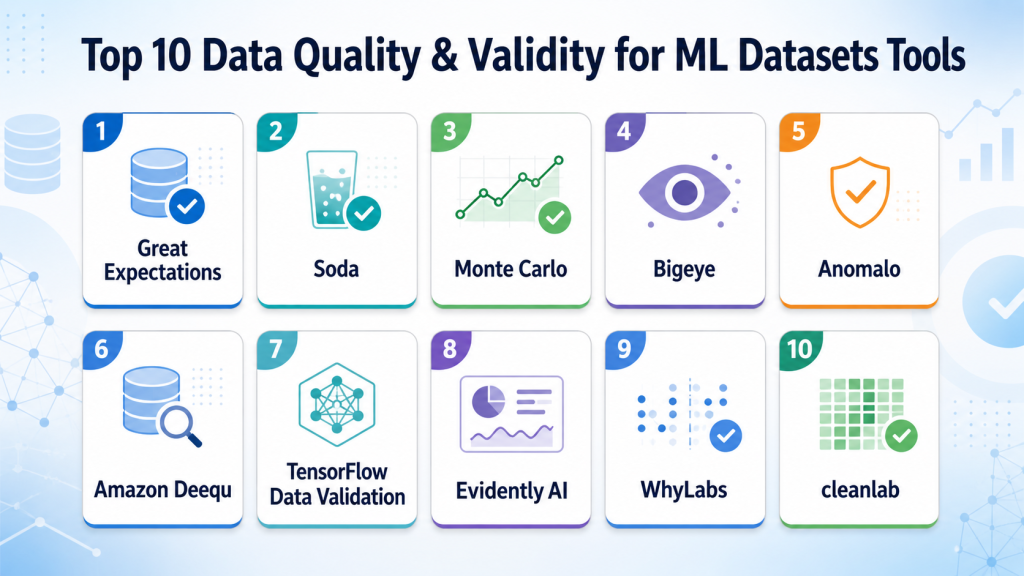
Top 10 Data Quality & Validity for ML Datasets Tools
1 — Great Expectations
One-line verdict: Best for data teams needing open-source validation checks, pipeline gates, and clear dataset expectations.
Short description:
Great Expectations helps teams define, run, and document data quality expectations across datasets and pipelines. It is widely used by data engineers, analytics engineers, and ML teams that want repeatable validation before data enters analytics or model training workflows.
Standout Capabilities
- Strong expectation-based data validation framework.
- Useful for schema, type, completeness, uniqueness, and range checks.
- Helps document data quality assumptions in a readable format.
- Fits ETL, ELT, data warehouse, and ML preparation workflows.
- Can act as a quality gate before model training or evaluation.
- Developer-friendly for teams that prefer code-based validation.
- Supports repeatable checks across pipeline runs.
- Useful for creating validation reports that teams can review.
AI-Specific Depth
- Model support: BYO model workflows can use validated datasets downstream.
- RAG / knowledge integration: Can validate structured metadata before RAG ingestion; text quality checks require custom setup.
- Evaluation: Supports dataset validation before training, testing, or evaluation workflows.
- Guardrails: Useful as a data quality guardrail before AI pipelines.
- Observability: Validation reports are available; full production observability depends on setup.
Pros
- Strong open-source foundation for data validation.
- Clear and readable expectation framework.
- Good fit for pipeline-based data quality gates.
Cons
- Requires setup and rule design.
- ML-specific drift and label checks may need additional tools.
- Enterprise governance depth depends on deployment and plan.
Security & Compliance
Security depends on deployment and configuration. Buyers should verify SSO, RBAC, audit logs, encryption, retention controls, residency, and certifications directly. Certifications: Not publicly stated.
Deployment & Platforms
- Open-source and cloud-style workflows may be available.
- Self-hosted, local, and pipeline-based usage possible.
- Cloud deployment varies by setup.
- Windows, macOS, and Linux support depends on environment.
Integrations & Ecosystem
Great Expectations fits well into data engineering and ML workflows where validation must run automatically before downstream use.
- Python ecosystem support.
- Data pipeline integration.
- Warehouse and database connectivity may be supported.
- CI/CD workflow support through custom setup.
- Validation reports and documentation.
- Can support ML dataset validation with custom expectations.
Pricing Model
Open-source and commercial options may be available. Exact enterprise pricing is not publicly stated.
Best-Fit Scenarios
- Adding validation gates before model training.
- Documenting dataset expectations for governance.
- Building repeatable data quality checks in pipelines.
2 — Soda
One-line verdict: Best for teams needing practical data quality checks, monitoring, and collaboration across modern data pipelines.
Short description:
Soda helps teams test, monitor, and improve data quality across pipelines and data platforms. It is useful for data engineers, analytics teams, and ML teams that need rule-based checks, anomaly detection, alerts, and quality visibility.
Standout Capabilities
- Supports data quality checks across modern data stacks.
- Useful for freshness, volume, schema, missing values, and distribution checks.
- Offers monitoring and alerting workflows.
- Helps data teams collaborate around failed checks.
- Can support data contracts and quality gates depending on setup.
- Useful for both analytics and ML dataset preparation.
- Can reduce downstream pipeline failures.
- Practical for teams that want operational data quality.
AI-Specific Depth
- Model support: BYO model workflows can consume validated data downstream.
- RAG / knowledge integration: Varies / N/A; structured metadata checks can support RAG pipelines.
- Evaluation: Helps validate datasets before training or evaluation.
- Guardrails: Useful as a data quality guardrail before AI workflows.
- Observability: Data quality monitoring, alerts, and trends may be available.
Pros
- Practical monitoring for production data pipelines.
- Useful for alerting and team collaboration.
- Good fit for data quality operations.
Cons
- ML-specific label quality checks may require extra tooling.
- Advanced setup depends on data stack complexity.
- Security and deployment details should be verified.
Security & Compliance
Enterprise controls may be available, but buyers should verify SSO, RBAC, audit logs, encryption, retention controls, residency, and certifications directly. Certifications: Not publicly stated.
Deployment & Platforms
- Cloud and self-hosted options may vary.
- CLI and pipeline workflows may be supported.
- Web-based monitoring may be available.
- Platform support depends on deployment.
Integrations & Ecosystem
Soda fits into data pipelines where teams need automated checks, alerts, and quality reporting before data reaches analytics or ML systems.
- Warehouse and database integrations may be available.
- Pipeline and orchestration integration may be supported.
- Alerting workflows may be available.
- Data quality checks can run automatically.
- Collaboration workflows may be supported.
- Export and reporting options vary by setup.
Pricing Model
Open-source and commercial options may be available. Exact pricing is not publicly stated.
Best-Fit Scenarios
- Monitoring production data quality.
- Adding automated checks to ML pipelines.
- Alerting teams before bad data reaches models.
3 — Monte Carlo
One-line verdict: Best for enterprises needing broad data observability, anomaly detection, lineage, and incident workflows.
Short description:
Monte Carlo is a data observability platform focused on monitoring data reliability across modern data environments. It helps teams detect data freshness issues, schema changes, volume anomalies, lineage risks, and data incidents before they affect analytics or AI systems.
Standout Capabilities
- Strong data observability for enterprise environments.
- Monitors freshness, volume, schema, lineage, and anomalies.
- Helps identify upstream and downstream impact of data issues.
- Useful for incident management and root cause analysis.
- Supports data reliability workflows across teams.
- Can help protect ML pipelines from broken upstream data.
- Good fit for mature data organizations.
- Helpful when data quality must be operationalized at scale.
AI-Specific Depth
- Model support: Varies / N/A; supports data reliability before downstream model workflows.
- RAG / knowledge integration: Can help monitor source data feeding AI systems depending on setup.
- Evaluation: Supports data reliability monitoring, not model evaluation directly.
- Guardrails: Useful as a data reliability guardrail before AI workflows.
- Observability: Strong focus on data observability, lineage, anomaly detection, and incidents.
Pros
- Strong enterprise-grade data observability.
- Useful for root cause analysis and incident handling.
- Helps teams monitor upstream data health.
Cons
- May be more than small teams need.
- ML-specific dataset validation may require complementary tools.
- Pricing and deployment details should be verified.
Security & Compliance
Enterprise security features may be available, but buyers should verify SSO, RBAC, audit logs, encryption, retention controls, residency, and certifications directly. Certifications: Not publicly stated.
Deployment & Platforms
- Cloud-based platform.
- Hybrid or private deployment: Varies / N/A.
- Web-based dashboards may be available.
- Desktop and mobile: Varies / N/A.
Integrations & Ecosystem
Monte Carlo fits best into enterprise data platforms where observability, lineage, and incident response are needed across data pipelines that support analytics and AI.
- Warehouse and lake integrations may be available.
- Lineage and impact analysis may be supported.
- Alerting and incident workflows may be available.
- Can connect with data engineering workflows.
- Useful for monitoring upstream ML data sources.
- Integration depth depends on environment.
Pricing Model
Typically enterprise-based. Exact pricing is not publicly stated.
Best-Fit Scenarios
- Enterprise data observability.
- Monitoring upstream data quality for ML pipelines.
- Managing data incidents and lineage impact.
4 — Bigeye
One-line verdict: Best for data teams needing automated data observability, quality alerts, and pipeline health monitoring.
Short description:
Bigeye helps teams monitor data quality across warehouses, pipelines, and analytics environments. It is useful for data teams that need automated anomaly detection, quality checks, alerts, and visibility into data health.
Standout Capabilities
- Data observability focused on quality monitoring.
- Helps detect anomalies in freshness, volume, and distributions.
- Useful for production pipeline monitoring.
- Supports alerts for data quality incidents.
- Helps teams identify broken or unusual datasets.
- Can support ML dataset reliability when connected to data sources.
- Useful for data teams needing operational quality visibility.
- Helps reduce manual monitoring work.
AI-Specific Depth
- Model support: Varies / N/A; validated data can support downstream ML models.
- RAG / knowledge integration: Varies / N/A; source data monitoring can support AI workflows.
- Evaluation: Data quality monitoring supports cleaner evaluation inputs.
- Guardrails: Useful as a quality guardrail before AI pipelines.
- Observability: Strong focus on data quality observability and alerts.
Pros
- Useful automated data quality monitoring.
- Good fit for operational data teams.
- Helps detect pipeline and data health issues quickly.
Cons
- Not primarily a label quality or ML evaluation tool.
- Advanced AI-specific workflows should be tested.
- Deployment and pricing details should be verified.
Security & Compliance
Buyers should verify SSO, RBAC, audit logs, encryption, retention controls, residency, and certifications directly. Certifications: Not publicly stated.
Deployment & Platforms
- Cloud-based platform.
- Hybrid or private deployment: Varies / N/A.
- Web-based dashboards may be available.
- Desktop and mobile: Varies / N/A.
Integrations & Ecosystem
Bigeye works well in modern data stacks where data teams need automated checks and alerts before issues affect analytics or ML workloads.
- Warehouse integrations may be available.
- Alerting workflows may be supported.
- Data quality monitoring may run automatically.
- Can support data reliability workflows.
- Reporting and dashboards may be available.
- Integration depth varies by data stack.
Pricing Model
Typically commercial or enterprise-based. Exact pricing is not publicly stated.
Best-Fit Scenarios
- Monitoring warehouse data quality.
- Preventing bad data from reaching ML workflows.
- Alerting teams about freshness, schema, or distribution issues.
5 — Anomalo
One-line verdict: Best for teams needing automated anomaly detection and data quality monitoring across large datasets.
Short description:
Anomalo focuses on detecting data quality issues automatically across tables and pipelines. It is useful for teams that want anomaly detection, data monitoring, and alerts without manually writing every quality rule.
Standout Capabilities
- Automated data quality monitoring.
- Helps detect anomalies without relying only on manual rules.
- Useful for large tables and production data pipelines.
- Can monitor data freshness, distribution changes, and unusual patterns.
- Helps reduce manual quality-checking effort.
- Useful for analytics and ML data pipelines.
- Supports incident detection workflows.
- Good fit for teams with many datasets to monitor.
AI-Specific Depth
- Model support: Varies / N/A; supports upstream data quality before model workflows.
- RAG / knowledge integration: Varies / N/A.
- Evaluation: Helps ensure datasets used for evaluation are not broken.
- Guardrails: Useful as a data anomaly guardrail before AI systems.
- Observability: Automated anomaly detection and data monitoring may be available.
Pros
- Reduces need to manually define every check.
- Useful for large-scale monitoring.
- Good fit for production data reliability workflows.
Cons
- ML-specific label validation may require another tool.
- Automated alerts need tuning to avoid noise.
- Deployment and pricing should be verified.
Security & Compliance
Enterprise security details should be verified directly, including SSO, RBAC, audit logs, encryption, retention controls, residency, and certifications. Certifications: Not publicly stated.
Deployment & Platforms
- Cloud-based platform.
- Hybrid or private deployment: Varies / N/A.
- Web-based dashboards may be available.
- Desktop and mobile: Varies / N/A.
Integrations & Ecosystem
Anomalo fits into environments where teams need broad data anomaly detection across many datasets before the data powers analytics, AI, or operational decisions.
- Data warehouse integrations may be available.
- Automated monitoring workflows may be supported.
- Alerting and incident workflows may be available.
- Can support data quality reporting.
- Useful for ML upstream data monitoring.
- Integration details vary by environment.
Pricing Model
Typically enterprise-based. Exact pricing is not publicly stated.
Best-Fit Scenarios
- Automated data anomaly detection.
- Monitoring many production datasets.
- Reducing manual data quality rule writing.
6 — Amazon Deequ
One-line verdict: Best for engineering teams needing open-source data quality checks on large-scale Spark datasets.
Short description:
Amazon Deequ is an open-source library for defining and running data quality checks on large datasets, especially in Spark-based environments. It is useful for data engineers and ML teams that need scalable validation for batch pipelines.
Standout Capabilities
- Open-source library for data quality validation.
- Strong fit for Spark and large-scale batch datasets.
- Supports constraints, metrics, and verification checks.
- Useful for schema, completeness, uniqueness, and distribution checks.
- Can be embedded into engineering workflows.
- Helps validate datasets before model training.
- Good fit for technical teams using big data pipelines.
- Can support repeatable validation in production jobs.
AI-Specific Depth
- Model support: BYO model workflows can use validated datasets downstream.
- RAG / knowledge integration: N/A for most use cases; structured checks may support metadata validation.
- Evaluation: Helps validate training and evaluation datasets.
- Guardrails: Useful as a batch data quality guardrail.
- Observability: Metrics can be collected; dashboards require custom setup.
Pros
- Strong for large-scale Spark validation.
- Open-source and developer-friendly.
- Useful for repeatable batch quality checks.
Cons
- Requires engineering and Spark expertise.
- Not a full business-user dashboard by default.
- Advanced governance requires custom implementation.
Security & Compliance
Security depends on deployment and environment. SSO, RBAC, audit logs, encryption, retention controls, and residency are handled by the user’s infrastructure. Certifications: Not publicly stated.
Deployment & Platforms
- Library-based workflow.
- Self-hosted and local pipeline usage.
- Cloud deployment depends on user environment.
- Platform support depends on Spark and runtime setup.
Integrations & Ecosystem
Deequ fits technical big data environments where validation must run inside Spark pipelines before datasets move into analytics or ML workflows.
- Spark ecosystem support.
- Batch pipeline integration.
- Metrics and constraints framework.
- Can support CI-style validation.
- Useful for data lake workflows.
- Custom dashboards require additional tooling.
Pricing Model
Open-source. Infrastructure and implementation costs depend on user environment.
Best-Fit Scenarios
- Validating large batch datasets.
- Spark-based ML data preparation.
- Engineering-led data quality checks.
7 — TensorFlow Data Validation
One-line verdict: Best for ML teams needing schema validation, data statistics, and training-serving skew checks.
Short description:
TensorFlow Data Validation is a library used for analyzing and validating machine learning data. It is especially useful in ML pipelines where teams need schema checks, dataset statistics, anomaly detection, and training-serving consistency checks.
Standout Capabilities
- Designed specifically for ML data validation workflows.
- Generates statistics for training and serving datasets.
- Helps detect schema anomalies and unexpected values.
- Can support training-serving skew detection.
- Useful inside ML pipeline frameworks.
- Helps validate datasets before model training.
- Good fit for TensorFlow ecosystem users.
- Supports reproducible validation in ML workflows.
AI-Specific Depth
- Model support: Strong fit for TensorFlow and BYO ML workflows.
- RAG / knowledge integration: N/A for most use cases.
- Evaluation: Supports validation of ML training and serving datasets.
- Guardrails: Useful as an ML dataset quality guardrail.
- Observability: Dataset statistics and anomaly outputs are available; dashboards require setup.
Pros
- Built for ML dataset validation.
- Useful for detecting training-serving data issues.
- Strong fit for technical ML pipelines.
Cons
- Best suited for technical users.
- Not a general enterprise data observability platform.
- Non-TensorFlow teams may prefer broader tools.
Security & Compliance
Security depends on the environment where it is deployed. SSO, RBAC, audit logs, encryption, retention controls, residency, and certifications are not publicly stated for self-managed use.
Deployment & Platforms
- Library-based ML pipeline workflow.
- Self-managed and local usage possible.
- Cloud usage depends on environment.
- Windows, macOS, and Linux support depends on setup.
Integrations & Ecosystem
TensorFlow Data Validation fits ML workflows where data validation is part of model development, training pipelines, and production consistency checks.
- TensorFlow ecosystem support.
- ML pipeline integration.
- Schema and statistics generation.
- Training-serving skew checks.
- Anomaly detection for datasets.
- Custom workflow integration through code.
Pricing Model
Open-source. Infrastructure and implementation costs depend on user environment.
Best-Fit Scenarios
- ML dataset validation in TensorFlow workflows.
- Training-serving skew checks.
- Schema and statistics validation for model pipelines.
8 — Evidently AI
One-line verdict: Best for ML teams needing data drift, data quality, and model monitoring in one workflow.
Short description:
Evidently AI helps teams evaluate data quality, detect drift, monitor model performance, and create reports for ML systems. It is useful for teams that want open-source-friendly monitoring and validation for model development and production.
Standout Capabilities
- Supports data drift and data quality reports.
- Useful for monitoring model inputs and outputs.
- Helps compare reference and current datasets.
- Can support ML monitoring and evaluation workflows.
- Open-source-friendly for technical teams.
- Useful for batch and production-style checks.
- Helps teams track model and dataset changes over time.
- Good fit for MLOps workflows.
AI-Specific Depth
- Model support: BYO model workflows may be supported.
- RAG / knowledge integration: Varies / N/A; can support structured evaluation of datasets.
- Evaluation: Supports data drift, data quality, and model performance reports.
- Guardrails: Useful as a monitoring guardrail for ML datasets.
- Observability: Data drift, quality, and model monitoring reports may be available.
Pros
- Strong fit for ML monitoring and drift detection.
- Open-source-friendly and practical for technical teams.
- Useful for comparing datasets over time.
Cons
- Requires setup and monitoring design.
- Enterprise governance depends on deployment.
- RAG and LLM-specific checks may need customization.
Security & Compliance
Security depends on deployment and plan. Buyers should verify SSO, RBAC, audit logs, encryption, retention controls, residency, and certifications directly. Certifications: Not publicly stated.
Deployment & Platforms
- Open-source and commercial workflows may be available.
- Self-hosted or cloud-style usage varies.
- Python-based workflows may be supported.
- Platform support depends on environment.
Integrations & Ecosystem
Evidently AI fits into ML pipelines where teams need reports, dashboards, drift checks, and data quality monitoring across development and production.
- Python ecosystem support.
- ML monitoring workflows.
- Data drift and quality reports.
- Batch and production checks.
- Can integrate with MLOps pipelines.
- Export and dashboard options vary by setup.
Pricing Model
Open-source and commercial options may be available. Exact pricing is not publicly stated.
Best-Fit Scenarios
- Detecting drift in model input data.
- Monitoring ML dataset quality over time.
- Creating reports for model and data health.
9 — WhyLabs
One-line verdict: Best for teams needing AI and data observability across model inputs, outputs, and production pipelines.
Short description:
WhyLabs focuses on AI observability, data monitoring, and model health workflows. It helps teams monitor data quality, drift, anomalies, and model behavior across production AI systems.
Standout Capabilities
- Focuses on AI and data observability.
- Monitors data drift, quality issues, and anomalies.
- Useful for production ML and AI systems.
- Can support input and output monitoring.
- Helps teams track model behavior over time.
- Useful for detecting data quality incidents.
- Supports operational AI monitoring workflows.
- Good fit for MLOps teams managing deployed models.
AI-Specific Depth
- Model support: BYO model workflows may be supported.
- RAG / knowledge integration: Varies / N/A.
- Evaluation: Supports monitoring and quality analysis, not only offline evaluation.
- Guardrails: Useful as an observability guardrail for production AI.
- Observability: Strong focus on data and model observability.
Pros
- Strong production AI monitoring fit.
- Useful for drift and anomaly detection.
- Helps monitor inputs, outputs, and data health.
Cons
- Requires production monitoring setup.
- Dataset validation before training may need complementary tools.
- Pricing and deployment details should be verified.
Security & Compliance
Buyers should verify SSO, RBAC, audit logs, encryption, retention controls, residency, and certifications directly. Certifications: Not publicly stated.
Deployment & Platforms
- Cloud and self-hosted options may vary.
- API and platform workflows may be available.
- Web dashboards may be supported.
- Platform support depends on setup.
Integrations & Ecosystem
WhyLabs fits into MLOps environments where teams need continuous monitoring of data quality, drift, anomalies, and model behavior.
- API and SDK workflows may be available.
- ML pipeline integration may be supported.
- Production monitoring dashboards.
- Drift and anomaly detection workflows.
- Alerting integrations may be available.
- Deployment options should be verified.
Pricing Model
Typically commercial or enterprise-based. Exact pricing is not publicly stated.
Best-Fit Scenarios
- Production ML data monitoring.
- Detecting drift and quality issues after deployment.
- AI observability across model inputs and outputs.
10 — cleanlab
One-line verdict: Best for teams needing label quality checks, noisy data detection, and data-centric ML improvement.
Short description:
cleanlab helps identify label errors, outliers, noisy samples, and other dataset quality problems that can reduce model performance. It is useful for AI teams that want to improve dataset validity, especially when labels or annotations may be unreliable.
Standout Capabilities
- Strong focus on label quality and data-centric AI.
- Helps detect mislabeled and noisy examples.
- Useful for identifying outliers and ambiguous samples.
- Supports review prioritization for suspicious records.
- Helps improve training data before model development.
- Useful across structured, text, and image-related workflows depending on setup.
- Can reduce wasted training effort on bad data.
- Good fit for ML teams improving dataset validity.
AI-Specific Depth
- Model support: Model-agnostic and BYO model workflows may be supported.
- RAG / knowledge integration: Varies / N/A.
- Evaluation: Helps improve training and evaluation datasets by detecting data quality issues.
- Guardrails: Useful as a data quality guardrail before model training.
- Observability: Data quality reports and scores may be available depending on setup.
Pros
- Strong for label error discovery.
- Useful for data-centric ML improvement.
- Helps prioritize human review of suspicious samples.
Cons
- Requires technical understanding of data and model signals.
- Not a complete data observability platform by itself.
- Enterprise details should be verified directly.
Security & Compliance
Security depends on deployment and plan. Buyers should verify SSO, RBAC, audit logs, encryption, retention controls, residency, and certifications directly. Certifications: Not publicly stated.
Deployment & Platforms
- Python and developer workflows may be supported.
- Web or enterprise platform options may vary.
- Cloud, local, or enterprise deployment: Varies / N/A.
- Windows, macOS, and Linux support depends on setup.
Integrations & Ecosystem
cleanlab fits into ML workflows where labels, predictions, and quality signals are used to improve datasets before training or evaluation.
- Python ecosystem support may be available.
- Works with model outputs and datasets.
- Can support notebook and ML pipeline workflows.
- Useful for review prioritization.
- Complements labeling and validation tools.
- Enterprise integration details should be verified.
Pricing Model
Open-source and commercial options may be available. Exact enterprise pricing is not publicly stated.
Best-Fit Scenarios
- Finding mislabeled training data.
- Prioritizing human review of suspicious records.
- Improving dataset quality before model training.
Comparison Table
| Tool Name | Best For | Deployment | Model Flexibility | Strength | Watch-Out | Public Rating |
|---|---|---|---|---|---|---|
| Great Expectations | Validation checks and quality gates | Self-hosted / Cloud / Varies | Open-source / BYO | Expectation-based validation | Requires rule design | N/A |
| Soda | Data quality monitoring | Cloud / Self-hosted / Varies | BYO adjacent | Practical checks and alerts | ML-specific depth varies | N/A |
| Monte Carlo | Enterprise data observability | Cloud / Varies | Varies / N/A | Lineage and incident workflows | May be heavy for SMB | N/A |
| Bigeye | Automated data quality alerts | Cloud / Varies | Varies / N/A | Data health monitoring | Verify AI-specific fit | N/A |
| Anomalo | Automated anomaly detection | Cloud / Varies | Varies / N/A | Rule-light monitoring | Alert tuning needed | N/A |
| Amazon Deequ | Spark-scale validation | Self-hosted / Local | Open-source / BYO | Batch data quality checks | Engineering-heavy | N/A |
| TensorFlow Data Validation | ML dataset validation | Self-hosted / Local | Open-source / BYO | Training-serving checks | Technical setup needed | N/A |
| Evidently AI | Data drift and ML monitoring | Self-hosted / Cloud / Varies | Open-source / BYO | Drift and quality reports | Needs monitoring design | N/A |
| WhyLabs | AI observability | Cloud / Self-hosted / Varies | BYO | Production data monitoring | Requires instrumentation | N/A |
| cleanlab | Label quality and noisy data | Cloud / Local / Varies | BYO / Model-agnostic | Label error detection | Not full observability alone | N/A |
Scoring & Evaluation
The scoring below is comparative, not absolute. It helps buyers compare tools based on dataset validation, ML workflow fit, reliability, integrations, ease of use, performance, governance, and support. Scores may change depending on your data stack, ML maturity, dataset type, deployment model, and monitoring needs. A high score does not mean one universal winner. Always validate tools with your own training data, production pipelines, quality rules, and downstream model performance metrics.
| Tool | Core | Reliability/Eval | Guardrails | Integrations | Ease | Perf/Cost | Security/Admin | Support | Weighted Total |
|---|---|---|---|---|---|---|---|---|---|
| Great Expectations | 9 | 8 | 7 | 8 | 7 | 9 | 7 | 8 | 8.00 |
| Soda | 8 | 8 | 7 | 8 | 8 | 8 | 7 | 8 | 7.85 |
| Monte Carlo | 9 | 8 | 8 | 9 | 8 | 7 | 8 | 9 | 8.30 |
| Bigeye | 8 | 8 | 8 | 8 | 8 | 7 | 8 | 8 | 7.90 |
| Anomalo | 8 | 8 | 8 | 8 | 8 | 7 | 8 | 8 | 7.90 |
| Amazon Deequ | 8 | 8 | 7 | 8 | 6 | 9 | 6 | 7 | 7.55 |
| TensorFlow Data Validation | 8 | 9 | 7 | 7 | 6 | 9 | 6 | 7 | 7.55 |
| Evidently AI | 8 | 9 | 7 | 8 | 7 | 8 | 7 | 8 | 7.90 |
| WhyLabs | 8 | 8 | 8 | 8 | 7 | 8 | 8 | 8 | 7.90 |
| cleanlab | 8 | 9 | 7 | 8 | 7 | 8 | 7 | 8 | 7.90 |
Top 3 for Enterprise
- Monte Carlo
- Bigeye
- Anomalo
Top 3 for SMB
- Great Expectations
- Soda
- Evidently AI
Top 3 for Developers
- Amazon Deequ
- TensorFlow Data Validation
- cleanlab
Which Data Quality & Validity for ML Datasets Tool Is Right for You?
Solo / Freelancer
Solo developers should start with open-source and lightweight tools. Great Expectations is useful for validation rules, TensorFlow Data Validation is good for ML-specific checks, Evidently AI is useful for drift reports, and cleanlab helps when label quality is a concern.
For very small datasets, basic scripts or notebook checks may be enough. But if the dataset will be reused for training, evaluation, or RAG, repeatable validation is safer.
SMB
SMBs should focus on tools that are easy to adopt and provide quick value. Great Expectations and Soda are strong for data checks, Evidently AI helps with ML drift and reports, and cleanlab is useful when labels or annotations may be noisy.
SMBs should avoid overly complex enterprise observability tools unless data pipelines are already production-critical. Start with the most frequent data failures and expand from there.
Mid-Market
Mid-market teams usually need stronger monitoring, alerting, reporting, and pipeline integration. Soda, Bigeye, Anomalo, Evidently AI, WhyLabs, and Great Expectations can fit depending on whether the focus is validation, observability, ML monitoring, or anomaly detection.
At this stage, data quality should become a standard gate before training, evaluation, deployment, and production monitoring. Ownership and escalation paths are important.
Enterprise
Enterprises should prioritize governance, observability, lineage, incident management, security, and scale. Monte Carlo, Bigeye, Anomalo, WhyLabs, Soda, and Great Expectations are strong options depending on the existing data stack and AI maturity.
Enterprise teams should validate quality coverage across warehouses, feature stores, pipelines, model inputs, and downstream business systems. The best tool should reduce incident impact and improve trust.
Regulated industries: finance/healthcare/public sector
Regulated industries need auditability, access controls, quality reports, validation history, and clear ownership. Broken training data can create compliance, fairness, safety, and operational risks.
Teams in finance, healthcare, insurance, and public sector should use validation rules, human review, dataset lineage, and approval workflows before sensitive datasets reach models.
Budget vs premium
Budget-conscious teams can start with open-source tools such as Great Expectations, Amazon Deequ, TensorFlow Data Validation, Evidently AI, and cleanlab. These are strong if the team has engineering skills.
Premium platforms are useful when teams need dashboards, anomaly detection, incident workflows, enterprise support, lineage, governance, and production-grade monitoring.
Build vs buy
Build your own quality workflow when checks are simple, pipelines are small, and your engineering team can maintain validation logic. Open-source tools are good foundations.
Buy or adopt a platform when data reliability affects business operations, compliance, production AI, or many teams. Many mature organizations use open-source checks plus enterprise observability.
Implementation Playbook: 30 / 60 / 90 Days
30 Days: Pilot and Success Metrics
- Select one important ML dataset or data pipeline.
- Define critical quality rules such as missing values, schema checks, freshness, uniqueness, and valid ranges.
- Identify ML-specific risks such as label errors, drift, leakage, class imbalance, and outliers.
- Run validation on recent dataset versions.
- Measure failure rate, alert quality, and downstream model impact.
- Create a small evaluation harness for data quality checks.
- Review failed records with data owners and ML teams.
- Document quality thresholds and ownership.
- Add checks before training or evaluation runs.
60 Days: Harden Security, Evaluation, and Rollout
- Add validation checks to production pipelines.
- Connect alerts to team workflows.
- Create human review rules for high-risk data failures.
- Add drift and distribution checks for model inputs.
- Validate RAG metadata, chunks, and retrieval fields if relevant.
- Add prompt and version control for AI datasets used in evaluation.
- Run red-team tests for bad data, leakage, and prompt injection risks.
- Build incident handling processes for broken datasets.
- Expand checks to more datasets and teams.
90 Days: Optimize Cost, Latency, Governance, and Scale
- Automate validation before training, evaluation, and deployment.
- Track data quality trends, alert noise, pipeline failures, and model impact.
- Add dashboards for data owners, ML teams, and governance leaders.
- Standardize quality rules by dataset type.
- Connect quality reports to audit and compliance workflows.
- Monitor cost, latency, and operational overhead.
- Add approval gates for high-risk datasets.
- Review vendor lock-in and exportability.
- Scale only after validation quality and ownership are stable.
Common Mistakes & How to Avoid Them
- Only checking schema: Add drift, label quality, distribution, freshness, and business-rule checks.
- Ignoring ML-specific risks: Validate class balance, leakage, outliers, training-serving skew, and label errors.
- No owner for failed checks: Assign every critical dataset to a clear data owner.
- Too many noisy alerts: Tune thresholds and focus on failures that affect models or users.
- No human review: Route suspicious labels, anomalies, and edge cases to domain experts.
- Skipping evaluation data checks: Poor test data can make models look better or worse than reality.
- Not validating RAG inputs: Broken metadata, duplicates, stale documents, and poor chunks can reduce answer quality.
- Unmanaged data retention: Define how validation logs, failed records, and reports are stored.
- No observability: Track trends, incidents, failures, drift, and downstream model impact.
- Cost surprises: Monitor compute, scanning frequency, storage, and alert handling effort.
- Prompt injection exposure: Validate text data used for RAG and AI agents for unsafe or malicious content.
- Vendor lock-in: Keep validation rules, reports, and datasets exportable.
- Treating data quality as one-time cleanup: Make validation continuous across ingestion, training, evaluation, and production.
- No incident response: Define what happens when bad data reaches a model, dashboard, or customer workflow.
FAQs
1. What is data quality for ML datasets?
Data quality means the dataset is accurate, complete, consistent, valid, fresh, and useful for model training or evaluation. Poor data quality can reduce model reliability.
2. What is data validity in machine learning?
Data validity means values follow expected formats, ranges, rules, and business logic. Invalid data can break pipelines or mislead models.
3. Why is data quality important for AI models?
Models learn from data, so broken data creates broken outputs. Good data quality improves reliability, fairness, evaluation, and production performance.
4. Can these tools work with BYO models?
Yes, many tools validate data before it reaches BYO models. Some also monitor model inputs and outputs after deployment.
5. Do these tools support self-hosting?
Some tools are open-source or self-hosted, while others are cloud platforms. Deployment should be verified based on security needs.
6. Can data quality tools help RAG systems?
Yes, they can validate document metadata, freshness, duplicate content, chunk quality, and retrieval fields. This improves retrieval reliability.
7. What is data drift?
Data drift happens when production data changes from training data. It can reduce model performance if not detected and handled.
8. What is training-serving skew?
Training-serving skew means the data used during training differs from data used in production. It can cause unexpected model behavior.
9. Can these tools detect label errors?
Some tools can help identify suspicious labels or noisy examples. Label quality checks may require ML-specific tools and human review.
10. How do data quality tools support governance?
They provide validation reports, check history, ownership, audit trails, and quality evidence. This helps teams prove data readiness.
11. How much do these tools cost?
Pricing varies by tool, data volume, deployment, users, and enterprise needs. Exact pricing should be verified directly.
12. What are guardrails in data quality workflows?
Guardrails are checks that stop bad data before it reaches training, evaluation, retrieval, or production systems. They reduce AI risk.
13. What alternatives exist to these tools?
Alternatives include manual checks, SQL tests, scripts, notebook validation, warehouse rules, and custom pipeline checks. These work for simpler cases.
14. How can teams switch tools later?
Keep validation rules, reports, datasets, and metrics exportable. Avoid storing critical quality logic only inside one vendor platform.
15. How should teams start?
Start with one important ML dataset, define key checks, run a pilot, review failures, and connect validation to training or evaluation workflows.
Conclusion
Data quality and validity for ML datasets is essential because reliable AI depends on clean, complete, accurate, and well-governed data. The best tool depends on your data stack, team maturity, model workflow, governance needs, and whether you need validation rules, observability, drift monitoring, anomaly detection, or label quality checks. Great Expectations, Soda, Monte Carlo, Bigeye, Anomalo, Amazon Deequ, TensorFlow Data Validation, Evidently AI, WhyLabs, and cleanlab each solve different parts of the data quality lifecycle.
Next steps:
- Shortlist: Pick 3 tools based on data stack, dataset type, deployment needs, and ML workflow fit.
- Pilot: Test with real datasets, validation rules, drift checks, human review, and model impact metrics.
- Verify and scale: Confirm quality coverage, security, cost, auditability, and workflow stability before rollout.
This blog clearly explains the importance of data quality and validity in building reliable ML models. The comparison helps in understanding which tools can improve dataset accuracy and consistency.
Good explanation of why data validity is as important as model architecture in machine learning success.The article makes complex ideas simple and practical.
This article simplifies a technical topic and makes data quality concepts easy to understand even for beginners in AI and ML.