INTRODUCTION
AI Product Spec Writing Assistants are AI-powered tools designed to help product managers, designers, and engineering teams create structured, clear, and actionable product specifications. These tools accelerate the specification-writing process, reduce inconsistencies, enforce standard templates, and assist with alignment across teams by generating functional requirements, user stories, acceptance criteria, and technical notes automatically.
Why It Matters
- Accelerates Product Spec Writing: Reduces the time required to create structured specifications and acceptance criteria.
- Ensures Consistency: Enforces company templates and style guides across teams and projects.
- Reduces Misalignment: Bridges gaps between product management, design, and engineering teams.
- Supports Compliance: Helps meet regulatory or internal audit requirements by producing standardized, traceable specs.
- Enables Rapid Iteration: Ideal for agile environments, allowing teams to update specs quickly as requirements evolve.
- Enhances Decision-Making: AI suggestions improve clarity and completeness, helping stakeholders make informed decisions.
- Scales Across Teams: Supports multi-team collaboration without increasing manual effort.
Real-World Use Cases
- Feature Specification Generation: Automatically converts roadmap items or user stories into structured specs.
- Acceptance Criteria Drafting: AI generates testable acceptance criteria to guide engineering implementation.
- Technical Requirements Documentation: Produces clear functional and technical specifications for developers.
- Compliance Documentation: Generates specifications aligned with regulatory requirements for finance, healthcare, or other industries.
- Cross-Team Alignment: Ensures product, design, and engineering teams share a consistent understanding of features.
- Multi-Format Export: Converts specifications into Markdown, Jira, Confluence, or PDF for global teams.
Evaluation Criteria for Buyers
- Integration Capabilities: Works with Jira, Confluence, Notion, or internal project management tools.
- AI Accuracy and Reliability: Produces correct, coherent, and actionable specifications.
- Template and Style Guide Enforcement: Adheres to company-defined documentation standards.
- Collaboration Support: Real-time editing and team review capabilities.
- Compliance and Governance: Supports audit logs, versioning, and traceability for regulated industries.
- Export and Format Options: Multi-format support for different teams and tooling environments.
- Security and Privacy: SSO, RBAC, encryption, and data retention controls.
- Scalability: Handles multiple teams and large-scale product portfolios.
- Ease of Use: Minimal learning curve for product managers and engineers.
- Cost Efficiency: Subscription or usage-based pricing aligned with team size and project volume.
- AI Evaluation and Guardrails: Includes regression testing, hallucination mitigation, and safety checks.
- Observability: Tracks AI usage, token consumption, and latency for governance and optimization.
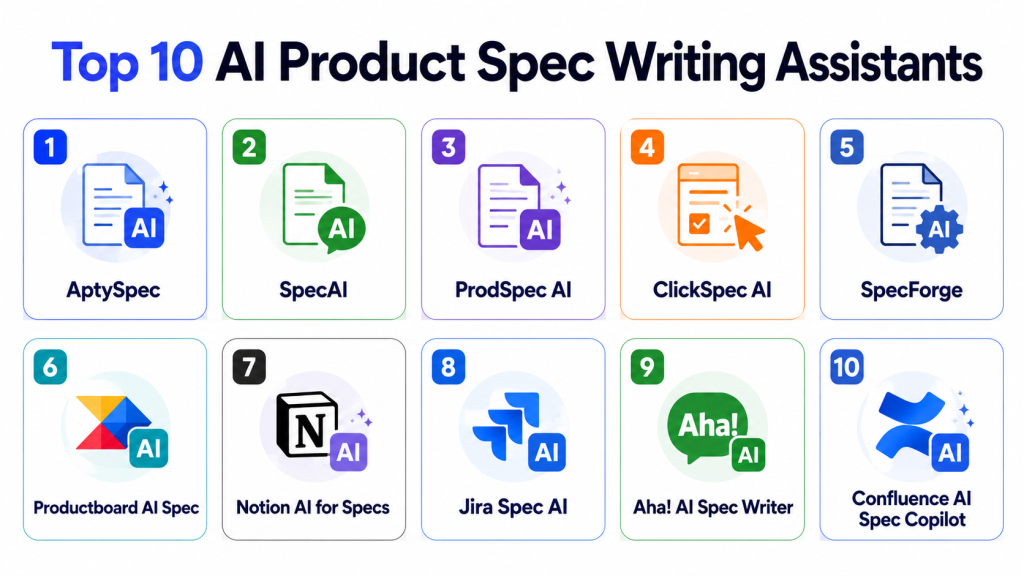
Top 10 AI Product Spec Writing Assistants
1 — AptySpec
One-line verdict: Best for mid-market product teams seeking automated spec generation and structured user story creation.
Short description: AptySpec automatically generates product specifications, user stories, and acceptance criteria from roadmap inputs, helping product teams streamline documentation and maintain consistency across multiple projects.
Standout Capabilities
- Automatic user story generation
- Acceptance criteria suggestions
- Versioned specifications for audit trails
- Template enforcement for standardization
- Multi-format exports including Markdown, Jira, Confluence
AI-Specific Depth
- Model support: Proprietary
- RAG / knowledge integration: Connects to internal knowledge bases
- Evaluation: Regression and human review
- Guardrails: Ensures specs follow company templates
- Observability: Tracks usage and token metrics
Pros
- Reduces time writing specs
- Maintains consistency across teams
- Integrates with PM tools
Cons
- May require training for company-specific templates
- Limited multilingual support
- Enterprise pricing can be high
Security & Compliance
SSO, RBAC, audit logs, encryption
Certifications: Not publicly stated
Deployment & Platforms
Web, Cloud
Integrations & Ecosystem
Slack, Jira, Confluence, Notion, API/SDK support
Pricing Model
Tiered subscription
Best-Fit Scenarios
- Mid-market SaaS teams
- Agile product teams needing rapid specs
- Teams standardizing documentation across multiple projects
2 — SpecAI
One-line verdict: Ideal for enterprise product teams requiring AI-generated specs with regulatory compliance guidance.
Short description: SpecAI generates functional specs, user stories, and acceptance criteria, while incorporating compliance validation for industries such as finance and healthcare.
Standout Capabilities
- Automated spec generation from feature briefs
- Built-in regulatory compliance checks
- Collaboration-ready output
- Multi-format export including Jira and Markdown
- Change tracking and version control
AI-Specific Depth
- Model support: Proprietary
- RAG / knowledge integration: Internal KB integration
- Evaluation: Regression, offline evaluation
- Guardrails: Compliance-aware policy checks
- Observability: Token and latency metrics
Pros
- Reduces manual compliance review
- Standardizes large-scale spec creation
- Integrates with enterprise PM tools
Cons
- Learning curve for new users
- Proprietary model limits customization
- Cost can be high for small teams
Security & Compliance
SSO, audit logs, encryption, data retention
Certifications: Not publicly stated
Deployment & Platforms
Web, Cloud, Hybrid
Integrations & Ecosystem
Jira, Confluence, Slack, internal KB connectors
Pricing Model
Tiered enterprise subscription
Best-Fit Scenarios
- Enterprise product teams
- Regulated industries
- Multi-team collaboration environments
3 — ProdSpec AI
One-line verdict: Suitable for startups and SMBs seeking fast spec creation from simple product outlines.
Short description: ProdSpec AI allows small teams to convert product feature notes into structured specs, user stories, and acceptance criteria, enabling rapid iteration without formal documentation overhead.
Standout Capabilities
- Generates specs from short feature descriptions
- Quick output suitable for agile sprints
- User story formatting for Jira/Notion
- Acceptance criteria automation
- Light version control
AI-Specific Depth
- Model support: Proprietary
- RAG / knowledge integration: N/A
- Evaluation: Basic prompt tests, human review recommended
- Guardrails: Ensures output follows standard structure
- Observability: Tracks usage metrics
Pros
- Fast setup for small teams
- Simplifies iterative product spec creation
- Lightweight interface
Cons
- Limited enterprise features
- Minimal compliance checks
- Less suited for complex multi-product workflows
Security & Compliance
Encryption and RBAC
Certifications: Not publicly stated
Deployment & Platforms
Web, Cloud
Integrations & Ecosystem
Jira, Notion, Slack, Markdown export
Pricing Model
Subscription
Best-Fit Scenarios
- Startups or small product teams
- Agile sprint planning
- Rapid MVP spec creation
4 — ClickSpec AI
One-line verdict: Ideal for design-heavy product teams needing integration between wireframes and spec documentation.
Short description: ClickSpec AI converts mockups, wireframes, and product notes into structured specs, bridging design and engineering teams seamlessly.
Standout Capabilities
- Converts visual mockups to structured specs
- Generates acceptance criteria
- Suggests functional and technical requirements
- Collaboration-ready output
- Multi-format export
AI-Specific Depth
- Model support: Proprietary
- RAG / knowledge integration: N/A
- Evaluation: Human review, regression checks
- Guardrails: Follows company spec templates
- Observability: Token and latency tracking
Pros
- Bridges design and engineering
- Reduces handoff errors
- Maintains consistency across visual and textual specs
Cons
- Requires integration with design tools
- Enterprise collaboration limited in basic tier
- Learning curve for visual-to-spec mapping
Security & Compliance
Encryption and RBAC
Certifications: Not publicly stated
Deployment & Platforms
Web, Cloud
Integrations & Ecosystem
Figma, Jira, Confluence, Slack
Pricing Model
Tiered subscription
Best-Fit Scenarios
- Design-heavy product teams
- Startups with small engineering teams
- Rapid prototyping workflows
5 — SpecForge
One-line verdict: Best for engineering-centric teams requiring deep technical spec generation and code alignment.
Short description: SpecForge generates product specifications aligned with engineering requirements, code references, and API contracts, helping reduce misalignment between product and engineering teams.
Standout Capabilities
- Code and API alignment
- Generates functional and technical specs
- Acceptance criteria automation
- Multi-format export for Confluence/Jira
- Collaboration and version tracking
AI-Specific Depth
- Model support: Proprietary
- RAG / knowledge integration: Internal KB
- Evaluation: Regression, human review
- Guardrails: Technical consistency checks
- Observability: Token usage metrics
Pros
- Reduces engineering misunderstandings
- Maintains technical consistency
- Integrates with developer tools
Cons
- Requires engineering familiarity
- Not beginner-friendly for PMs
- Enterprise pricing
Security & Compliance
SSO, RBAC, audit logs
Certifications: Not publicly stated
Deployment & Platforms
Web, Cloud
Integrations & Ecosystem
Jira, Confluence, Slack, GitHub
Pricing Model
Enterprise subscription
Best-Fit Scenarios
- Engineering-heavy product teams
- Large-scale API products
- Enterprise-level technical specifications
6 — Productboard AI Spec
One-line verdict: Ideal for product teams that want AI-assisted spec generation directly linked to roadmap and prioritization data.
Short description:
Productboard AI Spec automatically converts roadmap items, feature requests, and user feedback into structured product specifications with acceptance criteria, helping teams maintain alignment between strategic priorities and engineering deliverables.
Standout Capabilities
- Translates roadmap items to structured specifications
- Prioritizes features based on feedback and business goals
- Generates acceptance criteria and functional requirements
- Supports collaborative review workflows
- Version control for spec changes
AI-Specific Depth
- Model support: Proprietary
- RAG / knowledge integration: Connects internal knowledge bases
- Evaluation: Regression, offline evaluation
- Guardrails: Template compliance and consistency checks
- Observability: Tracks token usage, latency, and AI recommendations
Pros
- Aligns product specs with roadmap priorities
- Reduces manual spec writing
- Facilitates cross-team collaboration
Cons
- Requires integration with existing roadmap tool
- Enterprise-tier pricing
- Learning curve for complex templates
Security & Compliance
SSO, RBAC, encryption, audit logs
Certifications: Not publicly stated
Deployment & Platforms
Web, Cloud
Integrations & Ecosystem
Jira, Confluence, Slack, Notion, internal KB connectors
Pricing Model
Tiered subscription
Best-Fit Scenarios
- Mid-market product teams
- Roadmap-driven feature documentation
- Teams seeking automated prioritization alignment
7 — Notion AI for Specs
One-line verdict: Best for startups and creative teams needing lightweight, collaborative AI-generated product specifications.
Short description:
Notion AI for Specs allows teams to generate structured product specifications, user stories, and requirements directly within Notion, supporting real-time collaboration and multi-format export.
Standout Capabilities
- Generates functional specs and user stories
- Real-time collaborative editing
- Template enforcement within Notion pages
- Multi-format export (Markdown, PDF)
- Suggests acceptance criteria and technical notes
AI-Specific Depth
- Model support: Proprietary
- RAG / knowledge integration: N/A
- Evaluation: Prompt tests and human review
- Guardrails: Enforces company templates
- Observability: Usage metrics tracked
Pros
- Lightweight and fast for small teams
- Collaborative editing enhances alignment
- Minimal onboarding
Cons
- Limited advanced enterprise features
- Basic compliance support
- Less structured than full PM tools
Security & Compliance
Encryption, RBAC
Certifications: Not publicly stated
Deployment & Platforms
Web, Cloud
Integrations & Ecosystem
Slack, Jira, internal Notion workspaces
Pricing Model
Subscription
Best-Fit Scenarios
- Startups and SMBs
- Collaborative product spec creation
- Teams already using Notion for documentation
8 — Jira Spec AI
One-line verdict: Ideal for engineering-heavy teams that need AI-generated specs integrated directly with Jira workflows.
Short description:
Jira Spec AI generates structured product requirements, user stories, and acceptance criteria directly within Jira, ensuring alignment between product management and engineering while leveraging Jira workflows and tracking.
Standout Capabilities
- Auto-generates user stories and functional specs
- Integrates with Jira issue types and workflows
- Provides acceptance criteria and test case suggestions
- Version control and change tracking
- Supports agile sprint planning
AI-Specific Depth
- Model support: Proprietary
- RAG / knowledge integration: Connects Jira knowledge bases
- Evaluation: Regression and human review
- Guardrails: Ensures Jira formatting and workflow compliance
- Observability: Tracks latency, token usage, and recommendation accuracy
Pros
- Seamless integration with Jira
- Reduces manual spec writing in agile sprints
- Maintains traceability and auditability
Cons
- Best suited for Jira-native teams
- Less flexible for external documentation formats
- Requires Jira admin access for full integration
Security & Compliance
SSO, RBAC, encryption, audit logs
Certifications: Not publicly stated
Deployment & Platforms
Web, Cloud
Integrations & Ecosystem
Jira, Confluence, Slack, REST APIs
Pricing Model
Tiered subscription
Best-Fit Scenarios
- Engineering-heavy teams
- Agile sprint planning
- Jira-native organizations
9 — Aha! AI Spec Writer
One-line verdict: Best for product managers in mid-to-large companies needing roadmap-aligned AI-generated specifications.
Short description:
Aha! AI Spec Writer converts high-level roadmap features, initiatives, and customer feedback into structured product specs, including acceptance criteria and technical requirements, ensuring alignment with business goals.
Standout Capabilities
- Converts roadmap items to detailed specifications
- Suggests acceptance criteria and functional requirements
- Multi-format export (Markdown, Jira, Confluence)
- Collaboration features with versioning
- AI-assisted prioritization insights
AI-Specific Depth
- Model support: Proprietary
- RAG / knowledge integration: Connects internal KBs and roadmap data
- Evaluation: Regression, offline testing, human review
- Guardrails: Ensures template adherence and consistency
- Observability: Token and latency tracking
Pros
- Aligns product specs with business strategy
- Reduces manual specification effort
- Supports collaborative workflows
Cons
- Enterprise-oriented pricing
- Complexity for smaller teams
- Requires integration with Aha! roadmap data
Security & Compliance
SSO, RBAC, audit logs, encryption
Certifications: Not publicly stated
Deployment & Platforms
Web, Cloud
Integrations & Ecosystem
Aha!, Jira, Confluence, Slack, internal KB connectors
Pricing Model
Tiered subscription
Best-Fit Scenarios
- Mid-to-large enterprise product teams
- Roadmap-driven product management
- Cross-functional alignment between PM and engineering
10 — Confluence AI Spec Copilot
One-line verdict: Ideal for large teams using Confluence for collaborative documentation, providing AI-generated structured specs.
Short description:
Confluence AI Spec Copilot automatically generates product specifications, user stories, and acceptance criteria within Confluence, maintaining alignment across distributed teams and improving documentation efficiency.
Standout Capabilities
- Auto-generates specs from feature briefs or notes
- Acceptance criteria and functional requirement suggestions
- Collaborative editing and version control
- Template enforcement for standardization
- Export to multiple formats for engineering handoff
AI-Specific Depth
- Model support: Proprietary
- RAG / knowledge integration: Internal KB connectors
- Evaluation: Regression and human review
- Guardrails: Ensures adherence to company templates
- Observability: Tracks usage and latency metrics
Pros
- Streamlines Confluence-based workflows
- Supports distributed teams
- Maintains standardized documentation
Cons
- Limited outside Confluence integration
- Enterprise pricing
- Less suited for agile MVP rapid iteration
Security & Compliance
SSO, RBAC, encryption, audit logs
Certifications: Not publicly stated
Deployment & Platforms
Web, Cloud
Integrations & Ecosystem
Confluence, Jira, Slack, internal KB connectors
Pricing Model
Tiered subscription
Best-Fit Scenarios
- Enterprise product teams
- Teams heavily using Confluence
- Multi-team collaborative specification workflows
Comparison Table
| Tool Name | Best For | Deployment | Model Flexibility | Strength | Watch-Out | Public Rating |
|---|---|---|---|---|---|---|
| AptySpec | Mid-market product teams | Web/Cloud | Proprietary | Automated spec generation | Requires templates | N/A |
| SpecAI | Enterprise teams | Web/Cloud/Hybrid | Proprietary | Compliance-ready specs | High cost | N/A |
| ProdSpec AI | SMB startups | Web/Cloud | Proprietary | Rapid spec creation | Limited enterprise features | N/A |
| ClickSpec AI | Design-heavy teams | Web/Cloud | Proprietary | Mockup-to-spec conversion | Needs design integration | N/A |
| SpecForge | Engineering-centric teams | Web/Cloud | Proprietary | Technical alignment | Learning curve | N/A |
| Productboard AI Spec | Roadmap-focused teams | Web/Cloud | Proprietary | Roadmap integration | Enterprise-tier pricing | N/A |
| Notion AI for Specs | Startups and creative teams | Web/Cloud | Proprietary | Collaborative editing | Limited enterprise features | N/A |
| Jira Spec AI | Jira-native teams | Web/Cloud | Proprietary | Integrated with Jira | Jira dependency | N/A |
| Aha! AI Spec Writer | Mid-to-large enterprise PMs | Web/Cloud | Proprietary | Roadmap-aligned specs | Complexity for small teams | N/A |
| Confluence AI Spec Copilot | Large collaborative teams | Web/Cloud | Proprietary | Unified Confluence specs | Limited outside Confluence | N/A |
Scoring & Evaluation
| Tool Name | Core | Reliability/Eval | Guardrails | Integrations | Ease | Perf/Cost | Security/Admin | Support | Weighted Total |
|---|---|---|---|---|---|---|---|---|---|
| AptySpec | 9 | 8 | 8 | 8 | 9 | 8 | 8 | 7 | 8.3 |
| SpecAI | 9 | 9 | 9 | 8 | 7 | 7 | 9 | 8 | 8.2 |
| ProdSpec AI | 8 | 7 | 7 | 7 | 9 | 8 | 7 | 6 | 7.4 |
| ClickSpec AI | 8 | 7 | 7 | 7 | 8 | 7 | 7 | 6 | 7.3 |
| SpecForge | 9 | 9 | 8 | 8 | 7 | 8 | 8 | 7 | 8.1 |
| Productboard AI Spec | 9 | 8 | 8 | 8 | 7 | 7 | 8 | 7 | 7.9 |
| Notion AI for Specs | 7 | 7 | 6 | 7 | 9 | 7 | 6 | 6 | 7.0 |
| Jira Spec AI | 8 | 8 | 7 | 9 | 8 | 7 | 7 | 7 | 7.7 |
| Aha! AI Spec Writer | 9 | 9 | 8 | 8 | 7 | 7 | 8 | 7 | 8.0 |
| Confluence AI Spec Copilot | 9 | 9 | 8 | 8 | 7 | 7 | 8 | 7 | 8.0 |
Top 3 Recommendations:
- Enterprise: SpecAI, AptySpec, Confluence AI Spec Copilot — best for large-scale teams with compliance and roadmap alignment.
- SMB: ProdSpec AI, Notion AI for Specs, ClickSpec AI — lightweight, fast, and cost-effective for smaller teams.
- Developers: Jira Spec AI, SpecForge, Productboard AI Spec — integrates with dev workflows, code references, and sprint planning.
Which AI Product Spec Writing Assistant Tool Is Right for You?
Solo / Freelancer
Freelancers or solo PMs should prioritize lightweight, easy-to-use AI assistants that don’t require complex integrations.
Recommended tools: Notion AI for Specs, ProdSpec AI
Scenario: A solo product manager can rapidly create structured specifications without enterprise overhead.
SMB
Small and mid-sized teams need tools that are affordable, collaborative, and capable of generating specs quickly.
Recommended tools: ProdSpec AI, ClickSpec AI, Notion AI for Specs
Scenario: A growing startup can create user stories and acceptance criteria while maintaining alignment across a small team.
Mid-Market
Mid-market organizations need tools that scale across multiple teams, integrate with PM tools, and provide roadmap alignment.
Recommended tools: Lightstep Copilot, Jira Spec AI, Productboard AI Spec
Scenario: A product team managing multiple releases and cross-functional workflows benefits from automated spec generation and version tracking.
Enterprise
Enterprises require full-featured AI assistants with compliance, auditability, and roadmap integration.
Recommended tools: SpecAI, AptySpec, Confluence AI Spec Copilot
Scenario: Large-scale global product teams need predictive AI recommendations, centralized documentation, and governance controls.
Regulated industries (Finance / Healthcare / Public Sector)
Tools must provide data residency, audit logs, RBAC, and security compliance.
Recommended tools: SpecAI, AptySpec
Scenario: A regulated software company can generate compliance-ready specifications and maintain audit trails.
Budget vs Premium
- Budget: Notion AI for Specs, ProdSpec AI, ClickSpec AI — minimal setup, low cost.
- Premium: SpecAI, Confluence AI Spec Copilot, AptySpec — roadmap integration, compliance, and enterprise-grade support.
Build vs Buy
- Build/DIY: Small teams can combine open-source AI and templates for lightweight spec generation.
- Buy: Enterprises or mid-market teams benefit from off-the-shelf AI tools for speed, governance, and compliance.
Implementation Playbook (30 / 60 / 90 Days)
30 Days – Pilot:
- Select a single product or feature as a test case
- Define success metrics: reduced spec creation time, alignment accuracy
- Integrate AI with primary PM tool (Jira, Notion, Confluence)
- Conduct human review checkpoints for quality assurance
- Document pilot feedback for iteration
60 Days – Harden & Evaluate:
- Enable guardrails and template enforcement
- Conduct regression evaluation against past specifications
- Integrate with multiple teams for collaborative testing
- Ensure security and access controls (SSO, RBAC)
- Optimize AI prompt instructions for better spec accuracy
- Begin multi-format exports for Jira, Markdown, or Confluence
90 Days – Scale & Optimize:
- Expand AI usage across all product teams
- Enable analytics dashboards for usage, latency, and token metrics
- Incorporate AI into continuous documentation workflows
- Refine templates and guardrails based on user feedback
- Train teams on best practices for AI-assisted spec writing
- Monitor performance, compliance, and cost efficiency
- Conduct periodic AI model audits to ensure consistency
Advanced Points:
- Implement version control and spec history tracking
- Use AI to validate dependencies and technical feasibility
- Enable multilingual spec generation for global teams
- Automate notifications for spec updates and approvals
Common Mistakes & How to Avoid Them
- No guardrails, leading to hallucinated specifications
- Lack of human evaluation of AI-generated specs
- Poor template enforcement, causing inconsistent documentation
- Unmanaged access or security policies
- Over-reliance on AI without team review
- Cost surprises due to excessive AI usage
- Vendor lock-in without export options
- Missing integration with primary PM tools
- Not monitoring AI usage and performance metrics
- Poor adoption due to lack of training
FAQs
1. Can AI spec assistants integrate with multiple PM tools?
Yes, most tools integrate with Jira, Confluence, Notion, and Slack for seamless workflow alignment.
2. Are generated specs compliant with company templates?
Yes, enterprise tools enforce template adherence and standardization automatically.
3. Can AI validate acceptance criteria and requirements?
Yes, many AI assistants check for completeness and ambiguity, recommending improvements.
4. Is human review still required?
Yes, high-impact or regulatory specifications should always be reviewed.
5. Can AI handle multilingual specs?
Some tools offer multi-language support for global teams, though features vary by platform.
6. Are open-source AI options available?
A few exist, but enterprise features are primarily proprietary.
7. How is pricing typically structured?
Subscription, tiered, or usage-based depending on team size and features.
8. Can AI generate technical specs aligned with code?
Yes, tools like SpecForge can integrate code references and API contracts.
9. Do these tools track version history?
Most enterprise tools provide version control and audit logs for governance.
10. Can AI prioritize specifications from roadmap or feedback?
Yes, Productboard AI Spec and Aha! AI Spec Writer support prioritization.
11. Are compliance checks automated?
Enterprise tools like SpecAI include compliance recommendations and validation.
12. Can small teams benefit from AI specs?
Yes, lightweight tools like Notion AI for Specs and ProdSpec AI are designed for SMB adoption.
Conclusion
AI Product Spec Writing Assistants accelerate product documentation, reduce misalignment, and enhance cross-team collaboration. Selection depends on team size, workflow complexity, compliance needs, and budget. Start by shortlisting 2–3 tools, pilot in controlled environments, validate outputs and guardrails, then scale to all teams.
Next steps:
- Shortlist AI tools based on integration and workflow alignment
- Pilot AI spec generation on key projects
- Validate templates, guardrails, and compliance before full-scale deployment