Introduction
AI Dependency Upgrade Assistants are specialized tools that leverage artificial intelligence to automate the process of updating software dependencies across projects. They analyze codebases, detect outdated or vulnerable libraries, evaluate compatibility, and suggest or automatically apply upgrades. Unlike manual dependency management, these tools reduce human error, save developer time, and mitigate the risk of introducing security vulnerabilities during upgrades.
Why it matters:
- Reduced Security Risks: Automatically identifies outdated or vulnerable dependencies, preventing potential exploits and compliance issues.
- Time Efficiency: Frees developers from manual version tracking and testing, reducing human error and accelerating release cycles.
- Improved Compatibility: AI predicts and resolves conflicts between library updates and existing code, reducing build failures.
- CI/CD Integration: Automated upgrades are compatible with pipelines, enabling continuous delivery without interrupting development workflows.
- Enhanced Reliability: By keeping dependencies up-to-date, software is less prone to runtime errors or incompatibilities.
- Governance & Compliance: Tracks licenses and usage policies, helping enterprises meet regulatory and open-source compliance standards.
- Predictive Upgrade Insights: Suggests optimal timing and prioritization for upgrades based on historical code behavior and release patterns.
- Scalability: Handles large multi-repository and multi-language projects effectively, supporting enterprise-grade software stacks.
Real-world use cases:
- Enterprise SaaS platforms: Automatically updates dependencies across hundreds of microservices, reducing manual overhead.
- Financial services: Ensures security patches are applied to critical AI-driven risk models.
- Healthcare software: Keeps libraries for patient management and diagnostic tools current to avoid regulatory compliance risks.
- E-commerce platforms: Updates transaction and recommendation engine dependencies without breaking live services.
- Open-source projects: Helps maintain community contributions with minimal human effort.
- DevOps pipelines: Integrates automated updates into CI/CD, reducing downtime and manual testing.
- Gaming software: Keeps AI-powered engines and third-party plugins current, ensuring smooth user experience.
- IoT systems: Ensures libraries in embedded devices are up-to-date for security and performance.
Evaluation criteria for buyers:
- Accuracy: Correctly identifies outdated, vulnerable, or incompatible dependencies.
- Automation: Ability to apply updates automatically with minimal human intervention.
- Multi-language support: Handles dependencies across different programming languages.
- CI/CD Integration: Seamlessly integrates with existing pipelines for continuous delivery.
- Predictive Compatibility: Detects potential conflicts before applying upgrades.
- Security & Compliance: Tracks vulnerabilities, licensing, and regulatory requirements.
- Observability: Provides dashboards and reports on updates, risks, and trends.
- Scalability: Supports large repositories and enterprise-scale projects.
- Ease of Use: Clear UI, actionable recommendations, minimal onboarding.
- Customization: Ability to define rules, schedules, and policies for upgrades.
- Performance: Optimizes upgrade processes to minimize CI/CD pipeline slowdowns.
- Extensibility: Supports custom connectors or integrations for unique project workflows.
Best for: Software developers, DevOps teams, enterprise engineering organizations managing multi-language codebases.
Not ideal for: Small projects with minimal dependencies, or teams where manual upgrades are sufficient.
What’s Changed in AI Dependency Upgrade Assistants
- Support for multi-repository, multi-language codebases with automated dependency scanning.
- Predictive AI to assess compatibility before upgrades to reduce build errors.
- Integration with agentic workflows and tool calling for fully automated CI/CD upgrades.
- Enhanced evaluation for dependency security vulnerabilities and license compliance.
- Guardrails against breaking changes and upgrade-related regressions.
- Enterprise privacy controls including data residency and retention policies.
- Optimized cost and latency for large-scale upgrades in CI/CD pipelines.
- BYO model support for companies with proprietary dependency evaluation AI.
- Observability dashboards with metrics on update frequency, failure rates, and risk scoring.
- Governance and compliance tracking for audit-ready upgrade history.
- AI-assisted rollback suggestions in case of failed upgrades.
- Predictive prioritization for critical updates based on risk assessment.
Quick Buyer Checklist
- Supports multi-language dependency analysis
- Automated upgrade vs manual recommendation options
- Predictive conflict detection before applying upgrades
- Tracks vulnerabilities and license compliance
- Integrates with CI/CD pipelines and IDEs
- Provides dashboards and observability metrics
- Enables audit logs and governance tracking
- Supports BYO AI models or multi-model routing
- Provides rollback capabilities for failed upgrades
- Allows customization of schedules, policies, and rules
- Optimized for performance and latency
- Reduces vendor lock-in with extensibility and APIs
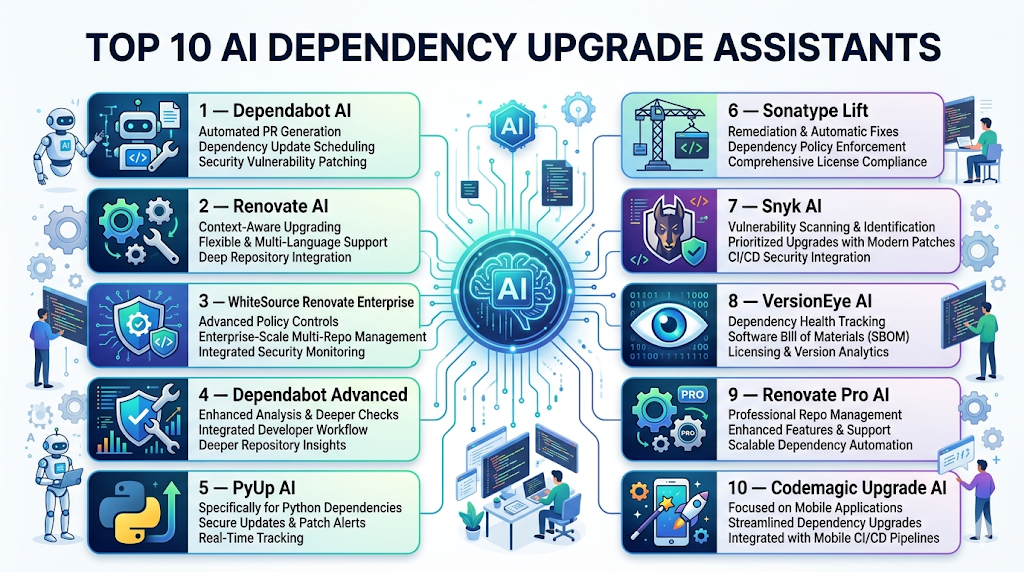
Top 10 AI Dependency Upgrade Assistants
1 — Dependabot AI
One-line verdict: Best for GitHub-based development teams needing automated dependency updates and security patching.
Short description: Dependabot AI automatically detects outdated dependencies, security vulnerabilities, and license issues, suggesting or applying updates directly in GitHub repositories. Developers use it to ensure project stability, reduce manual maintenance, and maintain secure software.
Standout Capabilities
- Automatic dependency scanning and updates
- Security vulnerability detection and patching
- License compliance monitoring
- GitHub-native integration
- Supports multiple languages including JS, Python, and Java
- Provides PRs with suggested updates and changelogs
- Configurable schedules and update rules
AI-Specific Depth
- Model support: Proprietary
- RAG / knowledge integration: N/A
- Evaluation: Regression testing for compatibility suggestions
- Guardrails: Prevents breaking updates in CI/CD
- Observability: Update trends and vulnerability metrics
Pros
- Reduces manual dependency management
- Ensures security patching
- Seamlessly integrates with GitHub workflows
Cons
- Limited to GitHub repositories
- May require manual approval for some updates
- Advanced multi-repo orchestration limited
Security & Compliance
- Uses GitHub security protocols
- Certifications: Not publicly stated
Deployment & Platforms
- Web
- Cloud
Integrations & Ecosystem
- GitHub
- CI/CD pipelines
- Slack and Jira notifications
Pricing Model
- Subscription-based
Best-Fit Scenarios
- GitHub-hosted projects
- Security-focused dependency updates
- Small to medium repositories needing automation
2 — Renovate AI
One-line verdict: Ideal for teams seeking cross-platform dependency updates with automated compatibility checks.
Short description: Renovate AI scans multiple repositories, identifies outdated dependencies, and suggests or applies upgrades with predictive compatibility checks. Developers use it to prevent build failures while keeping dependencies current.
Standout Capabilities
- Automated dependency scanning across multiple repos
- Predictive compatibility analysis
- Multi-language support including JS, Python, Java, Ruby
- Automated pull requests with suggested updates
- Configurable rules and update schedules
- Integration with CI/CD pipelines
- Rollback support for failed updates
AI-Specific Depth
- Model support: Proprietary / Open-source
- RAG / knowledge integration: N/A
- Evaluation: Regression and compatibility testing
- Guardrails: Prevents breaking builds
- Observability: Metrics dashboards for dependency health
Pros
- Supports large multi-repo projects
- Predictive conflict detection reduces CI failures
- Flexible configuration
Cons
- Setup complexity for enterprise-scale repos
- May require manual approvals for critical updates
- Initial onboarding takes time
Security & Compliance
- RBAC, encryption, audit logs
- Certifications: Not publicly stated
Deployment & Platforms
- Web, Windows, macOS, Linux
- Cloud / Hybrid
Integrations & Ecosystem
- GitHub, GitLab, Bitbucket
- CI/CD pipelines, Slack notifications
- API access for custom workflows
Pricing Model
- Tiered subscription
Best-Fit Scenarios
- Multi-repo enterprise projects
- CI/CD integrated dependency management
- Teams needing predictive compatibility checks
3 — WhiteSource Renovate Enterprise
One-line verdict: Best for enterprises managing multi-repo projects needing automated dependency updates and license compliance.
Short description: WhiteSource Renovate Enterprise automates dependency upgrades across large-scale repositories while analyzing security vulnerabilities, license risks, and compatibility issues. It allows teams to maintain enterprise-grade compliance while minimizing manual effort in updating dependencies across multiple languages and repositories.
Standout Capabilities
- Automated dependency scanning and upgrade proposals
- License compliance monitoring across repositories
- Predictive conflict detection to prevent build failures
- Multi-language support (Java, Python, JavaScript, Ruby, .NET)
- Pull request automation with suggested updates
- Integration with CI/CD pipelines and code review workflows
- Rollback options for failed upgrades
AI-Specific Depth
- Model support: Proprietary
- RAG / knowledge integration: N/A
- Evaluation: Compatibility checks and regression testing
- Guardrails: Prevents breaking updates through automated policy enforcement
- Observability: Dashboards for dependency health, vulnerability tracking, and update history
Pros
- Ensures enterprise-level compliance
- Handles multi-repo and multi-language projects efficiently
- Predictive upgrade analysis reduces CI/CD failures
Cons
- Requires enterprise licensing
- Setup can be complex for large-scale repos
- Learning curve for initial configuration
Security & Compliance
- SSO, RBAC, audit logging, encryption
- Certifications: Not publicly stated
Deployment & Platforms
- Web, Windows, Linux, macOS
- Cloud / Hybrid
Integrations & Ecosystem
- GitHub, GitLab, Bitbucket
- CI/CD pipelines
- Jira and Slack notifications
- API for custom workflows
Pricing Model
- Enterprise subscription, tiered by repo size
Best-Fit Scenarios
- Multi-repo enterprise projects
- High compliance environments
- Teams managing large-scale dependency graphs
4 — Dependabot Advanced
One-line verdict: Ideal for teams requiring automated dependency updates with enterprise security and compliance reporting.
Short description: Dependabot Advanced extends standard Dependabot capabilities with enhanced security scanning, license compliance, and automated upgrades. It integrates with enterprise repositories, prioritizing critical updates and maintaining build stability while reducing manual maintenance.
Standout Capabilities
- Automated dependency updates and PR creation
- Security vulnerability alerts and prioritization
- License compliance monitoring
- Multi-language support across JS, Python, Java, .NET
- Integration with GitHub Enterprise and CI/CD pipelines
- Rollback support for failed upgrades
- Reporting dashboards for executive oversight
AI-Specific Depth
- Model support: Proprietary
- RAG / knowledge integration: N/A
- Evaluation: Predictive impact assessment of upgrades
- Guardrails: Ensures CI/CD builds do not break
- Observability: Metrics dashboards, update history, and risk scoring
Pros
- Tight integration with GitHub Enterprise
- Reduces security and compliance risks
- Predictive prioritization of critical upgrades
Cons
- Limited to GitHub repositories
- Enterprise features require licensing
- Some multi-repo orchestration requires manual tuning
Security & Compliance
- SSO, RBAC, audit logs, encryption
- Certifications: Not publicly stated
Deployment & Platforms
- Web
- Cloud
Integrations & Ecosystem
- GitHub Enterprise
- CI/CD pipelines
- Jira, Slack, and API access
Pricing Model
- Subscription-based, tiered by enterprise scale
Best-Fit Scenarios
- GitHub-hosted enterprise projects
- Security and compliance-sensitive workflows
- Multi-language dependency management
5 — PyUp AI
One-line verdict: Best for Python developers needing automated package updates with security and compatibility checks.
Short description: PyUp AI analyzes Python projects to automatically update dependencies, ensuring compatibility and addressing security vulnerabilities. It generates pull requests for upgrades and integrates with CI/CD pipelines, reducing maintenance effort and increasing reliability for Python-based applications.
Standout Capabilities
- Automated Python dependency scanning and upgrade PRs
- Security vulnerability alerts for outdated packages
- Compatibility checks to prevent build failures
- Integration with CI/CD pipelines for automated testing
- License compliance verification
- Dashboard reporting for dependency health
- Predictive prioritization of critical updates
AI-Specific Depth
- Model support: Proprietary
- RAG / knowledge integration: N/A
- Evaluation: Compatibility and regression checks
- Guardrails: Prevents unsafe or incompatible upgrades
- Observability: Metrics for update success and vulnerability trends
Pros
- Reduces manual dependency management
- Improves Python project security
- CI/CD automation for faster releases
Cons
- Focused only on Python projects
- Requires configuration for multi-repo setups
- Enterprise integration limited without paid tiers
Security & Compliance
- Encryption, access controls
- Certifications: Not publicly stated
Deployment & Platforms
- Web
- Cloud
Integrations & Ecosystem
- GitHub, GitLab
- CI/CD pipelines
- Slack notifications
- APIs for automation
Pricing Model
- Subscription-based
Best-Fit Scenarios
- Python microservices and libraries
- Security-focused Python applications
- Teams needing automated CI/CD integration
6 — Sonatype Lift
One-line verdict: Ideal for multi-language enterprises needing predictive dependency updates and security vulnerability mitigation.
Short description: Sonatype Lift automates dependency upgrades across languages while integrating security scanning. It predicts compatibility conflicts and suggests safe updates, helping development teams maintain secure, up-to-date, and stable projects.
Standout Capabilities
- Automated updates across multiple languages
- Security vulnerability detection
- Predictive compatibility and conflict analysis
- CI/CD and IDE integration
- Risk scoring for prioritizing upgrades
- Reporting dashboards for compliance and history
- Rollback support for failed updates
AI-Specific Depth
- Model support: Proprietary
- RAG / knowledge integration: N/A
- Evaluation: Predictive conflict detection
- Guardrails: Enforces safe upgrade policies
- Observability: Metrics dashboards and reporting
Pros
- Supports multiple languages and repositories
- Reduces manual work and risk
- Integrates with CI/CD and IDEs
Cons
- Enterprise-tier subscription required for full features
- Initial setup complexity
- Learning curve for predictive configuration
Security & Compliance
- RBAC, SSO, audit logging, encryption
- Certifications: Not publicly stated
Deployment & Platforms
- Web, Windows, Linux, macOS
- Cloud / Hybrid
Integrations & Ecosystem
- GitHub, GitLab, Bitbucket
- CI/CD pipelines
- Jira, Slack
- API access
Pricing Model
- Enterprise subscription
Best-Fit Scenarios
- Multi-language enterprise codebases
- Security- and compliance-critical projects
- Automated CI/CD dependency management
7 — Snyk AI
One-line verdict: Best for security-focused developers needing automated dependency updates with vulnerability scanning.
Short description: Snyk AI scans dependencies, prioritizes critical security updates, and automates safe upgrades. It helps developers maintain secure, compliant software while integrating seamlessly into CI/CD pipelines.
Standout Capabilities
- Automated dependency scanning and updates
- Vulnerability detection and remediation
- License compliance verification
- Multi-language support
- CI/CD pipeline integration
- Pull request automation
- Risk scoring for critical updates
AI-Specific Depth
- Model support: Proprietary
- RAG / knowledge integration: N/A
- Evaluation: Security regression and compatibility testing
- Guardrails: Prevents breaking changes
- Observability: Metrics dashboards for vulnerabilities and upgrades
Pros
- Strong focus on security
- Reduces manual dependency work
- Predictive prioritization of critical updates
Cons
- Limited runtime compatibility checks
- Requires enterprise subscription for advanced features
- Multi-repo orchestration may need configuration
Security & Compliance
- SSO, RBAC, encryption
- Certifications: Not publicly stated
Deployment & Platforms
- Web, Windows, Linux, macOS
- Cloud / Hybrid
Integrations & Ecosystem
- GitHub, GitLab, Bitbucket
- CI/CD pipelines
- Jira, Slack, API access
Pricing Model
- Tiered subscription
Best-Fit Scenarios
- Security-conscious teams
- Enterprise-scale multi-repo projects
- CI/CD automated dependency updates
8 — VersionEye AI
One-line verdict: Ideal for teams managing multi-language projects with automated dependency tracking and alerting.
Short description: VersionEye AI monitors dependencies across repositories, automatically notifying developers of outdated or vulnerable packages. It predicts safe upgrade paths and integrates with CI/CD to reduce breakages and ensure continuous delivery.
Standout Capabilities
- Multi-language dependency monitoring
- Automated update notifications
- Predictive compatibility suggestions
- CI/CD integration
- License and vulnerability monitoring
- Dashboard for dependency trends
- Rollback support
AI-Specific Depth
- Model support: Proprietary
- RAG / knowledge integration: N/A
- Evaluation: Predictive compatibility and regression checks
- Guardrails: Prevents unsafe updates
- Observability: Dashboards with dependency health metrics
Pros
- Multi-language monitoring
- Automated notifications reduce manual work
- Predictive updates prevent CI failures
Cons
- Limited advanced CI/CD automation
- Requires configuration for large projects
- Enterprise support limited
Security & Compliance
- Encryption, access controls
- Certifications: Not publicly stated
Deployment & Platforms
- Web
- Cloud
Integrations & Ecosystem
- GitHub, GitLab, Bitbucket
- CI/CD pipelines
- Slack, Jira, API access
Pricing Model
- Subscription-based
Best-Fit Scenarios
- Multi-language repositories
- Agile CI/CD pipelines
- Teams tracking dependencies proactively
9 — Renovate Pro AI
One-line verdict: Best for enterprises requiring configurable upgrade policies and multi-repo dependency automation.
Short description: Renovate Pro AI automates dependency upgrades with configurable rules and predictive compatibility checks. It is designed for large-scale enterprise projects, integrating with CI/CD pipelines and providing dashboards for compliance and risk management.
Standout Capabilities
- Automated multi-repo upgrades
- Predictive conflict detection
- Configurable rules and schedules
- Multi-language support
- CI/CD integration
- Reporting dashboards
- Rollback support
AI-Specific Depth
- Model support: Proprietary / Open-source
- RAG / knowledge integration: N/A
- Evaluation: Regression testing and predictive compatibility
- Guardrails: Policy enforcement to prevent build failures
- Observability: Update success metrics and risk dashboards
Pros
- Multi-repo support
- Enterprise-grade predictive automation
- Flexible rule configuration
Cons
- Complex setup for large teams
- Learning curve for policy configuration
- Enterprise-tier subscription required
Security & Compliance
- SSO, RBAC, audit logging
- Certifications: Not publicly stated
Deployment & Platforms
- Web, Windows, Linux, macOS
- Cloud / Hybrid
Integrations & Ecosystem
- GitHub, GitLab, Bitbucket
- CI/CD pipelines
- Jira, Slack, APIs
Pricing Model
- Tiered subscription
Best-Fit Scenarios
- Large-scale enterprise projects
- Multi-language CI/CD pipelines
- Predictive upgrade management
10 — Codemagic Upgrade AI
One-line verdict: Ideal for mobile and cross-platform teams needing automated dependency updates with CI/CD integration.
Short description: Codemagic Upgrade AI focuses on mobile and cross-platform projects, automating dependency updates and security checks. It predicts compatibility issues and integrates with CI/CD pipelines for continuous delivery.
Standout Capabilities
- Automated dependency updates for mobile SDKs
- Predictive compatibility analysis
- Security vulnerability alerts
- CI/CD integration with rollback options
- Multi-language support for mobile frameworks
- Dashboards for upgrade trends and health
- Pull request automation
AI-Specific Depth
- Model support: Proprietary
- RAG / knowledge integration: N/A
- Evaluation: Compatibility and regression testing
- Guardrails: Prevents breaking updates
- Observability: Metrics dashboards
Pros
- Optimized for mobile projects
- Reduces manual update effort
- Predictive conflict detection
Cons
- Focused on mobile/cross-platform
- Enterprise features require subscription
- Limited non-mobile repository support
Security & Compliance
- RBAC, SSO, encryption
- Certifications: Not publicly stated
Deployment & Platforms
- Web, Windows, macOS, Linux
- Cloud / Hybrid
Integrations & Ecosystem
- GitHub, GitLab, Bitbucket
- CI/CD pipelines
- Slack, Jira, API access
Pricing Model
- Subscription-based, tiered
Best-Fit Scenarios
- Mobile and cross-platform apps
- Multi-repo enterprise projects
- Continuous delivery with automated dependency updates
Comparison Table
| Tool Name | Best For | Deployment | Model Flexibility | Strength | Watch-Out | Public Rating |
|---|---|---|---|---|---|---|
| Dependabot AI | GitHub repos needing automated updates | Cloud | Proprietary | GitHub-native automated upgrades | Limited to GitHub | N/A |
| Renovate AI | Multi-repo teams requiring predictive updates | Cloud / Hybrid | Proprietary | Multi-language predictive updates | Initial setup complexity | N/A |
| WhiteSource Renovate Enterprise | Large enterprises with multi-repo dependency management | Cloud / Hybrid | Proprietary | Enterprise compliance & multi-repo automation | Setup complexity | N/A |
| Dependabot Advanced | GitHub Enterprise with security focus | Cloud | Proprietary | Security-focused automated updates | Limited to GitHub | N/A |
| PyUp AI | Python developers | Cloud | Proprietary | Automated Python dependency updates | Python-only | N/A |
| Sonatype Lift | Multi-language enterprise projects | Cloud / Hybrid | Proprietary | Predictive conflict detection | Enterprise subscription required | N/A |
| Snyk AI | Security-conscious dev teams | Cloud / Hybrid | Proprietary | Security & compliance integration | Multi-repo orchestration requires config | N/A |
| VersionEye AI | Multi-language dependency monitoring | Cloud | Proprietary | Alerts for outdated or vulnerable packages | Limited CI/CD automation | N/A |
| Renovate Pro AI | Enterprises needing configurable upgrade policies | Cloud / Hybrid | Proprietary / Open-source | Policy-based multi-repo automation | Learning curve for rules | N/A |
| Codemagic Upgrade AI | Mobile & cross-platform projects | Cloud / Hybrid | Proprietary | Mobile-focused predictive upgrades | Non-mobile support limited | N/A |
Scoring & Evaluation (Transparent Rubric)
Scoring is comparative, not absolute, to help enterprises and developers evaluate tools based on their specific requirements. Weighted total:
| Tool | Core | Reliability/Eval | Guardrails | Integrations | Ease | Perf/Cost | Security/Admin | Support | Weighted Total |
|---|---|---|---|---|---|---|---|---|---|
| Dependabot AI | 8 | 7 | 7 | 8 | 8 | 7 | 8 | 7 | 7.7 |
| Renovate AI | 8 | 8 | 8 | 8 | 7 | 8 | 7 | 7 | 7.8 |
| WhiteSource Renovate Enterprise | 9 | 8 | 9 | 8 | 7 | 8 | 8 | 7 | 8.3 |
| Dependabot Advanced | 8 | 7 | 8 | 8 | 8 | 7 | 8 | 7 | 7.7 |
| PyUp AI | 7 | 7 | 7 | 7 | 8 | 7 | 6 | 6 | 6.8 |
| Sonatype Lift | 9 | 8 | 8 | 8 | 7 | 8 | 8 | 7 | 8.1 |
| Snyk AI | 8 | 8 | 8 | 8 | 7 | 7 | 8 | 7 | 7.8 |
| VersionEye AI | 7 | 7 | 6 | 7 | 8 | 7 | 6 | 6 | 6.7 |
| Renovate Pro AI | 8 | 8 | 8 | 8 | 7 | 8 | 7 | 7 | 7.9 |
| Codemagic Upgrade AI | 7 | 7 | 7 | 7 | 8 | 7 | 6 | 6 | 6.9 |
Top 3 for Enterprise:
- WhiteSource Renovate Enterprise → Multi-repo, policy-based upgrades with compliance tracking
- Sonatype Lift → Predictive dependency conflict resolution for large-scale projects
- Renovate Pro AI → Enterprise configuration and multi-repo automation
Top 3 for SMB:
- Renovate AI → Lightweight, predictive upgrades across smaller multi-repo projects
- Dependabot AI → Automated GitHub-native dependency updates
- Snyk AI → Security-focused dependency updates for smaller teams
Top 3 for Developers:
- PyUp AI → Python-specific automated updates and security checks
- VersionEye AI → Lightweight multi-language monitoring
- Codemagic Upgrade AI → Mobile and cross-platform dependency management
Which AI Dependency Upgrade Assistant Tool Is Right for You?
Solo / Freelancer
- Recommended: Dependabot AI, PyUp AI
- Why: Simple, lightweight, minimal configuration, reduces manual dependency effort.
- Use case: Single-repo Python or GitHub projects needing automated updates and security fixes.
SMB
- Recommended: Renovate AI, Snyk AI, VersionEye AI
- Why: Multi-repo support, predictive compatibility, integrates with CI/CD pipelines, scalable for small teams.
- Use case: Small engineering teams managing multi-language repositories with automated dependency management.
Mid-Market
- Recommended: Dependabot Advanced, Renovate Pro AI
- Why: Adds enhanced security, license compliance, and multi-repo automation suitable for mid-size companies.
- Use case: Mid-market companies deploying AI-driven software, requiring both security and predictive upgrades.
Enterprise
- Recommended: WhiteSource Renovate Enterprise, Sonatype Lift, Renovate Pro AI
- Why: Enterprise-grade predictive upgrades, multi-repo orchestration, CI/CD integration, compliance reporting.
- Use case: Large multi-language repositories, regulated industries, and AI-intensive software systems.
Regulated industries (Finance/Healthcare/Public Sector)
- Recommended: WhiteSource Renovate Enterprise, Sonatype Lift
- Why: Ensures regulatory compliance, security patching, and predictive upgrade prioritization.
Budget vs Premium
- Budget: Dependabot AI, PyUp AI, VersionEye AI → lightweight, minimal cost, cloud-native
- Premium: WhiteSource Renovate Enterprise, Sonatype Lift, Renovate Pro AI → enterprise-grade automation, predictive intelligence, CI/CD integration
Build vs Buy
- Build: Custom scripts for dependency scanning feasible for small projects
- Buy: Commercial AI assistants offer predictive conflict detection, security insights, multi-repo automation, and enterprise support
Implementation Playbook (30 / 60 / 90 Days)
30 Days – Pilot:
- Deploy on a single repo or critical module
- Measure success: update coverage, CI/CD build stability, false positives
- Enable dashboards for dependency health monitoring
- Validate predictive conflict detection
60 Days – Expansion:
- Roll out to additional repositories or modules
- Harden security: SSO, RBAC, encryption, retention policies
- Integrate fully into CI/CD pipelines
- Refine upgrade policies based on metrics
90 Days – Optimization & Scaling:
- Optimize CI/CD performance and latency for updates
- Scale dashboards and reporting across teams
- Automate regression tests and rollback strategies
- Establish governance, audit logs, and compliance tracking
Common Mistakes & How to Avoid Them
- Skipping compatibility evaluation for upgrades
- Over-automation without manual oversight
- Neglecting security vulnerabilities in dependencies
- Unmanaged retention of dependency history
- Failing to integrate with CI/CD pipelines
- Ignoring rollback strategies for failed upgrades
- Not tracking licenses or compliance metrics
- Limited observability and dashboards
- Underestimating multi-language repository complexity
- Vendor lock-in without abstraction layer
- Overlooking predictive risk scoring
- Poor communication between DevOps and developers
- Ignoring trends in vulnerability severity
- Updating without CI/CD test validation
FAQs
- Which programming languages are supported?
Most top assistants support Java, Python, JavaScript, TypeScript, .NET, Ruby, and additional enterprise languages depending on the tool. - Can these tools handle multi-repo projects?
Yes, enterprise tools like WhiteSource Renovate Enterprise and Renovate Pro AI support multi-repo dependency management. - Are these tools suitable for freelancers?
Yes, Dependabot AI and PyUp AI provide lightweight, easy-to-configure automated updates. - Do they integrate with CI/CD pipelines?
All top tools integrate with Jenkins, GitHub Actions, GitLab CI, and Bitbucket pipelines for continuous dependency management. - How do they ensure security and compliance?
They track vulnerabilities, enforce license compliance, and provide dashboards for audit and reporting. - Can these tools predict compatibility issues?
Yes, AI models analyze dependencies to predict conflicts before upgrades are applied. - Do they support rollback for failed upgrades?
Most enterprise assistants provide rollback strategies for failed upgrades to maintain stability. - Are they cloud-based or on-prem?
Many tools offer cloud, hybrid, or on-premises deployment options depending on enterprise requirements. - How accurate are AI predictions?
Accuracy varies by tool but enterprise-grade solutions combine predictive AI with CI/CD testing validation. - Can they prioritize critical updates?
Yes, predictive scoring highlights critical updates that could impact security, compliance, or build stability. - Do they integrate with IDEs?
Some tools, like Dependabot and Renovate, offer IDE plugins or alerts for developer awareness. - Are mobile projects supported?
Codemagic Upgrade AI is optimized for mobile and cross-platform dependencies. - Do these tools support multi-language pipelines?
Yes, enterprise-grade assistants like Sonatype Lift, Renovate Pro AI, and WhiteSource handle multiple languages. - How do they handle open-source licenses?
They automatically monitor license compliance, alerting teams to potential violations or incompatible usage. - Which industries benefit most?
Finance, healthcare, SaaS, e-commerce, mobile apps, and regulated sectors benefit due to compliance, security, and multi-repo management.
Conclusion
AI Dependency Upgrade Assistants are essential for automating, predicting, and safely managing dependency upgrades in modern software development. Choosing the right tool depends on team size, code complexity, security, and compliance requirements. Enterprises benefit from predictive multi-repo assistants like WhiteSource Renovate Enterprise and Sonatype Lift, while SMBs and individual developers can leverage Dependabot AI, PyUp AI, or Renovate AI for lightweight automation.
Next Steps:
- Shortlist tools aligned with your repository size, language mix, and CI/CD integration needs
- Pilot selected tools to evaluate predictive compatibility, update coverage, and CI/CD stability
- Verify security, compliance, and rollback strategies before scaling across teams
A well-structured guide highlighting the pros and cons of top dependency upgrade tools. It’s extremely useful for making smarter and faster upgrade decisions!
This article does a fantastic job highlighting the strengths and limitations of AI-driven dependency management platforms. A valuable resource for DevOps and software engineering teams.