INTRODUCTION
AI Observability Copilots are intelligent platforms that assist engineers and SREs in monitoring, troubleshooting, and optimizing complex systems. They automatically correlate logs, metrics, traces, and events to provide actionable insights, predictive alerts, and remediation recommendations.
Why it matters:
Cloud-native systems, multi-cloud deployments, and containerized microservices have made traditional monitoring insufficient. AI Observability Copilots accelerate anomaly detection, root cause analysis, and incident response, reducing downtime and improving service reliability. They are critical for maintaining high SLOs and operational efficiency in modern infrastructures.
Real-world use cases:
- Automated correlation of logs, metrics, and traces
- Predictive alerts for emerging system anomalies
- Guided remediation for on-call engineers
- Optimization insights for cloud and container infrastructure
- Root cause analysis across distributed services
- Trend analysis for post-mortem reporting
Evaluation criteria for buyers:
- Observability stack integration (logs, metrics, traces)
- Accuracy of anomaly detection and recommendations
- Multi-cloud and hybrid environment support
- Automated or guided remediation
- Security, privacy, and compliance features
- Customizable dashboards and alert workflows
- Scalability for enterprise workloads
- Cost, latency, and performance efficiency
- Guardrails and safe automation
- Auditability and reporting
Best for: SRE teams, DevOps engineers, cloud infrastructure teams, enterprise SaaS companies, regulated industries
Not ideal for: Small-scale static environments or teams with minimal incidents where manual monitoring is sufficient
What’s Changed in AI Observability Copilots
- Agentic workflows for automated troubleshooting
- Multi-modal inputs from logs, metrics, traces, and configuration data
- AI evaluation & testing to prevent hallucinations or unreliable recommendations
- Guardrails and prompt-injection defenses
- Enterprise privacy: data residency and retention controls
- Cost and latency optimization, model routing, BYO model support
- Observability of AI: traces, token/cost metrics, latency
- Governance and compliance reporting
- Predictive anomaly detection and SLO breach alerts
- Integration with alerting and incident management platforms
- Collaboration features for distributed SRE teams
- Enhanced automation with safe recommendations
Quick Buyer Checklist
- Data privacy and retention policies
- Model choice: hosted, BYO, open-source
- RAG/connectors for knowledge integration
- AI evaluation and testing
- Guardrails to prevent unsafe automation
- Latency, cost, and performance monitoring
- Auditability and admin controls
- Vendor lock-in and integration flexibility
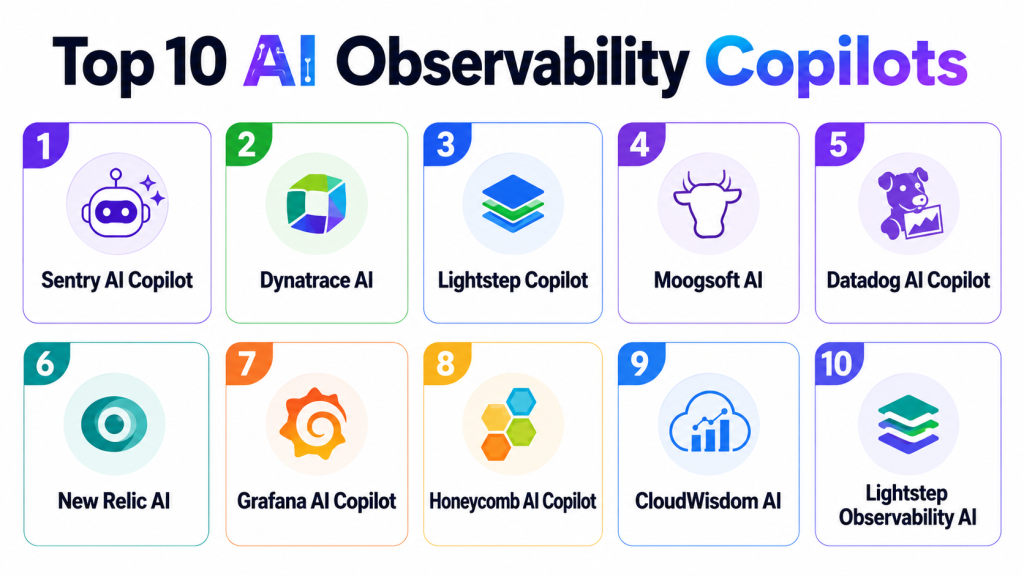
Top 10 AI Observability Copilots
1 — Sentry AI Copilot
One-line verdict: Best for SRE and DevOps teams needing AI-guided error analysis, predictive alerts, and root cause insights.
Short description:
Sentry AI Copilot monitors logs, metrics, and traces across distributed systems, automatically detecting anomalies and providing prioritized insights. It delivers guided remediation and predictive alerts for engineering teams, helping reduce downtime and accelerate incident resolution.
Standout Capabilities
- Real-time error detection and correlation
- Predictive anomaly alerts
- Root cause analysis recommendations
- Multi-service and multi-cloud support
- Custom dashboards and incident routing
AI-Specific Depth
- Model support: Proprietary
- RAG / knowledge integration: Internal KB connectors
- Evaluation: Regression, offline eval, human review
- Guardrails: Safe recommendation limits
- Observability: Tracks latency, token, and event metrics
Pros
- Reduces incident resolution time
- Improves root cause visibility
- Predictive alerts prevent outages
Cons
- Enterprise-focused; higher cost
- Requires mature observability stack
- Learning curve for configuration
Security & Compliance
SSO/SAML, RBAC, encryption, audit logs, retention policies
Certifications: Not publicly stated
Deployment & Platforms
Web, Linux, Cloud / Hybrid
Integrations & Ecosystem
APIs and connectors for GitHub, Jira, Slack, Datadog, Grafana, Prometheus
Pricing Model
Tiered subscription, usage-based for events
Best-Fit Scenarios
- Large enterprise SRE teams
- Multi-cloud observability
- Predictive monitoring environments
2 — Dynatrace AI
One-line verdict: Ideal for enterprises seeking automated performance anomaly detection and AI-driven observability guidance.
Short description:
Dynatrace AI ingests telemetry from logs, metrics, and traces, providing predictive insights and automated root cause analysis. It is suitable for large teams managing complex multi-cloud and hybrid infrastructures.
Standout Capabilities
- Automated problem detection
- Root cause identification across services
- Predictive SLO breach alerts
- Integrated remediation guidance
- Alert prioritization based on impact
AI-Specific Depth
- Model support: Proprietary
- RAG / knowledge integration: Connectors to internal knowledge bases
- Evaluation: Regression tests and human validation
- Guardrails: Safe recommendation policies
- Observability: Tracks latency, token consumption
Pros
- Scales across enterprise environments
- Reduces alert noise
- Provides actionable remediation guidance
Cons
- Higher cost for small teams
- Complex initial setup
- Proprietary model limits customization
Security & Compliance
Encryption, RBAC, SSO, audit logs
Certifications: Not publicly stated
Deployment & Platforms
Cloud / Hybrid, Web, Linux
Integrations & Ecosystem
Slack, PagerDuty, Jira, Prometheus, Grafana, REST APIs
Pricing Model
Tiered enterprise subscription
Best-Fit Scenarios
- Enterprise SRE teams
- Multi-cloud distributed systems
- Predictive observability use cases
3 — Lightstep Copilot
One-line verdict: Best for cloud-native teams needing AI-assisted distributed trace analysis and performance insights.
Short description:
Lightstep Copilot correlates distributed traces across microservices, highlights latency hotspots, and provides actionable root cause guidance. It enables SRE teams to optimize service reliability and reduce mean time to resolution.
Standout Capabilities
- Distributed trace correlation
- Latency hotspot identification
- Root cause prioritization
- Multi-service dashboards
- Integration with CI/CD pipelines
AI-Specific Depth
- Model support: Proprietary
- RAG / knowledge integration: N/A
- Evaluation: Regression and human review
- Guardrails: Safe recommendation policies
- Observability: Traces and token metrics
Pros
- Reduces troubleshooting time
- Visualizes complex microservice dependencies
- Predictive insights for proactive resolution
Cons
- Requires comprehensive instrumentation
- Less log correlation focus
- Setup can be complex for smaller teams
Security & Compliance
Encryption, audit logs, RBAC
Certifications: Not publicly stated
Deployment & Platforms
Cloud / Hybrid, Web
Integrations & Ecosystem
Prometheus, Grafana, Slack, Jira, REST APIs
Pricing Model
Tiered subscription
Best-Fit Scenarios
- Cloud-native microservices teams
- Performance optimization focus
- Distributed system reliability
4 — Moogsoft AI
One-line verdict: Best for large enterprises needing AI-based alert correlation, noise reduction, and guided incident response.
Short description:
Moogsoft AI consolidates alerts from multiple sources, correlates events, and suggests remediation steps. It reduces alert fatigue and improves cross-team collaboration in complex enterprise environments.
Standout Capabilities
- Event correlation across multiple systems
- Alert noise reduction
- AI-driven remediation suggestions
- Multi-team collaboration dashboards
- Predictive incident alerts
AI-Specific Depth
- Model support: Proprietary
- RAG / knowledge integration: Internal KB connectors
- Evaluation: Regression and human review
- Guardrails: Safe automation policies
- Observability: Tracks latency and token usage
Pros
- Reduces alert fatigue
- Provides actionable insights
- Improves collaboration across teams
Cons
- Higher complexity
- Enterprise subscription cost
- Limited open-source flexibility
Security & Compliance
SSO/SAML, RBAC, encryption, audit logs
Certifications: Not publicly stated
Deployment & Platforms
Cloud / Hybrid, Web
Integrations & Ecosystem
Slack, PagerDuty, Jira, Prometheus, Grafana, REST APIs
Pricing Model
Tiered enterprise subscription
Best-Fit Scenarios
- Multi-cloud enterprise environments
- Large SRE teams
- High alert volume systems
5 — Datadog AI Copilot
One-line verdict: Best for DevOps and SRE teams needing AI-guided observability across logs, metrics, and traces.
Short description:
Datadog AI Copilot analyzes telemetry data to detect anomalies, correlate issues, and provide actionable guidance for SRE teams. It helps teams maintain system reliability across cloud-native and hybrid environments.
Standout Capabilities
- Multi-source telemetry analysis
- Predictive anomaly detection
- Root cause analysis recommendations
- Automated correlation of logs, metrics, and traces
- Customizable dashboards and alerts
AI-Specific Depth
- Model support: Proprietary
- RAG / knowledge integration: N/A
- Evaluation: Regression and human review
- Guardrails: Safe automation policies
- Observability: Tracks latency and token usage
Pros
- Comprehensive observability coverage
- Predictive alerts improve uptime
- Scales across multi-cloud deployments
Cons
- Enterprise pricing
- Learning curve for full feature set
- Less flexibility for self-hosted environments
Security & Compliance
Encryption, RBAC, audit logs
Certifications: Not publicly stated
Deployment & Platforms
Cloud, Web
Integrations & Ecosystem
Slack, Jira, PagerDuty, Prometheus, Grafana
Pricing Model
Tiered subscription
Best-Fit Scenarios
- Multi-cloud SRE teams
- Cloud-native performance monitoring
- Predictive observability focus
6 — New Relic AI
One-line verdict: Ideal for monitoring teams seeking predictive alerts and AI-assisted remediation guidance.
Short description:
New Relic AI integrates metrics, traces, and logs to provide predictive alerts and AI-assisted root cause analysis, enabling faster incident resolution and improved service reliability.
Standout Capabilities
- Predictive anomaly detection
- Root cause recommendations
- Multi-service correlation
- Custom dashboards and alerts
- Automated prioritization of incidents
AI-Specific Depth
- Model support: Proprietary
- RAG / knowledge integration: Internal KB connectors
- Evaluation: Regression and offline tests
- Guardrails: Safe automated action policies
- Observability: Latency, token, and cost tracking
Pros
- Reduces MTTR
- Predictive insights prevent outages
- Integrates with observability stack
Cons
- Enterprise-focused pricing
- Complexity in hybrid environments
- Less suited for small teams
Security & Compliance
Encryption, RBAC, audit logs
Certifications: Not publicly stated
Deployment & Platforms
Cloud / Hybrid, Web
Integrations & Ecosystem
Slack, PagerDuty, Jira, Prometheus, Grafana
Pricing Model
Tiered subscription
Best-Fit Scenarios
- Enterprise SRE teams
- Hybrid cloud monitoring
- Multi-service observability
7 — Grafana AI Copilot
One-line verdict: Best for teams already using Grafana dashboards wanting AI-guided observability and anomaly detection.
Short description:
Grafana AI Copilot enhances existing dashboards with AI-driven insights, detects anomalies, and recommends remediation steps. Ideal for DevOps teams leveraging Grafana for metrics visualization and monitoring.
Standout Capabilities
- AI-powered dashboards and alerts
- Multi-metric anomaly detection
- Integration with traces and logs
- Customizable visualization templates
- Predictive performance insights
AI-Specific Depth
- Model support: Proprietary
- RAG / knowledge integration: N/A
- Evaluation: Regression and offline testing
- Guardrails: Safe recommendations
- Observability: Token and latency metrics
Pros
- Enhances Grafana dashboards
- Reduces time to detect anomalies
- AI guidance integrated with visualization
Cons
- Requires Grafana infrastructure
- Limited remediation automation
- Not full-stack observability standalone
Security & Compliance
Encryption, RBAC
Certifications: Not publicly stated
Deployment & Platforms
Cloud / Web
Integrations & Ecosystem
Prometheus, Loki, Jaeger, Slack, Jira
Pricing Model
Tiered subscription
Best-Fit Scenarios
- Teams already using Grafana
- Cloud-native monitoring
- Developer-focused dashboards
8 — Honeycomb AI Copilot
One-line verdict: Best for microservice-heavy environments needing AI-assisted event correlation and anomaly insights.
Short description:
Honeycomb AI Copilot correlates events and traces in real-time, surfaces anomalies, and recommends actionable insights for SRE and DevOps teams, helping reduce downtime and improve observability in complex systems.
Standout Capabilities
- Event and trace correlation
- AI-powered anomaly detection
- Recommendations for remediation
- Multi-service incident visualization
- Predictive SLO breach alerts
AI-Specific Depth
- Model support: Proprietary
- RAG / knowledge integration: Internal KB connectors
- Evaluation: Regression, offline testing
- Guardrails: Safe action policies
- Observability: Latency, cost metrics
Pros
- Real-time correlation insights
- Reduces incident MTTR
- Scales for microservices
Cons
- Enterprise-focused pricing
- Requires comprehensive observability setup
- Not lightweight for small teams
Security & Compliance
Encryption, RBAC, audit logs
Certifications: Not publicly stated
Deployment & Platforms
Cloud / Web
Integrations & Ecosystem
Slack, PagerDuty, Jira, Prometheus, Grafana
Pricing Model
Tiered subscription
Best-Fit Scenarios
- Microservice-heavy environments
- Multi-cloud SRE teams
- Predictive monitoring and anomaly detection
9 — CloudWisdom AI
One-line verdict: Ideal for cloud infrastructure teams seeking AI-driven predictive alerting and reliability recommendations.
Short description:
CloudWisdom AI ingests telemetry, predicts SLO breaches, and recommends optimization or remediation actions. It helps teams maintain high reliability while reducing operational overhead.
Standout Capabilities
- Predictive SLO breach alerts
- AI-guided remediation and optimization
- Multi-cloud telemetry analysis
- Visual dashboards for reliability metrics
- Integration with CI/CD pipelines
AI-Specific Depth
- Model support: Proprietary
- RAG / knowledge integration: Internal KB connectors
- Evaluation: Regression, human review
- Guardrails: Safe automated suggestions
- Observability: Latency, token metrics
Pros
- Predictive alerts improve uptime
- Reduces operational overhead
- Cloud-native optimization guidance
Cons
- Enterprise cost
- Setup complexity
- Limited for small-scale environments
Security & Compliance
Encryption, RBAC, audit logs
Certifications: Not publicly stated
Deployment & Platforms
Cloud / Web
Integrations & Ecosystem
Slack, PagerDuty, Jira, Prometheus, Grafana
Pricing Model
Tiered subscription
Best-Fit Scenarios
- Cloud infrastructure teams
- Multi-service reliability monitoring
- SLO-focused observability
10 — Lightstep Observability AI
One-line verdict: Best for SREs needing full-stack observability with AI-driven root cause and predictive guidance.
Short description:
Lightstep Observability AI provides a unified view across metrics, logs, and traces, automatically detecting anomalies, prioritizing alerts, and providing actionable remediation guidance for reliability engineers.
Standout Capabilities
- Full-stack metric, log, trace correlation
- Root cause analysis prioritization
- Predictive anomaly detection
- Automated alert triage
- Multi-cloud observability dashboards
AI-Specific Depth
- Model support: Proprietary
- RAG / knowledge integration: N/A
- Evaluation: Regression testing and human review
- Guardrails: Safe automation policies
- Observability: Token usage, latency, cost metrics
Pros
- Unified observability across services
- Reduces incident MTTR
- Predictive insights improve reliability
Cons
- Enterprise cost
- Requires complex setup
- Learning curve for full deployment
Security & Compliance
Encryption, RBAC, audit logs
Certifications: Not publicly stated
Deployment & Platforms
Cloud / Hybrid, Web
Integrations & Ecosystem
Prometheus, Grafana, Slack, Jira, CI/CD tools
Pricing Model
Tiered subscription
Best-Fit Scenarios
- Enterprise SRE teams
- Multi-cloud full-stack monitoring
- Predictive reliability and optimization
Comparison Table
| Tool Name | Best For | Deployment | Model Flexibility | Strength | Watch-Out | Public Rating |
|---|---|---|---|---|---|---|
| Sentry AI Copilot | SRE/DevOps teams | Cloud/Hybrid | Proprietary | Predictive insights | Enterprise cost | N/A |
| Dynatrace AI | Enterprise SRE teams | Cloud/Hybrid | Proprietary | Automated RCA | Complex setup | N/A |
| Lightstep Copilot | Cloud-native microservices | Cloud/Hybrid | Proprietary | Distributed trace analysis | Requires instrumentation | N/A |
| Moogsoft AI | Multi-cloud enterprises | Cloud/Hybrid | Proprietary | Event correlation | Complexity for small teams | N/A |
| Datadog AI Copilot | Multi-cloud DevOps teams | Cloud | Proprietary | Telemetry insights | Enterprise pricing | N/A |
| New Relic AI | Cloud monitoring teams | Cloud/Hybrid | Proprietary | Predictive alerts | Enterprise cost | N/A |
| Grafana AI Copilot | Grafana dashboard users | Cloud | Proprietary | Dashboard insights | Requires Grafana | N/A |
| Honeycomb AI Copilot | Microservice-heavy teams | Cloud | Proprietary | Event correlation | Enterprise pricing | N/A |
| CloudWisdom AI | Cloud infrastructure teams | Cloud | Proprietary | Predictive alerting | Setup complexity | N/A |
| Lightstep Observability AI | Full-stack SRE teams | Cloud/Hybrid | Proprietary | Root cause & predictions | Enterprise cost | N/A |
Scoring & Evaluation (Transparent Rubric)
| Tool Name | Core | Reliability/Eval | Guardrails | Integrations | Ease | Perf/Cost | Security/Admin | Support | Weighted Total |
|---|---|---|---|---|---|---|---|---|---|
| Sentry AI Copilot | 9 | 9 | 9 | 9 | 7 | 8 | 9 | 7 | 8.5 |
| Dynatrace AI | 8 | 9 | 8 | 8 | 7 | 7 | 8 | 7 | 7.9 |
| Lightstep Copilot | 8 | 8 | 8 | 8 | 7 | 7 | 8 | 6 | 7.5 |
| Moogsoft AI | 8 | 8 | 7 | 8 | 7 | 7 | 7 | 6 | 7.3 |
| Datadog AI Copilot | 8 | 8 | 7 | 8 | 7 | 7 | 7 | 6 | 7.3 |
| New Relic AI | 8 | 8 | 8 | 8 | 7 | 7 | 8 | 6 | 7.5 |
| Grafana AI Copilot | 7 | 7 | 6 | 7 | 8 | 7 | 6 | 6 | 6.8 |
| Honeycomb AI Copilot | 8 | 8 | 7 | 8 | 7 | 7 | 7 | 6 | 7.3 |
| CloudWisdom AI | 8 | 8 | 7 | 7 | 7 | 7 | 7 | 6 | 7.1 |
| Lightstep Observability AI | 9 | 9 | 8 | 8 | 7 | 7 | 8 | 6 | 7.8 |
Top 3 Recommendations:
- Enterprise: Sentry AI Copilot, Dynatrace AI, Lightstep Observability AI — best for large multi-cloud deployments with predictive insights.
- SMB: Grafana AI Copilot, CloudWisdom AI, Honeycomb AI Copilot — easy adoption, actionable recommendations, and low operational overhead.
- Developers: Lightstep Copilot, Datadog AI Copilot, New Relic AI — lightweight, integrates with CI/CD, and focuses on root cause and trace-level insights.
Which AI Observability Copilot Tool Is Right for You?
Solo / Freelancer
- Grafana AI Copilot or CloudWisdom AI for simple dashboards and anomaly detection without heavy setup.
SMB
- Honeycomb AI Copilot and CloudWisdom AI balance cost, speed, and predictive guidance for small teams.
Mid-Market
- Lightstep Copilot and Datadog AI Copilot provide multi-service observability with AI-assisted root cause detection.
Enterprise
- Sentry AI Copilot, Dynatrace AI, and Lightstep Observability AI offer predictive analytics, compliance features, and multi-cloud support.
Regulated industries
- Enterprise-grade tools with audit logs, SSO, RBAC, and retention policies: Sentry AI Copilot, Dynatrace AI.
Budget vs Premium
- Lightweight tools for small teams: Grafana AI Copilot, CloudWisdom AI
- Premium enterprise tools: Dynatrace AI, Lightstep Observability AI
Build vs Buy
- DIY monitoring may suit startups or single-service environments
- Buy enterprise AI Observability Copilots for predictive insights, automation, and compliance
Implementation Playbook (30 / 60 / 90 Days)
30 Days:
- Pilot AI in one environment or microservice
- Measure incident detection accuracy and MTTR improvements
- Define human review checkpoints for automated actions
60 Days:
- Harden security with RBAC, SSO, and audit logs
- Integrate with observability stack: Prometheus, Grafana, Datadog
- Configure alert thresholds and multi-cloud pipelines
- Test AI evaluation, guardrails, and safe automation policies
90 Days:
- Scale AI across multiple services and teams
- Optimize cost, latency, and token usage
- Conduct red-teaming for guardrail effectiveness
- Establish dashboards and metrics for governance
- Train teams on AI-assisted incident response
Common Mistakes & How to Avoid Them
- Ignoring AI guardrails
- No human review of automated recommendations
- Unmanaged data retention or privacy policies
- Lack of observability or monitoring metrics
- Over-automation without verification
- Alert fatigue due to poor prioritization
- Vendor lock-in without API abstraction
- Poor CI/CD integration
- Inadequate multi-cloud correlation
- Missing historical context for recurring incidents
FAQs
1. Can AI Observability Copilots handle multi-cloud environments?
Yes. They ingest metrics, logs, and traces from multiple clouds to detect anomalies across distributed systems.
2. How do these tools ensure data privacy?
Encryption, RBAC, audit logs, and retention policies ensure data protection and compliance.
3. Is human review required for AI recommendations?
Yes, especially for high-impact incidents or automated remediation, to prevent unintended actions.
4. Can dashboards and alerts be customized?
Most platforms allow full customization for dashboards, alerting workflows, and reports.
5. Do these tools provide predictive alerts?
Yes, they forecast anomalies and potential SLO breaches before they impact users.
6. Can they integrate with CI/CD pipelines?
Yes. APIs and webhooks enable automated telemetry collection, alerting, and remediation guidance.
7. Are open-source options available?
Some exist, but enterprise-grade features are mostly proprietary. Open-source tools may require self-hosting.
8. How is AI output evaluated for accuracy?
Regression tests, offline datasets, and optional human review validate AI predictions.
9. Can these assistants perform automated remediation safely?
Yes, with proper guardrails, policy checks, and human approval for critical actions.
10. How is pricing structured?
Subscription, usage-based, or tiered models are common depending on team size and telemetry volume.
11. Can alert fatigue be mitigated?
AI prioritizes alerts by severity and impact, reducing noise and focusing teams on critical issues.
12. Do these tools correlate incidents across multiple services?
Yes. Enterprise-grade copilot tools link metrics, logs, and traces across services to identify root causes.
Conclusion
AI Observability Copilots significantly reduce incident resolution time, improve system reliability, and provide actionable insights for SRE and DevOps teams. Selection depends on scale, complexity, cloud architecture, and workflow needs. Start by shortlisting, pilot with a subset of services, validate AI outputs and guardrails, then scale across all teams and environments.
Next steps:
- Shortlist 2–3 tools based on integration and workflow requirements
- Pilot AI in selected services or environments
- Validate guardrails, AI recommendations, and compliance before full deployment