Introduction
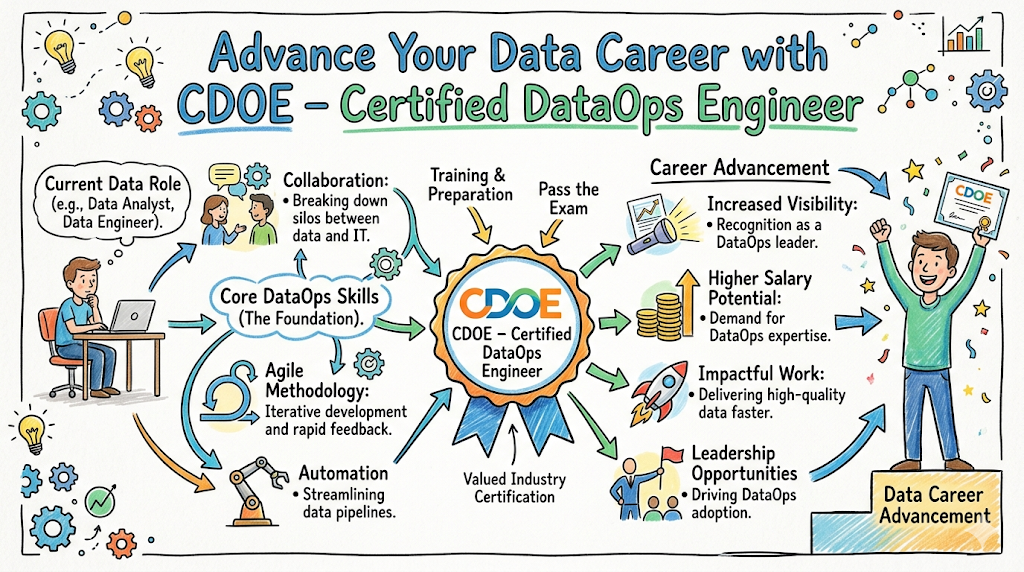
The CDOE – Certified DataOps Engineer is designed for professionals seeking to master the intersection of data engineering and operational excellence. This credential is provided by DataOpsSchool and is recognized globally as a benchmark for excellence in data lifecycle management. The curriculum is focused on bridging the gap between data development and production stability through automation. By pursuing this path, engineers are prepared to handle complex data architectures with a focus on quality and speed. This guide serves as a detailed roadmap for anyone looking to advance their career in the evolving landscape of data-driven engineering.
What is the CDOE – Certified DataOps Engineer?
The CDOE – Certified DataOps Engineer represents a professional standard that integrates agile methodologies and DevOps principles into the data management lifecycle. It is developed to ensure that data is treated as a product, requiring rigorous testing, continuous integration, and automated deployment. Unlike traditional data management, this approach focuses on the reduction of cycle time for data delivery while maintaining high levels of data quality. Modern engineering workflows are supported by these practices to eliminate manual bottlenecks and silos.
It exists to provide a production-focused learning experience that moves beyond theoretical concepts into real-world application. Enterprise practices are emphasized, ensuring that every candidate can manage data at scale within cloud-native environments. The methodology is built upon the DataOps Manifesto, prioritizing communication, integration, and automation. By mastering this program, technical professionals are equipped to build resilient data ecosystems that support business-critical decision-making.
Who Should Pursue CDOE – Certified DataOps Engineer?
This certification is highly suitable for data engineers, DevOps specialists, and Site Reliability Engineers who manage data infrastructure. Cloud professionals and platform engineers who wish to specialize in data-intensive applications will find the curriculum directly applicable to their daily tasks. It is also beneficial for security and data governance roles that require a structured approach to automated compliance. Both individual contributors and technical leaders are encouraged to pursue this credential to align their skills with modern standards.
In terms of career levels, beginners are provided with a solid foundation, while experienced engineers can refine their skills through advanced architectural tracks. The program is designed for a global audience, with specific relevance to the rapidly growing technology sector in India. Engineering managers and technical leads also benefit from the insights provided, enabling them to oversee successful DataOps transformations. This certification is a strategic move for anyone responsible for the reliability and velocity of data streams in an organization.
Why CDOE – Certified DataOps Engineer is Valuable and Beyond
The demand for DataOps expertise is driven by the increasing complexity of data landscapes and the need for faster insights. Longevity in a technical career is maintained by mastering methodologies that remain relevant even as specific tools change. Enterprise adoption of DataOps is growing rapidly as organizations seek to maximize the return on their data investments. This program ensures that professionals can lead these initiatives and remain competitive in the market.
Career investment in this certification is justified by the significant efficiency gains it brings to technical teams. By automating repetitive tasks and improving data quality, engineers can focus on high-value architectural improvements. The methodology provides a clear path for professional growth, leading to senior and principal roles. As data remains the core of modern business, the ability to manage it operationally is a skill that will remain in high demand for the foreseeable future.
CDOE – Certified DataOps Engineer Certification Overview
The program is delivered via the https://dataopsschool.com/certifications/ platform and is hosted on the DataOpsSchool website. A practical, assessment-based approach is used to ensure that candidates possess the hands-on skills required for production environments. The certification ownership ensures that the curriculum is consistently updated to reflect the latest industry trends and technological shifts. Different levels are offered to cater to various stages of professional expertise.
The structure is designed to be cumulative, where each level builds upon the knowledge gained in the previous stage. Foundational concepts are introduced first, followed by professional-grade automation and finally advanced architectural strategy. This ensures a comprehensive understanding of the DataOps lifecycle from both a technical and managerial perspective. The assessment process is rigorous, requiring candidates to demonstrate proficiency in real-world scenarios.
CDOE – Certified DataOps Engineer Certification Tracks & Levels
The certification is categorized into three primary levels: Foundation, Professional, and Advanced. Each level is tailored to specific career milestones, allowing for a structured progression through the discipline. The Foundation level is focused on core principles and basic automation, while the Professional level dives into complex orchestration and quality frameworks. The Advanced level is intended for senior leaders who must architect global data strategies.
Specialization tracks are also available to align with specific career paths such as SRE or FinOps. For instance, a candidate might choose to focus on the operational reliability of data or the cost optimization of data pipelines. These tracks allow professionals to customize their learning journey based on their current role and future aspirations. This tiered and tracked approach ensures that the certification remains relevant to a wide variety of technical disciplines.
Complete CDOE – Certified DataOps Engineer Certification Table
| Track | Level | Who it’s for | Prerequisites | Skills Covered | Recommended Order |
| Core DataOps | Foundation | Junior Engineers | Basic Linux/SQL | Data Pipelines, CI/CD | First |
| Core DataOps | Professional | Experienced DEs | CDOE Foundation | Automation, Quality | Second |
| Core DataOps | Advanced | Senior Architects | CDOE Professional | Scaling, Governance | Third |
| Specialized | SRE-Data | SRE Professionals | Platform Knowledge | Observability, SLIs | Optional |
| Specialized | FinOps-Data | FinOps Leads | Cloud Billing | Cost Optimization | Optional |
Detailed Guide for Each CDOE – Certified DataOps Engineer Certification
CDOE – Certified DataOps Engineer – Foundation
What it is
The Foundation certification validates a basic understanding of DataOps principles and the ability to implement simple automated pipelines. It serves as the entry point for anyone new to the field of data operations.
Who should take it
This is intended for junior data engineers, software developers, and technical project managers. It is suitable for those who require a clear overview of how data moves through an automated lifecycle.
Skills you’ll gain
- Understanding of the DataOps Manifesto and collaborative values.
- Ability to implement basic CI/CD for data scripts.
- Knowledge of version control for database schemas.
- Familiarity with automated validation and data quality checks.
Real-world projects you should be able to do
- Creation of a simple automated data ingestion pipeline.
- Implementation of basic version control for a data warehouse.
- Setup of automated alerts for pipeline failures.
Preparation plan
- 7-14 Days: Review of the core curriculum and completing practice assessments.
- 30 Days: Exploration of hands-on labs involving basic pipeline tools.
- 60 Days: Detailed study of all foundational topics and completion of a small project.
Common mistakes
- Focusing solely on tools without understanding the underlying principles.
- Neglecting the importance of basic Linux and SQL knowledge.
Best next certification after this
- Same-track option: CDOE Professional.
- Cross-track option: Certified DevOps Engineer.
- Leadership option: Technical Lead Certification.
CDOE – Certified DataOps Engineer – Professional
What it is
The Professional level focuses on high-level automation, sophisticated orchestration, and the implementation of robust data quality frameworks. It validates the ability to manage complex data environments at scale.
Who should take it
Experienced data engineers and DevOps professionals should pursue this level to demonstrate their expertise. It is meant for those responsible for the stability and performance of production data systems.
Skills you’ll gain
- Advanced orchestration of multi-stage data pipelines.
- Implementation of “Data as Code” frameworks.
- Designing automated testing for large-scale datasets.
- Implementation of observability and monitoring for data health.
Real-world projects you should be able to do
- Development of a self-healing data pipeline system.
- Setup of a real-time monitoring dashboard for data quality.
- Creation of automated rollback procedures for failed data deployments.
Preparation plan
- 7-14 Days: Intensive review of advanced orchestration and testing tools.
- 30 Days: Execution of complex hands-on lab scenarios.
- 60 Days: Building an end-to-end production-grade DataOps ecosystem.
Common mistakes
- Overcomplicating pipeline logic beyond what is necessary.
- Ignoring security and compliance within the automated pipeline.
Best next certification after this
- Same-track option: CDOE Advanced.
- Cross-track option: Certified SRE Professional.
- Leadership option: Data Engineering Manager Certification.
CDOE – Certified DataOps Engineer – Advanced
What it is
This level validates the highest tier of expertise in DataOps strategy, global governance, and large-scale architectural design. It is the pinnacle of the DataOps learning journey.
Who should take it
Senior architects, principal engineers, and CTOs are the primary audience for this certification. It is intended for those who lead technical strategy and organizational change.
Skills you’ll gain
- Architecting global-scale data operations across multi-cloud environments.
- Strategic implementation of data governance and automated compliance.
- Leadership in driving DataOps cultural transformation.
- Optimizing large-scale infrastructure for performance and cost.
Real-world projects you should be able to do
- Designing a multi-region data governance strategy.
- Leading a complete organizational shift to automated DataOps workflows.
- Developing a strategic roadmap for data infrastructure scaling.
Preparation plan
- 7-14 Days: Review of high-level case studies and architectural patterns.
- 30 Days: Deep dive into global compliance and scaling strategies.
- 60 Days: Completion of a comprehensive strategy-focused capstone project.
Common mistakes
- Focusing on technical details while neglecting business ROI.
- Ignoring the long-term maintenance implications of architectural decisions.
Best next certification after this
- Same-track option: Post-Advanced Specializations.
- Cross-track option: Certified Cloud Architect.
- Leadership option: Executive Leadership Program.
Choose Your Learning Path
DevOps Path
The integration of data operations into existing DevOps workflows is the primary focus of this path. It is explored how data changes can be synchronized with application releases to ensure a seamless delivery cycle. Infrastructure as Code principles are applied to data environments to maintain consistency across dev, test, and production stages. This path is ideal for generalist DevOps engineers seeking to expand their impact.
DevSecOps Path
The priority of this path is the inclusion of security and compliance checks within the automated data pipeline. Techniques for automated data masking, encryption, and audit logging are integrated into the continuous delivery process. It is ensured that data remains secure without compromising the speed of delivery. This path is essential for professionals working in highly regulated industries.
SRE Path
Reliability and observability of data systems are the core components of the SRE learning path. Focus is placed on establishing Service Level Objectives for data quality and pipeline uptime. Automated remediation and incident response protocols are developed to minimize the impact of data failures. This path is recommended for those who manage critical data infrastructure.
AIOps Path
In the AIOps path, the application of machine learning for IT operations is analyzed in detail. It is learned how to use intelligent insights to predict pipeline failures and optimize resource allocation automatically. The focus is on building smarter systems that can self-manage and self-heal. This specialization is geared toward engineers looking to lead the next wave of intelligent automation.
MLOps Path
The MLOps path specifically addresses the lifecycle of machine learning models and the data required to train them. It is explored how to manage the versioning of datasets and models within a unified automation framework. Techniques for automated model deployment and performance monitoring are mastered to ensure model reliability. This path is perfect for data scientists and engineers.
DataOps Path
A pure focus on the data management lifecycle defines this path, from initial ingestion to final consumption. The optimization of data quality and the reduction of cycle time for data delivery are the primary goals. Advanced techniques in data orchestration and team collaboration are thoroughly covered. This is the standard path for dedicated data engineering professionals.
FinOps Path
The economic aspect of data operations is the central theme of the FinOps learning path. It is studied how to monitor and control the costs associated with cloud data storage and processing effectively. Strategies for optimizing resource utilization to maximize business value are implemented across the data lifecycle. This path is becoming vital as organizations seek to manage cloud spending.
Role → Recommended CDOE – Certified DataOps Engineer Certifications
| Role | Recommended Certifications |
| DevOps Engineer | CDOE Foundation, DevOps Professional |
| SRE | CDOE Professional, SRE-Data |
| Platform Engineer | CDOE Foundation, Advanced Architecture |
| Cloud Engineer | CDOE Foundation, Professional Cloud Ops |
| Security Engineer | CDOE Foundation, DevSecOps-Data |
| Data Engineer | CDOE Foundation, Professional, Advanced |
| FinOps Practitioner | CDOE Foundation, FinOps-Data |
| Engineering Manager | CDOE Foundation, Advanced Strategy |
Next Certifications to Take After CDOE – Certified DataOps Engineer
Same Track Progression
Deep specialization into specific data technologies is often pursued once the core CDOE levels are completed. Advanced certifications in specific database engines or specialized orchestration tools can be sought to solidify expertise. This ensures that the professional remains at the forefront of the DataOps field. Continuous learning is required to keep pace with the evolving data landscape.
Cross-Track Expansion
Broadening the skill set is achieved by exploring certifications in related domains such as SRE or DevSecOps. Understanding the broader engineering ecosystem allows for better integration of DataOps into the overall strategy. This expansion makes the professional more versatile and valuable to cross-functional teams. It allows for a more holistic approach to system design.
Leadership & Management Track
Transitioning into leadership roles is supported by pursuing management-focused certifications. These programs focus on team building, strategic planning, and project management within a technical context. This is the recommended path for those who wish to move from individual contributor roles to organizational leadership. Leadership skills are essential for driving large-scale DataOps adoption.
Training & Certification Support Providers for CDOE – Certified DataOps Engineer
DevOpsSchool
Comprehensive training programs are provided by DevOpsSchool to help professionals master the latest industry tools and methodologies. A wide range of courses is offered, covering everything from foundational concepts to advanced engineering practices. The curriculum is updated regularly to reflect the current demands of the global tech market. Learners are supported through interactive sessions and hands-on labs that simulate real-world scenarios. The focus is placed on career transformation, ensuring that students are ready for high-level roles upon completion. Expertise is shared by seasoned industry veterans who bring practical insights to the classroom environment. This provider is a primary resource for anyone looking to enter the world of modern software operations.
Cotocus
Specialized training solutions are delivered by Cotocus, focusing on high-end technical skills required for modern IT infrastructure. The programs are designed to meet the specific needs of enterprises looking to upskill their engineering teams. A practical, project-based approach is utilized to ensure that the knowledge gained is immediately applicable. Expert mentors provide personalized guidance to help candidates overcome technical challenges during their learning journey. Cotocus is recognized for its commitment to quality education and its ability to bridge the skill gap in the technology sector. Support is provided throughout the certification process to ensure student success. It is a preferred partner for corporate technical training and individual upskilling.
Scmgalaxy
A vast repository of resources and training modules is hosted by Scmgalaxy for the community of DevOps and SRE professionals. It serves as a central hub for learning about software configuration management and pipeline automation. Detailed tutorials and guides are offered to simplify complex technical concepts for learners at all levels. The platform encourages community interaction and knowledge sharing among engineers worldwide. Regular workshops and webinars are conducted to keep the audience informed about the latest technological advancements. Scmgalaxy is a valuable resource for anyone seeking to stay current in the fast-paced world of software operations. It remains one of the most trusted names for technical documentation and community support.
BestDevOps
Premium coaching and certification prep services are offered by BestDevOps to professionals aiming for elite technical credentials. The training is structured to be intensive and results-oriented, focusing on core competencies required by top employers. A variety of learning formats, including self-paced and instructor-led sessions, are available to accommodate different schedules. The materials provided are highly detailed and designed to ensure a deep understanding of the subject matter. BestDevOps has earned a reputation for excellence by consistently helping candidates achieve their career goals. Continuous support is offered to learners even after they complete their initial training programs. It is an excellent choice for those seeking a guided path to certification.
Devsecopsschool.com
Education in the critical domain of security integration is provided by devsecopsschool.com. The curriculum is focused on teaching engineers how to embed security protocols into the continuous delivery pipeline. This platform addresses the growing need for proactive security measures in software development. Learners are guided through the implementation of automated security testing and compliance auditing. The training is designed to be highly practical, emphasizing real-world applications of DevSecOps principles. By specializing in this field, professionals are prepared to protect organizational assets in an increasingly complex threat landscape. Experts in the field share their knowledge to foster a secure engineering culture across the industry.
Sreschool.com
Reliability engineering concepts are the core focus of the training provided by sreschool.com. The programs are designed to teach the skills necessary for maintaining high-availability systems at scale. Topics such as error budgets, incident management, and system observability are covered in depth. A blend of theoretical knowledge and practical exercises is used to prepare students for the challenges of site reliability. The school aims to produce engineers who can balance the need for speed with the requirement for stability. Supportive mentors are available to help students navigate the complexities of modern platform engineering. This is a primary destination for those pursuing excellence in the field of SRE.
Aiopsschool.com
The intersection of artificial intelligence and IT operations is explored through the courses at aiopsschool.com. Students are taught how to leverage machine learning models to improve the efficiency and reliability of IT systems. The curriculum covers the automation of monitoring, anomaly detection, and capacity planning using AI. This training is essential for engineers looking to lead the next wave of intelligent infrastructure management. The focus is placed on creating systems that can learn and adapt to changing operational demands over time. Expertise in AIOps is provided to help professionals stay ahead in an increasingly data-driven world. The platform provides all the tools needed for a successful transition.
Dataopsschool.com
A dedicated learning environment for data engineering and operations is provided by dataopsschool.com. This platform hosts the official CDOE certification and offers comprehensive preparatory materials for all levels of expertise. The training is focused on the entire lifecycle of data, from initial ingestion to final consumption. Best practices in data quality, orchestration, and pipeline automation are emphasized throughout the various courses. The school is committed to fostering a community of DataOps professionals who can drive innovation. Hands-on labs are provided to ensure that students gain practical experience with industry-standard tools. It is the central authority for anyone pursuing a career in DataOps.
Finopsschool.com
Cloud financial management is the primary subject taught at finopsschool.com. The training is designed to help professionals understand and optimize the costs associated with cloud infrastructure effectively. Students learn how to implement a culture of financial accountability within technical teams. Strategies for resource optimization and cost forecasting are explored in detail through practical examples. The curriculum is aimed at both engineers and financial professionals who need to collaborate on cloud spending. By mastering FinOps principles, individuals are able to ensure that their organizations get the most value from their cloud investments. Expert instructors provide the guidance necessary to manage complex cloud budgets.
Frequently Asked Questions (General)
- What is the main purpose of getting a technical certification?
A technical certification serves to validate professional skills against an industry-recognized standard. It provides a structured learning path and demonstrates a commitment to ongoing professional development. - How much time should be allocated for exam preparation?
It is generally recommended that 30 to 60 days of consistent study be allocated for professional-level exams. This duration allows for a deep dive into the materials and the completion of hands-on exercises. - Are there any specific prerequisites for the foundation level?
Most foundation-level programs require only a basic understanding of computer science and general IT concepts. They are designed to be accessible to those entering the field for the first time. - Is the investment in certification actually worth it?
Significant career benefits are often seen, including increased salary potential and access to more senior roles. The knowledge gained also leads to improved efficiency and job performance. - How long does a certification typically remain valid?
Most technical certifications remain valid for two to three years before requiring renewal. This ensures that the professional stays current with the latest technological advancements. - Can certification exams be taken from a home environment?
Online proctoring is a standard option for most exams, allowing candidates to take them from their home or office. This provides flexibility and convenience for busy professionals. - What is the typical format of a professional assessment?
Assessments usually consist of a combination of multiple-choice questions and hands-on lab scenarios. This format tests both theoretical knowledge and practical technical skills. - How are hands-on labs conducted during an exam?
Hands-on labs are conducted in a secure virtual environment where specific technical tasks must be completed. This allows candidates to demonstrate their ability to solve real-world problems. - What happens if the exam is not passed on the first attempt?
Most providers offer a retake policy, although a waiting period and an additional fee may be required. It is advised to review the feedback and focus on weak areas before retaking. - Should a professional focus on specializing or being a generalist?
A combination of both is often the most effective strategy for long-term career growth. Starting with a broad foundation followed by deep specialization makes a professional highly versatile. - How can an employer verify a candidate’s certification?
Employers can verify credentials through digital badges or unique certification IDs provided by the issuer. This ensures that the candidate’s claims are authentic and up to date. - Are there group training programs available for organizations?
Many providers offer corporate packages for teams looking to upskill together in a structured environment. These programs can often be customized to meet the specific technical needs of the company.
FAQs on CDOE – Certified DataOps Engineer
- Is the CDOE – Certified DataOps Engineer difficult for beginners to achieve?
The foundation level is designed to be accessible, but higher levels require significant hands-on experience in data engineering. It is recommended that beginners follow the structured levels in order. - How does DataOps differ from traditional Data Engineering?
Data Engineering focuses on building the pipelines, while DataOps focuses on the automation, quality, and lifecycle management of those pipelines. It introduces DevOps principles to the data domain. - Are specific coding skills required for the CDOE – Certified DataOps Engineer?
A basic understanding of scripting and SQL is needed for the foundation, while professional levels require more advanced skills. These skills are essential for building automated testing and orchestration logic. - What tools are included in the certification curriculum?
The curriculum is focused on methodologies rather than specific tools, but it involves practice with orchestration and testing frameworks. This ensures the skills remain relevant regardless of the toolchain. - Is this certification recognized by global employers?
Yes, it is recognized as a benchmark for excellence in data operations across various industries. It is particularly valued in data-intensive sectors such as finance and technology. - Can the foundation level be skipped by experienced engineers?
While it is possible depending on the provider’s rules, it is generally recommended to start with the foundation to ensure no gaps exist. This provides a solid base for advanced tracks. - How often is the CDOE – Certified DataOps Engineer syllabus updated?
The syllabus is reviewed periodically to ensure it reflects the latest industry trends and technological shifts. This ensures that the certification remains a valid measure of professional expertise. - What is the primary return on investment for the CDOE – Certified DataOps Engineer?
The ROI is seen through improved pipeline reliability and reduced delivery times for the organization. For the individual, it leads to specialized roles and higher career growth potential.
Final Thoughts
The pursuit of the CDOE – Certified DataOps Engineer is a strategic decision for any professional looking to excel in the modern data landscape. It is observed that as data complexity increases, the role of the DataOps engineer becomes more critical to organizational success. This certification provides a clear and rigorous path to mastering the necessary skills.
The program is designed to move beyond theory and provide practical, production-ready expertise. It challenges engineers to think differently about data delivery and automation. For those committed to the principles of continuous improvement and operational excellence, the investment in this credential is highly justified. Success in this career path is achieved through a combination of validated knowledge and the consistent application of DataOps methodologies in real-world scenarios.