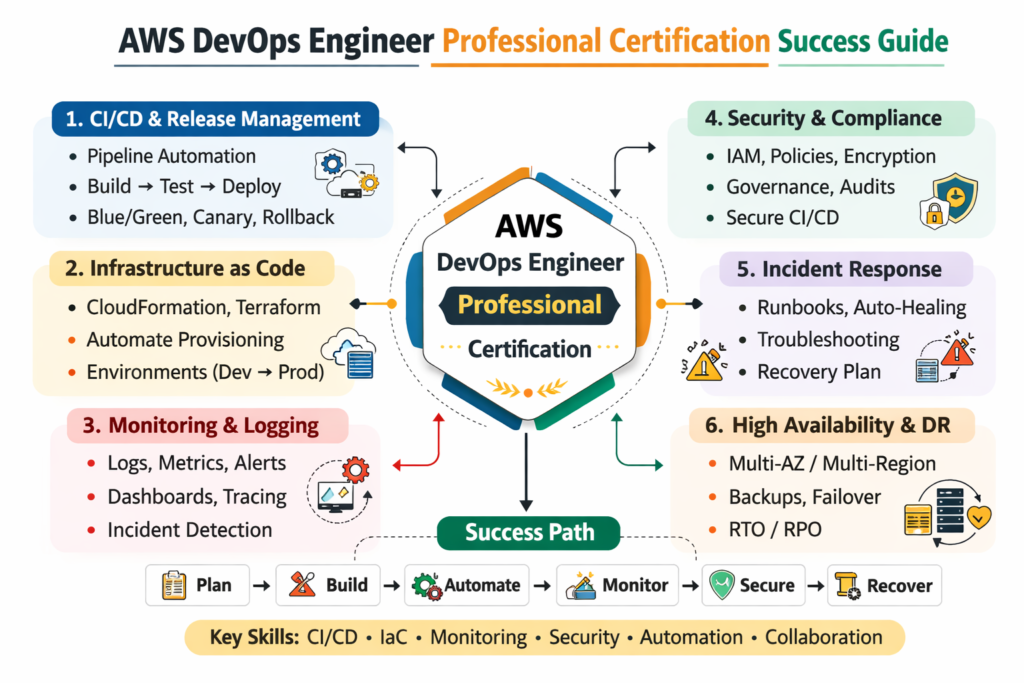
Introduction
The AWS DevOps Engineer – Professional certification represents the pinnacle of cloud-based DevOps expertise. This advanced credential validates your ability to provision, operate, and manage distributed application systems on AWS at scale. Whether you’re an engineer looking to advance your career or a manager evaluating skill requirements for your team, this certification demonstrates mastery of modern DevOps practices combined with deep AWS platform knowledge. The demand for certified DevOps professionals continues to surge globally. Organizations across India and worldwide are seeking engineers who can automate infrastructure, implement CI/CD pipelines, ensure high availability, and maintain security compliance. This certification proves you possess these critical skills.
What is AWS Certified DevOps Engineer – Professional?
The AWS Certified DevOps Engineer – Professional (exam code: DOP-C02) is an advanced-level certification that validates technical expertise in automating the testing and deployment of AWS infrastructure and applications. This isn’t just another certification—it’s a comprehensive validation of your ability to implement and manage continuous delivery systems, automate security controls, and design highly scalable, self-healing infrastructure. The exam tests your proficiency across six critical domains: SDLC automation, configuration management and Infrastructure as Code, resilient cloud solutions, monitoring and logging, incident and event response, and security and compliance. It requires deep hands-on experience with AWS services like CodePipeline, CodeDeploy, CloudFormation, EC2, RDS, Lambda, and many others, assuming you already understand AWS fundamentals and have real-world experience managing production environments.
Who Should Take This Certification?
- DevOps Engineers
If you are currently working as a DevOps Engineer with 2-3 years of experience, this certification is the natural next step to validate your expertise. It proves your ability to automate complex CI/CD pipelines and manage large-scale AWS environments efficiently. This credential distinguishes you from junior peers by demonstrating your capability to handle professional-level architectural challenges. - Software Engineers
For developers who want to transition into operations or platform engineering, this certification bridges the gap between code and infrastructure. It teaches you how your code actually runs in production and how to automate its deployment. You will gain the skills necessary to take full ownership of the software lifecycle, from commit to production monitoring. - System Administrators
Sysadmins managing traditional infrastructure will find this certification essential for modernizing their skill set for the cloud era. It validates your ability to move from manual server management to automated Infrastructure as Code practices. You will learn to treat infrastructure configuration just like software, enabling version control and rapid replication of environments. - Cloud Engineers
Cloud specialists responsible for designing and implementing infrastructure will deepen their understanding of automation and reliability patterns. This certification moves beyond basic provisioning to focus on self-healing systems and advanced deployment strategies. It ensures you can build cloud solutions that are not just functional but also resilient and easily maintainable. - Site Reliability Engineers (SREs)
SREs focused on maintaining system uptime and reliability will find the sections on monitoring, logging, and incident response particularly valuable. This certification covers the tools and strategies needed to automate failure recovery and ensure high availability. It validates your ability to design systems that can withstand disruptions without manual intervention. - Solutions Architects
Architects who design systems need to understand how those systems will be operated and deployed day-to-day. This deep dive into DevOps practices helps architects design solutions that are easier to automate and manage. It provides the operational perspective necessary to create truly “well-architected” cloud solutions that scale effectively. - Engineering Managers
Managers leading DevOps or platform teams need this knowledge to make informed decisions about tooling and processes. Understanding the technical depth of this certification helps you better evaluate team capabilities and project timelines. It gives you the vocabulary and conceptual understanding to guide your team toward best practices in automation and security.
Skills You’ll Gain
- Advanced CI/CD Pipeline Design
You will master the art of designing sophisticated pipelines using AWS CodePipeline that handle complex workflows and dependencies. This involves integrating multiple stages for testing, manual approval, and multi-region deployment to ensure safe releases. You’ll learn to automate the entire software release process, ensuring rapid and reliable delivery of new features to customers. - Infrastructure as Code (IaC) Mastery
You will gain deep proficiency in defining entire cloud environments using CloudFormation, AWS CDK, and Terraform templates. This skill allows you to version control your infrastructure, enabling you to audit changes and roll back errors instantly. You will learn to provision complex stacks consistently across development, testing, and production environments with zero drift. - Automated Testing and Deployment
This certification teaches you how to integrate automated testing frameworks directly into your deployment pipelines for immediate feedback. You will learn to implement advanced deployment strategies like blue/green and canary deployments to minimize user impact during updates. This ensures that only code that passes rigorous quality checks ever reaches your production users. - Configuration Management
You will learn to manage operating system configurations and patches at scale using AWS Systems Manager and OpsWorks. This involves automating the enforcement of compliance policies across thousands of instances without manual login. You will gain the ability to maintain consistency across your entire fleet of servers, reducing security vulnerabilities and configuration drift. - High Availability and Disaster Recovery
You will develop the skills to design architectures that remain available even when individual components or entire availability zones fail. This includes setting up multi-region failover strategies and automated data backup and recovery workflows. You will learn to build systems that automatically detect failures and reroute traffic to healthy resources to maintain business continuity. - Auto-scaling and Load Balancing
You will master the configuration of Auto Scaling groups and Application Load Balancers to handle fluctuating traffic patterns dynamically. This ensures your applications scale out during peak demand to maintain performance and scale in during lulls to save costs. You will learn to define scaling policies based on custom metrics that reflect the actual load on your application. - Comprehensive Monitoring
You will learn to set up deep observability using CloudWatch, X-Ray, and CloudTrail to gain visibility into every part of your system. This involves creating custom dashboards and metrics that provide real-time insights into application health and performance. You will be able to trace requests across microservices to pinpoint bottlenecks and latency issues quickly. - Log Aggregation and Analysis
You will gain expertise in centralizing logs from various sources into a single analytical platform for easier troubleshooting. This includes using CloudWatch Logs Insights and Athena to query vast amounts of log data to find specific error patterns. You will learn to set up automated filters that alert you to critical security or operational events immediately. - Automated Incident Response
This skill focuses on creating event-driven architectures that automatically respond to system alerts without human intervention. You will learn to use Amazon EventBridge and Lambda functions to trigger remediation scripts when specific thresholds are breached. This reduces the mean time to recovery (MTTR) by fixing known issues the instant they occur. - Security Automation
You will learn to integrate security checks directly into your CI/CD pipeline, often referred to as “shifting security left.” This involves automating vulnerability scanning of code and container images before they are deployed. You will also master the use of AWS Config to automatically detect and remediate non-compliant resources in your account. - Cost Optimization
You will understand how to automate cost controls, such as shutting down development resources during non-business hours. This includes setting up budgets and alerts to detect cost anomalies before they become expensive surprises. You will learn to design architectures that use the most cost-effective resources, such as Spot Instances, for appropriate workloads. - Multi-region Deployment Strategies
You will learn to architect and deploy applications that run simultaneously across multiple AWS regions for global reach. This involves replicating data and synchronizing deployments to ensure a consistent user experience worldwide. You will master the complexities of global traffic management using Route 53 to route users to the nearest healthy region.
Real-World Projects You Should Be Able to Do After Certification
- Build End-to-End CI/CD Pipelines
You should be able to construct a fully automated pipeline that takes code from a repository through build and test phases to production. This includes setting up manual approval gates for governance and automated rollbacks if deployments fail health checks. The project demonstrates your ability to orchestrate AWS CodeBuild and CodeDeploy for seamless application updates. - Implement Infrastructure as Code
You will be able to provision entire environments—VPCs, subnets, EC2 instances, and databases—using a single CloudFormation template. This project involves using nested stacks for modularity and export values to share data between stacks. It proves your ability to treat infrastructure as software, enabling rapid replication for disaster recovery or testing. - Design Self-Healing Systems
You should be capable of designing a system that automatically replaces failed instances and recovers from database outages. This involves configuring Auto Scaling groups with health checks and RDS Multi-AZ deployments for automatic failover. The project demonstrates your ability to build architectures that maintain uptime without human intervention during hardware failures. - Create Automated Security Scanning
You will be able to integrate tools like Amazon Inspector or third-party scanners into your build pipeline to block vulnerable code. This project involves configuring the pipeline to fail the build if high-severity vulnerabilities are detected during the commit phase. It proves your competence in implementing DevSecOps practices that secure applications before they reach production. - Set Up Comprehensive Monitoring Dashboards
You should be able to build a unified CloudWatch dashboard that displays key performance indicators (KPIs) for your application and infrastructure. This includes setting up composite alarms that only trigger paging when multiple specific conditions are met, reducing alarm fatigue. The project validates your ability to provide clear, actionable visibility into system health for operations teams. - Implement Disaster Recovery Solutions
You will be capable of implementing a “Pilot Light” or “Warm Standby” disaster recovery strategy across a secondary AWS region. This involves automating the replication of data and the rapid provisioning of compute resources when a disaster is declared. It demonstrates your ability to ensure business continuity and meet strict Recovery Time Objectives (RTO). - Deploy Containerized Applications
You should be able to design a pipeline that builds Docker images, pushes them to ECR, and deploys them to an ECS or EKS cluster. This project involves managing rolling updates for containers and configuring service auto-scaling based on CPU or memory usage. It proves your expertise in managing modern, microservices-based application architectures. - Configure Automated Compliance Validation
You will be able to set up AWS Config rules that continuously monitor your resources for compliance with internal or regulatory standards. This project involves creating auto-remediation actions that automatically fix non-compliant resources, such as closing open security groups. It demonstrates your ability to maintain governance and security posture at scale without manual audits. - Build Serverless CI/CD Workflows
You should be capable of creating a fully serverless deployment pipeline using AWS SAM, Lambda, and API Gateway. This involves implementing safe traffic shifting features like canary deployments for Lambda functions to test new versions. The project validates your ability to apply DevOps principles specifically to modern serverless architectures. - Implement Blue/Green and Canary Deployments
You will be able to configure CodeDeploy to route a small percentage of traffic to a new version of your application to test stability. This project involves setting up automated analysis of error rates during the deployment to trigger an instant rollback if issues arise. It proves your mastery of advanced deployment techniques that minimize risk in production environments. - Create Multi-Region Active-Active Architectures
You should be able to design a global application architecture where all regions actively serve traffic and replicate data in real-time. This involves using DynamoDB Global Tables and Route 53 latency-based routing to serve users from the closest location. The project demonstrates your ability to build highly resilient, low-latency global systems. - Design Cost-Optimized Infrastructure
You will be able to implement automated lifecycle policies for S3 data and snapshots to move old data to cheaper storage tiers. This project involves using AWS Lambda to automatically tag resources for cost allocation and stop non-production instances at night. It proves your ability to optimize cloud spend systematically through automation and governance.
Preparation Plan
7-14 Day Intensive Plan (for experienced professionals)
Prerequisites: Already hold AWS Developer or SysOps Associate certifications and work daily with AWS DevOps tools.
- Days 1-2:
Start by thoroughly reviewing the official exam guide to understand the domain weightings and identify your specific knowledge gaps. Take a diagnostic practice test to pinpoint exactly which areas need the most focused attention during your study. - Days 3-4:
Dedicate these days to a deep dive into the SDLC automation domain, focusing heavily on CodePipeline, CodeBuild, and CodeDeploy intricacies. Set up a complex pipeline in your own AWS account to reinforce the theoretical concepts with practical muscle memory. - Days 5-6:
Shift your focus to Configuration Management and Infrastructure as Code, specifically mastering advanced CloudFormation features like nested stacks and drift detection. Spend time experimenting with Systems Manager to understand how to patch and manage fleets of EC2 instances at scale. - Days 7-8:
Concentrate on Resilient Cloud Solutions, studying patterns for high availability, disaster recovery, and multi-region architectures. Review the specific differences between various disaster recovery strategies (Pilot Light vs. Warm Standby) and when to use each. - Days 9-10:
Master the Monitoring and Logging domain by setting up CloudWatch Agents, configuring metric filters, and creating custom dashboards. Ensure you understand how to use CloudWatch Logs Insights to query log data and how to integrate X-Ray for tracing. - Days 11-12:
Review Incident Response and Security automation, focusing on EventBridge rules, Lambda triggers, and AWS Config compliance checks. Practice creating auto-remediation workflows that automatically fix security issues when they are detected by your monitoring systems. - Days 13-14:
Spend the final days taking full-length, timed practice exams to simulate the actual testing environment and build your mental endurance. Review every incorrect answer in detail to understand the logic behind the correct choice, and rest before exam day.
30-Day Balanced Plan (for working professionals)
Prerequisites: Have AWS associate certification and some DevOps experience.
- Week 1:
Focus entirely on the SDLC Automation domain, covering the entire CodeSuite family and testing strategies in depth. Spend your evenings building a sample project that utilizes CodeCommit, CodeBuild, and CodePipeline to deploy a simple application. - Week 2:
Dedicate this week to Configuration Management and Infrastructure as Code, diving deep into CloudFormation templates and troubleshooting. Learn how to use Systems Manager Parameter Store and Secrets Manager to handle sensitive configuration data securely. - Week 3:
Study Resilient Cloud Solutions and Monitoring, focusing on designing self-healing architectures and setting up comprehensive observability. creating alarms and dashboards in a lab environment to understand how operational data flows through AWS services. - Week 4:
Focus on Security, Incident Response, and taking multiple full-length practice exams to gauge your readiness. Use the weekends to perform hands-on labs for any topics where your practice exam scores indicate you are weak. - Daily commitment:
Aim for 2-3 hours of focused study time each day, perhaps one hour in the morning and two in the evening. Consistency is key, so try to maintain this rhythm without skipping days to keep the information fresh. - Weekends:
Reserve weekends for longer, uninterrupted hands-on labs where you can build and tear down complex infrastructure. This is also the best time to take timed practice exams, as you can simulate the full 3-hour duration without work distractions.
60-Day Comprehensive Plan (for career changers)
Prerequisites: Basic AWS knowledge and limited DevOps experience.
- Weeks 1-2:
Start by completing the AWS Certified Developer – Associate or SysOps Administrator – Associate certification course material to build a strong foundation. This ensures you understand the core services like EC2, S3, and IAM before tackling the advanced professional-level concepts. - Weeks 3-4:
Deep dive into Continuous Integration and Continuous Delivery concepts, studying CodePipeline and CodeDeploy with extensive hands-on labs. creating simple pipelines first, then gradually adding complexity with manual approval stages and test actions. - Weeks 5-6:
Master CloudFormation and Infrastructure as Code principles, learning to write templates from scratch rather than just using wizards. Understand the nuances of stack updates, deletion policies, and how to use helper scripts like cfn-init and cfn-signal. - Weeks 7-8:
Study resilient architecture patterns, focusing on how to implement auto-scaling and load balancing for various application types. Learn about Route 53 routing policies and how to design failover mechanisms for high availability. - Weeks 9-10:
Focus extensively on monitoring, logging, observability, and troubleshooting using CloudWatch and related tools. practice analyzing log data to find root causes of simulated failures in your lab environment. - Weeks 11-12:
Cover security automation, compliance, and incident response, learning how to use AWS Config and Trusted Advisor. Understand how to implement “security by design” principles and automate responses to common security threats. - Weeks 13-14:
dedicate these final weeks to taking practice exams, reviewing weak areas, and finalizing your hands-on projects. Ensure you are consistently scoring above 80% on practice tests before you schedule your actual exam appointment. - Daily commitment:
Commit to 1-2 hours of study each day, allowing you to absorb the material gradually without burning out. Use this time for watching video lectures, reading whitepapers, and doing small, focused lab exercises.
Common Mistakes to Avoid
- Skipping hands-on practice
Many candidates rely solely on video courses or reading material, which is a fatal mistake for this scenario-based exam. You must spend significant time in the AWS console building pipelines and troubleshooting errors to understand how things actually work. - Ignoring associate-level prerequisites
Attempting this professional exam without first mastering the fundamentals covered in the Associate exams often leads to confusion and failure. You need a rock-solid understanding of core services like IAM and VPC before you can understand the advanced automation questions. - Not using practice exams
The question style on the Professional exam is complex and wordy, often distracting you with irrelevant details. Without taking timed practice exams, you won’t learn how to filter out noise and identify the key requirements in the scenario. - Focusing only on popular services
While services like EC2 and S3 are important, the exam frequently tests niche services like OpsWorks, Elastic Beanstalk, and Systems Manager. Ignoring these less common tools will cost you valuable points on questions that specifically require them. - Memorizing instead of understanding
The exam questions are designed to test your ability to apply knowledge to novel scenarios, not just recall facts. Rote memorization will fail you when a question asks for the “most operationally efficient” solution among four technically valid options. - Neglecting CloudFormation
CloudFormation is the backbone of infrastructure automation on AWS and appears in a huge percentage of exam questions. You need to understand it deeply, including intrinsic functions, stack policies, and helper scripts, not just the basics. - Underestimating security topics
Security and compliance are woven into almost every domain of the exam, not just the security section. You must understand IAM policies, encryption, and security automation in depth, as they are critical for every DevOps role. - Ignoring time management
With 75 complex, scenario-based questions to answer in 180 minutes, you have roughly 2.4 minutes per question. Many candidates fail simply because they run out of time, so practicing your pacing is just as important as studying the content. - Not reviewing AWS whitepapers
Official AWS whitepapers provide the “ideal” architectural patterns and best practices that the exam questions are based on. Skipping these documents means missing out on the exact mindset and terminology that the exam writers use. - Scheduling too early
This is widely considered one of the most difficult IT certifications, so rushing to take it before you are ready is a waste of money. Be honest with your self-assessment and only schedule the exam when you are consistently passing practice tests with a margin of safety.
Certification Overview Table
| Detail | Information |
|---|---|
| Track | AWS DevOps Professional |
| Level | Professional (Advanced) |
| Who It’s For | DevOps Engineers, Cloud Engineers, Software Engineers, SREs with 2+ years AWS experience |
| Prerequisites | Recommended: AWS Developer or SysOps Associate certification; 2+ years AWS hands-on experience; programming proficiency |
| Skills Covered | CI/CD automation, Infrastructure as Code, resilient architectures, monitoring and logging, incident response, security automation |
| Recommended Order | 1st: AWS Associate certification → 2nd: AWS DevOps Professional → 3rd: Specialty or architect certification |
Best Next Certification After AWS DevOps Professional
Option 1: Same Track (AWS Specialization)
- AWS Certified Solutions Architect – Professional
This certification broadens your expertise from “how to build/deploy” to “what to build” for complex enterprise scenarios. It complements your DevOps skills by deepening your understanding of hybrid architectures and large-scale system design. - AWS Certified Security – Specialty
For those who enjoyed the security domain, this deep dive focuses entirely on data protection, encryption, and threat detection. It is the perfect credential for engineers who want to pivot into a specialized DevSecOps or Cloud Security role. - AWS Certified Advanced Networking – Specialty
This is ideal if you work with complex hybrid clouds, Direct Connect, or intricate VPC peering arrangements. Mastering networking ensures you can design the connectivity backbone that your automated DevOps pipelines rely on.
Option 2: Cross-Track (Broaden DevOps Expertise)
- Certified Kubernetes Administrator (CKA)
Since modern DevOps relies heavily on containers, mastering Kubernetes is often the most valuable non-AWS skill you can add. This vendor-neutral certification proves you can manage the orchestration layer that sits on top of your cloud infrastructure. - Certified DevSecOps Professional (DSOCP)
This certification validates your ability to integrate security practices into every stage of the DevOps lifecycle. It focuses on the methodology and cultural aspects of security, complementing the technical AWS-specific security skills you already have. - SRE Certified Professional (SRECP)
Moving from “DevOps” to “SRE” involves a shift in focus toward reliability engineering, error budgets, and service level objectives (SLOs). This certification validates the specific practices used by Google and other tech giants to maintain massive production systems. - HashiCorp Terraform Associate
While AWS CloudFormation is great, Terraform is the industry standard for multi-cloud Infrastructure as Code. Earning this certification proves you can manage infrastructure across AWS, Azure, and Google Cloud using a single unified toolset.
Option 3: Leadership Track
- AWS Certified Solutions Architect – Professional
This acts as a bridge to leadership by validating your ability to design complex solutions that align with business goals. It gives you the high-level architectural perspective needed to lead teams and make strategic technical decisions. - Certified DevOps Manager (CDM)
This certification focuses on the people, process, and cultural transformation aspects of leading a DevOps organization. It prepares you to manage teams, measure performance metrics (DORA), and drive organizational change beyond just the technical tools. - DevOps Leader (DOL)
This credential targets the strategic leadership skills required to scale DevOps practices across an entire enterprise. It covers topics like value stream mapping, organizational design, and aligning IT strategy with business outcomes.
Choose Your Path: 6 Learning Journeys
The DevOps ecosystem extends far beyond traditional DevOps engineering. Here are six specialized paths you can pursue:
1. DevOps Path
Focus: Speed and delivery automation
Goal: Master CI/CD pipelines and bridge development with operations
Key certifications: AWS Certified DevOps Engineer – Professional, Certified DevOps Professional (CDP), Certified DevOps Architect (CDA), Azure DevOps Engineer Expert
Best for: Engineers focused on release automation and deployment optimization
Description: This is the core track for engineers who want to specialize in the tools and processes that accelerate software delivery. You will focus on building robust pipelines, automating testing, and ensuring that code flows from developer machines to production servers as quickly and safely as possible.
2. DevSecOps Path
Focus: Security at speed
Goal: Shift security left and automate compliance
Key certifications: DevSecOps Certified Professional (DSOCP), AWS Certified Security – Specialty, Certified DevSecOps Engineer, Certified Kubernetes Security Specialist (CKS)
Best for: Engineers who want to combine security expertise with DevOps automation
Description: This path integrates security practices directly into the DevOps workflow, ensuring that speed does not compromise safety. You will learn to automate security scans, manage vulnerabilities, and build compliance checks directly into the CI/CD pipeline, making security everyone’s responsibility.
3. SRE (Site Reliability Engineering) Path
Focus: Reliability, uptime, and incident reduction
Goal: Use software engineering to solve infrastructure problems
Key certifications: SRE Certified Professional (SRECP), AWS Certified DevOps Engineer – Professional, Certified Site Reliability Engineer, Master in Observability Engineering (MOE)
Best for: Engineers focused on system reliability, SLOs, and production stability
Description: This path applies software engineering principles to infrastructure and operations problems to create highly reliable systems. You will focus on defining Service Level Objectives (SLOs), managing error budgets, and performing blameless post-mortems to continuously improve system resilience.
4. AIOps / MLOps Path
Focus: AI-driven operations and ML pipeline automation
Goal: Smarter operations with machine learning signals
Key certifications: AIOps Certified Professional, MLOps Foundation Certification, AWS Certified DevOps Engineer – Professional, MLOps Certified Professional
Best for: Engineers working with ML models or AI-driven infrastructure automation
Description: This emerging path focuses on operationalizing machine learning models and using AI to improve IT operations. You will learn to build pipelines that retrain and deploy ML models automatically, as well as how to use AI tools to detect anomalies and predict system failures before they occur.
5. DataOps Path
Focus: DevOps principles applied to data pipelines
Goal: Automate and optimize data engineering workflows
Key certifications: DataOps Foundation Certification, DataOps Certified Professional, AWS Certified Data Analytics – Specialty, Certified DevOps Professional (CDP)
Best for: Data engineers and analysts who want to apply DevOps practices to data workflows
Description: This path brings the rigor of DevOps automation and testing to the world of data engineering and analytics. You will focus on orchestrating complex data pipelines, ensuring data quality through automated testing, and reducing the cycle time for data analytics projects.
6. FinOps Path
Focus: Cloud cost optimization and financial operations
Goal: Control cloud spending without slowing teams
Key certifications: FinOps Foundation Certification, FinOps Certified Professional, AWS Certified DevOps Engineer – Professional, Certified DevOps Manager (CDM)
Best for: Engineers and managers focused on cloud cost management and optimization
Description: This path bridges the gap between engineering, finance, and business teams to manage cloud costs effectively. You will learn to implement cost allocation strategies, optimize resource usage, and enable engineering teams to make data-driven spending decisions without slowing down innovation.
Role → Recommended Certifications Mapping
| Role | Recommended Certification Path |
|---|---|
| DevOps Engineer | AWS Developer Associate → AWS DevOps Professional → Certified DevOps Architect (CDA) OR DevSecOps Certified Professional (DSOCP) |
| Site Reliability Engineer (SRE) | SRE Certified Professional (SRECP) → AWS DevOps Professional → Certified DevOps Architect (CDA) |
| Platform Engineer | AWS DevOps Professional → Certified DevOps Architect (CDA) → SRE Certified Professional (SRECP) OR Certified DevOps Manager (CDM) |
| Cloud Engineer | AWS Developer or SysOps Associate → AWS DevOps Professional → FinOps Foundation OR AWS Solutions Architect Professional |
| Security Engineer | AWS Security Specialty → DevSecOps Certified Professional (DSOCP) → AWS DevOps Professional |
| Data Engineer | DataOps Foundation → AWS Data Analytics Specialty → AWS DevOps Professional → DataOps Certified Professional |
| FinOps Practitioner | AWS DevOps Professional → FinOps Foundation → FinOps Certified Professional → Certified DevOps Manager (CDM) |
| Engineering Manager | AWS DevOps Professional → Certified DevOps Manager (CDM) → DevOps Leader (DOL) → AWS Solutions Architect Professional |
Top Training and Certification Providers
Several specialized institutions provide comprehensive training and certification support for AWS DevOps Engineer – Professional:
DevOpsSchool
As a pioneer in the industry, DevOpsSchool offers an intensive 30-hour instructor-led program packed with over 100 hands-on lab assignments. Their curriculum includes real-time scenario-based projects and mock interviews, ensuring you are job-ready, not just exam-ready. The course provides lifetime access to learning materials and is led by expert instructors with 10-15 years of field experience.
Cotocus
Specializing in corporate training, Cotocus delivers customized learning paths that focus heavily on practical implementation and business use cases. Their training is designed to bridge the gap between theoretical concepts and daily work requirements, with dedicated support from experienced mentors. They offer a structured approach that helps professionals apply their learning immediately to their current projects.
Scmgalaxy
Scmgalaxy offers a comprehensive DevOps training ecosystem that combines certification prep with a strong emphasis on community support and resources. Their courses are known for their structured approach, covering the entire software supply chain from source code management to deployment. They provide excellent career guidance and networking opportunities alongside their technical curriculum.
BestDevOps
This provider focuses exclusively on DevOps certifications, offering highly targeted preparation programs designed to maximize your exam score. Their training modules are laser-focused on exam topics, providing extensive practice tests and mentorship from certified professionals. It is an ideal choice for candidates who want a streamlined, efficient path to passing the certification.
DevSecOpsSchool
If you are looking to integrate security deeply into your DevOps practice, this specialized school offers combined training programs for both domains. Their curriculum covers the intersection of AWS DevOps tools and security best practices, preparing you for the DevSecOps path. It is perfect for engineers who want to ensure their automated pipelines are secure by default.
SRESchool
Dedicated to Site Reliability Engineering, this institution is ideal for those who want to combine AWS DevOps expertise with SRE principles. Their training emphasizes reliability, monitoring, incident response, and error budgets, going beyond standard DevOps topics. This prepares you for high-demand SRE roles that require a mix of software engineering and operations skills.
AIOpsSchool
This forward-looking school specializes in training for AI-driven operations, combining DevOps automation with machine learning concepts. Their courses teach you how to leverage AI tools to enhance observability, predict failures, and automate remediation. It is the perfect place for engineers who want to stay ahead of the curve in the emerging field of AIOps.
DataOpsSchool
Focusing on the intersection of data engineering and DevOps, this school teaches you how to apply automation principles to data pipelines. Their training covers AWS DevOps tools specifically in the context of managing big data workflows and analytics platforms. This is essential for data professionals who need to manage scalable data infrastructure on AWS.
FinOpsSchool
This institution is dedicated to the growing field of cloud financial operations, teaching you how to manage and optimize cloud costs effectively. Their program combines AWS DevOps technical knowledge with financial best practices, essential for modern cloud management. It prepares you for roles focused on cloud cost optimization and value realization.
Frequently Asked Questions (FAQs)
1. How difficult is the AWS DevOps Engineer Professional exam?
The exam is widely considered one of the most challenging AWS certifications available. It requires not just theoretical knowledge, but deep practical experience with CI/CD pipelines and complex troubleshooting scenarios. The questions are long and situational, requiring you to analyze trade-offs and select the optimal solution quickly.
2. How much time should I spend preparing for this certification?
Preparation time varies, but experienced professionals typically need 7-14 days of intensive study. Those with moderate experience should plan for a steady 30-day schedule, while career changers may need 60 days or more to build the necessary foundation. Expect to dedicate 1-3 hours daily to study and labs, depending on your target date.
3. Do I need to pass associate-level certifications first?
While AWS officially removed the prerequisite requirement in 2018, attempting this professional exam without an associate certification is extremely risky. The exam assumes you already possess the knowledge covered in the Developer or SysOps Associate exams. Most successful candidates hold at least one associate credential to ensure they have the necessary baseline knowledge.
4. What programming languages should I know?
You do not need to be a software developer, but you must be proficient in reading and writing code in at least one high-level language. Python is the most popular choice for AWS automation, followed by Node.js, Java, and Go. You will need to understand scripting for Lambda functions, build specs, and infrastructure definitions.
5. Is hands-on experience required or can I pass by studying alone?
Hands-on experience is absolutely essential; you cannot pass this exam through memorization alone. The scenario-based questions test your ability to troubleshoot real-world problems and make architectural decisions that only come from practice. You need to spend significant time in the AWS console building and breaking things.
6. What is the exam cost and how long is the certification valid?
The exam costs $300 USD, and once passed, the certification is valid for three years. To maintain your certified status, you must recertify before the three-year period expires by passing the current version of the exam. AWS regularly updates the exam content to reflect new services and industry best practices.
7. Which AWS services are most important to master?
You must have mastery of the core DevOps services: CodePipeline, CodeBuild, CodeDeploy, and CloudFormation. Additionally, deep knowledge of CloudWatch, Systems Manager, Elastic Beanstalk, and OpsWorks is frequently tested. Do not overlook security services like IAM, AWS Config, and Secrets Manager, as they are integral to every domain.
8. How does this certification impact my career and salary?
This certification is a powerful career accelerator, often leading to salary increases of 15-25% for certified professionals. It opens doors to senior roles such as Senior DevOps Engineer, Platform Architect, and Site Reliability Engineer. The global demand for this expertise means certified individuals are highly sought after by top-tier tech companies.
9. Should I take the exam online or at a testing center?
Both options are valid, but they offer different experiences. Testing centers provide a controlled, distraction-free environment with professional equipment. Online proctored exams offer the convenience of testing from home but require a strict setup with no interruptions. Choose the option that allows you to be most relaxed and focused.
10. What happens if I fail the exam?
If you do not pass, you must wait a mandatory 14-day period before you can retake the exam. You will have to pay the full exam fee again for the retake. Use the score report provided after your attempt to identify your weak domains and focus your study efforts there before trying again.
11. Are practice exams worth the investment?
Yes, high-quality practice exams are one of the best investments you can make for your preparation. They help you get used to the complex question format, identify your knowledge gaps, and practice your time management. Taking multiple timed practice tests is the best way to simulate the pressure of the actual exam day.
12. Can I earn this certification without cloud experience?
It is technically possible but highly unlikely and not recommended. The exam is designed to validate experience, not just book knowledge. Without 2+ years of hands-on work, you will likely struggle with the nuance of the scenario-based questions. It is better to build experience with associate-level certifications first.
FAQs on AWS DevOps Engineer – Professional
1) What is AWS DevOps Engineer – Professional?
It is a professional-level certification that validates your ability to build and run delivery and operations systems on AWS. It focuses on CI/CD automation, monitoring and logging, governance, incident response, and resilient architecture. It is aimed at people who already work with AWS in real environments. It checks decision-making, not just definitions.
2) Who should take this certification?
It is best for DevOps Engineers, Platform Engineers, Cloud Engineers, and SREs who work on AWS and manage production workloads. It also fits developers moving into DevOps if they already have AWS exposure. If you handle deployments, automation, monitoring, and reliability in your job, this certification aligns well. Managers can also take it to understand delivery maturity and risk control.
3) What skills do I need before starting preparation?
You should be comfortable with AWS fundamentals, basic scripting, and common DevOps workflows like build, test, deploy, and rollback. You should understand infrastructure automation concepts and have experience operating services in production. Basic knowledge of monitoring, logging, and incident handling will help a lot. If you can explain how you deploy safely and recover fast, you are ready to start.
4) How hard is AWS DevOps Engineer – Professional?
It is considered challenging because questions are scenario-based and test real production thinking. You must choose the best approach under constraints like risk, downtime, speed, and governance. People struggle when they memorize services but cannot explain trade-offs. With hands-on practice and structured revision, it becomes manageable.
5) How long does it take to prepare?
If you already work as an AWS DevOps engineer, 2–3 weeks of focused revision can be enough. For most working professionals, 30 days is a balanced plan with steady practice. If you are transitioning into DevOps or are new to AWS operations, plan for 60 days. The right timeline depends on your real hands-on exposure.
6) What topics should I prioritize the most?
Prioritize CI/CD pipeline design, safe deployment strategies, monitoring and logging strategy, governance automation, incident response workflows, and HA/DR decision-making. These topics show up repeatedly because they are core DevOps responsibilities. Focus on scenarios like “something failed during deployment” or “alerts are noisy” and how you would fix them. Practice explaining “why this option” clearly.
7) What are common mistakes learners make?
A common mistake is learning tools without practicing end-to-end workflows. Another mistake is ignoring rollback planning and release safety while focusing only on deployment speed. Many learners also treat monitoring as dashboards, not as an incident system with alerts and runbooks. Finally, people often skip governance and HA/DR planning, which are critical in real production environments.
8) What should I do right after passing the certification?
After passing, apply what you learned in your current work: improve one pipeline, fix alert noise, strengthen governance checks, or automate a recovery workflow. Then choose a direction based on your role—security-focused growth (DevSecOps), reliability leadership (SRE), data platform stability (DataOps), or cost governance (FinOps). Build 2–3 real portfolio improvements so your certification translates into measurable outcomes. That is what makes the credential truly valuable.
Testimonials
“The training was very useful and interactive. Rajesh helped develop the confidence of all students by explaining complex topics in a simple manner. The real-world examples shared during the sessions were invaluable for understanding how these tools are used in actual production environments.” — Abhinav Gupta, Pune
“Rajesh is a very good trainer who was able to resolve our queries and questions effectively and promptly. We really liked the hands-on examples covered during this training program, as they helped bridge the gap between theory and practice.” — Indrayani, India
“Very well organized training that helped a lot to understand the DevOps concept and details related to various tools. The structure of the course made it easy to follow along, and the materials provided will be a great reference for the future.” — Sumit Kulkarni, Software Engineer
“Good training session about basic DevOps concepts. Working sessions were also good, however proper query resolution was sometimes missed, maybe due to time constraint. Overall, it provided a solid foundation for understanding the AWS DevOps landscape.” — Ravi Daur, Noida
“Thanks Rajesh, Training was good. Appreciate the knowledge you possess and displayed in the training. Your deep understanding of the subject matter was evident and helped clarify many of the doubts we had about the certification.” — Vinayakumar, Project Manager, Bangalore
Conclusion
The AWS Certified DevOps Engineer – Professional certification represents a significant career milestone. It validates your expertise in modern DevOps practices, AWS platform mastery, and the ability to design and manage enterprise-grade infrastructure. This certification opens doors to senior engineering roles, higher salaries, and leadership opportunities across India and globally. Success requires commitment to hands-on practice, strategic preparation, and real-world experience. Whether you choose the intensive 7-14 day plan or the comprehensive 60-day approach, focus on understanding rather than memorization. Use official documentation, practice labs, and mock exams to build confidence. Beyond earning the certification, consider your long-term career path. Whether you specialize in DevSecOps, SRE, AIOps, DataOps, or FinOps, this certification provides a solid foundation. The DevOps landscape continues to evolve, and certified professionals who adapt and grow will remain in high demand. Take the first step today. Choose a preparation plan, enroll in training, and commit to mastering the skills that define modern cloud infrastructure. Your investment in this certification will pay dividends throughout your career.