Introduction
Agentic IT Operations Platforms are AI-driven solutions designed to autonomously manage IT infrastructure, operations, and workflows. These platforms deploy intelligent agents that monitor systems, detect anomalies, automate remediation, and orchestrate complex operational tasks without constant human oversight. This allows IT teams to reduce operational overhead, enhance system reliability, and improve overall service quality.
In today’s complex IT environments, organizations often operate across hybrid clouds, multiple vendors, and containerized infrastructures. Agentic IT platforms help automate repetitive tasks, detect and resolve incidents proactively, and provide predictive insights. They integrate with ITSM systems, observability tools, and analytics platforms, allowing seamless workflow orchestration and continuous performance optimization.
Use cases include:
- Automated incident detection and remediation
- Predictive maintenance and proactive problem resolution
- Configuration compliance monitoring and drift detection
- Multi-cloud resource optimization
- Workflow orchestration for IT operations teams
- Real-time analytics for operational insights and SLA compliance
Best for: Enterprise IT teams, DevOps departments, and organizations operating complex hybrid cloud environments.
Not ideal for: Small organizations with simple IT infrastructure or those relying exclusively on manual operations.
What’s Changed in Agentic IT Operations Platforms
- Agentic workflows capable of autonomous remediation
- Tool calling and orchestration across hybrid IT environments
- Multimodal telemetry integration: logs, metrics, traces
- Evaluation frameworks for anomaly detection and AI reliability
- Guardrails and prompt-injection prevention for automated operations
- Enterprise privacy: retention, encryption, and residency controls
- Cost and latency optimization through model routing and BYO models
- Observability dashboards: token usage, latency, workflow metrics
- Governance and compliance aligned with ITIL, SOC, and internal policies
- Predictive analytics for proactive incident prevention
- Automated incident prioritization and escalation
- AI-assisted root cause analysis
Quick Buyer Checklist
- Data privacy and retention
- Model choice: hosted, BYO, or open-source
- RAG / knowledge integration for IT documentation
- Evaluation/testing frameworks for AI decision-making
- Guardrails to prevent unsafe automated actions
- Latency and cost optimization
- Auditability & admin access controls (RBAC, SSO, logs)
- Vendor lock-in risk
- Integration with monitoring, ITSM, and orchestration tools
- Analytics and reporting dashboards
- Multi-cloud and hybrid environment support
- Community and support resources
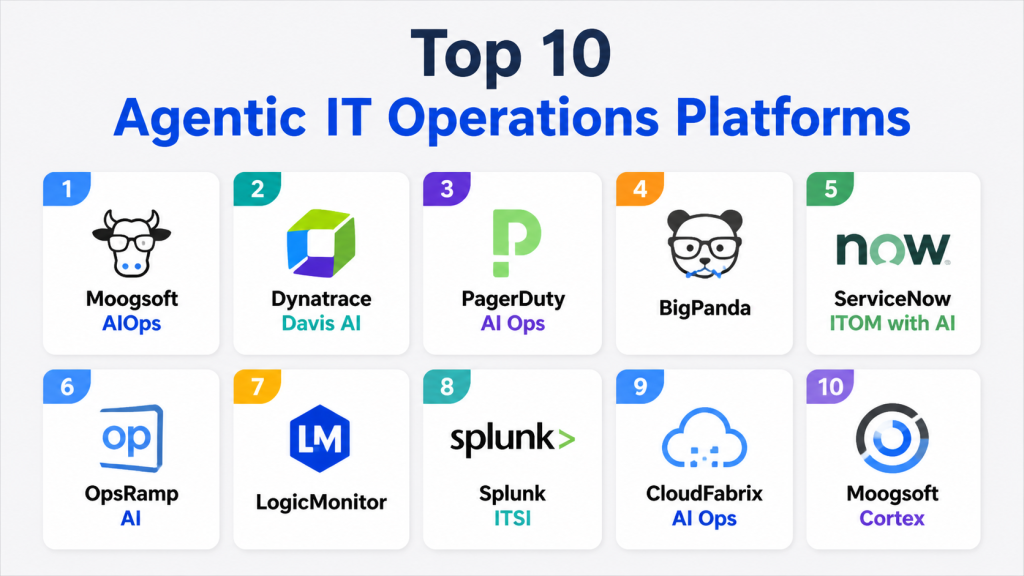
Top 10 Agentic IT Operations Platforms
1 — Moogsoft AIOps
One-line verdict: Best for enterprises needing automated incident detection and correlation across multi-cloud environments.
Short description: Moogsoft AIOps uses AI agents to detect anomalies, correlate events, and automate incident workflows, improving operational efficiency.
Standout Capabilities
- Automated event correlation
- Anomaly detection across hybrid infrastructure
- Noise reduction for alerts
- Predictive incident analytics
- Integration with ITSM systems
- Real-time dashboards
- AI-driven root cause analysis
AI-Specific Depth
- Model support: Proprietary
- RAG / knowledge integration: IT knowledge base connectors
- Evaluation: Regression testing and human-in-the-loop review
- Guardrails: Policy enforcement
- Observability: Traces, token/cost metrics, latency
Pros
- Reduces alert fatigue
- Speeds up incident resolution
- Scales across multi-cloud environments
Cons
- High enterprise pricing
- Requires configuration expertise
- Proprietary model only
Security & Compliance
- SSO/SAML, RBAC, audit logs: Not publicly stated
Deployment & Platforms
- Web, Cloud
- Varies / N/A
Integrations & Ecosystem
- APIs/SDKs for ITSM and monitoring tools
- Connectors for ServiceNow, Jira, Slack
- Analytics dashboards
- Workflow orchestration
Pricing Model
- Tiered subscription
Best-Fit Scenarios
- Multi-cloud enterprises
- Proactive incident management
- IT operations automation
2 — Dynatrace Davis AI
One-line verdict: Ideal for large-scale IT environments needing AI-driven observability and autonomous remediation.
Short description: Dynatrace Davis AI monitors performance, detects anomalies, and automates remediation using AI agents across applications and infrastructure.
Standout Capabilities
- Full-stack observability
- Automatic anomaly detection
- AI-driven root cause identification
- Predictive performance analytics
- Service dependency mapping
- Real-time dashboards
- Automated remediation suggestions
AI-Specific Depth
- Model support: Proprietary
- RAG / knowledge integration: Internal CMDB and knowledge base
- Evaluation: Regression testing and human review
- Guardrails: Safe automation policies
- Observability: Latency, token usage, performance metrics
Pros
- Comprehensive observability
- AI-driven insights for complex environments
- Reduces manual troubleshooting
Cons
- Enterprise pricing
- Complex hybrid setup
- Proprietary only
Security & Compliance
- SSO/SAML, RBAC, audit logs: Not publicly stated
Deployment & Platforms
- Web, Cloud
- Varies / N/A
Integrations & Ecosystem
- API/SDK for monitoring, ITSM, and CMDB
- Slack/Teams integration
- Custom dashboards
- Automation workflows
Pricing Model
- Tiered subscription
Best-Fit Scenarios
- Large enterprise IT teams
- Multi-cloud observability
- Predictive maintenance
3 — PagerDuty AI Ops
One-line verdict: Best for organizations requiring intelligent alerting, incident management, and automated operational workflows.
Short description: PagerDuty AI Ops prioritizes alerts, detects anomalies, and automates response workflows for IT operations teams.
Standout Capabilities
- Automated alert triaging
- Incident correlation and prioritization
- Integration with monitoring and ITSM tools
- Automated escalation and routing
- Predictive maintenance analytics
- Real-time collaboration dashboards
- Event noise reduction
AI-Specific Depth
- Model support: Proprietary
- RAG / knowledge integration: IT knowledge base connectors
- Evaluation: Regression and human review
- Guardrails: Policy enforcement
- Observability: Token usage, latency, workflow traces
Pros
- Reduces alert fatigue
- Speeds incident resolution
- Integrates with multiple ITSM tools
Cons
- Learning curve for complex environments
- Enterprise pricing
- Proprietary models only
Security & Compliance
- SSO/SAML, RBAC, audit logs: Not publicly stated
Deployment & Platforms
- Web, Cloud
- Varies / N/A
Integrations & Ecosystem
- API/SDK for ITSM, monitoring
- Slack/Teams connectors
- Analytics and reporting
- Workflow automation
Pricing Model
- Tiered subscription
Best-Fit Scenarios
- Multi-cloud operations
- Incident management automation
- High-volume alert environments
4 — BigPanda
One-line verdict: Ideal for enterprises needing AI-powered event correlation and operational intelligence at scale.
Short description: BigPanda AI agents consolidate alerts from multiple monitoring tools, providing automated incident correlation and response.
Standout Capabilities
- Event correlation across hybrid IT stacks
- Automated incident creation
- Noise reduction for alerts
- Root cause identification
- Predictive analytics
- Real-time dashboards
- ITSM integration
AI-Specific Depth
- Model support: Proprietary
- RAG / knowledge integration: Knowledge connectors for IT documentation
- Evaluation: Regression, simulation, human review
- Guardrails: Safe automation policies
- Observability: Token, latency, event metrics
Pros
- Reduces operational noise
- Accelerates root cause analysis
- Integrates with multiple monitoring tools
Cons
- Enterprise pricing
- Proprietary models only
- Requires onboarding
Security & Compliance
- SSO/SAML, RBAC, audit logs: Not publicly stated
Deployment & Platforms
- Web, Cloud
- Varies / N/A
Integrations & Ecosystem
- API/SDK for ITSM and monitoring
- Analytics dashboards
- Workflow automation
- Event management
Pricing Model
- Tiered subscription
Best-Fit Scenarios
- Enterprise IT teams
- Multi-tool monitoring
- Incident correlation
5 — ServiceNow ITOM with AI
One-line verdict: Best for enterprises integrating ITOM workflows with AI-driven automation and incident resolution.
Short description: ServiceNow ITOM provides AI agents for automated operations, incident management, and observability across hybrid IT infrastructures.
Standout Capabilities
- Automated ITOM workflows
- AI-based incident prediction
- Service mapping and monitoring
- Root cause analysis
- Multi-cloud support
- Analytics dashboards
- SLA management
AI-Specific Depth
- Model support: Proprietary
- RAG / knowledge integration: CMDB and internal knowledge connectors
- Evaluation: Regression testing, human review
- Guardrails: Policy enforcement
- Observability: Latency, cost, token usage
Pros
- Fully integrated ITOM and AI automation
- Reduces manual operations
- Multi-cloud support
Cons
- Complexity for small teams
- Premium enterprise pricing
- Proprietary only
Security & Compliance
- SSO/SAML, RBAC, audit logs, encryption: Not publicly stated
Deployment & Platforms
- Web, Cloud, Hybrid
- Windows/macOS
Integrations & Ecosystem
- API/SDK for ITSM, monitoring, CMDB
- Analytics and reporting
- Workflow automation
- Event management connectors
Pricing Model
- Tiered subscription
Best-Fit Scenarios
- Enterprise IT operations
- Hybrid cloud environments
- Automated incident management
6 — OpsRamp AI
One-line verdict: Ideal for enterprises seeking AI-driven monitoring, alerting, and event correlation across hybrid IT environments.
Short description: OpsRamp AI uses intelligent agents to detect anomalies, automate incident responses, and provide predictive analytics across IT systems.
Standout Capabilities
- Automated event correlation and alerts
- Predictive maintenance and anomaly detection
- Multi-cloud resource monitoring
- Automated remediation workflows
- ITSM integration
- Dashboard analytics for operational insights
- Root cause analysis with AI assistance
AI-Specific Depth
- Model support: Proprietary
- RAG / knowledge integration: IT documentation and vector DB connectors
- Evaluation: Regression tests and human review
- Guardrails: Policy enforcement for automated actions
- Observability: Token usage, latency, workflow metrics
Pros
- Proactive incident detection
- Multi-cloud monitoring
- Automated remediation
Cons
- Enterprise-focused pricing
- Proprietary models only
- Complex setup
Security & Compliance
- SSO/SAML, RBAC, audit logs: Not publicly stated
Deployment & Platforms
- Web, Cloud
- Varies / N/A
Integrations & Ecosystem
- APIs/SDKs for ITSM, monitoring, and logging
- Alerts and notification integrations
- Workflow orchestration
- Analytics dashboards
Pricing Model
- Tiered subscription
Best-Fit Scenarios
- Multi-cloud enterprise operations
- Proactive incident management
- Automated IT workflows
7 — LogicMonitor
One-line verdict: Best for enterprises needing AI-powered infrastructure monitoring and predictive operational insights.
Short description: LogicMonitor AI Ops provides intelligent monitoring, predictive analytics, and automated alert prioritization across hybrid and cloud IT systems.
Standout Capabilities
- Predictive analytics for infrastructure health
- Automated anomaly detection and alerts
- Root cause identification
- Event correlation across multi-cloud environments
- Real-time dashboards and reporting
- ITSM integrations
- Customizable alerting rules
AI-Specific Depth
- Model support: Proprietary
- RAG / knowledge integration: Internal connectors
- Evaluation: Regression and human-in-the-loop review
- Guardrails: Safe automation policies
- Observability: Latency, token usage, workflow traces
Pros
- Early detection of potential issues
- Multi-cloud and hybrid support
- Automated alert prioritization
Cons
- Enterprise pricing
- Proprietary only
- Initial configuration complexity
Security & Compliance
- SSO/SAML, RBAC, audit logs: Not publicly stated
Deployment & Platforms
- Web, Cloud
- Varies / N/A
Integrations & Ecosystem
- API/SDK for monitoring, ITSM, logging
- Dashboard analytics
- Workflow automation
- Event connectors
Pricing Model
- Tiered subscription
Best-Fit Scenarios
- Large IT operations teams
- Predictive monitoring and analytics
- Automated alert management
8 — Splunk ITSI
One-line verdict: Ideal for enterprises needing AI-driven service intelligence and predictive analytics for IT operations.
Short description: Splunk ITSI provides AI agents for monitoring services, detecting anomalies, and enabling proactive incident response.
Standout Capabilities
- Service-centric monitoring and insights
- Predictive analytics for anomaly detection
- Event correlation and root cause analysis
- Multi-cloud and hybrid infrastructure support
- Real-time dashboards
- ITSM integration
- SLA and KPI tracking
AI-Specific Depth
- Model support: Proprietary
- RAG / knowledge integration: Internal connectors
- Evaluation: Regression testing and human review
- Guardrails: Policy enforcement
- Observability: Token usage, latency, workflow metrics
Pros
- Service-level insights
- Predictive monitoring
- AI-assisted root cause analysis
Cons
- Enterprise cost
- Proprietary models only
- Complexity for setup
Security & Compliance
- SSO/SAML, RBAC, audit logs: Not publicly stated
Deployment & Platforms
- Web, Cloud
- Varies / N/A
Integrations & Ecosystem
- API/SDK for ITSM, monitoring
- Analytics dashboards
- Workflow automation
- Event management connectors
Pricing Model
- Tiered subscription
Best-Fit Scenarios
- Enterprise IT operations
- Multi-cloud monitoring
- Proactive incident management
9 — CloudFabrix AI Ops
One-line verdict: Best for enterprises seeking AI-powered insights and automation for hybrid IT operations.
Short description: CloudFabrix AI Ops provides AI agents for anomaly detection, predictive maintenance, and automated remediation across IT systems.
Standout Capabilities
- Multi-cloud monitoring and observability
- Predictive incident detection and automation
- Event correlation and root cause analysis
- Dashboards and reporting
- SLA monitoring
- ITSM integration
- Workflow automation
AI-Specific Depth
- Model support: Proprietary
- RAG / knowledge integration: Knowledge base connectors
- Evaluation: Regression and human review
- Guardrails: Policy enforcement
- Observability: Latency, token usage, workflow metrics
Pros
- Predictive insights for operations
- Multi-cloud monitoring
- Automated remediation
Cons
- Enterprise pricing
- Proprietary only
- Complex configuration
Security & Compliance
- SSO/SAML, RBAC, audit logs: Not publicly stated
Deployment & Platforms
- Web, Cloud
- Varies / N/A
Integrations & Ecosystem
- API/SDK for ITSM and monitoring
- Analytics dashboards
- Workflow automation
- Event management connectors
Pricing Model
- Tiered subscription
Best-Fit Scenarios
- Multi-cloud enterprise operations
- Automated incident management
- Predictive IT monitoring
10 — Moogsoft Cortex
One-line verdict: Ideal for enterprises needing AI-driven operational intelligence and event correlation for complex IT environments.
Short description: Moogsoft Cortex uses AI agents to correlate events, detect anomalies, and provide automated remediation across hybrid IT systems.
Standout Capabilities
- Event correlation and noise reduction
- AI-based incident prioritization
- Root cause analysis
- Predictive analytics for infrastructure
- Automated remediation
- Multi-cloud monitoring
- ITSM integration
AI-Specific Depth
- Model support: Proprietary
- RAG / knowledge integration: Knowledge connectors
- Evaluation: Regression and human review
- Guardrails: Policy enforcement
- Observability: Latency, token usage, workflow metrics
Pros
- Reduces operational noise
- Proactive incident detection
- Multi-cloud support
Cons
- Enterprise pricing
- Proprietary only
- Complex configuration
Security & Compliance
- SSO/SAML, RBAC, audit logs: Not publicly stated
Deployment & Platforms
- Web, Cloud
- Varies / N/A
Integrations & Ecosystem
- API/SDK for ITSM and monitoring
- Analytics dashboards
- Event management connectors
- Workflow orchestration
Pricing Model
- Tiered subscription
Best-Fit Scenarios
- Enterprise IT operations
- Hybrid cloud monitoring
- Automated incident management
Comparison Table
| Tool Name | Best For | Deployment | Model Flexibility | Strength | Watch-Out | Public Rating |
|---|---|---|---|---|---|---|
| Moogsoft AIOps | Enterprise | Cloud | Proprietary | Event correlation | Enterprise pricing | N/A |
| Dynatrace Davis AI | Enterprise | Cloud | Proprietary | Full-stack observability | Complex hybrid setup | N/A |
| PagerDuty AI Ops | Enterprise | Cloud | Proprietary | Intelligent alerting | Enterprise pricing | N/A |
| BigPanda | Enterprise | Cloud | Proprietary | Event correlation | Onboarding complexity | N/A |
| ServiceNow ITOM | Enterprise | Cloud/Hybrid | Proprietary | ITOM automation | Complexity | N/A |
| OpsRamp AI | Enterprise | Cloud | Proprietary | Predictive insights | Enterprise-focused | N/A |
| LogicMonitor | Enterprise | Cloud | Proprietary | Predictive monitoring | Setup complexity | N/A |
| Splunk ITSI | Enterprise | Cloud | Proprietary | Service intelligence | Enterprise cost | N/A |
| CloudFabrix AI Ops | Enterprise | Cloud | Proprietary | Multi-cloud monitoring | Complexity | N/A |
| Moogsoft Cortex | Enterprise | Cloud | Proprietary | Operational intelligence | Enterprise pricing | N/A |
Scoring & Evaluation
| Tool | Core | Reliability/Eval | Guardrails | Integrations | Ease | Perf/Cost | Security/Admin | Support | Weighted Total |
|---|---|---|---|---|---|---|---|---|---|
| Moogsoft AIOps | 9 | 8 | 8 | 9 | 7 | 8 | 7 | 7 | 8.1 |
| Dynatrace Davis AI | 9 | 9 | 8 | 9 | 7 | 8 | 8 | 7 | 8.4 |
| PagerDuty AI Ops | 8 | 8 | 7 | 8 | 8 | 7 | 7 | 6 | 7.7 |
| BigPanda | 8 | 8 | 7 | 8 | 7 | 7 | 7 | 6 | 7.5 |
| ServiceNow ITOM | 9 | 8 | 8 | 9 | 7 | 8 | 8 | 7 | 8.1 |
| OpsRamp AI | 8 | 8 | 8 | 8 | 7 | 8 | 7 | 6 | 7.6 |
| LogicMonitor | 8 | 8 | 8 | 8 | 7 | 7 | 7 | 6 | 7.5 |
| Splunk ITSI | 8 | 8 | 7 | 8 | 7 | 7 | 7 | 6 | 7.4 |
| CloudFabrix AI Ops | 8 | 8 | 8 | 8 | 7 | 7 | 7 | 6 | 7.5 |
| Moogsoft Cortex | 9 | 8 | 8 | 9 | 7 | 8 | 7 | 7 | 8.0 |
Top 3 for Enterprise: Dynatrace Davis AI, Moogsoft AIOps, ServiceNow ITOM
Top 3 for SMB: LogicMonitor, Splunk ITSI, CloudFabrix AI Ops
Top 3 for Developers: PagerDuty AI Ops, OpsRamp AI, BigPanda
Which Agentic IT Operations Platform Is Right for You?
Solo / Freelancer
- OpsRamp AI or LogicMonitor for simplified monitoring and automation in small IT teams.
SMB
- PagerDuty AI Ops, Splunk ITSI, CloudFabrix AI Ops for multi-cloud monitoring with low complexity.
Mid-Market
- Moogsoft AIOps, BigPanda for proactive incident detection and alert correlation.
Enterprise
- Dynatrace Davis AI, ServiceNow ITOM, Moogsoft Cortex for full-scale hybrid cloud operations and AI-driven automation.
Regulated industries
- Dynatrace Davis AI, ServiceNow ITOM for compliance, auditability, and secure operations.
Budget vs premium
- Budget: OpsRamp AI, LogicMonitor
- Premium: Dynatrace Davis AI, ServiceNow ITOM, Moogsoft AIOps
Build vs buy
- Build: Splunk ITSI, CloudFabrix AI Ops for custom workflows
- Buy: Dynatrace Davis AI, Moogsoft Cortex for enterprise-ready deployment
Implementation Playbook
30 Days: Deploy pilot agents in sandbox, track accuracy, latency, and incident handling metrics. Configure dashboards, alerts, and initial guardrails.
60 Days: Harden security policies, enforce SSO/RBAC, and implement prompt/version control. Conduct red-team simulations and AI safety checks. Integrate automated escalation and workflow orchestration.
90 Days: Optimize cost, latency, and model routing. Scale agents across multi-cloud environments. Monitor observability dashboards, enforce governance, and continuously improve incident response automation.
Common Mistakes & How to Avoid Them
- Ignoring prompt injection risks
- No evaluation or regression testing
- Unmanaged data retention
- Lack of observability and dashboards
- Unexpected operational costs
- Over-automation without human oversight
- Vendor lock-in without abstraction
- Weak BYO model governance
- Poor multi-agent orchestration
- SLA alert gaps
- Insufficient access controls
- Ignoring latency and token monitoring
- Limited analytics for workflow efficiency
FAQs
1. How is IT data handled in these platforms?
Data is encrypted in transit and at rest, with configurable retention and residency options.
2. Can I use my own AI models with these platforms?
Some platforms support BYO models, while others rely on proprietary AI only.
3. Are there open-source alternatives for Agentic IT Ops?
Limited open-source options exist, often requiring more setup and maintenance.
4. Can these AI agents integrate with internal IT systems and APIs?
Yes, secure APIs and connectors enable integration with ITSM, monitoring, and CMDB systems.
5. How are false positives minimized?
Regression testing and human-in-the-loop review refine AI decisions and reduce errors.
6. Do these platforms support multi-cloud and hybrid environments?
Yes, they monitor across public clouds, on-premises systems, and hybrid environments.
7. Can I track the performance of AI agents?
Dashboards track latency, token usage, workflow execution, and incident resolution metrics.
8. How are complex incidents escalated?
Automated rules escalate high-priority or unresolved incidents to human operators.
9. How does pricing work for these platforms?
Pricing is typically tiered, subscription-based, or usage-based, scaling with users and monitored systems.
10. Are these tools suitable for regulated industries?
Yes, enterprise-grade platforms provide governance, audit logging, and compliance features.
11. Can I test these platforms before full deployment?
Sandbox environments allow piloting AI agents, workflows, and guardrails before scaling.
12. How difficult is it to switch between platforms?
Switching may require workflow exports and reconfiguration of integrations, especially with proprietary AI models.
Conclusion
Agentic IT Operations Platforms empower organizations to automate monitoring, incident detection, and remediation across complex hybrid and multi-cloud environments. By leveraging intelligent AI agents, these platforms reduce manual workload, enhance system reliability, and accelerate incident response, while maintaining compliance, governance, and cost control.
Selecting the right platform depends on organizational scale, infrastructure complexity, and operational priorities. Small teams may prefer simpler, lower-cost tools, while large enterprises require advanced analytics, multi-cloud orchestration, and robust AI-driven automation. Key evaluation factors include model flexibility, guardrails, observability, integrations, and cost efficiency.