Intorduction
The tech landscape has shifted fundamentally. We no longer just write code; we engineer massive, distributed, resilient systems. At the heart of this revolution is Kubernetes. Over the years, I have seen platforms rise and fall, but Kubernetes has cemented itself as the operating system of the cloud. However, deploying a cluster is one thing; keeping it secure, highly available, and optimized in a production environment is entirely different. This is where the Certified Kubernetes Administrator (CKA) certification comes in. It separates the theorists from the practitioners. Whether you are a software engineer looking to level up, or an engineering manager trying to build a high-performing platform team in India or globally, understanding the CKA is non-negotiable. This master guide will break down everything you need to know about this highly respected credential.
The Kubernetes Certification Ecosystem
Before diving deep into the CKA, it is important to understand where it fits within the broader ecosystem of IT certifications.
| Track | Level | Who it’s for | Prerequisites | Skills covered | Recommended order |
|---|---|---|---|---|---|
| Kubernetes Administration | Intermediate / Advanced | System Admins, DevOps Engineers, Platform Engineers | Basic Linux, Containers (Docker/Containerd) | Cluster architecture, Installation, Networking, Troubleshooting | 1st or 2nd (after CKAD) |
| Application Development | Intermediate | Software Engineers, Backend Developers | Programming basics, basic containerization | Pod design, Configuration, Observability, Services | 1st |
| Cloud Security | Advanced | DevSecOps, Security Engineers | Active CKA Certification | Cluster hardening, Microservice security, Network policies | 3rd (Requires CKA) |
Deep Dive: Certified Kubernetes Administrator (CKA)
What it is
The CKA is a 100% hands-on, performance-based exam that tests your ability to configure, manage, and troubleshoot Kubernetes clusters in a live command-line environment. It proves you can handle real-world administrative tasks without relying on multiple-choice guesswork.
Who should take it
This certification is designed for IT professionals transitioning into cloud-native roles. It is ideal for System Administrators, Operations Engineers, DevOps Practitioners, and Software Engineers who want to understand the infrastructure hosting their microservices. Engineering Managers should also consider the curriculum to better architect team workflows.
Skills you’ll gain
- Deep understanding of Kubernetes architecture and control plane components.
- Ability to install, configure, and upgrade highly available clusters.
- Mastery of Kubernetes networking, ingress rules, and service meshes.
- Expertise in storage classes, persistent volumes, and dynamic provisioning.
- Advanced troubleshooting skills for failing pods, broken nodes, and network partitions.
- Hands-on experience with
etcdbackup and restoration procedures.
Real-world projects you should be able to do after it
- Zero-Downtime Cluster Upgrades: Safely draining nodes and upgrading Kubernetes versions in production environments.
- Disaster Recovery Implementation: Creating automated
etcdsnapshots and performing full state restorations during a simulated outage. - Custom Networking Setup: Deploying and configuring Container Network Interfaces (CNI) like Calico or Flannel for cross-node communication.
- Resource Optimization: Implementing namespaces, resource quotas, and limit ranges to prevent rogue applications from crashing the cluster.
Preparation plan
Your timeline depends entirely on your daily hands-on exposure to Linux and containers.
- 7–14 days (The Veteran Track): For engineers already managing Kubernetes daily. Spend this time purely on exam strategy, mastering
kubectlimperative commands, and taking timed mock exams to build speed. - 30 days (The Standard Track): For those with Docker experience but limited cluster admin exposure. Dedicate weeks 1-2 to core concepts (Networking, Storage, RBAC), week 3 to installation and troubleshooting, and week 4 to intensive practice labs.
- 60 days (The Beginner Track): For traditional SysAdmins or developers new to containers. Spend the first 15 days mastering Linux namespaces, cgroups, and Docker. Then transition into Kubernetes fundamentals, taking time to manually build a cluster “the hard way” before using automated tools.
Common mistakes
- Ignoring Imperative Commands: Relying entirely on writing YAML from scratch. You must use
kubectl createandkubectl exposewith--dry-run=client -o yamlto save time. - Poor Time Management: Getting stuck on a 4% weight question and running out of time for the easy 8% questions.
- Forgetting Context Switching: Failing to switch to the correct cluster context (
kubectl config use-context) before answering a question, resulting in zero points. - Panic during Troubleshooting: Blindly deleting pods instead of checking
kubectl describeorkubectl logsto find the root cause of the failure.
Best next certification after this
Once you hold the CKA, your fundamental understanding of the platform is solidified. The absolute best next step is the Certified Kubernetes Security Specialist (CKS), which requires an active CKA to even register. It builds directly on your admin knowledge and teaches you how to lock the cluster down against modern threats.
Choose Your Path
Kubernetes is rarely used in isolation. It is the engine that powers various engineering disciplines. Here is how CKA fits into six distinct learning paths:
1. DevOps
In the DevOps path, CKA is the anchor. You will combine Kubernetes with CI/CD tools (like Jenkins or ArgoCD) and Infrastructure as Code (Terraform) to automate the deployment of applications from git commit to live production clusters.
2. DevSecOps
Security is no longer an afterthought. In this path, CKA provides the architectural baseline. You will use this knowledge to implement network policies, integrate image scanning in admission controllers, and enforce strict Role-Based Access Control (RBAC) across namespaces.
3. SRE (Site Reliability Engineering)
SREs care about uptime, latency, and error budgets. The CKA teaches you how Kubernetes handles self-healing. You will layer this with observability tools (Prometheus, Grafana) to build highly resilient, auto-scaling systems that survive availability zone failures.
4. AIOps / MLOps
Machine learning models require massive, scalable compute. The CKA helps you understand how to schedule GPU-intensive workloads, manage large datasets through persistent volumes, and deploy distributed training jobs across a scalable Kubernetes footprint.
5. DataOps
Data pipelines need orchestration. A DataOps path leverages CKA knowledge to run stateful applications, manage Kafka or Cassandra clusters on Kubernetes via Operators, and ensure reliable data streaming without data loss during pod restarts.
6. FinOps
Cloud waste is a massive issue. In the FinOps path, CKA knowledge is used to implement tight resource requests and limits, utilize spot instances for stateless Kubernetes worker nodes, and use tools like Kubecost to attribute cloud spend to specific engineering teams.
Role → Recommended Certifications Mapping
| Role | Foundation | Core Certification | Advanced Step |
|---|---|---|---|
| DevOps Engineer | Docker Fundamentals | CKA | CI/CD Masterclass |
| SRE | Linux Administration | CKA | Cloud Observability & Monitoring |
| Platform Engineer | Terraform / IaC | CKA | Service Mesh (Istio/Linkerd) |
| Cloud Engineer | Cloud Provider Cert (AWS/Azure) | CKA | Advanced Cloud Architect |
| Security Engineer | Network Security | CKA | Certified Kubernetes Security Specialist (CKS) |
| Data Engineer | SQL/NoSQL Mastery | CKA | Kubernetes Operators for Data |
| FinOps Practitioner | Cloud Billing Fundamentals | CKA | Cloud Cost Optimization Practitioner |
| Engineering Manager | Agile / Scrum | CKA (Technical Context) | System Architecture & Design |
Next Certifications to Take
After passing the CKA, your journey is far from over. Depending on your career aspirations, you have three distinct avenues:
1. Same Track (Technical Depth)
Certified Kubernetes Security Specialist (CKS). If you want to become the ultimate Kubernetes authority in your organization, stay on this track. You will learn to secure the container supply chain, harden the cluster infrastructure, and manage runtime security.
2. Cross-Track (Toolchain Breadth)
HashiCorp Certified: Terraform Associate. Kubernetes manages the containers, but you need something to provision the underlying virtual machines and VPCs. Terraform is the industry standard for this, making it the perfect complementary skill to your CKA.
3. Leadership (Architectural View)
Cloud Provider Solutions Architect (Professional level). Whether AWS, Azure, or GCP, taking a professional-level architect certification allows you to zoom out. You will learn how Kubernetes integrates with managed databases, global load balancers, and multi-region networking.
Top Institutions for Training & Certifications
Mastering Kubernetes requires structured learning and dedicated lab environments. Here are the top institutions that provide exceptional Training cum Certification help for the CKA:
- DevOpsSchool
DevOpsSchool is a premier destination for robust, hands-on IT training. They provide an immersive CKA curriculum that bridges the gap between theoretical concepts and production-level execution. Their expert-led sessions are tailored for both beginners and seasoned pros. - Cotocus
Cotocus focuses heavily on consulting-driven training, meaning their instructors bring real-world infrastructure problems into the classroom. Their CKA program emphasizes automation and modern cloud-native practices, ensuring students are job-ready from day one. - Scmgalaxy
Known for its massive community and deep technical forums, Scmgalaxy offers CKA training that is highly collaborative. They provide excellent study materials, cheat sheets, and peer-to-peer learning environments that make tackling complex cluster administration much easier. - BestDevOps
BestDevOps lives up to its name by offering streamlined, highly focused certification bootcamps. Their CKA training is designed for working professionals who need to grasp core concepts quickly through intensive, structured labs and mock exams. - devsecopsschool.com
While their primary focus is security, devsecopsschool.com offers CKA training with a unique hardened perspective. They teach standard Kubernetes administration but constantly weave in security best practices, perfectly setting you up for a future CKS transition. - sreschool.com
This institution frames the CKA through the lens of Site Reliability Engineering. Their training focuses heavily on observability, high availability, and disaster recovery within Kubernetes, making it ideal for engineers tasked with keeping production systems online. - aiopsschool.com
Bridging the gap between infrastructure and artificial intelligence, aiopsschool.com teaches K8s administration with a nod toward modern workloads. Their CKA candidates learn how to manage the underlying clusters that will eventually host complex, auto-remediating AI models. - dataopsschool.com
For data professionals, this institution provides CKA training that emphasizes stateful sets, persistent storage, and data pipeline orchestration. They help data engineers understand how to run robust data infrastructure on top of ephemeral container environments. - finopsschool.com
Finopsschool.com offers a unique take on Kubernetes administration by tying technical configurations to financial outcomes. Their CKA modules highlight resource optimization, namespace quotas, and efficient node scaling to ensure cloud budgets are strictly maintained.
Testimonials
“I spent years writing code but treated deployments like a black box. Taking the CKA training completely demystified our infrastructure. I now actively help our platform team debug production outages. It completely transformed my trajectory as a Software Engineer.”
— Rahul S., Senior Software Engineer, India
“Managing a team of DevOps engineers is tough when you don’t understand the underlying technology. Going through the CKA preparation gave me the vocabulary and the technical depth to actually evaluate our architectural decisions. It is the most practical exam I’ve ever taken.”
— Sarah M., Engineering Manager, Global FinTech
“The hands-on nature of the CKA is what makes it valuable. There are no trick questions or vocabulary tests—you either know how to fix the broken cluster in the terminal, or you don’t. Earning this certification instantly validated my skills and opened doors for Senior SRE roles.”
— Amit K., Site Reliability Engineer
Frequently Asked Questions (FAQs)
1. Is the CKA exam multiple choice?
No. The CKA is a 100% performance-based exam. You will be given access to a command-line interface running actual Kubernetes clusters and asked to perform tasks, troubleshoot issues, and configure components live.
2. How difficult is the CKA?
It is widely considered one of the more challenging IT certifications because you cannot guess the answers. It requires genuine muscle memory, speed, and a deep understanding of Linux and Kubernetes primitives.
3. Do I need to be a programmer to pass?
No programming experience is required. However, you must be very comfortable with Linux command-line operations, editing files in vim or nano, and writing/understanding YAML configuration files.
4. How long does it take to prepare?
For someone with basic Linux and Docker knowledge, 30 to 60 days of consistent, daily practice (1-2 hours a day) is usually sufficient. Seasoned Kubernetes admins might only need a week or two to familiarize themselves with the exam format.
5. Should I take CKAD before CKA?
It is not mandatory, but highly recommended if you are a developer. The Certified Kubernetes Application Developer (CKAD) focuses on deploying apps, which provides a great foundation before tackling the heavier infrastructure administration topics in the CKA.
6. What are the prerequisites for the CKA?
There are no formal certifications required before taking the CKA. However, a strong foundational knowledge of containerization (Docker/Containerd) and Linux operating systems is practically mandatory.
7. How long is the certification valid?
The CKA certification is currently valid for 2 years from the date you pass the exam. After that, you must recertify to demonstrate that your skills are up to date with the latest Kubernetes releases.
8. What happens if I fail the exam?
The exam registration typically includes one free retake. This significantly reduces the pressure of your first attempt. Treat a failure as a valuable diagnostic tool to understand your weak points.
9. Can I use bookmarks or the internet during the exam?
You cannot browse the general internet, but you are permitted to use the official Kubernetes documentation website. Navigating the official docs quickly is a crucial skill you must practice.
10. How does the CKA impact career outcomes?
Holding a CKA practically guarantees your resume will pass initial technical screening for DevOps, SRE, and Platform Engineering roles. It is highly respected by hiring managers globally due to its rigorous, hands-on nature.
11. Is it worth taking if my company uses managed Kubernetes (EKS/AKS/GKE)?
Absolutely. Managed services handle the control plane, but you are still responsible for worker nodes, networking, RBAC, deployments, and security. The CKA covers all these critical user-space administrative duties.
12. What is the best way to practice for the time limit?
The exam is time-constrained. The best preparation is mastering imperative kubectl commands instead of writing YAML manually, setting up command aliases, and using platforms like DevOpsSchool or killer.sh for timed simulator practice.
FAQs on Certified Kubernetes Administrator (CKA)
1. Is the CKA exam multiple choice?
No. The CKA is a 100% performance-based exam. You will not be clicking A, B, C, or D. Instead, you are given access to a live command-line terminal with actual Kubernetes clusters. You must fix broken nodes, deploy applications, and configure networking live. There is no guessing involved.
2. How long does it take to prepare for the CKA?
If you already have basic Linux and Docker experience, 30 to 60 days of consistent, daily practice is usually enough. If you manage Kubernetes clusters daily at your current job, you might only need one to two weeks just to familiarize yourself with the strict time limits and exam format.
3. What are the prerequisites for the CKA?
The Linux Foundation does not require you to hold any prior certifications to register. However, practical prerequisites exist. You absolutely must understand basic Linux administration, command-line text editors like vim or nano, and fundamental container concepts.
4. Should I take CKAD before CKA?
It is not mandatory, but it is highly recommended if your background is purely in software development. The Certified Kubernetes Application Developer (CKAD) teaches you how to run and configure apps on a cluster. This builds a solid foundation before you tackle the heavier infrastructure and control plane topics found in the CKA.
5. Is the CKA worth it if my company uses managed Kubernetes (EKS, AKS, or GKE)?
Yes, absolutely. Cloud providers only manage the underlying control plane. You are still completely responsible for configuring worker nodes, internal networking, Role-Based Access Control (RBAC), storage volumes, and security policies. The CKA covers all of these critical administrative duties.
6. How does passing the CKA impact career outcomes?
Because the exam is strictly hands-on, engineering managers globally trust it. It serves as a powerful technical filter. Having an active CKA on your resume practically guarantees you will pass the initial HR screening for high-paying DevOps, SRE, and Platform Engineering roles.
7. Can I use the internet during the exam?
You cannot use Google, Stack Overflow, or personal notes. However, you are permitted to keep one browser tab open to the official Kubernetes documentation. Learning how to navigate these docs quickly to copy YAML templates is a critical skill you must practice.
8. How long is the CKA certification valid?
The certification remains valid for exactly 2 years from the day you pass the exam. To maintain your active status, you must recertify before the expiration date. This ensures your administrative skills evolve alongside the latest Kubernetes releases.
Conclusion
Mastering Kubernetes is no longer just an impressive resume booster; it is quickly becoming an industry baseline for modern infrastructure roles. The Certified Kubernetes Administrator (CKA) stands out in a crowded market of certifications because it demands real, practical execution. It proves that when production is down and the pressure is on, you possess the technical depth to navigate the terminal, identify the root cause, and restore the system. Whether you are aiming to become a top-tier DevOps Engineer, a highly effective SRE, or an Engineering Manager who leads by example, the CKA is an investment in your technical foundation that will pay dividends for years to come. Start small, build your clusters, get comfortable breaking them, and learn how to fix them. The cloud-native world is waiting for you.
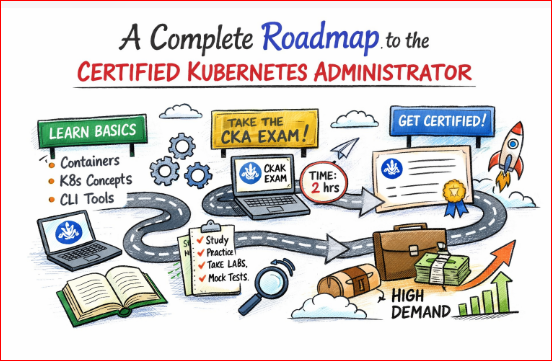
Great roadmap for CKA certification—clearly explains Kubernetes administration basics, core concepts, and a structured path for mastering cluster management skills.
Great roadmap for CKA! Very clear and practical, especially the focus on real-world Kubernetes skills. Really helpful for building a strong DevOps career path.