Introduction
AI Wind Turbine Predictive Maintenance uses artificial intelligence, machine learning, sensor data, SCADA information, vibration analysis, weather conditions, and historical maintenance records to identify potential equipment problems before they become expensive failures.
Instead of relying only on fixed maintenance schedules or reacting after a component fails, predictive maintenance systems continuously analyze turbine behavior and look for unusual patterns. The objective is to identify early warning signals, estimate equipment health, prioritize inspections, and help operators plan maintenance at the most appropriate time.
When evaluating these platforms, buyers should consider sensor compatibility, SCADA integration, vibration analytics, anomaly detection, fault classification, predictive accuracy, explainability, remaining-useful-life capabilities, maintenance-workflow integration, cybersecurity, data retention, deployment flexibility, and scalab Wind-farm operators, renewable-energy companies, utilities, turbine manufacturers, asset managers, offshore wind operators, maintenance contractors, and organizations managing large fleets of turbVery small wind installations with limited sensor coverage and low maintenance complexity. For these environments, traditional inspections and basic condition monitoring may be more practical.
What’s Changed in AI Wind Turbine Predictive Maintenance
- AI models are increasingly analyzing high-frequency sensor data alongside traditional SCADA information.
- Predictive systems can combine multiple signals instead of relying on a single sensor.
- Digital twins are increasingly being used to understand turbine behavior under different operating conditions.
- Machine-learning models can identify deviations from normal operating behavior.
- Anomaly detection can help identify problems before a specific failure mode is confirmed.
- Remaining-useful-life estimation is becoming more important for maintenance planning.
- AI can prioritize turbines and components according to risk rather than simply generating alerts.
- Weather conditions can be incorporated into equipment-health analysis.
- Offshore wind operators increasingly need remote monitoring because physical inspections can be expensive and weather-dependent.
- Computer vision can complement sensor-based maintenance by detecting blade or structural damage from images.
- AI-assisted maintenance systems can help engineers investigate alerts and summarize potential causes.
- Human-in-the-loop review remains important for high-cost or safety-critical maintenance decisions.
- Model drift can occur as turbines age, components are replaced, or operating conditions change.
- Fleet-wide models can benefit from learning across similar turbines while still accounting for turbine-specific behavior.
- Edge analytics can reduce the need to continuously transmit high-frequency sensor data.
- Cybersecurity is increasingly important because predictive-maintenance platforms connect to operational technology.
- Integration with computerized maintenance management systems can turn predictions into actionable work orders.
- Organizations are increasingly measuring the financial value of predictions rather than only model accuracy.
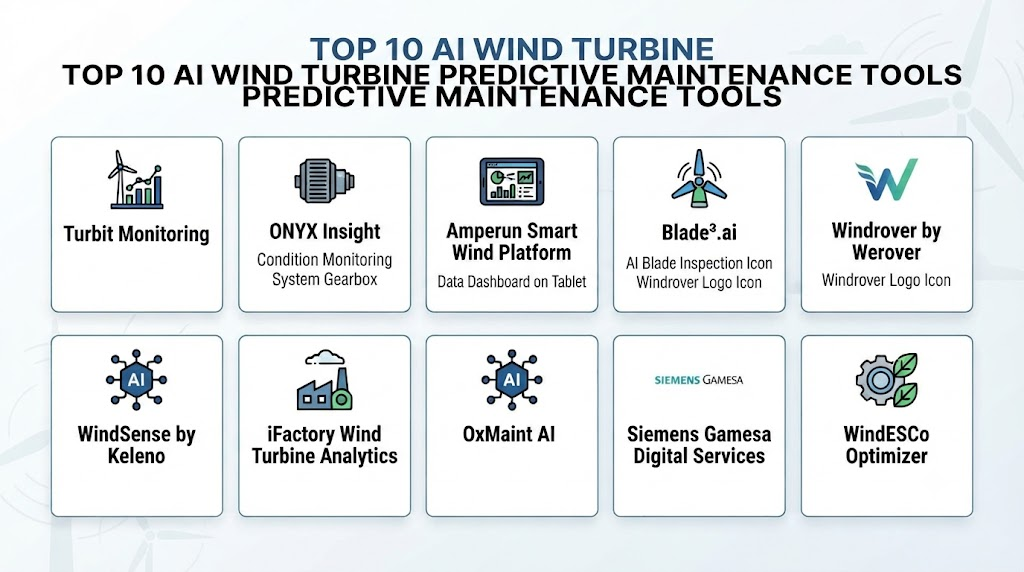
Top 10 AI Wind Turbine Predictive Maintenance Tools
1. ONYX Insight
One-line verdict: Best for wind operators seeking specialized AI-driven turbine performance, condition monitoring, and predictive maintenance capabilities.
Short description:
ONYX Insight focuses specifically on wind-energy technology and asset-performance monitoring. Its solutions use turbine data and analytics to help operators identify potential component problems and improve maintenance planning.
Standout Capabilities
- Wind-turbine condition monitoring
- Predictive maintenance
- Gearbox monitoring
- Component diagnostics
- Fleet analytics
- Turbine performance monitoring
- Failure detection
- Maintenance decision support
AI-Specific Depth
- Model support: Proprietary analytics and AI approaches; exact model architecture is not publicly stated.
- RAG / knowledge integration: N/A for core predictive maintenance.
- Evaluation: Predictive performance can be evaluated against historical failures and maintenance outcomes.
- Guardrails: Human review and operational workflows can be incorporated into maintenance decisions.
- Observability: Asset-health and condition-monitoring workflows provide operational visibility.
Pros
- Strong wind-energy specialization
- Focused on predictive maintenance
- Suitable for large turbine fleets
Cons
- Primarily targeted at professional wind-energy operators
- Integration requirements can be significant
- Exact capabilities vary by product
Security & Compliance
Security capabilities vary by solution and deployment. Specific certifications should be verified for the selected implementation.
Deployment & Platforms
- Cloud: Varies
- Web: Varies
- Edge: Varies
- Enterprise: Yes
Integrations & Ecosystem
The platform can work with turbine and operational data to support asset-health workflows.
- SCADA
- Turbine sensors
- Condition-monitoring systems
- Asset-management systems
- Maintenance workflows
- APIs
Pricing Model
Enterprise pricing is typically customized according to assets, modules, data volume, and service requirements.
Best-Fit Scenarios
- Large wind-farm fleets
- Gearbox and drivetrain monitoring
- Predictive maintenance programs
2. SKF
One-line verdict: Best for organizations combining vibration analysis, rotating-equipment expertise, and predictive maintenance for critical turbine components.
Short description:
SKF provides condition-monitoring and predictive-maintenance technologies for rotating machinery. Its capabilities can be applied to wind-turbine components such as bearings, gearboxes, shafts, and other rotating equipment.
Standout Capabilities
- Vibration monitoring
- Bearing condition monitoring
- Machine diagnostics
- Predictive maintenance
- Sensor technologies
- Asset-health monitoring
- Lubrication monitoring
- Maintenance analytics
AI-Specific Depth
- Model support: Analytics and machine-learning capabilities vary by solution.
- RAG / knowledge integration: N/A.
- Evaluation: Condition-monitoring models can be validated using historical equipment behavior and failures.
- Guardrails: Maintenance recommendations can be reviewed by engineering teams.
- Observability: Condition-monitoring systems provide equipment-health information and trends.
Pros
- Deep rotating-equipment expertise
- Strong bearing and vibration capabilities
- Broad industrial maintenance ecosystem
Cons
- Not exclusively focused on wind turbines
- Product selection can be complex
- Integration depends on the installed monitoring architecture
Security & Compliance
Security and compliance capabilities depend on the selected solution. Specific certifications should be verified before procurement.
Deployment & Platforms
- Cloud: Varies
- Edge: Supported for applicable monitoring solutions
- On-premises: Varies
- Web: Varies
Integrations & Ecosystem
- Vibration sensors
- Bearings
- Gearboxes
- SCADA
- Industrial systems
- Asset-management platforms
Pricing Model
Commercial pricing varies by hardware, software, service, and deployment requirements.
Best-Fit Scenarios
- Bearing monitoring
- Gearbox condition monitoring
- Industrial wind-turbine maintenance
3. Brüel & Kjær Vibro
One-line verdict: Best for advanced vibration monitoring and condition-based maintenance of critical wind-turbine rotating components.
Short description:
Brüel & Kjær Vibro specializes in vibration monitoring and machine condition analysis. Its technologies are relevant to wind turbines because rotating components such as gearboxes and generators produce measurable vibration signatures.
Standout Capabilities
- Vibration monitoring
- Machine condition monitoring
- Turbine monitoring
- Gearbox diagnostics
- Bearing analysis
- Real-time monitoring
- Condition alerts
- Asset-health analysis
AI-Specific Depth
- Model support: Analytics and diagnostic methods vary by product.
- RAG / knowledge integration: N/A.
- Evaluation: Vibration diagnostics can be validated against known failure patterns.
- Guardrails: Alert thresholds and engineering workflows provide operational controls.
- Observability: Continuous vibration and machine-condition monitoring provide strong observability.
Pros
- Strong vibration expertise
- Suitable for rotating machinery
- Useful for early fault detection
Cons
- Specialized monitoring technology can require expertise
- Not a complete maintenance-management system
- Additional integration may be required
Security & Compliance
Specific security and certification details should be verified for the selected deployment.
Deployment & Platforms
- Edge: Supported for applicable monitoring architectures
- Cloud: Varies
- On-premises: Varies
- Web: Varies
Integrations & Ecosystem
- Vibration sensors
- SCADA
- Turbine controllers
- Condition-monitoring systems
- Maintenance systems
- APIs
Pricing Model
Pricing varies according to monitoring hardware, software, services, and turbine requirements.
Best-Fit Scenarios
- Gearbox monitoring
- Generator monitoring
- Vibration-based predictive maintenance
4. Siemens Gamesa Digital Services
One-line verdict: Best for operators managing Siemens Gamesa turbines and seeking manufacturer-linked digital asset-performance and maintenance capabilities.
Short description:
Siemens Gamesa provides digital technologies and services for wind-turbine fleets. Manufacturer-linked analytics can combine turbine operating information with engineering knowledge to support performance monitoring and maintenance decisions.
Standout Capabilities
- Turbine monitoring
- Asset performance
- Predictive maintenance
- Fleet analytics
- Remote diagnostics
- Turbine optimization
- Operational analytics
- Maintenance support
AI-Specific Depth
- Model support: Proprietary analytics and machine-learning approaches vary by service.
- RAG / knowledge integration: Engineering knowledge can support diagnostic workflows; exact implementation varies.
- Evaluation: Historical asset data and maintenance outcomes can support model evaluation.
- Guardrails: Operational and maintenance workflows can include human approval.
- Observability: Remote monitoring and fleet analytics provide visibility into turbine behavior.
Pros
- Strong OEM expertise
- Deep turbine-specific knowledge
- Useful for supported turbine fleets
Cons
- Most useful for compatible turbine environments
- Can create OEM dependency
- Capabilities vary across services and turbine models
Security & Compliance
Security and compliance details depend on the selected service and deployment.
Deployment & Platforms
- Cloud: Varies
- Web: Varies
- Remote monitoring: Yes
- Hybrid: Varies
Integrations & Ecosystem
- Turbine SCADA
- Sensors
- OEM systems
- Asset-management platforms
- Maintenance workflows
- Analytics systems
Pricing Model
Enterprise service pricing varies according to fleet size, service scope, and contract structure.
Best-Fit Scenarios
- Siemens Gamesa fleets
- OEM-supported maintenance
- Large wind portfolios
5. Vestas Digital Solutions
One-line verdict: Best for Vestas turbine operators wanting manufacturer-connected monitoring, analytics, and predictive maintenance services.
Short description:
Vestas provides digital services for wind-turbine monitoring, performance analysis, and operational management. Its manufacturer expertise can be valuable for operators seeking turbine-specific insights.
Standout Capabilities
- Turbine monitoring
- Fleet analytics
- Predictive maintenance
- Performance optimization
- Remote diagnostics
- Asset management
- Operational analytics
- Maintenance planning
AI-Specific Depth
- Model support: Proprietary analytics; exact AI architecture is not publicly stated.
- RAG / knowledge integration: N/A.
- Evaluation: Historical turbine and maintenance data can support model validation.
- Guardrails: Operational workflows can include engineering review.
- Observability: Remote monitoring and asset analytics provide ongoing visibility.
Pros
- Strong OEM knowledge
- Turbine-specific capabilities
- Suitable for large Vestas fleets
Cons
- Most relevant to Vestas equipment
- OEM dependency can be a consideration
- Product capabilities vary by service agreement
Security & Compliance
Specific security controls and certifications should be verified for the applicable service.
Deployment & Platforms
- Cloud: Varies
- Web: Varies
- Remote monitoring: Yes
- Hybrid: Varies
Integrations & Ecosystem
- Vestas turbine systems
- SCADA
- Sensors
- Asset-management systems
- Maintenance workflows
- Analytics platforms
Pricing Model
Enterprise and service-contract pricing varies.
Best-Fit Scenarios
- Vestas wind farms
- OEM-supported maintenance
- Fleet-level monitoring
6. GE Vernova Digital Wind Solutions
One-line verdict: Best for operators seeking turbine analytics and predictive-maintenance capabilities within broader utility and renewable-energy environments.
Short description:
GE Vernova provides digital technologies for energy and wind operations. Its wind-related digital capabilities can support asset monitoring, operational analytics, and maintenance workflows.
Standout Capabilities
- Turbine monitoring
- Asset performance
- Predictive analytics
- Remote diagnostics
- Fleet management
- Performance analytics
- Maintenance planning
- Energy optimization
AI-Specific Depth
- Model support: Proprietary analytics and AI approaches vary.
- RAG / knowledge integration: N/A.
- Evaluation: Asset-performance data can be used for historical model validation.
- Guardrails: Engineering and operational workflows provide decision controls.
- Observability: Fleet and turbine monitoring support ongoing performance visibility.
Pros
- Strong energy-industry ecosystem
- Suitable for enterprise deployments
- Broad digital-energy capabilities
Cons
- Enterprise implementation can be complex
- Product capabilities vary
- May be more than smaller operators need
Security & Compliance
Security and compliance should be evaluated for the selected product and deployment.
Deployment & Platforms
- Cloud: Varies
- On-premises: Varies
- Hybrid: Varies
- Web: Varies
Integrations & Ecosystem
- SCADA
- Turbine controllers
- Sensors
- Asset-management systems
- Utility systems
- APIs
Pricing Model
Enterprise pricing is typically customized.
Best-Fit Scenarios
- Enterprise wind operations
- Large turbine fleets
- Integrated energy organizations
7. Greenbyte
One-line verdict: Best for renewable asset managers needing centralized monitoring, performance analytics, and fleet-level operational visibility.
Short description:
Greenbyte has been associated with renewable-energy asset management and performance monitoring. Its technologies are relevant to wind operators that need centralized visibility across renewable portfolios.
Standout Capabilities
- Wind-asset monitoring
- Portfolio analytics
- Performance monitoring
- Data aggregation
- Operational dashboards
- Alerting
- Renewable portfolio management
- Data visualization
AI-Specific Depth
- Model support: Analytics capabilities vary; exact AI model architecture is not publicly stated.
- RAG / knowledge integration: N/A.
- Evaluation: Performance monitoring can support validation of predictive workflows.
- Guardrails: Alert and operational workflows vary.
- Observability: Strong emphasis on asset and portfolio visibility.
Pros
- Renewable-energy specialization
- Multi-asset visibility
- Useful operational dashboards
Cons
- Exact predictive-maintenance functionality depends on the solution
- Product availability and positioning may vary
- Advanced diagnostics may require additional technologies
Security & Compliance
Specific controls and certifications should be verified for the current deployment.
Deployment & Platforms
- Cloud: Varies
- Web: Yes for applicable products
- APIs: Varies
- Hybrid: Varies
Integrations & Ecosystem
- SCADA
- Renewable assets
- Sensors
- Data historians
- Asset-management systems
- APIs
Pricing Model
Commercial pricing varies according to portfolio size and functionality.
Best-Fit Scenarios
- Renewable portfolio monitoring
- Multi-site wind operations
- Asset-performance analytics
8. SkySpecs
One-line verdict: Best for wind operators combining digital inspections, asset intelligence, and maintenance planning across turbine fleets.
Short description:
SkySpecs provides technologies focused on wind-asset inspection and management. Its ecosystem can combine inspection information with asset-management workflows to help operators identify and prioritize maintenance requirements.
Standout Capabilities
- Wind-turbine inspections
- Blade inspection
- Asset management
- Maintenance planning
- Digital inspection records
- Defect identification
- Fleet analytics
- Workflow management
AI-Specific Depth
- Model support: Computer vision and analytics capabilities vary by product; exact model architecture is not publicly stated.
- RAG / knowledge integration: N/A.
- Evaluation: Inspection results can be compared with historical defects and maintenance outcomes.
- Guardrails: Human inspection and engineering review remain important.
- Observability: Inspection records and asset-management workflows provide visibility.
Pros
- Strong inspection capabilities
- Useful for blade and external-component monitoring
- Connects inspection data with maintenance workflows
Cons
- More inspection-focused than pure sensor-based predictive maintenance
- Requires inspection data
- Best value may require broader asset-management adoption
Security & Compliance
Security and compliance details should be verified for the selected product and deployment.
Deployment & Platforms
- Cloud: Yes
- Web: Yes
- Mobile: Varies
- Hybrid: Varies
Integrations & Ecosystem
- Drone inspection
- Images
- Turbine records
- Asset-management systems
- Maintenance workflows
- APIs
Pricing Model
Enterprise pricing varies by fleet size, inspection requirements, and services.
Best-Fit Scenarios
- Blade inspection
- Wind-farm asset management
- Maintenance prioritization
9. Nanoprecise Sci Corp
One-line verdict: Best for condition monitoring of rotating machinery using sensor-based diagnostics and predictive maintenance analytics.
Short description:
Nanoprecise provides condition-monitoring technologies designed to detect mechanical problems in rotating equipment. Such technologies can be applied to wind-turbine components where vibration and machine-health data are important.
Standout Capabilities
- Vibration monitoring
- Machine-health analytics
- Predictive maintenance
- Rotating-equipment diagnostics
- Anomaly detection
- Sensor-based monitoring
- Equipment-health scoring
- Maintenance alerts
AI-Specific Depth
- Model support: Proprietary AI and machine-learning approaches; exact architecture is not publicly stated.
- RAG / knowledge integration: N/A.
- Evaluation: Historical equipment behavior and known failures can support evaluation.
- Guardrails: Maintenance recommendations can be reviewed by engineering teams.
- Observability: Continuous equipment-health monitoring supports operational visibility.
Pros
- AI-focused condition monitoring
- Applicable to rotating machinery
- Potentially useful beyond wind turbines
Cons
- Requires suitable sensor deployment
- Not a complete wind-farm management system
- Integration effort varies
Security & Compliance
Specific security controls and certifications should be verified for the applicable deployment.
Deployment & Platforms
- Cloud: Varies
- Edge: Varies
- Web: Varies
- Hybrid: Varies
Integrations & Ecosystem
- Vibration sensors
- Rotating equipment
- SCADA
- Maintenance platforms
- Industrial data systems
- APIs
Pricing Model
Commercial pricing is typically customized.
Best-Fit Scenarios
- Gearbox monitoring
- Rotating-component diagnostics
- Sensor-driven maintenance
10. MATLAB Predictive Maintenance Toolbox
One-line verdict: Best for engineering teams developing customized machine-learning and predictive-maintenance models for wind-turbine equipment.
Short description:
MATLAB Predictive Maintenance Toolbox provides tools for developing condition-monitoring and predictive-maintenance workflows. Engineers can use it to analyze sensor data, build models, detect anomalies, and estimate equipment health.
Standout Capabilities
- Condition monitoring
- Anomaly detection
- Feature engineering
- Machine-learning models
- Signal processing
- Predictive modeling
- Remaining-useful-life workflows
- Digital-twin development
AI-Specific Depth
- Model support: Multiple machine-learning and analytical methods can be implemented.
- RAG / knowledge integration: N/A.
- Evaluation: Strong support for model training, validation, testing, and comparison.
- Guardrails: Developer-defined.
- Observability: Custom monitoring can be built into analytical workflows.
Pros
- Highly customizable
- Strong engineering ecosystem
- Useful for research and production-model development
Cons
- Requires technical expertise
- Not a turnkey wind-farm monitoring service
- Licensing costs can be significant
Security & Compliance
Security depends largely on the deployment architecture and surrounding infrastructure. Specific certifications should be verified.
Deployment & Platforms
- Windows: Supported
- macOS: Supported for applicable MATLAB environments
- Linux: Supported
- Cloud: Available through applicable services
- Self-hosted: Yes
Integrations & Ecosystem
- Python
- MATLAB
- Sensor data
- SCADA
- Databases
- Machine-learning workflows
- APIs
Pricing Model
Commercial licensing with options depending on products, users, and organizational requirements.
Best-Fit Scenarios
- Custom turbine predictive-maintenance models
- Research and development
- Engineering analytics
Comparison Table
| Tool Name | Best For | Deployment | Model Flexibility | Strength | Watch-Out | Public Rating |
|---|---|---|---|---|---|---|
| ONYX Insight | Wind predictive maintenance | Cloud/Hybrid | Proprietary/Managed | Wind specialization | Enterprise integration | N/A |
| SKF | Bearing and rotating equipment | Edge/Cloud varies | Proprietary/Custom | Condition monitoring | Broader industrial focus | N/A |
| Brüel & Kjær Vibro | Vibration diagnostics | Edge/Cloud varies | Proprietary/Custom | Vibration expertise | Requires specialist knowledge | N/A |
| Siemens Gamesa | OEM fleet monitoring | Cloud/Hybrid | Proprietary | Turbine expertise | OEM dependency | N/A |
| Vestas | OEM asset monitoring | Cloud/Hybrid | Proprietary | Vestas integration | OEM dependency | N/A |
| GE Vernova | Enterprise wind analytics | Cloud/Hybrid | Proprietary/Custom | Energy ecosystem | Complex deployment | N/A |
| Greenbyte | Renewable portfolio monitoring | Cloud | Managed | Fleet visibility | Advanced diagnostics vary | N/A |
| SkySpecs | Inspection and maintenance | Cloud | AI/computer vision | Digital inspections | Inspection-oriented | N/A |
| Nanoprecise | Rotating machinery | Cloud/Edge | Proprietary | AI condition monitoring | Requires sensors | N/A |
| MATLAB Predictive Maintenance Toolbox | Custom development | Self-hosted/Cloud | Multi-model/custom | Engineering flexibility | Requires expertise | N/A |
Scoring & Evaluation
The following scoring is a comparative assessment based on predictive-maintenance functionality, wind-energy relevance, AI capabilities, integration potential, usability, and enterprise suitability.
The scores are not official vendor ratings and should not replace technical validation using the buyer’s own turbine data.
Actual performance depends heavily on sensor quality, turbine type, historical failures, component characteristics, operating conditions, and maintenance practices.
| Tool | Core | Reliability/Eval | Guardrails | Integrations | Ease | Perf/Cost | Security/Admin | Support | Weighted Total |
|---|---|---|---|---|---|---|---|---|---|
| ONYX Insight | 9.6 | 9.4 | 9.0 | 9.3 | 8.7 | 8.7 | 8.8 | 9.3 | 9.1 |
| SKF | 9.3 | 9.4 | 9.2 | 9.2 | 8.4 | 8.5 | 9.0 | 9.3 | 9.0 |
| Brüel & Kjær Vibro | 9.2 | 9.5 | 9.2 | 8.9 | 8.0 | 8.4 | 8.8 | 9.2 | 8.9 |
| Siemens Gamesa | 9.5 | 9.3 | 9.2 | 9.5 | 8.4 | 8.2 | 9.3 | 9.5 | 9.2 |
| Vestas | 9.5 | 9.3 | 9.2 | 9.4 | 8.5 | 8.2 | 9.3 | 9.5 | 9.1 |
| GE Vernova | 9.4 | 9.2 | 9.1 | 9.5 | 8.1 | 8.3 | 9.3 | 9.4 | 9.0 |
| Greenbyte | 8.8 | 8.7 | 8.4 | 9.1 | 8.8 | 8.5 | 8.5 | 8.8 | 8.7 |
| SkySpecs | 9.0 | 9.0 | 8.8 | 9.0 | 8.7 | 8.2 | 8.7 | 9.0 | 8.8 |
| Nanoprecise | 8.9 | 9.1 | 8.6 | 8.7 | 8.3 | 8.5 | 8.3 | 8.7 | 8.7 |
| MATLAB Predictive Maintenance Toolbox | 9.2 | 9.6 | 8.8 | 9.5 | 7.8 | 8.0 | 8.7 | 9.5 | 8.9 |
Top 3 for Enterprise
- Siemens Gamesa
- ONYX Insight
- Vestas
Top 3 for SMB
- SKF
- SkySpecs
- Nanoprecise
Top 3 for Developers
- MATLAB Predictive Maintenance Toolbox
- Nanoprecise
- SKF
Which AI Wind Turbine Predictive Maintenance Tool Is Right for You?
Solo / Freelancer
Independent engineers and consultants typically need flexible analytical tools rather than a complete enterprise wind-farm platform.
Prioritize:
- Sensor-data access
- Python or MATLAB compatibility
- Signal processing
- Machine-learning support
- Anomaly detection
- Data visualization
- Model evaluation
A development-oriented environment can be useful for building custom turbine-health models.
SMB
Smaller wind operators should prioritize tools that can deliver actionable alerts without requiring a large data-science team.
Look for:
- SCADA integration
- Automated anomaly detection
- Simple asset-health dashboards
- Condition alerts
- Maintenance recommendations
- Remote monitoring
- Straightforward deployment
Mid-Market
Mid-market wind operators generally need centralized monitoring across multiple turbines or sites.
Important capabilities include:
- Fleet-level analytics
- Component-level monitoring
- Failure prediction
- Alert prioritization
- Maintenance workflow integration
- Historical analytics
- API access
- Automated reporting
Enterprise
Large wind portfolios require a comprehensive asset-health architecture.
Prioritize:
- High-frequency condition monitoring
- SCADA integration
- Fleet analytics
- Digital twins
- Remaining-useful-life estimation
- Predictive diagnostics
- CMMS integration
- Edge processing
- Enterprise identity management
- Auditability
- Model governance
- Disaster recovery
Regulated and Critical Infrastructure
Wind assets may form part of critical electricity infrastructure, so security should be evaluated alongside predictive performance.
Review:
- Identity and access management
- Network segmentation
- Encryption
- Data retention
- Data residency
- Remote access
- Audit logs
- Incident response
- Vendor access
- Backup and recovery
- Operational technology security
Budget vs Premium
Budget-conscious operators can begin with:
- Existing SCADA data
- Basic anomaly detection
- Limited sensor deployment
- Open-source analytics
- Targeted component monitoring
Premium solutions become more attractive when operators manage:
- Large fleets
- Offshore turbines
- Expensive components
- Difficult-access sites
- High downtime costs
- Complex maintenance logistics
Build vs Buy
Buy when you need:
- Proven wind-industry workflows
- Ready-made monitoring
- Turbine-specific knowledge
- Vendor support
- Faster deployment
Build when:
- Your organization has strong data-science expertise
- Proprietary failure data is valuable
- You need highly customized models
- Your turbine fleet has unusual characteristics
A hybrid model is often effective: use specialized condition-monitoring infrastructure while developing proprietary models for specific failure modes.
Implementation Playbook: 30 / 60 / 90 Days
First 30 Days: Pilot + Success Metrics
Select one turbine subsystem or failure mode.
Good candidates include:
- Gearbox
- Main bearing
- Generator
- Pitch system
- Hydraulic system
Collect:
- SCADA data
- Vibration data
- Temperature data
- Maintenance history
- Failure records
- Weather information
- Turbine operating conditions
Define baseline metrics:
- False-positive rate
- False-negative rate
- Detection lead time
- Precision
- Recall
- Mean time to detection
- Avoided downtime
- Maintenance cost impact
Days 31–60: Security + Evaluation + Rollout
Create a dedicated testing environment.
Test the model against:
- Normal operation
- Startup
- Shutdown
- High winds
- Low winds
- Rapid weather changes
- Sensor failures
- Communication interruptions
- Known component failures
- Maintenance events
Build:
- Model-version control
- Evaluation datasets
- Regression tests
- Data-quality checks
- Alert review procedures
- Incident handling
- Human approval workflows
Red-team the system by injecting unusual sensor patterns and incomplete data.
Days 61–90: Optimize Cost/Latency + Governance + Scale
After validation, move the solution into controlled production.
Optimize:
- Sensor frequency
- Data transmission
- Edge processing
- Cloud processing
- Model inference
- Storage
- Alert frequency
- Retraining schedules
Create governance around:
- Model updates
- Threshold changes
- Alert overrides
- False alarms
- Missed failures
- Data-quality issues
- Component replacements
- Model drift
Expand from a pilot component to additional turbines only after establishing reliable performance.
Common Mistakes & How to Avoid Them
- Training models without reliable failure history.
- Using only SCADA data when vibration data is necessary.
- Ignoring sensor calibration.
- Treating every anomaly as a failure.
- Generating too many alerts.
- Failing to prioritize alerts by business impact.
- Ignoring turbine operating conditions.
- Ignoring weather conditions.
- Failing to account for turbine aging.
- Training one model and assuming every turbine behaves identically.
- Ignoring component replacements.
- Failing to track false positives.
- Measuring accuracy without measuring maintenance value.
- Automating maintenance decisions without engineering review.
- Connecting predictive systems directly to operational controls.
- Ignoring cybersecurity.
- Failing to monitor model drift.
- Not versioning datasets and models.
- Ignoring data latency.
- Failing to create fallback procedures.
- Assuming historical failure patterns will remain unchanged.
- Ignoring offshore operating constraints.
- Treating AI alerts as guaranteed failures.
- Failing to integrate predictions into maintenance workflows.
FAQs
What is AI wind turbine predictive maintenance?
It is the use of AI, machine learning, sensor data, and operational information to identify abnormal turbine behavior and predict potential equipment problems before failures occur.
Which wind-turbine components can AI monitor?
Common targets include gearboxes, bearings, generators, shafts, pitch systems, hydraulic systems, blades, and other mechanical or electrical components.
Can SCADA data be used for predictive maintenance?
Yes. SCADA data can provide valuable information about turbine operating behavior, although high-frequency vibration or other sensor data may be necessary for certain failure modes.
Can AI predict gearbox failures?
AI can identify patterns associated with potential gearbox problems, but prediction quality depends on available failure data, sensor quality, operating conditions, and model design.
Can AI detect bearing problems?
Yes. Vibration, temperature, acoustic, lubrication, and operational data can be used to identify patterns associated with bearing degradation.
What is anomaly detection in wind turbines?
Anomaly detection identifies turbine behavior that differs from an established normal operating pattern. An anomaly does not necessarily mean a component has failed.
What is remaining-useful-life prediction?
Remaining-useful-life prediction attempts to estimate how long a component may continue operating before reaching a defined failure or degradation condition.
Can predictive maintenance reduce turbine downtime?
It can help reduce unexpected downtime by providing earlier warnings and allowing operators to plan inspections and repairs. Actual savings depend on implementation quality and maintenance practices.
Can AI monitor offshore wind turbines?
Yes. Predictive monitoring can be especially valuable offshore because physical access can be expensive, weather-dependent, and operationally difficult.
Can AI inspect turbine blades?
Yes. Computer vision can analyze photographs, drone imagery, and inspection data to identify visible defects or changes. This complements rather than necessarily replaces engineering inspections.
Does predictive maintenance require IoT sensors?
Not always. Existing SCADA data can provide a useful starting point. Additional sensors may be required for specific components and failure modes.
Can predictive maintenance work without historical failures?
It can. Anomaly detection and condition monitoring can work with limited failure history, although supervised failure prediction generally benefits from reliable historical examples.
How should predictive-maintenance AI be evaluated?
Use historical backtesting, time-based validation, component-level testing, false-positive analysis, false-negative analysis, and measurement of detection lead time.
What is the biggest challenge with AI turbine maintenance?
A major challenge is obtaining high-quality labeled failure data. Serious failures may be relatively rare, making it difficult to train and validate supervised models.
Can AI replace turbine technicians?
No. AI should support technicians and engineers by prioritizing inspections and identifying potential problems. Physical inspection, engineering judgment, and repair decisions remain important.
Can predictive maintenance integrate with CMMS systems?
Yes. Depending on the platform, predictive alerts can potentially be integrated into maintenance-management workflows so teams can investigate and schedule work.
Is cloud deployment safe for wind-turbine predictive maintenance?
Cloud deployment can be appropriate, but organizations should carefully evaluate data security, network segmentation, access control, encryption, latency, and operational fallback requirements.
Should wind operators build or buy predictive-maintenance software?
Buying is often faster for standardized wind-farm requirements. Building may be worthwhile when the organization has specialized turbine data, strong engineering teams, and unique failure-prediction requirements.
What is the best AI wind turbine predictive-maintenance tool?
There is no universal winner. OEM platforms can be strong for compatible turbines, specialized condition-monitoring companies can excel at mechanical diagnostics, and development platforms are useful for custom models.
Conclusion
AI Wind Turbine Predictive Maintenance can help renewable-energy operators move from reactive maintenance toward condition-based and risk-informed asset management. By combining SCADA data, vibration measurements, temperature readings, weather information, maintenance history, and machine-learning techniques, operators can identify abnormal behavior earlier and make better maintenance decisions.The most valuable systems do not simply generate alerts. They help answer practical questions: Which turbine needs attention? Which component may be degrading? How urgent is the problem? What evidence supports the prediction? How much downtime could be avoided? And should an engineer inspect the equipment now?The right solution depends on turbine manufacturer, fleet size, sensor availability, maintenance strategy, operating environment, and technical capabilities. OEM platforms can be attractive for manufacturer-specific fleets, specialized condition-monitoring technologies can provide deeper mechanical diagnostics, and development platforms can offer flexibility for organizations building proprietary models.