Introduction
AI Ride-Hailing Matching Algorithms use artificial intelligence, machine learning, optimization, geospatial data, and real-time mobility information to match passengers with suitable drivers. Instead of relying only on simple proximity rules, modern matching systems can consider pickup distance, estimated arrival time, driver availability, traffic, trip characteristics, vehicle type, demand levels, and marketplace conditions.
Common use cases include passenger-driver matching, pickup-time reduction, dynamic dispatching, driver repositioning, pooling, demand forecasting, marketplace balancing, airport dispatch, and handling demand spikes.
Best for: Ride-hailing companies, taxi operators, mobility platforms, delivery and logistics businesses, transportation startups, fleet operators, and technology teams building dispatch systems.
Not ideal for: Small operators with a handful of vehicles, businesses that only need manual dispatch, or organizations without real-time location and trip data.
What’s Changed in AI Ride-Hailing Matching Algorithms
- Matching systems increasingly combine real-time location, traffic, demand, and driver availability.
- AI can estimate pickup times instead of relying only on geographic distance.
- Dynamic matching can consider the probability that a driver will accept a trip.
- Demand forecasting can help anticipate where vehicles will be needed next.
- Matching can consider marketplace balance rather than optimizing individual trips alone.
- AI can help reduce unnecessary driver repositioning.
- Pooling algorithms can evaluate multiple passengers and shared-route opportunities.
- Real-time traffic conditions can influence matching and pickup estimates.
- Vehicle type and trip requirements can be incorporated into matching decisions.
- Reinforcement-learning approaches can be explored for complex dispatch optimization.
- Edge and cloud processing can support different latency requirements.
- Privacy-preserving approaches are increasingly important because location data is highly sensitive.
- Explainability matters when automated matching affects drivers or passengers.
- Model monitoring is important because demand and driver behavior change over time.
- Fraud and abnormal marketplace behavior can be considered alongside matching systems.
- Modern systems increasingly treat matching as a marketplace optimization problem rather than a simple nearest-driver search.
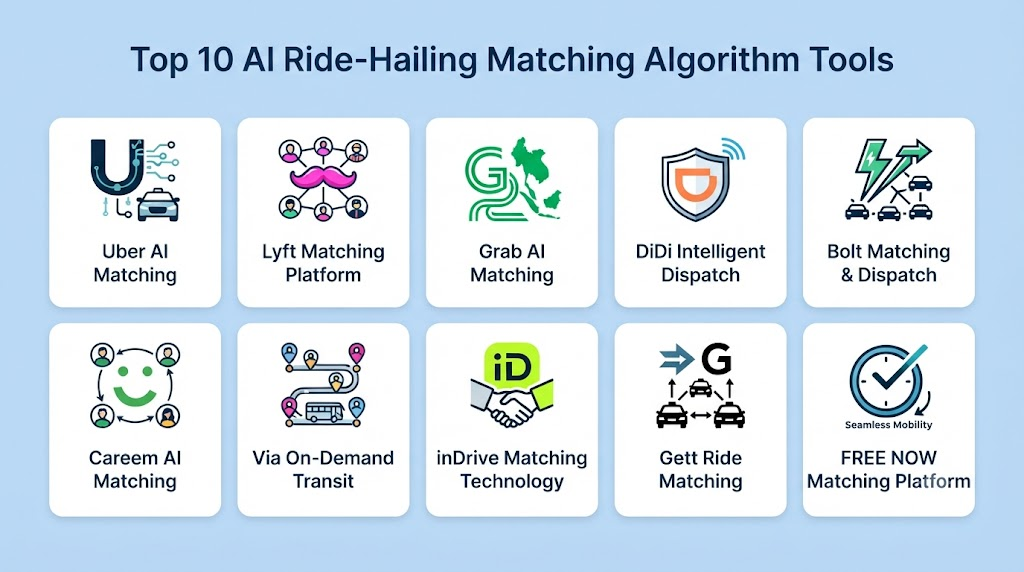
Top 10 AI Ride-Hailing Matching Algorithm Tools
1 — Via Transportation
One-line verdict: Best for organizations combining AI-powered demand-responsive mobility, dynamic routing, and passenger-vehicle matching.
Short description:
Via develops technology for demand-responsive transportation and shared mobility. Its systems are designed to match passengers and vehicles dynamically while optimizing routing and transportation operations.
Standout Capabilities
- Dynamic vehicle-passenger matching
- Demand-responsive transportation
- Dynamic routing
- Ride pooling
- Fleet allocation
- Real-time trip management
- Mobility analytics
- Operational optimization
AI-Specific Depth
- Model support: Proprietary optimization and machine-learning capabilities.
- RAG / knowledge integration: N/A.
- Evaluation: Trip and operational performance analytics.
- Guardrails: Service constraints and operational policies.
- Observability: Trip, routing, and mobility metrics.
Pros
- Strong expertise in demand-responsive mobility.
- Designed around dynamic matching and routing.
- Suitable for complex transportation operations.
Cons
- Primarily enterprise and mobility-platform oriented.
- Exact AI architecture is not publicly stated.
- Implementation can require substantial operational integration.
Security & Compliance
Security, privacy, access management, and data-retention capabilities vary by deployment and agreement.
Deployment & Platforms
- Cloud
- Web
- Mobile
- APIs
Integrations & Ecosystem
Via can connect rider-facing applications with fleet and transportation systems.
- Passenger applications
- Driver applications
- GPS
- Fleet systems
- APIs
- Payment systems
- Mobility platforms
Pricing Model
Enterprise/custom pricing.
Best-Fit Scenarios
- Demand-responsive transit
- Ride pooling
- Dynamic mobility services
2 — Uber Marketplace Technology
One-line verdict: Best for large-scale ride-hailing marketplaces requiring sophisticated real-time matching and dispatch infrastructure.
Short description:
Uber operates one of the world’s largest ride-hailing marketplaces and has developed extensive technology around matching riders with drivers, predicting ETAs, managing supply and demand, and optimizing marketplace performance.
Standout Capabilities
- Real-time matching
- Driver-rider dispatch
- ETA prediction
- Demand forecasting
- Marketplace optimization
- Dynamic pricing integration
- Driver positioning
- Large-scale geospatial processing
AI-Specific Depth
- Model support: Proprietary machine-learning systems.
- RAG / knowledge integration: N/A.
- Evaluation: Marketplace and trip-performance evaluation.
- Guardrails: Operational policies and marketplace constraints.
- Observability: Real-time marketplace and trip metrics.
Pros
- Proven at very large marketplace scale.
- Extensive experience with real-time mobility data.
- Strong research and engineering ecosystem.
Cons
- The internal matching technology is not sold as a simple standalone product.
- Organizations cannot simply adopt Uber’s internal marketplace algorithms.
- Recreating comparable functionality requires significant engineering.
Security & Compliance
Security and privacy capabilities are part of the broader platform but exact internal matching architecture and controls are not publicly stated in full.
Deployment & Platforms
- Cloud
- Mobile
- APIs
- Distributed infrastructure
Integrations & Ecosystem
- GPS
- Maps
- Mobile applications
- Payment systems
- Driver platforms
- Data infrastructure
- Machine-learning systems
Pricing Model
Not publicly applicable as a standalone matching product.
Best-Fit Scenarios
- Studying marketplace architectures
- Large-scale mobility platforms
- Custom dispatch-system development
3 — Lyft Marketplace Technology
One-line verdict: Best as a reference architecture for real-time rider-driver matching and large-scale mobility marketplace optimization.
Short description:
Lyft operates a large ride-hailing marketplace where automated systems match riders and drivers while accounting for location, demand, availability, ETA, and marketplace conditions.
Standout Capabilities
- Driver-rider matching
- Real-time dispatch
- ETA prediction
- Marketplace analytics
- Demand forecasting
- Geospatial optimization
- Driver supply management
- Dynamic marketplace management
AI-Specific Depth
- Model support: Proprietary machine-learning systems.
- RAG / knowledge integration: N/A.
- Evaluation: Trip and marketplace performance metrics.
- Guardrails: Operational policies and marketplace constraints.
- Observability: Marketplace telemetry and operational analytics.
Pros
- Large-scale marketplace experience.
- Strong real-time matching requirements.
- Useful reference for mobility-platform architecture.
Cons
- Internal algorithms are not offered as a conventional software product.
- Exact models and ranking systems are not publicly stated.
- Replicating the architecture requires significant engineering.
Security & Compliance
Security and privacy controls are part of the broader platform; detailed internal matching controls vary and are not fully public.
Deployment & Platforms
- Cloud
- Mobile
- APIs
- Distributed systems
Integrations & Ecosystem
- GPS
- Mapping
- Mobile applications
- Driver systems
- Payment systems
- Data platforms
- Machine-learning infrastructure
Pricing Model
Not publicly applicable as a standalone commercial matching tool.
Best-Fit Scenarios
- Marketplace architecture research
- Large mobility platforms
- Custom matching development
4 — Google Maps Platform
One-line verdict: Best for developers building custom ride-hailing matching systems requiring strong mapping, routing, distance, and ETA capabilities.
Short description:
Google Maps Platform provides mapping, routing, geocoding, distance, and location technologies that can form the foundation of a custom ride-hailing matching system. Developers can combine these capabilities with their own machine-learning models.
Standout Capabilities
- Route calculation
- Distance estimation
- Geocoding
- Location services
- Traffic information
- Travel-time estimation
- Maps visualization
- Developer APIs
AI-Specific Depth
- Model support: Platform capabilities vary; custom ML can be added.
- RAG / knowledge integration: N/A.
- Evaluation: Application-specific.
- Guardrails: API and platform controls.
- Observability: Application and API monitoring.
Pros
- Strong geospatial foundation.
- Extensive developer ecosystem.
- Useful for custom matching architectures.
Cons
- Does not provide a complete ride-hailing marketplace.
- Usage costs depend on API consumption.
- Custom matching logic remains the developer’s responsibility.
Security & Compliance
Identity, access management, API controls, encryption, logging, and related capabilities depend on the selected cloud and platform configuration.
Deployment & Platforms
- Cloud
- Web
- Android
- iOS
- APIs
Integrations & Ecosystem
- Mapping
- Routing
- Geocoding
- Location APIs
- Cloud infrastructure
- Mobile applications
- Custom ML systems
Pricing Model
Usage-based commercial pricing.
Best-Fit Scenarios
- Custom ride-hailing applications
- Location-aware matching
- Routing infrastructure
5 — HERE Technologies
One-line verdict: Best for mobility companies needing enterprise-grade mapping, routing, traffic, and location intelligence for custom matching systems.
Short description:
HERE provides mapping, routing, traffic, location, and mobility technologies. Its APIs and location services can supply the geospatial foundation required for custom rider-driver matching algorithms.
Standout Capabilities
- Mapping
- Routing
- Traffic data
- Geocoding
- Location intelligence
- Fleet services
- Mobility APIs
- Route optimization
AI-Specific Depth
- Model support: Proprietary location and analytics capabilities vary.
- RAG / knowledge integration: N/A.
- Evaluation: Application-specific.
- Guardrails: API and platform controls.
- Observability: Location and application telemetry.
Pros
- Strong location technology.
- Useful for fleet and mobility applications.
- Suitable for enterprise integrations.
Cons
- Requires custom matching logic.
- Not a complete ride-hailing dispatch platform.
- Commercial terms vary.
Security & Compliance
Security and privacy controls vary by product and deployment.
Deployment & Platforms
- Cloud
- APIs
- Web
- Mobile
- Automotive environments
Integrations & Ecosystem
- Maps
- Routing
- Traffic
- Fleet systems
- Mobility platforms
- APIs
- Developer tools
Pricing Model
Usage-based and enterprise commercial models vary.
Best-Fit Scenarios
- Enterprise mobility platforms
- Custom dispatch systems
- Fleet optimization
6 — Amazon Location Service
One-line verdict: Best for developers building scalable location-aware applications with managed cloud mapping and tracking infrastructure.
Short description:
Amazon Location Service provides cloud capabilities for maps, tracking, geofencing, and location-aware applications. It can support the geospatial layer of a custom ride-hailing matching architecture.
Standout Capabilities
- Maps
- Location tracking
- Geofencing
- Route-related capabilities
- Asset tracking
- Location APIs
- Cloud integration
- Event-driven architectures
AI-Specific Depth
- Model support: Custom AI models can be integrated.
- RAG / knowledge integration: N/A.
- Evaluation: Application-specific.
- Guardrails: Cloud and application controls.
- Observability: Cloud monitoring and application telemetry.
Pros
- Strong cloud integration.
- Useful for custom applications.
- Scalable infrastructure.
Cons
- Does not provide complete ride-hailing matching logic.
- Requires development expertise.
- AI functionality must generally be built or integrated.
Security & Compliance
Cloud identity, access, encryption, logging, and governance capabilities depend on configuration and selected services.
Deployment & Platforms
- Cloud
- APIs
- Web
- Mobile
Integrations & Ecosystem
- AWS services
- Maps
- Geofencing
- Tracking
- APIs
- Databases
- Machine-learning services
Pricing Model
Usage-based cloud pricing.
Best-Fit Scenarios
- Custom mobility applications
- Location-aware services
- Cloud-native dispatch systems
7 — Optibus
One-line verdict: Best for transportation operators adapting fleet assignment and scheduling concepts to demand-driven mobility operations.
Short description:
Optibus focuses on public transportation planning, scheduling, and fleet optimization. While it is not a conventional ride-hailing matching engine, its optimization capabilities can be relevant to mobility operators managing vehicle supply against changing demand.
Standout Capabilities
- Fleet optimization
- Scheduling
- Route planning
- Vehicle allocation
- Scenario planning
- Operational analytics
- Service planning
- Optimization
AI-Specific Depth
- Model support: Proprietary optimization capabilities.
- RAG / knowledge integration: N/A.
- Evaluation: Scheduling and operational scenario evaluation.
- Guardrails: Operational constraints.
- Observability: Planning and operational metrics.
Pros
- Strong transportation optimization.
- Useful for larger mobility fleets.
- Connects demand with resource allocation.
Cons
- Not designed specifically for on-demand ride-hailing.
- Matching capabilities differ from ride-hailing dispatch.
- Enterprise implementation can require configuration.
Security & Compliance
Security and administrative capabilities vary by deployment.
Deployment & Platforms
- Cloud
- Web
- Enterprise
Integrations & Ecosystem
- Fleet systems
- Scheduling
- Transit data
- APIs
- Vehicle information
- Operational platforms
Pricing Model
Enterprise/custom pricing.
Best-Fit Scenarios
- Fleet allocation
- Transportation optimization
- Demand-driven operations
8 — OR-Tools
One-line verdict: Best for developers building customized driver-passenger matching and dispatch optimization with open-source optimization technology.
Short description:
Google’s OR-Tools is an open-source optimization suite that supports vehicle routing, constraint optimization, scheduling, and related problems. Developers can use it as a building block for custom ride-hailing matching systems.
Standout Capabilities
- Vehicle routing
- Constraint programming
- Optimization
- Scheduling
- Assignment problems
- Route optimization
- Custom objective functions
- Algorithm experimentation
AI-Specific Depth
- Model support: Optimization rather than a proprietary AI model.
- RAG / knowledge integration: N/A.
- Evaluation: Fully customizable.
- Guardrails: Constraint-based optimization.
- Observability: Application-dependent.
Pros
- Open-source.
- Highly customizable.
- Strong optimization foundation.
Cons
- Requires software-engineering expertise.
- Does not provide a complete ride-hailing marketplace.
- Production infrastructure must be built separately.
Security & Compliance
Depends on the deployment environment and surrounding application architecture.
Deployment & Platforms
- Windows
- macOS
- Linux
- Cloud
- Containers
Integrations & Ecosystem
- Python
- C++
- Java
- .NET
- Databases
- APIs
- Machine-learning systems
Pricing Model
Open-source.
Best-Fit Scenarios
- Custom matching engines
- Dispatch optimization
- Mobility research
9 — NVIDIA AI / CUDA Ecosystem
One-line verdict: Best for teams developing high-performance custom matching models requiring accelerated machine learning and real-time inference.
Short description:
NVIDIA’s AI ecosystem provides hardware, software, and development frameworks that can support custom ride-hailing optimization and prediction systems. It is useful when matching involves large-scale machine-learning inference or complex optimization workloads.
Standout Capabilities
- GPU-accelerated AI
- Model training
- Model inference
- Deep learning
- Real-time analytics
- Optimization
- Edge AI
- High-performance computing
AI-Specific Depth
- Model support: Broad open-source and custom model support.
- RAG / knowledge integration: N/A for core matching.
- Evaluation: Depends on the deployed ML stack.
- Guardrails: Application-specific.
- Observability: Depends on selected NVIDIA and cloud tooling.
Pros
- High-performance AI infrastructure.
- Supports custom models.
- Suitable for demanding real-time workloads.
Cons
- Infrastructure-oriented rather than a ready-made matching platform.
- Requires advanced engineering expertise.
- Hardware and cloud costs can be significant.
Security & Compliance
Depends on deployment architecture, cloud provider, and organizational controls.
Deployment & Platforms
- Cloud
- Linux
- Data centers
- Edge
- GPU infrastructure
Integrations & Ecosystem
- PyTorch
- TensorFlow
- CUDA
- Kubernetes
- Databases
- APIs
- Machine-learning platforms
Pricing Model
Commercial hardware and software components; pricing varies.
Best-Fit Scenarios
- High-volume matching
- Real-time AI inference
- Custom mobility platforms
10 — Python Geospatial and Machine-Learning Stack
One-line verdict: Best for engineering teams building proprietary ride-hailing matching systems from location, demand, and driver-behavior data.
Short description:
A Python-based stack can combine geospatial processing, machine learning, optimization, databases, and real-time APIs into a custom matching engine. This approach offers maximum flexibility but places architecture, security, evaluation, and maintenance responsibilities on the development team.
Standout Capabilities
- Custom matching models
- Geospatial processing
- ETA prediction
- Demand forecasting
- Driver acceptance prediction
- Optimization
- Real-time APIs
- Experimentation
AI-Specific Depth
- Model support: Open-source, hosted, and custom models.
- RAG / knowledge integration: Generally N/A.
- Evaluation: Fully customizable.
- Guardrails: Application-specific.
- Observability: Depends on the selected infrastructure.
Pros
- Maximum customization.
- Large open-source ecosystem.
- Avoids dependence on one matching vendor.
Cons
- High engineering requirements.
- Ongoing model maintenance is necessary.
- Security and governance must be designed internally.
Security & Compliance
Depends entirely on the infrastructure, cloud provider, databases, APIs, and application architecture.
Deployment & Platforms
- Windows
- macOS
- Linux
- Cloud
- Containers
- Edge
Integrations & Ecosystem
- Python
- GeoPandas
- Scikit-learn
- PyTorch
- OR-Tools
- PostGIS
- Redis
- APIs
Pricing Model
Open-source components with infrastructure and engineering costs varying by implementation.
Best-Fit Scenarios
- Proprietary ride-hailing platforms
- Research and experimentation
- Custom dispatch systems
Comparison Table
| Tool | Best For | Deployment | Model Flexibility | Strength | Watch-Out | Public Rating |
|---|---|---|---|---|---|---|
| Via Transportation | Demand-responsive mobility | Cloud | Proprietary | Dynamic matching | Enterprise-oriented | |
| Uber Technology | Large marketplaces | Cloud | Proprietary | Real-time matching | Not standalone | |
| Lyft Technology | Mobility marketplaces | Cloud | Proprietary | Marketplace optimization | Internal technology | |
| Google Maps Platform | Custom matching | Cloud/API | Multi-model | Mapping and routing | Matching must be built | |
| HERE Technologies | Enterprise mobility | Cloud/API | Multi-model | Location intelligence | Requires custom logic | |
| Amazon Location Service | Cloud mobility apps | Cloud | Multi-model | Location infrastructure | Not complete matching | |
| Optibus | Fleet optimization | Cloud | Proprietary | Resource allocation | Transit-oriented | |
| OR-Tools | Custom optimization | Any | Open-source | Routing optimization | Engineering required | |
| NVIDIA AI Ecosystem | High-performance AI | Cloud/Edge | Multi-model | Accelerated inference | Infrastructure complexity | |
| Python ML Stack | Custom matching | Any | Open-source | Maximum flexibility | Maintenance burden |
Scoring & Evaluation
These scores are comparative editorial assessments rather than official vendor ratings. Ride-hailing matching performance depends heavily on marketplace size, geographic density, traffic conditions, data quality, latency requirements, and optimization objectives.
| Tool | Core | Reliability/Eval | Guardrails | Integrations | Ease | Perf/Cost | Security/Admin | Support | Weighted Total |
|---|---|---|---|---|---|---|---|---|---|
| Via Transportation | 10 | 9 | 9 | 9 | 9 | 8 | 9 | 9 | 9.00 |
| Uber Technology | 10 | 10 | 9 | 10 | 6 | 9 | 9 | 10 | 9.10 |
| Lyft Technology | 10 | 10 | 9 | 10 | 6 | 9 | 9 | 10 | 9.10 |
| Google Maps Platform | 9 | 9 | 9 | 10 | 9 | 8 | 10 | 10 | 9.25 |
| HERE Technologies | 9 | 9 | 9 | 10 | 8 | 8 | 9 | 10 | 9.05 |
| Amazon Location Service | 8 | 9 | 9 | 10 | 8 | 9 | 10 | 10 | 9.05 |
| Optibus | 9 | 9 | 9 | 9 | 8 | 8 | 9 | 10 | 8.90 |
| OR-Tools | 9 | 10 | 9 | 10 | 6 | 10 | 8 | 9 | 8.95 |
| NVIDIA AI Ecosystem | 10 | 10 | 9 | 10 | 6 | 8 | 9 | 10 | 9.10 |
| Python ML Stack | 10 | 10 | 9 | 10 | 6 | 9 | 7 | 10 | 9.05 |
Top 3 for Enterprise
- Via Transportation
- Google Maps Platform
- HERE Technologies
Top 3 for SMB
- Google Maps Platform
- Amazon Location Service
- OR-Tools
Top 3 for Developers
- OR-Tools
- Python ML Stack
- Google Maps Platform
Which AI Ride-Hailing Matching Algorithm Tool Is Right for You?
Solo / Freelancer
Developers building prototypes should avoid creating the entire marketplace infrastructure immediately.
Prioritize:
- Mapping APIs
- Routing
- Geocoding
- Geospatial databases
- Optimization
- Basic ETA prediction
- Real-time location updates
A combination of Google Maps Platform, OR-Tools, Python, and a geospatial database can provide a strong foundation.
SMB
Smaller mobility businesses should focus on reliable dispatch rather than sophisticated experimental AI.
Prioritize:
- Driver availability
- Accurate pickup ETA
- Simple matching rules
- Route optimization
- Real-time GPS
- Basic demand forecasting
- Operational dashboards
Managed location and routing services can significantly reduce development effort.
Mid-Market
Mid-sized ride-hailing companies should move toward marketplace-aware matching.
A practical architecture is:
Rider Request → Geolocation → Candidate Drivers → ETA Prediction → Driver Availability → Matching Score → Dispatch → Acceptance → Feedback
The matching score can consider pickup distance, ETA, vehicle requirements, driver availability, and predicted acceptance probability.
Enterprise
Large ride-hailing platforms should evaluate:
- Millisecond-level or near-real-time dispatch
- Massive geospatial datasets
- Demand forecasting
- Driver repositioning
- Pooling
- Dynamic pricing integration
- Marketplace balancing
- Fraud detection
- Model monitoring
- Experimentation
- Multi-region infrastructure
- Privacy and governance
At this level, a custom matching engine may provide more flexibility than relying entirely on a third-party service.
Regulated Industries
Mobility platforms should pay particular attention to:
- Location-data privacy
- Driver-data governance
- Passenger-data protection
- Access controls
- Data retention
- Encryption
- Audit logging
- Algorithmic transparency
- Security monitoring
Budget vs Premium
A smaller service can start with geographic proximity, routing, and basic scoring.
Premium systems become valuable when matching must incorporate:
- Real-time traffic
- Driver acceptance probability
- Demand forecasting
- Pooling
- Marketplace balance
- Dynamic supply positioning
- Large-scale experimentation
Build vs Buy
Build when matching is a core competitive advantage and the company has strong engineering and data-science capabilities.
Buy or integrate when the main objective is launching quickly.
A hybrid approach is often practical: use third-party mapping and routing services while keeping the core matching logic proprietary.
Implementation Playbook
30 Days: Pilot + Success Metrics
- Define matching objectives.
- Identify rider and driver datasets.
- Establish real-time location pipelines.
- Build candidate-driver selection.
- Integrate routing.
- Calculate pickup ETAs.
- Implement a baseline matching algorithm.
- Establish evaluation datasets.
Measure:
- Pickup ETA
- Matching latency
- Acceptance rate
- Cancellation rate
- Driver utilization
- Passenger wait time
- Empty driving distance
60 Days: Harden Security + Evaluation + Rollout
- Introduce ML-based ETA prediction.
- Add driver acceptance prediction.
- Test different matching strategies.
- Build offline replay simulations.
- Test peak-demand scenarios.
- Test sparse-driver scenarios.
- Introduce model versioning.
- Add monitoring.
- Implement privacy controls.
- Establish incident-handling procedures.
90 Days: Optimize Cost + Latency + Governance
- Deploy advanced matching models.
- Optimize candidate selection.
- Add demand forecasting.
- Improve driver repositioning.
- Test pooling.
- Monitor marketplace balance.
- Optimize infrastructure costs.
- Introduce continuous model evaluation.
- Establish governance.
- Create real-time operational dashboards.
Common Mistakes & How to Avoid Them
- Always selecting the nearest driver: The closest driver may not provide the best overall match.
- Ignoring ETA: Geographic distance alone does not account for traffic.
- Ignoring driver acceptance: A theoretically optimal match can fail if the driver rejects it.
- Ignoring cancellations: Matching quality should be measured through completed trips, not only assignments.
- Optimizing passenger wait time alone: Driver utilization and marketplace balance also matter.
- Ignoring demand forecasting: Anticipating future demand can reduce supply shortages.
- Using stale location data: Old GPS positions can produce bad matches.
- Ignoring latency: Matching decisions become less useful when location data is outdated.
- No offline evaluation: New matching models should be tested before production deployment.
- Ignoring model drift: Driver and passenger behavior changes over time.
- Over-optimizing one city: Different markets have different mobility patterns.
- Ignoring privacy: Continuous location tracking requires careful governance.
- No human or operational fallback: Critical systems need robust failure handling.
- Ignoring vendor lock-in: Mapping, routing, and location dependencies should be abstracted where practical.
FAQs
What are AI ride-hailing matching algorithms?
They are algorithms that use machine learning, optimization, geospatial information, and real-time marketplace data to match passengers with suitable drivers.
How does ride-hailing matching work?
A typical system identifies nearby eligible drivers, estimates pickup times, calculates matching scores, applies operational constraints, and dispatches the selected trip.
Is the closest driver always the best match?
No. Traffic, road networks, vehicle type, driver availability, predicted acceptance, and future demand can make another driver a better choice.
Can AI predict driver acceptance?
Yes. Historical driver behavior can potentially be used to estimate the likelihood that a driver will accept a particular trip.
Can AI predict passenger demand?
Yes. Demand forecasting can identify areas and times where ride requests are likely to increase.
Can AI reduce passenger waiting time?
It can help by improving driver selection, ETA prediction, and supply positioning, although actual results depend on driver availability and traffic conditions.
Can matching algorithms support ride pooling?
Yes. Pooling algorithms can evaluate multiple passenger requests and determine whether trips can be combined without violating service constraints.
What data is required for ride-hailing matching?
Typical systems use GPS positions, rider requests, driver availability, historical trips, routes, traffic information, vehicle characteristics, and operational constraints.
Can a startup build its own matching algorithm?
Yes. A startup can combine mapping APIs, routing engines, geospatial databases, optimization libraries, and machine-learning models to create a custom system.
Does ride-hailing matching require machine learning?
No. Rule-based and optimization-based approaches can work effectively. Machine learning becomes useful when predicting ETAs, demand, acceptance, cancellations, and other uncertain variables.
What is the role of reinforcement learning?
Reinforcement learning can potentially optimize sequential dispatch and marketplace decisions, but production deployment requires extensive simulation, evaluation, safety constraints, and monitoring.
How important is latency?
Extremely important. Ride-hailing marketplaces change continuously, so matching systems need sufficiently fresh location and availability data.
How can matching algorithms protect privacy?
Organizations can minimize retained location data, apply access controls, use appropriate aggregation or anonymization techniques, and establish clear retention policies.
How much do ride-hailing matching systems cost?
Costs vary considerably. Managed mapping and location APIs typically use usage-based pricing, while custom systems add infrastructure, engineering, data, and operational costs.
Should companies build or buy matching technology?
If matching is a core competitive advantage, building the core algorithm can make sense. Mapping, routing, and other infrastructure can often be sourced from specialized providers.
How should matching quality be measured?
Important metrics include passenger wait time, pickup ETA accuracy, driver acceptance, cancellation rate, matching latency, completed trips, driver utilization, and empty vehicle distance.
Conclusion
AI Ride-Hailing Matching Algorithms are becoming more sophisticated as mobility platforms move from simple nearest-driver matching toward marketplace-wide optimization. Modern systems can combine real-time location, traffic, demand forecasts, ETA predictions, driver behavior, vehicle characteristics, and operational constraints.Via Transportation is particularly relevant to demand-responsive mobility, while Google Maps Platform and HERE Technologies provide strong geospatial foundations for custom systems. OR-Tools is useful for open-source optimization, while Python and NVIDIA technologies provide flexibility for organizations building proprietary machine-learning infrastructure.There is no universal best matching algorithm. The right architecture depends on marketplace size, geographic density, latency requirements, available data, driver behavior, regulatory requirements, and whether the matching engine itself is a strategic competitive advan