Introduction
AI Public Transit Demand Prediction uses artificial intelligence, machine learning, historical ridership data, ticketing information, GPS feeds, weather, events, traffic conditions, and other mobility signals to forecast how many passengers are likely to use buses, trains, metro systems, and other public transportation services. These forecasts help transit agencies make better decisions about scheduling, fleet allocation, staffing, capacity, and service planning.
Common use cases include passenger-volume forecasting, route-level demand prediction, peak-period planning, fleet allocation, timetable optimization, crowding prediction, service disruption planning, special-event transportation planning, and dynamic transit operations.
Best for: Public transit agencies, metropolitan transportation authorities, bus operators, rail and metro operators, smart-city programs, mobility planners, and transportation technology teams.
Not ideal for: Very small transit systems with limited historical data, agencies that only need basic timetable management, or organizations without reliable ridership and operational datasets.
What’s Changed in AI Public Transit Demand Prediction
- AI models increasingly combine ticketing, GPS, passenger counts, weather, traffic, and event data.
- Time-series models can forecast demand at route, stop, station, corridor, and network levels.
- Machine learning can identify recurring weekday, weekend, seasonal, and holiday patterns.
- Real-time data can help distinguish normal demand from unexpected surges.
- Multimodal forecasting can combine bus, rail, metro, cycling, walking, and other mobility information.
- Connected-vehicle and automatic passenger-counting data can improve forecasting granularity.
- AI can incorporate special events, school schedules, weather, construction, and disruptions.
- More systems are moving from long-term planning toward short-term operational forecasting.
- Demand predictions can increasingly feed directly into fleet and schedule planning.
- Explainability is important when forecasts influence public-service decisions.
- Data privacy is becoming more important as agencies use detailed mobility information.
- Edge and cloud processing can support different latency and deployment requirements.
- Digital twins and simulation can help agencies test service changes before implementation.
- Model monitoring is increasingly important because ridership patterns can change significantly over time.
- AI-based forecasting can support demand-responsive and flexible transit services.
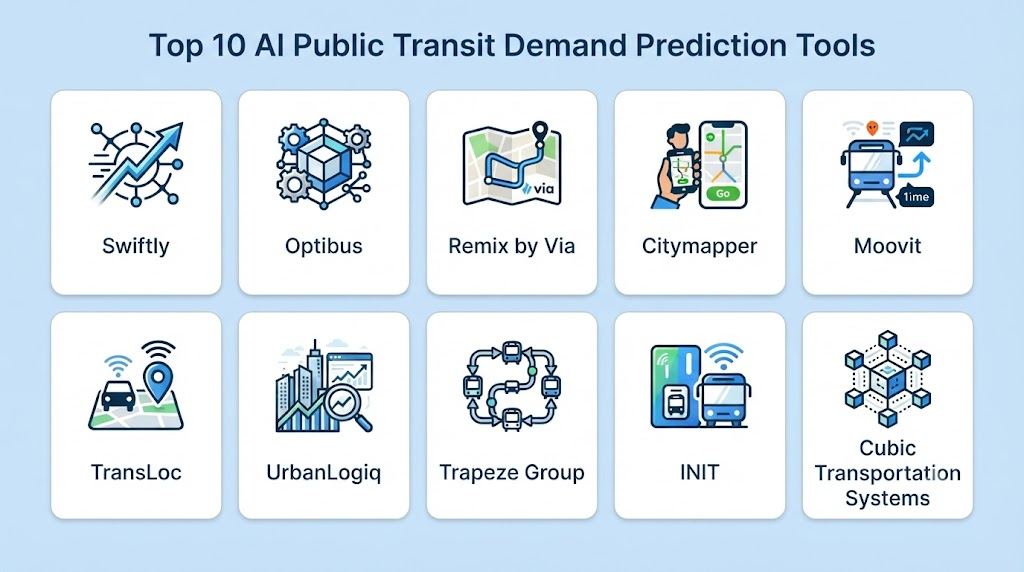
Top 10 AI Public Transit Demand Prediction Tools
1 — Remix by Via
One-line verdict: Best for transit agencies combining demand analysis, service planning, network design, and scenario modeling.
Short description:
Remix is a transportation planning platform associated with Via that helps agencies design, analyze, and evaluate public transit networks. Its planning capabilities can support demand-informed decisions around routes, service levels, and network changes.
Standout Capabilities
- Transit network planning
- Route analysis
- Service planning
- Scenario modeling
- Transit accessibility analysis
- Transportation planning
- Network visualization
- Data-driven planning
AI-Specific Depth
- Model support: Analytics and optimization capabilities vary.
- RAG / knowledge integration: N/A.
- Evaluation: Scenario and transportation-performance analysis.
- Guardrails: Planning constraints and operational parameters.
- Observability: Planning metrics and network analytics.
Pros
- Strong transit-planning focus.
- Useful for evaluating service scenarios.
- Supports network-level transportation decisions.
Cons
- More focused on planning than real-time demand forecasting.
- Advanced predictive capabilities vary by implementation.
- Requires quality transportation data.
Security & Compliance
Security, privacy, access controls, and retention vary by deployment and agreement.
Deployment & Platforms
- Cloud
- Web
- Enterprise
Integrations & Ecosystem
Remix can work with transportation datasets and planning workflows.
- Transit data
- GTFS
- GIS
- Ridership data
- Network planning
- APIs
- Transportation analytics
Pricing Model
Enterprise/custom pricing.
Best-Fit Scenarios
- Transit network planning
- Service redesign
- Demand-informed planning
2 — Optibus
One-line verdict: Best for transit operators combining AI-assisted planning, scheduling, fleet allocation, and operational forecasting.
Short description:
Optibus provides software for public transportation planning and operations. Its platform supports scheduling, route planning, vehicle allocation, and operational decision-making, making it useful for organizations connecting demand forecasts with service planning.
Standout Capabilities
- Transit scheduling
- Route planning
- Vehicle scheduling
- Driver scheduling
- Service planning
- Fleet optimization
- Scenario analysis
- Operational planning
AI-Specific Depth
- Model support: Proprietary optimization and analytics capabilities.
- RAG / knowledge integration: N/A.
- Evaluation: Planning and operational scenario evaluation.
- Guardrails: Scheduling and operational constraints.
- Observability: Operational planning metrics.
Pros
- Strong transit-operations focus.
- Connects planning with scheduling.
- Suitable for complex transit networks.
Cons
- Demand prediction is part of a broader transit-planning workflow.
- Requires accurate operational data.
- Enterprise implementations can require substantial configuration.
Security & Compliance
Security and administrative capabilities vary by deployment.
Deployment & Platforms
- Cloud
- Web
- Enterprise
Integrations & Ecosystem
- GTFS
- Vehicle data
- Scheduling systems
- Driver systems
- Fleet-management platforms
- APIs
- Transit data
Pricing Model
Enterprise/custom pricing.
Best-Fit Scenarios
- Large transit operators
- Schedule optimization
- Demand-informed fleet planning
3 — Swiftly
One-line verdict: Best for transit agencies using real-time operational data, analytics, and passenger information to understand changing demand.
Short description:
Swiftly provides transit data and analytics technology for public transportation agencies. Its platform connects operational and passenger-related data to support planning, performance analysis, and better transit decision-making.
Standout Capabilities
- Transit analytics
- Real-time vehicle data
- Performance monitoring
- Passenger information
- Transit planning
- Data integration
- Service analysis
- Operational insights
AI-Specific Depth
- Model support: Proprietary analytics capabilities vary.
- RAG / knowledge integration: N/A.
- Evaluation: Transit-performance analytics.
- Guardrails: Operational rules and agency controls.
- Observability: Real-time transit and performance monitoring.
Pros
- Strong real-time transit data capabilities.
- Useful for operational analytics.
- Designed specifically for public transportation.
Cons
- Demand prediction is part of a broader analytics ecosystem.
- Forecasting capabilities vary by implementation.
- Requires integration with agency data.
Security & Compliance
Security and privacy controls vary according to deployment.
Deployment & Platforms
- Cloud
- Web
- Mobile-facing applications
- APIs
Integrations & Ecosystem
- GTFS
- GTFS-Realtime
- AVL
- Transit data
- APIs
- Passenger-information systems
- Agency systems
Pricing Model
Enterprise/custom pricing.
Best-Fit Scenarios
- Transit analytics
- Operational forecasting
- Real-time transit management
4 — Via Transportation
One-line verdict: Best for agencies using demand-responsive transit and AI-assisted mobility planning to match supply with passenger demand.
Short description:
Via develops technology for demand-responsive transportation, shared mobility, and public transit operations. Its approach is especially relevant when demand prediction needs to connect directly with flexible routing and vehicle allocation.
Standout Capabilities
- Demand-responsive transit
- Dynamic routing
- Fleet allocation
- Passenger matching
- Mobility analytics
- Transit operations
- Route optimization
- Real-time operations
AI-Specific Depth
- Model support: Proprietary optimization and machine-learning capabilities.
- RAG / knowledge integration: N/A.
- Evaluation: Operational and mobility-performance evaluation.
- Guardrails: Service constraints and operational policies.
- Observability: Trip, routing, and operational analytics.
Pros
- Strong demand-responsive transportation expertise.
- Connects demand with operational decisions.
- Useful for flexible transit services.
Cons
- Strongly oriented toward Via’s mobility ecosystem.
- Not primarily a standalone forecasting platform.
- Deployment can involve significant operational integration.
Security & Compliance
Security and privacy controls vary by service and deployment.
Deployment & Platforms
- Cloud
- Web
- Mobile
- APIs
Integrations & Ecosystem
- Transit systems
- GPS
- Booking systems
- Fleet systems
- APIs
- Mobility platforms
- Passenger applications
Pricing Model
Enterprise/project-based pricing.
Best-Fit Scenarios
- Demand-responsive transit
- Microtransit
- Flexible mobility services
5 — PTV Group
One-line verdict: Best for transportation agencies combining demand forecasting, travel modeling, simulation, and network-level planning.
Short description:
PTV Group provides transportation modeling, traffic simulation, and mobility-planning software. Its tools can help agencies model travel demand and evaluate how changes in public transportation services may affect network behavior.
Standout Capabilities
- Travel-demand modeling
- Transportation simulation
- Transit planning
- Network modeling
- Scenario analysis
- Mobility forecasting
- Traffic simulation
- Transportation analytics
AI-Specific Depth
- Model support: Modeling and optimization capabilities vary.
- RAG / knowledge integration: N/A.
- Evaluation: Simulation and scenario evaluation.
- Guardrails: Transportation-model constraints.
- Observability: Simulation and network metrics.
Pros
- Strong transportation modeling capabilities.
- Useful for long-term planning.
- Supports complex network scenarios.
Cons
- More modeling-oriented than operational forecasting.
- Requires specialized transportation expertise.
- Implementation can be complex.
Security & Compliance
Security capabilities vary by product and deployment.
Deployment & Platforms
- Desktop
- Cloud
- Enterprise
- Web
Integrations & Ecosystem
- GIS
- GTFS
- Transportation datasets
- Simulation tools
- APIs
- Planning systems
Pricing Model
Commercial licensing and enterprise pricing vary.
Best-Fit Scenarios
- Transportation planning
- Demand modeling
- Network scenario analysis
6 — Aimsun
One-line verdict: Best for transit planners using detailed simulation to test demand scenarios and network-level transportation strategies.
Short description:
Aimsun provides traffic and transportation simulation technology for analyzing mobility networks. It can help planners model transit scenarios, evaluate changes in demand, and understand interactions between public transportation and road traffic.
Standout Capabilities
- Transportation simulation
- Traffic modeling
- Transit simulation
- Scenario analysis
- Network modeling
- Demand analysis
- Mobility planning
- Performance evaluation
AI-Specific Depth
- Model support: Simulation and optimization capabilities vary.
- RAG / knowledge integration: N/A.
- Evaluation: Extensive scenario and simulation evaluation.
- Guardrails: Model constraints and transportation rules.
- Observability: Simulation metrics and network outputs.
Pros
- Strong simulation environment.
- Useful for complex transportation scenarios.
- Supports network-level analysis.
Cons
- Requires specialized expertise.
- Not primarily a turnkey demand-forecasting service.
- Simulation quality depends on model calibration.
Security & Compliance
Security varies by deployment.
Deployment & Platforms
- Desktop
- Cloud
- Enterprise
- Simulation environments
Integrations & Ecosystem
- Transit data
- GIS
- Traffic models
- Simulation systems
- APIs
- Transportation datasets
Pricing Model
Commercial and enterprise licensing.
Best-Fit Scenarios
- Transit scenario modeling
- Network simulation
- Transportation research
7 — Remix / Transit Planning Platforms
One-line verdict: Best for agencies that need demand-informed transit network design rather than only short-term passenger forecasting.
Short description:
Modern transit-planning platforms allow agencies to combine demographic, ridership, geographic, and operational information when evaluating service changes. These tools are particularly useful for planning rather than minute-by-minute demand prediction.
Standout Capabilities
- Network design
- Service planning
- Ridership analysis
- Scenario planning
- Geographic analysis
- Accessibility analysis
- Route evaluation
- Transit planning
AI-Specific Depth
- Model support: Varies by platform.
- RAG / knowledge integration: N/A.
- Evaluation: Scenario and planning evaluation.
- Guardrails: Planning constraints.
- Observability: Network and service metrics.
Pros
- Useful for strategic planning.
- Supports network-level decisions.
- Helps visualize service changes.
Cons
- Not necessarily a dedicated AI forecasting engine.
- Forecasting depth varies.
- Requires quality transit data.
Security & Compliance
Varies by provider and deployment.
Deployment & Platforms
- Cloud
- Web
- Enterprise
Integrations & Ecosystem
- GTFS
- GIS
- Ridership datasets
- Census and demographic data
- APIs
- Planning systems
Pricing Model
Enterprise/custom pricing.
Best-Fit Scenarios
- Transit network redesign
- Service planning
- Ridership analysis
8 — MATLAB / Simulink
One-line verdict: Best for transportation researchers building custom passenger-demand forecasting models and testing advanced algorithms.
Short description:
MATLAB and Simulink provide machine-learning, statistics, optimization, time-series, and simulation capabilities. Transportation teams can use them to develop custom public-transit demand models using historical ridership and external mobility data.
Standout Capabilities
- Time-series forecasting
- Machine learning
- Deep learning
- Statistical modeling
- Optimization
- Simulation
- Data analysis
- Custom model development
AI-Specific Depth
- Model support: Broad machine-learning and deep-learning support.
- RAG / knowledge integration: N/A.
- Evaluation: Extensive statistical and machine-learning evaluation.
- Guardrails: Model constraints and validation workflows.
- Observability: Model and forecasting analytics.
Pros
- Highly customizable.
- Strong analytical capabilities.
- Suitable for research and proprietary models.
Cons
- Requires technical expertise.
- Production deployment requires additional infrastructure.
- Not a turnkey transit operations platform.
Security & Compliance
Security depends on deployment and organizational configuration.
Deployment & Platforms
- Windows
- macOS
- Linux
- Cloud
- Engineering environments
Integrations & Ecosystem
- Python
- APIs
- GIS
- Databases
- Machine-learning frameworks
- Simulation tools
- Transportation datasets
Pricing Model
Commercial licensing; exact pricing varies.
Best-Fit Scenarios
- Custom demand models
- Transit research
- Advanced forecasting
9 — Python ML Ecosystem
One-line verdict: Best for developer teams building highly customized public-transit demand forecasting pipelines.
Short description:
Python’s machine-learning ecosystem provides a flexible foundation for transit demand prediction. Teams can combine forecasting libraries, deep-learning frameworks, geospatial tools, databases, and public-transit datasets into custom solutions.
Standout Capabilities
- Time-series forecasting
- Machine learning
- Deep learning
- Geospatial analysis
- Data engineering
- Model experimentation
- Custom APIs
- Automated pipelines
AI-Specific Depth
- Model support: Broad open-source and hosted-model ecosystem.
- RAG / knowledge integration: Not generally relevant to demand forecasting.
- Evaluation: Highly customizable.
- Guardrails: Application-specific.
- Observability: Depends on the selected infrastructure.
Pros
- Extremely flexible.
- Large developer ecosystem.
- Can reduce dependence on a single vendor.
Cons
- Requires engineering resources.
- Security and governance must be implemented.
- Long-term maintenance becomes the organization’s responsibility.
Security & Compliance
Depends entirely on the selected infrastructure, libraries, cloud environment, and organizational controls.
Deployment & Platforms
- Windows
- macOS
- Linux
- Cloud
- Containers
- Edge
Integrations & Ecosystem
- Pandas
- Scikit-learn
- PyTorch
- TensorFlow
- GIS tools
- Databases
- APIs
Pricing Model
Open-source software ecosystem with infrastructure and enterprise costs varying by implementation.
Best-Fit Scenarios
- Custom forecasting
- Research teams
- Developer-led transit analytics
10 — Google Cloud Vertex AI
One-line verdict: Best for organizations building scalable custom transit-demand forecasting systems on managed cloud machine-learning infrastructure.
Short description:
Google Cloud’s Vertex AI provides managed machine-learning infrastructure that can support custom forecasting pipelines. Transit agencies or technology providers can combine historical ridership, GPS, weather, event, and geographic data to develop forecasting systems.
Standout Capabilities
- Machine-learning development
- Model training
- Model deployment
- Data pipelines
- Forecasting workflows
- Model monitoring
- Enterprise infrastructure
- Custom AI applications
AI-Specific Depth
- Model support: Multiple machine-learning approaches and model-development options.
- RAG / knowledge integration: Available capabilities exist but are generally not central to transit demand forecasting.
- Evaluation: Model evaluation and monitoring capabilities.
- Guardrails: Cloud security and AI governance capabilities vary.
- Observability: Model and infrastructure monitoring capabilities.
Pros
- Scalable cloud infrastructure.
- Strong ML ecosystem.
- Suitable for custom forecasting pipelines.
Cons
- Requires cloud and ML expertise.
- Costs depend heavily on usage.
- Transit-specific functionality must generally be developed or integrated.
Security & Compliance
Cloud security, identity, access management, encryption, logging, and governance capabilities depend on configuration and applicable services.
Deployment & Platforms
- Cloud
- APIs
- Containers
- Enterprise infrastructure
Integrations & Ecosystem
- Cloud data warehouses
- Databases
- APIs
- Machine-learning pipelines
- Geospatial data
- Analytics systems
- Data engineering tools
Pricing Model
Usage-based cloud pricing.
Best-Fit Scenarios
- Custom enterprise forecasting
- Large-scale ML
- Cloud-native transit analytics
Comparison Table
| Tool | Best For | Deployment | Model Flexibility | Strength | Watch-Out | Public Rating |
|---|---|---|---|---|---|---|
| Remix by Via | Transit planning | Cloud | Proprietary | Network planning | Forecasting depth varies | |
| Optibus | Transit operations | Cloud | Proprietary | Scheduling and optimization | Enterprise configuration | |
| Swiftly | Transit analytics | Cloud | Proprietary | Real-time data | Product-dependent forecasting | |
| Via Transportation | Demand-responsive transit | Cloud | Proprietary | Dynamic mobility | Ecosystem-oriented | |
| PTV Group | Demand modeling | Cloud/Desktop | Multi-model | Transportation modeling | Specialist expertise | |
| Aimsun | Simulation | Cloud/Desktop | Multi-model | Network simulation | Calibration required | |
| Remix / Planning Platforms | Service planning | Cloud | Varies | Scenario analysis | Not always real-time | |
| MATLAB / Simulink | Custom forecasting | Desktop/Cloud | Multi-model | Technical flexibility | Requires expertise | |
| Python ML Ecosystem | Custom development | Cloud/Desktop | Open-source | Maximum flexibility | Maintenance burden | |
| Google Cloud Vertex AI | Enterprise ML | Cloud | Multi-model | Scalability | Requires cloud expertise |
Scoring & Evaluation
These scores are comparative editorial assessments rather than official vendor ratings. Actual forecasting quality depends on data availability, passenger-count accuracy, network complexity, model selection, and operational conditions.
| Tool | Core | Reliability/Eval | Guardrails | Integrations | Ease | Perf/Cost | Security/Admin | Support | Weighted Total |
|---|---|---|---|---|---|---|---|---|---|
| Remix by Via | 9 | 8 | 9 | 9 | 9 | 8 | 9 | 9 | 8.75 |
| Optibus | 10 | 9 | 9 | 10 | 8 | 8 | 9 | 10 | 9.05 |
| Swiftly | 9 | 9 | 9 | 10 | 9 | 8 | 9 | 9 | 9.05 |
| Via Transportation | 9 | 9 | 9 | 9 | 9 | 8 | 9 | 9 | 8.95 |
| PTV Group | 10 | 10 | 9 | 9 | 7 | 8 | 9 | 10 | 9.00 |
| Aimsun | 9 | 10 | 9 | 9 | 7 | 8 | 9 | 9 | 8.85 |
| Remix / Planning Platforms | 9 | 8 | 9 | 9 | 9 | 8 | 9 | 9 | 8.75 |
| MATLAB / Simulink | 10 | 10 | 10 | 10 | 7 | 7 | 9 | 10 | 9.25 |
| Python ML Ecosystem | 10 | 10 | 9 | 10 | 6 | 9 | 7 | 10 | 9.05 |
| Google Cloud Vertex AI | 10 | 10 | 9 | 10 | 7 | 8 | 10 | 10 | 9.30 |
Top 3 for Enterprise
- Google Cloud Vertex AI
- Optibus
- Swiftly
Top 3 for SMB
- Swiftly
- Remix by Via
- Via Transportation
Top 3 for Developers
- Python ML Ecosystem
- MATLAB / Simulink
- Google Cloud Vertex AI
Which AI Public Transit Demand Prediction Tool Is Right for You?
Solo / Freelancer
Developers and researchers typically need access to datasets and flexible modeling tools rather than a complete transit-management suite.
Prioritize:
- Python compatibility
- Historical ridership data
- Time-series models
- GIS support
- APIs
- Experiment tracking
- Model evaluation
A custom Python solution can be effective when technical expertise is available.
SMB
Smaller transit operators should prioritize simple analytics and practical forecasting.
Look for:
- Ridership dashboards
- Route-level forecasting
- Automated reports
- Schedule planning
- Passenger-count integration
- Basic scenario analysis
A specialized transit platform can reduce the engineering burden.
Mid-Market
Mid-sized agencies should connect demand forecasting with actual operational planning.
A practical architecture is:
Ridership Data → Data Quality → Demand Forecast → Capacity Analysis → Schedule/Fleet Planning → Performance Monitoring
This makes the forecast actionable instead of treating it as a standalone analytics report.
Enterprise
Large transit agencies should evaluate:
- Network-wide forecasts
- Stop-level predictions
- Real-time passenger data
- Multimodal data
- Event and weather integration
- Automated forecasting pipelines
- Model monitoring
- Digital twins
- Scenario planning
- Data governance
- API access
Optibus, Swiftly, PTV Group, and cloud ML platforms can serve different parts of this architecture.
Regulated Industries
Public transportation agencies should pay particular attention to:
- Passenger-data privacy
- Location-data governance
- Access control
- Data retention
- Encryption
- Audit logs
- Vendor security
- Model governance
- Public-sector procurement requirements
Budget vs Premium
A smaller agency may only need historical ridership forecasting and route-level analytics.
Premium deployments become more valuable when the agency needs:
- Real-time forecasting
- Network-wide optimization
- Automated fleet allocation
- High-frequency predictions
- Large-scale data pipelines
- Advanced simulation
- Custom machine-learning models
Build vs Buy
Build when forecasting is strategically important and the organization has data scientists, engineers, and transportation experts.
Buy when the agency wants faster deployment, integrated transit workflows, and vendor support.
A hybrid approach is often effective: use a commercial transit platform for operational data and build specialized forecasting models for unique routes or passenger-demand patterns.
Implementation Playbook
30 Days: Pilot + Success Metrics
- Identify high-value routes.
- Collect historical ridership.
- Validate passenger-count data.
- Gather vehicle-location information.
- Identify seasonal patterns.
- Collect relevant weather information.
- Identify major local events.
- Establish baseline forecasting accuracy.
Track:
- Mean absolute error
- Forecast bias
- Peak-demand accuracy
- Route-level accuracy
- Stop-level accuracy
- Forecast latency
- Operational usefulness
60 Days: Harden Security + Evaluation + Rollout
- Build the production forecasting pipeline.
- Integrate real-time data where available.
- Compare multiple forecasting approaches.
- Create an evaluation dataset.
- Test peak and off-peak periods.
- Test unusual demand conditions.
- Add model-version tracking.
- Establish data-quality monitoring.
- Configure access controls.
- Validate privacy and retention policies.
90 Days: Optimize Cost + Latency + Governance
- Expand forecasting to additional routes.
- Add station or stop-level predictions.
- Incorporate event and weather signals.
- Connect forecasts with scheduling.
- Add capacity planning.
- Monitor model drift.
- Automate forecast reporting.
- Establish governance processes.
- Optimize model infrastructure costs.
- Create long-term performance dashboards.
Common Mistakes & How to Avoid Them
- Using only historical ridership: Demand can change because of weather, events, construction, and service disruptions.
- Ignoring data quality: Incorrect passenger counts can distort forecasts.
- Forecasting only at network level: Route and stop-level differences can be substantial.
- Ignoring seasonality: School schedules, holidays, and seasonal travel can strongly affect demand.
- Ignoring special events: Concerts, sports events, festivals, and public gatherings can cause major demand spikes.
- Using one model for every route: Different routes may have very different demand characteristics.
- Skipping baseline comparisons: AI should demonstrate improvement over existing forecasting methods.
- Ignoring forecast uncertainty: A prediction should ideally communicate uncertainty, not only a single number.
- No model monitoring: Forecast quality can deteriorate as travel patterns change.
- Ignoring service disruptions: Disruptions can make historical patterns temporarily unreliable.
- Over-automating scheduling: Human transit planners should review major service changes.
- Ignoring privacy: Passenger and location datasets can contain sensitive mobility information.
- Ignoring integration: Forecasts are most valuable when connected to scheduling and fleet decisions.
- Underestimating infrastructure costs: Large-scale forecasting requires reliable data pipelines and computing infrastructure.
FAQs
What is AI public transit demand prediction?
It is the use of machine learning and transportation data to estimate future passenger demand for buses, trains, metro services, and other public transportation.
What data is used for transit demand forecasting?
Common inputs include historical ridership, ticketing data, passenger counts, vehicle locations, schedules, weather, events, holidays, demographics, and service disruptions.
Can AI predict passenger demand by route?
Yes. Models can forecast demand at network, route, corridor, station, stop, or time-period levels depending on the available data.
Can AI predict crowding?
Yes. Demand forecasts can be combined with vehicle capacity and scheduled service to estimate potential crowding.
Can AI predict demand in real time?
Yes. Real-time passenger counts, vehicle locations, ticketing data, and other signals can be incorporated into short-term forecasting systems.
How accurate are AI transit forecasts?
There is no universal accuracy level. Results depend on data quality, forecast horizon, route characteristics, model selection, and unexpected events.
Can AI account for weather?
Yes. Weather variables such as temperature, rainfall, snow, and extreme conditions can be incorporated into forecasting models when relevant data is available.
Can AI predict demand during special events?
Yes. Event information can be incorporated to estimate unusual passenger volumes, although the quality of the prediction depends on the availability and accuracy of event data.
Can small transit agencies use AI forecasting?
Yes. Smaller agencies can use cloud-based analytics or simpler machine-learning models without building a large internal data-science team.
Does public transit demand prediction require AI?
No. Traditional statistical forecasting can still work well for stable demand patterns. AI becomes particularly useful when relationships are complex or large numbers of data sources need to be combined.
Can transit agencies build their own forecasting models?
Yes. Agencies with data-science capabilities can develop models using Python, machine-learning frameworks, statistical tools, and transportation datasets.
Should transit forecasts be automated?
Forecast generation can be automated, but important service-planning decisions should normally include appropriate human review.
What is the difference between demand prediction and transit optimization?
Demand prediction estimates future passenger requirements. Optimization uses those forecasts to help determine schedules, routes, fleet allocation, capacity, or other operational decisions.
How much does AI transit demand prediction cost?
Costs vary based on data volume, software, cloud infrastructure, integrations, fleet size, forecast frequency, and implementation requirements.
How should agencies evaluate a forecasting platform?
Compare forecast accuracy against a baseline, evaluate route-level performance, test unusual conditions, assess latency, measure operational usefulness, and verify security and governance requirements.
Can AI support demand-responsive transit?
Yes. Demand forecasts can complement dynamic routing and vehicle-allocation systems, particularly when passenger demand changes throughout the day.
Conclusion
AI Public Transit Demand Prediction can help transportation organizations move from reactive service planning toward more data-driven decisions. The strongest implementations combine ridership history with real-time operational information, weather, events, vehicle locations, passenger counts, and network characteristics.Optibus is particularly relevant when forecasting needs to connect with transit scheduling and operations. Swiftly is well suited to agencies focused on transit data and operational analytics, while Via Transportation is particularly relevant to demand-responsive mobility. PTV Group and Aimsun are valuable for transportation modeling and simulation, while Python, MATLAB / Simulink, and cloud ML platforms provide greater flexibility for organizations building customized forecasting systems.The best solution depends on the agency’s size, data maturity, operational complexity, technical capabilities, and forecasting requirem