Introduction
Parameter-Efficient Fine-Tuning (PEFT) tooling is a set of frameworks and platforms designed to fine-tune large AI models without modifying all model parameters. Instead of retraining an entire model, PEFT leverages techniques such as adapters, LoRA (Low-Rank Adaptation), prefix-tuning, and prompt-tuning to efficiently update only a small subset of parameters. This drastically reduces computational cost, storage requirements, and training time, while enabling highly customizable models.
In 2026, PEFT tooling is critical as model sizes have ballooned into hundreds of billions of parameters, making traditional full fine-tuning impractical for most organizations. PEFT enables startups, enterprises, and research labs to adapt large language and multimodal models to domain-specific tasks without the prohibitive resource expenditure.
Real-world use cases include:
- Adapting large language models for enterprise customer support and knowledge bases.
- Fine-tuning multimodal AI models for medical imaging or scientific research.
- Quickly updating models for new product catalogs, regulatory requirements, or domain-specific jargon.
- Experimenting with multiple specialized models without incurring full retraining costs.
- Developing conversational AI with consistent personality or brand tone.
- Academic and research projects that require reproducible fine-tuning experiments with limited hardware.
Evaluation Criteria for Buyers:
- Support for multiple PEFT methods (LoRA, adapters, prompt-tuning, prefix-tuning).
- Compatibility with popular LLM frameworks (PyTorch, TensorFlow, JAX).
- Ease of integration into existing ML pipelines.
- Training efficiency and memory footprint reduction.
- Model evaluation and benchmarking support.
- Guardrails for avoiding model drift or performance regressions.
- Observability and logging of fine-tuning runs.
- Security and enterprise compliance.
- Reproducibility and version control.
- Support for distributed and multi-GPU training.
- Interoperability with RAG pipelines or vector databases.
- Community support and documentation quality.
Best for: AI researchers, ML engineers, NLP developers, enterprises deploying domain-specific LLMs, and academic labs experimenting with large models.
Not ideal for: Teams using only small models, organizations without GPU resources, or workflows that require fully managed SaaS AI models.
What’s Changed in PEFT Tooling
- Native support for extremely large models (100B+ parameters) with memory-efficient adapters.
- Integration of multimodal fine-tuning workflows for text, vision, and audio.
- Built-in evaluation pipelines to test for hallucinations, bias, and task-specific accuracy.
- Advanced distributed training support across GPU and TPU clusters.
- Pre-configured LoRA and adapter modules for popular LLM architectures.
- Optimized for low-latency inference while maintaining model accuracy.
- Guardrails to prevent catastrophic forgetting during incremental fine-tuning.
- Enterprise-grade observability dashboards for cost, latency, and token metrics.
- Interoperability with RAG, vector DBs, and knowledge integration frameworks.
- Versioning and experiment tracking to ensure reproducibility.
- Reduced compute and storage costs by leveraging PEFT methods over full fine-tuning.
- Enhanced community models, benchmarks, and pre-built PEFT configurations.
Quick Buyer Checklist
- Verify PEFT method support: LoRA, adapters, prompt-tuning, prefix-tuning.
- Confirm framework compatibility: PyTorch, TensorFlow, JAX.
- Check training efficiency and GPU/memory usage.
- Evaluate reproducibility and experiment tracking.
- Assess observability and monitoring features.
- Ensure security and enterprise compliance.
- Confirm integration with RAG pipelines and vector DBs.
- Check for distributed and multi-GPU training support.
- Consider community support and documentation quality.
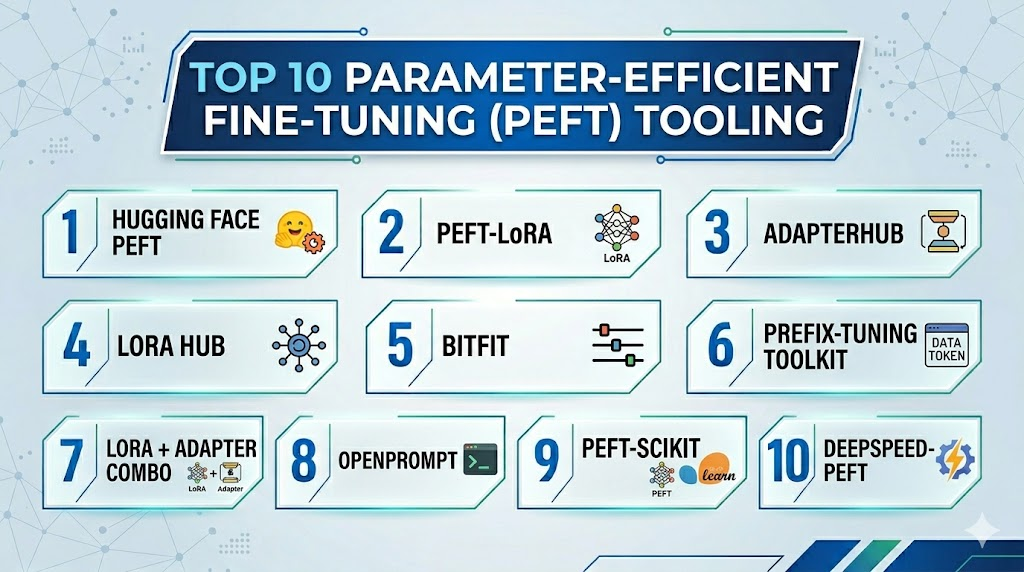
Top 10 Parameter-Efficient Fine-Tuning (PEFT) Tooling (Updated)
1- Hugging Face PEFT Library
One-line verdict: Best for developers and researchers needing a community-driven, versatile PEFT toolkit with broad LLM support.
Short description: Provides modular PEFT implementations (LoRA, adapters, prompt-tuning) integrated with the Transformers library for PyTorch and TensorFlow models.
Standout Capabilities
- LoRA, adapters, and prefix-tuning support.
- Seamless integration with Transformers.
- Pre-configured examples for multiple architectures.
- Supports multi-GPU and distributed training.
- Versioned fine-tuning pipelines.
- Community-contributed adapters and LoRA modules.
AI-Specific Depth
- Model support: open-source / BYO
- RAG / knowledge integration: connectors
- Evaluation: offline and human-in-loop tests
- Guardrails: N/A
- Observability: token metrics, training logs
Pros
- Strong community support.
- Wide framework compatibility.
- Flexible PEFT methods.
Cons
- Requires understanding Transformers library.
- Some features need manual tuning.
- Enterprise-level governance is limited.
Security & Compliance
SSO/RBAC optional via Hugging Face Hub. Certifications: Not publicly stated.
Deployment & Platforms
Web, Linux, macOS, Windows. Cloud and self-hosted.
Integrations & Ecosystem
Python SDK, CLI, Transformers, Gradio demos, ML pipelines, CI/CD.
Pricing Model
Open-source core; enterprise tier for private models.
Best-Fit Scenarios
- Research and experimentation.
- Fine-tuning domain-specific LLMs.
- Multi-team collaboration with shared adapters.
2- PEFT-LoRA
One-line verdict: Optimized for LoRA-based fine-tuning workflows on large LLMs with minimal GPU memory overhead.
Short description: Focuses on low-rank adaptation of model layers, enabling efficient fine-tuning with fewer trainable parameters.
Standout Capabilities
- Supports LoRA for transformer-based models.
- Reduces memory footprint significantly.
- Easy integration into PyTorch training loops.
- Compatible with distributed training.
- Pre-built scripts for common NLP tasks.
AI-Specific Depth
- Model support: open-source / BYO
- RAG / knowledge integration: N/A
- Evaluation: regression tests
- Guardrails: N/A
- Observability: training logs, latency metrics
Pros
- Highly memory-efficient.
- Accelerates fine-tuning of large models.
- Supports distributed workflows.
Cons
- Limited to LoRA approach.
- Fewer pre-built adapters.
- Requires PyTorch expertise.
Security & Compliance
Varies / N/A.
Deployment & Platforms
Linux, macOS, Cloud. Self-hosted.
Integrations & Ecosystem
PyTorch, MLflow, Hugging Face Transformers, training pipelines.
Pricing Model
Open-source.
Best-Fit Scenarios
- Adapting LLMs with limited GPU resources.
- Domain-specific NLP fine-tuning.
- Research-focused LoRA experimentation.
3- AdapterHub
One-line verdict: Ideal for modular adapter-based PEFT workflows across NLP, vision, and speech models.
Short description: Provides an ecosystem of adapters for efficient fine-tuning, with pre-trained and community-contributed modules.
Standout Capabilities
- Task-specific adapters for transformers.
- Pre-trained adapters available.
- Adapter composition for multi-task learning.
- Integration with Hugging Face and PyTorch.
- Experiment tracking and versioning.
AI-Specific Depth
- Model support: open-source / BYO
- RAG / knowledge integration: N/A
- Evaluation: offline task benchmarking
- Guardrails: N/A
- Observability: training logs
Pros
- Reusable adapters.
- Multi-task flexibility.
- Strong community ecosystem.
Cons
- Limited enterprise governance.
- Only supports adapter PEFT.
- Documentation varies by adapter.
Security & Compliance
Varies / N/A.
Deployment & Platforms
Linux, macOS, Cloud. Self-hosted optional.
Integrations & Ecosystem
PyTorch, Hugging Face, APIs, CLI, CI/CD.
Pricing Model
Open-source.
Best-Fit Scenarios
- Multi-task NLP deployment.
- Academic research on adapters.
- Experimentation with pre-trained modules.
4- LoRA Hub
One-line verdict: Focused hub for LoRA experiments, enabling fast adaptation of large models with minimal compute.
Short description: Specialized repository for LoRA-based fine-tuning modules, templates, and community-contributed weights.
Standout Capabilities
- Pre-built LoRA modules for popular architectures.
- Easy plug-and-play with PyTorch.
- Memory-efficient training scripts.
- Adapter composition support.
- Versioned module management.
AI-Specific Depth
- Model support: open-source / BYO
- RAG / knowledge integration: N/A
- Evaluation: offline validation
- Guardrails: N/A
- Observability: training metrics
Pros
- Simple integration.
- Low compute footprint.
- Focused community contributions.
Cons
- Narrow PEFT approach.
- Limited multimodal support.
- Enterprise governance features minimal.
Security & Compliance
Varies / N/A.
Deployment & Platforms
Linux, macOS, Cloud. Self-hosted possible.
Integrations & Ecosystem
PyTorch, Hugging Face Transformers, experiment pipelines.
Pricing Model
Open-source.
Best-Fit Scenarios
- NLP fine-tuning with minimal compute.
- LoRA research experimentation.
- Domain-specific adaptations.
5- BitFit
One-line verdict: Best for lightweight fine-tuning with only bias term adaptation for rapid experimentation.
Short description: Adapts only bias parameters in transformer models, providing ultra-efficient fine-tuning for small datasets.
Standout Capabilities
- Bias-only parameter adaptation.
- Extremely memory-efficient.
- Works with multiple transformer architectures.
- Fast training cycles.
- Minimal storage overhead.
AI-Specific Depth
- Model support: open-source / BYO
- RAG / knowledge integration: N/A
- Evaluation: offline evaluation
- Guardrails: N/A
- Observability: training logs
Pros
- Ultra-lightweight tuning.
- Quick experiments.
- Minimal infrastructure requirements.
Cons
- Limited adaptation power.
- Cannot capture complex task-specific nuances.
- Narrow applicability.
Security & Compliance
Varies / N/A.
Deployment & Platforms
Linux, macOS, Cloud. Self-hosted optional.
Integrations & Ecosystem
PyTorch, Transformers, experiment pipelines.
Pricing Model
Open-source.
Best-Fit Scenarios
- Rapid prototyping.
- Small dataset adaptation.
- Low-resource experimentation.
6- Prefix-Tuning Toolkit
One-line verdict: Suited for researchers implementing prefix-tuning strategies to steer large LLMs efficiently.
Short description: Provides modular scripts and configurations for prefix-tuning, controlling model behavior via small learned vectors.
Standout Capabilities
- Prefix tuning support for multiple transformers.
- Configurable vector length and placement.
- Works with large LLMs efficiently.
- Supports multi-task adaptation.
- Evaluation scripts included.
AI-Specific Depth
- Model support: open-source / BYO
- RAG / knowledge integration: N/A
- Evaluation: offline benchmarks
- Guardrails: N/A
- Observability: training metrics
Pros
- Efficient control of model outputs.
- Reduces training time and cost.
- Flexible multi-task support.
Cons
- Limited community adoption.
- Requires familiarity with LLM internals.
- Narrow applicability beyond NLP.
Security & Compliance
Varies / N/A.
Deployment & Platforms
Linux, macOS, Cloud. Self-hosted optional.
Integrations & Ecosystem
PyTorch, Transformers, experiment pipelines, APIs.
Pricing Model
Open-source.
Best-Fit Scenarios
- Task-specific output steering.
- Large model adaptation with minimal compute.
- Multi-task NLP research.
7- LoRA + Adapter Combo Toolkit
One-line verdict: Ideal for developers experimenting with combined PEFT methods for high-accuracy fine-tuning.
Short description: Combines LoRA and adapters for flexible, modular parameter-efficient fine-tuning, balancing memory efficiency and task coverage.
Standout Capabilities
- Supports LoRA + adapter combination.
- Memory-efficient multi-task tuning.
- Pre-built templates for transformer models.
- Multi-GPU support.
- Training metrics and logs.
AI-Specific Depth
- Model support: open-source / BYO
- RAG / knowledge integration: N/A
- Evaluation: offline testing
- Guardrails: N/A
- Observability: latency, memory metrics
Pros
- Flexible tuning strategies.
- Efficient resource usage.
- Supports multi-task models.
Cons
- Complex configuration.
- Narrow community adoption.
- Limited enterprise tooling.
Security & Compliance
Varies / N/A.
Deployment & Platforms
Linux, macOS, Cloud. Self-hosted possible.
Integrations & Ecosystem
PyTorch, Transformers, experiment pipelines, CI/CD.
Pricing Model
Open-source.
Best-Fit Scenarios
- Multi-task NLP experiments.
- Domain-specific model adaptation.
- Research pipelines requiring combined PEFT.
8- OpenPrompt
One-line verdict: Best for prompt-tuning workflows enabling low-cost fine-tuning via soft prompt vectors.
Short description: Focuses on prompt-based PEFT strategies for LLMs, providing tools for learning soft prompts without full parameter updates.
Standout Capabilities
- Soft prompt training for NLP tasks.
- Template-based prompt design.
- Supports multiple transformer models.
- Pre-built evaluation pipelines.
- Multi-GPU support.
AI-Specific Depth
- Model support: open-source / BYO
- RAG / knowledge integration: connectors
- Evaluation: offline task benchmarks
- Guardrails: N/A
- Observability: training logs, token metrics
Pros
- Low-resource fine-tuning.
- Fast experimentation.
- Works across multiple models.
Cons
- Limited control over deep model behavior.
- NLP-focused only.
- Requires understanding prompt mechanics.
Security & Compliance
Varies / N/A.
Deployment & Platforms
Linux, macOS, Cloud. Self-hosted optional.
Integrations & Ecosystem
PyTorch, Transformers, vector DB connectors, experiment pipelines.
Pricing Model
Open-source.
Best-Fit Scenarios
- NLP fine-tuning with small datasets.
- Experimenting with prompt strategies.
- Rapid prototyping of LLM behavior.
9- PEFT-SciKit
One-line verdict: Focused on classical ML and small transformer models for lightweight PEFT experiments.
Short description: Provides parameter-efficient training techniques for classical ML and small transformer models with easy scikit-learn integration.
Standout Capabilities
- Supports adapters, LoRA for smaller models.
- Scikit-learn pipeline integration.
- Training metrics and logging.
- Lightweight resource footprint.
- Multi-task capability.
AI-Specific Depth
- Model support: open-source / BYO
- RAG / knowledge integration: N/A
- Evaluation: offline validation
- Guardrails: N/A
- Observability: training logs
Pros
- Lightweight and easy to integrate.
- Fast training.
- Supports multi-task experiments.
Cons
- Limited large LLM support.
- Few community-contributed modules.
- Narrow applicability beyond ML research.
Security & Compliance
Varies / N/A.
Deployment & Platforms
Linux, macOS, Cloud. Self-hosted possible.
Integrations & Ecosystem
Python SDKs, scikit-learn, PyTorch.
Pricing Model
Open-source.
Best-Fit Scenarios
- Small-scale ML experimentation.
- Academic research with limited compute.
- Lightweight transformer adaptation.
10- DeepSpeed-PEFT
One-line verdict: Enterprise-focused toolkit for distributed PEFT fine-tuning with large-scale LLM support.
Short description: Leverages DeepSpeed for efficient distributed fine-tuning of very large models using adapters, LoRA, and other PEFT methods.
Standout Capabilities
- Distributed multi-GPU fine-tuning.
- Supports LoRA, adapters, and mixed PEFT strategies.
- Memory and compute optimization.
- Integration with large transformer models.
- Experiment tracking and reproducibility.
AI-Specific Depth
- Model support: open-source / BYO / multi-model
- RAG / knowledge integration: connectors
- Evaluation: offline and online benchmarking
- Guardrails: N/A
- Observability: latency, memory, token metrics
Pros
- Handles extremely large models efficiently.
- Distributed and scalable.
- Flexible PEFT method support.
Cons
- Complex setup for small teams.
- Requires GPUs/TPUs.
- Documentation can be dense.
Security & Compliance
SSO and RBAC possible. Certifications: Not publicly stated.
Deployment & Platforms
Linux, Cloud. Self-hosted possible.
Integrations & Ecosystem
PyTorch, Transformers, vector DB connectors, ML pipelines.
Pricing Model
Open-source.
Best-Fit Scenarios
- Enterprise LLM adaptation.
- Multi-task fine-tuning at scale.
- High-performance research and production.
Comparison Table (Top 10)
| Tool Name | Best For | Deployment | Model Flexibility | Strength | Watch-Out | Public Rating |
|---|---|---|---|---|---|---|
| Hugging Face PEFT | Research & enterprise LLMs | Cloud/Self-hosted | Open-source / BYO | Versatile PEFT toolkit | Enterprise governance limited | N/A |
| PEFT-LoRA | LoRA fine-tuning | Cloud/Self-hosted | Open-source / BYO | Memory-efficient LoRA | Only LoRA | N/A |
| AdapterHub | Modular adapters | Cloud/Self-hosted | Open-source / BYO | Adapter reuse | Limited enterprise tools | N/A |
| LoRA Hub | LoRA experiments | Cloud/Self-hosted | Open-source / BYO | Fast LoRA adaptation | Narrow PEFT focus | N/A |
| BitFit | Bias-only adaptation | Cloud/Self-hosted | Open-source / BYO | Ultra-efficient | Limited adaptation power | N/A |
| Prefix-Tuning Toolkit | Prefix control | Cloud/Self-hosted | Open-source / BYO | Lightweight task steering | Limited adoption | N/A |
| LoRA + Adapter Combo | Combined PEFT | Cloud/Self-hosted | Open-source / BYO | Flexible multi-task tuning | Complex config | N/A |
| OpenPrompt | Soft prompt tuning | Cloud/Self-hosted | Open-source / BYO | Rapid NLP fine-tuning | NLP only | N/A |
| PEFT-SciKit | Small ML / transformers | Cloud/Self-hosted | Open-source / BYO | Lightweight integration | LLM-limited | N/A |
| DeepSpeed-PEFT | Distributed LLM fine-tuning | Cloud/Self-hosted | Open-source / BYO / Multi-model | Large model scalability | Complex setup | N/A |
Scoring & Evaluation (Transparent Rubric)
Weighted scoring: Core 20%, Reliability/Eval 15%, Guardrails 10%, Integrations 15%, Ease 10%, Perf/Cost 15%, Security/Admin 10%, Support 5%.
| Tool | Core | Reliability/Eval | Guardrails | Integrations | Ease | Perf/Cost | Security/Admin | Support | Weighted Total |
|---|---|---|---|---|---|---|---|---|---|
| Hugging Face PEFT | 9 | 8 | 7 | 9 | 8 | 8 | 7 | 8 | 8.3 |
| PEFT-LoRA | 8 | 7 | 6 | 7 | 8 | 9 | 6 | 7 | 7.5 |
| AdapterHub | 8 | 7 | 6 | 8 | 8 | 8 | 6 | 7 | 7.5 |
| LoRA Hub | 7 | 7 | 6 | 7 | 7 | 8 | 6 | 7 | 7.1 |
| BitFit | 6 | 6 | 5 | 6 | 9 | 9 | 5 | 6 | 6.7 |
| Prefix-Tuning Toolkit | 7 | 6 | 5 | 7 | 7 | 8 | 5 | 6 | 6.8 |
| LoRA + Adapter Combo | 8 | 7 | 6 | 8 | 7 | 8 | 6 | 7 | 7.4 |
| OpenPrompt | 7 | 7 | 6 | 7 | 8 | 8 | 6 | 7 | 7.1 |
| PEFT-SciKit | 6 | 6 | 5 | 6 | 8 | 8 | 5 | 6 | 6.5 |
| DeepSpeed-PEFT | 9 | 8 | 7 | 8 | 7 | 9 | 7 | 7 | 8.1 |
Top 3 for Enterprise: Hugging Face PEFT, DeepSpeed-PEFT, LoRA + Adapter Combo
Top 3 for SMB: AdapterHub, PEFT-LoRA, OpenPrompt
Top 3 for Developers: Hugging Face PEFT, PEFT-LoRA, BitFit
Which PEFT Tool Is Right for You?
Solo / Freelancer
Use BitFit or OpenPrompt for low-cost, lightweight experimentation with small datasets.
SMB
AdapterHub or PEFT-LoRA offer flexible, easy-to-deploy PEFT solutions for domain adaptation.
Mid-Market
Hugging Face PEFT or LoRA + Adapter Combo allow multi-task fine-tuning without heavy infrastructure.
Enterprise
DeepSpeed-PEFT and Hugging Face PEFT provide large-scale distributed fine-tuning with robust model tracking.
Regulated industries (finance/healthcare/public sector)
Prefer DeepSpeed-PEFT or enterprise Hugging Face deployment with SSO, RBAC, and audit logging.
Budget vs premium
Low-cost experimentation: BitFit, PEFT-SciKit
High-value enterprise fine-tuning: DeepSpeed-PEFT, Hugging Face PEFT
Build vs buy (when to DIY)
DIY PEFT modules work for research and experimentation; adopt enterprise-grade tooling when scaling to regulated or multi-team production.
Implementation Playbook (30 / 60 / 90 Days)
- 30 days: Pilot a PEFT method (LoRA, adapter, prefix-tuning) on a small dataset; measure accuracy, latency, memory usage. Track metrics and logs.
- 60 days: Harden security, integrate distributed training if needed; run evaluation pipelines; implement experiment versioning.
- 90 days: Optimize cost and latency; expand PEFT methods across teams; enforce guardrails; establish monitoring, audit, and governance procedures.
Common Mistakes & How to Avoid Them
- Ignoring evaluation metrics after fine-tuning.
- No prompt injection or model drift monitoring.
- Untracked or unmanaged experiment versions.
- Overfitting PEFT layers to small datasets.
- Ignoring latency and memory usage on large models.
- Skipping reproducibility checks.
- Using PEFT on unsuitable model architectures.
- Lack of observability and logging.
- Over-reliance on a single PEFT method.
- Vendor lock-in without exportable modules.
- Inconsistent guardrails across teams.
- Insufficient multi-GPU or distributed setup for large models.
FAQs
1- What is Parameter-Efficient Fine-Tuning (PEFT)?
PEFT is a technique to fine-tune large models by updating only a small subset of parameters, reducing cost, memory, and training time.
2- How does LoRA differ from adapters in PEFT?
LoRA modifies low-rank matrices in layers, whereas adapters introduce small neural modules in between layers; both reduce trainable parameters.
3- Can PEFT be used for multimodal models?
Yes, PEFT methods like adapters and prefix-tuning can fine-tune multimodal models across text, vision, and audio.
4- Do I need GPUs for PEFT?
While PEFT is memory-efficient, large LLMs still benefit from GPUs or TPUs, especially for multi-task or distributed training.
5- How is model performance evaluated in PEFT?
Through offline testing, prompt evaluation, regression checks, and sometimes human-in-the-loop verification.
6- Can I combine PEFT methods?
Yes, frameworks like LoRA + Adapter Combo support hybrid approaches for flexible fine-tuning strategies.
7- Are PEFT methods reproducible?
When using versioned modules and proper logging, PEFT experiments are fully reproducible.
8- How does PEFT impact inference latency?
Minimal impact; in many cases, only minor latency overhead occurs compared to full models.
9- Is PEFT suitable for regulated industries?
Yes, with enterprise-grade platforms offering SSO, RBAC, audit logging, and data compliance.
10- Can I integrate PEFT with RAG pipelines?
Many PEFT tools support connector integration with vector databases and RAG-based knowledge augmentation.
11- What are typical PEFT methods available?
LoRA, adapters, prompt-tuning, prefix-tuning, and bias-only tuning (BitFit) are common approaches.
12- Does PEFT reduce cloud costs?
Yes, by fine-tuning fewer parameters, PEFT significantly lowers compute and storage requirements.
Conclusion
PEFT tooling enables organizations to adapt large AI models efficiently, unlocking customization with minimal compute. Selecting the right PEFT tool depends on model size, infrastructure, task complexity, and enterprise requirements. Small teams may prefer BitFit or OpenPrompt for experimentation, while enterprises benefit from DeepSpeed-PEFT or Hugging Face PEFT for large-scale production workflows.
One aspect that could be explored further is adapter management at scale. As organizations create dozens of task-specific PEFT adapters, tracking compatibility, ownership, and lifecycle becomes a significant challenge. Without a clear strategy for adapter discovery and reuse, teams can end up with fragmented AI assets that are difficult to maintain over time.