Introduction
The Certified MLOps Architect is a comprehensive professional program designed for engineers who want to bridge the gap between machine learning development and production operations. This guide is written for software engineers, data professionals, and platform architects who need to understand how models are deployed, monitored, and scaled in enterprise environments. In the current landscape of DevOps and platform engineering, the ability to manage the lifecycle of artificial intelligence models is a critical skill for any senior technical role. This guide is created to help professionals understand the certification landscape and make informed decisions about their career growth. By following this path at Aiopsschool, engineers can transition from manual model handling to automated, scalable architecture.
What is the Certified MLOps Architect?
The Certified MLOps Architect is a validation of an engineer’s ability to design and maintain production-grade machine learning pipelines. It is not focused on the mathematical theory of algorithms but rather on the engineering required to make those algorithms work in a live environment. This certification represents a shift toward Machine Learning Operations where automation and reliability are prioritized. Modern engineering workflows require models to be treated like any other software artifact, requiring version control, CI/CD, and monitoring. This program ensures that enterprise practices are applied to data science projects to reduce the time between model development and deployment.
Who Should Pursue Certified MLOps Architect?
This certification is highly beneficial for DevOps engineers, Site Reliability Engineers (SREs), and Cloud Architects who are tasked with supporting data science teams. Data engineers and machine learning professionals who want to understand the infrastructure side of their work will also find great value here. It is suitable for beginners who have a basic understanding of cloud computing as well as experienced leads who manage large-scale technical teams. For the global market, especially in tech hubs across India and North America, this role is becoming a standard requirement for senior infrastructure positions. Managers who need to oversee the delivery of AI-driven products will gain the necessary technical vocabulary to lead effectively.
Why Certified MLOps Architect is Valuable and Beyond
The demand for MLOps experts is growing as companies realize that most machine learning models never make it to production due to operational bottlenecks. By obtaining this certification, a professional ensures their skills remain relevant even as specific tools and libraries change over time. The focus is on the architectural principles of automation and observability, which are universal across all cloud platforms. Longevity in a technical career is achieved by mastering the delivery process rather than just the code. The return on time invested is significant, as enterprises are actively looking for architects who can reduce the cost and risk of deploying complex models.
Certified MLOps Architect Certification Overview
The program is delivered through the official training portal and is hosted on the Aiopsschool website. It is structured as a comprehensive journey that moves from foundational concepts to advanced architectural design. The assessment approach is practical, requiring candidates to demonstrate knowledge of real-world scenarios rather than memorizing definitions. Ownership of the certification resides with the provider, ensuring that the curriculum is updated as industry standards for cloud-native AI evolve. The structure is designed to be accessible for working professionals who need to balance their learning with daily job responsibilities.
Certified MLOps Architect Certification Tracks & Levels
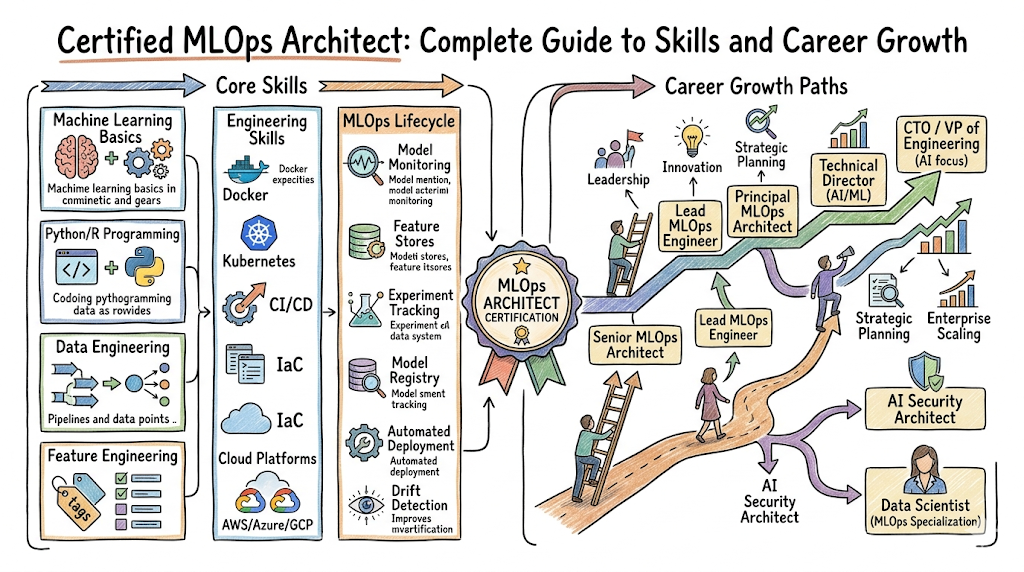
The certification is divided into three distinct levels to accommodate different career stages. The Foundation level is intended for those new to the domain, covering the basic terminology and the MLOps lifecycle. The Professional level moves into the implementation of CI/CD pipelines and model versioning for intermediate engineers. Finally, the Advanced/Architect level is designed for senior professionals who must design entire ecosystems for model governance and global scaling. These levels are aligned with career progression, allowing an engineer to move from a supporting role to a leadership position within the MLOps track.
Complete Certified MLOps Architect Certification Table
| Track | Level | Who it’s for | Prerequisites | Skills Covered | Recommended Order |
| MLOps Core | Foundation | Beginners and Junior DevOps | Basic Cloud Knowledge | MLOps Lifecycle, Tools | First |
| MLOps Core | Professional | Mid-level Engineers | Foundation Level | CI/CD for ML, Testing | Second |
| MLOps Core | Advanced | Senior Architects | Professional Level | Governance, Scaling, Security | Third |
| Specialized | Platform | SRE and Platform Leads | Professional Level | Kubernetes for ML, Monitoring | Optional |
Detailed Guide for Each Certified MLOps Architect Certification
Certified MLOps Architect – Foundation
What it is
This certification validates the fundamental understanding of the MLOps philosophy and the core components of a machine learning pipeline. It is the starting point for anyone entering the field of automated machine learning.
Who should take it
It is suitable for junior developers, system administrators, and recent graduates who want to build a career in specialized cloud operations. It is also a good fit for project managers who work with data teams.
Skills you’ll gain
- Understanding of the MLOps maturity model.
- Knowledge of basic model versioning techniques.
- Familiarity with the data engineering and model training workflow.
Real-world projects you should be able to do
- Setup a basic version control system for datasets.
- Map a manual ML workflow into a structured pipeline document.
Preparation plan
- 7–14 days: Review official documentation and terminology.
- 30 days: Complete all introductory labs and video modules.
- 60 days: Review case studies of basic pipeline deployments.
Common mistakes
- Focusing too much on ML algorithms instead of the operational workflow.
- Skipping the fundamental definitions of model drift.
Best next certification after this
- Same-track option: Professional MLOps Level.
- Cross-track option: DataOps Foundation.
- Leadership option: Certified Engineering Lead.
Certified MLOps Architect – Professional
What it is
This level focuses on the practical implementation of automation within the ML lifecycle. It validates the ability to build and maintain CI/CD pipelines specifically for machine learning models.
Who should take it
Mid-level DevOps engineers and Data engineers who are responsible for the daily deployment of models should take this exam. It requires hands-on experience with automation tools.
Skills you’ll gain
- Implementation of Automated Testing for Models.
- Management of Feature Stores.
- Building deployment pipelines using containers.
Real-world projects you should be able to do
- Create a Jenkins or GitLab pipeline that triggers a model retrain.
- Deploy a model as a microservice using Docker and Kubernetes.
Preparation plan
- 7–14 days: Intensive lab practice with CI/CD tools.
- 30 days: Study model monitoring and alerting strategies.
- 60 days: Full review of end-to-end pipeline automation.
Common mistakes
- Ignoring the importance of data quality checks in the pipeline.
- Failing to account for environment parity between dev and prod.
Best next certification after this
- Same-track option: Advanced MLOps Architect.
- Cross-track option: DevSecOps Professional.
- Leadership option: Technical Program Manager.
Certified MLOps Architect – Advanced
What it is
This certification is for those who design the entire strategy for MLOps within an organization. It covers high-level architecture, security, and cost optimization for AI workloads.
Who should take it
Senior Architects and Principal Engineers who need to make platform-wide decisions should pursue this. It requires a deep understanding of enterprise-scale systems.
Skills you’ll gain
- Designing multi-cloud MLOps architectures.
- Implementing model governance and compliance frameworks.
- Advanced cost management for GPU and cloud resources.
Real-world projects you should be able to do
- Design a globally distributed model serving infrastructure.
- Create a compliance dashboard for model auditing and bias detection.
Preparation plan
- 7–14 days: Deep dive into case studies of enterprise failures.
- 30 days: Architecture design workshops and peer reviews.
- 60 days: Comprehensive study of security and scaling patterns.
Common mistakes
- Over-engineering the solution for small-scale teams.
- Neglecting the financial impact of large-scale model training.
Best next certification after this
- Same-track option: Specialist Platform Architect.
- Cross-track option: FinOps Certified Professional.
- Leadership option: Chief Technology Officer track.
Choose Your Learning Path
DevOps Path
The focus of this path is on integration and deployment. Engineers in this track learn how to apply standard DevOps principles like Infrastructure as Code to machine learning environments. This ensures that the underlying resources for AI are reproducible and consistent across all stages of development. It is the most common path for those transitioning from traditional web operations into the machine learning domain.
DevSecOps Path
In this path, the emphasis is placed on the security of the model and the data. Professionals learn how to scan for vulnerabilities in model artifacts and ensure that the data pipelines comply with privacy regulations. Security is integrated directly into the automated MLOps workflow to prevent data leaks. This path is essential for those working in highly regulated industries like finance or healthcare.
SRE Path
This path is dedicated to the reliability and performance of models in production. Site Reliability Engineers learn how to set Service Level Objectives for model latency and accuracy. Monitoring for model drift and managing incident responses for AI services are key components here. It ensures that the machine learning services meet the same availability standards as the rest of the application stack.
AIOps Path
AIOps focuses on using artificial intelligence to improve general IT operations. This path teaches engineers how to implement ML models that can predict system failures or automate the resolution of tickets. It is about applying the AI toolset to the Ops domain specifically to reduce the noise in monitoring systems. This is a specialized path for those focused on internal platform efficiency.
MLOps Path
The MLOps path is the core journey for managing the machine learning lifecycle. It covers everything from data ingestion and model training to deployment and model retirement. Engineers learn to treat models as first-class citizens in the software delivery process. This path ensures high-frequency updates and high quality for all machine learning products delivered to the end users.
DataOps Path
DataOps is centered on the data supply chain that feeds the machine learning models. This track focuses on data quality, data versioning, and the automation of data pipelines. It ensures that the fuel for the MLOps architect is clean, timely, and reliable. Without a solid DataOps foundation, the outputs of the MLOps pipeline cannot be trusted for business decisions.
FinOps Path
This path addresses the high costs associated with machine learning workloads. Professionals learn how to optimize cloud spending, specifically for expensive GPU instances and large-scale data storage. It provides the financial visibility needed to make MLOps projects sustainable for the business over the long term. This is an essential skill for senior architects managing large budgets.
Role → Recommended Certified MLOps Architect Certifications
| Role | Recommended Certifications |
| DevOps Engineer | Professional MLOps + DevSecOps Foundation |
| SRE | Professional MLOps + SRE Specialist |
| Platform Engineer | Advanced MLOps Architect + Kubernetes Cert |
| Cloud Engineer | Foundation MLOps + Professional MLOps |
| Security Engineer | Professional MLOps + DevSecOps Professional |
| Data Engineer | Professional MLOps + DataOps Specialist |
| FinOps Practitioner | Foundation MLOps + FinOps Certified |
| Engineering Manager | Foundation MLOps + Advanced MLOps |
Next Certifications to Take After Certified MLOps Architect
Same Track Progression
Deep specialization is achieved by moving into niche areas of MLOps. After the Architect level, an engineer might pursue advanced certifications in distributed computing or specific cloud provider AI specialities. This allows the professional to become the primary subject matter expert for large-scale AI infrastructure projects. Continuous learning in this track ensures that an architect stays at the forefront of automation technology and can handle the most complex enterprise requirements.
Cross-Track Expansion
Skill broadening is essential for senior roles that require a wider view of the technical landscape. After mastering MLOps, moving into DevSecOps or FinOps provides a more holistic view of the enterprise. This ensures that the architect is not just deploying models, but doing so securely and cost-effectively, which is highly valued by stakeholders. Expanding into these areas allows a professional to participate in high-level strategic planning and cross-departmental coordination.
Leadership & Management Track
For those looking to move away from hands-on technical work, the leadership track is the next step. Understanding MLOps provides the technical foundation needed to lead data science and engineering departments effectively. This transition focuses on strategy, team building, and aligning technical output with business goals. A leader with an MLOps background is uniquely positioned to manage the risks and opportunities associated with artificial intelligence in a modern business environment.
Training & Certification Support Providers for Certified MLOps Architect
DevOpsSchool
DevOpsSchool is a leading global provider of technical training focused on the entire DevOps spectrum. They offer a deep curriculum that covers automation, containerization, and the integration of machine learning into standard delivery pipelines. Their courses are designed by industry veterans who bring a wealth of practical knowledge to the classroom. For those pursuing the MLOps Architect path, DevOpsSchool provides a robust environment for learning the necessary toolsets like Kubernetes, Terraform, and various CI/CD engines. The organization emphasizes hands-on experience, ensuring that every student can build and manage a production-grade infrastructure. Their vast library of resources and community support makes them a top choice for professionals looking to upskill in a structured manner.
Cotocus
Cotocus is a specialized technical training and consulting firm that focuses on high-end cloud technologies and enterprise-scale operations. They are known for providing intensive, mentor-led programs that help engineering teams adopt modern MLOps practices. Their training approach is highly practical, often incorporating real-world scenarios and business challenges into the learning modules. Cotocus helps professionals understand the nuances of architecting complex systems that are both resilient and scalable. They provide excellent support for those looking to master the architectural side of machine learning, focusing on governance, security, and global deployment strategies. Their expertise in consulting gives them a unique perspective on the skills that are currently in high demand within the global technology market.
Scmgalaxy
Scmgalaxy is a comprehensive community portal and training provider that has been serving the DevOps and Configuration Management industry for many years. They offer an extensive range of tutorials, workshops, and certification guides that are essential for any MLOps aspirant. Their focus on the “Configuration” part of the lifecycle is particularly useful for architects who need to manage model versions and data lineages. Scmgalaxy provides a wealth of free and paid resources that help engineers stay updated with the latest trends in automation and software delivery. Their workshops are known for being interactive and driven by the needs of the community, making it an excellent platform for both beginners and experienced practitioners to collaborate and grow together.
BestDevOps
BestDevOps provides a streamlined and efficient learning path for professionals who need to master DevOps and MLOps tools quickly. Their training programs are designed to be concise and focused on the most critical skills required in the job market today. They offer specialized modules that cover the deployment of machine learning models using modern cloud-native architectures. BestDevOps is an ideal choice for busy engineers who prefer a self-paced learning environment supported by high-quality video content and practical labs. Their focus is on ensuring that every learner can demonstrate competence in the key areas of automation and monitoring. They help individuals build a strong technical portfolio that can be used to advance their careers in the competitive IT industry.
devsecopsschool.com
This provider focuses on the critical intersection of security and operations within the MLOps lifecycle. DevSecOpsSchool offers training that teaches engineers how to integrate security scanning, compliance checks, and vulnerability management into their automated pipelines. This is an essential skill for any MLOps architect who must handle sensitive enterprise data. Their courses provide a deep dive into the tools and practices used to secure containers, models, and cloud infrastructure. By training here, professionals learn how to build architectures that are not only fast and reliable but also secure by design. Their curriculum is highly relevant for those working in sectors like banking, healthcare, and government where security is a primary concern.
sreschool.com
Sreschool.com is dedicated to the principles of Site Reliability Engineering, which are vital for maintaining the health of machine learning models in production. They provide training on how to monitor service levels, manage incidents, and ensure the overall reliability of complex AI systems. For an MLOps architect, understanding the concepts taught here is key to building systems that do not fail under heavy loads. The courses cover observability, error budgets, and post-mortem analysis, providing a structured way to handle operational challenges. Sreschool.com helps engineers transition from a reactive approach to a proactive one, ensuring that the machine learning infrastructure is always performing at its best for the end users.
As the primary platform for the Certified MLOps Architect program, aiopsschool.com is a specialized training site focused on AI-driven operations. They provide a cohesive and comprehensive learning journey that takes an engineer from foundational concepts to advanced architectural design. Their curriculum is specifically tailored to the needs of the MLOps and AIOps domains, offering unique insights that are not found in general DevOps courses. The platform features integrated assessment tools and official certification paths that are recognized across the industry. Aiopsschool.com is the central hub for anyone looking to become an expert in managing the machine learning lifecycle and using AI to improve technical operations in an enterprise setting.
dataopsschool.com
Dataopsschool.com focuses on the essential data management skills that underpin any successful MLOps architecture. They offer courses that teach engineers how to build automated data pipelines, ensure data quality, and manage data versioning at scale. Since data is the core component of machine learning, the training provided here is a critical building block for any architect. Their curriculum covers the entire data supply chain, from ingestion and cleaning to storage and model feeding. Professionals who train at Dataopsschool.com learn how to reduce the friction between data science and operations teams. This ensures that the models always have access to high-quality data, which is necessary for accurate and reliable results in production.
finopsschool.com
Finopsschool.com provides the financial knowledge required to manage the high costs associated with machine learning and cloud infrastructure. They offer specialized training on cloud cost optimization, budgeting, and financial accountability for technical teams. For an MLOps architect, understanding the cost implications of their design choices is crucial for the long-term success of any AI project. The courses cover how to monitor GPU usage, optimize storage costs, and implement financial visibility across the engineering organization. Finopsschool.com helps technical professionals bridge the gap between engineering and finance, allowing them to lead projects that are both technically excellent and financially sustainable for the business.
Frequently Asked Questions (General)
- How difficult is the MLOps certification?
The difficulty is considered mid-to-high because it requires a combination of DevOps, cloud, and data engineering knowledge. It is designed for professionals who already have some technical experience. - How long does it take to get certified?
Most students complete the program within 3 to 6 months. This depends on your prior experience with automation tools and how much time you can dedicate each week. - What are the prerequisites for the exam?
You should have a basic understanding of Linux and cloud computing. Familiarity with Python and the general machine learning lifecycle is also highly recommended. - Is this certification worth the investment?
Yes, MLOps is one of the highest-paying specializations in the current market. It addresses a major skills gap that many enterprises are struggling to fill. - Which level should I start with?
If you are new to MLOps, start with the Foundation level. Those with significant DevOps experience may choose to begin at the Professional level. - Do I need to be a data scientist?
No, you do not need to be a data scientist. This is an engineering role focused on the deployment and management of models, not the creation of the models themselves. - How is the exam structured?
The exam consists of multiple-choice questions and practical scenario-based challenges. It tests your ability to apply MLOps principles to real-world architectural problems. - Is the certification recognized globally?
Yes, the certification is based on industry-standard practices that are used by top technology companies worldwide, including those in India and the US. - Can I renew my certification?
Yes, certifications are usually valid for two to three years. You can renew them by taking an updated exam or completing continuing education credits. - Does it cover specific cloud providers?
The principles are cloud-agnostic, but the practical labs often use platforms like AWS, Azure, or Google Cloud to demonstrate implementation. - What is the difference between MLOps and AIOps?
MLOps is the management of the machine learning lifecycle. AIOps is the use of machine learning to automate and improve general IT operations. - Are there any hands-on labs involved?
Yes, hands-on labs are a core part of the Professional and Architect levels. You must demonstrate your ability to build and monitor pipelines in a real environment.
FAQs on Certified MLOps Architect
- What makes the Certified MLOps Architect program unique compared to standard cloud certifications?
This program specifically addresses the intersection of data science and operations, focusing on the unique challenges of model versioning and deployment. It provides a specialized framework that is not covered in general cloud or DevOps certifications. - How does this certification help in achieving a senior architect role?
It validates your ability to design end-to-end ecosystems for machine learning, which is a high-level strategic task. Companies look for this specific validation when hiring for principal engineer and architectural positions. - Is there a focus on specific MLOps tools like Kubeflow or MLflow?
Yes, the curriculum covers the most popular open-source and proprietary tools in the market. It teaches you how to evaluate and select the right toolset for different enterprise needs. - Can this certification help a manager lead technical teams more effectively?
Absolutely, it provides managers with the technical vocabulary and understanding of the MLOps lifecycle. This allows them to set realistic timelines and better manage the risks associated with AI projects. - Does the program cover model security and compliance?
Security and governance are major components of the Advanced/Architect level. You will learn how to build compliant pipelines that satisfy legal and regulatory requirements for data privacy. - Are there specific tracks for different industries like finance or healthcare?
While the core principles are the same, the program uses case studies from various industries to show how MLOps is applied in different contexts. - What is the assessment approach for the Advanced level?
The Advanced level assessment is focused on architectural design. You may be asked to design a solution for a complex, global-scale machine learning problem as part of the evaluation. - How does the program stay updated with the fast-moving AI industry?
The curriculum is reviewed regularly by industry experts at Aiopsschool. Updates are made as new standards for model management and cloud-native technology emerge.
Final Thoughts
From a career mentoring perspective, the path toward becoming an MLOps Architect is one of the most stable and rewarding routes in modern engineering. We are seeing a fundamental shift where machine learning is moving from a laboratory setting into the heart of business applications. This shift creates a massive need for professionals who can build the “factory” that produces and maintains these models.
Choosing this certification is about more than just adding a line to your resume. It is about gaining the technical maturity to manage the most complex workloads in the cloud today. If you enjoy solving architectural puzzles and want to be at the center of the AI revolution, this investment in your skills will pay off for years to come. Focus on building real pipelines, understanding the failures of production systems, and staying curious. The industry needs architects who can provide reliable solutions in an era of rapid change.
This blog does a great job explaining why data quality is as important as model design. The pros and cons section helps in understanding each tool better.