Introduction
AI Insurance Telematics Risk Scoring uses vehicle, driving, and contextual data to estimate how risky a driving pattern may be for insurance purposes. Instead of relying only on traditional factors, insurers can analyze signals such as acceleration, braking, speeding, cornering, mileage, time of driving, trip patterns, and other telematics information to develop more dynamic risk profiles.
Common use cases include usage-based insurance, pay-as-you-drive programs, driver risk assessment, fleet insurance, claims support, driver coaching, fraud investigation, and personalized insurance pricing.
Best for: Auto insurers, insurtech companies, fleet insurers, brokers, mobility companies, and organizations developing usage-based insurance products.
Not ideal for: Small insurers without sufficient telematics data, organizations operating in markets with restrictive data-use requirements, or businesses where traditional actuarial models already provide sufficient risk differentiation.
What’s Changed in AI Insurance Telematics Risk Scoring
- AI models can analyze substantially larger volumes of driving data than traditional rule-based scoring systems.
- Machine learning can identify combinations of driving behaviors that may not be obvious from individual events.
- Real-time and near-real-time scoring can support driver feedback and risk intervention.
- Smartphone, connected-car, OBD, and embedded-vehicle data can provide different levels of telematics coverage.
- AI can distinguish recurring driving patterns from isolated events.
- Context-aware models can consider road, weather, traffic, time, and trip characteristics where appropriate data is available.
- Advanced analytics can combine historical driving behavior with claims and actuarial information.
- Explainability is becoming more important when scores influence insurance decisions.
- Privacy and consent requirements can significantly affect how telematics data is collected and processed.
- AI governance is increasingly important when automated models influence pricing, underwriting, or eligibility.
- Model monitoring is needed to identify drift as vehicles, roads, driving behavior, and customer populations change.
- Fraud detection can use behavioral patterns to identify inconsistencies in reported or observed activity.
- Edge processing can reduce latency and potentially limit transmission of raw driving data.
- Cloud AI enables large-scale portfolio analysis and model development.
- Insurers increasingly need controls against unfair or unintended proxy variables.
- Human review remains important for consequential underwriting and claims decisions.
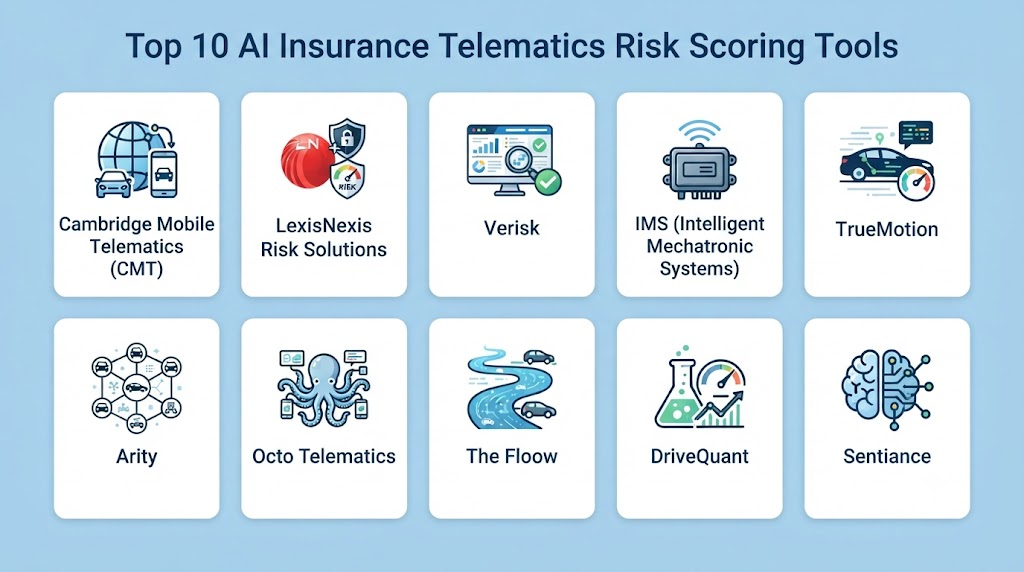
Top 10 AI Insurance Telematics Risk Scoring Tools
1 — Cambridge Mobile Telematics
One-line verdict: Best for insurers seeking large-scale smartphone and sensor-based driving analytics for usage-based insurance programs.
Short description:
Cambridge Mobile Telematics specializes in telematics and mobility intelligence based on smartphone and sensor data. Its technology is designed to analyze driving behavior and support insurance and road-safety applications.
Standout Capabilities
- Smartphone-based telematics
- Driving behavior analytics
- Risk scoring
- Usage-based insurance support
- Driver feedback
- Trip analysis
- Distracted-driving detection
- Mobility analytics
AI-Specific Depth
- Model support: Proprietary machine-learning and telematics models.
- RAG / knowledge integration: N/A as a core capability.
- Evaluation: Driving-data and model-performance evaluation.
- Guardrails: Product and deployment controls.
- Observability: Analytics and monitoring capabilities vary by implementation.
Pros
- Strong specialization in mobile telematics.
- Designed for insurance use cases.
- Can support large-scale driving behavior analysis.
Cons
- Primarily enterprise-oriented.
- Requires access to suitable driving data.
- Exact scoring methodology is proprietary.
Security & Compliance
Specific security controls, certifications, retention policies, and data-residency options should be verified for the applicable deployment.
Deployment & Platforms
- Cloud
- Smartphone
- Mobile applications
- Connected-data environments
Integrations & Ecosystem
Cambridge Mobile Telematics can support insurance programs through telematics data, analytics, and application integrations.
- Mobile sensors
- Smartphone applications
- Insurance platforms
- APIs
- Analytics systems
- Vehicle data
- Customer applications
Pricing Model
Enterprise commercial model; exact pricing is not publicly stated.
Best-Fit Scenarios
- Usage-based insurance
- Smartphone telematics
- Driver-risk analytics
2 — IMS
One-line verdict: Best for insurers wanting established telematics infrastructure for usage-based insurance and driver risk analytics.
Short description:
IMS provides insurance telematics technology designed to help insurers collect and analyze driving data. Its platform supports usage-based insurance and related driver-risk applications.
Standout Capabilities
- Insurance telematics
- Usage-based insurance
- Driver behavior analysis
- Risk scoring
- Telematics data management
- Mobile telematics
- Connected-car data
- Insurance integration
AI-Specific Depth
- Model support: Proprietary analytics and scoring models.
- RAG / knowledge integration: N/A.
- Evaluation: Model and telematics analytics processes vary.
- Guardrails: Deployment-specific controls.
- Observability: Platform-dependent.
Pros
- Insurance-focused.
- Supports multiple telematics approaches.
- Suitable for insurer-scale deployments.
Cons
- Enterprise implementation can be complex.
- Scoring methodologies are not fully public.
- Availability varies by market and program.
Security & Compliance
Specific controls and certifications should be confirmed during procurement.
Deployment & Platforms
- Cloud
- Mobile
- Connected vehicle
- Telematics devices
Integrations & Ecosystem
- Insurance systems
- Telematics devices
- Mobile applications
- APIs
- Claims systems
- Policy systems
- Analytics platforms
Pricing Model
Enterprise commercial pricing; exact pricing is not publicly stated.
Best-Fit Scenarios
- UBI programs
- Insurer telematics
- Driver-risk scoring
3 — LexisNexis Risk Solutions Telematics
One-line verdict: Best for insurers combining telematics intelligence with broader insurance risk and analytics workflows.
Short description:
LexisNexis Risk Solutions provides insurance data and analytics technologies, including telematics-related solutions. These capabilities can help insurers incorporate driving behavior into underwriting, pricing, and customer engagement workflows.
Standout Capabilities
- Telematics analytics
- Driving behavior insights
- Insurance risk analysis
- Usage-based insurance
- Data enrichment
- Driver insights
- Risk segmentation
- Insurance workflow integration
AI-Specific Depth
- Model support: Proprietary analytics and risk models.
- RAG / knowledge integration: N/A as a core feature.
- Evaluation: Model validation and analytics processes vary.
- Guardrails: Insurance and deployment controls.
- Observability: Enterprise implementation-dependent.
Pros
- Broad insurance-data ecosystem.
- Strong insurer focus.
- Useful for integrating multiple risk signals.
Cons
- Enterprise-oriented.
- Exact scoring methodology is proprietary.
- Regional availability varies.
Security & Compliance
Security, privacy, retention, and compliance capabilities vary by product and contract and should be verified directly.
Deployment & Platforms
- Cloud
- APIs
- Insurance systems
- Mobile/telematics ecosystems
Integrations & Ecosystem
- Insurance platforms
- Policy administration
- Claims
- Telematics
- Data services
- APIs
- Analytics systems
Pricing Model
Enterprise commercial model.
Best-Fit Scenarios
- Insurance underwriting
- Telematics-based risk analysis
- Large insurer data environments
4 — Verisk
One-line verdict: Best for insurers wanting telematics and analytics integrated with broader property-and-casualty insurance intelligence.
Short description:
Verisk provides insurance data, analytics, and technology solutions. Its ecosystem can help insurers analyze risk using multiple data sources, including automotive and telematics-related information.
Standout Capabilities
- Insurance analytics
- Risk assessment
- Data enrichment
- Telematics-related analytics
- Underwriting support
- Claims analytics
- Portfolio analytics
- Risk segmentation
AI-Specific Depth
- Model support: Proprietary analytics and machine-learning capabilities vary by solution.
- RAG / knowledge integration: N/A.
- Evaluation: Insurance model validation varies.
- Guardrails: Product-specific.
- Observability: Enterprise implementation-dependent.
Pros
- Deep insurance-industry expertise.
- Broad analytics ecosystem.
- Suitable for enterprise insurers.
Cons
- Not primarily a developer-first telematics platform.
- Product capabilities vary.
- Enterprise integration may be substantial.
Security & Compliance
Specific security and compliance details should be verified for the selected product.
Deployment & Platforms
- Cloud
- APIs
- Enterprise insurance environments
Integrations & Ecosystem
- Policy systems
- Claims
- Underwriting
- Telematics
- Data platforms
- APIs
- Analytics tools
Pricing Model
Enterprise commercial pricing.
Best-Fit Scenarios
- Enterprise underwriting
- Insurance analytics
- Risk portfolio management
5 — Octo Telematics
One-line verdict: Best for insurers seeking specialized telematics data, mobility analytics, and usage-based insurance capabilities.
Short description:
Octo Telematics provides connected-vehicle and driving-behavior data services for insurance and mobility applications. Its technology is focused on telematics-driven insights and insurance risk analysis.
Standout Capabilities
- Telematics data
- Driving behavior analytics
- Usage-based insurance
- Mobility analytics
- Risk scoring
- Connected-vehicle data
- Driver insights
- Insurance analytics
AI-Specific Depth
- Model support: Proprietary analytics and machine-learning technologies.
- RAG / knowledge integration: N/A.
- Evaluation: Telematics and risk-model evaluation.
- Guardrails: Deployment-specific.
- Observability: Platform-dependent.
Pros
- Strong telematics specialization.
- Insurance-focused applications.
- Large-scale mobility analytics capabilities.
Cons
- Enterprise-oriented.
- Exact algorithms are proprietary.
- Geographic coverage varies.
Security & Compliance
Security, privacy, and compliance characteristics should be validated for the selected service and market.
Deployment & Platforms
- Cloud
- Connected vehicles
- Telematics devices
- Mobile environments
Integrations & Ecosystem
- Vehicle data
- Telematics devices
- Insurance platforms
- APIs
- Analytics systems
- Mobile applications
- Connected-car platforms
Pricing Model
Enterprise commercial model.
Best-Fit Scenarios
- Usage-based insurance
- Telematics risk scoring
- Mobility analytics
6 — Arity
One-line verdict: Best for insurers seeking driving intelligence and mobility data designed for insurance risk applications.
Short description:
Arity focuses on mobility and driving data analytics. Its technology can help insurers understand driving behavior and develop data-driven insurance products and risk models.
Standout Capabilities
- Driving behavior analytics
- Mobility intelligence
- Insurance risk insights
- Telematics data
- Driver segmentation
- Trip analytics
- Risk modeling
- Data enrichment
AI-Specific Depth
- Model support: Proprietary analytics and machine-learning models.
- RAG / knowledge integration: N/A.
- Evaluation: Analytics and model validation vary.
- Guardrails: Deployment-specific.
- Observability: Enterprise-dependent.
Pros
- Strong insurance orientation.
- Focused on driving and mobility intelligence.
- Useful for data-driven risk segmentation.
Cons
- Enterprise-focused.
- Proprietary scoring limits transparency.
- Availability depends on market and use case.
Security & Compliance
Specific controls and certifications should be verified for the relevant implementation.
Deployment & Platforms
- Cloud
- APIs
- Mobility-data environments
- Insurance platforms
Integrations & Ecosystem
- Insurance systems
- Mobility data
- Telematics
- APIs
- Analytics
- Policy workflows
- Customer platforms
Pricing Model
Enterprise commercial pricing.
Best-Fit Scenarios
- Insurance risk modeling
- Driver segmentation
- Mobility analytics
7 — TrueMotion
One-line verdict: Best for insurance programs focused on smartphone-based driving behavior and actionable driver safety insights.
Short description:
TrueMotion provides telematics and driving analytics technology focused on understanding driver behavior. Its capabilities have been used for insurance and driver-safety applications.
Standout Capabilities
- Smartphone telematics
- Driving behavior analysis
- Driver scoring
- Distracted-driving insights
- Trip analysis
- Risk analytics
- Driver feedback
- Insurance applications
AI-Specific Depth
- Model support: Proprietary telematics analytics.
- RAG / knowledge integration: N/A.
- Evaluation: Driving-behavior evaluation.
- Guardrails: Product-level controls.
- Observability: Deployment-dependent.
Pros
- Strong mobile telematics focus.
- Useful driver behavior insights.
- Suitable for engagement-oriented insurance programs.
Cons
- Smartphone-based approaches depend on device and permissions.
- Product availability and ownership arrangements may vary.
- Exact algorithms are proprietary.
Security & Compliance
Specific security and compliance characteristics should be verified for the current product offering.
Deployment & Platforms
- Smartphones
- Mobile applications
- Cloud
- Insurance platforms
Integrations & Ecosystem
- Smartphone sensors
- Mobile apps
- Insurance platforms
- APIs
- Analytics
- Customer engagement
- Telematics systems
Pricing Model
Enterprise commercial model.
Best-Fit Scenarios
- Smartphone UBI
- Driver engagement
- Distracted-driving analytics
8 — Cambridge Telematics Data and Analytics Ecosystem
One-line verdict: Best for insurers seeking scalable driving-data analytics to support behavioral risk and safety-oriented insurance programs.
Short description:
Cambridge Mobile Telematics provides a broad telematics ecosystem for analyzing driving behavior. Its data-driven approach can support risk scoring, insurance engagement, and road-safety programs.
Standout Capabilities
- Driving behavior analytics
- Risk scoring
- Smartphone telematics
- Trip analysis
- Driver safety
- UBI support
- Behavioral insights
- Insurance analytics
AI-Specific Depth
- Model support: Proprietary AI and machine-learning models.
- RAG / knowledge integration: N/A.
- Evaluation: Driving analytics and model evaluation.
- Guardrails: Application-level controls.
- Observability: Analytics capabilities vary by deployment.
Pros
- Strong telematics specialization.
- Scalable behavioral analytics.
- Insurance-oriented use cases.
Cons
- Enterprise implementation.
- Proprietary methodology.
- Requires appropriate data collection.
Security & Compliance
Exact controls and certifications are not assumed and should be verified during procurement.
Deployment & Platforms
- Cloud
- Mobile
- Telematics
- APIs
Integrations & Ecosystem
- Smartphone sensors
- Mobile applications
- Insurance systems
- APIs
- Analytics platforms
- Vehicle data
- Customer engagement systems
Pricing Model
Enterprise pricing; exact pricing is not publicly stated.
Best-Fit Scenarios
- UBI
- Driver risk scoring
- Road-safety programs
9 — DriveQuant
One-line verdict: Best for insurers and mobility businesses seeking configurable smartphone telematics and driving behavior analytics.
Short description:
DriveQuant provides smartphone-based telematics technology for analyzing driving behavior. Its platform can be used for insurance and mobility applications involving trip data and driver-risk insights.
Standout Capabilities
- Smartphone telematics
- Trip analysis
- Driving behavior scoring
- Risk assessment
- Mobile SDK capabilities
- Driver feedback
- Mobility analytics
- Insurance applications
AI-Specific Depth
- Model support: Proprietary driving analytics.
- RAG / knowledge integration: N/A.
- Evaluation: Driving-data model evaluation.
- Guardrails: Application-level controls.
- Observability: Platform-dependent.
Pros
- Mobile-first approach.
- Useful for rapid telematics deployment.
- Suitable for customized applications.
Cons
- Smartphone sensors introduce data-quality considerations.
- Advanced insurance workflows require integration.
- Exact scoring methodology is proprietary.
Security & Compliance
Specific security and compliance controls should be confirmed for the intended deployment.
Deployment & Platforms
- Android
- iOS
- Cloud
- Mobile SDKs
Integrations & Ecosystem
- Mobile SDKs
- Smartphones
- Insurance applications
- APIs
- Analytics platforms
- Mobility systems
- Customer applications
Pricing Model
Enterprise commercial model.
Best-Fit Scenarios
- Mobile UBI
- Insurtech applications
- Driver analytics
10 — Open-Source Telematics ML Stack
One-line verdict: Best for insurers and insurtech developers wanting complete control over telematics data, scoring models, and AI deployment.
Short description:
Organizations can build proprietary telematics risk-scoring systems using machine-learning frameworks, vehicle data, smartphone sensors, databases, and insurance systems. This approach provides maximum control but requires substantial engineering and actuarial expertise.
Standout Capabilities
- Custom risk models
- Vehicle-data processing
- Smartphone telemetry
- Feature engineering
- Driver segmentation
- Real-time scoring
- Model experimentation
- Custom APIs
AI-Specific Depth
- Model support: Open-source, proprietary, or custom models.
- RAG / knowledge integration: Generally N/A.
- Evaluation: Fully customizable.
- Guardrails: Organization-controlled.
- Observability: Organization-controlled.
Pros
- Maximum model control.
- Flexible deployment.
- Reduced dependence on a single vendor.
Cons
- High engineering burden.
- Requires actuarial and ML expertise.
- Security and compliance become internal responsibilities.
Security & Compliance
Depends entirely on implementation. Self-hosting can provide greater control over sensitive telematics data but requires mature security practices.
Deployment & Platforms
- Cloud
- Self-hosted
- Edge
- Linux
- Containers
- Hybrid
Integrations & Ecosystem
- Machine-learning frameworks
- Vehicle APIs
- OBD data
- Smartphone sensors
- Data warehouses
- Insurance systems
- APIs
Pricing Model
Open-source software plus infrastructure, engineering, data, and operational costs.
Best-Fit Scenarios
- Proprietary insurance scoring
- Insurtech platforms
- Research and model development
Comparison Table
| Tool | Best For | Deployment | Model Flexibility | Strength | Watch-Out | Public Rating |
|---|---|---|---|---|---|---|
| Cambridge Mobile Telematics | Smartphone UBI | Cloud/Mobile | Proprietary | Driving analytics | Enterprise focus | |
| IMS | Insurance telematics | Cloud/Hybrid | Proprietary | UBI infrastructure | Integration complexity | |
| LexisNexis Risk Solutions | Insurance risk analytics | Cloud/API | Proprietary | Data ecosystem | Proprietary models | |
| Verisk | Insurance analytics | Cloud/API | Proprietary | Insurance intelligence | Product variation | |
| Octo Telematics | Telematics analytics | Cloud/Hybrid | Proprietary | Mobility data | Regional variation | |
| Arity | Driving intelligence | Cloud/API | Proprietary | Risk insights | Enterprise-oriented | |
| TrueMotion | Mobile telematics | Cloud/Mobile | Proprietary | Driver behavior | Smartphone dependency | |
| CMT Ecosystem | UBI and safety | Cloud/Mobile | Proprietary | Scale | Data requirements | |
| DriveQuant | Mobile telematics | Cloud/Mobile | Proprietary | Mobile SDK | Smartphone limitations | |
| Open-Source Telematics ML | Custom scoring | Any | Open-source | Full control | Engineering burden |
Scoring & Evaluation
The scores below are comparative assessments rather than official vendor ratings. They reflect the overall suitability of each approach for AI-driven insurance telematics risk scoring, considering capabilities, integration, explainability, security, performance, and implementation complexity.
| Tool | Core | Reliability/Eval | Guardrails | Integrations | Ease | Perf/Cost | Security/Admin | Support | Weighted Total |
|---|---|---|---|---|---|---|---|---|---|
| Cambridge Mobile Telematics | 10 | 9 | 9 | 10 | 9 | 8 | 9 | 10 | 9.25 |
| IMS | 10 | 9 | 9 | 10 | 8 | 8 | 9 | 10 | 9.05 |
| LexisNexis Risk Solutions | 10 | 10 | 9 | 10 | 8 | 8 | 10 | 10 | 9.40 |
| Verisk | 10 | 10 | 9 | 10 | 8 | 8 | 10 | 10 | 9.40 |
| Octo Telematics | 10 | 9 | 9 | 9 | 8 | 8 | 9 | 10 | 9.00 |
| Arity | 10 | 9 | 9 | 9 | 8 | 8 | 9 | 10 | 8.95 |
| TrueMotion | 9 | 9 | 9 | 9 | 9 | 8 | 9 | 9 | 8.95 |
| CMT Ecosystem | 10 | 9 | 9 | 10 | 9 | 8 | 9 | 10 | 9.25 |
| DriveQuant | 9 | 9 | 8 | 9 | 9 | 9 | 8 | 9 | 8.90 |
| Open-Source Telematics ML | 10 | 8 | 8 | 10 | 5 | 9 | 7 | 8 | 8.05 |
Top 3 for Enterprise
- LexisNexis Risk Solutions
- Verisk
- Cambridge Mobile Telematics
Top 3 for SMB
- DriveQuant
- TrueMotion
- Cambridge Mobile Telematics
Top 3 for Developers
- Open-Source Telematics ML Stack
- DriveQuant
- IMS
Which AI Insurance Telematics Risk Scoring Tool Is Right for You?
Solo / Freelancer
For an experimental project, an open-source ML stack is usually more flexible than an enterprise insurance platform.
A prototype can combine:
- Smartphone sensor data
- GPS
- Trip segmentation
- Feature engineering
- Machine-learning models
- Risk scoring
- Simple dashboards
However, a prototype should not be treated as an insurance-grade underwriting model without actuarial validation and appropriate governance.
SMB
Smaller insurers and insurtech companies should prioritize:
- Mobile SDK availability
- Easy data collection
- Clear APIs
- Simple risk scoring
- Reasonable implementation complexity
- Privacy controls
- Driver engagement
A mobile-first telematics provider can be more practical than building a complete infrastructure internally.
Mid-Market
Mid-sized insurers can consider combining telematics data with existing underwriting systems.
A typical architecture is:
Vehicle/Smartphone Data → Data Normalization → Feature Engineering → ML Risk Model → Explainability Layer → Policy System
The scoring layer should be version-controlled and regularly validated.
Enterprise
Large insurers should evaluate:
- Large-scale data ingestion
- Connected-car integrations
- Mobile telematics
- Actuarial modeling
- Claims integration
- Underwriting integration
- Explainability
- Fairness monitoring
- Model governance
- Data residency
- Security
- Auditability
- Real-time analytics
Regulated Industries
Insurance is particularly sensitive because risk scores can influence financial outcomes.
Organizations should evaluate:
- Consent
- Data minimization
- Privacy
- Explainability
- Model validation
- Fairness
- Proxy discrimination
- Automated decision-making requirements
- Auditability
- Data retention
- Customer appeals
- Human oversight
Budget vs Premium
A basic implementation can use smartphone telematics and a relatively simple scoring model.
Premium enterprise systems may add:
- Multiple telematics sources
- Connected-vehicle data
- Large-scale analytics
- Advanced risk modeling
- Claims integration
- Fraud analytics
- Portfolio-level modeling
- Real-time scoring
Build vs Buy
Buy when speed, established insurance integrations, and proven telematics infrastructure are the priority.
Build when the insurer has specialized actuarial expertise, proprietary data, and a strong reason to differentiate its scoring methodology.
A hybrid approach can combine commercial telematics data with proprietary underwriting models.
Implementation Playbook
30 Days: Pilot + Success Metrics
- Define the insurance use case.
- Determine which telematics signals are necessary.
- Establish consent requirements.
- Create data-quality checks.
- Build an initial feature set.
- Develop a baseline risk model.
- Establish scoring thresholds.
- Define success metrics.
Track:
- Data completeness
- Trip detection accuracy
- Event detection accuracy
- Score stability
- Model precision
- Customer engagement
- False-positive rates
- Latency
60 Days: Harden Security + Evaluation + Rollout
- Build a formal evaluation dataset.
- Compare AI scores with validated actuarial outcomes.
- Test different driver populations.
- Evaluate model fairness.
- Perform sensitivity analysis.
- Add explainability.
- Implement model version control.
- Establish data-retention policies.
- Test API security.
- Create incident-response procedures.
90 Days: Optimize Cost + Latency + Governance
- Optimize model inference.
- Reduce unnecessary data processing.
- Introduce real-time scoring where valuable.
- Monitor model drift.
- Establish automated model monitoring.
- Review score distributions.
- Integrate underwriting workflows.
- Integrate claims workflows.
- Establish governance reviews.
- Expand to additional insurance products.
Common Mistakes & How to Avoid Them
- Treating AI risk scores as automatically accurate: Validate them against reliable outcomes.
- Ignoring actuarial expertise: Machine learning should complement, not bypass, sound actuarial practices.
- Collecting excessive telematics data: Only collect information necessary for the stated purpose.
- Using opaque scores: Provide appropriate explanations for consequential decisions.
- Ignoring fairness: Test whether models disadvantage particular customer groups.
- Allowing proxy variables: Seemingly harmless variables can create unintended discrimination.
- No model monitoring: Driving patterns and vehicle technology change.
- Ignoring data quality: GPS and sensor data can contain missing or noisy observations.
- Overreacting to isolated events: A single hard-braking event should not necessarily dominate a long-term risk profile.
- Ignoring context: Speeding or braking should be interpreted with appropriate road and traffic context where available.
- No human review: High-impact insurance decisions may require human oversight.
- Poor consent management: Customers should understand what telematics data is collected and why.
- Ignoring cybersecurity: Vehicle and smartphone data pipelines can become attractive attack surfaces.
- No vendor abstraction: Dependence on one telematics provider can make switching difficult.
- Ignoring model drift: A model that performs well today may degrade as vehicle fleets and driving behavior change.
FAQs
What is AI insurance telematics risk scoring?
It is the use of machine learning and telematics data to estimate driving-related insurance risk. The data can come from smartphones, connected vehicles, OBD devices, or other sources.
What data is used for telematics risk scoring?
Depending on the program, data can include speed, acceleration, braking, cornering, mileage, trip duration, time of driving, location, and other vehicle or contextual signals.
Is telematics risk scoring the same as a traditional insurance score?
No. Traditional insurance models may rely heavily on historical claims and customer characteristics, while telematics scoring focuses more directly on observed or inferred driving behavior.
Can AI determine insurance premiums automatically?
It can contribute to pricing or underwriting workflows, but whether automated scoring can directly determine premiums depends on the insurer’s model, regulatory environment, and governance framework.
Does telematics require a physical device?
No. Programs can use smartphones, connected vehicles, embedded systems, OBD devices, or combinations of these technologies.
Can insurers use smartphone data?
Yes, where appropriate consent, legal requirements, platform permissions, and product design allow it.
Is telematics data private?
Telematics data can be highly sensitive because it may reveal location, movement patterns, and driving behavior. Strong privacy, retention, access, and security controls are therefore important.
Can AI telematics models be explained?
Yes, although the level of explanation depends on the model. Insurers should consider interpretable features, explanation methods, model documentation, and appropriate customer-facing explanations.
Can telematics models be unfair?
Yes. Models can unintentionally produce disparate outcomes through biased data, proxy variables, or differences in data availability. Fairness testing should therefore be part of model governance.
Can AI detect distracted driving?
Some telematics systems are designed to identify indicators associated with distracted driving, particularly smartphone-related behavior. Actual detection capabilities vary by technology and implementation.
Can telematics help with fraud detection?
Potentially. Driving and trip patterns can be compared with reported information or claims data to identify inconsistencies requiring further investigation.
What is usage-based insurance?
Usage-based insurance uses information about vehicle use or driving behavior to support insurance products. Common approaches include pay-as-you-drive and pay-how-you-drive models.
Can telematics scoring work in real time?
Yes. Some architectures can process driving events in near real time, although latency depends on data connectivity, device capabilities, processing architecture, and model complexity.
Should insurers build their own AI scoring models?
Not necessarily. Buying a telematics platform can accelerate deployment, while proprietary models may make sense when the insurer has strong internal data science and actuarial capabilities.
How expensive is AI telematics risk scoring?
Costs vary considerably. Expenses can include telematics devices, mobile applications, cloud processing, data licensing, model development, integration, security, and ongoing operations.
How should insurers evaluate a telematics platform?
Evaluate data quality, scoring accuracy, explainability, integrations, privacy, security, fairness, scalability, latency, model governance, implementation effort, and total operating cost.
Conclusion
AI Insurance Telematics Risk Scoring enables insurers to move from static assumptions toward more dynamic analysis of driving behavior. By combining telematics data with machine learning, insurers can support usage-based insurance, risk segmentation, driver engagement, claims analysis, and potentially more personalized insurance products.Platforms such as Cambridge Mobile Telematics, IMS, LexisNexis Risk Solutions, Verisk, Octo Telematics, Arity, TrueMotion, and DriveQuant represent different approaches to telematics-driven insurance analytics. An open-source approach can provide greater control but requires significantly more internal engineering and governance.The best platform is not necessarily the one with the most sophisticated AI. The strongest choice is the one that delivers reliable data, defensible risk models, explainable outcomes, strong privacy, appropriate fairness controls, and practical integration with existing insurance syst