Introduction
Robot Fleet Management with AI refers to software and platforms that coordinate multiple robots operating within the same facility or operational environment. Instead of managing every robot independently, fleet-management systems provide centralized tools for task assignment, traffic coordination, monitoring, optimization, maintenance, and operational analytics.
AI makes fleet management more adaptive by helping systems predict congestion, prioritize tasks, optimize robot allocation, identify unusual behavior, forecast maintenance needs, and respond to changing workloads. This is particularly important as organizations deploy larger fleets of autonomous mobile robots, warehouse robots, delivery robots, industrial vehicles, and other autonomous systems.
Best for: Warehouses, distribution centers, manufacturing facilities, logistics companies, retailers, hospitals, airports, and organizations operating multiple autonomous robots.
Not ideal for: Businesses running only one or two simple robots with fixed workflows. In such environments, the robot manufacturer’s native controller may be sufficient.
What Has Changed in Robot Fleet Management with AI
- AI is increasingly being used for dynamic task allocation rather than simple queue-based assignment.
- Fleet systems can use real-time operational information to adapt robot priorities.
- Predictive analytics can identify potential robot failures before they become operational incidents.
- AI can help optimize battery usage and charging schedules.
- Digital twins can support fleet simulation and capacity planning.
- Computer vision and sensor analytics can help identify operational anomalies.
- Multi-robot systems increasingly need to coordinate heterogeneous robot types.
- Natural-language interfaces are emerging for querying fleet status and operational information.
- AI agents can assist operators with repetitive monitoring and troubleshooting workflows.
- Fleet-management systems are increasingly integrated with warehouse-management and manufacturing systems.
- Edge computing can reduce latency for time-sensitive robot decisions.
- Cybersecurity and access control are becoming increasingly important as robot fleets become connected enterprise infrastructure.
Quick Buyer Checklist
Before selecting an AI-powered robot fleet-management platform, evaluate:
- Supports your robot types.
- Supports multi-vendor fleets where required.
- Provides centralized fleet monitoring.
- Supports task assignment and prioritization.
- Provides traffic management.
- Supports battery and charging management.
- Provides robot health monitoring.
- Supports predictive maintenance.
- Provides APIs.
- Integrates with WMS, MES, ERP, or other enterprise systems.
- Supports real-time telemetry.
- Provides historical analytics.
- Supports simulation or digital-twin workflows.
- Provides role-based access controls.
- Provides audit logging.
- Supports edge deployment where necessary.
- Provides failure and exception handling.
- Supports AI model monitoring where applicable.
- Provides data-retention controls.
- Allows integration with existing robotics infrastructure.
- Provides a practical migration path if the fleet expands.
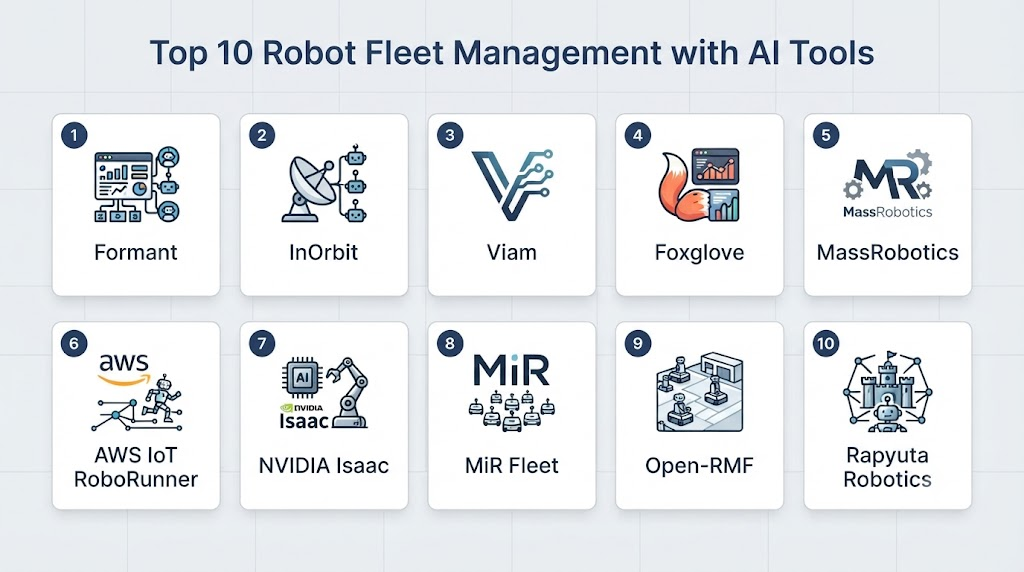
Top 10 Robot Fleet Management with AI Tools
1. NVIDIA Isaac Mission Control
One-line verdict: Best for organizations managing heterogeneous autonomous robot fleets with advanced orchestration and AI infrastructure.
Short description:
NVIDIA Isaac Mission Control is designed to orchestrate fleets of autonomous robots and coordinate their operation within complex environments. It is particularly relevant to industrial, warehouse, and logistics environments where multiple autonomous systems need centralized coordination.
Standout Capabilities
- Multi-robot orchestration.
- Fleet coordination.
- Task management.
- Robot interoperability.
- Workflow integration.
- AI-enabled robotics infrastructure.
- Simulation integration.
- Operational monitoring.
AI-Specific Depth
- Model support: Designed to integrate with NVIDIA robotics and AI technologies; external models can be incorporated through the broader ecosystem.
- RAG / knowledge integration: N/A as a core fleet-management capability.
- Evaluation: Fleet performance metrics and simulation-based testing can support evaluation.
- Guardrails: Task constraints, robot capabilities, operational policies, and safety controls.
- Observability: Robot telemetry, task status, operational metrics, and fleet-level monitoring.
Pros
- Strong ecosystem for AI robotics.
- Designed for complex autonomous fleets.
- Suitable for heterogeneous robotic environments.
Cons
- Requires substantial robotics engineering expertise.
- NVIDIA infrastructure may influence technology choices.
- Advanced deployments can be complex.
Security & Compliance
Security depends on deployment architecture and surrounding enterprise infrastructure. Certifications: Not publicly stated.
Deployment & Platforms
- Linux: Strong robotics support.
- Cloud: Possible.
- Self-hosted: Yes.
- Edge: Yes.
- Hybrid: Possible.
Integrations & Ecosystem
The platform is designed to connect robotic systems with broader AI and automation infrastructure.
- Autonomous robots.
- Robot operating systems.
- AI models.
- Simulation.
- Enterprise applications.
- Fleet telemetry.
- Digital-twin environments.
Pricing Model
Not publicly stated.
Best-Fit Scenarios
- Large autonomous robot fleets.
- Warehouse automation.
- Multi-vendor robotics environments.
2. MiR Fleet
One-line verdict: Best for organizations operating mobile robot fleets that need centralized task coordination and operational monitoring.
Short description:
MiR Fleet provides centralized management for mobile robot deployments. It helps organizations coordinate missions, monitor robots, manage traffic, and connect autonomous mobile robots with operational workflows.
Standout Capabilities
- Fleet management.
- Mission assignment.
- Traffic management.
- Robot monitoring.
- Task prioritization.
- Map management.
- Operational visibility.
- Workflow integration.
AI-Specific Depth
- Model support: Primarily robotics fleet-management technology; detailed external-model support is not publicly stated.
- RAG / knowledge integration: N/A.
- Evaluation: Fleet performance and mission metrics.
- Guardrails: Robot capabilities, traffic rules, mission constraints, and operational controls.
- Observability: Fleet status, robot state, missions, and operational data.
Pros
- Strong focus on mobile robot fleets.
- Centralized fleet visibility.
- Useful for industrial environments.
Cons
- Primarily associated with the MiR ecosystem.
- Multi-vendor interoperability should be evaluated carefully.
- Advanced AI capabilities vary by deployment.
Security & Compliance
Enterprise security capabilities should be validated against deployment requirements. Certifications: Not publicly stated.
Deployment & Platforms
- Web: Yes.
- Cloud: Varies.
- Self-hosted: Varies.
- Edge: Supported through robotics infrastructure.
Integrations & Ecosystem
MiR Fleet integrates with mobile-robot workflows and enterprise automation systems.
- MiR robots.
- Mission systems.
- Warehouse workflows.
- APIs.
- Facility maps.
- Enterprise automation systems.
Pricing Model
Not publicly stated.
Best-Fit Scenarios
- Manufacturing plants.
- Internal logistics.
- Mobile robot deployments.
3. Open-RMF
One-line verdict: Best for developers building interoperable multi-vendor robot fleets across complex facilities and automation environments.
Short description:
Open-RMF is an open framework designed to enable multiple types of robots and building systems to coordinate their activities. It is particularly useful when organizations need interoperability rather than a fleet system tied to one robot manufacturer.
Standout Capabilities
- Multi-vendor robot interoperability.
- Fleet coordination.
- Traffic management.
- Task scheduling.
- Door and lift integration.
- Building-system coordination.
- Open architecture.
- ROS ecosystem integration.
AI-Specific Depth
- Model support: AI can be integrated externally; the framework itself is primarily an interoperability and coordination layer.
- RAG / knowledge integration: N/A.
- Evaluation: Simulation and fleet-performance evaluation.
- Guardrails: Traffic constraints, task rules, and facility-level coordination.
- Observability: Robot status, task state, fleet events, and system messages.
Pros
- Open architecture.
- Strong interoperability potential.
- Useful for multi-vendor deployments.
Cons
- Requires engineering resources.
- AI capabilities depend on additional components.
- Production deployment requires careful integration.
Security & Compliance
Security depends on the implementation. Certifications: Not publicly stated.
Deployment & Platforms
- Linux: Yes.
- Self-hosted: Yes.
- Cloud: Possible.
- Edge: Yes.
- Hybrid: Possible.
Integrations & Ecosystem
Open-RMF can integrate different robots and facility infrastructure.
- ROS 2.
- Mobile robots.
- Elevators.
- Doors.
- Building-management systems.
- Fleet adapters.
- Facility-management systems.
Pricing Model
Open-source software.
Best-Fit Scenarios
- Multi-vendor robot fleets.
- Smart buildings.
- Research and industrial interoperability projects.
4. Locus Robotics Fleet Management
One-line verdict: Best for warehouse operators deploying autonomous mobile robots for high-volume fulfillment and material movement.
Short description:
Locus Robotics provides autonomous mobile robots and fleet-management technology designed for warehouse operations. Its platform coordinates robotic activity while integrating with fulfillment workflows.
Standout Capabilities
- Autonomous warehouse robots.
- Fleet coordination.
- Task allocation.
- Warehouse workflow integration.
- Order fulfillment support.
- Operational monitoring.
- Fleet analytics.
- Human-robot collaboration.
AI-Specific Depth
- Model support: Proprietary robotics and optimization technologies.
- RAG / knowledge integration: N/A.
- Evaluation: Operational performance and fulfillment metrics.
- Guardrails: Robot navigation, task constraints, and operational policies.
- Observability: Fleet activity, robot status, and fulfillment analytics.
Pros
- Strong warehouse focus.
- Designed for large-scale fulfillment environments.
- Integrated robotics and fleet-management ecosystem.
Cons
- Primarily focused on its own robotics ecosystem.
- Best suited to warehouse applications.
- Commercial details are not publicly stated.
Security & Compliance
Specific security controls and certifications should be verified during procurement. Certifications: Not publicly stated.
Deployment & Platforms
- Web: Enterprise interface.
- Cloud: Used as part of the platform architecture.
- Edge: Robotics infrastructure.
- Self-hosted: Varies / N/A.
Integrations & Ecosystem
The system is designed to integrate robots with warehouse operations.
- Warehouse-management systems.
- Order-management systems.
- Autonomous mobile robots.
- Warehouse data.
- Task systems.
- Operational analytics.
Pricing Model
Not publicly stated.
Best-Fit Scenarios
- E-commerce warehouses.
- Distribution centers.
- High-volume fulfillment.
5. GreyOrange GreyMatter
One-line verdict: Best for large fulfillment operations combining robotic automation, warehouse orchestration, and AI-driven decision-making.
Short description:
GreyOrange GreyMatter is an AI-driven fulfillment orchestration platform designed to coordinate warehouse automation, inventory movement, robotics, and operational workflows.
Standout Capabilities
- Warehouse orchestration.
- AI-based decision-making.
- Robot coordination.
- Order fulfillment.
- Inventory movement.
- Workflow optimization.
- Real-time decision support.
- Automation management.
AI-Specific Depth
- Model support: Proprietary AI and optimization technology.
- RAG / knowledge integration: N/A as a core fleet-management feature.
- Evaluation: Operational metrics and workflow performance.
- Guardrails: Operational rules, workflow constraints, and human controls.
- Observability: Warehouse and automation analytics.
Pros
- Broad warehouse-orchestration capabilities.
- Strong AI focus.
- Can coordinate different automation processes.
Cons
- More comprehensive than a simple robot fleet manager.
- Implementation can require significant integration.
- Pricing is not publicly stated.
Security & Compliance
Specific enterprise security capabilities should be validated. Certifications: Not publicly stated.
Deployment & Platforms
- Cloud: Available.
- Web: Yes.
- Edge: Used for operational robotics.
- Hybrid: Possible.
Integrations & Ecosystem
GreyMatter can integrate warehouse automation with enterprise operational systems.
- WMS.
- Warehouse robots.
- Automation systems.
- Inventory systems.
- Order systems.
- Analytics platforms.
Pricing Model
Not publicly stated.
Best-Fit Scenarios
- Large warehouses.
- Automated fulfillment centers.
- Complex robotic operations.
6. Blue Yonder Robotics and Warehouse Orchestration
One-line verdict: Best for enterprises connecting robotic fleets with warehouse-management and supply-chain operations.
Short description:
Blue Yonder provides warehouse and supply-chain software that can coordinate automation and robotic workflows. Its broader platform approach makes it relevant to organizations that want fleet operations connected directly to warehouse execution.
Standout Capabilities
- Warehouse orchestration.
- Robotics integration.
- Task management.
- Supply-chain planning.
- Warehouse execution.
- Operational analytics.
- AI-driven optimization.
- Enterprise integration.
AI-Specific Depth
- Model support: AI and machine-learning capabilities across the broader platform.
- RAG / knowledge integration: Varies by application.
- Evaluation: Operational analytics and performance measurement.
- Guardrails: Workflow rules, enterprise controls, and operational constraints.
- Observability: Warehouse and supply-chain analytics.
Pros
- Strong enterprise supply-chain ecosystem.
- Useful for connecting robots with WMS workflows.
- Broad AI and optimization capabilities.
Cons
- Broader platform can be complex.
- Not a pure robotics fleet-management product.
- Pricing is not publicly stated.
Security & Compliance
Enterprise security features vary by product and deployment. Certifications: Not publicly stated.
Deployment & Platforms
- Web: Yes.
- Cloud: Yes.
- Hybrid: Possible.
- Self-hosted: Varies.
Integrations & Ecosystem
The platform can connect warehouse automation with enterprise supply-chain systems.
- WMS.
- Robotics.
- Warehouse execution.
- ERP.
- Supply-chain systems.
- Analytics.
- APIs.
Pricing Model
Not publicly stated.
Best-Fit Scenarios
- Enterprise warehouses.
- Global supply-chain operations.
- Robotic warehouse deployments.
7. Körber Warehouse Robotics
One-line verdict: Best for warehouse operators integrating multiple automation technologies into broader warehouse execution workflows.
Short description:
Körber provides warehouse-management and automation technologies that can integrate robotic systems with warehouse processes. Its broader ecosystem is relevant to organizations managing complex automated fulfillment operations.
Standout Capabilities
- Warehouse execution.
- Robotics integration.
- Automation orchestration.
- Task management.
- Warehouse analytics.
- Inventory workflows.
- Enterprise integration.
- Operational optimization.
AI-Specific Depth
- Model support: AI and optimization capabilities vary across products.
- RAG / knowledge integration: Varies / N/A.
- Evaluation: Operational metrics and warehouse analytics.
- Guardrails: Workflow rules and automation controls.
- Observability: Warehouse and automation monitoring.
Pros
- Strong warehouse ecosystem.
- Integrates robotics with broader operations.
- Suitable for complex automation environments.
Cons
- Not solely a robot fleet-management product.
- Integration complexity can be significant.
- Pricing is not publicly stated.
Security & Compliance
Security and compliance capabilities vary by product. Certifications: Not publicly stated.
Deployment & Platforms
- Cloud: Available.
- Web: Yes.
- Hybrid: Possible.
- Self-hosted: Varies.
Integrations & Ecosystem
- WMS.
- Robotics.
- Automation systems.
- Inventory platforms.
- Warehouse execution.
- Enterprise APIs.
Pricing Model
Not publicly stated.
Best-Fit Scenarios
- Automated distribution centers.
- Warehouse modernization.
- Complex robotics deployments.
8. Vecna Robotics
One-line verdict: Best for industrial environments using autonomous mobile robots for material movement and flexible warehouse workflows.
Short description:
Vecna Robotics develops autonomous mobile robots and fleet-management technology for material handling. Its approach focuses on coordinating robots in industrial and warehouse environments.
Standout Capabilities
- Autonomous mobile robots.
- Fleet management.
- Task orchestration.
- Material movement.
- Dynamic workflow management.
- Robot monitoring.
- Traffic coordination.
- Operational analytics.
AI-Specific Depth
- Model support: Proprietary autonomy and optimization technologies.
- RAG / knowledge integration: N/A.
- Evaluation: Operational performance metrics.
- Guardrails: Navigation and task constraints.
- Observability: Robot and fleet telemetry.
Pros
- Strong industrial material-handling focus.
- Flexible mobile-robot applications.
- Designed for changing workflows.
Cons
- Primarily associated with its robotics ecosystem.
- Broader multi-vendor compatibility should be evaluated.
- Pricing is not publicly stated.
Security & Compliance
Specific controls and certifications should be validated for the deployment. Certifications: Not publicly stated.
Deployment & Platforms
- Web: Yes.
- Cloud: Varies.
- Edge: Yes.
- Self-hosted: Varies.
Integrations & Ecosystem
- Autonomous mobile robots.
- Warehouse systems.
- Manufacturing systems.
- APIs.
- Fleet telemetry.
- Operational software.
Pricing Model
Not publicly stated.
Best-Fit Scenarios
- Manufacturing.
- Warehouse material handling.
- Industrial logistics.
9. Fetch Robotics Fleet Management
One-line verdict: Best for organizations deploying collaborative autonomous mobile robots across warehouse and industrial environments.
Short description:
Fetch Robotics developed autonomous mobile robot solutions and fleet-management capabilities for warehouse and industrial material movement. Its technology is associated with centralized coordination and robotic workflow management.
Standout Capabilities
- AMR fleet coordination.
- Task assignment.
- Navigation.
- Material transport.
- Warehouse workflows.
- Robot monitoring.
- Fleet analytics.
- Enterprise integration.
AI-Specific Depth
- Model support: Proprietary robotics technology.
- RAG / knowledge integration: N/A.
- Evaluation: Fleet and operational metrics.
- Guardrails: Navigation, task, and robot constraints.
- Observability: Fleet telemetry and operational status.
Pros
- Strong AMR heritage.
- Suitable for material movement.
- Useful for collaborative warehouse workflows.
Cons
- Product ownership and current commercial positioning should be verified before procurement.
- Vendor-specific ecosystem considerations apply.
- Current pricing is not publicly stated.
Security & Compliance
Current product-specific security details should be verified. Certifications: Not publicly stated.
Deployment & Platforms
- Web: Varies.
- Cloud: Varies.
- Self-hosted: Varies.
- Edge: Robotics infrastructure.
Integrations & Ecosystem
- Autonomous mobile robots.
- Warehouse-management systems.
- Manufacturing workflows.
- APIs.
- Fleet telemetry.
Pricing Model
Not publicly stated.
Best-Fit Scenarios
- Existing Fetch Robotics deployments.
- Warehouse material handling.
- Industrial AMR operations.
10. OTTO Fleet Manager
One-line verdict: Best for manufacturing and logistics organizations coordinating autonomous mobile robots for industrial material transport.
Short description:
OTTO Motors provides autonomous mobile robots and fleet-management technology for manufacturing and logistics environments. Its platform coordinates robot missions and helps integrate autonomous material transport into production workflows.
Standout Capabilities
- AMR fleet management.
- Mission management.
- Traffic coordination.
- Material transport.
- Production workflow integration.
- Fleet monitoring.
- Robot utilization analytics.
- Operational optimization.
AI-Specific Depth
- Model support: Proprietary autonomy and optimization technologies.
- RAG / knowledge integration: N/A.
- Evaluation: Mission and fleet performance metrics.
- Guardrails: Navigation and operational constraints.
- Observability: Robot telemetry, mission status, and fleet analytics.
Pros
- Strong manufacturing focus.
- Designed for industrial material movement.
- Integrated robot and fleet-management approach.
Cons
- Primarily focused on its own ecosystem.
- Industrial integration can require engineering work.
- Pricing is not publicly stated.
Security & Compliance
Security and certification details should be validated for the specific deployment. Certifications: Not publicly stated.
Deployment & Platforms
- Web: Enterprise fleet interface.
- Cloud: Varies.
- Edge: Yes.
- Self-hosted: Varies.
- Hybrid: Possible.
Integrations & Ecosystem
- Manufacturing systems.
- Warehouse-management systems.
- Autonomous mobile robots.
- APIs.
- Production workflows.
- Fleet analytics.
Pricing Model
Not publicly stated.
Best-Fit Scenarios
- Manufacturing plants.
- Industrial logistics.
- Autonomous material transport.
Comparison Table
| Tool | Best For | Deployment | AI Flexibility | Strength | Watch-Out |
|---|---|---|---|---|---|
| NVIDIA Isaac Mission Control | Heterogeneous robot fleets | Cloud / Edge / Self-hosted | High | AI robotics orchestration | Technical complexity |
| MiR Fleet | Mobile robot fleets | Cloud / Edge | Medium | Centralized AMR management | Ecosystem considerations |
| Open-RMF | Multi-vendor fleets | Self-hosted / Edge | High through integrations | Interoperability | Requires engineering |
| Locus Robotics | Warehouse fulfillment | Cloud / Edge | Proprietary AI | Warehouse optimization | Vendor ecosystem |
| GreyOrange GreyMatter | Automated warehouses | Cloud / Hybrid | High | AI orchestration | Implementation complexity |
| Blue Yonder | Enterprise supply chains | Cloud / Hybrid | High | WMS integration | Broad platform |
| Körber | Warehouse automation | Cloud / Hybrid | Medium/High | Warehouse ecosystem | Integration complexity |
| Vecna Robotics | Industrial AMRs | Cloud / Edge | Proprietary AI | Flexible material handling | Vendor ecosystem |
| Fetch Robotics | AMR deployments | Varies | Proprietary autonomy | Collaborative AMRs | Current positioning should be verified |
| OTTO Fleet Manager | Manufacturing logistics | Edge / Hybrid | Proprietary autonomy | Industrial transport | Ecosystem considerations |
Scoring & Evaluation
The following scoring is a comparative framework rather than an official vendor ranking. Scores reflect suitability for AI-enabled robot fleet management, not overall company quality.
The most important factors include fleet orchestration, AI capabilities, interoperability, enterprise integrations, ease of deployment, performance, security, and operational support.
| Tool | Core | AI/Reliability | Guardrails | Integrations | Ease | Perf/Cost | Security/Admin | Support | Weighted Total |
|---|---|---|---|---|---|---|---|---|---|
| NVIDIA Isaac Mission Control | 9.5 | 9.5 | 9.0 | 9.5 | 7.5 | 9.0 | 8.5 | 9.0 | 9.0 |
| MiR Fleet | 9.0 | 8.0 | 9.0 | 8.5 | 8.5 | 8.5 | 8.5 | 9.0 | 8.6 |
| Open-RMF | 8.5 | 8.0 | 9.0 | 9.5 | 7.0 | 8.5 | 8.0 | 8.5 | 8.4 |
| Locus Robotics | 9.5 | 9.0 | 9.0 | 9.0 | 8.5 | 9.0 | 8.5 | 9.0 | 9.0 |
| GreyOrange GreyMatter | 9.5 | 9.0 | 9.0 | 9.5 | 7.5 | 8.5 | 9.0 | 9.0 | 8.9 |
| Blue Yonder | 9.0 | 8.5 | 9.0 | 9.5 | 7.5 | 8.5 | 9.0 | 9.5 | 8.9 |
| Körber | 8.5 | 8.0 | 8.5 | 9.0 | 8.0 | 8.5 | 8.5 | 9.0 | 8.6 |
| Vecna Robotics | 9.0 | 8.5 | 9.0 | 8.5 | 8.0 | 8.5 | 8.5 | 8.5 | 8.6 |
| Fetch Robotics | 8.5 | 8.0 | 8.5 | 8.0 | 8.0 | 8.0 | 8.0 | 8.0 | 8.1 |
| OTTO Fleet Manager | 9.0 | 8.5 | 9.0 | 8.5 | 8.0 | 8.5 | 8.5 | 8.5 | 8.6 |
Top 3 for Enterprise
- NVIDIA Isaac Mission Control
- Locus Robotics
- GreyOrange GreyMatter
Top 3 for SMB
- MiR Fleet
- Open-RMF
- OTTO Fleet Manager
Top 3 for Developers
- Open-RMF
- NVIDIA Isaac Mission Control
- MiR Fleet
Which Robot Fleet Management with AI Tool Is Right for You?
Solo / Freelancer
Individual developers generally do not need a commercial enterprise fleet-management platform unless they are developing a robotics product.
For prototypes, focus on:
- Open-RMF.
- ROS 2.
- Simulation.
- Robot APIs.
- Custom fleet orchestration.
- Open-source tools.
A lightweight architecture can be easier to maintain than a complete enterprise platform.
SMB
Smaller organizations should prioritize easy deployment and direct integration with their existing robot fleet.
Look for:
- Simple fleet dashboards.
- Task management.
- Basic analytics.
- Robot health monitoring.
- Easy APIs.
- Vendor support.
MiR Fleet or a vendor-specific fleet manager can be appropriate when the fleet is relatively standardized.
Mid-Market
Mid-market organizations often need stronger orchestration without the complexity of a global enterprise deployment.
Prioritize:
- Multi-robot coordination.
- WMS integration.
- Battery management.
- Fleet analytics.
- Exception handling.
- API access.
- Expansion capabilities.
Enterprise
Enterprise organizations should treat fleet management as an operational platform rather than simply a robot dashboard.
Prioritize:
- Multi-vendor support.
- Large fleet scalability.
- High availability.
- Enterprise authentication.
- Auditability.
- Real-time telemetry.
- AI optimization.
- Digital twins.
- Data integration.
- Cybersecurity.
Regulated Industries
Hospitals, pharmaceutical facilities, airports, public infrastructure, and other regulated environments require additional attention to safety and security.
Evaluate:
- Access control.
- Audit logs.
- Network segmentation.
- Robot authentication.
- Data retention.
- Incident response.
- Human override.
- Operational safety.
Budget vs Premium
Open-source platforms can reduce licensing costs but may increase engineering and maintenance requirements.
Commercial fleet-management platforms can reduce development effort but may introduce:
- Subscription costs.
- Vendor dependencies.
- Integration costs.
- Hardware ecosystem limitations.
The correct comparison should consider total cost of ownership rather than software price alone.
Build vs Buy
Building your own fleet-management layer may make sense when:
- You operate proprietary robots.
- You need specialized algorithms.
- You have a strong robotics engineering team.
- Existing commercial platforms do not support your workflows.
- You require complete control over fleet data.
Buying is generally more practical when you need production-ready fleet management quickly.
A hybrid strategy can work well: use a commercial platform for core orchestration while developing proprietary AI optimization layers around it.
Implementation Playbook
First 30 Days: Pilot + Success Metrics
Start with a limited fleet.
Define:
- Robot types.
- Facility boundaries.
- Task categories.
- Priority rules.
- Charging requirements.
- Traffic zones.
- Failure scenarios.
Measure:
- Robot utilization.
- Task completion time.
- Idle time.
- Battery utilization.
- Congestion.
- Mission failure rate.
- Human intervention rate.
Days 31–60: Harden Security + Evaluation + Rollout
During the second phase:
- Connect enterprise systems.
- Configure authentication.
- Establish role-based permissions.
- Review API access.
- Segment robot networks.
- Configure audit logs.
- Establish data-retention policies.
- Test failure recovery.
- Test robot disconnection.
- Validate AI recommendations.
- Create fleet-performance baselines.
For AI components, create an evaluation harness that measures:
- Task-allocation accuracy.
- Scheduling quality.
- Prediction accuracy.
- False alerts.
- Latency.
- Model drift.
Days 61–90: Optimize Cost/Latency + Governance + Scale
The final stage should focus on operational optimization.
Activities include:
- Optimize task allocation.
- Improve traffic management.
- Optimize charging schedules.
- Reduce unnecessary robot travel.
- Tune AI models.
- Monitor infrastructure costs.
- Establish incident procedures.
- Add predictive-maintenance workflows.
- Expand the fleet.
- Test peak workloads.
Common Mistakes & How to Avoid Them
- Managing robots independently: Use centralized fleet orchestration where appropriate.
- Ignoring interoperability: Consider multi-vendor support before expanding the fleet.
- Poor task allocation: Use real operational data to optimize assignments.
- Ignoring battery state: Charging can become a major fleet bottleneck.
- No congestion monitoring: More robots can reduce throughput if traffic is poorly managed.
- Ignoring failure recovery: Design workflows for disconnected or failed robots.
- Over-automating AI decisions: Maintain human override for important operational decisions.
- Skipping simulation: Test large fleet scenarios before physical rollout.
- Ignoring cybersecurity: Robots are connected operational assets and should be secured accordingly.
- No observability: Track robot state, task state, latency, failures, and utilization.
- Ignoring network reliability: Fleet coordination depends on reliable communications.
- No data governance: Establish retention and access policies for robot telemetry.
- Overlooking vendor lock-in: Evaluate APIs and data portability.
- Scaling too quickly: Validate one facility or workflow before expanding fleet size.
FAQs
What is Robot Fleet Management with AI?
It is software that coordinates multiple robots and uses AI or advanced optimization to improve task assignment, traffic management, maintenance, scheduling, and operational efficiency.
Why is AI useful for robot fleet management?
AI can analyze operational data to identify patterns, optimize assignments, predict failures, reduce congestion, and adapt fleet behavior to changing workloads.
Can one platform manage robots from different manufacturers?
Some platforms and open frameworks support multi-vendor fleets, while vendor-specific systems may focus primarily on their own robot ecosystem.
What is the difference between fleet management and robot control?
Robot control manages the behavior of an individual robot. Fleet management coordinates multiple robots and their tasks at a higher operational level.
Can AI manage robot charging?
Yes. AI and optimization techniques can help schedule charging based on battery levels, workload, robot availability, and operational priorities.
Can AI predict robot failures?
Predictive-maintenance systems can analyze telemetry and historical data to identify patterns associated with potential failures. Accuracy depends on data quality and the specific robot.
Do fleet-management platforms support warehouse systems?
Many enterprise platforms integrate with warehouse-management and warehouse-execution systems, but exact integrations vary.
Can fleet management work without AI?
Yes. Traditional fleet managers can use rules, scheduling algorithms, and deterministic traffic-management systems. AI adds adaptive prediction and optimization capabilities.
Is self-hosted fleet management available?
Some platforms support self-hosted or edge deployments, while others are more cloud-oriented. Deployment options vary significantly.
How important is edge computing?
Edge computing can be valuable when robots require low-latency communication, local decision-making, or continued operation when cloud connectivity is interrupted.
How can fleet-management costs be reduced?
Organizations can improve utilization, reduce unnecessary robot travel, optimize charging, automate repetitive operational tasks, and use simulation to identify capacity requirements before purchasing additional robots.
What security controls should a fleet-management system have?
Important controls include authentication, role-based access, network segmentation, encryption, audit logging, secure APIs, device identity, and incident-response procedures.
Can AI agents operate robot fleets?
AI agents may assist with monitoring, reporting, troubleshooting, scheduling recommendations, and other workflows. Direct autonomous control should be constrained by appropriate safety and authorization mechanisms.
What metrics should be tracked?
Important metrics include utilization, throughput, task completion time, idle time, battery usage, congestion, failure rate, intervention rate, and overall system availability.
Should companies build or buy fleet-management software?
Buying is generally faster for standard operational requirements. Building can make sense when robots, workflows, or optimization requirements are highly specialized.
What is the biggest challenge in robot fleet management?
Scaling coordination without creating congestion, bottlenecks, unreliable communication, excessive idle time, or complicated operational workflows is one of the major challenges.
Conclusion
Robot Fleet Management with AI is becoming increasingly important as organizations move from individual autonomous robots toward large, connected fleets. Managing ten, fifty, or hundreds of robots requires more than simply monitoring individual machines. Organizations need intelligent task allocation, traffic management, battery optimization, predictive maintenance, analytics, and integration with operational systems.The most suitable platforms depend heavily on the environment. NVIDIA Isaac Mission Control is well suited to advanced AI robotics ecosystems, while Open-RMF is attractive for multi-vendor interoperability. MiR Fleet, Locus Robotics, GreyOrange GreyMatter, Blue Yonder, Körber, Vecna Robotics, and OTTO Fleet Manager are relevant to different industrial and warehouse automation scenarios.The strongest approach is to evaluate the entire operational architecture rather than choosing a platform solely because it advertises AI capabilities.