Introduction
Edge AI inference platforms provide the software, runtime, tools, and infrastructure needed to run artificial intelligence models directly on devices or near the point where data is generated. Instead of sending every image, audio stream, sensor reading, or industrial event to a distant cloud service, edge inference allows models to process data locally.
This approach is increasingly important for robotics, manufacturing, autonomous systems, smart cameras, healthcare devices, retail, telecommunications, automotive applications, and industrial IoT. Local inference can reduce latency, limit bandwidth requirements, improve resilience during connectivity interruptions, and provide stronger control over sensitive data.
Best for: AI engineers, robotics teams, embedded developers, manufacturers, automotive companies, IoT providers, and enterprises deploying models across large numbers of edge devices.
Not ideal for: Teams running large models that require substantial compute, organizations without edge hardware requirements, or workloads where cloud inference already provides acceptable latency, cost, and privacy.
What Has Changed in Edge AI Inference Platforms
- Smaller AI models are making sophisticated inference practical on edge devices.
- Quantization is increasingly important for reducing memory and compute requirements.
- Hardware-aware optimization can improve inference performance substantially.
- Multimodal models are moving toward edge deployment.
- Generative AI is increasingly being adapted for local inference.
- Vision-language models are creating new edge use cases.
- Edge AI platforms increasingly support multiple hardware targets.
- Containerized AI deployment is becoming more common.
- Model compilation and acceleration are increasingly automated.
- Privacy-sensitive workloads are moving inference closer to the data source.
- Edge observability is becoming important for large distributed deployments.
- Fleet management is increasingly connected to model deployment and version control.
- AI security is expanding from model security to device, runtime, and supply-chain security.
- Developers increasingly expect support for ONNX, TensorRT, OpenVINO, TFLite, or other portable model formats.
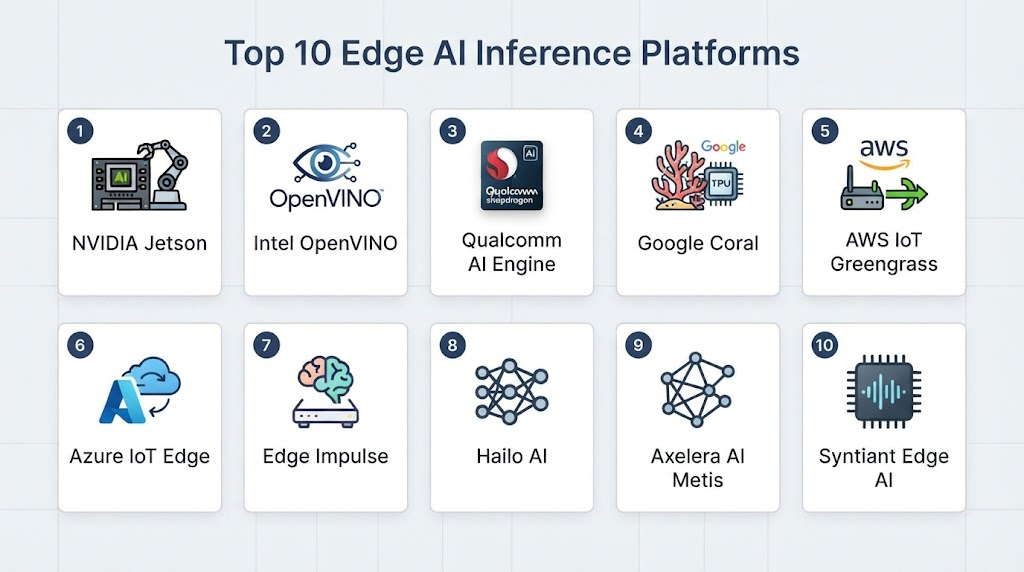
Top 10 Edge AI Inference Platforms
1. NVIDIA TensorRT
One-line verdict: Best for developers optimizing high-performance AI inference on NVIDIA GPUs and accelerated edge computing hardware.
Short description:
NVIDIA TensorRT is an inference optimization and runtime technology designed to accelerate deep-learning models on NVIDIA hardware. It is widely relevant to computer vision, robotics, autonomous systems, generative AI, and other performance-sensitive workloads.
Standout Capabilities
- Deep-learning inference optimization.
- NVIDIA GPU acceleration.
- Model compilation.
- Quantization support.
- Graph optimization.
- High-throughput inference.
- Low-latency execution.
- Integration with NVIDIA AI tooling.
AI-Specific Depth
- Model support: Supports major deep-learning model workflows and NVIDIA-optimized formats.
- RAG / knowledge integration: N/A for the inference runtime itself.
- Evaluation: Benchmarking and inference-performance evaluation.
- Guardrails: N/A as a primary function; application-level controls are required.
- Observability: Performance profiling and inference metrics through the broader NVIDIA ecosystem.
Pros
- Excellent performance on NVIDIA hardware.
- Strong ecosystem for AI developers.
- Suitable for demanding real-time workloads.
Cons
- Strong dependency on NVIDIA hardware.
- Optimization can require technical expertise.
- Not a complete device-fleet management platform.
Security & Compliance
Security depends on the deployment architecture and surrounding NVIDIA software stack. Certifications: Not publicly stated for TensorRT as a standalone inference runtime.
Deployment & Platforms
- Linux: Yes.
- Windows: Supported in applicable environments.
- Edge: Yes.
- Cloud: Yes.
- Self-hosted: Yes.
- Embedded: Supported through relevant NVIDIA platforms.
Integrations & Ecosystem
TensorRT fits into the broader NVIDIA AI ecosystem.
- CUDA.
- NVIDIA Jetson.
- NVIDIA Triton Inference Server.
- PyTorch workflows.
- ONNX.
- NVIDIA AI tooling.
- Robotics frameworks.
Pricing Model
TensorRT software is available as part of NVIDIA’s software ecosystem; hardware and associated enterprise products may have separate costs.
Best-Fit Scenarios
- Robotics.
- Computer vision.
- Autonomous machines.
- High-performance edge inference.
2. NVIDIA JetPack
One-line verdict: Best for embedded developers building complete AI applications on NVIDIA Jetson edge computing platforms.
Short description:
NVIDIA JetPack provides the software stack for Jetson devices, combining drivers, CUDA-based acceleration, AI libraries, computer-vision components, and development tools. It is particularly useful for embedded AI and robotics applications.
Standout Capabilities
- Embedded AI development.
- GPU acceleration.
- Computer vision.
- AI inference.
- Robotics support.
- Camera processing.
- Hardware-accelerated libraries.
- Edge application development.
AI-Specific Depth
- Model support: Broad model support through NVIDIA AI frameworks and runtimes.
- RAG / knowledge integration: Possible through application-level components.
- Evaluation: Performance profiling and benchmarking.
- Guardrails: Application-dependent.
- Observability: Hardware and application monitoring through the broader Jetson ecosystem.
Pros
- Strong embedded AI ecosystem.
- Excellent robotics support.
- Hardware and software are tightly integrated.
Cons
- Primarily tied to Jetson hardware.
- Embedded development requires technical expertise.
- Hardware selection affects capabilities.
Security & Compliance
Security depends on Jetson hardware, software versions, and deployment configuration. Certifications: Not publicly stated for the overall JetPack stack.
Deployment & Platforms
- Linux: Yes.
- Edge: Yes.
- Embedded: Yes.
- Cloud: Used primarily as part of edge-to-cloud architectures.
Integrations & Ecosystem
- TensorRT.
- CUDA.
- OpenCV.
- PyTorch.
- ONNX.
- ROS.
- NVIDIA robotics technologies.
Pricing Model
JetPack software is associated with Jetson hardware; hardware costs vary by device.
Best-Fit Scenarios
- Robotics.
- Smart cameras.
- Autonomous systems.
- Embedded computer vision.
3. Intel OpenVINO Toolkit
One-line verdict: Best for developers deploying optimized AI inference across Intel CPUs, GPUs, and supported AI accelerators.
Short description:
OpenVINO is an open-source toolkit for optimizing and deploying AI models across Intel hardware. It is especially useful for computer vision, generative AI, and edge applications that need hardware flexibility within the Intel ecosystem.
Standout Capabilities
- Model optimization.
- CPU inference.
- GPU inference.
- NPU support on applicable hardware.
- Quantization.
- Computer vision.
- Generative AI deployment.
- Cross-device inference.
AI-Specific Depth
- Model support: Supports common model formats and frameworks through OpenVINO conversion and runtime capabilities.
- RAG / knowledge integration: Can support RAG applications through surrounding software.
- Evaluation: Benchmarking and performance measurement.
- Guardrails: Application-level.
- Observability: Profiling and performance tools.
Pros
- Open-source toolkit.
- Broad Intel hardware support.
- Useful for edge and local AI.
Cons
- Optimized primarily for Intel hardware.
- Performance varies by processor and accelerator.
- Developers may need to optimize models for specific devices.
Security & Compliance
Security depends on the application and deployment architecture. Certifications: Not publicly stated for OpenVINO as a standalone toolkit.
Deployment & Platforms
- Linux: Yes.
- Windows: Yes.
- macOS: Applicable development support varies.
- Edge: Yes.
- Cloud: Yes.
- Self-hosted: Yes.
Integrations & Ecosystem
- ONNX.
- PyTorch.
- TensorFlow workflows.
- OpenCV.
- Intel CPUs.
- Intel GPUs.
- Intel NPUs.
Pricing Model
Open-source software.
Best-Fit Scenarios
- Intel-based edge devices.
- Computer vision.
- Local generative AI.
- Industrial AI.
4. Qualcomm AI Engine
One-line verdict: Best for mobile, automotive, IoT, and embedded applications requiring efficient AI inference on Qualcomm platforms.
Short description:
Qualcomm AI Engine technologies provide hardware-accelerated AI capabilities across Qualcomm-powered devices. The platform is relevant to smartphones, automotive systems, industrial devices, cameras, and IoT applications.
Standout Capabilities
- On-device AI.
- CPU/GPU/NPU acceleration.
- Low-power inference.
- Computer vision.
- Audio AI.
- Generative AI support.
- Mobile AI.
- Automotive AI.
AI-Specific Depth
- Model support: Supports models through Qualcomm AI software and hardware ecosystems.
- RAG / knowledge integration: Application-dependent.
- Evaluation: Device-level AI performance benchmarking.
- Guardrails: Application-dependent.
- Observability: Performance and hardware telemetry through applicable tooling.
Pros
- Strong power efficiency.
- Broad embedded ecosystem.
- Suitable for real-time AI.
Cons
- Primarily tied to Qualcomm hardware.
- Developer tooling varies by platform.
- Hardware-specific optimization may be required.
Security & Compliance
Security varies by Qualcomm platform and implementation. Certifications: Not publicly stated for AI Engine as a general platform.
Deployment & Platforms
- Android: Common.
- Embedded: Yes.
- Automotive: Yes.
- IoT: Yes.
- Edge: Yes.
Integrations & Ecosystem
- Qualcomm AI software.
- Snapdragon platforms.
- Automotive platforms.
- Camera systems.
- Mobile applications.
- Embedded systems.
Pricing Model
Typically associated with Qualcomm hardware platforms and commercial deployments. Exact pricing is Not publicly stated.
Best-Fit Scenarios
- Mobile AI.
- Automotive AI.
- Low-power edge devices.
5. Google Coral
One-line verdict: Best for developers experimenting with efficient on-device machine-learning inference using Edge TPU acceleration.
Short description:
Google Coral provides hardware and software technologies for running machine-learning inference locally using Edge TPU acceleration. It is particularly useful for compact computer-vision and embedded AI applications.
Standout Capabilities
- Edge inference.
- TPU acceleration.
- Low-power AI.
- Computer vision.
- Embedded machine learning.
- Local processing.
- Compact deployment.
- Offline inference.
AI-Specific Depth
- Model support: TensorFlow Lite-based workflows are central to the platform.
- RAG / knowledge integration: N/A.
- Evaluation: Model and device benchmarking.
- Guardrails: Application-dependent.
- Observability: Basic application and hardware monitoring.
Pros
- Efficient edge inference.
- Designed for embedded deployments.
- Useful for offline computer vision.
Cons
- Hardware ecosystem is more specialized.
- Model compatibility requires attention.
- Not designed as a complete enterprise AI deployment platform.
Security & Compliance
Deployment-specific. Certifications: Not publicly stated.
Deployment & Platforms
- Linux: Yes.
- Embedded: Yes.
- Edge: Yes.
- Cloud: Primarily complementary to cloud services.
Integrations & Ecosystem
- TensorFlow Lite.
- Edge TPU.
- Python.
- Embedded Linux.
- Computer-vision applications.
- IoT devices.
Pricing Model
Hardware-based; exact pricing varies by device and supplier.
Best-Fit Scenarios
- Embedded computer vision.
- IoT prototypes.
- Low-power AI applications.
6. Apple Core ML
One-line verdict: Best for developers deploying machine-learning models efficiently across Apple devices with local inference.
Short description:
Core ML is Apple’s framework for integrating machine-learning models into applications running on Apple hardware. It supports on-device inference and can take advantage of Apple’s CPU, GPU, and Neural Engine capabilities.
Standout Capabilities
- On-device inference.
- Neural Engine acceleration.
- Computer vision.
- Speech-related AI.
- Privacy-focused local processing.
- Mobile AI.
- Model conversion.
- Hardware acceleration.
AI-Specific Depth
- Model support: Core ML model format with conversion tools for supported frameworks.
- RAG / knowledge integration: Application-dependent.
- Evaluation: Developer benchmarking and model testing.
- Guardrails: Application-dependent.
- Observability: Application-level performance monitoring.
Pros
- Strong integration with Apple hardware.
- Excellent local-inference experience.
- Useful for privacy-sensitive applications.
Cons
- Apple ecosystem dependency.
- Not suitable for general-purpose industrial edge hardware.
- Deployment flexibility is limited compared with cross-platform runtimes.
Security & Compliance
Apple provides platform security capabilities; application compliance depends on implementation. Certifications for Core ML: Not publicly stated.
Deployment & Platforms
- iOS: Yes.
- iPadOS: Yes.
- macOS: Yes.
- watchOS: Applicable scenarios vary.
- Edge: Yes.
Integrations & Ecosystem
- Swift.
- Xcode.
- Apple Neural Engine.
- Vision framework.
- Speech technologies.
- Apple hardware.
Pricing Model
Included within Apple’s developer ecosystem; Apple hardware may have separate costs.
Best-Fit Scenarios
- iOS AI applications.
- On-device computer vision.
- Privacy-sensitive consumer applications.
7. ONNX Runtime
One-line verdict: Best for developers seeking a portable inference runtime that can deploy models across diverse hardware environments.
Short description:
ONNX Runtime is an open-source machine-learning inference engine designed to run models across different hardware and software environments. Its portability makes it particularly valuable for teams avoiding unnecessary dependence on a single AI hardware vendor.
Standout Capabilities
- Cross-platform inference.
- ONNX model support.
- Hardware acceleration.
- Edge deployment.
- Cloud deployment.
- Multiple execution providers.
- Model optimization.
- Open-source development.
AI-Specific Depth
- Model support: ONNX is the core model format.
- RAG / knowledge integration: N/A as a runtime feature.
- Evaluation: Benchmarking and model-performance testing.
- Guardrails: Application-dependent.
- Observability: Runtime and application performance monitoring.
Pros
- Strong portability.
- Open-source ecosystem.
- Supports multiple hardware backends.
Cons
- Hardware-specific optimization can require work.
- Not a complete edge-device management platform.
- Advanced deployments may require engineering expertise.
Security & Compliance
Depends on the deployment. Certifications: Not publicly stated for ONNX Runtime as a standalone project.
Deployment & Platforms
- Linux: Yes.
- Windows: Yes.
- macOS: Yes.
- Android: Yes.
- iOS: Supported through relevant deployment approaches.
- Edge: Yes.
- Cloud: Yes.
Integrations & Ecosystem
- ONNX.
- PyTorch.
- Microsoft technologies.
- NVIDIA hardware.
- Intel hardware.
- Qualcomm hardware.
- Cloud platforms.
Pricing Model
Open-source software.
Best-Fit Scenarios
- Multi-hardware deployments.
- Portable AI applications.
- Enterprise AI infrastructure.
8. TensorFlow Lite
One-line verdict: Best for developers building lightweight machine-learning applications for mobile, embedded, and resource-constrained devices.
Short description:
TensorFlow Lite, now part of Google’s broader on-device AI tooling direction, has been widely used for deploying machine-learning models to mobile and embedded environments.
Standout Capabilities
- Lightweight inference.
- Mobile deployment.
- Embedded AI.
- Quantization.
- Hardware acceleration.
- Computer vision.
- Offline inference.
- Resource-efficient models.
AI-Specific Depth
- Model support: TensorFlow and compatible lightweight model workflows.
- RAG / knowledge integration: N/A.
- Evaluation: Model benchmarking and testing.
- Guardrails: Application-dependent.
- Observability: Application-level monitoring.
Pros
- Mature edge-AI ecosystem.
- Efficient for constrained devices.
- Strong mobile support.
Cons
- Developers must consider current Google on-device AI tooling direction.
- Model conversion may require optimization.
- Not an enterprise fleet-management system.
Security & Compliance
Deployment-dependent. Certifications: Not publicly stated.
Deployment & Platforms
- Android: Yes.
- Linux: Yes.
- Embedded: Yes.
- iOS: Supported through applicable integrations.
- Edge: Yes.
Integrations & Ecosystem
- TensorFlow.
- Google AI tooling.
- Android.
- Edge TPU ecosystems.
- Python.
- Mobile development frameworks.
Pricing Model
Open-source software.
Best-Fit Scenarios
- Mobile AI.
- Embedded devices.
- Lightweight computer vision.
9. AWS IoT Greengrass
One-line verdict: Best for enterprises managing AI inference and application workloads across large fleets of connected edge devices.
Short description:
AWS IoT Greengrass extends cloud capabilities to edge devices, allowing applications and machine-learning workloads to operate closer to where data is produced. It is particularly useful for organizations already using AWS IoT infrastructure.
Standout Capabilities
- Edge application deployment.
- Local processing.
- Device management.
- Cloud-to-edge integration.
- Machine-learning workflows.
- Offline operation.
- IoT fleet management.
- Secure device communication.
AI-Specific Depth
- Model support: Supports machine-learning deployments through AWS services and compatible runtimes.
- RAG / knowledge integration: Application-dependent.
- Evaluation: Can integrate with broader AWS ML evaluation workflows.
- Guardrails: AWS security and application controls.
- Observability: Cloud and edge monitoring through AWS services.
Pros
- Strong cloud-edge integration.
- Useful for large device fleets.
- Good fit for AWS-centric organizations.
Cons
- AWS ecosystem dependency.
- Architecture can become complex.
- Cloud-service costs require careful monitoring.
Security & Compliance
AWS provides extensive security capabilities across its platform, but exact controls and certifications depend on the architecture and services used.
Deployment & Platforms
- Linux: Yes.
- Edge: Yes.
- Cloud: Yes.
- IoT devices: Yes.
- Hybrid: Yes.
Integrations & Ecosystem
- AWS IoT.
- Amazon SageMaker.
- AWS cloud services.
- Edge devices.
- Containers.
- Device management.
- Monitoring services.
Pricing Model
Cloud and usage-based pricing varies according to AWS services, device count, compute, storage, and data usage.
Best-Fit Scenarios
- Enterprise IoT.
- Industrial edge.
- Large distributed device fleets.
10. Azure IoT Edge
One-line verdict: Best for Microsoft-oriented enterprises deploying containerized AI inference across distributed industrial and IoT edge environments.
Short description:
Azure IoT Edge enables cloud workloads and containerized applications to run closer to devices. It can support AI inference, analytics, and other workloads at the edge while integrating with Azure’s broader cloud ecosystem.
Standout Capabilities
- Containerized edge workloads.
- Local AI inference.
- Device management.
- Cloud-edge integration.
- Offline processing.
- IoT connectivity.
- Edge analytics.
- Enterprise deployment management.
AI-Specific Depth
- Model support: Flexible through containerized runtimes and Azure AI/ML technologies.
- RAG / knowledge integration: Application-dependent.
- Evaluation: Can integrate with broader Azure AI evaluation workflows.
- Guardrails: Azure security and application controls.
- Observability: Azure monitoring and device telemetry.
Pros
- Strong Microsoft ecosystem.
- Flexible container-based architecture.
- Suitable for enterprise IoT deployments.
Cons
- Azure ecosystem dependency.
- Edge architecture requires operational expertise.
- Costs vary with associated Azure services.
Security & Compliance
Security capabilities depend on the Azure services and architecture used. Certifications: specific compliance coverage should be verified for the chosen configuration.
Deployment & Platforms
- Linux: Yes.
- Windows: Applicable scenarios vary.
- Edge: Yes.
- Cloud: Yes.
- Hybrid: Yes.
Integrations & Ecosystem
- Azure IoT.
- Azure Machine Learning.
- Azure AI.
- Containers.
- Kubernetes-related technologies.
- Device management.
- Monitoring.
Pricing Model
Usage and service-based pricing varies according to Azure services, infrastructure, and device deployments.
Best-Fit Scenarios
- Industrial IoT.
- Enterprise edge AI.
- Microsoft-centric environments.
Comparison Table
| Tool | Best For | Deployment | Model Flexibility | Strength | Watch-Out | Public Rating |
|---|---|---|---|---|---|---|
| NVIDIA TensorRT | High-performance NVIDIA inference | Edge / Cloud / Self-hosted | Hosted / BYO models | Performance optimization | NVIDIA dependency | N/A |
| NVIDIA JetPack | Embedded AI and robotics | Edge / Embedded | BYO models | Complete Jetson stack | Hardware dependency | N/A |
| Intel OpenVINO | Intel-based edge AI | Edge / Cloud / Self-hosted | BYO / Multi-format | Hardware optimization | Intel ecosystem | N/A |
| Qualcomm AI Engine | Mobile and embedded AI | Edge / Embedded | BYO models | Power efficiency | Qualcomm dependency | N/A |
| Google Coral | Low-power embedded inference | Edge / Embedded | BYO models | Efficient TPU inference | Specialized hardware | N/A |
| Apple Core ML | Apple-device AI | Edge / Mobile | BYO models | On-device performance | Apple ecosystem | N/A |
| ONNX Runtime | Portable inference | Edge / Cloud / Self-hosted | BYO / Multi-format | Cross-platform flexibility | Optimization complexity | N/A |
| TensorFlow Lite | Mobile and embedded AI | Edge / Mobile | BYO models | Lightweight inference | Requires model optimization | N/A |
| AWS IoT Greengrass | Enterprise IoT edge | Cloud / Edge / Hybrid | Multi-model through AWS | Fleet integration | AWS dependency | N/A |
| Azure IoT Edge | Enterprise edge workloads | Cloud / Edge / Hybrid | BYO / Multi-model | Containerized edge | Azure dependency | N/A |
Scoring & Evaluation
The following scores are comparative estimates based on platform capabilities and typical deployment considerations, rather than official vendor rankings. Actual performance depends heavily on hardware, model architecture, quantization, workload size, and deployment configuration.
| Tool | Core | Reliability/Eval | Guardrails | Integrations | Ease | Perf/Cost | Security/Admin | Support | Weighted Total |
|---|---|---|---|---|---|---|---|---|---|
| NVIDIA TensorRT | 10 | 9.5 | 7.5 | 9.5 | 7.5 | 10 | 8.5 | 9.5 | 9.1 |
| NVIDIA JetPack | 9.5 | 9 | 8 | 9.5 | 7.5 | 9.5 | 8.5 | 9.5 | 8.9 |
| Intel OpenVINO | 9 | 9 | 8 | 9 | 8 | 9 | 8.5 | 9 | 8.8 |
| Qualcomm AI Engine | 9 | 8.5 | 8 | 8.5 | 7.5 | 9.5 | 8.5 | 9 | 8.6 |
| Google Coral | 8 | 8 | 7.5 | 7.5 | 8 | 9.5 | 7.5 | 8 | 8.1 |
| Apple Core ML | 8.5 | 8.5 | 8 | 8.5 | 9 | 9 | 8.5 | 9.5 | 8.7 |
| ONNX Runtime | 9.5 | 9 | 8 | 9.5 | 8 | 9 | 8 | 9 | 8.9 |
| TensorFlow Lite | 8.5 | 8.5 | 7.5 | 9 | 8.5 | 9 | 8 | 9 | 8.6 |
| AWS IoT Greengrass | 9 | 8.5 | 9 | 9.5 | 7.5 | 8.5 | 9.5 | 9.5 | 8.9 |
| Azure IoT Edge | 9 | 8.5 | 9 | 9.5 | 7.5 | 8.5 | 9.5 | 9.5 | 8.9 |
Top 3 for Enterprise
- NVIDIA TensorRT
- AWS IoT Greengrass
- Azure IoT Edge
Top 3 for SMB
- ONNX Runtime
- Intel OpenVINO
- TensorFlow Lite
Top 3 for Developers
- ONNX Runtime
- NVIDIA TensorRT
- Intel OpenVINO
Which Edge AI Inference Platform Is Right for You?
Solo / Freelancer
Individual developers should prioritize portability, documentation, hardware availability, and low development overhead.
Good starting points include:
- ONNX Runtime.
- OpenVINO.
- TensorFlow Lite.
- Core ML for Apple applications.
- TensorRT for NVIDIA-based projects.
For prototypes, choose the runtime that matches your available hardware rather than optimizing for enterprise fleet management.
SMB
Small and medium-sized businesses should avoid unnecessary infrastructure complexity.
Prioritize:
- Easy deployment.
- Hardware availability.
- Low inference latency.
- Reasonable power consumption.
- Simple model conversion.
- Strong community support.
- Minimal operational overhead.
ONNX Runtime and OpenVINO are particularly attractive where hardware flexibility matters.
Mid-Market
Mid-market organizations should consider both inference performance and deployment management.
Look for:
- Model versioning.
- Monitoring.
- Remote deployment.
- Hardware acceleration.
- Container support.
- Security.
- Device management.
- Cloud integration.
Enterprise
Enterprise teams need a complete edge AI architecture rather than just an inference library.
Evaluate:
- Fleet management.
- Security.
- Device identity.
- Remote updates.
- Model governance.
- Observability.
- Hardware acceleration.
- Cloud integration.
- Offline operation.
- Disaster recovery.
NVIDIA, AWS, and Azure ecosystems can be particularly compelling when the organization’s existing infrastructure aligns with them.
Regulated Industries
Organizations handling sensitive information should prioritize local inference where appropriate.
Evaluate:
- Data residency.
- Retention.
- Encryption.
- Device security.
- Access controls.
- Auditability.
- Model governance.
- Software supply-chain security.
- Secure update mechanisms.
Local inference can reduce the amount of raw data sent to external services, but it does not automatically guarantee compliance.
Budget vs Premium
The cheapest inference runtime is not necessarily the lowest-cost solution.
Consider:
- Hardware acquisition.
- Power consumption.
- Cloud connectivity.
- Engineering time.
- Model optimization.
- Device management.
- Monitoring.
- Maintenance.
- Security updates.
A highly optimized model running on inexpensive hardware may outperform an unnecessarily powerful architecture from a total-cost perspective.
Build vs Buy
Build a custom inference architecture when you require:
- Specialized hardware.
- Unique model optimization.
- Strict latency requirements.
- Highly customized device management.
- Proprietary AI workloads.
Use an established platform when:
- You need faster deployment.
- Your team has limited embedded expertise.
- You require hardware support.
- You need enterprise fleet management.
- You need established monitoring and security capabilities.
A hybrid architecture is often practical: use an established runtime while building proprietary application logic around it.
Implementation Playbook
First 30 Days: Pilot + Success Metrics
Select one representative edge workload.
Define:
- Target hardware.
- Model architecture.
- Input data.
- Inference frequency.
- Latency target.
- Memory limit.
- Power constraints.
- Connectivity requirements.
Measure:
- Inference latency.
- Throughput.
- CPU/GPU/NPU utilization.
- Memory usage.
- Power consumption.
- Model accuracy.
- Device temperature.
- Failure rate.
Benchmark both the original and optimized model.
Days 31–60: Security + Evaluation + Rollout
Create a formal model evaluation process.
Test:
- Accuracy.
- Precision and recall.
- Edge-case behavior.
- Model drift.
- Quantization impact.
- Hardware-specific differences.
- Failure recovery.
Add:
- Model version control.
- Secure deployment.
- Device authentication.
- Access controls.
- Logging.
- Update procedures.
- Rollback mechanisms.
For AI systems, also evaluate adversarial inputs and malformed data.
Days 61–90: Optimization + Governance + Scale
Once the pilot is stable:
- Optimize quantization.
- Reduce inference latency.
- Improve power efficiency.
- Optimize memory usage.
- Establish fleet monitoring.
- Automate model deployment.
- Monitor model drift.
- Establish incident procedures.
- Create hardware-specific deployment profiles.
Large deployments should maintain clear separation between application releases, model versions, runtime versions, and device firmware.
Common Mistakes & How to Avoid Them
- Choosing hardware before benchmarking models: Test real workloads before committing to hardware.
- Ignoring quantization: Quantization can substantially affect memory and performance.
- Using cloud inference unnecessarily: Local inference may be better for latency-sensitive or privacy-sensitive workloads.
- Ignoring power consumption: Performance is only one metric for edge devices.
- No model evaluation: Measure accuracy after optimization rather than assuming it remains unchanged.
- Ignoring device heterogeneity: Different processors can produce significantly different performance.
- No model version control: Maintain traceability between deployed models and devices.
- Weak update mechanisms: Edge devices need secure and recoverable update processes.
- Poor observability: Monitor device health and inference performance.
- Ignoring offline operation: Edge applications should define behavior during connectivity loss.
- Overlooking memory limitations: Large models may fail even when compute appears sufficient.
- Creating excessive vendor dependency: Consider portable model formats and abstraction layers.
- Ignoring security at the device level: Protect models, credentials, APIs, and update channels.
- Scaling without fleet management: Thousands of devices require automated deployment and monitoring.
FAQs
What is an edge AI inference platform?
It is software that enables trained AI models to run close to where data is generated, such as cameras, robots, vehicles, phones, industrial computers, and IoT devices.
Why run AI inference at the edge?
Edge inference can reduce latency, bandwidth consumption, and dependency on cloud connectivity. It can also help organizations keep sensitive data closer to its source.
Does edge AI require a GPU?
No. AI inference can run on CPUs, GPUs, NPUs, TPUs, FPGAs, and other accelerators depending on the workload and platform.
What is model quantization?
Quantization reduces the numerical precision used by a model. It can reduce memory usage and improve inference efficiency, although excessive quantization can affect model accuracy.
Can edge AI run generative AI models?
Yes. Smaller language models, multimodal models, and optimized generative models can run on suitable edge hardware. Large models may still require cloud or high-performance local infrastructure.
Can edge inference work without an internet connection?
Yes. One of the major benefits of edge inference is the ability to process data locally without continuously communicating with a cloud service.
Which edge AI platform is best for NVIDIA hardware?
NVIDIA TensorRT and the broader NVIDIA Jetson software ecosystem are strong options for NVIDIA-based edge deployments.
Which platform is best for portable deployments?
ONNX Runtime is particularly attractive when portability across hardware and operating environments is a major requirement.
Is OpenVINO open source?
OpenVINO is an open-source toolkit designed to optimize and deploy AI models across supported Intel hardware.
Can edge AI reduce cloud costs?
Potentially. Processing data locally can reduce bandwidth and cloud inference requirements, although edge infrastructure, hardware, management, and maintenance create their own costs.
Is self-hosting possible?
Yes. Several inference runtimes can be deployed locally or self-hosted. Cloud-edge platforms may provide additional centralized management.
How do I evaluate an edge inference platform?
Start with real-world benchmarks. Measure accuracy, latency, throughput, memory usage, power consumption, reliability, deployment complexity, and total operating cost.
What security risks exist in edge AI?
Risks include device compromise, model theft, insecure updates, exposed APIs, weak authentication, malicious inputs, and software supply-chain vulnerabilities.
Can edge AI use multiple models?
Yes. Many modern inference runtimes can execute multiple models, although resource limitations and scheduling requirements must be considered.
How important is hardware compatibility?
Extremely important. An inference runtime may support a model technically but still deliver poor performance if the target accelerator is not well optimized.
Should companies build their own edge AI platform?
Usually only when they have specialized requirements or a large engineering team. Established runtimes can reduce development and maintenance effort.
Conclusion
Edge AI inference is becoming an important part of modern AI infrastructure because more organizations need intelligence to operate close to where data is created. Robotics, autonomous systems, smart cameras, industrial equipment, vehicles, mobile devices, and IoT deployments all benefit from faster local processing.The best platform depends heavily on hardware and workload requirements. NVIDIA TensorRT is a strong choice for high-performance NVIDIA inference, while JetPack is particularly useful for embedded NVIDIA applications. OpenVINO offers strong Intel-oriented optimization, ONNX Runtime provides valuable portability, and Qualcomm AI Engine is well suited to Qualcomm-powered embedded and mobile environments. Cloud-edge platforms such as AWS IoT Greengrass and Azure IoT Edge are particularly relevant when organizations need centralized management of distributed edge deployments.There is no universal winner. Hardware, model architecture, latency, accuracy, power consumption, security, deployment scale, and operational requirements should drive the decisio