Introduction
Robotics Manipulation Planning with Machine Learning (ML) combines robotic motion planning, computer vision, reinforcement learning, imitation learning, simulation, optimization, and real-time control to help robots decide how to grasp, move, position, and interact with objects.
Traditional manipulation systems often depend on predefined trajectories and carefully engineered rules. ML-based approaches can make robots more adaptable by learning from demonstrations, simulation data, sensor feedback, and previous interactions.
These technologies are increasingly relevant for warehouse automation, industrial assembly, electronics manufacturing, laboratory robotics, agriculture, logistics, and general-purpose robotics.
When evaluating a robotics manipulation planning tool, organizations should consider simulation quality, motion-planning capabilities, ML support, reinforcement learning, imitation learning, perception integration, robot compatibility, GPU acceleration, deployment options, real-time performance, safety, documentation, and ecosystem maturity.
Best for: Robotics engineers, AI engineers, researchers, automation teams, universities, manufacturers, warehouse operators, and organizations developing intelligent robotic systems.
Not ideal for: Simple fixed automation tasks where deterministic motion planning and traditional industrial robot programming already provide reliable performance. ML can introduce unnecessary complexity when the environment is highly predictable.
What Has Changed in Robotics Manipulation Planning with ML
- Vision-based manipulation is becoming increasingly capable of handling diverse objects.
- Reinforcement learning is being combined with simulation to reduce physical-robot training requirements.
- Imitation learning enables robots to learn manipulation behaviors from demonstrations.
- Vision-language-action models are connecting natural-language instructions with robotic actions.
- Foundation models are being explored for reusable manipulation skills.
- Simulation environments are becoming more important for large-scale training.
- Sim-to-real techniques are improving the transfer of learned policies to physical robots.
- Tactile sensing is increasingly combined with visual perception for contact-aware manipulation.
- GPU acceleration is enabling faster simulation and model training.
- Learning-based planners are increasingly combined with classical motion planners.
- Synthetic data can reduce the need for expensive real-world data collection.
- Uncertainty estimation and safety controls are becoming increasingly important for learned policies.
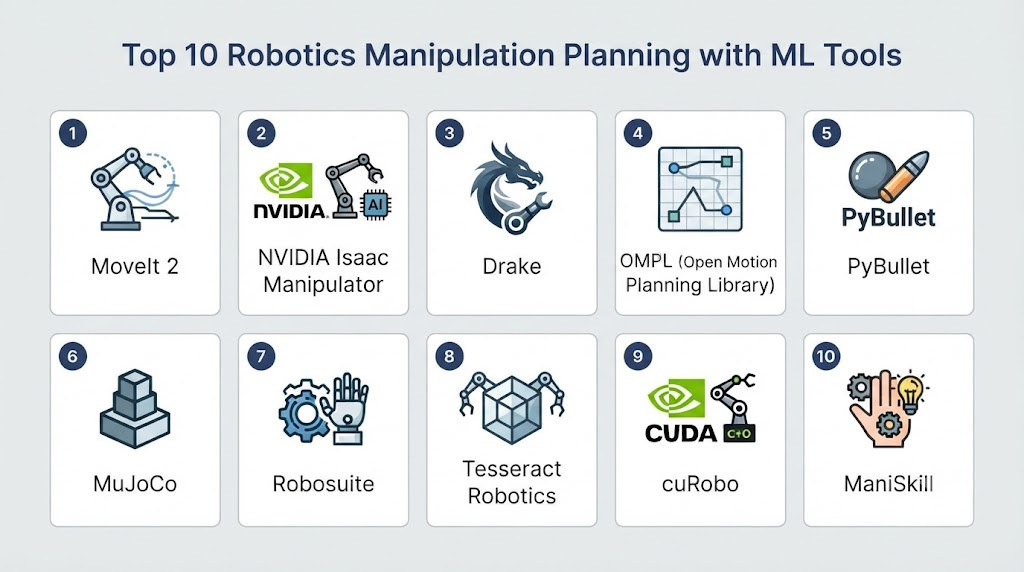
Top 10 Robotics Manipulation Planning with ML Tools
1. NVIDIA Isaac Lab
One-line verdict: Best for researchers and engineering teams training advanced robot manipulation policies in GPU-accelerated simulation.
Short description:
NVIDIA Isaac Lab is a robotics learning framework built around simulation and reinforcement learning workflows. It is designed for developing robot policies using large-scale simulated environments and can support manipulation, locomotion, and other robotic tasks.
Standout Capabilities
- GPU-accelerated robotics simulation.
- Reinforcement-learning workflows.
- Robot manipulation environments.
- Large-scale parallel simulation.
- Domain randomization.
- Synthetic-data workflows.
- Integration with NVIDIA robotics technologies.
- Support for learning-based control.
AI-Specific Depth
- Model support: Supports reinforcement-learning algorithms and integration with external ML frameworks.
- RAG / knowledge integration: N/A.
- Evaluation: Simulation-based evaluation, task rewards, success metrics, and policy testing.
- Guardrails: Simulation constraints, robot limits, and configurable environments; application-specific safety layers remain necessary.
- Observability: Simulation metrics, training metrics, and policy performance measurements.
Pros
- Excellent for large-scale simulation and RL research.
- Strong GPU acceleration.
- Suitable for complex manipulation experiments.
Cons
- Requires substantial technical knowledge.
- NVIDIA-focused infrastructure can influence architecture decisions.
- Physical deployment still requires additional robotics integration and validation.
Security & Compliance
Security depends largely on the deployment environment and infrastructure. Certifications: Not publicly stated.
Deployment & Platforms
- Linux: Yes.
- Cloud: Possible depending on infrastructure.
- Self-hosted: Yes.
- Windows: Varies by component and workflow.
- Hybrid: Possible.
Integrations & Ecosystem
Isaac Lab is designed to work within broader NVIDIA and robotics ecosystems.
- Robot simulation.
- Reinforcement-learning frameworks.
- Python.
- ROS-based workflows.
- NVIDIA GPUs.
- Robot models.
- Custom simulation environments.
Pricing Model
The framework itself is associated with NVIDIA’s robotics software ecosystem. Specific commercial infrastructure costs vary.
Best-Fit Scenarios
- Training manipulation policies.
- Large-scale reinforcement-learning research.
- Sim-to-real robotics development.
2. MoveIt 2
One-line verdict: Best for ROS-based robotic manipulation planning requiring mature motion planning and integration capabilities.
Short description:
MoveIt 2 is a widely used robotics manipulation framework within the ROS 2 ecosystem. It provides motion planning, collision checking, manipulation interfaces, and robot configuration tools that can be combined with ML-based perception and policies.
Standout Capabilities
- Motion planning.
- Collision checking.
- Manipulation planning.
- Robot kinematics.
- Planning-scene management.
- ROS 2 integration.
- Gripper control integration.
- Custom planner support.
AI-Specific Depth
- Model support: Primarily a robotics planning framework; ML models can be integrated externally.
- RAG / knowledge integration: N/A.
- Evaluation: Planning success, collision checks, trajectory metrics, and application-specific ML evaluation.
- Guardrails: Collision checking, joint limits, and planning constraints.
- Observability: Planning results, trajectories, robot states, and ROS 2 tooling.
Pros
- Strong ROS 2 integration.
- Mature manipulation-planning ecosystem.
- Can combine classical planning with ML components.
Cons
- ML is not its primary focus.
- Configuration can be technically demanding.
- Performance depends heavily on robot and planner configuration.
Security & Compliance
Security is largely determined by the ROS 2 deployment architecture. Certifications: Not publicly stated.
Deployment & Platforms
- Linux: Strong support.
- Cloud: Possible.
- Self-hosted: Yes.
- Windows: Varies.
- Hybrid: Possible.
Integrations & Ecosystem
MoveIt 2 works with a broad robotics development ecosystem.
- ROS 2.
- Robot drivers.
- Motion planners.
- Perception systems.
- Simulation environments.
- Python.
- C++.
Pricing Model
Open-source software.
Best-Fit Scenarios
- ROS 2 manipulation projects.
- Industrial robot research.
- Hybrid ML and classical planning systems.
3. MuJoCo
One-line verdict: Best for researchers developing and testing learning-based manipulation and control in physics simulation.
Short description:
MuJoCo is a physics engine widely used for robotics simulation, reinforcement learning, and control research. It provides a physics environment where robotic manipulation policies can be trained and evaluated before physical deployment.
Standout Capabilities
- Physics simulation.
- Contact modeling.
- Robot simulation.
- Reinforcement-learning research.
- Manipulation environments.
- Fast simulation.
- Custom robot models.
- Control experimentation.
AI-Specific Depth
- Model support: Integrates with external reinforcement-learning and ML frameworks.
- RAG / knowledge integration: N/A.
- Evaluation: Simulation rollouts, reward functions, task success, and trajectory metrics.
- Guardrails: Physics and simulation constraints.
- Observability: Simulation state, trajectories, contacts, and training metrics.
Pros
- Strong physics simulation.
- Popular for reinforcement-learning research.
- Useful for contact-rich manipulation experiments.
Cons
- Requires external ML frameworks for many advanced learning workflows.
- Sim-to-real transfer remains an application challenge.
- Building realistic environments requires technical effort.
Security & Compliance
Deployment-specific. Certifications: Not publicly stated.
Deployment & Platforms
- Linux: Yes.
- Windows: Yes.
- macOS: Yes.
- Cloud: Possible.
- Self-hosted: Yes.
Integrations & Ecosystem
MuJoCo can integrate with many robotics and ML workflows.
- Python.
- Reinforcement learning.
- Robot models.
- Control algorithms.
- Custom environments.
- Research frameworks.
Pricing Model
Open-source software.
Best-Fit Scenarios
- RL research.
- Manipulation simulation.
- Physics-based control experiments.
4. Gazebo
One-line verdict: Best for robotics teams needing open simulation and integration with ROS-based manipulation development.
Short description:
Gazebo is a robotics simulation platform used for developing, testing, and validating robotic systems before deployment. It can simulate sensors, environments, robots, and physical interactions.
Standout Capabilities
- Robot simulation.
- Physics simulation.
- Sensor simulation.
- ROS integration.
- Environment modeling.
- Manipulation testing.
- Autonomous robotics development.
- Hardware-in-the-loop workflows.
AI-Specific Depth
- Model support: External ML and reinforcement-learning models can be integrated.
- RAG / knowledge integration: N/A.
- Evaluation: Simulation metrics and application-specific evaluation.
- Guardrails: Physics constraints and configurable simulation boundaries.
- Observability: Robot state, sensor data, simulation logs, and trajectories.
Pros
- Open robotics ecosystem.
- Strong ROS compatibility.
- Useful for simulation before physical testing.
Cons
- Simulation configuration can be complex.
- ML capabilities depend on external frameworks.
- Realism depends on environment and physics configuration.
Security & Compliance
Deployment-dependent. Certifications: Not publicly stated.
Deployment & Platforms
- Linux: Yes.
- Cloud: Possible.
- Self-hosted: Yes.
- Windows: Varies by version and component.
Integrations & Ecosystem
Gazebo can connect with many robotics development tools.
- ROS 2.
- Robot models.
- Sensor plugins.
- Python.
- C++.
- ML frameworks.
- Hardware interfaces.
Pricing Model
Open-source software.
Best-Fit Scenarios
- ROS-based robotics projects.
- Manipulation simulation.
- Academic and industrial research.
5. PyBullet
One-line verdict: Best for developers who need accessible physics simulation for robotics manipulation and reinforcement-learning experiments.
Short description:
PyBullet is a Python-oriented physics simulation environment frequently used for robotics and reinforcement learning. It provides an accessible way to simulate robot arms, objects, collisions, and physical interactions.
Standout Capabilities
- Physics simulation.
- Robot-arm simulation.
- Collision detection.
- Reinforcement-learning experimentation.
- Python integration.
- Custom environments.
- Contact simulation.
- Rapid prototyping.
AI-Specific Depth
- Model support: External ML and RL libraries.
- RAG / knowledge integration: N/A.
- Evaluation: Simulation rewards, success rates, trajectories, and custom metrics.
- Guardrails: Physics and collision constraints.
- Observability: Simulation state and robot trajectories.
Pros
- Easy to prototype with Python.
- Useful for robotics research.
- Lightweight compared with some large simulation stacks.
Cons
- Less enterprise-oriented than larger robotics platforms.
- Simulation realism depends on configuration.
- Requires external ML tooling.
Security & Compliance
Deployment-dependent. Certifications: Not publicly stated.
Deployment & Platforms
- Linux: Yes.
- Windows: Yes.
- macOS: Yes.
- Cloud: Possible.
- Self-hosted: Yes.
Integrations & Ecosystem
- Python.
- Reinforcement learning.
- Robot models.
- Control algorithms.
- Computer vision.
- Custom simulation environments.
Pricing Model
Open-source software.
Best-Fit Scenarios
- Robotics education.
- RL experimentation.
- Rapid manipulation prototyping.
6. NVIDIA Isaac Sim
One-line verdict: Best for high-fidelity robotics simulation, synthetic data, perception, and advanced manipulation development.
Short description:
NVIDIA Isaac Sim provides a high-fidelity simulation environment for robotics development. It supports realistic sensor simulation, robot environments, synthetic data, and testing of AI-powered robotics workflows.
Standout Capabilities
- High-fidelity simulation.
- Synthetic-data generation.
- Sensor simulation.
- Robot manipulation.
- Physics simulation.
- Digital-twin workflows.
- ROS integration.
- AI development.
AI-Specific Depth
- Model support: Supports integration with external AI and robotics models.
- RAG / knowledge integration: N/A.
- Evaluation: Simulation-based evaluation and scenario testing.
- Guardrails: Physics, collision, and simulation constraints.
- Observability: Simulation telemetry and robot-state monitoring.
Pros
- Strong visual and physical simulation.
- Excellent synthetic-data capabilities.
- Useful for complex robotics workflows.
Cons
- Hardware requirements can be substantial.
- NVIDIA ecosystem dependency.
- Advanced workflows require significant engineering expertise.
Security & Compliance
Deployment-specific. Certifications: Not publicly stated.
Deployment & Platforms
- Linux: Yes.
- Cloud: Supported depending on infrastructure.
- Self-hosted: Yes.
- Hybrid: Possible.
Integrations & Ecosystem
- ROS 2.
- NVIDIA robotics technologies.
- Python.
- AI models.
- Synthetic data.
- Robot hardware.
- Simulation environments.
Pricing Model
Software and infrastructure costs vary by deployment and commercial requirements.
Best-Fit Scenarios
- Industrial robotics.
- Synthetic-data generation.
- High-fidelity manipulation simulation.
7. RoboSuite
One-line verdict: Best for researchers building learning-based manipulation benchmarks and reinforcement-learning experiments.
Short description:
RoboSuite is a robotics simulation framework focused heavily on manipulation research. It provides environments and tools for studying learning-based robotic manipulation.
Standout Capabilities
- Manipulation environments.
- Robot-arm simulation.
- Reinforcement learning.
- Imitation learning.
- Benchmarking.
- Custom tasks.
- Physics simulation.
- Research-oriented workflows.
AI-Specific Depth
- Model support: External ML and RL algorithms.
- RAG / knowledge integration: N/A.
- Evaluation: Manipulation success rates and research benchmarks.
- Guardrails: Simulation constraints.
- Observability: Environment state, actions, rewards, and trajectories.
Pros
- Strong focus on manipulation research.
- Useful benchmark environments.
- Good for ML experimentation.
Cons
- Research-oriented rather than enterprise-focused.
- Physical deployment requires additional infrastructure.
- Requires knowledge of robotics and ML.
Security & Compliance
Deployment-dependent. Certifications: Not publicly stated.
Deployment & Platforms
- Linux: Yes.
- Cloud: Possible.
- Self-hosted: Yes.
- Windows: Varies.
Integrations & Ecosystem
- Python.
- MuJoCo.
- Reinforcement learning.
- Imitation learning.
- Robot models.
- Research environments.
Pricing Model
Open-source software.
Best-Fit Scenarios
- Academic manipulation research.
- RL experimentation.
- Benchmark development.
8. ManiSkill
One-line verdict: Best for large-scale GPU-accelerated manipulation learning and benchmarking across diverse robotic tasks.
Short description:
ManiSkill is a robotics simulation and learning framework focused on manipulation. It provides environments designed for reinforcement learning, imitation learning, and large-scale robotic experimentation.
Standout Capabilities
- Manipulation benchmarks.
- GPU-accelerated simulation.
- Reinforcement learning.
- Imitation learning.
- Visual observations.
- Contact-rich tasks.
- Parallel environments.
- Research benchmarking.
AI-Specific Depth
- Model support: Supports external RL and ML algorithms.
- RAG / knowledge integration: N/A.
- Evaluation: Benchmark task success and learning performance.
- Guardrails: Simulation constraints and task-specific limits.
- Observability: Training metrics, simulation state, rewards, and trajectories.
Pros
- Strong manipulation focus.
- Suitable for large-scale learning.
- Useful for modern robotics research.
Cons
- Technical learning curve.
- Primarily research-oriented.
- Real-world deployment requires additional integration.
Security & Compliance
Deployment-dependent. Certifications: Not publicly stated.
Deployment & Platforms
- Linux: Yes.
- Cloud: Possible.
- Self-hosted: Yes.
- GPU: Recommended for large-scale workloads.
Integrations & Ecosystem
- Python.
- Reinforcement learning.
- Imitation learning.
- GPU computing.
- Robot models.
- Simulation environments.
Pricing Model
Open-source software.
Best-Fit Scenarios
- Manipulation research.
- Large-scale RL training.
- Robotics benchmarking.
9. OpenRAVE
One-line verdict: Best for robotics researchers working on kinematics, motion planning, collision checking, and manipulation experimentation.
Short description:
OpenRAVE is a robotics planning and simulation framework historically used for robotic manipulation research. It provides tools for motion planning, kinematics, collision checking, and robotic-arm experimentation.
Standout Capabilities
- Motion planning.
- Kinematic analysis.
- Collision detection.
- Manipulation research.
- Robot modeling.
- Grasp planning.
- Simulation.
- Planning experimentation.
AI-Specific Depth
- Model support: External ML models can be integrated.
- RAG / knowledge integration: N/A.
- Evaluation: Planning and simulation metrics.
- Guardrails: Collision and kinematic constraints.
- Observability: Robot state and planning results.
Pros
- Strong historical relevance to manipulation research.
- Useful planning concepts.
- Supports custom robotics experimentation.
Cons
- Older ecosystem compared with newer frameworks.
- May require additional work for modern ML workflows.
- Long-term maintenance and compatibility should be evaluated carefully.
Security & Compliance
Deployment-dependent. Certifications: Not publicly stated.
Deployment & Platforms
- Linux: Primary historical environment.
- Self-hosted: Yes.
- Cloud: Possible through custom infrastructure.
- Windows/macOS: Varies.
Integrations & Ecosystem
- Robot models.
- Motion planners.
- Python.
- Robotics research tools.
- Custom algorithms.
Pricing Model
Open-source software.
Best-Fit Scenarios
- Robotics research.
- Motion-planning experiments.
- Legacy manipulation projects.
10. NVIDIA Isaac Gym
One-line verdict: Best for large-scale GPU-based reinforcement-learning experiments involving simulated robotic manipulation.
Short description:
NVIDIA Isaac Gym is a GPU-accelerated physics simulation environment designed for reinforcement-learning research. It enables many simulated environments to run in parallel, making it useful for training robotic policies.
Standout Capabilities
- GPU-accelerated physics.
- Parallel environments.
- Reinforcement learning.
- Robotic manipulation.
- High-throughput simulation.
- Policy training.
- Domain randomization.
- Large-scale experimentation.
AI-Specific Depth
- Model support: External reinforcement-learning frameworks.
- RAG / knowledge integration: N/A.
- Evaluation: Reward metrics, simulation success, and policy performance.
- Guardrails: Physics and simulation constraints.
- Observability: Simulation state, rewards, trajectories, and training metrics.
Pros
- High simulation throughput.
- Strong for RL research.
- Useful for large-scale experiments.
Cons
- NVIDIA-specific ecosystem.
- Requires strong GPU resources.
- Users should evaluate its role relative to newer NVIDIA robotics simulation technologies.
Security & Compliance
Deployment-dependent. Certifications: Not publicly stated.
Deployment & Platforms
- Linux: Yes.
- Cloud: Possible.
- Self-hosted: Yes.
- GPU: Required for intended high-performance workflows.
Integrations & Ecosystem
- Python.
- Reinforcement learning.
- NVIDIA GPUs.
- Robot models.
- Simulation environments.
- ML training pipelines.
Pricing Model
Availability and infrastructure costs vary.
Best-Fit Scenarios
- RL manipulation research.
- Large-scale simulation.
- GPU-accelerated robot learning.
Comparison Table
| Tool | Best For | Deployment | ML Flexibility | Strength | Watch-Out |
|---|---|---|---|---|---|
| NVIDIA Isaac Lab | Advanced robot learning | Self-hosted / Cloud | High | GPU-accelerated RL | Technical complexity |
| MoveIt 2 | ROS 2 manipulation | Self-hosted | High through integrations | Motion planning | ML is external |
| MuJoCo | RL research | Self-hosted / Cloud | High | Physics simulation | Sim-to-real challenge |
| Gazebo | ROS simulation | Self-hosted | High through integrations | Robotics ecosystem | Configuration complexity |
| PyBullet | Rapid prototyping | Self-hosted | High through integrations | Accessible simulation | Less enterprise-focused |
| NVIDIA Isaac Sim | High-fidelity simulation | Self-hosted / Cloud | High | Synthetic data | Hardware requirements |
| RoboSuite | Manipulation research | Self-hosted | High | Research environments | Research-oriented |
| ManiSkill | Large-scale manipulation learning | Self-hosted / Cloud | High | GPU simulation | Technical learning curve |
| OpenRAVE | Planning research | Self-hosted | External ML | Motion planning | Older ecosystem |
| NVIDIA Isaac Gym | RL simulation | Self-hosted / Cloud | High | Parallel simulation | GPU dependency |
Scoring & Evaluation
The following scores are comparative rather than absolute. They reflect the suitability of each tool for ML-based robotic manipulation planning rather than general robotics development.
The evaluation considers manipulation capabilities, ML integration, simulation, ecosystem, usability, performance, deployment flexibility, and developer support.
| Tool | Core | ML/Reliability | Safety | Integrations | Ease | Perf/Cost | Security/Admin | Support | Weighted Total |
|---|---|---|---|---|---|---|---|---|---|
| NVIDIA Isaac Lab | 9.5 | 9.5 | 8.5 | 9.0 | 7.5 | 9.5 | 8.5 | 9.0 | 9.0 |
| MoveIt 2 | 9.5 | 8.0 | 9.5 | 9.5 | 7.5 | 8.5 | 8.5 | 9.5 | 8.9 |
| MuJoCo | 9.0 | 9.5 | 8.5 | 9.0 | 8.5 | 9.5 | 8.0 | 9.0 | 8.9 |
| Gazebo | 9.0 | 8.0 | 9.0 | 9.5 | 7.5 | 8.0 | 8.5 | 9.0 | 8.6 |
| PyBullet | 8.0 | 8.5 | 8.0 | 8.5 | 9.0 | 9.0 | 7.5 | 8.5 | 8.4 |
| NVIDIA Isaac Sim | 9.5 | 9.0 | 9.0 | 9.5 | 7.5 | 8.5 | 8.5 | 9.0 | 8.9 |
| RoboSuite | 8.5 | 9.0 | 8.0 | 8.5 | 8.0 | 8.5 | 7.5 | 8.5 | 8.4 |
| ManiSkill | 9.0 | 9.5 | 8.0 | 8.5 | 7.5 | 9.5 | 7.5 | 8.5 | 8.7 |
| OpenRAVE | 7.5 | 7.0 | 8.0 | 7.5 | 6.5 | 7.5 | 7.0 | 6.5 | 7.3 |
| NVIDIA Isaac Gym | 8.5 | 9.5 | 8.0 | 8.5 | 7.0 | 9.5 | 7.5 | 8.0 | 8.5 |
Top 3 for Enterprise
- NVIDIA Isaac Sim
- NVIDIA Isaac Lab
- MoveIt 2
Top 3 for SMB
- MoveIt 2
- PyBullet
- Gazebo
Top 3 for Developers
- MuJoCo
- ManiSkill
- PyBullet
Which Robotics Manipulation Planning with ML Tool Is Right for You?
Solo / Freelancer
Individual developers should prioritize tools that are easy to install, have strong Python support, and allow rapid experimentation.
Best options:
- MuJoCo for physics and RL experimentation.
- PyBullet for accessible robotics prototyping.
- MoveIt 2 for ROS-based manipulation.
Avoid building an extremely complex simulation infrastructure unless the project requires it.
SMB
Small robotics teams should focus on tools that can support real robots without requiring a huge engineering organization.
Prioritize:
- Robot compatibility.
- ROS support.
- Simulation.
- Documentation.
- Hardware integration.
- Community support.
- Low infrastructure overhead.
MoveIt 2, Gazebo, and PyBullet can be practical starting points depending on the project.
Mid-Market
Mid-market robotics organizations can benefit from combining simulation with learned manipulation policies.
A typical architecture could use:
- Isaac Sim or another simulator.
- ML training framework.
- MoveIt 2.
- Computer vision.
- Robot-specific drivers.
- Classical safety controls.
Enterprise
Large manufacturers and robotics companies should prioritize scalable simulation, GPU acceleration, digital twins, data pipelines, observability, safety architecture, and deployment management.
NVIDIA Isaac Sim and Isaac Lab are particularly relevant for large-scale AI robotics development, while MoveIt 2 can provide strong motion-planning infrastructure.
Regulated Industries
Healthcare, laboratory, aerospace, and other safety-sensitive environments should place greater emphasis on:
- Deterministic safety controls.
- Human oversight.
- Testing.
- Traceability.
- Hardware safety.
- Model validation.
- Failure recovery.
ML should generally operate within clearly defined safety boundaries.
Budget vs Premium
Open-source tools can significantly reduce software licensing costs, but they do not eliminate engineering costs.
Budget for:
- GPUs.
- Simulation infrastructure.
- Robot hardware.
- Sensor systems.
- Data collection.
- Engineering.
- Model training.
- Testing.
- Maintenance.
A commercial ecosystem can be attractive when reducing engineering effort is more important than minimizing licensing expenses.
Build vs Buy
Building your own manipulation planner may make sense when you have highly specialized tasks or proprietary robot hardware.
A custom approach is attractive when:
- Your manipulation tasks are unique.
- You have strong ML expertise.
- You need custom policies.
- You have significant training data.
- You require control over the complete stack.
Using existing frameworks is usually better when you need to reach a working prototype quickly.
A hybrid architecture is often the most practical option: use established planning and simulation frameworks while developing proprietary ML policies.
Implementation Playbook
First 30 Days: Pilot + Success Metrics
Start with one clearly defined manipulation task.
Activities should include:
- Select the robot.
- Define the workspace.
- Select sensors.
- Establish a baseline planner.
- Build a simulation environment.
- Collect demonstrations if required.
- Define success metrics.
- Establish safety boundaries.
- Create initial datasets.
Measure:
- Task success.
- Grasp success.
- Execution time.
- Collision rate.
- Recovery rate.
- Inference latency.
Days 31–60: Harden Security + Evaluation + Rollout
The second stage should focus on testing.
Activities include:
- Train the initial policy.
- Run large simulation batches.
- Test unseen objects.
- Test different object positions.
- Introduce sensor noise.
- Perform domain randomization.
- Compare ML against the baseline.
- Test failure recovery.
- Build regression tests.
- Evaluate sim-to-real transfer.
Maintain version control for:
- Training datasets.
- Model checkpoints.
- Simulation environments.
- Reward functions.
- Robot configurations.
- Policy parameters.
Days 61–90: Optimize Cost/Latency + Governance + Scale
After achieving reliable results:
- Optimize inference speed.
- Reduce unnecessary GPU usage.
- Improve simulation throughput.
- Expand object diversity.
- Introduce additional manipulation tasks.
- Improve monitoring.
- Add uncertainty estimation.
- Establish deployment procedures.
- Create incident-handling processes.
- Formalize model-update workflows.
Common Mistakes & How to Avoid Them
- Training directly on physical robots: Use simulation whenever possible before real-world training.
- Ignoring the sim-to-real gap: Randomize simulation conditions and validate on physical hardware.
- Using poor training data: Collect diverse demonstrations and include failures.
- Skipping a baseline: Compare ML performance with classical planning.
- Ignoring safety: Add independent collision, force, and workspace controls.
- Overtraining a single environment: Test different objects, lighting, positions, and surfaces.
- Ignoring latency: A highly accurate model can still be unsuitable for real-time control.
- Using an oversized model: Select models according to actual robotics requirements.
- Ignoring hardware constraints: Sensors, actuators, GPUs, and robot controllers affect performance.
- No failure recovery: Design explicit recovery behaviors.
- No evaluation harness: Track task success and failure categories consistently.
- Overusing reinforcement learning: Imitation learning may be more efficient when demonstrations are available.
- Ignoring uncertainty: Low-confidence predictions should trigger safer behavior.
- Automating everything: Keep humans involved during early physical deployment.
FAQs
What is Robotics Manipulation Planning with ML?
It is the use of machine learning to help robots determine how to grasp, move, position, and interact with objects.
Is ML better than traditional motion planning?
Not always. ML provides adaptability, while traditional planners can offer predictable constraints and strong collision handling. Hybrid systems are often practical.
What is the best tool for robotic manipulation learning?
There is no universal winner. NVIDIA Isaac Lab, Isaac Sim, MuJoCo, ManiSkill, MoveIt 2, and other frameworks serve different development requirements.
Can reinforcement learning train robotic arms?
Yes. Reinforcement learning can train robotic manipulation policies, particularly when suitable simulation environments and reward functions are available.
Can robots learn manipulation from demonstrations?
Yes. Imitation learning allows robots to learn behaviors from human or robot demonstrations.
What is sim-to-real transfer?
Sim-to-real transfer is the process of taking a policy trained in simulation and deploying it on a physical robot.
Why is sim-to-real difficult?
Real robots contain sensor noise, mechanical imperfections, friction differences, object variability, and environmental conditions that may not be accurately represented in simulation.
Do ML manipulation systems require GPUs?
Not always. Training large models and running large-scale simulations can benefit significantly from GPUs, while smaller inference models may run on CPUs or embedded hardware.
Can MoveIt 2 use machine learning?
Yes. MoveIt 2 can be integrated with external ML-based perception, prediction, and decision-making systems while providing classical manipulation and motion-planning capabilities.
Is reinforcement learning safe on real robots?
It can be used, but direct exploration on physical robots introduces risks. Simulation, constrained exploration, safety controllers, and human supervision are important.
What role does computer vision play?
Computer vision provides information about objects, positions, surfaces, obstacles, and environments that manipulation policies can use to make decisions.
Why is tactile sensing important?
Vision cannot always determine whether a grasp is stable. Tactile and force sensing can provide contact and slip information that improves manipulation.
Can vision-language-action models control robots?
They can be used in emerging robotics architectures to connect visual observations and natural-language tasks with robot actions, but reliability depends heavily on the model, robot, environment, and safety architecture.
What is the difference between a simulator and a manipulation planner?
A simulator models the physical environment and robot, while a manipulation planner determines actions or trajectories. A simulator can be used to train and evaluate manipulation planners.
Should businesses build their own robotics ML platform?
Only when their requirements justify the engineering investment. Established simulation, planning, and ML frameworks can significantly reduce development time.
How should manipulation models be evaluated?
Evaluate task success, grasp success, collision rate, trajectory efficiency, latency, generalization, recovery behavior, and performance on physical hardware.
What is the biggest challenge in ML-based manipulation?
Generalizing learned behavior to unfamiliar objects and environments while maintaining reliable, safe physical interaction remains one of the hardest problems.
Conclusion
Robotics Manipulation Planning with ML is becoming an important component of modern intelligent robotics. Machine learning enables robots to learn manipulation behaviors from demonstrations, simulation, sensor data, and interaction rather than relying entirely on manually programmed trajectories.The most effective development strategy is usually not to abandon classical robotics. Instead, ML can be combined with motion planning, kinematics, collision detection, simulation, optimization, and deterministic safety systems.The right choice depends on whether your priority is large-scale reinforcement learning, high-fidelity simulation, ROS integration, rapid prototyping, manipulation research, or deployment on physical robots.