Introduction
AI Rail Scheduling Optimization refers to the use of artificial intelligence, machine learning, optimization algorithms, predictive analytics, and real-time railway data to create better train schedules and manage rail capacity. These systems help railway operators coordinate trains, tracks, platforms, crews, rolling stock, maintenance windows, and passenger demand more efficiently.
Traditional railway scheduling often depends on fixed timetables and manually defined operating rules. While these approaches remain useful, modern rail networks are increasingly dynamic. Delays, maintenance activities, weather, passenger demand, infrastructure constraints, and connecting services can quickly make an original schedule less effective.
AI-based optimization can evaluate thousands of possible scheduling combinations and identify alternatives that reduce conflicts, improve punctuality, increase infrastructure utilization, and support faster recovery from disruptions.
Common applications include train timetable optimization, platform allocation, conflict detection, delay recovery, crew scheduling, rolling-stock planning, capacity optimization, freight scheduling, passenger-demand forecasting, and real-time traffic management.
Best for: Railway operators, metro systems, high-speed rail networks, freight rail companies, infrastructure managers, transit authorities, and transportation organizations managing complex networks.
Not ideal for: Small rail operations with simple routes and predictable schedules. For these organizations, conventional scheduling software and rule-based planning may provide sufficient functionality at lower complexity.
What’s Changed in AI Rail Scheduling Optimization
- AI systems are increasingly combining historical railway data with real-time traffic information.
- Optimization engines can evaluate multiple timetable alternatives rather than relying on a single predefined schedule.
- Predictive models can estimate the impact of delays on downstream services.
- Real-time optimization can help dispatchers respond to disruptions faster.
- Digital twins are increasingly useful for simulating railway capacity and timetable scenarios.
- AI can combine infrastructure constraints, passenger demand, rolling-stock availability, and maintenance schedules.
- Predictive maintenance information can be incorporated into scheduling decisions.
- Machine learning can improve estimates of train running times and dwell times.
- AI-assisted scheduling can help identify bottlenecks before they become operational problems.
- Multimodal planning can connect rail schedules with buses, metro services, airports, and other transportation modes.
- Optimization systems can increasingly support scenario analysis for infrastructure changes.
- Automated recommendations can assist railway control-room personnel while keeping humans responsible for critical decisions.
- Cloud and edge architectures can support centralized planning and real-time operational applications.
- AI governance is becoming important where scheduling recommendations influence safety-sensitive operations.
- Cybersecurity is increasingly important because railway scheduling systems interact with operational technology.
- Model monitoring can help identify degradation caused by timetable changes, infrastructure modifications, or unusual events.
- Cost and computational efficiency matter when optimization problems become extremely large.
- Explainability is important when dispatchers need to understand why an alternative schedule was recommended.
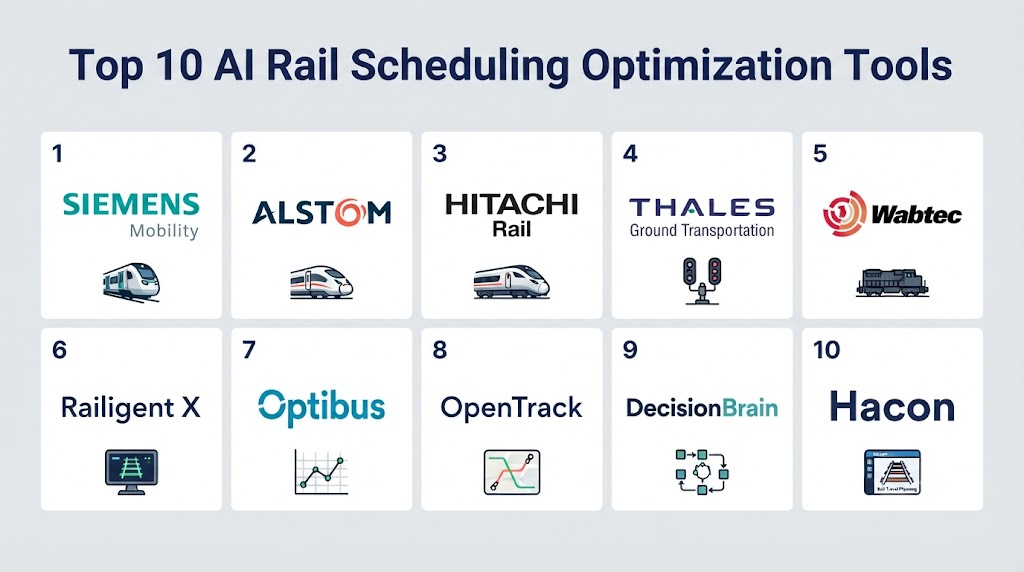
Top 10 AI Rail Scheduling Optimization Tools
1 — Siemens Railigent X
One-line verdict: Best for large railway organizations combining AI, predictive analytics, asset intelligence, and operational optimization.
Short description:
Siemens Railigent X is a railway-focused digital ecosystem designed to connect operational and asset data with analytics and AI capabilities. It can support railway operators in improving fleet availability, maintenance planning, and operational decision-making.
Standout Capabilities
- Railway data analytics
- Predictive maintenance
- Fleet intelligence
- Operational monitoring
- Asset performance analysis
- Railway data integration
- AI-supported decision-making
- Digital railway applications
AI-Specific Depth
- Model support: Proprietary AI and analytics capabilities.
- RAG / knowledge integration: N/A as a core scheduling capability.
- Evaluation: Operational and predictive-model evaluation.
- Guardrails: Operational rules and human oversight.
- Observability: Fleet and operational monitoring.
Pros
- Strong railway specialization.
- Useful for large-scale railway ecosystems.
- Supports predictive and operational analytics.
Cons
- Enterprise-oriented.
- Implementation may require extensive integration.
- Not solely a timetable optimization product.
Security & Compliance
Security and compliance capabilities vary by deployment and product configuration. Specific certifications should be verified for the selected implementation.
Deployment & Platforms
- Cloud
- Enterprise
- Hybrid
- Railway infrastructure
Integrations & Ecosystem
Railigent X can connect railway assets and operational information with digital applications.
- Rolling-stock systems
- Sensors
- Maintenance platforms
- Operational databases
- Analytics systems
- APIs
- Railway infrastructure
Pricing Model
Enterprise commercial model; exact pricing is not publicly stated.
Best-Fit Scenarios
- Large railway networks
- Predictive railway operations
- Fleet and asset optimization
2 — Hitachi Rail Lumada
One-line verdict: Best for railway organizations seeking AI-driven operational intelligence, asset optimization, and integrated digital rail management.
Short description:
Hitachi Rail combines railway technology with digital and analytics capabilities through its Lumada ecosystem. Its solutions can support railway operators with operational intelligence, predictive maintenance, and data-driven decision-making.
Standout Capabilities
- Railway analytics
- Predictive maintenance
- Operational intelligence
- Fleet monitoring
- Asset optimization
- Data integration
- Digital railway applications
- Performance management
AI-Specific Depth
- Model support: Proprietary AI and analytics.
- RAG / knowledge integration: N/A.
- Evaluation: Product-specific.
- Guardrails: Operational controls and human oversight.
- Observability: Operational and asset monitoring.
Pros
- Strong railway expertise.
- Suitable for complex rail environments.
- Broad digital railway capabilities.
Cons
- Enterprise implementation.
- Multiple products may require architectural planning.
- Specific scheduling capabilities vary by solution.
Security & Compliance
Security and compliance depend on the selected product and deployment. Certifications should be independently verified before procurement.
Deployment & Platforms
- Cloud
- Hybrid
- Enterprise
- Railway infrastructure
Integrations & Ecosystem
- Train systems
- Infrastructure
- Sensors
- Fleet data
- Maintenance systems
- APIs
- Operational platforms
Pricing Model
Enterprise commercial model.
Best-Fit Scenarios
- Digital railway transformation
- Fleet optimization
- Operational intelligence
3 — OPTURNO
One-line verdict: Best for railway operators needing optimization-based decision support for complex timetable and traffic-management challenges.
Short description:
OPTURNO focuses on railway planning and optimization. Optimization-based approaches can help operators analyze complex scheduling problems involving infrastructure capacity, train paths, conflicts, and operational constraints.
Standout Capabilities
- Railway timetable planning
- Train-path optimization
- Infrastructure capacity planning
- Conflict analysis
- Scenario comparison
- Scheduling optimization
- Operational planning
- Decision support
AI-Specific Depth
- Model support: Optimization algorithms and analytics.
- RAG / knowledge integration: N/A.
- Evaluation: Scenario and optimization comparison.
- Guardrails: Railway operating constraints.
- Observability: Planning and operational analytics.
Pros
- Strong focus on railway optimization.
- Suitable for complex scheduling problems.
- Useful for scenario analysis.
Cons
- Specialized rather than general-purpose.
- Requires detailed railway infrastructure data.
- Deployment complexity can vary.
Security & Compliance
Specific security and compliance information should be verified for the selected implementation.
Deployment & Platforms
- Enterprise
- Web
- Cloud or hosted environments may vary
Integrations & Ecosystem
- Timetable systems
- Infrastructure databases
- Train-path information
- Railway planning systems
- APIs
- Operational data
- Traffic-management systems
Pricing Model
Enterprise commercial model; exact pricing is not publicly stated.
Best-Fit Scenarios
- Timetable optimization
- Rail-capacity planning
- Infrastructure scenario analysis
4 — RailSys
One-line verdict: Best for railway timetable simulation, infrastructure planning, capacity analysis, and operational scenario testing.
Short description:
RailSys provides railway planning and simulation technologies for analyzing timetables, infrastructure capacity, train operations, and railway performance. Simulation can help operators test schedules before implementation.
Standout Capabilities
- Timetable simulation
- Railway capacity analysis
- Infrastructure planning
- Train-operation simulation
- Conflict detection
- Schedule evaluation
- Scenario analysis
- Network planning
AI-Specific Depth
- Model support: Simulation, optimization, and analytical approaches.
- RAG / knowledge integration: N/A.
- Evaluation: Simulation-based evaluation.
- Guardrails: Infrastructure and operational constraints.
- Observability: Simulation and performance outputs.
Pros
- Strong railway simulation capabilities.
- Useful for timetable testing.
- Supports infrastructure planning.
Cons
- Primarily specialized railway software.
- Requires accurate network models.
- May require specialist expertise.
Security & Compliance
Deployment-specific security and compliance details should be confirmed with the provider.
Deployment & Platforms
- Desktop
- Enterprise
- Hosted options may vary
Integrations & Ecosystem
- Timetable data
- Infrastructure models
- Train characteristics
- Operational planning
- Simulation systems
- Data interfaces
- Railway databases
Pricing Model
Enterprise commercial model.
Best-Fit Scenarios
- Timetable simulation
- Capacity planning
- Infrastructure development
5 — OpenTrack
One-line verdict: Best for railway researchers, planners, and engineering teams performing detailed timetable and infrastructure simulations.
Short description:
OpenTrack is a railway simulation environment used to model train operations, infrastructure, timetables, and railway traffic. It can support analysis of alternative schedules and infrastructure scenarios.
Standout Capabilities
- Railway simulation
- Timetable analysis
- Infrastructure modeling
- Train dynamics
- Capacity analysis
- Schedule testing
- Scenario evaluation
- Railway planning
AI-Specific Depth
- Model support: Simulation and optimization integration.
- RAG / knowledge integration: N/A.
- Evaluation: Simulation-based evaluation.
- Guardrails: User-defined operational constraints.
- Observability: Simulation outputs and operational metrics.
Pros
- Detailed railway simulation.
- Useful for planning and research.
- Supports complex railway scenarios.
Cons
- Requires railway modeling expertise.
- Not a turnkey AI scheduling platform.
- Automation capabilities depend on implementation.
Security & Compliance
Specific enterprise security capabilities vary by deployment.
Deployment & Platforms
- Desktop
- Engineering environments
- Enterprise deployments may vary
Integrations & Ecosystem
- Infrastructure models
- Timetables
- Train data
- Simulation workflows
- External optimization tools
- Data files
- Analytical systems
Pricing Model
Commercial licensing model; exact pricing is not publicly stated.
Best-Fit Scenarios
- Railway research
- Timetable simulation
- Infrastructure planning
6 — AnyLogic
One-line verdict: Best for organizations building custom railway simulations that combine optimization, passenger behavior, and operational scenarios.
Short description:
AnyLogic is a general-purpose simulation platform that supports discrete-event, agent-based, and system-dynamics modeling. Railway organizations can use it to build customized models for scheduling, passenger movement, capacity, and operational scenarios.
Standout Capabilities
- Agent-based simulation
- Discrete-event simulation
- System dynamics
- Scenario modeling
- Optimization
- Passenger-flow modeling
- Transportation simulation
- Custom model development
AI-Specific Depth
- Model support: Custom analytics and optimization; external AI integration is possible.
- RAG / knowledge integration: Custom.
- Evaluation: Scenario and simulation evaluation.
- Guardrails: Model-specific constraints.
- Observability: Simulation dashboards and metrics.
Pros
- Highly flexible.
- Excellent for custom scenarios.
- Can model complex passenger and railway interactions.
Cons
- Requires modeling expertise.
- Not specifically designed only for railways.
- Customization increases implementation effort.
Security & Compliance
Security characteristics depend on deployment and organization configuration.
Deployment & Platforms
- Windows
- Cloud options
- Enterprise
- Simulation environments
Integrations & Ecosystem
- APIs
- Databases
- External optimization tools
- Python
- Java
- Data platforms
- Transportation systems
Pricing Model
Commercial licensing model; exact pricing varies.
Best-Fit Scenarios
- Custom railway simulation
- Passenger-demand scenarios
- Schedule optimization research
7 — IBM ILOG CPLEX Optimization Studio
One-line verdict: Best for developers and operations-research teams building advanced mathematical railway scheduling and optimization models.
Short description:
IBM ILOG CPLEX Optimization Studio provides optimization technologies that can be applied to complex scheduling and resource-allocation problems. Railway organizations can use mathematical optimization to model train paths, resource constraints, and timetable objectives.
Standout Capabilities
- Mathematical optimization
- Constraint programming
- Scheduling
- Resource allocation
- Scenario analysis
- Optimization modeling
- Large-scale problem solving
- Developer tooling
AI-Specific Depth
- Model support: Optimization models; external machine-learning integration is possible.
- RAG / knowledge integration: N/A.
- Evaluation: Mathematical objective and constraint evaluation.
- Guardrails: Explicit model constraints.
- Observability: Solver statistics and model outputs.
Pros
- Powerful optimization capabilities.
- Highly customizable.
- Suitable for complex scheduling problems.
Cons
- Requires optimization expertise.
- Not a ready-made railway application.
- Model development can take significant effort.
Security & Compliance
Enterprise security and deployment options vary.
Deployment & Platforms
- Windows
- Linux
- Cloud
- Enterprise
- APIs
Integrations & Ecosystem
- Python
- Java
- C++
- APIs
- Databases
- Enterprise applications
- Optimization workflows
Pricing Model
Commercial enterprise licensing.
Best-Fit Scenarios
- Custom scheduling engines
- Railway optimization research
- Large-scale resource allocation
8 — Google OR-Tools
One-line verdict: Best for developers building flexible, cost-conscious custom railway scheduling and resource-optimization solutions.
Short description:
Google OR-Tools is an open-source optimization toolkit that supports constraint programming, routing, linear programming, and related optimization problems. Developers can use it to create custom railway scheduling applications.
Standout Capabilities
- Constraint programming
- Scheduling
- Routing
- Linear optimization
- Resource allocation
- Custom optimization
- Open-source development
- API-based integration
AI-Specific Depth
- Model support: Optimization rather than a proprietary AI model platform.
- RAG / knowledge integration: N/A.
- Evaluation: Objective-function and constraint testing.
- Guardrails: Explicit constraints.
- Observability: Application-level monitoring must generally be implemented by the developer.
Pros
- Open-source.
- Highly customizable.
- Suitable for developer-led projects.
Cons
- Requires engineering expertise.
- Does not provide a complete railway operations platform.
- Production monitoring must be designed separately.
Security & Compliance
Security depends largely on the implementation architecture.
Deployment & Platforms
- Linux
- Windows
- macOS
- Cloud
- Containers
Integrations & Ecosystem
- Python
- C++
- Java
- .NET
- APIs
- Databases
- Custom applications
Pricing Model
Open-source software with development and infrastructure costs.
Best-Fit Scenarios
- Custom railway optimization
- Research projects
- Developer-led scheduling systems
9 — Gurobi Optimization
One-line verdict: Best for high-performance railway scheduling models requiring sophisticated mathematical optimization and constraint handling.
Short description:
Gurobi provides mathematical optimization software used for complex decision-making problems. Railway engineering and operations-research teams can apply it to timetable planning, crew scheduling, fleet allocation, and infrastructure-capacity problems.
Standout Capabilities
- Mixed-integer optimization
- Linear programming
- Constraint optimization
- Scheduling
- Resource allocation
- Scenario analysis
- High-performance solving
- Developer APIs
AI-Specific Depth
- Model support: Mathematical optimization; external ML integration can be developed.
- RAG / knowledge integration: N/A.
- Evaluation: Solver and objective-function evaluation.
- Guardrails: Explicit mathematical constraints.
- Observability: Solver metrics and application monitoring.
Pros
- Strong performance.
- Highly customizable.
- Widely applicable to complex optimization problems.
Cons
- Requires technical optimization knowledge.
- Not a complete railway management application.
- Commercial licensing applies to many use cases.
Security & Compliance
Security and enterprise controls depend on deployment and licensing configuration.
Deployment & Platforms
- Windows
- Linux
- macOS
- Cloud
- Containers
Integrations & Ecosystem
- Python
- Java
- C++
- .NET
- MATLAB
- APIs
- Databases
Pricing Model
Commercial licensing; academic and other licensing options may vary.
Best-Fit Scenarios
- Large timetable optimization
- Crew scheduling
- Railway resource allocation
10 — AWS Custom AI and Optimization Stack
One-line verdict: Best for engineering teams building cloud-native railway scheduling systems with custom AI, optimization, and real-time data pipelines.
Short description:
Railway operators with strong software teams can build custom scheduling platforms using cloud machine learning, optimization libraries, streaming analytics, databases, and operational APIs. This approach provides maximum flexibility but requires substantial engineering work.
Standout Capabilities
- Custom machine learning
- Real-time analytics
- Optimization
- Data lakes
- Event processing
- Predictive scheduling
- Custom APIs
- Cloud deployment
AI-Specific Depth
- Model support: Hosted, open-source, custom, and multi-model approaches can be supported.
- RAG / knowledge integration: Customizable.
- Evaluation: Custom evaluation frameworks.
- Guardrails: Organization-defined controls.
- Observability: Cloud and application monitoring can be implemented.
Pros
- Maximum architectural flexibility.
- Supports real-time applications.
- Suitable for proprietary railway optimization.
Cons
- Requires experienced engineering teams.
- Governance becomes the organization’s responsibility.
- Total implementation effort can be significant.
Security & Compliance
Security controls depend on architecture, configuration, and operational governance.
Deployment & Platforms
- Cloud
- Hybrid
- Edge
- Containers
- APIs
Integrations & Ecosystem
- Railway databases
- IoT
- Streaming data
- APIs
- Machine-learning platforms
- Optimization libraries
- Operational systems
Pricing Model
Usage-based cloud model; total cost varies by architecture and workload.
Best-Fit Scenarios
- Custom railway AI
- Real-time scheduling
- Large-scale operational analytics
Comparison Table
| Tool | Best For | Deployment | Model Flexibility | Strength | Watch-Out | Public Rating |
|---|---|---|---|---|---|---|
| Siemens Railigent X | Digital railway operations | Cloud/Hybrid | Proprietary | Railway ecosystem | Enterprise complexity | |
| Hitachi Rail Lumada | Digital rail intelligence | Cloud/Hybrid | Proprietary | Operational analytics | Product complexity | |
| OPTURNO | Timetable optimization | Cloud/Enterprise | Proprietary | Railway optimization | Specialized implementation | |
| RailSys | Railway simulation | Desktop/Enterprise | Optimization/Simulation | Timetable simulation | Specialist expertise | |
| OpenTrack | Railway simulation | Desktop | Extensible | Detailed modeling | Not turnkey AI | |
| AnyLogic | Custom simulation | Desktop/Cloud | Flexible | Scenario modeling | Development effort | |
| IBM ILOG CPLEX | Optimization development | Cloud/Enterprise/Desktop | Custom | Mathematical optimization | Technical complexity | |
| Google OR-Tools | Custom optimization | Cloud/Local | Open-source | Developer flexibility | Requires engineering | |
| Gurobi | Advanced optimization | Cloud/Local | Custom | Solver performance | Commercial licensing | |
| AWS Custom AI Stack | Custom railway AI | Cloud/Hybrid | Multi-model | Maximum flexibility | Engineering burden |
Scoring & Evaluation
The scoring below is a comparative editorial assessment rather than an official vendor rating. Scores reflect general suitability for AI-assisted rail scheduling and optimization. Actual performance can vary significantly depending on railway size, data quality, infrastructure complexity, integration architecture, and implementation quality.
| Tool | Core | Reliability/Eval | Guardrails | Integrations | Ease | Perf/Cost | Security/Admin | Support | Weighted Total |
|---|---|---|---|---|---|---|---|---|---|
| Siemens Railigent X | 9 | 9 | 9 | 10 | 8 | 8 | 9 | 10 | 9.00 |
| Hitachi Rail Lumada | 9 | 9 | 9 | 10 | 8 | 8 | 9 | 10 | 8.95 |
| OPTURNO | 10 | 10 | 10 | 9 | 7 | 9 | 9 | 9 | 9.15 |
| RailSys | 10 | 9 | 10 | 9 | 7 | 8 | 9 | 9 | 8.95 |
| OpenTrack | 9 | 9 | 9 | 8 | 7 | 9 | 8 | 9 | 8.65 |
| AnyLogic | 9 | 9 | 9 | 10 | 7 | 8 | 9 | 9 | 8.90 |
| IBM ILOG CPLEX | 10 | 10 | 10 | 10 | 7 | 9 | 10 | 10 | 9.45 |
| Google OR-Tools | 9 | 9 | 9 | 9 | 8 | 10 | 8 | 9 | 8.95 |
| Gurobi | 10 | 10 | 10 | 10 | 7 | 10 | 9 | 10 | 9.55 |
| AWS Custom AI Stack | 10 | 10 | 9 | 10 | 6 | 9 | 9 | 10 | 9.20 |
Top 3 for Enterprise
- Gurobi
- IBM ILOG CPLEX Optimization Studio
- OPTURNO
Top 3 for SMB
- Google OR-Tools
- OpenTrack
- AnyLogic
Top 3 for Developers
- Google OR-Tools
- Gurobi
- IBM ILOG CPLEX Optimization Studio
Which AI Rail Scheduling Optimization Tool Is Right for You?
Solo / Freelancer
For an individual developer, the best approach is usually to build a focused prototype rather than implement an entire railway scheduling platform.
Start with:
- A small railway network
- Train schedules
- Track capacity
- Station constraints
- Train priorities
- Delay scenarios
- An optimization engine
Open-source optimization technologies can be particularly useful for experimentation.
SMB
Smaller railway operators should prioritize:
- Simple timetable optimization
- Conflict detection
- Delay recovery
- Basic capacity analysis
- Operational dashboards
- Easy data integration
Avoid purchasing a large enterprise platform unless the operational complexity justifies it.
Mid-Market
Mid-market operators can benefit from connecting:
- Timetable data
- Train telemetry
- Infrastructure information
- Passenger demand
- Rolling-stock availability
- Crew information
- Maintenance schedules
A centralized optimization layer can then evaluate multiple scheduling scenarios.
Enterprise
Large railway networks should consider integrated optimization covering:
- Timetable planning
- Train paths
- Platform allocation
- Rolling stock
- Crew scheduling
- Maintenance
- Freight
- Passenger demand
- Disruption recovery
- Infrastructure capacity
- Real-time dispatching
Enterprise buyers should also prioritize interoperability and governance.
Regulated Industries
Railway operations have significant safety implications. AI systems should therefore be evaluated for:
- Data integrity
- Explainability
- Human oversight
- Cybersecurity
- Auditability
- Access control
- Model validation
- Failure handling
- Operational resilience
- Change management
AI should assist qualified railway personnel rather than blindly replacing operational judgment.
Budget vs Premium
Budget-oriented organizations can start with:
- Open-source optimization
- Timetable simulation
- Basic machine learning
- Historical data analysis
Premium deployments can add:
- Real-time optimization
- Digital twins
- Predictive disruption management
- Fleet intelligence
- Advanced simulation
- Enterprise integration
- Automated decision support
Build vs Buy
Buy when you need established railway workflows, specialized domain knowledge, and faster implementation.
Build when your railway has unique constraints, strong engineering resources, and a need for proprietary optimization.
A hybrid approach can combine commercial railway systems with custom AI and optimization services.
Implementation Playbook
30 Days: Pilot + Success Metrics
- Select one scheduling problem.
- Gather historical timetable data.
- Document infrastructure constraints.
- Establish a baseline scheduling method.
- Define optimization objectives.
- Build a small prototype.
- Test several scheduling scenarios.
- Establish human review.
Useful metrics include:
- On-time performance
- Average delay
- Schedule conflicts
- Platform utilization
- Track utilization
- Train throughput
- Recovery time
- Passenger connection success
60 Days: Harden Security + Evaluation + Rollout
- Create an evaluation dataset.
- Test peak and off-peak schedules.
- Test disruptions.
- Test maintenance closures.
- Test missing data.
- Test extreme operational conditions.
- Establish model and optimization version control.
- Implement access controls.
- Add audit logging.
- Validate recommendations with railway experts.
90 Days: Optimize Cost + Latency + Governance
- Integrate real-time operational data.
- Optimize solver performance.
- Reduce unnecessary computation.
- Add predictive delay models.
- Introduce real-time rescheduling.
- Establish model monitoring.
- Implement governance procedures.
- Create incident-management processes.
- Expand to additional routes.
- Continuously compare AI schedules with operational outcomes.
Common Mistakes & How to Avoid Them
- Optimizing only one train: Railway scheduling is a network problem, so downstream impacts must be considered.
- Ignoring infrastructure constraints: Track capacity and platform availability must be included in the optimization model.
- Using inaccurate data: Incorrect train times or infrastructure information can produce unusable schedules.
- No baseline: Compare AI recommendations with existing scheduling methods.
- Ignoring disruptions: Test cancellations, delays, maintenance, and infrastructure failures.
- Over-automation: Critical railway decisions should maintain appropriate human oversight.
- No evaluation framework: Test schedules systematically before deployment.
- Ignoring model drift: Operational patterns change over time.
- No explainability: Dispatchers need to understand why a schedule was recommended.
- Ignoring computational cost: Large optimization problems can require substantial computing resources.
- Poor integration: Scheduling tools should communicate with operational systems.
- Ignoring passenger demand: A mathematically efficient schedule may not provide the best passenger outcome.
- Ignoring freight priorities: Mixed passenger and freight networks require explicit prioritization rules.
- No cybersecurity planning: Railway scheduling systems can interact with critical operational infrastructure.
- Vendor lock-in: Prefer interoperable APIs and portable data models where practical.
FAQs
What is AI Rail Scheduling Optimization?
AI Rail Scheduling Optimization uses machine learning, mathematical optimization, simulation, and real-time railway data to create and improve train schedules.
What can AI optimize in railway operations?
AI can support timetable planning, train paths, platform allocation, crew scheduling, rolling-stock utilization, maintenance windows, freight movements, and disruption recovery.
Can AI optimize railway timetables?
Yes. Optimization algorithms can evaluate large numbers of timetable combinations while considering infrastructure, operational, and service constraints.
Can AI reschedule trains during disruptions?
Yes. Real-time optimization can evaluate alternative schedules after delays, cancellations, infrastructure failures, or other disruptions.
Does AI replace railway dispatchers?
It does not have to. AI can provide recommendations while dispatchers and qualified railway personnel retain decision-making authority.
What data does AI rail scheduling require?
Typical inputs include timetables, infrastructure information, train characteristics, station constraints, historical delays, real-time train positions, maintenance information, and demand data.
Can AI improve railway punctuality?
Potentially. Better scheduling and disruption management can reduce conflicts and improve recovery, but actual improvement depends on implementation and operating conditions.
Can AI optimize freight rail schedules?
Yes. Freight scheduling can consider train priorities, network capacity, terminals, locomotive availability, crew constraints, and delivery requirements.
Can AI optimize railway crew schedules?
Yes. Constraint-based optimization can account for crew availability, qualifications, working-time rules, shifts, and operational requirements.
Can AI optimize platform allocation?
Yes. Optimization systems can assign trains to platforms while considering arrival and departure times, passenger connections, platform capacity, and conflicts.
Can AI work with railway digital twins?
Yes. Digital twins can simulate railway infrastructure and operations, allowing organizations to test schedules and operational scenarios before deployment.
Is open-source software suitable for railway scheduling?
Open-source optimization libraries can be useful for research and custom applications. Production railway environments require additional engineering, testing, monitoring, security, and governance.
How much does rail scheduling optimization software cost?
There is no standard price. Costs depend on network size, number of users, integrations, infrastructure, optimization complexity, deployment model, and implementation services.
Should a railway build or buy an AI scheduling system?
Buying is often preferable when specialized railway workflows are required. Building can make sense when the organization has unique requirements and strong engineering capabilities.
How should an AI railway scheduler be evaluated?
Evaluate schedule quality, delay reduction, conflicts, capacity utilization, computational performance, robustness, explainability, integration, security, and operational usability.
Can AI optimize both passenger and freight rail?
Yes. However, mixed networks require explicit priorities and constraints so that the optimization system understands the operational objectives of each service.
What is the biggest challenge in AI rail scheduling?
The biggest challenges are usually data quality, complex constraints, system integration, computational complexity, operational acceptance, and maintaining reliable performance during unusual events.
Can AI scheduling operate in real time?
Yes, depending on the architecture and optimization problem. Real-time systems need low-latency data pipelines and algorithms capable of producing useful solutions within operational time limits.
Conclusion
AI Rail Scheduling Optimization is becoming increasingly valuable as railway networks become more interconnected, capacity-constrained, and data-driven.The strongest solutions combine optimization, predictive analytics, simulation, real-time operational data, infrastructure constraints, passenger demand, and human decision-making rather than relying on a single AI model.Tools such as Siemens Railigent X, Hitachi Rail Lumada, OPTURNO, RailSys, OpenTrack, AnyLogic, IBM ILOG CPLEX, Google OR-Tools, and Gurobi address different parts of the railway optimization landscape. Some are specialized railway platforms, while others are developer-focused optimization technologies that can be used to build custom systems.The right solution depends on the railway organization’s size, network complexity, operational priorities, data maturity, budget, and engineering capabilities.The goal should not simply be to create the most technically sophisticated schedule. The objective is to create schedules that are reliable, operationally feasible, resilient to disruption, efficient in their use of infrastructure, responsive to passenger needs, and understandable to railway professionals.