Introduction
AI Accident Detection & Claims Automation combines artificial intelligence, computer vision, telematics, machine learning, and insurance workflow automation to identify vehicle accidents and accelerate the claims process. Instead of depending entirely on manual accident reporting, insurers can use AI to detect collision events, assess vehicle damage, validate information, estimate repair severity, prioritize claims, and route cases for human review.
Common use cases include automatic crash detection, first-notice-of-loss automation, damage assessment, claims triage, fraud detection, repair-cost estimation, roadside assistance, driver notifications, and straight-through processing for eligible claims.
Best for: Auto insurers, insurtech companies, fleet operators, automotive OEMs, claims administrators, repair networks, and organizations processing large volumes of motor claims.
Not ideal for: Small organizations with very low claim volumes, simple insurance operations that already have efficient manual workflows, or cases where physical inspection is mandatory before settlement.
What’s Changed in AI Accident Detection & Claims Automation
- Computer vision can analyze vehicle images and videos to identify visible damage.
- Telematics can provide collision-related signals before a customer submits a claim.
- AI can combine images, sensor data, claim descriptions, policy information, and historical data.
- Generative AI can help summarize accident reports and organize unstructured claim information.
- Multimodal models can analyze text, photographs, video, and structured telematics data together.
- AI-powered FNOL workflows can reduce repetitive manual data entry.
- Automated triage can prioritize straightforward claims while routing complex cases to specialists.
- Damage estimation models can help identify affected vehicle components.
- Fraud analytics can identify inconsistencies across accident descriptions, images, and historical claims.
- Human-in-the-loop workflows remain important for disputed, severe, or ambiguous claims.
- Explainability is increasingly important when AI influences claim decisions.
- Privacy controls are essential when processing vehicle images, location information, driver data, and personal information.
- Model monitoring can detect changes in image quality, vehicle models, repair costs, and claim patterns.
- AI agents can potentially orchestrate multiple claims tasks but should operate within tightly controlled permissions.
- Auditability is critical when automated systems influence financial outcomes.
- Cost and latency optimization matter when AI processes large volumes of images and documents.
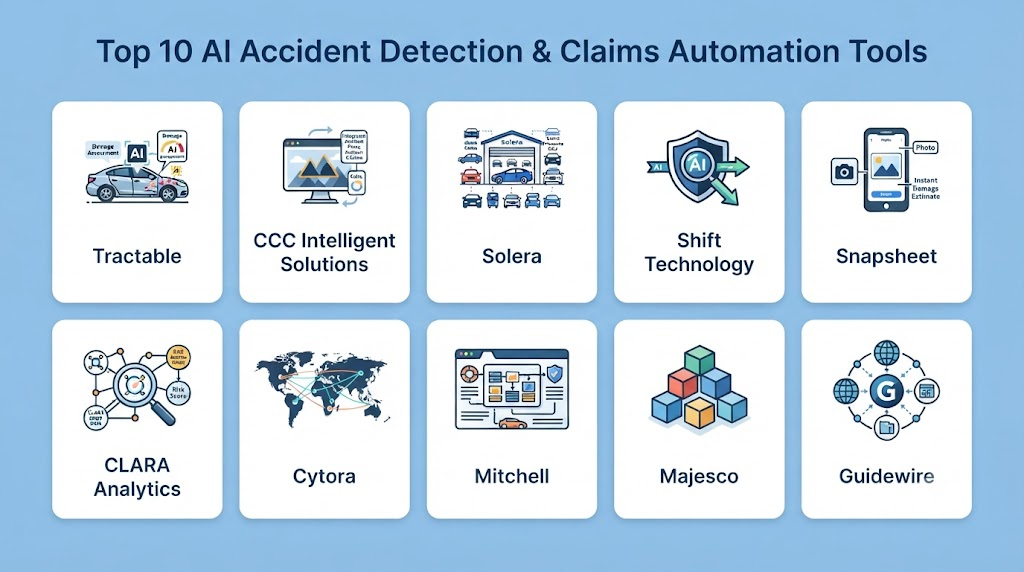
Top 10 AI Accident Detection & Claims Automation Tools
1 — Tractable
One-line verdict: Best for insurers wanting AI-powered vehicle damage assessment and claims automation based on images.
Short description:
Tractable specializes in AI-based visual damage assessment for automotive insurance and related workflows. Its technology uses vehicle images to help insurers assess damage and support claims and repair processes.
Standout Capabilities
- Vehicle damage assessment
- Computer vision
- Claims automation
- Image-based inspection
- Damage estimation
- Repair workflow support
- Claims triage
- Automotive AI
AI-Specific Depth
- Model support: Proprietary computer-vision AI.
- RAG / knowledge integration: N/A as a core capability.
- Evaluation: Image and damage-assessment model evaluation.
- Guardrails: Workflow-specific controls and human review.
- Observability: Enterprise implementation-dependent.
Pros
- Strong specialization in automotive damage assessment.
- Image-based workflow can reduce manual inspection effort.
- Designed around insurance use cases.
Cons
- Primarily enterprise-focused.
- Requires suitable vehicle images.
- Complex damage may still require human inspection.
Security & Compliance
Specific security controls, certifications, retention policies, and data-residency options should be verified for the applicable deployment.
Deployment & Platforms
- Cloud
- Web-based workflows
- APIs
- Mobile/image capture environments
Integrations & Ecosystem
Tractable can integrate AI damage assessment into broader insurance and repair workflows.
- Claims platforms
- Image capture
- Repair networks
- APIs
- Insurer systems
- Vehicle data
- Assessment workflows
Pricing Model
Enterprise commercial model; exact pricing is not publicly stated.
Best-Fit Scenarios
- Motor claims automation
- Vehicle damage assessment
- Digital claims processing
2 — CCC Intelligent Solutions
One-line verdict: Best for insurers and repair networks seeking a broad technology ecosystem for collision claims and repair workflows.
Short description:
CCC Intelligent Solutions provides technology for the automotive claims and collision-repair ecosystem. Its platform combines data, workflow automation, estimating, AI, and connectivity across insurers and repair organizations.
Standout Capabilities
- Claims workflow automation
- Collision repair estimating
- AI-assisted claims
- Damage assessment
- Repair ecosystem connectivity
- Claims data
- Digital workflows
- Insurance integrations
AI-Specific Depth
- Model support: Proprietary AI and analytics technologies.
- RAG / knowledge integration: Varies by application.
- Evaluation: Product-specific AI and analytics evaluation.
- Guardrails: Workflow and enterprise controls.
- Observability: Platform-dependent.
Pros
- Broad insurance ecosystem.
- Deep collision-repair specialization.
- Extensive workflow capabilities.
Cons
- Enterprise-oriented.
- Broad platform can require substantial integration.
- Exact AI capabilities vary across products.
Security & Compliance
Security and compliance details vary by product and contract and should be verified during procurement.
Deployment & Platforms
- Cloud
- Web
- APIs
- Enterprise systems
- Mobile workflows
Integrations & Ecosystem
- Insurance claims systems
- Repair shops
- Estimating
- Parts
- Vehicle information
- APIs
- Enterprise workflows
Pricing Model
Enterprise commercial model.
Best-Fit Scenarios
- Large auto insurers
- Collision repair networks
- End-to-end claims workflows
3 — Solera
One-line verdict: Best for organizations wanting a large automotive claims, repair, estimating, and vehicle-data ecosystem.
Short description:
Solera provides technology across automotive claims, repair, estimating, vehicle data, and related workflows. Its ecosystem supports insurers, repairers, automotive businesses, and other participants in the vehicle lifecycle.
Standout Capabilities
- Claims automation
- Vehicle damage assessment
- Repair estimating
- Collision workflows
- Vehicle data
- Digital inspections
- Workflow automation
- Insurance connectivity
AI-Specific Depth
- Model support: Proprietary AI and analytics vary by solution.
- RAG / knowledge integration: Varies / N/A.
- Evaluation: Product-specific.
- Guardrails: Workflow controls.
- Observability: Deployment-dependent.
Pros
- Broad automotive ecosystem.
- Strong repair and claims capabilities.
- Supports multiple stages of the claims process.
Cons
- Large enterprise ecosystem can be complex.
- Product capabilities vary by market.
- Integration may require substantial implementation.
Security & Compliance
Specific security and compliance information should be verified for the selected product and deployment.
Deployment & Platforms
- Cloud
- Web
- Mobile
- APIs
- Enterprise systems
Integrations & Ecosystem
- Insurers
- Repair networks
- Estimating
- Vehicle data
- Claims systems
- APIs
- Digital inspection tools
Pricing Model
Enterprise commercial pricing.
Best-Fit Scenarios
- Large insurance operations
- Claims automation
- Collision repair ecosystems
4 — Mitchell
One-line verdict: Best for insurers and repair organizations requiring established collision estimating and claims workflow technology.
Short description:
Mitchell provides automotive claims and collision-repair technology, including estimating and workflow solutions. Its ecosystem can support insurers and repair organizations with digital claims processing and repair operations.
Standout Capabilities
- Collision estimating
- Claims workflows
- Repair management
- Vehicle information
- Digital inspections
- Data analytics
- Workflow automation
- Insurance integration
AI-Specific Depth
- Model support: Proprietary analytics and AI capabilities vary.
- RAG / knowledge integration: N/A or product-dependent.
- Evaluation: Product-specific.
- Guardrails: Enterprise workflow controls.
- Observability: Deployment-dependent.
Pros
- Established automotive claims ecosystem.
- Strong collision-repair expertise.
- Useful for insurer-repairer workflows.
Cons
- Enterprise-focused.
- Not primarily an AI-first developer platform.
- Specific capabilities vary by product.
Security & Compliance
Security and compliance characteristics should be confirmed for the applicable product.
Deployment & Platforms
- Cloud
- Web
- Mobile
- Enterprise systems
Integrations & Ecosystem
- Claims systems
- Repair shops
- Estimating
- Vehicle data
- Insurers
- APIs
- Parts and repair workflows
Pricing Model
Enterprise commercial model.
Best-Fit Scenarios
- Collision claims
- Repair estimating
- Insurance workflows
5 — Solera Qapter
One-line verdict: Best for digital vehicle inspections and image-driven collision assessment within broader claims and repair workflows.
Short description:
Qapter is part of Solera’s digital automotive ecosystem and supports vehicle inspection and claims-related workflows. Its digital approach can help organizations capture and process vehicle-condition information.
Standout Capabilities
- Digital vehicle inspection
- Image-based assessment
- Damage documentation
- Claims workflows
- Repair estimation
- Mobile inspection
- Digital documentation
- Workflow integration
AI-Specific Depth
- Model support: AI capabilities vary by product implementation.
- RAG / knowledge integration: N/A.
- Evaluation: Product-specific.
- Guardrails: Workflow-level controls.
- Observability: Implementation-dependent.
Pros
- Digital-first inspection workflow.
- Strong automotive ecosystem.
- Useful for remote assessment processes.
Cons
- Best suited to organizations already using automotive claims ecosystems.
- Exact AI capabilities vary.
- Severe or ambiguous damage can still require physical inspection.
Security & Compliance
Specific controls should be verified for the applicable deployment.
Deployment & Platforms
- Web
- Mobile
- Cloud
- APIs
Integrations & Ecosystem
- Vehicle inspections
- Claims
- Repair estimating
- Insurers
- Mobile devices
- APIs
- Automotive data
Pricing Model
Enterprise commercial model.
Best-Fit Scenarios
- Digital inspections
- Remote claims
- Collision assessment
6 — WeGoLook
One-line verdict: Best for combining digital inspection workflows with human-assisted verification when automated evidence is insufficient.
Short description:
WeGoLook provides inspection and verification services that can support insurance and other industries. It is particularly relevant where organizations need additional evidence or physical inspection alongside digital claims processes.
Standout Capabilities
- Digital inspections
- Physical inspection coordination
- Evidence collection
- Photo documentation
- Claims support
- Asset verification
- Human-assisted workflows
- Field inspection
AI-Specific Depth
- Model support: AI capabilities vary / N/A for some workflows.
- RAG / knowledge integration: N/A.
- Evaluation: Workflow-specific.
- Guardrails: Human verification provides an additional control.
- Observability: Service-dependent.
Pros
- Human-assisted verification.
- Useful for ambiguous cases.
- Flexible inspection workflows.
Cons
- Not purely automated.
- Physical inspection can add time and cost.
- AI capabilities are not the central focus of every service.
Security & Compliance
Specific controls and certifications should be verified for the selected service.
Deployment & Platforms
- Web
- Mobile
- Field operations
- Cloud
Integrations & Ecosystem
- Insurance claims
- Inspection workflows
- Mobile capture
- APIs
- Evidence management
- Field operations
- Claims administrators
Pricing Model
Commercial service model; exact pricing varies.
Best-Fit Scenarios
- Complex claims
- Physical verification
- Hybrid claims operations
7 — Ravin AI
One-line verdict: Best for automated vehicle inspection and damage intelligence using computer vision and vehicle imagery.
Short description:
Ravin AI develops computer-vision technology for vehicle inspection and condition assessment. Its approach can support insurance, fleet, automotive, and vehicle-commerce workflows.
Standout Capabilities
- Vehicle inspection
- Computer vision
- Damage detection
- Vehicle condition assessment
- Automated inspection
- Image analysis
- Digital vehicle workflows
- Condition reporting
AI-Specific Depth
- Model support: Proprietary computer-vision models.
- RAG / knowledge integration: N/A.
- Evaluation: Image and vehicle-condition evaluation.
- Guardrails: Application-level controls.
- Observability: Deployment-dependent.
Pros
- Specialized vehicle computer vision.
- Automated inspection potential.
- Applicable across multiple vehicle workflows.
Cons
- Requires quality visual input.
- Complex damage may need human review.
- Exact model performance varies by scenario.
Security & Compliance
Security, privacy, retention, and certifications should be verified for the relevant deployment.
Deployment & Platforms
- Cloud
- Mobile/image capture
- APIs
- Automotive environments
Integrations & Ecosystem
- Insurance platforms
- Vehicle marketplaces
- Fleets
- Inspection systems
- APIs
- Cameras
- Digital workflows
Pricing Model
Enterprise commercial model.
Best-Fit Scenarios
- Automated inspection
- Vehicle condition assessment
- Claims support
8 — UVeye
One-line verdict: Best for automated vehicle inspection using computer vision across insurance, dealerships, fleets, and automotive operations.
Short description:
UVeye develops automated vehicle inspection systems using imaging and AI-based analysis. Its technology can identify vehicle-condition issues and produce inspection information useful for automotive workflows.
Standout Capabilities
- Automated vehicle inspection
- Computer vision
- Damage detection
- Vehicle condition analysis
- Imaging
- Inspection automation
- Fleet inspection
- Automotive analytics
AI-Specific Depth
- Model support: Proprietary computer-vision AI.
- RAG / knowledge integration: N/A.
- Evaluation: Inspection-model evaluation.
- Guardrails: Operational controls.
- Observability: Deployment-dependent.
Pros
- Automated physical inspection approach.
- Useful across multiple automotive sectors.
- Consistent image-based assessment.
Cons
- Requires specialized inspection infrastructure.
- Not a pure software-only solution.
- Deployment can be operationally complex.
Security & Compliance
Specific security and compliance characteristics should be verified for the selected deployment.
Deployment & Platforms
- Physical inspection systems
- Cloud
- Automotive facilities
- APIs
Integrations & Ecosystem
- Insurance
- Fleets
- Dealerships
- Vehicle service
- Inspection systems
- APIs
- Automotive data
Pricing Model
Enterprise commercial model.
Best-Fit Scenarios
- Automated inspections
- Fleet claims
- Automotive facilities
9 — Tractable AI Claims Ecosystem
One-line verdict: Best for organizations prioritizing computer-vision-based damage assessment and faster digital claims decisions.
Short description:
Tractable’s automotive AI focuses on analyzing vehicle imagery and supporting insurance claims and repair decisions. It is particularly relevant to insurers seeking to automate visual damage assessment.
Standout Capabilities
- Computer vision
- Damage assessment
- Image analysis
- Claims automation
- Repair estimation
- Digital inspection
- Claims triage
- Automotive AI
AI-Specific Depth
- Model support: Proprietary AI.
- RAG / knowledge integration: N/A.
- Evaluation: Computer-vision model evaluation.
- Guardrails: Workflow and human-review controls.
- Observability: Enterprise-dependent.
Pros
- Strong automotive computer vision.
- Direct insurance relevance.
- Can reduce manual image-review workloads.
Cons
- Enterprise-oriented.
- Requires appropriate image quality.
- Human review remains necessary for difficult cases.
Security & Compliance
Specific security and compliance details should be confirmed during procurement.
Deployment & Platforms
- Cloud
- Web
- APIs
- Mobile/image workflows
Integrations & Ecosystem
- Claims platforms
- Insurers
- Repair networks
- Image capture
- APIs
- Vehicle data
- Assessment systems
Pricing Model
Enterprise commercial pricing.
Best-Fit Scenarios
- Motor claims
- Damage assessment
- Digital FNOL
10 — Custom Multimodal Claims AI Stack
One-line verdict: Best for insurers wanting complete control over accident detection, multimodal claims processing, and proprietary automation.
Short description:
Large insurers and insurtech teams can build their own claims AI stack using computer vision, machine learning, speech, OCR, LLMs, telematics, and claims-system integrations. This approach offers maximum flexibility but requires significant engineering, actuarial, security, and governance expertise.
Standout Capabilities
- Accident detection
- Computer vision
- OCR
- LLM-based claims assistance
- Telematics analysis
- Damage classification
- Fraud detection
- Custom workflow automation
AI-Specific Depth
- Model support: Hosted, open-source, proprietary, or multi-model.
- RAG / knowledge integration: Fully customizable.
- Evaluation: Fully customizable.
- Guardrails: Organization-controlled.
- Observability: Organization-controlled.
Pros
- Maximum customization.
- Full control over data and models.
- Can integrate proprietary claims intelligence.
Cons
- High engineering cost.
- Requires extensive validation.
- Security and governance are internal responsibilities.
Security & Compliance
Can be designed for strict privacy and governance requirements, but all controls must be implemented and maintained by the organization.
Deployment & Platforms
- Cloud
- Self-hosted
- Edge
- Hybrid
- Linux
- Containers
Integrations & Ecosystem
- Claims platforms
- Telematics
- Computer vision
- LLMs
- OCR
- Data warehouses
- Repair systems
Pricing Model
Infrastructure, model usage, software, data, and engineering costs vary significantly.
Best-Fit Scenarios
- Large insurers
- Proprietary claims automation
- Insurtech development
Comparison Table
| Tool | Best For | Deployment | Model Flexibility | Strength | Watch-Out | Public Rating |
|---|---|---|---|---|---|---|
| Tractable | Vehicle damage assessment | Cloud/API | Proprietary | Computer vision | Image quality | |
| CCC Intelligent Solutions | Collision claims ecosystem | Cloud/API | Proprietary | Claims workflow | Enterprise complexity | |
| Solera | Claims and repair | Cloud/Hybrid | Proprietary | Automotive ecosystem | Integration | |
| Mitchell | Collision estimating | Cloud/Web | Proprietary | Repair workflows | Product variation | |
| Solera Qapter | Digital inspection | Cloud/Mobile | Proprietary | Digital assessment | Complex damage | |
| WeGoLook | Hybrid inspection | Cloud/Field | Varies | Human verification | Manual component | |
| Ravin AI | Vehicle inspection | Cloud/Hybrid | Proprietary | Computer vision | Visual-input dependency | |
| UVeye | Automated inspection | Physical/Cloud | Proprietary | Automated scanning | Hardware requirement | |
| Tractable AI Ecosystem | Digital claims | Cloud/API | Proprietary | Damage assessment | Enterprise focus | |
| Custom Multimodal AI | Proprietary claims systems | Any | Multi-model | Full control | Engineering burden |
Scoring & Evaluation
The scores below are comparative assessments rather than official vendor ratings. They consider claims functionality, AI capabilities, integrations, automation potential, security, performance, and implementation complexity.
| Tool | Core | Reliability/Eval | Guardrails | Integrations | Ease | Perf/Cost | Security/Admin | Support | Weighted Total |
|---|---|---|---|---|---|---|---|---|---|
| Tractable | 10 | 10 | 9 | 9 | 9 | 8 | 9 | 10 | 9.25 |
| CCC Intelligent Solutions | 10 | 9 | 10 | 10 | 8 | 8 | 10 | 10 | 9.45 |
| Solera | 10 | 9 | 10 | 10 | 8 | 8 | 10 | 10 | 9.40 |
| Mitchell | 10 | 9 | 9 | 10 | 8 | 8 | 9 | 10 | 9.15 |
| Solera Qapter | 9 | 9 | 9 | 9 | 9 | 8 | 9 | 10 | 9.00 |
| WeGoLook | 8 | 8 | 10 | 8 | 8 | 7 | 9 | 9 | 8.20 |
| Ravin AI | 9 | 9 | 9 | 8 | 8 | 8 | 8 | 9 | 8.60 |
| UVeye | 9 | 9 | 9 | 8 | 7 | 7 | 9 | 9 | 8.35 |
| Tractable AI Ecosystem | 10 | 10 | 9 | 9 | 9 | 8 | 9 | 10 | 9.25 |
| Custom Multimodal AI | 10 | 8 | 8 | 10 | 5 | 9 | 7 | 8 | 8.05 |
Top 3 for Enterprise
- CCC Intelligent Solutions
- Solera
- Tractable
Top 3 for SMB
- Tractable
- Solera Qapter
- Ravin AI
Top 3 for Developers
- Custom Multimodal Claims AI Stack
- Ravin AI
- Tractable
Which AI Accident Detection & Claims Automation Tool Is Right for You?
Solo / Freelancer
For a prototype, developers can build a basic accident-analysis workflow using:
- Smartphone sensor data
- GPS
- Vehicle images
- Computer vision
- OCR
- An LLM
- Simple claims APIs
The system should remain a prototype until accuracy, security, and insurance-specific validation are completed.
SMB
Smaller insurers should prioritize:
- Digital FNOL
- Mobile photo collection
- Basic damage assessment
- Claims triage
- Simple integrations
- Human review
- Clear audit trails
A focused damage-assessment platform can be more practical than building a complete AI claims ecosystem.
Mid-Market
A mid-sized insurer can create a multimodal claims architecture:
Accident Event → FNOL → Images/Video → AI Damage Analysis → Policy Validation → Fraud Checks → Triage → Human Review → Settlement/Repair
This architecture should keep AI decisions separate from final financial authorization where appropriate.
Enterprise
Large insurers should evaluate:
- Telematics integration
- Image and video analysis
- Claims-system integration
- Repair networks
- Fraud analytics
- LLM-based claims assistance
- Automated triage
- Explainability
- Model monitoring
- Security
- Privacy
- Auditability
- Human-in-the-loop workflows
Regulated Industries
Insurance organizations should carefully evaluate:
- Automated decision-making
- Customer consent
- Data minimization
- Image retention
- Location information
- Vehicle data
- Explainability
- Fairness
- Human oversight
- Audit trails
- Data residency
- Third-party model processing
Budget vs Premium
Budget-conscious teams can start with:
- Digital FNOL
- OCR
- Image classification
- Rule-based triage
- Basic claims automation
Premium systems can add:
- Multimodal AI
- Telematics
- Automated damage estimation
- Fraud analytics
- Generative AI
- Repair-network integration
- Real-time accident detection
Build vs Buy
Buy when speed, established claims integrations, and proven automotive workflows are the priority.
Build when proprietary claims intelligence is strategically important and the insurer has strong AI, actuarial, and engineering teams.
A hybrid approach can be particularly effective: commercial computer vision for damage assessment combined with proprietary claims rules, fraud models, and workflow orchestration.
Implementation Playbook
30 Days: Pilot + Success Metrics
- Define target claims.
- Select one accident type or damage category.
- Establish FNOL workflow.
- Collect representative images.
- Integrate telematics where available.
- Build initial damage classification.
- Define human-review thresholds.
- Establish success metrics.
Measure:
- Accident-detection accuracy
- Damage classification accuracy
- FNOL completion time
- Claims processing time
- Human-review rate
- False positives
- False negatives
- AI response latency
60 Days: Harden Security + Evaluation + Rollout
- Build a multimodal evaluation dataset.
- Test different vehicle models.
- Test poor-quality images.
- Test unusual damage.
- Evaluate ambiguous claims.
- Add fraud checks.
- Establish model-version control.
- Implement access controls.
- Review data retention.
- Add audit logging.
- Perform red-team testing.
90 Days: Optimize Cost + Latency + Governance
- Optimize image processing.
- Route simple cases through lightweight models.
- Use larger models only for difficult cases.
- Improve telematics integration.
- Monitor model drift.
- Establish claims-AI governance.
- Review human escalation thresholds.
- Integrate repair networks.
- Automate eligible workflows.
- Establish ongoing quality monitoring.
Common Mistakes & How to Avoid Them
- Automating every claim: Complex and disputed claims need human involvement.
- Trusting one image: Multiple views can be necessary for reliable damage assessment.
- Ignoring image quality: Poor lighting and angles can reduce model performance.
- Skipping evaluation: Test real claims rather than relying only on laboratory examples.
- Ignoring model drift: New vehicle designs and repair practices can change model performance.
- Using LLMs without guardrails: Generative models should not independently authorize sensitive financial decisions.
- No human escalation: Ambiguous cases need a clear review path.
- Ignoring fraud: Accident automation should not remove fraud controls.
- Poor data retention: Images and accident information may contain sensitive information.
- No audit trail: Claims decisions should be traceable.
- Overlooking cybersecurity: Claims APIs and telematics integrations require strong protection.
- Ignoring bias: Damage models should be tested across vehicle types and relevant operating conditions.
- No cost controls: Processing every image with expensive models can increase operating costs.
- Creating vendor lock-in: Maintain APIs and abstraction layers where practical.
- Confusing AI confidence with certainty: A high model score does not guarantee that a claim is correct.
FAQs
What is AI accident detection?
AI accident detection uses vehicle sensors, telematics, smartphones, cameras, or other data to identify signals associated with a collision.
What is claims automation?
Claims automation uses software and AI to automate repetitive activities such as FNOL, document processing, damage assessment, triage, and workflow routing.
Can AI detect a vehicle accident automatically?
Yes, depending on available sensor and telematics data. Detection accuracy varies by device, vehicle, collision type, and implementation.
Can AI assess vehicle damage from photographs?
Yes. Computer-vision systems can analyze vehicle images and identify visible damage. Complex or hidden damage may still require physical inspection.
Can AI estimate repair costs?
AI can support repair estimation by identifying damaged components and combining visual information with repair data. Actual estimates depend on vehicle, location, parts, labor, and repair methodology.
Can AI automate FNOL?
Yes. AI can help collect accident information, process images and documents, validate policy information, and route the claim into the appropriate workflow.
What is multimodal claims AI?
Multimodal claims AI processes multiple types of information, such as text, images, video, telematics, and structured insurance data, within one workflow.
Can AI detect insurance fraud?
AI can identify unusual patterns and inconsistencies that may warrant investigation. It should generally support investigation rather than automatically label every unusual claim as fraudulent.
Does accident detection require telematics?
No. Accident detection can use smartphones, connected vehicles, embedded sensors, cameras, or combinations of these technologies.
Is human review still necessary?
Yes, especially for severe, disputed, unusual, or ambiguous claims. Human-in-the-loop workflows provide an important safety and governance mechanism.
Is accident data sensitive?
Yes. Accident information can contain location, vehicle, driver, passenger, photographic, and insurance information. Strong privacy and access controls are therefore important.
Can AI claims processing work offline?
Some image-processing or edge-AI capabilities can work locally, but broader claims workflows often depend on connectivity to insurance systems.
How should claims AI be evaluated?
Measure detection accuracy, damage classification, false positives, false negatives, processing time, human-review rates, cost per claim, customer experience, and model stability.
Can insurers build their own claims AI?
Yes. Large insurers can combine computer vision, LLMs, telematics, OCR, rules engines, and claims APIs. However, building a production-grade system requires substantial engineering and governance.
How much does AI claims automation cost?
There is no universal price. Costs depend on claim volume, AI inference, data storage, integrations, software licensing, human review, security, and implementation.
What is the best approach for small insurers?
Start with one high-volume workflow such as digital FNOL or image-based damage assessment. Expand automation only after demonstrating reliable results.
Conclusion
AI Accident Detection & Claims Automation is transforming motor insurance workflows by connecting accident signals, vehicle imagery, telematics, computer vision, claims systems, and human review into increasingly automated processes.Tools such as Tractable, CCC Intelligent Solutions, Solera, Mitchell, Ravin AI, and UVeye address different parts of the accident and claims lifecycle. Enterprise insurers can also combine multiple technologies into a multimodal claims architecture tailored to their own policies, data, and workflows.The strongest systems will not attempt to eliminate humans from every claim. Instead, they will use AI to handle high-volume, repetitive, well-understood tasks while escalating uncertain or consequential decisions to qualified human reviewers.