Introduction
AI Fitness Plan Generators use artificial intelligence to create personalized workout routines based on goals, fitness level, available equipment, schedule, preferences, and training history. Instead of following one fixed workout program, users can receive plans that adapt as their circumstances change.
These tools are useful for people who want structured exercise without hiring a personal trainer for every session. Depending on the platform, AI can recommend exercises, organize training splits, adjust workout difficulty, track progress, and provide guidance when users miss sessions or change their goals.
Common use cases include muscle building, strength training, fat-loss programs, home workouts, running plans, mobility routines, beginner fitness programs, sports conditioning, and personalized gym programming.When comparing AI fitness planners, look at personalization quality, exercise libraries, progression logic, equipment support, workout adaptation, wearable integrations, form guidance, recovery recommendations, data privacy, safety controls, cost, and whether the system provides human coa Beginners, gym users, athletes, busy professionals, home exercisers, and fitness enthusiasts who want structured and personalized training pro People recovering from significant injuries, users with complex medical conditions, or anyone who needs individualized clinical exercise prescription. In those situations, qualified healthcare or exercise professionals are more appropriate.
What’s Changed in AI Fitness Plan Generators
- AI is moving workout planning from static routines toward adaptive programming.
- Conversational interfaces allow users to describe goals and constraints naturally.
- Plans can be adjusted when users miss workouts or change available equipment.
- Wearable data can provide additional information about activity, heart rate, sleep, or recovery where supported.
- AI can help personalize training volume, exercise selection, and workout duration.
- Computer vision is increasingly being used for exercise-form feedback in compatible applications.
- Voice-based coaching can provide hands-free instructions during workouts.
- Multimodal systems can combine workout history, user feedback, movement information, and wearable data.
- AI-generated plans increasingly account for home environments and limited equipment.
- Recovery and fatigue are becoming more important parts of personalized training.
- Users increasingly expect explanations for why exercises or progressions are recommended.
- Privacy matters more as fitness platforms collect increasingly detailed behavioral and biometric information.
- AI fitness systems need safeguards against recommending inappropriate workloads.
- Human coaching remains valuable for complex goals, technique correction, and injury-related situations.
- Cost and subscription flexibility are becoming important differentiators between AI fitness platforms.
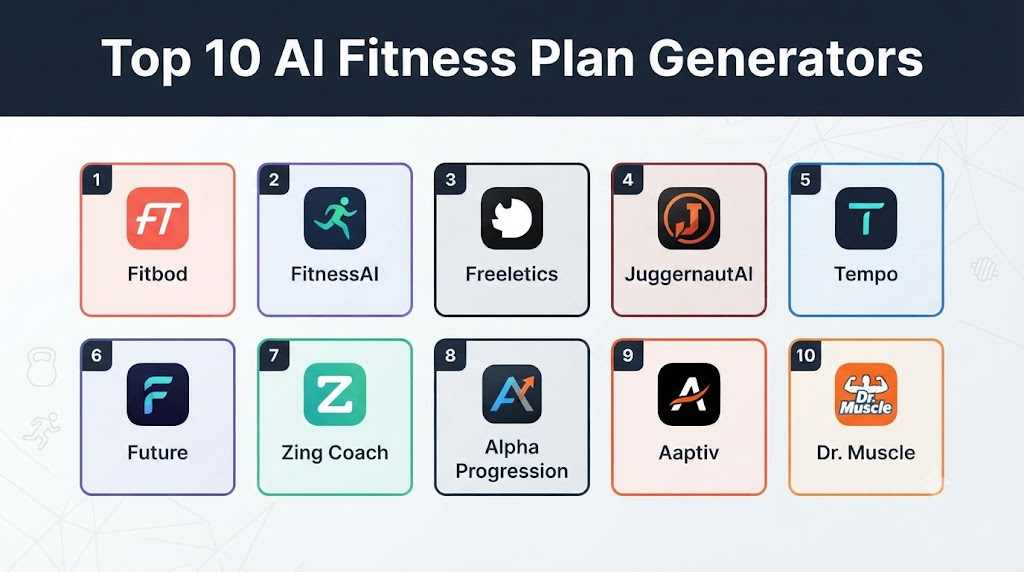
Top 10 AI Fitness Plan Generators
1. Fitbod
One-line verdict: Best for personalized strength-training plans that adapt workouts to equipment, goals, training history, and recovery.
Short description:
Fitbod is designed around personalized strength and resistance training. It generates workouts using information about previous training, available equipment, target muscles, and other user inputs to create individualized sessions.
Standout Capabilities
- Personalized strength workouts
- Training-history analysis
- Equipment-based exercise selection
- Muscle-group planning
- Workout progression
- Exercise substitutions
- Workout tracking
- Adaptive programming
AI-Specific Depth
- Model support: Proprietary algorithms and AI-driven workout generation; exact model architecture is not publicly stated.
- RAG / knowledge integration: Uses workout history, exercise information, user goals, and training context; exact retrieval architecture is not publicly stated.
- Evaluation: Detailed AI evaluation methodology is not publicly stated.
- Guardrails: Fitness-oriented programming constraints are applied, but detailed guardrail architecture is not publicly stated.
- Observability: Workout history and progress are visible to users; internal AI traces and token metrics are not exposed.
Pros
- Strong strength-training personalization
- Useful exercise substitutions
- Good for structured gym programming
Cons
- Primarily focused on fitness rather than clinical exercise
- Some advanced features may require a subscription
- Generated recommendations still require user judgment
Security & Compliance
Privacy and security practices should be reviewed before connecting personal fitness data. Specific AI certifications are not publicly stated.
Deployment & Platforms
- Android
- iOS
- Cloud-based services
Integrations & Ecosystem
- Workout tracking
- Exercise library
- Training history
- Equipment preferences
- Fitness data
Pricing Model
Subscription-based model; exact pricing varies.
Best-Fit Scenarios
- Gym strength training
- Muscle-building programs
- Users wanting adaptive workouts
2. Freeletics
One-line verdict: Best for users seeking adaptive bodyweight and fitness training with AI-supported personalization and structured coaching.
Short description:
Freeletics combines AI-supported workout personalization with structured training programs. It is particularly useful for users who want flexible workouts that can be performed with limited equipment or bodyweight.
Standout Capabilities
- AI-supported training
- Bodyweight workouts
- Personalized programs
- Fitness goals
- Workout adaptation
- Training progression
- Exercise library
- Home-friendly workouts
AI-Specific Depth
- Model support: Proprietary AI and training algorithms; exact models are not publicly stated.
- RAG / knowledge integration: User goals, training history, preferences, and exercise information.
- Evaluation: Detailed AI evaluation methodology is not publicly stated.
- Guardrails: Training constraints and fitness programming logic are used; detailed AI guardrails are not publicly stated.
- Observability: Workout progress is visible; internal AI observability is not publicly exposed.
Pros
- Excellent for home workouts
- Flexible training
- Strong personalization focus
Cons
- Some advanced functionality requires payment
- AI recommendations are not medical prescriptions
- Less suitable for highly specialized strength programming
Security & Compliance
Specific AI certifications are not publicly stated.
Deployment & Platforms
- Android
- iOS
- Cloud-based
Integrations & Ecosystem
- Training programs
- Exercise library
- Workout tracking
- Fitness goals
- Mobile devices
Pricing Model
Subscription-based options vary.
Best-Fit Scenarios
- Home fitness
- Bodyweight training
- Busy users
3. Future
One-line verdict: Best for users wanting personalized strength programming with automated workout adjustments and detailed training recommendations.
Short description:
Future is a digital fitness coaching platform that combines technology with personalized coaching. Depending on the service arrangement, users can receive structured workouts and ongoing guidance rather than relying solely on an automated workout generator.
Standout Capabilities
- Personalized workout plans
- Strength training
- Coaching
- Workout tracking
- Goal-based programming
- Progress monitoring
- Trainer interaction
- Adaptive planning
AI-Specific Depth
- Model support: AI and algorithmic personalization may support the experience; exact model architecture is not publicly stated.
- RAG / knowledge integration: User training information and coaching context; exact architecture is not publicly stated.
- Evaluation: Detailed AI evaluation methodology is not publicly stated.
- Guardrails: Human coaching provides an additional safety layer; detailed AI guardrail architecture is not publicly stated.
- Observability: Training progress is visible; detailed AI traces are not publicly exposed.
Pros
- Human coaching component
- Highly personalized experience
- Strong accountability
Cons
- Typically more expensive than self-guided apps
- Not purely AI-generated
- Availability and coaching experience can vary
Security & Compliance
Specific AI certifications and detailed AI data controls are not publicly stated.
Deployment & Platforms
- iOS
- Android
- Cloud-connected services
Integrations & Ecosystem
- Personal coaches
- Workout plans
- Training history
- Fitness tracking
- Mobile applications
Pricing Model
Premium subscription or coaching-based model; exact pricing varies.
Best-Fit Scenarios
- Users wanting accountability
- Personalized strength training
- People who prefer human support
4. JuggernautAI
One-line verdict: Best for serious strength athletes seeking algorithm-driven programming for structured resistance training and performance goals.
Short description:
JuggernautAI focuses on personalized strength programming and is particularly relevant to users interested in structured resistance training. Its approach is designed around adapting training to individual goals and performance.
Standout Capabilities
- Strength programming
- Personalized training
- Training progression
- Performance tracking
- Exercise selection
- Adaptive programming
- Structured training blocks
- Strength-focused planning
AI-Specific Depth
- Model support: Proprietary AI-driven programming; exact model architecture is not publicly stated.
- RAG / knowledge integration: Training history, goals, performance, and programming data.
- Evaluation: Detailed AI evaluation methodology is not publicly stated.
- Guardrails: Training-program constraints are used; detailed safety architecture is not publicly stated.
- Observability: Training performance and progress are tracked; internal AI traces are not generally available.
Pros
- Strong strength-training focus
- Suitable for experienced lifters
- Structured programming
Cons
- Less appropriate for casual fitness
- Requires consistent training data
- Not designed as medical exercise guidance
Security & Compliance
Specific certifications and detailed AI security controls are not publicly stated.
Deployment & Platforms
- Mobile
- Cloud-based services
Integrations & Ecosystem
- Strength programming
- Training history
- Exercise selection
- Performance tracking
- Workout planning
Pricing Model
Subscription-based model; exact pricing varies.
Best-Fit Scenarios
- Powerlifting-style training
- Experienced lifters
- Performance-focused programs
5. Train Fitness
One-line verdict: Best for users who want AI-assisted workout tracking, exercise recognition, and personalized training support through mobile devices.
Short description:
Train Fitness provides workout tracking and fitness coaching capabilities designed to help users monitor resistance training and build consistent routines.
Standout Capabilities
- Workout tracking
- Exercise recognition
- Strength training
- Personalized workouts
- Training history
- Progress tracking
- Exercise database
- Mobile fitness experience
AI-Specific Depth
- Model support: Proprietary AI and recognition technologies; exact models are not publicly stated.
- RAG / knowledge integration: Exercise data and user training history; architecture is not publicly stated.
- Evaluation: Detailed AI evaluation methodology is not publicly stated.
- Guardrails: Fitness-programming controls are applied; detailed guardrails are not publicly stated.
- Observability: User-facing workout statistics are available; detailed AI traces are not exposed.
Pros
- Useful workout tracking
- Technology-assisted exercise recognition
- Good for resistance training
Cons
- Experience may depend on compatible devices
- AI architecture is not fully transparent
- Not designed for clinical exercise prescription
Security & Compliance
Specific AI certifications are not publicly stated.
Deployment & Platforms
- iOS
- Compatible wearable/device ecosystem
- Cloud-based services
Integrations & Ecosystem
- Workout tracking
- Exercise recognition
- Wearables
- Training history
- Fitness data
Pricing Model
Subscription-based features may apply.
Best-Fit Scenarios
- Strength training
- Workout tracking
- Wearable users
6. Alpha Progression
One-line verdict: Best for gym users who want structured hypertrophy and strength programming with detailed workout customization.
Short description:
Alpha Progression focuses on personalized gym training, particularly strength and muscle-building programs. It provides structured workout planning and progression-oriented recommendations.
Standout Capabilities
- Hypertrophy programming
- Strength training
- Workout generation
- Exercise selection
- Progress tracking
- Exercise substitutions
- Training customization
- Workout planning
AI-Specific Depth
- Model support: Proprietary algorithms and personalization; exact AI model architecture is not publicly stated.
- RAG / knowledge integration: User goals, workout history, exercises, and training data.
- Evaluation: Detailed AI evaluation methodology is not publicly stated.
- Guardrails: Training constraints are applied; detailed safety mechanisms are not publicly stated.
- Observability: Workout progress is tracked; detailed AI observability is not publicly exposed.
Pros
- Strong gym focus
- Detailed customization
- Good for hypertrophy-oriented training
Cons
- Less useful for non-gym users
- Requires consistent tracking
- Not medical exercise guidance
Security & Compliance
Specific certifications are not publicly stated.
Deployment & Platforms
- Android
- iOS
- Cloud-based
Integrations & Ecosystem
- Exercise library
- Workout tracking
- Strength programming
- Progress tracking
- Training history
Pricing Model
Subscription-based model; exact pricing varies.
Best-Fit Scenarios
- Muscle building
- Gym programming
- Progressive overload
7. Caliber
One-line verdict: Best for users combining personalized strength programming, workout tracking, and optional human coaching.
Short description:
Caliber focuses on strength training and personalized fitness programs. The platform combines digital programming with coaching options, making it useful for users who want more structure than a basic workout tracker.
Standout Capabilities
- Strength programs
- Personalized workouts
- Progress tracking
- Exercise instruction
- Coaching
- Training plans
- Workout logging
- Goal tracking
AI-Specific Depth
- Model support: Specific AI models are not publicly stated.
- RAG / knowledge integration: User training information and exercise content; exact architecture is not publicly stated.
- Evaluation: Detailed AI evaluation methodology is not publicly stated.
- Guardrails: Fitness safety and programming controls may apply; detailed AI guardrail architecture is not publicly stated.
- Observability: Workout progress and performance metrics are available; AI-specific traces are not publicly exposed.
Pros
- Strength-focused
- Human coaching options
- Strong workout tracking
Cons
- Not exclusively AI-driven
- Premium coaching can cost more
- Some features may vary by plan
Security & Compliance
Specific certifications are not publicly stated.
Deployment & Platforms
- Android
- iOS
- Cloud-based
Integrations & Ecosystem
- Strength training
- Coaching
- Workout tracking
- Exercise library
- Fitness goals
Pricing Model
Free and paid/coaching options may vary.
Best-Fit Scenarios
- Strength beginners
- Personalized gym training
- Users wanting coaching
8. Aaptiv
One-line verdict: Best for users seeking guided workouts and personalized fitness experiences across cardio, strength, mobility, and other training styles.
Short description:
Aaptiv provides guided fitness programs across multiple workout categories. Its personalized approach can help users select workouts according to fitness goals, interests, and available time.
Standout Capabilities
- Guided workouts
- Strength training
- Cardio
- Mobility
- Running
- Personalized recommendations
- Audio coaching
- Fitness programs
AI-Specific Depth
- Model support: Specific AI model architecture is not publicly stated.
- RAG / knowledge integration: User preferences and workout content; exact architecture is not publicly stated.
- Evaluation: Detailed AI evaluation methodology is not publicly stated.
- Guardrails: General fitness-programming constraints may apply; detailed AI safety architecture is not publicly stated.
- Observability: User progress and activity can be tracked; internal AI traces are not publicly exposed.
Pros
- Broad workout variety
- Accessible guided workouts
- Good for different fitness styles
Cons
- Less specialized for advanced strength athletes
- AI functionality may vary
- Subscription may be required for some content
Security & Compliance
Specific AI certifications are not publicly stated.
Deployment & Platforms
- Android
- iOS
- Cloud-based services
Integrations & Ecosystem
- Guided workouts
- Running
- Strength
- Cardio
- Mobility
- Fitness programs
Pricing Model
Subscription-based model; exact pricing varies.
Best-Fit Scenarios
- General fitness
- Cardio
- Guided home workouts
9. Zing Coach
One-line verdict: Best for users seeking AI-driven personalized fitness coaching that adapts workouts to goals, preferences, and progress.
Short description:
Zing Coach is designed around personalized digital fitness coaching. Its AI-driven approach aims to create and adjust workouts based on individual fitness objectives and user feedback.
Standout Capabilities
- AI fitness coaching
- Personalized workouts
- Goal setting
- Workout adaptation
- Fitness assessments
- Progress tracking
- Exercise guidance
- Personalized recommendations
AI-Specific Depth
- Model support: Proprietary AI technologies; exact model architecture is not publicly stated.
- RAG / knowledge integration: User profile, fitness goals, training history, and exercise information.
- Evaluation: Detailed AI evaluation methodology is not publicly stated.
- Guardrails: Fitness-oriented safety constraints may apply; detailed guardrail architecture is not publicly stated.
- Observability: User progress and workout information are available; internal AI traces are not publicly exposed.
Pros
- AI-first coaching experience
- Personalized workouts
- Adaptation based on user context
Cons
- AI recommendations require user judgment
- Detailed model architecture is not publicly disclosed
- Not appropriate for medical rehabilitation
Security & Compliance
Specific AI certifications are not publicly stated.
Deployment & Platforms
- Android
- iOS
- Cloud-based services
Integrations & Ecosystem
- AI coaching
- Workout plans
- Fitness assessments
- Exercise library
- Progress tracking
Pricing Model
Subscription-based options may apply.
Best-Fit Scenarios
- Personalized fitness
- Beginners
- Users wanting AI coaching
10. PUSH
One-line verdict: Best for performance-oriented athletes interested in technology-assisted strength tracking, workload monitoring, and training optimization.
Short description:
PUSH has focused on technology-assisted strength training and performance measurement. Its ecosystem is relevant to users and coaches who want objective training information to support programming decisions.
Standout Capabilities
- Strength tracking
- Performance monitoring
- Training data
- Workout analysis
- Athlete monitoring
- Coaching support
- Performance optimization
AI-Specific Depth
- Model support: Proprietary algorithms and analytics; exact AI model architecture is not publicly stated.
- RAG / knowledge integration: Training and performance data.
- Evaluation: Detailed AI evaluation methodology is not publicly stated.
- Guardrails: Training constraints may apply; detailed AI safety architecture is not publicly stated.
- Observability: Performance metrics and training information are available; internal AI traces are not publicly exposed.
Pros
- Performance-oriented
- Data-driven training
- Useful for advanced athletes and coaches
Cons
- More specialized than general fitness apps
- Hardware or specialized equipment may be relevant
- Not designed for medical exercise prescription
Security & Compliance
Specific AI certifications are not publicly stated.
Deployment & Platforms
- Mobile
- Cloud-connected services
- Compatible fitness hardware where applicable
Integrations & Ecosystem
- Performance tracking
- Strength data
- Coaching
- Training analysis
- Fitness hardware
Pricing Model
Product and service pricing varies.
Best-Fit Scenarios
- Performance training
- Athlete monitoring
- Strength optimization
Comparison Table
| Tool Name | Best For | Deployment | Model Flexibility | Strength | Watch-Out | Public Rating |
|---|---|---|---|---|---|---|
| Fitbod | Strength training | Cloud / Mobile | Proprietary | Adaptive gym workouts | Subscription | N/A |
| Freeletics | Home fitness | Cloud / Mobile | Proprietary | Adaptive bodyweight training | Premium features | N/A |
| Future | Personalized coaching | Cloud / Mobile | Hosted / Proprietary | Human coaching | Higher cost | N/A |
| JuggernautAI | Strength athletes | Cloud / Mobile | Proprietary | Performance programming | Advanced users | N/A |
| Train Fitness | Workout tracking | Cloud / Mobile | Proprietary | Exercise recognition | Device dependence | N/A |
| Alpha Progression | Hypertrophy | Cloud / Mobile | Proprietary | Gym customization | Gym-focused | N/A |
| Caliber | Strength + coaching | Cloud / Mobile | Hosted / Proprietary | Coaching | Premium options | N/A |
| Aaptiv | General fitness | Cloud / Mobile | Hosted | Workout variety | Less specialized | N/A |
| Zing Coach | AI coaching | Cloud / Mobile | Proprietary | Personalized workouts | AI limitations | N/A |
| PUSH | Athletic performance | Cloud / Mobile | Proprietary | Performance analytics | Specialized ecosystem | N/A |
Scoring & Evaluation
The scoring is comparative rather than absolute. A platform optimized for bodybuilding may score differently from one designed for beginners or home workouts.
The weighted criteria are:
- Core features – 20%
- AI reliability & evaluation – 15%
- Guardrails & safety – 10%
- Integrations & ecosystem – 15%
- Ease of use – 10%
- Performance & cost controls – 15%
- Security & admin – 10%
- Support & community – 5%
| Tool | Core | Reliability/Eval | Guardrails | Integrations | Ease | Perf/Cost | Security/Admin | Support | Weighted Total |
|---|---|---|---|---|---|---|---|---|---|
| Fitbod | 10 | 9 | 9 | 9 | 9 | 8 | 9 | 9 | 9.00 |
| Freeletics | 9 | 9 | 9 | 8 | 10 | 9 | 9 | 9 | 9.00 |
| Future | 10 | 9 | 10 | 8 | 9 | 7 | 9 | 10 | 9.05 |
| JuggernautAI | 10 | 9 | 9 | 8 | 8 | 8 | 8 | 9 | 8.75 |
| Train Fitness | 9 | 8 | 8 | 9 | 9 | 8 | 8 | 8 | 8.45 |
| Alpha Progression | 9 | 9 | 9 | 8 | 9 | 9 | 8 | 9 | 8.85 |
| Caliber | 9 | 8 | 9 | 8 | 9 | 8 | 9 | 9 | 8.70 |
| Aaptiv | 9 | 8 | 9 | 8 | 10 | 9 | 8 | 9 | 8.80 |
| Zing Coach | 9 | 8 | 9 | 8 | 9 | 9 | 8 | 8 | 8.60 |
| PUSH | 9 | 8 | 8 | 9 | 7 | 7 | 8 | 9 | 8.15 |
Top 3 for Enterprise
- Future
- Fitbod
- Freeletics
Top 3 for SMB
- Freeletics
- Fitbod
- Caliber
Top 3 for Developers
- Fitbod
- Train Fitness
- PUSH
Which AI Fitness Plan Generator Is Right for You?
Solo / Freelancer
Solo users should choose based on their fitness objective.
For general home fitness, Freeletics is a strong option. For strength training, Fitbod and Alpha Progression are more specialized. Users seeking accountability may prefer a coaching-oriented platform such as Future or Caliber.
SMB
Small gyms, trainers, and wellness businesses can use AI fitness platforms to supplement human coaching.
The most important considerations are:
- Client management
- Workout customization
- Exercise libraries
- Progress tracking
- Coach visibility
- Data privacy
- Integration options
- Client communication
AI should assist trainers rather than automatically replace professional judgment.
Mid-Market
Fitness businesses with larger client populations should prioritize centralized management, consistent programming, analytics, privacy, and integration capabilities.
Evaluate whether the platform supports multiple coaches, multiple clients, standardized programs, personalized modifications, and appropriate administrative controls.
Enterprise
Enterprise fitness and wellness organizations should conduct a deeper technology and security assessment.
Important areas include:
- User authentication
- Role-based access
- Data governance
- API access
- Data retention
- Auditability
- Integration capabilities
- Vendor security
- AI evaluation
- Human oversight
- Incident management
Regulated Industries
Healthcare organizations and rehabilitation providers need additional caution. A general AI fitness planner should not automatically be treated as a clinical exercise-prescription system.
If the application is used around patients, rehabilitation, chronic conditions, or sensitive health information, organizations should verify regulatory, privacy, clinical, and security requirements before deployment.
Budget vs Premium
Budget fitness apps can provide useful workout generation and tracking without professional coaching.
Premium platforms become more valuable when users need:
- Advanced personalization
- Human coaching
- Wearable integrations
- Detailed analytics
- Specialized programming
- Higher accountability
Build vs Buy
Buy when you need standard workout generation, exercise tracking, or personalized fitness plans.
Build or customize when you need:
- A proprietary fitness methodology
- Custom athlete programming
- Enterprise integrations
- Specialized equipment support
- Internal wellness systems
- Custom AI evaluation
- Organization-specific safety policies
A custom solution requires ongoing model evaluation, exercise-content maintenance, security, and safety oversight.
Implementation Playbook
First 30 Days: Pilot + Success Metrics
- Define target fitness goals.
- Select a pilot group.
- Record baseline training information.
- Establish workout adherence metrics.
- Test generated plans.
- Review exercise substitutions.
- Test equipment constraints.
- Evaluate progression recommendations.
- Test AI responses to unusual requests.
- Document inappropriate recommendations.
Days 31–60: Security + Evaluation + Rollout
- Review privacy settings.
- Establish data-retention requirements.
- Test wearable integrations.
- Build an AI evaluation set.
- Test workout-generation consistency.
- Evaluate progression logic.
- Test unsafe or unrealistic workout requests.
- Establish human escalation.
- Review exercise demonstrations.
- Introduce version control for training programs.
Days 61–90: Optimization + Governance + Scale
- Analyze adherence.
- Measure workout completion.
- Review progression outcomes.
- Optimize workout duration.
- Reduce unnecessary notifications.
- Monitor AI-generated recommendations.
- Establish regular evaluation.
- Review vendor updates.
- Document incident procedures.
- Scale successful programs.
Common Mistakes & How to Avoid Them
- Treating an AI-generated workout as universally appropriate.
- Ignoring previous injuries or physical limitations.
- Increasing training volume too quickly.
- Failing to review exercise substitutions.
- Using AI as a replacement for qualified professionals.
- Assuming wearable measurements are perfectly accurate.
- Ignoring recovery and fatigue.
- Providing incomplete information about equipment.
- Failing to track workout progression.
- Overtraining because the AI continually recommends additional sessions.
- Ignoring poor exercise technique.
- Failing to evaluate AI-generated programs.
- Collecting unnecessary health or fitness data.
- Ignoring privacy and retention settings.
- Allowing fitness data to remain with a vendor indefinitely.
- Failing to provide human escalation.
- Optimizing for engagement rather than actual fitness outcomes.
- Choosing a platform solely because it advertises advanced AI.
- Becoming dependent on a proprietary ecosystem.
- Failing to maintain a backup of training history.
FAQs
What is an AI Fitness Plan Generator?
It is software that uses AI or algorithmic personalization to create workout plans based on goals, fitness level, equipment, schedule, and training history.
Can AI create a complete workout plan?
Yes. Many platforms can generate complete sessions containing exercises, sets, repetitions, durations, or other training parameters.
Are AI-generated workouts safe?
Safety depends on the quality of the platform and the information provided by the user. AI-generated programs should not automatically be considered appropriate for injuries, medical conditions, or complex training requirements.
Can AI fitness apps replace personal trainers?
They can automate parts of workout planning and tracking, but they do not fully replace the judgment, observation, motivation, and individualized expertise of a qualified trainer.
Can AI fitness apps build muscle-building programs?
Yes. Several platforms focus heavily on resistance training, hypertrophy, progressive overload, and structured gym programming.
Can AI create home workouts?
Yes. Many AI fitness applications can adapt workouts to bodyweight or limited equipment.
Can I tell an AI fitness app what equipment I own?
Many platforms allow users to specify available equipment so that workouts can be adjusted accordingly.
Can AI fitness plans adapt over time?
Yes. Adaptive systems can use workout history, completed sessions, user feedback, and performance information to modify future workouts.
Do AI fitness apps work with wearables?
Some support wearable devices or fitness platforms. Available integrations differ significantly between applications.
Can AI analyze exercise form?
Some applications and technologies can use computer vision or device sensors to provide form-related feedback. Accuracy depends on the exercise, camera setup, hardware, and implementation.
Can I use an AI fitness planner for running?
Yes. Some fitness platforms specialize in running or include running programs, while others focus more heavily on strength training.
Can AI help with progressive overload?
Yes. Some systems can recommend changes to weight, repetitions, volume, or difficulty based on previous workouts and training progress.
Can AI fitness apps account for recovery?
Some platforms incorporate recovery information, training history, or user feedback. The sophistication of recovery recommendations varies.
Do AI fitness apps require a subscription?
Many use subscriptions, although free tiers or limited functionality may be available. Exact pricing varies by application.
Can I use my own AI model with an AI fitness app?
Most consumer fitness applications do not provide unrestricted BYO-model functionality. Custom enterprise solutions may offer greater model flexibility.
Do AI fitness apps store workout data?
Many store workout history so they can provide progress tracking and personalization. Users should review the application’s current privacy and retention policies.
Are AI fitness plans suitable for beginners?
They can be useful for beginners when the platform provides appropriate progression, exercise explanations, and simple routines. Beginners should prioritize technique and gradual progression.
Can AI fitness planners help with weight loss?
They can support exercise planning and activity consistency, but weight management involves nutrition, sleep, lifestyle, and individual health factors as well.
What is the best AI fitness plan generator?
There is no universal winner. Fitbod is particularly strong for personalized strength training, Freeletics for flexible fitness programs, JuggernautAI for serious strength athletes, and Future for users who value human coaching.
What are alternatives to AI fitness plan generators?
Alternatives include personal trainers, strength coaches, running coaches, traditional training programs, fitness books, gym programming services, and professionally designed exercise plans.
Conclusion
AI Fitness Plan Generators are changing how people approach workout programming by making personalized training more accessible. Instead of following one routine indefinitely, users can receive programs that account for goals, available equipment, previous workouts, preferences, and progress.The strongest option depends on the type of training you want. Fitbod is a strong choice for personalized strength programming, Freeletics works well for flexible home-oriented fitness, JuggernautAI is better suited to serious strength athletes, while Future combines technology with human coaching. Other platforms such as Alpha Progression, Caliber, Zing Coach, and Train Fitness serve more specialized needs.The most important factor is not simply whether a platform uses AI. Look at how intelligently it adapts training, how clearly it explains recommendations, how it handles safety, what data it collects, how it protects that data, and whether users can obtain professional help when AI-generated guidance is insufficien