Introduction
AI Wellness Coaching Apps use artificial intelligence to provide personalized guidance around everyday wellness, habits, activity, sleep, nutrition, stress management, mindfulness, and lifestyle routines. Instead of relying only on static articles or generic recommendations, these apps can adapt conversations, reminders, goals, and suggestions based on information provided by the user and, in some cases, connected activity or wearable data.
The category is becoming increasingly relevant as people look for convenient, personalized support between professional appointments and across everyday routines. AI can make wellness guidance more conversational, help users maintain habits, identify patterns in their routines, and turn broad goals into practical daily actions.
Common use cases include habit formation, fitness motivation, sleep routines, mindfulness, stress management, nutrition tracking, activity coaching, wellness journaling, and personalized goal setting.When evaluating these apps, consider personalization quality, AI reliability, privacy, data retention, wearable integrations, coaching methodology, habit tracking, human-coach availability, notification controls, evidence quality, transparency, security, cost, and the ability to export or delete personal Adults looking for convenient support with everyday wellness habits, fitness motivation, mindfulness, sleep routines, nutrition awareness, and lifestyle organizatPeople seeking diagnosis or treatment of medical conditions, users experiencing urgent health problems, or anyone who needs individualized clinical care rather than general wellness guidance. AI wellness apps should complement—not replace—qualified healthcare professionals when medical care is needed.
What’s Changed in AI Wellness Coaching Apps
- Conversational AI is making wellness coaching feel more interactive than traditional questionnaires and static plans.
- AI can personalize recommendations based on goals, preferences, routines, and user feedback.
- Wearable integrations can provide additional context around activity, sleep, heart rate, and other wellness measurements where supported.
- AI-generated daily plans can adapt when users miss workouts, change schedules, or modify their goals.
- Habit coaching is increasingly focused on small behavioral changes rather than rigid programs.
- Multimodal interactions can combine text, voice, questionnaires, activity information, and other user-provided inputs.
- Personalization is becoming more continuous as AI systems learn from ongoing interactions.
- Privacy is increasingly important because wellness apps can process highly personal lifestyle information.
- Users are becoming more aware of the distinction between wellness coaching and medical advice.
- AI systems need stronger safeguards against confidently presenting unsupported health claims.
- Human escalation is valuable when conversations move beyond general wellness into medical or psychological concerns.
- Wearable and health-data integrations can make coaching more contextual but also increase privacy and security considerations.
- AI-generated recommendations should be explainable enough for users to understand why a particular suggestion was made.
- Subscription models are increasingly competing with free wellness applications and general-purpose AI assistants.
- Users increasingly expect personalization without excessive notifications or intrusive data collection.
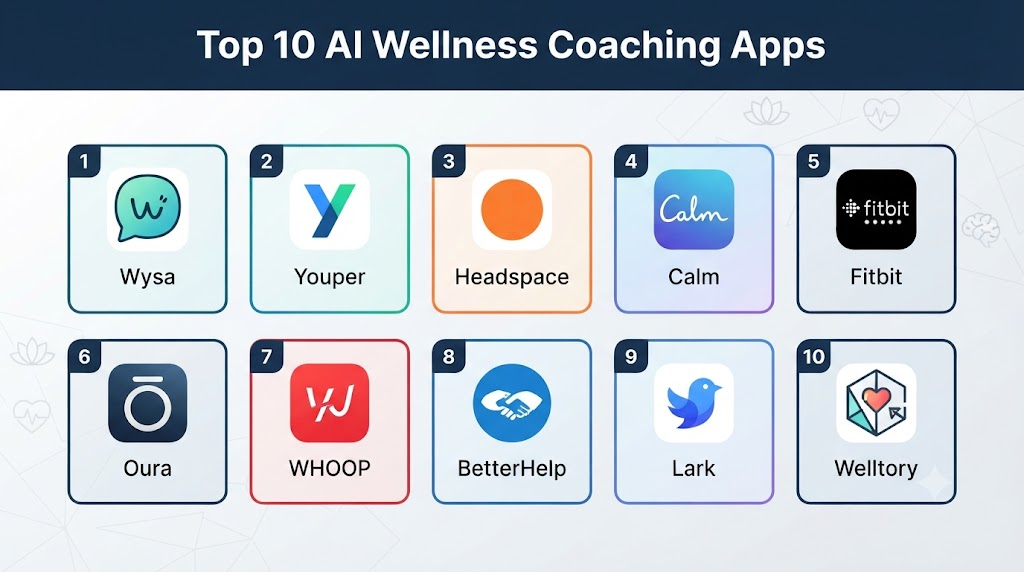
Top 10 AI Wellness Coaching Apps
1. Wysa
One-line verdict: Best for conversational emotional wellness support, self-guided exercises, and habit-oriented mental wellness conversations.
Short description:
Wysa is an AI-based mental wellness platform designed around conversational support and structured self-help exercises. It focuses on emotional well-being, stress, mindfulness, and related everyday wellness needs rather than functioning as a replacement for professional healthcare.
Standout Capabilities
- Conversational AI
- Guided wellness exercises
- Mood-oriented conversations
- Mindfulness activities
- Stress-management resources
- Self-guided programs
- Personalized interactions
- Human-support options in applicable offerings
AI-Specific Depth
- Model support: Proprietary AI and conversational technologies; exact model configuration is not publicly stated for every feature.
- RAG / knowledge integration: Structured wellness content and conversational context; exact retrieval architecture is not publicly stated.
- Evaluation: The platform has published research and evaluation work around its conversational approach, but detailed evaluation coverage varies by feature.
- Guardrails: Designed for wellness and emotional-support use cases with safety mechanisms; exact guardrail architecture is not publicly stated.
- Observability: User-facing conversation and program progress are available; detailed AI tracing and token metrics are not generally exposed.
Pros
- Strong conversational wellness experience
- Useful guided exercises
- Focused on emotional well-being
Cons
- Not a substitute for clinical care
- AI behavior can vary between conversations
- Some services and features may differ by offering
Security & Compliance
Security and privacy controls vary by service and deployment. Specific certifications and detailed AI data-retention controls should be verified for the particular offering.
Deployment & Platforms
- Mobile
- Web
- Cloud-based services
Integrations & Ecosystem
- Conversational wellness tools
- Guided exercises
- Digital wellness programs
- Applicable coaching services
Pricing Model
Free and paid offerings may vary by product and region. Exact pricing is not stated here.
Best-Fit Scenarios
- Stress-management support
- Mindfulness routines
- Conversational emotional wellness
2. Headspace
One-line verdict: Best for users who want AI-enhanced personalization combined with established mindfulness, meditation, sleep, and wellness content.
Short description:
Headspace is a well-known mindfulness and wellness platform that provides meditation, sleep resources, stress-management content, and other behavioral wellness tools. Its AI capabilities can add personalization and conversational experiences to a broader wellness ecosystem.
Standout Capabilities
- Meditation
- Mindfulness programs
- Sleep content
- Stress-management resources
- Personalized recommendations
- Conversational experiences
- Wellness routines
- Structured content library
AI-Specific Depth
- Model support: Proprietary and integrated AI technologies; exact model support varies.
- RAG / knowledge integration: Platform content and user context can inform personalization; exact architecture is not publicly stated.
- Evaluation: Headspace has established wellness content and research-oriented programs, but detailed AI evaluation methodology is not publicly stated for every feature.
- Guardrails: Wellness-oriented safety controls apply; detailed AI guardrail architecture is not publicly stated.
- Observability: User-facing progress and engagement features are available; detailed AI observability is not generally exposed.
Pros
- Large wellness content library
- Strong mindfulness focus
- Accessible for beginners
Cons
- Primarily wellness-focused rather than clinical
- AI functionality varies across features
- Subscription requirements may apply
Security & Compliance
Privacy and security practices vary by service. Specific AI certifications are not publicly stated here.
Deployment & Platforms
- Android
- iOS
- Web
- Cloud-based
Integrations & Ecosystem
- Meditation programs
- Sleep content
- Mindfulness exercises
- Wellness routines
- Mobile platforms
- Coaching-related services where available
Pricing Model
Subscription-based offerings with availability varying by market and plan.
Best-Fit Scenarios
- Meditation beginners
- Sleep routines
- Everyday stress management
3. Calm
One-line verdict: Best for users seeking AI-assisted personalization around mindfulness, relaxation, sleep, and everyday mental wellness.
Short description:
Calm focuses on meditation, mindfulness, relaxation, sleep, and related wellness activities. Its technology can help users discover relevant content and establish personalized wellness routines.
Standout Capabilities
- Meditation
- Sleep stories and resources
- Relaxation exercises
- Mindfulness programs
- Personalized content
- Wellness routines
- Breathing exercises
- Stress-management resources
AI-Specific Depth
- Model support: Proprietary AI technologies where applicable; exact models are not publicly stated.
- RAG / knowledge integration: Platform content and user preferences; exact architecture is not publicly stated.
- Evaluation: Detailed AI-specific evaluation is not publicly stated.
- Guardrails: Wellness safety controls may apply; detailed AI guardrail implementation is not publicly stated.
- Observability: User progress and engagement are available; detailed AI traces are not generally exposed.
Pros
- Strong relaxation and mindfulness library
- Simple user experience
- Useful for establishing routines
Cons
- More content-oriented than coaching-oriented
- AI capabilities vary
- Primarily focused on wellness rather than clinical care
Security & Compliance
Specific AI security certifications and detailed processing controls are not publicly stated.
Deployment & Platforms
- Android
- iOS
- Web
- Cloud-based
Integrations & Ecosystem
- Meditation
- Sleep
- Breathing exercises
- Mindfulness
- Wellness content
- Mobile devices
Pricing Model
Subscription-based options vary.
Best-Fit Scenarios
- Meditation
- Relaxation
- Sleep routines
4. Fitbit
One-line verdict: Best for users who want AI-assisted wellness insights combined with wearable activity, sleep, and fitness data.
Short description:
Fitbit combines wearable data with software designed to help users understand activity, sleep, exercise, and other aspects of everyday wellness. AI and machine-learning capabilities can support personalized insights and recommendations depending on the product and service.
Standout Capabilities
- Activity tracking
- Sleep tracking
- Exercise information
- Wellness insights
- Personalized recommendations
- Wearable integration
- Goal tracking
- Health and lifestyle trends
AI-Specific Depth
- Model support: Google/Fitbit proprietary machine-learning and AI technologies; exact models vary.
- RAG / knowledge integration: Wearable data, user settings, and platform information.
- Evaluation: Specific AI evaluation methodologies are not publicly stated for every feature.
- Guardrails: Safety mechanisms apply, but detailed AI guardrail architecture is not publicly stated.
- Observability: Users receive metrics and insights; detailed AI traces and token metrics are not generally exposed.
Pros
- Strong wearable ecosystem
- Useful activity and sleep context
- Personalized wellness insights
Cons
- Best experience may require compatible hardware
- Some features depend on subscriptions or devices
- Wellness insights should not be interpreted as medical diagnosis
Security & Compliance
Data security and privacy depend on the specific Fitbit and Google services involved. Users should review current data-control options for their account and device.
Deployment & Platforms
- Android
- iOS
- Fitbit devices
- Web-connected services
Integrations & Ecosystem
- Fitbit wearables
- Activity tracking
- Sleep tracking
- Exercise
- Google ecosystem
- Compatible services
Pricing Model
Hardware purchases and optional subscription services may apply.
Best-Fit Scenarios
- Wearable users
- Activity tracking
- Sleep and fitness awareness
5. Oura
One-line verdict: Best for users who want personalized wellness insights centered around sleep, recovery, readiness, and wearable data.
Short description:
Oura combines a wearable device with software designed to provide insights into sleep, readiness, activity, and recovery. Its personalized approach makes it particularly relevant to users who want continuous wellness feedback.
Standout Capabilities
- Sleep insights
- Readiness metrics
- Activity tracking
- Recovery-oriented information
- Personalized recommendations
- Wearable data
- Wellness trends
- Behavioral insights
AI-Specific Depth
- Model support: Proprietary algorithms and AI technologies; exact models are not publicly stated for all features.
- RAG / knowledge integration: Wearable measurements, user information, and platform content.
- Evaluation: Research and validation information exists for aspects of the platform, but detailed AI evaluation is not publicly stated for every feature.
- Guardrails: Wellness-oriented safety controls apply; detailed AI guardrail architecture is not publicly stated.
- Observability: Users receive trends and scores; detailed AI tracing is not exposed.
Pros
- Strong sleep focus
- Useful longitudinal wellness insights
- Wearable-driven personalization
Cons
- Requires compatible hardware
- Subscription costs may apply
- Wellness metrics should not be treated as medical diagnoses
Security & Compliance
Privacy and security controls vary by service. Specific AI certifications are not publicly stated here.
Deployment & Platforms
- Android
- iOS
- Oura wearable
- Cloud-connected services
Integrations & Ecosystem
- Oura Ring
- Sleep data
- Activity information
- Wellness programs
- Compatible health and fitness platforms
Pricing Model
Hardware plus subscription-based services may apply.
Best-Fit Scenarios
- Sleep improvement
- Recovery tracking
- Long-term wellness monitoring
6. Noom
One-line verdict: Best for behavior-change coaching focused on nutrition, activity, habits, and sustainable lifestyle improvements.
Short description:
Noom combines behavioral psychology, nutrition guidance, habit tracking, and digital coaching. Its AI capabilities can support personalized experiences, while the platform also uses structured educational and behavioral content.
Standout Capabilities
- Habit coaching
- Nutrition tracking
- Behavioral education
- Goal setting
- Personalized plans
- Progress tracking
- Coaching
- Lifestyle programs
AI-Specific Depth
- Model support: Proprietary AI capabilities where applicable; exact models are not publicly stated.
- RAG / knowledge integration: User information and structured wellness content; exact architecture is not publicly stated.
- Evaluation: Detailed AI evaluation methodology is not publicly stated.
- Guardrails: Wellness-oriented controls apply; detailed AI guardrail architecture is not publicly stated.
- Observability: User progress and engagement are tracked; detailed AI observability is not publicly exposed.
Pros
- Strong behavior-change orientation
- Structured programs
- Nutrition and habit focus
Cons
- Some programs are specialized
- Subscription costs may apply
- Not a replacement for individualized medical nutrition care
Security & Compliance
Specific AI certifications and detailed AI processing controls are not publicly stated.
Deployment & Platforms
- Android
- iOS
- Web-connected services
Integrations & Ecosystem
- Nutrition tracking
- Activity data
- Coaching
- Behavioral programs
- Wellness content
Pricing Model
Subscription and program pricing varies.
Best-Fit Scenarios
- Habit formation
- Nutrition awareness
- Lifestyle change
7. BetterHelp
One-line verdict: Best for users seeking digital mental wellness support with technology-assisted experiences and access to human professionals.
Short description:
BetterHelp is primarily a digital mental-health platform connecting users with licensed professionals rather than being purely an AI wellness application. AI-related features can support aspects of the user experience, but human professional care remains central to its model.
Standout Capabilities
- Digital counseling access
- Therapist matching
- Messaging
- Video sessions
- Mental wellness resources
- Personalized experiences
- Digital support tools
AI-Specific Depth
- Model support: Specific AI model usage varies and is not publicly stated for all features.
- RAG / knowledge integration: Varies / N/A.
- Evaluation: Detailed AI evaluation is not publicly stated.
- Guardrails: Human professional involvement provides an important safety layer; detailed AI guardrail architecture is not publicly stated.
- Observability: Platform-level activity is available; AI-specific observability is not publicly stated.
Pros
- Human professional component
- Convenient digital access
- Broader than AI-only coaching
Cons
- Not primarily an AI coaching application
- Cost can be higher than self-guided apps
- Availability and service structure vary
Security & Compliance
Privacy and security requirements are important for any platform handling sensitive mental-health information. Exact certifications and controls should be verified for the applicable service.
Deployment & Platforms
- Web
- Android
- iOS
- Cloud-based
Integrations & Ecosystem
- Professional counselors
- Messaging
- Video communication
- Wellness resources
- Mobile applications
Pricing Model
Subscription-based service; exact pricing varies.
Best-Fit Scenarios
- Users wanting human support
- Digital counseling
- Mental wellness guidance
8. BetterSleep
One-line verdict: Best for users seeking personalized sleep improvement through sleep tracking, relaxation content, and behavioral routines.
Short description:
BetterSleep focuses specifically on sleep improvement. It combines sleep-related content, tracking, relaxation exercises, and personalized features to help users establish healthier sleep routines.
Standout Capabilities
- Sleep tracking
- Sleep sounds
- Relaxation content
- Meditation
- Sleep routines
- Personalized recommendations
- Sleep-related education
AI-Specific Depth
- Model support: Specific AI models are not publicly stated.
- RAG / knowledge integration: User preferences and sleep-related content; exact architecture is not publicly stated.
- Evaluation: Detailed AI evaluation methodology is not publicly stated.
- Guardrails: Wellness-focused safety mechanisms; detailed AI guardrails are not publicly stated.
- Observability: User-facing sleep information and progress are available; detailed AI traces are not publicly stated.
Pros
- Strong sleep specialization
- Large relaxation content library
- Easy to use
Cons
- Narrower wellness focus
- AI functionality is not fully transparent
- Subscription requirements may apply
Security & Compliance
Specific AI certifications and detailed data-processing controls are not publicly stated.
Deployment & Platforms
- Android
- iOS
- Cloud-based
Integrations & Ecosystem
- Sleep tracking
- Meditation
- Relaxation
- Sleep sounds
- Wellness content
Pricing Model
Subscription-based options vary.
Best-Fit Scenarios
- Sleep routines
- Relaxation
- Bedtime habits
9. Finch
One-line verdict: Best for users who prefer a friendly, gamified approach to habit building, self-care, and everyday emotional wellness.
Short description:
Finch uses a virtual-pet experience to encourage users to complete self-care activities, establish habits, reflect on their day, and work toward personal wellness goals.
Standout Capabilities
- Habit tracking
- Self-care activities
- Journaling
- Goal setting
- Mood reflection
- Gamification
- Personalized prompts
- Wellness routines
AI-Specific Depth
- Model support: Specific AI model architecture is not publicly stated.
- RAG / knowledge integration: User interactions and structured wellness content; exact architecture is not publicly stated.
- Evaluation: Detailed AI evaluation methodology is not publicly stated.
- Guardrails: Wellness-oriented safety mechanisms apply; detailed AI guardrails are not publicly stated.
- Observability: User progress is visible; detailed AI observability is not publicly stated.
Pros
- Engaging gamified experience
- Encourages consistent habits
- Accessible for beginners
Cons
- Gamification may not appeal to everyone
- Not a clinical treatment platform
- AI capabilities are less transparent than some specialized systems
Security & Compliance
Specific AI certifications are not publicly stated.
Deployment & Platforms
- Android
- iOS
- Cloud-connected services
Integrations & Ecosystem
- Habit tracking
- Journaling
- Self-care exercises
- Goal tracking
- Wellness content
Pricing Model
Free and paid features may be available depending on the plan.
Best-Fit Scenarios
- Habit formation
- Daily self-care
- Users who enjoy gamification
10. Welltory
One-line verdict: Best for users interested in data-driven wellness insights combining wearable information, lifestyle tracking, and personalized recommendations.
Short description:
Welltory focuses on wellness analytics and personalized insights using data from connected devices and user inputs. It is particularly relevant for people who enjoy tracking patterns across activity, recovery, and lifestyle data.
Standout Capabilities
- Wearable integrations
- Wellness analytics
- Activity insights
- Personalized recommendations
- Lifestyle tracking
- Data visualization
- Trend analysis
- Connected-device ecosystem
AI-Specific Depth
- Model support: Proprietary algorithms and AI technologies; exact models are not publicly stated.
- RAG / knowledge integration: User-provided and connected-device information.
- Evaluation: Detailed AI evaluation methodology is not publicly stated.
- Guardrails: Wellness safety mechanisms apply; detailed AI guardrail architecture is not publicly stated.
- Observability: User-facing metrics and trends are available; internal AI traces are not generally exposed.
Pros
- Strong data-oriented approach
- Broad wearable integration
- Useful trend visualization
Cons
- Can feel complex for casual users
- Interpretation of wellness metrics requires context
- Not a medical diagnostic system
Security & Compliance
Security and privacy controls vary by service and integration. Specific certifications are not publicly stated here.
Deployment & Platforms
- Android
- iOS
- Cloud-connected services
Integrations & Ecosystem
- Wearables
- Fitness platforms
- Activity data
- Lifestyle information
- Health-related data sources
Pricing Model
Free and subscription-based features may vary.
Best-Fit Scenarios
- Data-focused wellness users
- Wearable enthusiasts
- Longitudinal lifestyle tracking
Comparison Table
| Tool Name | Best For | Deployment | Model Flexibility | Strength | Watch-Out | Public Rating |
|---|---|---|---|---|---|---|
| Wysa | Emotional wellness | Cloud / Mobile | Hosted | Conversational support | Not clinical care | N/A |
| Headspace | Mindfulness | Cloud / Mobile | Hosted | Meditation content | Subscription | N/A |
| Calm | Relaxation and sleep | Cloud / Mobile | Hosted | Wellness library | Limited coaching depth | N/A |
| Fitbit | Activity and sleep | Cloud / Mobile | Proprietary | Wearable ecosystem | Hardware dependence | N/A |
| Oura | Sleep and recovery | Cloud / Mobile | Proprietary | Longitudinal insights | Hardware + subscription | N/A |
| Noom | Behavior change | Cloud / Mobile | Hosted | Habit coaching | Program-specific | N/A |
| BetterHelp | Human wellness support | Cloud / Mobile | Varies | Professional support | Not AI-first | N/A |
| BetterSleep | Sleep wellness | Cloud / Mobile | Hosted | Sleep specialization | Narrower scope | N/A |
| Finch | Self-care habits | Cloud / Mobile | Hosted | Gamification | Not for clinical care | N/A |
| Welltory | Data-driven wellness | Cloud / Mobile | Proprietary | Wellness analytics | Data complexity | N/A |
Scoring & Evaluation
The scoring below is comparative rather than absolute. Wellness applications differ significantly in their goals, so a meditation-focused application should not automatically be judged by the same standards as a wearable-driven coaching platform.
The weighted criteria are:
- Core features – 20%
- AI reliability & evaluation – 15%
- Guardrails & safety – 10%
- Integrations & ecosystem – 15%
- Ease of use – 10%
- Performance & cost controls – 15%
- Security & admin – 10%
- Support & community – 5%
| Tool | Core | Reliability/Eval | Guardrails | Integrations | Ease | Perf/Cost | Security/Admin | Support | Weighted Total |
|---|---|---|---|---|---|---|---|---|---|
| Wysa | 9 | 9 | 9 | 8 | 9 | 8 | 9 | 9 | 8.75 |
| Headspace | 9 | 9 | 9 | 8 | 10 | 8 | 9 | 10 | 9.00 |
| Calm | 9 | 8 | 9 | 8 | 10 | 8 | 9 | 10 | 8.80 |
| Fitbit | 10 | 9 | 9 | 10 | 9 | 8 | 9 | 10 | 9.25 |
| Oura | 9 | 9 | 9 | 9 | 9 | 7 | 9 | 9 | 8.85 |
| Noom | 9 | 8 | 9 | 8 | 9 | 8 | 9 | 9 | 8.65 |
| BetterHelp | 9 | 8 | 10 | 7 | 9 | 7 | 9 | 10 | 8.65 |
| BetterSleep | 8 | 8 | 9 | 7 | 10 | 9 | 8 | 9 | 8.55 |
| Finch | 8 | 8 | 9 | 7 | 10 | 9 | 8 | 9 | 8.45 |
| Welltory | 9 | 8 | 8 | 10 | 8 | 8 | 8 | 8 | 8.45 |
Top 3 for Enterprise
- Fitbit
- Headspace
- Wysa
Top 3 for SMB
- Headspace
- Fitbit
- Noom
Top 3 for Developers
- Fitbit
- Welltory
- Wysa
Which AI Wellness Coaching App Is Right for You?
Solo / Freelancer
Individuals should begin with the specific wellness goal rather than choosing an app solely because it advertises AI.
For mindfulness, Headspace or Calm can be strong starting points. For habit formation, Finch or Noom may be more suitable. Users focused on wearable-driven insights can consider Fitbit, Oura, or Welltory.
SMB
Small businesses considering wellness programs should prioritize employee privacy and avoid collecting unnecessary personal information.
Important considerations include:
- Voluntary participation
- Data minimization
- Privacy policies
- Aggregated reporting where appropriate
- Employee consent
- Data retention
- Separation of wellness information from employment decisions
Mid-Market
Larger organizations should evaluate whether wellness data is genuinely necessary for their program.
Prioritize:
- Privacy governance
- Administrative controls
- Data minimization
- Integration requirements
- User consent
- Security reviews
- Vendor transparency
- Clear boundaries between wellness and medical care
Enterprise
Enterprise wellness programs need more than attractive AI features. They require clear governance around personal data, employee participation, AI recommendations, and escalation.
Organizations should evaluate:
- Identity management
- Access controls
- Data processing
- Retention
- Security
- Regional privacy requirements
- Human escalation
- AI transparency
- Vendor risk
- Data export and deletion
Regulated Industries
Healthcare organizations, insurers, government agencies, and other regulated environments should distinguish between general wellness support and clinical applications.
If an application processes sensitive personal or health-related information, organizations should verify applicable privacy obligations, data-processing practices, security controls, retention, and user consent before deployment.
Budget vs Premium
Free wellness apps can be enough for basic meditation, habit tracking, and journaling.
Premium services become more useful when users want personalized coaching, wearable integrations, advanced analytics, professional support, or extensive content libraries.
Build vs Buy
Buy when the objective is standard wellness coaching such as:
- Habit formation
- Mindfulness
- Sleep routines
- Activity motivation
- General nutrition awareness
Build or customize when you need:
- Proprietary wellness programs
- Enterprise integrations
- Custom AI coaching logic
- Internal employee wellness workflows
- Specialized data governance
- Custom evaluation systems
For sensitive wellness applications, custom development should include strong human oversight, privacy controls, evaluation, and escalation procedures.
Implementation Playbook
First 30 Days: Pilot + Success Metrics
- Define the wellness objective.
- Select a small pilot group.
- Establish participation guidelines.
- Define measurable outcomes.
- Test AI conversations.
- Evaluate personalization.
- Review notification frequency.
- Test wearable integrations where relevant.
- Examine privacy settings.
- Document inappropriate or unsafe AI responses.
Days 31–60: Security + Evaluation + Rollout
- Review data-processing practices.
- Configure privacy settings.
- Define data-retention requirements.
- Create an AI evaluation set.
- Test common wellness questions.
- Test ambiguous questions.
- Test potentially unsafe health-related requests.
- Establish escalation pathways.
- Test human-support options.
- Review AI-generated recommendations.
- Train administrators on appropriate usage.
Days 61–90: Optimization + Governance + Scale
- Measure engagement.
- Analyze retention.
- Review coaching quality.
- Reduce unnecessary notifications.
- Optimize personalization.
- Monitor AI failures.
- Establish periodic evaluation.
- Review vendor changes.
- Document incident procedures.
- Expand the program based on validated results.
Common Mistakes & How to Avoid Them
- Treating wellness AI as a medical professional.
- Accepting AI-generated health claims without verification.
- Collecting more personal information than necessary.
- Ignoring data-retention policies.
- Failing to review privacy controls.
- Allowing excessive notifications.
- Confusing personalization with clinical accuracy.
- Using wearable metrics without explaining their limitations.
- Failing to provide human escalation for sensitive situations.
- Ignoring false or misleading AI responses.
- Assuming every recommendation is evidence-based.
- Deploying AI wellness tools without evaluating their safety boundaries.
- Failing to test conversations involving vulnerable users.
- Allowing employee wellness data to influence employment decisions.
- Ignoring vendor lock-in.
- Failing to provide data deletion or export mechanisms.
- Measuring engagement without measuring actual user value.
- Over-automating personalized wellness recommendations.
- Treating AI-generated plans as universally appropriate.
- Failing to distinguish general wellness from diagnosis or treatment.
FAQs
What is an AI Wellness Coaching App?
It is an application that uses AI to provide personalized guidance around everyday wellness goals such as habits, activity, mindfulness, sleep, nutrition, and stress management.
Can AI wellness apps replace doctors?
No. Wellness apps are generally designed for lifestyle support rather than diagnosis or treatment. Medical concerns should be addressed with qualified healthcare professionals.
Are AI wellness recommendations reliable?
Quality varies by application and topic. Users should treat AI recommendations as general guidance and verify important health-related information with qualified professionals.
Do AI wellness apps collect personal data?
Many do collect information needed to provide personalization. The exact data collected, retained, and shared varies by application, so privacy policies should be reviewed before use.
Can wellness apps use wearable data?
Yes. Some applications can connect to wearable devices and fitness platforms to provide activity, sleep, recovery, or other wellness insights.
Is wearable data always medically accurate?
No. Consumer wearable measurements can have limitations and should not automatically be interpreted as clinical measurements or diagnoses.
Can AI wellness apps provide personalized plans?
Yes. Many applications can adapt goals, reminders, activities, or recommendations based on user preferences and progress.
Are AI wellness apps private?
Privacy varies significantly. Users should check what information is collected, how it is processed, how long it is retained, and whether it can be deleted or exported.
Can AI wellness apps work offline?
Some basic functions may work offline, but cloud-based AI conversations generally require network connectivity.
Do AI wellness apps use large language models?
Some may use language models or conversational AI, but exact model architectures are not always publicly disclosed.
Can I use my own AI model with a wellness app?
Most consumer applications do not provide unrestricted BYO-model functionality. Developer-oriented or custom wellness systems may support it.
Are AI wellness apps suitable for workplaces?
They can be used for voluntary wellness programs, but employers should carefully consider privacy, consent, data minimization, and separation of wellness information from employment decisions.
How much do AI wellness apps cost?
Pricing varies considerably. Some have free functionality, while others use subscriptions, hardware purchases, or premium services.
What should I do if an AI wellness coach gives concerning advice?
Do not rely on the response for an important health decision. Seek guidance from a qualified healthcare professional, particularly when symptoms or urgent concerns are involved.
Can AI wellness apps help with sleep?
Yes. Many provide sleep routines, relaxation exercises, meditation, sleep tracking, or behavioral recommendations. Persistent sleep problems may require professional evaluation.
Can AI help with habit formation?
Yes. AI can personalize reminders, break goals into smaller actions, track progress, and provide conversational encouragement.
What is the difference between AI wellness coaching and mental-health treatment?
Wellness coaching generally focuses on everyday lifestyle and self-care. Mental-health treatment involves assessment and clinical care from appropriately qualified professionals.
Can AI wellness apps integrate with Apple Health or similar platforms?
Some applications support integrations with health and fitness data platforms, but available integrations vary by app and device.
Which AI Wellness Coaching App is best?
There is no universal winner. Headspace and Calm are strong for mindfulness, Fitbit and Oura are useful for wearable-driven wellness, Noom focuses on behavior change, and Wysa emphasizes conversational emotional wellness support.
What are alternatives to AI Wellness Coaching Apps?
Alternatives include human wellness coaches, personal trainers, registered nutrition professionals, therapists, mindfulness instructors, traditional habit-tracking apps, and general-purpose AI assistants.
Conclusion
AI Wellness Coaching Apps are making everyday wellness support more personalized, conversational, and accessible. They can help users establish habits, stay accountable, understand activity patterns, improve mindfulness routines, and organize wellness goals.Different platforms serve very different purposes. Wysa is focused on conversational emotional wellness, Headspace and Calm emphasize mindfulness and relaxation, Fitbit and Oura connect coaching with wearable data, Noom focuses on behavior change, and apps such as Finch use gamification to encourage consistent self-care.AI can be a useful wellness companion, but it should remain within appropriate boundaries. For symptoms, diagnosis, treatment decisions, emergencies, or complex personal health situations, qualified professionals remain essential.