Introduction
AI Budgeting with Transaction Insights tools combine budgeting software, automated transaction categorization, machine learning, financial analytics, and increasingly conversational AI to help users understand where their money goes and how their spending affects financial goals.
Traditional budgeting apps primarily record transactions and display charts. AI-powered systems aim to go further by recognizing spending patterns, identifying unusual transactions, explaining changes in expenses, detecting recurring payments, forecasting cash flow, and turning raw transaction data into practical insights.
Common use cases include:
- Automatic transaction categorization
- Spending-pattern analysis
- Budget creation and adjustment
- Unusual transaction detection
- Recurring-payment identification
- Cash-flow forecasting
- Savings recommendations
- Subscription monitoring
- Merchant and category analysis
- Conversational questions about financial activity
Best for: Individuals, families, freelancers, young professionals, and financially engaged users who want automated spending analysis without manually maintaining spreadsheets.
Not ideal for: Users who need highly specialized accounting, tax, estate, or investment advice, or people who prefer keeping financial data completely offline. In those situations, traditional spreadsheets, desktop finance software, accountants, or professional financial advisors may be more appropriate.
When evaluating these tools, focus on transaction accuracy, account connectivity, categorization quality, AI reliability, privacy, security, budgeting flexibility, cash-flow forecasting, alerts, integrations, data export, automation, pricing, and the ability to correct AI-generated classifications.
What’s Changed in AI Budgeting with Transaction Insights
- Automatic categorization is becoming more adaptive: AI systems can increasingly learn from corrections instead of relying entirely on fixed merchant-category rules.
- Transaction data is becoming conversational: Users can ask questions such as “Where did my spending increase?” or “How much did I spend on dining?” without manually building reports.
- AI is identifying patterns instead of only transactions: Modern systems can analyze groups of transactions to identify recurring costs, spending trends, and behavioral changes.
- Proactive insights are becoming more important: Instead of waiting for users to open a dashboard, platforms can surface potentially important spending changes and financial events.
- Recurring expenses are easier to identify: AI can recognize subscriptions, memberships, bills, and other repeated transactions even when merchant descriptions vary.
- Cash-flow forecasting is improving: Historical transaction data can be used to estimate upcoming income and expenses, although forecasts remain estimates rather than guarantees.
- AI-generated explanations are becoming a major interface: A financial dashboard can now be paired with natural-language explanations of why spending changed.
- Privacy is becoming a critical buying factor: Transaction histories can reveal sensitive information about a person’s lifestyle, purchases, location patterns, and financial situation.
- AI accuracy matters more than conversational fluency: A system that sounds convincing but miscategorizes transactions can produce poor financial recommendations.
- Human correction remains essential: Users need simple ways to correct categories, merchants, recurring transactions, and other financial assumptions.
- Automation requires stronger controls: Any system capable of initiating financial actions should provide clear authorization, confirmation, and audit mechanisms.
- Financial AI is moving toward personalization: Instead of recommending generic budgets, systems can increasingly consider an individual’s actual income, spending patterns, goals, and financial history.
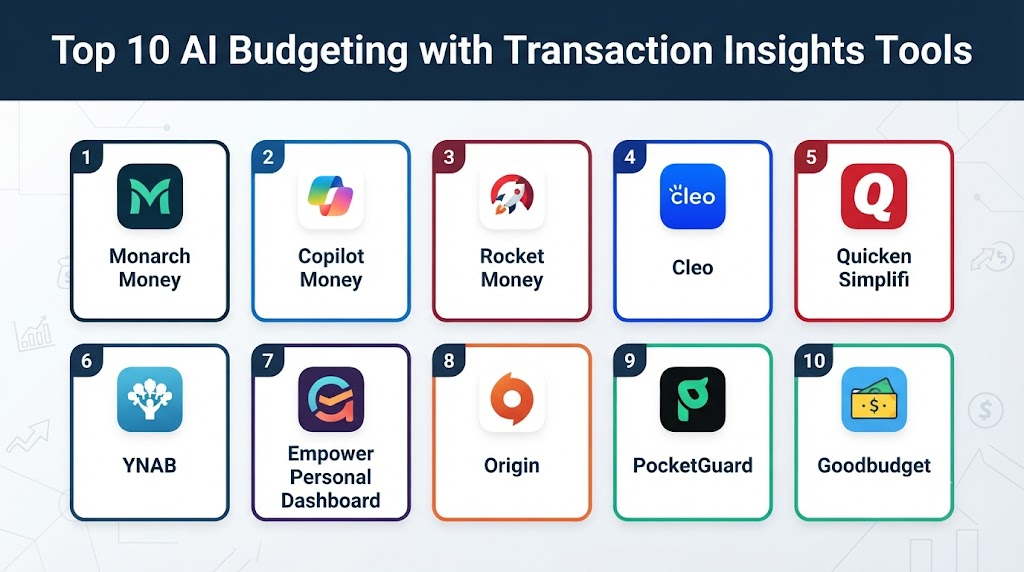
Top 10 AI Budgeting with Transaction Insights Tools
1. Monarch Money
One-line verdict: Best overall for households wanting AI-assisted transaction analysis, budgeting, financial insights, and comprehensive money management.
Short description
Monarch Money combines budgeting, transaction tracking, account aggregation, investment monitoring, net-worth tracking, and financial planning. Its AI capabilities add conversational analysis and automated insights on top of the financial data users already manage inside the platform.
The combination makes it particularly useful for users who want more than a traditional budget spreadsheet.
Standout Capabilities
- Automatic transaction categorization
- AI-powered financial insights
- Conversational financial assistant
- Budget tracking
- Cash-flow analysis
- Investment tracking
- Net-worth monitoring
- Household financial management
AI-Specific Depth
- Model support: Provider-managed AI with multiple AI and machine-learning components.
- RAG / knowledge integration: Uses connected financial information and application context.
- Evaluation: Detailed public AI evaluation methodology is not fully stated.
- Guardrails: Provider-managed application and financial-data controls.
- Observability: User-facing financial insights are available; detailed model-level tracing is not publicly stated.
Pros
- Excellent balance between budgeting and financial analytics.
- Strong household-management capabilities.
- AI works with actual transaction and account information.
Cons
- More comprehensive than necessary for users who only want basic budgeting.
- Advanced financial decisions still require independent verification.
- Subscription cost may not appeal to users seeking a completely free solution.
Security & Compliance
The platform provides security and privacy controls around financial-account connections and user data. Exact certification details should be verified against the current provider documentation.
Certifications: Not publicly stated here.
Deployment & Platforms
- Web
- iOS
- Android
- Cloud
Integrations & Ecosystem
Monarch is designed to bring financial accounts and transactions into one unified financial-management environment.
- Bank accounts
- Credit cards
- Investment accounts
- Transactions
- Budgets
- Net worth
- Financial goals
Pricing Model
Subscription-based.
Best-Fit Scenarios
- Household budgeting
- Transaction analysis
- Comprehensive personal-finance management
2. Copilot Money
One-line verdict: Best for users wanting intelligent transaction categorization, spending analysis, budgeting, and a polished financial dashboard.
Short description
Copilot Money uses automation and AI to organize financial transactions, track spending, monitor investments, and help users understand their financial behavior. Its categorization system is one of the platform’s central strengths.
The platform also provides conversational capabilities for interacting with personal financial information.
Standout Capabilities
- AI-assisted transaction categorization
- Spending analysis
- Budgeting
- Subscription tracking
- Investment monitoring
- Cash-flow tracking
- Net-worth tracking
- Financial assistant capabilities
AI-Specific Depth
- Model support: Provider-managed AI and machine-learning systems.
- RAG / knowledge integration: Connected financial accounts and user transaction data.
- Evaluation: Detailed public AI evaluation methodology is not stated.
- Guardrails: Provider-managed controls.
- Observability: Financial dashboards and insights; detailed AI tracing is not publicly stated.
Pros
- Strong transaction categorization.
- Excellent spending visualization.
- Good combination of budgeting and investment tracking.
Cons
- Primarily designed for supported personal-finance workflows.
- Less suitable for advanced professional financial planning.
- Some features depend on account connectivity.
Security & Compliance
The platform uses financial-data connections designed for personal-finance aggregation. Specific current certifications should be verified before enterprise or high-sensitivity use.
Certifications: Not publicly stated here.
Deployment & Platforms
- Web
- iOS
- macOS
- Cloud
Integrations & Ecosystem
- Bank accounts
- Credit cards
- Investment accounts
- Transactions
- Subscriptions
- Budgets
- Net worth
Pricing Model
Subscription-based.
Best-Fit Scenarios
- Automated transaction categorization
- Spending analysis
- Users who want a modern budgeting experience
3. YNAB
One-line verdict: Best for disciplined budgeting combined with transaction management and structured financial decision-making.
Short description
YNAB is primarily a budgeting platform rather than an AI-first financial advisor. Its strength is creating a structured relationship between incoming money, spending decisions, financial priorities, and transactions.
For users who value deliberate budgeting more than automated AI recommendations, this approach can be highly effective.
Standout Capabilities
- Structured budgeting
- Automatic transaction import
- Budget categories
- Spending analysis
- Goal tracking
- Account synchronization
- Budget reports
- Financial planning workflows
AI-Specific Depth
- Model support: Provider-managed automation and AI capabilities where applicable.
- RAG / knowledge integration: User budget and transaction data.
- Evaluation: Detailed AI evaluation is not publicly stated.
- Guardrails: Application-level controls.
- Observability: Budget reports and transaction information; model-level observability is not publicly stated.
Pros
- Strong budgeting methodology.
- Excellent user control.
- Encourages proactive financial decisions.
Cons
- Not primarily an AI transaction-insights platform.
- Requires user involvement.
- Less focused on automated financial forecasting.
Security & Compliance
Security and privacy controls are provided as part of the platform. Specific certification claims should be verified against current documentation.
Certifications: Not publicly stated here.
Deployment & Platforms
- Web
- iOS
- Android
- Cloud
Integrations & Ecosystem
- Bank accounts
- Credit cards
- Transactions
- Budgets
- Goals
- Reports
- Financial planning
Pricing Model
Subscription-based.
Best-Fit Scenarios
- Budget-conscious households
- Debt reduction
- Users who want active control over spending
4. Rocket Money
One-line verdict: Best for transaction insights involving subscriptions, recurring expenses, bills, and unnecessary spending.
Short description
Rocket Money focuses heavily on recurring financial expenses. It can help users identify subscriptions, monitor spending, manage recurring bills, and understand where money is being spent.
Its AI capabilities add a conversational and proactive layer to financial information.
Standout Capabilities
- Subscription identification
- Recurring transaction analysis
- Spending insights
- Bill management
- Financial alerts
- AI assistant
- Subscription cancellation assistance
- Expense monitoring
AI-Specific Depth
- Model support: Provider-managed AI.
- RAG / knowledge integration: Connected financial information and transaction data.
- Evaluation: Detailed public AI evaluation is not stated.
- Guardrails: Application-level controls and user authorization.
- Observability: User-facing alerts and insights; detailed AI tracing is not publicly stated.
Pros
- Excellent recurring-expense analysis.
- Useful subscription-management features.
- Proactive notifications can reduce financial leakage.
Cons
- Not designed primarily for comprehensive investment planning.
- Some functionality requires paid access.
- Automated financial actions should be reviewed carefully.
Security & Compliance
Security depends on the account connections and services used.
Certifications: Not publicly stated here.
Deployment & Platforms
- Web
- iOS
- Android
- Cloud
Integrations & Ecosystem
- Bank accounts
- Credit cards
- Transactions
- Subscriptions
- Bills
- Spending
- Financial alerts
Pricing Model
Freemium and subscription-based.
Best-Fit Scenarios
- Subscription cleanup
- Recurring expense monitoring
- Reducing unnecessary spending
5. Quicken Simplifi
One-line verdict: Best for straightforward budgeting, transaction tracking, spending plans, and everyday financial organization.
Short description
Quicken Simplifi provides users with a centralized view of transactions, spending, income, bills, savings goals, and financial accounts.
It is more focused on practical financial organization than an AI-first conversational experience, making it suitable for users who want automation without an overly complex interface.
Standout Capabilities
- Spending plans
- Transaction tracking
- Bill tracking
- Savings goals
- Account aggregation
- Financial reports
- Cash-flow visibility
- Automated transaction organization
AI-Specific Depth
- Model support: Provider-managed automation and AI where applicable.
- RAG / knowledge integration: Connected financial-account data.
- Evaluation: Not publicly stated.
- Guardrails: Application-level controls.
- Observability: Financial reports and insights; model-level tracing is not publicly stated.
Pros
- Simple financial organization.
- Useful transaction management.
- Good everyday budgeting experience.
Cons
- Less AI-centric than newer AI-first platforms.
- Advanced planning may require another tool.
- Conversational AI depth may be limited.
Security & Compliance
Security and privacy details should be evaluated based on the current product offering.
Certifications: Not publicly stated here.
Deployment & Platforms
- Web
- iOS
- Android
- Cloud
Integrations & Ecosystem
- Bank accounts
- Credit cards
- Transactions
- Bills
- Savings goals
- Spending plans
- Financial reports
Pricing Model
Subscription-based.
Best-Fit Scenarios
- Everyday budgeting
- Transaction organization
- Users who want straightforward financial management
6. Empower
One-line verdict: Best for users who want transaction tracking combined with investments, net worth, retirement, and broader financial analysis.
Short description
Empower provides a broader financial dashboard that combines spending and transaction information with investment portfolios, retirement planning, and net-worth tracking.
It is particularly useful when budgeting is only one part of a larger financial picture.
Standout Capabilities
- Transaction tracking
- Net-worth monitoring
- Investment analysis
- Portfolio tracking
- Retirement planning
- Cash-flow monitoring
- Financial dashboards
- Wealth-management services
AI-Specific Depth
- Model support: Provider-managed analytics and AI where applicable.
- RAG / knowledge integration: Connected financial-account information.
- Evaluation: Detailed AI evaluation is not publicly stated.
- Guardrails: Financial-platform controls.
- Observability: Financial analytics are available; model-level tracing is not publicly stated.
Pros
- Strong investment integration.
- Useful net-worth tracking.
- Suitable for more complex financial situations.
Cons
- Budgeting is not its only focus.
- AI functionality is less central than in dedicated AI assistants.
- Wealth-management offerings may involve additional considerations.
Security & Compliance
Empower operates within financial services and provides security controls appropriate to its services. Exact current certifications should be independently verified.
Certifications: Not publicly stated here.
Deployment & Platforms
- Web
- iOS
- Android
- Cloud
Integrations & Ecosystem
- Bank accounts
- Investment accounts
- Retirement accounts
- Transactions
- Net worth
- Portfolio analysis
Pricing Model
Financial-management functionality can be available without the same structure as paid wealth-management services.
Best-Fit Scenarios
- Investors
- High-value financial tracking
- Users combining budgeting with retirement planning
7. Origin
One-line verdict: Best for AI-assisted analysis that connects transactions and budgets with broader financial planning.
Short description
Origin takes a broader approach to personal financial management. Rather than focusing exclusively on transaction categorization, it connects budgeting and financial data with investment, tax, retirement, and long-term planning.
Its AI Advisor is designed to interact with a user’s financial information and provide planning-oriented assistance.
Standout Capabilities
- AI financial advisor
- Transaction and spending analysis
- Budgeting
- Investment planning
- Retirement planning
- Tax planning
- Net-worth analysis
- Scenario modeling
AI-Specific Depth
- Model support: Provider-managed multi-agent AI architecture.
- RAG / knowledge integration: Financial data and planning context.
- Evaluation: Origin has publicly discussed evaluating its AI against professional financial-planning questions.
- Guardrails: Financial-planning controls and application-level safeguards.
- Observability: Detailed model tracing and token-level metrics are not publicly stated.
Pros
- Broad financial-planning coverage.
- AI can connect everyday spending with long-term planning.
- Useful for financially complex users.
Cons
- Potentially excessive for simple budgeting.
- Important recommendations should be independently verified.
- Pricing and feature availability can vary.
Security & Compliance
Security and privacy controls are provided as part of the platform. Specific certifications should be verified against current provider information.
Certifications: Not publicly stated here.
Deployment & Platforms
- Web
- Mobile
- Cloud
Integrations & Ecosystem
- Bank accounts
- Investment accounts
- Transactions
- Budgets
- Retirement planning
- Tax planning
- Financial scenarios
Pricing Model
Subscription-based.
Best-Fit Scenarios
- Comprehensive financial planning
- Transaction-to-goal analysis
- Users with complex finances
8. Monarch Money
One-line verdict: Strong household-focused option for users who want transactions, budgets, cash flow, and financial insights together.
Short description
Monarch is especially useful when several people need to understand and manage shared household finances. Transaction information can be connected to budgets, cash flow, goals, investments, and net worth.
Its AI features make that information easier to explore through natural-language interactions.
Standout Capabilities
- Household financial management
- Transaction categorization
- Budgeting
- AI financial insights
- Cash-flow analysis
- Investment tracking
- Net-worth tracking
- Financial recaps
AI-Specific Depth
- Model support: Provider-managed AI and machine-learning systems.
- RAG / knowledge integration: Connected account and transaction context.
- Evaluation: Detailed public evaluation methodology is not stated.
- Guardrails: Application-level financial-data controls.
- Observability: User-facing financial analytics; detailed model tracing is not publicly stated.
Pros
- Excellent for families.
- Strong overall financial dashboard.
- Good combination of transactions and budgets.
Cons
- Subscription required for the primary experience.
- May be excessive for simple personal budgets.
- Advanced recommendations still need verification.
Security & Compliance
Security controls are provided around financial-account connections and user information.
Certifications: Not publicly stated here.
Deployment & Platforms
- Web
- iOS
- Android
- Cloud
Integrations & Ecosystem
- Bank accounts
- Credit cards
- Investments
- Transactions
- Budgets
- Financial goals
- Household accounts
Pricing Model
Subscription-based.
Best-Fit Scenarios
- Family budgets
- Shared household finances
- Comprehensive transaction analysis
9. Goodbudget
One-line verdict: Best for envelope-style budgeting users who want structured spending management with less dependence on complex AI.
Short description
Goodbudget uses the envelope-budgeting approach to help users assign money to specific spending categories and financial priorities.
It is more methodology-driven than AI-driven, making it a useful alternative for people who want deliberate budgeting rather than highly automated recommendations.
Standout Capabilities
- Envelope budgeting
- Spending categories
- Household budget sharing
- Debt planning
- Spending tracking
- Goal-oriented budgeting
- Budget reports
- Multi-device synchronization
AI-Specific Depth
- Model support: Not publicly stated.
- RAG / knowledge integration: N/A.
- Evaluation: N/A.
- Guardrails: Application-level controls.
- Observability: Financial reports rather than AI-model observability.
Pros
- Simple budgeting methodology.
- Encourages intentional spending.
- Useful for shared household budgets.
Cons
- Limited AI capabilities.
- Less sophisticated transaction intelligence than AI-first platforms.
- Advanced investment analytics are not its primary focus.
Security & Compliance
Security details should be checked against current product documentation.
Certifications: Not publicly stated here.
Deployment & Platforms
- Web
- iOS
- Android
- Cloud
Integrations & Ecosystem
- Budget envelopes
- Transactions
- Household budgets
- Debt planning
- Financial goals
- Reports
Pricing Model
Free and paid tiers.
Best-Fit Scenarios
- Envelope budgeting
- Couples and households
- Users who prefer manual financial control
10. Rocket Money
One-line verdict: Best for users prioritizing transaction-based subscription discovery, recurring expense monitoring, and financial alerts.
Short description
Rocket Money is especially useful for turning transaction history into actionable information about recurring expenses. Its focus on subscriptions and bills makes it different from comprehensive budgeting platforms.
The platform is most valuable when recurring financial leakage is a major concern.
Standout Capabilities
- Recurring transaction identification
- Subscription monitoring
- Spending alerts
- Bill tracking
- AI-assisted financial conversations
- Expense analysis
- Financial summaries
- Subscription-management workflows
AI-Specific Depth
- Model support: Provider-managed AI.
- RAG / knowledge integration: Financial-account and transaction information.
- Evaluation: Detailed AI evaluation is not publicly stated.
- Guardrails: User authorization and application controls.
- Observability: Alerts and summaries; detailed model-level metrics are not publicly stated.
Pros
- Strong recurring-expense focus.
- Easy-to-understand spending insights.
- Useful proactive alerts.
Cons
- Not a complete financial-planning system.
- Paid features may be needed for advanced functionality.
- Automated actions require careful review.
Security & Compliance
Security practices vary by service and connected account.
Certifications: Not publicly stated here.
Deployment & Platforms
- Web
- iOS
- Android
- Cloud
Integrations & Ecosystem
- Bank accounts
- Credit cards
- Transactions
- Subscriptions
- Bills
- Spending alerts
- Financial assistant
Pricing Model
Freemium and subscription-based.
Best-Fit Scenarios
- Subscription management
- Recurring-expense analysis
- Spending alerts
Comparison Table
| Tool Name | Best For | Deployment | Model Flexibility | Strength | Watch-Out | Public Rating |
|---|---|---|---|---|---|---|
| Monarch Money | Comprehensive budgeting | Cloud | Hosted | Strong overall insights | Subscription cost | N/A |
| Copilot Money | Transaction intelligence | Cloud/Mobile | Hosted | Smart categorization | Account compatibility | N/A |
| YNAB | Structured budgeting | Cloud/Mobile | Hosted | Budget methodology | Less AI-centric | N/A |
| Rocket Money | Recurring expenses | Cloud/Mobile | Hosted | Subscription detection | Advanced features may require payment | N/A |
| Quicken Simplifi | Everyday budgeting | Cloud/Mobile | Hosted | Simple financial tracking | Limited AI depth | N/A |
| Empower | Investment + budgeting | Cloud/Mobile | Hosted | Wealth analytics | Less AI-centric | N/A |
| Origin | AI financial planning | Cloud/Mobile | Hosted/Multi-agent | Comprehensive planning | May be excessive for simple budgets | N/A |
| Goodbudget | Envelope budgeting | Cloud/Mobile | N/A | Simple methodology | Limited AI | N/A |
| Monarch Money | Household finance | Cloud/Mobile | Hosted | Shared financial visibility | Premium positioning | N/A |
| Rocket Money | Subscription insights | Cloud/Mobile | Hosted | Recurring-spend analysis | Narrower scope | N/A |
Scoring & Evaluation
The following scores are comparative editorial estimates based on the category requirements rather than official vendor ratings. The highest score does not automatically mean the best tool for every user.
The weighting emphasizes core budgeting and transaction functionality while giving substantial importance to AI reliability, integrations, security, and cost control.
| Tool | Core | Reliability/Eval | Guardrails | Integrations | Ease | Perf/Cost | Security/Admin | Support | Weighted Total |
|---|---|---|---|---|---|---|---|---|---|
| Monarch Money | 9.5 | 8.8 | 8.8 | 9.5 | 9.3 | 8.8 | 9.0 | 9.0 | 9.1 |
| Copilot Money | 9.2 | 8.6 | 8.5 | 9.1 | 9.5 | 8.7 | 8.7 | 8.8 | 8.9 |
| YNAB | 9.4 | 8.3 | 8.5 | 8.6 | 9.0 | 8.8 | 8.7 | 9.0 | 8.8 |
| Rocket Money | 9.1 | 8.3 | 8.5 | 9.2 | 9.3 | 8.7 | 8.7 | 8.8 | 8.8 |
| Quicken Simplifi | 8.8 | 8.1 | 8.3 | 8.8 | 9.2 | 8.8 | 8.6 | 8.8 | 8.6 |
| Empower | 9.0 | 8.5 | 8.7 | 9.0 | 8.8 | 8.2 | 9.0 | 9.0 | 8.7 |
| Origin | 9.3 | 9.0 | 9.0 | 9.0 | 8.7 | 8.4 | 9.0 | 8.9 | 8.9 |
| Goodbudget | 8.2 | 7.8 | 8.2 | 7.8 | 8.9 | 9.1 | 8.3 | 8.5 | 8.3 |
Top 3 for Enterprise
- Origin
- Monarch Money
- Empower
Top 3 for SMB
- Monarch Money
- Copilot Money
- Rocket Money
Top 3 for Developers
- Origin
- Monarch Money
- Copilot Money
Which AI Budgeting with Transaction Insights Tool Is Right for You?
Solo / Freelancer
Freelancers often need transaction intelligence because their income and expenses can vary significantly from month to month.
Prioritize:
- Automatic categorization
- Cash-flow tracking
- Recurring-expense detection
- Tax-related organization
- Savings goals
- Custom categories
- Budget flexibility
Copilot Money and Monarch Money are strong options for general financial organization, while Origin becomes more attractive when long-term financial planning is also important.
SMB
Small-business owners should avoid mixing business accounting with personal budgeting unless the software explicitly supports the required business workflows.
For personal financial management, focus on:
- Income visibility
- Personal expenses
- Savings
- Debt
- Investments
- Household budgeting
For actual business accounting, use dedicated accounting software designed for business records and compliance.
Mid-Market
Users with multiple income sources, investment accounts, loans, and financial goals should prioritize comprehensive account aggregation.
Look for:
- Multi-account connectivity
- Transaction categorization
- Cash-flow forecasting
- Investment tracking
- Net-worth calculations
- Custom financial goals
- Advanced reporting
Monarch Money, Origin, and Empower are particularly relevant for this level of complexity.
Enterprise
Organizations evaluating AI-powered budgeting or employee financial-wellness solutions should prioritize privacy and governance rather than simply counting AI features.
Review:
- Data ownership
- Data retention
- User consent
- Account permissions
- Authentication
- Encryption
- Auditability
- Administrative controls
- AI transparency
- Human oversight
Consumer finance applications should not automatically be assumed to satisfy enterprise requirements.
Regulated Industries
Financial institutions and other regulated organizations require a significantly deeper evaluation.
Assess:
- Data residency
- Data processing
- Data retention
- Encryption
- Access controls
- AI model governance
- Audit logging
- Incident response
- Human review
- Regulatory responsibilities
AI-generated financial insights should be treated as decision-support information unless the provider explicitly offers an appropriately regulated advisory service.
Budget vs Premium
Budget users should prioritize:
- Transaction imports
- Categorization
- Basic budgets
- Spending reports
- Alerts
Premium users may benefit from:
- AI financial assistants
- Advanced analytics
- Investment tracking
- Retirement planning
- Cash-flow forecasting
- Financial scenarios
Build vs Buy
Building a custom transaction-insights system can make sense for banks, fintech platforms, large employers, and financial institutions with proprietary data and workflows.
A custom solution can provide:
- Custom transaction models
- Proprietary categorization
- Custom AI models
- Financial rules
- Internal integrations
- Enterprise governance
- Specialized security
For most individuals and small businesses, buying an established platform is more practical.
Implementation Playbook
30 Days: Pilot + Success Metrics
Begin with a focused use case.
For example:
- Reduce dining expenses
- Identify subscriptions
- Improve savings
- Reduce discretionary spending
- Create a realistic monthly budget
- Understand cash-flow changes
Establish baseline metrics before using the platform.
Track:
- Monthly income
- Monthly expenses
- Savings rate
- Recurring expenses
- Discretionary spending
- Debt payments
- Investment contributions
During the pilot, test transaction intelligence using questions such as:
- Which categories increased this month?
- Which merchants do I use most?
- What recurring expenses appeared?
- Which transactions look unusual?
- How much did I spend compared with last month?
- Which categories exceed my budget?
- What expenses are likely to occur next month?
60 Days: Security + Evaluation
Review transaction classifications regularly.
Create a correction workflow for:
- Incorrect categories
- Duplicate transactions
- Incorrect merchant names
- Missing transactions
- Incorrect recurring-payment identification
- Unusual transactions
Test AI reliability with known financial data.
The assistant should:
- Calculate correctly
- Explain its assumptions
- Distinguish known information from estimates
- Avoid inventing transactions
- Identify uncertainty
- Avoid making unsupported financial claims
Also review account permissions, authentication, data retention, privacy controls, and connected financial accounts.
90 Days: Optimize + Scale
Once the system is reliable, use it as part of a recurring financial-review process.
A practical monthly workflow is:
- Review transactions.
- Correct categorization errors.
- Compare spending against the previous period.
- Identify recurring expenses.
- Review unusual transactions.
- Check budget performance.
- Review savings.
- Analyze cash flow.
- Update financial goals.
- Verify major AI-generated recommendations.
Common Mistakes & How to Avoid Them
- Assuming every AI categorization is correct: Review and correct transactions regularly.
- Ignoring duplicate transactions: Account synchronization can occasionally create duplicate or delayed records.
- Trusting AI explanations without checking source data: Always compare recommendations against actual transactions.
- Connecting unnecessary accounts: Minimize financial-data exposure.
- Ignoring privacy policies: Financial transaction histories can contain highly sensitive information.
- Failing to review recurring expenses: Subscription and bill detection is useful only when users act on the information.
- Treating forecasts as guarantees: AI cash-flow forecasts are estimates based on assumptions and historical behavior.
- Allowing excessive automation: Financial actions should have appropriate confirmation and authorization.
- Skipping evaluation: Test the assistant with known spending scenarios.
- Ignoring incorrect merchant recognition: Merchant-level errors can cause repeated categorization problems.
- Overlooking cash-flow seasonality: Historical data may not represent irregular expenses.
- Using AI for tax decisions without verification: Tax rules can be complex and jurisdiction-specific.
- Ignoring vendor lock-in: Check whether your financial data can be exported.
- Confusing budgeting insights with financial advice: Spending analysis does not automatically constitute personalized investment or tax advice.
FAQs
What is AI budgeting with transaction insights?
It combines budgeting software with AI-powered transaction analysis. The system can categorize purchases, identify spending patterns, detect recurring expenses, and provide financial insights.
How does AI categorize transactions?
AI can analyze merchant names, transaction descriptions, amounts, historical behavior, and previously corrected categories to determine the most likely spending category.
Can AI automatically create a budget?
Some platforms can suggest budgets based on income and historical spending. Users should review these suggestions because historical spending does not always represent future priorities.
Can AI detect unusual transactions?
Yes. AI and statistical systems can identify transactions that differ from normal spending patterns. However, unusual does not necessarily mean fraudulent.
Can AI identify subscriptions?
Yes. Transaction patterns can help identify recurring subscriptions and memberships, particularly when similar merchants appear repeatedly.
Is AI budgeting accurate?
Accuracy depends on the quality of account connections, transaction data, categorization models, and user corrections. Important financial decisions should not rely on unverified AI output.
Can AI predict my monthly expenses?
It can estimate future expenses using historical transactions and recurring-payment patterns. Unexpected purchases can make forecasts inaccurate.
Can AI help me save money?
It can identify spending patterns, recurring expenses, and categories where savings may be possible. The user still needs to decide which changes are realistic.
Can AI track credit-card spending?
Many financial platforms can aggregate credit-card transactions through supported financial-data connections.
Does AI budgeting require access to my bank account?
Not always. Some budgeting tools support manual transaction entry, while automated transaction insights generally require financial-account connectivity.
Is connecting financial accounts safe?
Security varies by provider and integration. Users should review account permissions, authentication, encryption, data retention, and privacy practices before connecting accounts.
Can I use AI budgeting without sharing financial data?
Yes, but functionality will generally be more limited. Users can manually provide transactions or use locally stored financial data with appropriate software.
Can AI budgeting replace a spreadsheet?
For many users, yes. Automated account connections and transaction categorization can reduce manual work. Spreadsheets still provide greater customization for users who want complete control.
Can AI budgeting help with debt?
Yes. Transaction and budget data can help users understand debt payments, discretionary spending, and available cash flow. Actual repayment decisions should consider interest rates and loan terms.
Can AI budgeting help freelancers?
Yes. Automated transaction categorization and cash-flow analysis can be especially useful for freelancers with variable income and irregular expenses.
Which tool is best for transaction insights?
Monarch Money and Copilot Money are strong general-purpose options, while Rocket Money is particularly useful for recurring transactions and subscriptions.
Which tool is best for strict budgeting?
YNAB is particularly strong for users who want a structured budgeting methodology and deliberate control over every spending category.
Which tool is best for investment-focused users?
Empower and Origin are stronger choices when transaction analysis needs to be combined with investment and retirement planning.
Can AI budgeting detect fraud?
It can identify unusual transaction patterns, but dedicated fraud-detection systems operated by financial institutions are more appropriate for formal fraud monitoring.
Can AI budgeting automatically move money?
Some financial platforms may offer automated financial actions, but availability varies. Users should understand exactly what permissions and authorization are required.
Should I trust AI-generated financial recommendations?
Treat them as decision-support information. Verify calculations, assumptions, account information, and important recommendations before acting.
Conclusion
AI Budgeting with Transaction Insights is becoming a practical evolution of traditional personal-finance software. Instead of simply recording transactions and displaying charts, modern platforms can help users understand spending patterns, categorize purchases, identify recurring expenses, monitor budgets, and interact with financial information using natural language.Monarch Money is a strong overall choice for comprehensive budgeting and transaction insights. Copilot Money stands out for intelligent transaction organization and spending analysis. YNAB remains valuable for users who prefer structured budgeting and direct control, while Rocket Money is particularly useful for subscriptions and recurring expenses. Origin is more suitable for users who want to connect everyday transactions with broader financial planning, and Empower is useful when investment and retirement analysis are equally important.The most important consideration is not how impressive an AI assistant sounds. It is whether the underlying transaction data is accurate, the categorization can be corrected, recommendations are transparent, privacy protections are appropriate, and the system communicates uncertainty honestly.