Introduction
AI Telematics Anomaly Detection uses artificial intelligence, machine learning, vehicle telemetry, GPS data, sensor readings, and behavioral analytics to identify unusual patterns in vehicles, fleets, and connected assets. Instead of relying only on fixed rules, AI-based systems can learn what normal vehicle behavior looks like and flag deviations that may indicate mechanical problems, unsafe driving, fraud, unusual vehicle usage, data-quality issues, or potential security events.
Typical use cases include detecting abnormal fuel consumption, unusual routes, unexpected vehicle movement, harsh driving behavior, suspicious idling, diagnostic anomalies, sensor abnormalities, unauthorized vehicle use, and emerging maintenance risks.
Best for: Fleet operators, logistics companies, transportation businesses, insurers, leasing companies, automotive organizations, rental fleets, public transportation providers, and enterprises managing connected vehicles.
Not ideal for: Individuals with a single vehicle, very small fleets without telematics data, or organizations that only need basic GPS tracking and simple rule-based alerts.
What’s Changed in AI Telematics Anomaly Detection
- AI models can analyze multiple telemetry signals simultaneously instead of evaluating isolated alerts.
- Time-series models can identify changes in vehicle behavior over hours, days, or weeks.
- Anomaly detection can combine GPS, speed, acceleration, engine data, fuel consumption, and diagnostic information.
- AI can establish vehicle-specific behavioral baselines rather than applying identical thresholds to every vehicle.
- Fleet-wide models can identify unusual behavior across thousands of vehicles.
- Modern systems can distinguish recurring operational patterns from genuinely unusual events.
- Predictive maintenance and anomaly detection are increasingly connected.
- AI can prioritize anomalies based on severity and operational impact.
- False-positive reduction is becoming an important purchasing criterion.
- Edge processing can support faster anomaly detection when connectivity is limited.
- Cloud systems can aggregate telemetry from geographically distributed fleets.
- Explainable alerts are increasingly important because fleet managers need to understand why an event was flagged.
- Connected-vehicle security is becoming more important as telematics systems interact with operational infrastructure.
- Data quality monitoring is increasingly integrated with anomaly detection.
- AI-based anomaly detection can support EV fleets by monitoring charging, battery, energy, and thermal telemetry.
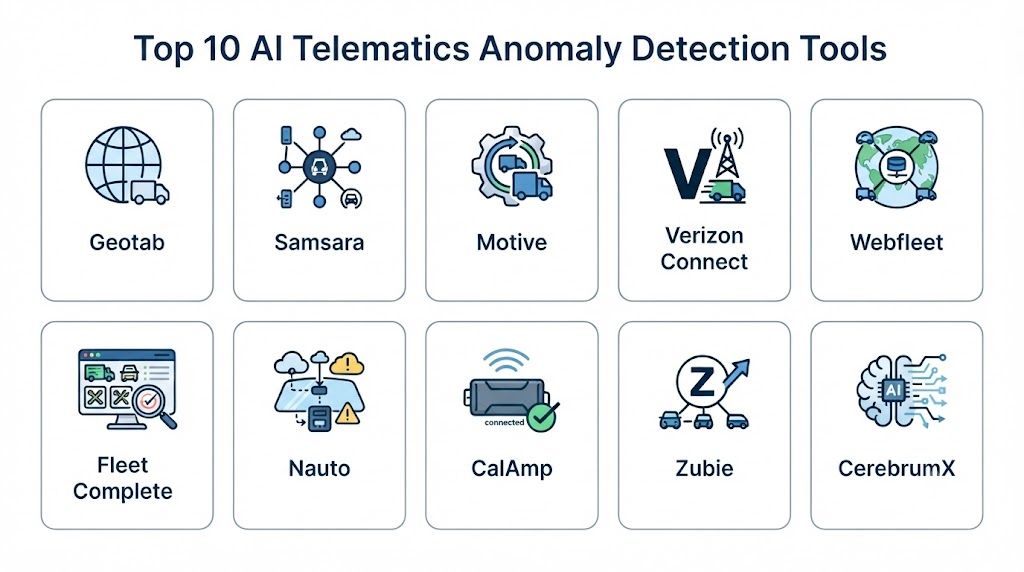
Top 10 AI Telematics Anomaly Detection Tools
1 — Samsara
One-line verdict: Best for organizations combining real-time fleet telemetry, vehicle monitoring, safety analytics, and anomaly-oriented alerts.
Short description:
Samsara provides a connected-operations platform for fleets that combines vehicle telematics, GPS, diagnostics, safety data, cameras, and operational analytics. Its broad telemetry ecosystem makes it useful for identifying unusual vehicle and fleet behavior.
Standout Capabilities
- Real-time vehicle tracking
- Vehicle diagnostics
- Driver behavior monitoring
- Fleet analytics
- GPS monitoring
- Safety event detection
- Operational alerts
- Connected vehicle data
AI-Specific Depth
- Model support: Proprietary AI and analytics capabilities vary by product.
- RAG / knowledge integration: N/A.
- Evaluation: Fleet and operational analytics.
- Guardrails: Configurable rules, policies, and alert thresholds.
- Observability: Extensive vehicle and operational telemetry.
Pros
- Broad telemetry coverage.
- Strong fleet-management ecosystem.
- Useful combination of vehicle and driver data.
Cons
- Anomaly detection is part of a larger platform.
- Hardware is commonly part of the deployment.
- Exact AI methodology is not publicly stated.
Security & Compliance
Security, access controls, retention, and compliance capabilities vary by product and configuration.
Deployment & Platforms
- Cloud
- Web
- Mobile
- Vehicle hardware
Integrations & Ecosystem
Samsara can connect vehicle telemetry with broader fleet and operational workflows.
- Vehicle diagnostics
- GPS
- Fleet-management systems
- Maintenance workflows
- APIs
- Driver applications
- Connected cameras
Pricing Model
Subscription and hardware/service-based commercial pricing; exact pricing varies.
Best-Fit Scenarios
- Large commercial fleets
- Transportation operations
- Fleet anomaly monitoring
2 — Geotab
One-line verdict: Best for large fleets requiring extensive telematics data, vehicle diagnostics, and customizable analytics.
Short description:
Geotab provides connected-vehicle and fleet-management technology that collects large volumes of vehicle telemetry. Its ecosystem can support anomaly detection through vehicle diagnostics, driver analytics, GPS information, and third-party applications.
Standout Capabilities
- Vehicle telematics
- GPS tracking
- Vehicle diagnostics
- Fleet analytics
- Driver behavior
- Asset monitoring
- API ecosystem
- Custom applications
AI-Specific Depth
- Model support: Proprietary analytics and AI capabilities vary.
- RAG / knowledge integration: N/A.
- Evaluation: Fleet and vehicle analytics.
- Guardrails: Rules, thresholds, and configurable alerts.
- Observability: Extensive telemetry and fleet monitoring.
Pros
- Large telematics ecosystem.
- Extensive data access.
- Strong integration possibilities.
Cons
- Can require technical configuration.
- Advanced analytics may need additional development.
- Data quality depends on vehicle and hardware compatibility.
Security & Compliance
Security and privacy controls vary by product and deployment.
Deployment & Platforms
- Cloud
- Web
- Mobile
- Vehicle hardware
- APIs
Integrations & Ecosystem
- Vehicle diagnostics
- GPS
- Fleet platforms
- Maintenance systems
- APIs
- Analytics applications
- Third-party solutions
Pricing Model
Subscription and hardware-based commercial pricing.
Best-Fit Scenarios
- Enterprise fleets
- Custom anomaly detection
- Telematics analytics
3 — Motive
One-line verdict: Best for transportation fleets combining telematics, driver behavior, safety monitoring, and operational anomaly detection.
Short description:
Motive provides fleet-management and connected-operations technology covering vehicle tracking, telematics, safety, driver management, and vehicle information. Its platform can help fleet managers identify unusual driving and operational patterns.
Standout Capabilities
- Vehicle tracking
- Fleet telematics
- Driver behavior monitoring
- Safety analytics
- Vehicle diagnostics
- Fleet management
- Operational alerts
- Camera-based monitoring
AI-Specific Depth
- Model support: Proprietary AI capabilities vary.
- RAG / knowledge integration: N/A.
- Evaluation: Safety and fleet analytics.
- Guardrails: Configurable fleet rules and alerts.
- Observability: Vehicle, driver, and operational telemetry.
Pros
- Strong transportation focus.
- Combines telematics and safety data.
- Useful for operational monitoring.
Cons
- Not solely an anomaly-detection product.
- Hardware deployment may be required.
- Exact AI capabilities vary by product.
Security & Compliance
Security and administrative controls vary by service and deployment.
Deployment & Platforms
- Cloud
- Web
- Mobile
- Vehicle hardware
Integrations & Ecosystem
- Vehicle telematics
- GPS
- Cameras
- Fleet systems
- Maintenance
- APIs
- Driver applications
Pricing Model
Subscription and hardware-based commercial pricing.
Best-Fit Scenarios
- Commercial transportation
- Driver behavior monitoring
- Fleet anomaly analysis
4 — Nauto
One-line verdict: Best for fleets focused on AI-powered driving behavior, safety-event detection, and vehicle-camera analytics.
Short description:
Nauto focuses on AI-powered driver and fleet safety technology. Its connected systems analyze vehicle and camera data to identify risky driving events and patterns that may require intervention.
Standout Capabilities
- Driver behavior analysis
- AI video analytics
- Collision-risk detection
- Distracted-driving detection
- Safety-event monitoring
- Fleet analytics
- Real-time alerts
- Driver coaching
AI-Specific Depth
- Model support: Proprietary computer-vision and AI models.
- RAG / knowledge integration: N/A.
- Evaluation: Safety-event and model-performance analytics.
- Guardrails: Configurable safety policies and event rules.
- Observability: Vehicle, camera, and safety-event telemetry.
Pros
- Strong AI safety focus.
- Combines video and vehicle data.
- Useful for high-risk fleet operations.
Cons
- More focused on safety than general vehicle telemetry.
- Camera hardware is central to many use cases.
- Privacy considerations require careful implementation.
Security & Compliance
Security and privacy controls vary by deployment and organizational requirements.
Deployment & Platforms
- Cloud
- Vehicle hardware
- Cameras
- Web
Integrations & Ecosystem
- Vehicle telemetry
- Cameras
- Fleet-management systems
- Safety platforms
- APIs
- Driver-management workflows
Pricing Model
Enterprise/custom pricing.
Best-Fit Scenarios
- Fleet safety
- Driver anomaly detection
- Video-based telematics
5 — Zonar
One-line verdict: Best for commercial fleets requiring vehicle diagnostics, telematics, inspections, and operational anomaly visibility.
Short description:
Zonar provides connected transportation technology for commercial fleets. Its systems collect vehicle information and support diagnostics, fleet tracking, inspections, maintenance, and operational monitoring.
Standout Capabilities
- Vehicle diagnostics
- Telematics
- Fleet tracking
- Maintenance monitoring
- Vehicle inspections
- Driver workflows
- Fleet analytics
- Asset monitoring
AI-Specific Depth
- Model support: Proprietary analytics; exact AI architecture varies.
- RAG / knowledge integration: N/A.
- Evaluation: Fleet and vehicle analytics.
- Guardrails: Operational rules and alert thresholds.
- Observability: Vehicle and fleet telemetry.
Pros
- Commercial-fleet specialization.
- Strong diagnostic data.
- Integrates operational and vehicle information.
Cons
- Primarily transportation-focused.
- Advanced AI capabilities vary.
- Hardware implementation may be required.
Security & Compliance
Security and enterprise controls vary by product and deployment.
Deployment & Platforms
- Cloud
- Web
- Mobile
- Vehicle hardware
Integrations & Ecosystem
- Vehicle diagnostics
- GPS
- Maintenance
- Fleet-management systems
- APIs
- Inspection systems
Pricing Model
Commercial/enterprise pricing varies.
Best-Fit Scenarios
- Commercial transportation
- School bus fleets
- Fleet diagnostics
6 — Uptake
One-line verdict: Best for enterprises applying advanced AI analytics to connected assets and predictive operational monitoring.
Short description:
Uptake provides AI-driven asset-performance and predictive-maintenance technologies. Although broader than telematics alone, its capabilities can be used to identify abnormal asset behavior and emerging vehicle-health issues.
Standout Capabilities
- Predictive analytics
- Asset-health monitoring
- Anomaly detection
- Failure prediction
- Industrial AI
- Fleet analytics
- Operational intelligence
- Data integration
AI-Specific Depth
- Model support: Proprietary machine-learning and analytics.
- RAG / knowledge integration: N/A.
- Evaluation: Predictive-model and asset-performance evaluation.
- Guardrails: Operational thresholds and business rules.
- Observability: Asset telemetry and predictive analytics.
Pros
- Strong AI and predictive-maintenance capabilities.
- Useful for complex assets.
- Enterprise-oriented analytics.
Cons
- More complex than a conventional telematics platform.
- Requires significant data integration.
- Enterprise implementation may take time.
Security & Compliance
Enterprise security and administrative controls vary by deployment.
Deployment & Platforms
- Cloud
- Enterprise
- APIs
- Industrial environments
Integrations & Ecosystem
- Telematics
- IoT
- Maintenance systems
- Asset databases
- APIs
- Enterprise data platforms
Pricing Model
Enterprise/custom pricing.
Best-Fit Scenarios
- Enterprise fleets
- Predictive anomaly detection
- Connected industrial assets
7 — Verizon Connect
One-line verdict: Best for fleets needing telematics-based tracking, vehicle information, driver analytics, and operational alerts.
Short description:
Verizon Connect provides fleet-management and telematics solutions for vehicle tracking, driver management, fleet operations, and vehicle information. Its telemetry can support rule-based and analytics-driven anomaly identification.
Standout Capabilities
- GPS tracking
- Vehicle telematics
- Driver behavior
- Fleet analytics
- Vehicle diagnostics
- Alerts
- Asset tracking
- Fleet reporting
AI-Specific Depth
- Model support: Proprietary analytics; exact AI architecture varies.
- RAG / knowledge integration: N/A.
- Evaluation: Fleet and vehicle performance analytics.
- Guardrails: Configurable alerts and operational rules.
- Observability: Vehicle and fleet telemetry.
Pros
- Established telematics ecosystem.
- Broad fleet functionality.
- Useful operational visibility.
Cons
- Anomaly detection is not its only focus.
- Advanced AI functionality varies.
- Exact model capabilities are not publicly stated.
Security & Compliance
Security and administrative capabilities vary by service.
Deployment & Platforms
- Cloud
- Web
- Mobile
- Vehicle hardware
Integrations & Ecosystem
- GPS
- Vehicle diagnostics
- Fleet systems
- Maintenance
- APIs
- Asset tracking
Pricing Model
Subscription and commercial service pricing varies.
Best-Fit Scenarios
- Fleet monitoring
- Vehicle tracking
- Operational anomaly alerts
8 — Samsara Vehicle Gateway + Connected Operations
One-line verdict: Best for organizations already using connected vehicle infrastructure and wanting centralized telemetry-based operational intelligence.
Short description:
Samsara’s connected vehicle infrastructure provides continuous telemetry that can be analyzed for unusual driving, vehicle, and operational behavior. It is particularly useful when anomaly detection needs to be part of a larger fleet-management workflow.
Standout Capabilities
- Vehicle telemetry
- GPS
- Diagnostics
- Safety analytics
- Operational monitoring
- Fleet dashboards
- Alerts
- Maintenance data
AI-Specific Depth
- Model support: Proprietary AI capabilities vary.
- RAG / knowledge integration: N/A.
- Evaluation: Operational and safety analytics.
- Guardrails: Rules and configurable alerts.
- Observability: Real-time telemetry.
Pros
- Broad connected-operations platform.
- Large range of telemetry sources.
- Strong operational visibility.
Cons
- Best value comes from broader platform adoption.
- Hardware deployment is generally involved.
- This is not a dedicated anomaly-detection engine.
Security & Compliance
Controls vary according to the product configuration.
Deployment & Platforms
- Cloud
- Web
- Mobile
- Vehicle hardware
Integrations & Ecosystem
- Vehicle gateways
- GPS
- Cameras
- Maintenance
- APIs
- Fleet systems
Pricing Model
Commercial subscription and hardware/service model.
Best-Fit Scenarios
- Connected fleets
- Operational monitoring
- Fleet anomaly detection
9 — Geotab Marketplace Analytics Ecosystem
One-line verdict: Best for organizations extending telematics data with specialized analytics and custom anomaly-detection applications.
Short description:
Geotab’s broader ecosystem allows organizations to use telematics data with external applications and analytics solutions. This makes it useful when standard fleet analytics need to be extended with specialized anomaly-detection models.
Standout Capabilities
- Telematics data
- API access
- Fleet analytics
- Vehicle diagnostics
- Third-party integrations
- Custom applications
- Data analysis
- Fleet reporting
AI-Specific Depth
- Model support: Depends on the selected application or custom model.
- RAG / knowledge integration: N/A.
- Evaluation: Depends on the analytics solution.
- Guardrails: Application-specific.
- Observability: Telematics and application-level monitoring.
Pros
- Flexible ecosystem.
- Strong telematics data foundation.
- Suitable for custom analytics.
Cons
- Requires more technical expertise.
- AI quality depends on the selected application.
- Not a single dedicated anomaly-detection product.
Security & Compliance
Security depends on the platform and connected application.
Deployment & Platforms
- Cloud
- Web
- APIs
- Vehicle hardware
Integrations & Ecosystem
- Telematics
- APIs
- Analytics platforms
- Fleet systems
- Maintenance
- Third-party applications
Pricing Model
Varies by platform, application, and deployment.
Best-Fit Scenarios
- Custom analytics
- Enterprise telematics
- Specialized anomaly detection
10 — MATLAB / Simulink
One-line verdict: Best for engineering teams developing custom anomaly-detection models from raw vehicle telemetry and sensor data.
Short description:
MATLAB and Simulink provide engineering environments for signal processing, machine learning, simulation, anomaly detection, and time-series analysis. Automotive teams can use them to build customized telematics anomaly-detection algorithms.
Standout Capabilities
- Time-series analysis
- Machine learning
- Signal processing
- Anomaly detection
- Vehicle simulation
- Sensor analytics
- Model development
- Algorithm testing
AI-Specific Depth
- Model support: Broad machine-learning and deep-learning capabilities.
- RAG / knowledge integration: N/A.
- Evaluation: Extensive model-validation capabilities.
- Guardrails: Engineering constraints and validation workflows.
- Observability: Model, simulation, and signal analytics.
Pros
- Highly customizable.
- Strong automotive engineering capabilities.
- Suitable for proprietary algorithms.
Cons
- Requires technical expertise.
- Production deployment needs additional engineering.
- Licensing costs can be significant.
Security & Compliance
Security depends on deployment and organizational configuration.
Deployment & Platforms
- Windows
- macOS
- Linux
- Cloud
- Embedded environments
Integrations & Ecosystem
- Python
- C/C++
- Simulink
- Automotive data
- Sensor systems
- Test platforms
- Machine-learning frameworks
Pricing Model
Commercial licensing; exact pricing varies.
Best-Fit Scenarios
- Automotive R&D
- Custom anomaly detection
- Vehicle-data research
Comparison Table
| Tool | Best For | Deployment | Model Flexibility | Strength | Watch-Out | Public Rating |
|---|---|---|---|---|---|---|
| Samsara | Connected fleets | Cloud/Hardware | Proprietary | Broad telemetry | Platform-centric | |
| Geotab | Enterprise telematics | Cloud/Hardware | Proprietary | Data ecosystem | Technical complexity | |
| Motive | Transportation fleets | Cloud/Hardware | Proprietary | Fleet safety | Broad platform | |
| Nauto | AI fleet safety | Cloud/Hardware | Proprietary | Video analytics | Camera dependency | |
| Zonar | Commercial fleets | Cloud/Hardware | Proprietary | Vehicle diagnostics | Fleet-specific | |
| Uptake | Asset intelligence | Cloud | Proprietary | Predictive analytics | Enterprise implementation | |
| Verizon Connect | Fleet tracking | Cloud/Hardware | Proprietary | Telematics | AI depth varies | |
| Samsara Gateway | Connected operations | Cloud/Hardware | Proprietary | Real-time telemetry | Requires ecosystem | |
| Geotab Ecosystem | Custom analytics | Cloud/Hardware | Multi-model | Extensibility | Requires development | |
| MATLAB / Simulink | Custom models | Desktop/Cloud | Multi-model | Engineering flexibility | Requires expertise |
Scoring & Evaluation
These scores are comparative editorial assessments rather than official vendor ratings. Results can vary significantly depending on telemetry quality, vehicle types, fleet size, sensor availability, model configuration, and the definition of an anomaly.
| Tool | Core | Reliability/Eval | Guardrails | Integrations | Ease | Perf/Cost | Security/Admin | Support | Weighted Total |
|---|---|---|---|---|---|---|---|---|---|
| Samsara | 10 | 9 | 9 | 10 | 9 | 8 | 9 | 10 | 9.25 |
| Geotab | 10 | 9 | 9 | 10 | 8 | 9 | 9 | 10 | 9.20 |
| Motive | 9 | 9 | 9 | 9 | 9 | 8 | 9 | 9 | 8.95 |
| Nauto | 9 | 10 | 10 | 8 | 8 | 8 | 9 | 9 | 9.00 |
| Zonar | 9 | 8 | 9 | 9 | 8 | 8 | 9 | 9 | 8.65 |
| Uptake | 10 | 10 | 9 | 9 | 7 | 8 | 9 | 10 | 9.10 |
| Verizon Connect | 9 | 8 | 9 | 9 | 9 | 8 | 9 | 10 | 8.95 |
| Samsara Gateway | 10 | 9 | 9 | 10 | 9 | 8 | 9 | 10 | 9.25 |
| Geotab Ecosystem | 9 | 9 | 9 | 10 | 7 | 9 | 9 | 9 | 8.95 |
| MATLAB / Simulink | 10 | 10 | 10 | 10 | 7 | 7 | 9 | 10 | 9.25 |
Top 3 for Enterprise
- Geotab
- Samsara
- Uptake
Top 3 for SMB
- Motive
- Verizon Connect
- Samsara
Top 3 for Developers
- MATLAB / Simulink
- Geotab ecosystem
- Uptake
Which AI Telematics Anomaly Detection Tool Is Right for You?
Solo / Freelancer
Developers and researchers building specialized anomaly-detection systems may benefit more from direct telemetry access and development environments than complete fleet-management suites.
Prioritize:
- APIs
- Raw telemetry
- Time-series data
- Machine-learning frameworks
- Simulation
- Custom model deployment
- Historical datasets
MATLAB / Simulink can be useful for algorithm development, while a telematics provider can supply real-world vehicle data.
SMB
Smaller fleets should prioritize easy deployment and useful alerts rather than highly customized AI.
Look for:
- GPS anomaly alerts
- Vehicle diagnostics
- Driver behavior monitoring
- Fleet dashboards
- Automated notifications
- Basic maintenance integration
Motive, Verizon Connect, and Samsara can be appropriate depending on the fleet’s requirements.
Mid-Market
Mid-market fleets should combine multiple telemetry sources.
A useful architecture is:
GPS + Diagnostics + Vehicle Sensors + Driver Data → Data Processing → Baseline → Anomaly Detection → Severity Score → Alert → Investigation
The system should allow fleet managers to investigate why an anomaly occurred rather than simply displaying a warning.
Enterprise
Large organizations should evaluate:
- High-volume telemetry ingestion
- Custom APIs
- Vehicle-specific baselines
- Fleet-wide anomaly models
- Predictive maintenance
- Cybersecurity monitoring
- Edge analytics
- Model governance
- Data retention
- Integration with maintenance systems
Geotab, Samsara, and Uptake are strong candidates for different enterprise requirements.
Regulated Industries
Organizations handling sensitive transportation or driver information should consider:
- Data privacy
- Location-data controls
- Access management
- Auditability
- Data retention
- Encryption
- Security monitoring
- Incident response
Budget vs Premium
A standard telematics platform may be enough when the objective is simple anomaly alerts.
Premium solutions become more valuable when the organization requires:
- Large-scale analytics
- Custom models
- Predictive maintenance
- Complex integrations
- Advanced video analytics
- Real-time anomaly scoring
- Enterprise governance
Build vs Buy
Build when anomaly detection is a strategic capability and the organization has strong data-science and automotive engineering teams.
Buy when the priority is rapid deployment and reliable fleet operations.
A hybrid strategy is often practical: buy the telematics infrastructure and build specialized anomaly-detection models using the available APIs.
Implementation Playbook
30 Days: Pilot + Success Metrics
- Identify the anomalies that matter most.
- Collect historical telemetry.
- Establish normal behavior for each vehicle class.
- Identify available GPS and diagnostic signals.
- Label known historical incidents.
- Define anomaly severity.
- Establish baseline alert volumes.
- Select initial models.
Measure:
- Detection rate
- False-positive rate
- False-negative rate
- Detection latency
- Investigation time
- Number of actionable alerts
60 Days: Harden Security + Evaluation + Rollout
- Connect real-time telemetry.
- Implement anomaly scoring.
- Create vehicle-specific baselines.
- Validate against historical events.
- Test unusual operating conditions.
- Add alert prioritization.
- Introduce model-version control.
- Create investigation workflows.
- Establish access controls.
- Test failure and connectivity scenarios.
90 Days: Optimize Cost + Latency + Governance
- Deploy models across more vehicles.
- Optimize inference frequency.
- Introduce edge processing where useful.
- Monitor model drift.
- Add predictive maintenance signals.
- Connect anomalies with maintenance workflows.
- Create governance policies.
- Review data-retention requirements.
- Automate reporting.
- Establish continuous model evaluation.
Common Mistakes & How to Avoid Them
- Using only fixed thresholds: AI can identify complex patterns that simple thresholds miss.
- Ignoring vehicle-specific behavior: Normal behavior differs between vehicles, routes, loads, and operating environments.
- Treating every anomaly as a failure: Some anomalies are harmless operational variations.
- Generating too many alerts: Excessive alerts lead to alert fatigue.
- Ignoring data quality: Bad telemetry produces unreliable anomaly scores.
- Skipping historical validation: Models need to be tested against real events.
- Ignoring false negatives: Missed anomalies can be more damaging than false alarms.
- Ignoring driver context: Traffic, weather, road conditions, and operational requirements can explain unusual behavior.
- Failing to explain alerts: Fleet managers need actionable reasons for investigating an event.
- Ignoring model drift: Fleet composition and driving patterns change over time.
- Over-automating decisions: High-impact actions should include appropriate human oversight.
- Ignoring privacy: Telematics can expose detailed location and behavioral information.
- Neglecting cybersecurity: Connected vehicle systems can become targets for attacks.
- Ignoring integration: An anomaly should connect to an operational workflow, such as maintenance or safety investigation.
FAQs
What is AI telematics anomaly detection?
It is the use of machine learning and vehicle telemetry to identify unusual patterns in vehicle, driver, location, diagnostic, or operational behavior.
What data does AI telematics anomaly detection use?
Common inputs include GPS position, speed, acceleration, braking, engine diagnostics, fuel consumption, battery data, mileage, sensor information, and driver behavior.
Can AI detect unusual driving behavior?
Yes. AI can analyze driving patterns to identify behavior such as unusual acceleration, braking, speeding, route deviations, or other abnormal patterns.
Can telematics AI detect vehicle faults?
It can identify patterns associated with potential faults, especially when diagnostic and sensor data are available. It should complement rather than replace appropriate technical inspection.
What is the difference between anomaly detection and predictive maintenance?
Anomaly detection identifies unusual behavior, while predictive maintenance focuses more specifically on estimating potential maintenance requirements or component failures.
Can anomaly detection work without historical failure data?
Yes. Unsupervised and semi-supervised techniques can establish normal behavior and identify deviations without requiring large collections of labeled failures.
What is vehicle-specific anomaly detection?
Instead of applying one definition of normal behavior to an entire fleet, the system learns patterns for individual vehicles or comparable vehicle groups.
Can AI detect GPS anomalies?
Yes. Systems can identify unusual route deviations, unexpected vehicle movement, impossible location changes, or other location-data inconsistencies.
Can AI detect fuel anomalies?
Yes. Fuel consumption can be compared against historical behavior, vehicle characteristics, routes, loads, and operating conditions to identify unusual patterns.
Is real-time data necessary?
Not always. Historical analysis can identify patterns, while real-time telemetry is more useful when immediate alerts or operational intervention is required.
Can telematics anomaly detection support EVs?
Yes. EV-specific anomaly detection can analyze battery temperature, state of charge, charging behavior, energy consumption, thermal systems, and other electric-vehicle signals.
Can organizations build their own anomaly-detection system?
Yes. A custom system can use telematics APIs, time-series databases, machine-learning models, and fleet-management integrations. The main challenge is obtaining high-quality data and maintaining models over time.
How accurate is AI anomaly detection?
There is no universal accuracy figure. Performance depends on data quality, anomaly definitions, vehicle population, operating conditions, and model design.
How much does telematics anomaly detection cost?
Pricing varies according to vehicle count, hardware, software capabilities, integrations, analytics requirements, and contract structure. Exact pricing should be obtained from each provider.
Does AI replace fleet managers?
No. AI can prioritize unusual events and reduce manual monitoring, but fleet managers remain important for investigation, context, operational decisions, and corrective action.
What should buyers measure during a pilot?
Measure detection accuracy, false-positive rate, alert volume, detection latency, investigation time, maintenance impact, safety outcomes, and overall operational value.
Conclusion
AI Telematics Anomaly Detection allows organizations to move beyond simple GPS tracking and fixed alert thresholds toward continuous, data-driven monitoring of connected vehicles.Samsara, Geotab, and Motive are strong choices for organizations seeking broad fleet-management and telematics ecosystems. Nauto is particularly relevant to AI-powered safety and video-based analysis, while Uptake is better suited to organizations approaching anomaly detection from an asset-performance and predictive-maintenance perspective. MATLAB / Simulink provides greater flexibility for engineering teams developing proprietary models.The best platform depends on fleet size, vehicle types, available telemetry, desired anomaly types, technical expertise, security requirements, and whether you need a complete fleet platform or a custom AI analytics layer.