Introduction
AI EV Battery Health Prediction tools use machine learning, battery analytics, sensor data, and predictive algorithms to estimate the condition, degradation, remaining useful life, and performance of electric-vehicle batteries. Instead of relying only on fixed maintenance intervals, these systems analyze information such as battery voltage, current, temperature, charging behavior, driving patterns, and historical battery performance.
Battery-health prediction can help automotive manufacturers, fleet operators, battery developers, charging providers, insurers, and EV owners understand how batteries are aging and identify potential problems earlier.
Common use cases include battery state-of-health estimation, remaining useful life prediction, warranty analysis, predictive maintenance, fleet battery monitoring, fast-charging optimization, second-life battery assessment, and battery residual-value estimation.
Best for: EV manufacturers, battery companies, fleet operators, mobility providers, charging networks, automotive engineering teams, and organizations managing large EV datasets.
Not ideal for: Individual EV owners who only need basic battery information or organizations without access to battery telemetry and historical operating data.
What’s Changed in AI EV Battery Health Prediction
- Machine-learning models are increasingly being combined with traditional battery-management algorithms.
- Battery-health prediction can use real-world charging and driving data instead of relying exclusively on laboratory testing.
- Time-series models can analyze degradation patterns across long operating periods.
- AI can help distinguish normal battery aging from unusual degradation behavior.
- Fleet-scale battery analytics can compare vehicles operating under different temperatures, loads, routes, and charging patterns.
- Models can incorporate battery temperature, charge rate, depth of discharge, voltage behavior, and current patterns.
- Predictive systems are increasingly being used for warranty and residual-value analysis.
- Fast-charging behavior is becoming an important variable in battery-health modeling.
- AI-assisted battery diagnostics can support earlier identification of abnormal cells or battery packs.
- Digital-twin approaches can combine physical battery models with machine learning.
- Edge processing can allow battery analytics to operate closer to the vehicle.
- Cloud platforms can aggregate battery data across large vehicle fleets.
- Model validation is increasingly important because battery-health estimates can influence safety and financial decisions.
- Battery-health models need to account for different chemistries, pack designs, temperatures, and usage profiles.
- Privacy and data governance are becoming increasingly important as vehicles continuously generate operational data.
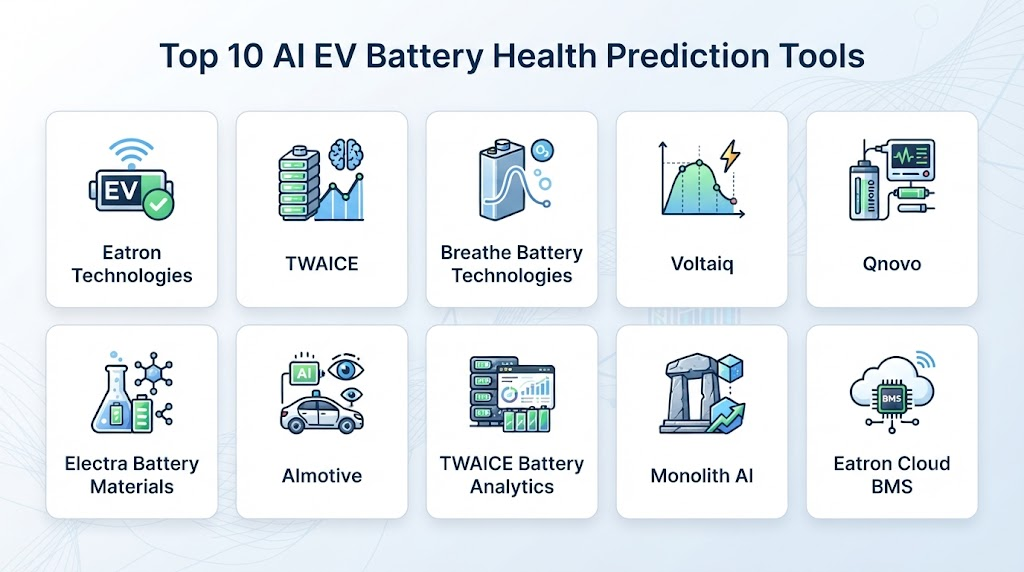
Top 10 AI EV Battery Health Prediction Tools
1 — Eatron Technologies
One-line verdict: Best for automotive organizations developing intelligent battery-management and battery-health prediction capabilities.
Short description:
Eatron Technologies develops software for intelligent battery management, battery analytics, and energy-management applications. Its technology is designed for automotive and battery applications where software can help improve battery performance, longevity, and operational understanding.
Standout Capabilities
- Intelligent battery management
- Battery analytics
- State-of-health estimation
- State-of-charge estimation
- Battery optimization
- Cloud battery intelligence
- Vehicle integration
- Fleet-level analytics
AI-Specific Depth
- Model support: Proprietary battery intelligence and machine-learning technologies; exact model architectures vary.
- RAG / knowledge integration: N/A.
- Evaluation: Battery-model and operational validation; exact methodology varies.
- Guardrails: Battery-management safety constraints and application controls.
- Observability: Battery telemetry and analytics capabilities vary by deployment.
Pros
- Strong automotive focus.
- Designed around intelligent battery-management use cases.
- Suitable for connected EV ecosystems.
Cons
- Primarily enterprise-oriented.
- Implementation can require vehicle and BMS integration.
- Exact model architecture is not publicly stated.
Security & Compliance
Security, privacy, data retention, and access controls vary according to product and customer deployment.
Deployment & Platforms
- Vehicle/edge
- Cloud
- Automotive systems
- Fleet environments
Integrations & Ecosystem
- Battery-management systems
- Vehicle telemetry
- Cloud platforms
- Automotive software
- Battery analytics
- Fleet systems
Pricing Model
Enterprise/custom pricing.
Best-Fit Scenarios
- EV manufacturers
- Intelligent BMS development
- Fleet battery analytics
2 — TWAICE
One-line verdict: Best for battery analytics, degradation modeling, fleet insights, and battery lifecycle management.
Short description:
TWAICE provides battery analytics software designed to help organizations understand battery performance and degradation. Its platform is relevant to automotive companies, battery manufacturers, fleets, and organizations managing battery lifecycle decisions.
Standout Capabilities
- Battery analytics
- Battery degradation analysis
- Battery lifecycle modeling
- Fleet analytics
- Battery performance monitoring
- Predictive insights
- Battery valuation
- Lifecycle management
AI-Specific Depth
- Model support: Proprietary battery analytics and modeling; exact AI architectures vary.
- RAG / knowledge integration: N/A.
- Evaluation: Battery-model validation and empirical data analysis.
- Guardrails: Battery and operational constraints.
- Observability: Battery-performance monitoring and analytics.
Pros
- Strong battery analytics specialization.
- Useful across battery lifecycle stages.
- Relevant to fleet and automotive organizations.
Cons
- Enterprise-focused.
- Requires quality battery data.
- Exact AI architecture is not publicly stated.
Security & Compliance
Specific security, compliance, retention, and access controls vary by deployment.
Deployment & Platforms
- Cloud
- Enterprise
- Fleet analytics environments
Integrations & Ecosystem
- Battery data
- BMS telemetry
- Vehicle fleets
- Battery manufacturers
- Automotive systems
- Analytics platforms
Pricing Model
Enterprise/custom pricing.
Best-Fit Scenarios
- Battery degradation prediction
- Fleet battery monitoring
- Battery lifecycle management
3 — Eatron Cloud BMS
One-line verdict: Best for organizations combining vehicle battery-management software with cloud-based battery intelligence.
Short description:
Eatron’s cloud-oriented battery-management technologies connect battery data with analytics and software intelligence. This approach can help organizations analyze battery behavior beyond what traditional onboard BMS functionality provides.
Standout Capabilities
- Cloud battery management
- Battery analytics
- State-of-health estimation
- Fleet insights
- Battery monitoring
- Software-defined BMS
- Remote analytics
- Battery optimization
AI-Specific Depth
- Model support: Proprietary AI and battery models.
- RAG / knowledge integration: N/A.
- Evaluation: Battery and vehicle telemetry validation.
- Guardrails: Battery safety and operating constraints.
- Observability: Cloud battery monitoring.
Pros
- Connects edge and cloud intelligence.
- Useful for connected EV fleets.
- Strong automotive orientation.
Cons
- Requires significant integration.
- Enterprise-oriented.
- Detailed implementation capabilities vary.
Security & Compliance
Security and privacy controls depend on deployment and customer architecture.
Deployment & Platforms
- Vehicle edge
- Cloud
- Hybrid architectures
Integrations & Ecosystem
- BMS
- Vehicle telemetry
- Cloud infrastructure
- Fleet systems
- Battery analytics
- Automotive software
Pricing Model
Enterprise/custom pricing.
Best-Fit Scenarios
- Connected EVs
- Cloud BMS
- Battery analytics
4 — Voltaiq
One-line verdict: Best for battery organizations analyzing large experimental and operational datasets to understand degradation and performance.
Short description:
Voltaiq provides battery intelligence software for organizations working with battery testing, development, manufacturing, and operational data. It can help teams organize, analyze, and interpret battery behavior across different conditions.
Standout Capabilities
- Battery data analytics
- Battery testing
- Performance analysis
- Degradation analysis
- Data management
- Battery development
- Manufacturing analytics
- Visualization
AI-Specific Depth
- Model support: Analytics and machine-learning capabilities vary.
- RAG / knowledge integration: N/A.
- Evaluation: Battery testing and analytical validation.
- Guardrails: Data and workflow controls.
- Observability: Battery-performance analytics.
Pros
- Strong battery-data focus.
- Useful for R&D teams.
- Supports large battery datasets.
Cons
- More battery-industry oriented than consumer-EV oriented.
- Requires structured battery data.
- Exact AI features vary.
Security & Compliance
Security and administrative features vary by enterprise deployment.
Deployment & Platforms
- Cloud
- Enterprise
- Laboratory and testing environments
Integrations & Ecosystem
- Battery test equipment
- Battery datasets
- Laboratory systems
- Manufacturing systems
- Analytics
- APIs
Pricing Model
Enterprise/custom pricing.
Best-Fit Scenarios
- Battery R&D
- Battery testing
- Degradation analytics
5 — Breathe Battery Technologies
One-line verdict: Best for EV manufacturers seeking software intelligence for battery charging and battery-life optimization.
Short description:
Breathe Battery Technologies develops software focused on improving battery charging and battery performance. Its technologies are particularly relevant to electric vehicles and battery-powered products where charging behavior can affect usability and battery longevity.
Standout Capabilities
- Adaptive charging
- Battery optimization
- Charging intelligence
- Battery longevity
- Charging algorithms
- EV applications
- Battery-management integration
- Software-based optimization
AI-Specific Depth
- Model support: Proprietary algorithms and software; exact model architecture is not publicly stated.
- RAG / knowledge integration: N/A.
- Evaluation: Battery-performance validation.
- Guardrails: Charging and battery operating constraints.
- Observability: Battery and charging metrics vary.
Pros
- Strong charging specialization.
- Relevant to battery longevity.
- Automotive applications.
Cons
- More focused on charging optimization than general fleet health analytics.
- Enterprise integration required.
- Exact AI methodology is not publicly stated.
Security & Compliance
Specific security and compliance information varies by deployment.
Deployment & Platforms
- Vehicle software
- Embedded systems
- Automotive platforms
Integrations & Ecosystem
- EV charging
- BMS
- Automotive software
- Battery systems
- Charging infrastructure
Pricing Model
Enterprise/custom pricing.
Best-Fit Scenarios
- EV charging optimization
- Battery longevity
- Automotive software
6 — AVL Battery Solutions
One-line verdict: Best for automotive engineering teams combining battery testing, simulation, diagnostics, and lifecycle analysis.
Short description:
AVL provides automotive engineering and testing technologies covering battery development, simulation, validation, and vehicle systems. Its broader engineering ecosystem can support battery-health modeling and predictive analytics.
Standout Capabilities
- Battery testing
- Battery simulation
- BMS development
- Battery validation
- Vehicle engineering
- Data analytics
- Battery modeling
- Powertrain development
AI-Specific Depth
- Model support: Engineering models and AI/ML capabilities vary.
- RAG / knowledge integration: N/A.
- Evaluation: Extensive testing and simulation workflows.
- Guardrails: Engineering and safety validation processes.
- Observability: Test and simulation telemetry.
Pros
- Deep automotive engineering expertise.
- Strong testing ecosystem.
- Useful across battery-development stages.
Cons
- Complex for smaller organizations.
- Enterprise-oriented.
- AI capabilities vary by solution.
Security & Compliance
Enterprise security and compliance controls vary by product and deployment.
Deployment & Platforms
- Desktop
- Laboratory
- Cloud
- Automotive engineering environments
Integrations & Ecosystem
- Battery test systems
- Simulation
- BMS
- Vehicle systems
- Engineering software
- Data platforms
Pricing Model
Enterprise/custom pricing.
Best-Fit Scenarios
- Battery engineering
- Automotive R&D
- Battery validation
7 — MATLAB / Simulink
One-line verdict: Best for engineers developing custom battery-health prediction models, simulations, and validated control algorithms.
Short description:
MATLAB and Simulink provide engineering environments for battery modeling, simulation, control design, machine learning, and data analysis. Engineers can use them to develop custom state-of-health and remaining-useful-life prediction systems.
Standout Capabilities
- Battery modeling
- Machine learning
- Signal processing
- Simulation
- State estimation
- Algorithm development
- Control systems
- Model testing
AI-Specific Depth
- Model support: Machine learning and deep-learning frameworks.
- RAG / knowledge integration: N/A.
- Evaluation: Extensive custom model evaluation capabilities.
- Guardrails: Model constraints and engineering validation.
- Observability: Simulation and model-analysis tools.
Pros
- Extremely flexible.
- Strong engineering ecosystem.
- Excellent for custom research and development.
Cons
- Requires technical expertise.
- Licensing costs can be significant.
- Production deployment may require additional engineering.
Security & Compliance
Enterprise security depends on deployment and organizational configuration.
Deployment & Platforms
- Windows
- macOS
- Linux
- Cloud
- Embedded deployment options
Integrations & Ecosystem
- Python
- C/C++
- Simulink
- Embedded systems
- Machine learning
- Battery models
- Test equipment
Pricing Model
Commercial licensing; exact pricing varies.
Best-Fit Scenarios
- Battery research
- Custom SOH prediction
- BMS algorithm development
8 — Ansys
One-line verdict: Best for engineering teams combining battery simulation, multiphysics modeling, AI, and validation workflows.
Short description:
Ansys provides engineering simulation technologies used across automotive and battery development. Its tools can help model thermal, electrical, structural, and electrochemical battery behavior, supporting predictive battery-development workflows.
Standout Capabilities
- Battery simulation
- Thermal modeling
- Multiphysics
- Battery design
- Engineering simulation
- Data analysis
- Reduced-order modeling
- Validation
AI-Specific Depth
- Model support: Engineering simulation and machine-learning capabilities vary.
- RAG / knowledge integration: N/A.
- Evaluation: Simulation and engineering validation.
- Guardrails: Engineering constraints.
- Observability: Simulation metrics and model outputs.
Pros
- Strong multiphysics capabilities.
- Useful for battery engineering.
- Supports simulation-driven development.
Cons
- Complex learning curve.
- Primarily engineering-oriented.
- May require additional systems for fleet-level health prediction.
Security & Compliance
Security and enterprise controls vary by product and deployment.
Deployment & Platforms
- Desktop
- Cloud
- Enterprise
- Engineering environments
Integrations & Ecosystem
- CAD
- Simulation
- Battery models
- HPC
- Engineering data
- APIs
- Automotive systems
Pricing Model
Enterprise/custom commercial licensing.
Best-Fit Scenarios
- Battery engineering
- Thermal analysis
- Simulation-driven development
9 — Monolith AI
One-line verdict: Best for automotive engineering teams applying AI to complex physical-system testing and vehicle development data.
Short description:
Monolith provides machine-learning technologies for engineering and physical-system data. Its approach can help engineering organizations build predictive models from test data, including applications relevant to automotive and battery development.
Standout Capabilities
- Engineering AI
- Test-data analysis
- Predictive modeling
- Machine learning
- Physical-system analytics
- Automated data analysis
- Engineering workflows
- Model development
AI-Specific Depth
- Model support: Machine-learning models designed for engineering datasets.
- RAG / knowledge integration: N/A.
- Evaluation: Engineering-model validation.
- Guardrails: Application-specific.
- Observability: Model and engineering-data analytics.
Pros
- AI-first engineering approach.
- Useful for complex physical systems.
- Can reduce manual analysis.
Cons
- Not exclusively an EV battery platform.
- Battery-specific capabilities depend on implementation.
- Enterprise-oriented.
Security & Compliance
Specific controls vary by deployment.
Deployment & Platforms
- Cloud
- Enterprise
- Engineering environments
Integrations & Ecosystem
- Engineering data
- Test systems
- Simulation
- APIs
- Machine-learning workflows
- Automotive systems
Pricing Model
Enterprise/custom pricing.
Best-Fit Scenarios
- Engineering AI
- Battery testing analytics
- Automotive R&D
10 — Python Battery Analytics Stack
One-line verdict: Best for technical teams building proprietary battery-health prediction pipelines from vehicle and BMS telemetry.
Short description:
A custom Python-based stack can combine machine learning, time-series processing, battery models, databases, and visualization tools. It is not a single commercial product, but it provides maximum flexibility for organizations developing proprietary battery-health prediction systems.
Standout Capabilities
- Custom ML models
- Time-series analysis
- Battery degradation modeling
- Data pipelines
- Feature engineering
- Fleet analytics
- Model experimentation
- Custom deployment
AI-Specific Depth
- Model support: Open-source and proprietary models can be integrated.
- RAG / knowledge integration: N/A.
- Evaluation: Fully customizable.
- Guardrails: Custom safety and validation controls.
- Observability: Custom monitoring and model telemetry.
Pros
- Maximum flexibility.
- No dependence on one commercial battery platform.
- Excellent for proprietary research.
Cons
- Requires significant engineering.
- Maintenance becomes the organization’s responsibility.
- Production validation can be difficult.
Security & Compliance
Entirely dependent on implementation, infrastructure, access controls, and organizational policies.
Deployment & Platforms
- Cloud
- Self-hosted
- Edge
- Windows
- Linux
- macOS
Integrations & Ecosystem
- Python
- PyTorch
- TensorFlow
- Scikit-learn
- Databases
- BMS data
- Cloud platforms
Pricing Model
Open-source software plus infrastructure and engineering costs.
Best-Fit Scenarios
- Proprietary battery analytics
- Research
- Custom fleet-health systems
Comparison Table
| Tool | Best For | Deployment | Model Flexibility | Strength | Watch-Out | Public Rating |
|---|---|---|---|---|---|---|
| Eatron Technologies | Intelligent BMS | Cloud/Edge | Proprietary | Automotive battery intelligence | Enterprise integration | |
| TWAICE | Battery analytics | Cloud | Proprietary | Degradation analytics | Requires quality data | |
| Eatron Cloud BMS | Cloud battery intelligence | Hybrid | Proprietary | Edge + cloud BMS | Integration complexity | |
| Voltaiq | Battery data analytics | Cloud | Proprietary/varies | Battery data | More R&D focused | |
| Breathe Battery Technologies | Charging optimization | Embedded | Proprietary | Battery longevity | Charging-focused | |
| AVL Battery Solutions | Battery engineering | Hybrid | Mixed | Testing + engineering | Complex | |
| MATLAB / Simulink | Custom modeling | Desktop/Cloud | Multi-model | Engineering flexibility | Requires expertise | |
| Ansys | Battery simulation | Desktop/Cloud | Multi-model | Multiphysics | Learning curve | |
| Monolith AI | Engineering AI | Cloud | ML/custom | Test-data intelligence | Not battery-specific | |
| Python Battery Analytics Stack | Custom development | Self-hosted/Cloud | Open/custom | Maximum flexibility | Engineering burden |
Scoring & Evaluation
These scores are comparative assessments rather than official vendor ratings. Battery-health prediction is highly dependent on the quality of telemetry, battery chemistry, operating conditions, model validation, and deployment architecture.
| Tool | Core | Reliability/Eval | Guardrails | Integrations | Ease | Perf/Cost | Security/Admin | Support | Weighted Total |
|---|---|---|---|---|---|---|---|---|---|
| Eatron Technologies | 10 | 9 | 10 | 10 | 8 | 9 | 9 | 10 | 9.35 |
| TWAICE | 10 | 10 | 9 | 9 | 8 | 8 | 9 | 10 | 9.15 |
| Eatron Cloud BMS | 10 | 9 | 10 | 10 | 8 | 9 | 9 | 10 | 9.35 |
| Voltaiq | 9 | 9 | 8 | 9 | 8 | 8 | 9 | 9 | 8.70 |
| Breathe Battery Technologies | 9 | 9 | 10 | 8 | 8 | 9 | 9 | 9 | 8.90 |
| AVL Battery Solutions | 10 | 10 | 10 | 10 | 7 | 8 | 9 | 10 | 9.45 |
| MATLAB / Simulink | 10 | 10 | 10 | 10 | 7 | 7 | 9 | 10 | 9.25 |
| Ansys | 10 | 10 | 10 | 10 | 7 | 7 | 9 | 10 | 9.25 |
| Monolith AI | 8 | 9 | 8 | 8 | 8 | 8 | 9 | 9 | 8.40 |
| Python Battery Analytics Stack | 10 | 9 | 10 | 10 | 5 | 10 | 7 | 8 | 8.70 |
Top 3 for Enterprise
- AVL Battery Solutions
- Eatron Technologies
- TWAICE
Top 3 for SMB
- TWAICE
- Voltaiq
- MATLAB / Simulink
Top 3 for Developers
- Python Battery Analytics Stack
- MATLAB / Simulink
- Ansys
Which AI EV Battery Health Prediction Tool Is Right for You?
Solo / Freelancer
For individual researchers or developers, a complete commercial battery platform may be excessive.
A custom Python environment or MATLAB / Simulink can provide a flexible foundation for experimenting with:
- SOH prediction
- Battery degradation
- Time-series models
- Remaining useful life
- Charging behavior
- Temperature effects
SMB
Smaller battery companies and fleet operators should prioritize platforms that reduce the amount of infrastructure they must build themselves.
Look for:
- Easy data ingestion
- Battery dashboards
- Historical analysis
- Degradation analytics
- APIs
- Fleet-level comparisons
- Simple reporting
Mid-Market
Mid-market organizations should establish a standardized battery-health data pipeline.
A practical architecture is:
BMS Telemetry → Data Pipeline → Feature Engineering → Health Model → Confidence Score → Dashboard → Maintenance Decision
The organization should also maintain battery-chemistry and vehicle-specific model versions.
Enterprise
Large EV manufacturers and fleet operators need a more comprehensive architecture.
Important capabilities include:
- Cell-level analysis
- Pack-level SOH
- Real-time telemetry
- Cloud analytics
- Edge inference
- Fleet comparison
- Predictive maintenance
- Warranty analytics
- Model monitoring
- Battery lifecycle analysis
- Data governance
Regulated Industries
Battery-health predictions can influence safety, warranties, insurance, and financial decisions.
Organizations should therefore maintain:
- Model versioning
- Data lineage
- Prediction confidence
- Audit logs
- Access controls
- Data retention
- Validation records
- Incident-management procedures
Budget vs Premium
Open-source development can be inexpensive from a licensing perspective but requires engineering investment.
Premium platforms can be more economical when an organization needs:
- Ready-made battery analytics
- Fleet monitoring
- Technical support
- Enterprise integration
- Battery lifecycle modeling
- Production deployment
Build vs Buy
Build when battery intelligence is a strategic differentiator and the company owns substantial vehicle or BMS datasets.
Buy when the goal is to quickly establish battery monitoring without building a complete analytics platform.
A hybrid approach is often effective: use a commercial battery analytics platform for baseline health estimates while developing proprietary models for specific battery chemistries or vehicle platforms.
Implementation Playbook
30 Days: Pilot + Success Metrics
- Define the battery-health prediction objective.
- Identify available BMS signals.
- Collect historical battery data.
- Identify battery chemistry and pack configuration.
- Establish baseline SOH calculations.
- Define degradation indicators.
- Build a small prediction model.
- Establish validation datasets.
- Define acceptable prediction error.
Useful metrics include:
- SOH prediction error
- Remaining-useful-life error
- Early-warning accuracy
- False-positive rate
- False-negative rate
- Prediction latency
- Battery coverage
60 Days: Harden Security + Evaluation + Rollout
- Add more vehicles and battery packs.
- Test different temperature conditions.
- Evaluate fast-charging behavior.
- Test different driving patterns.
- Validate across battery ages.
- Compare multiple model architectures.
- Establish model version control.
- Add automated regression testing.
- Implement access controls.
- Create battery-data lineage.
90 Days: Optimize Cost + Latency + Governance
- Deploy models closer to vehicles where appropriate.
- Optimize cloud-processing costs.
- Automate battery-health alerts.
- Introduce model-drift monitoring.
- Add fleet-level benchmarking.
- Connect predictions to maintenance workflows.
- Develop warranty analytics.
- Establish governance procedures.
- Automate model retraining where appropriate.
- Continuously validate predictions against measured battery behavior.
Common Mistakes & How to Avoid Them
- Using insufficient battery data: Health prediction requires meaningful historical information.
- Ignoring temperature: Thermal conditions strongly affect battery behavior.
- Treating all batteries the same: Chemistry, pack design, age, and usage differ.
- Ignoring fast charging: Charging behavior can influence degradation patterns.
- Using only laboratory data: Real-world operation can differ significantly from controlled testing.
- Skipping model validation: A prediction model should be tested against independent data.
- Ignoring uncertainty: Battery-health predictions should communicate confidence where possible.
- Overfitting fleet data: A model that works on one vehicle population may not generalize.
- Ignoring battery-management-system changes: Firmware and calibration changes can affect telemetry.
- Failing to monitor model drift: Battery populations and usage patterns change over time.
- Ignoring cell-level behavior: Pack-level averages can hide individual cell problems.
- Treating AI predictions as safety guarantees: Predictive models should complement appropriate battery safety systems.
- Ignoring data privacy: Vehicle telemetry can contain sensitive operational information.
- Building without an operational workflow: A prediction is useful only when someone can act on it.
FAQs
What is EV battery health prediction?
It is the process of estimating battery condition and degradation using measurements such as voltage, current, temperature, charging history, and operating behavior.
What does battery state of health mean?
State of health generally describes how the current condition or usable capacity of a battery compares with an appropriate reference condition. Exact definitions can vary by system.
Can AI predict battery degradation?
Yes. Machine-learning and hybrid physics-plus-ML approaches can identify patterns associated with battery degradation when sufficient quality data is available.
What data is needed for battery-health prediction?
Common inputs include voltage, current, temperature, state of charge, charging history, discharge cycles, energy throughput, and historical battery-health measurements.
Can AI predict remaining battery life?
It can estimate remaining useful life, but accuracy depends strongly on battery chemistry, data quality, operating conditions, and the prediction horizon.
Can battery health be predicted in real time?
Yes. Models can run in cloud systems or, where appropriate, closer to the vehicle. The required architecture depends on latency and data availability.
Can battery-health prediction detect faulty cells?
Some systems can identify abnormal behavior that may indicate cell-level issues. The reliability of such detection depends on sensor coverage, battery architecture, and model validation.
Does fast charging affect battery health?
Fast charging can be an important variable in battery degradation analysis. Its actual effect depends on battery chemistry, charging conditions, temperature, charging strategy, and other factors.
Can battery-health models work across different EV models?
Not automatically. Differences in battery chemistry, pack architecture, BMS behavior, sensors, and operating conditions can require model adaptation or validation.
Is a physics-based model better than AI?
Neither is universally superior. Physics-based models can provide useful structure and interpretability, while machine learning can identify complex patterns from real-world data. Hybrid approaches can combine both.
Can small companies build their own battery-health model?
Yes, provided they have sufficient battery telemetry, engineering expertise, and appropriate validation data. The main challenge is achieving reliable performance across different operating conditions.
Is self-hosting possible?
Yes. Custom battery-health systems can be deployed on private infrastructure, edge devices, or cloud environments. Commercial platform deployment options vary.
How much does EV battery-health software cost?
There is no universal price. Commercial platforms generally use enterprise or customized pricing, while custom systems involve software, infrastructure, data, and engineering costs.
Can battery-health prediction improve fleet maintenance?
Yes. Fleet operators can use health predictions to identify vehicles that may need inspection, maintenance, or battery-related attention before performance problems become more significant.
How should an AI battery model be evaluated?
Use independent test data and measure prediction error, early-warning performance, robustness across temperatures and battery ages, false alarms, and generalization across vehicle populations.
Conclusion
AI EV Battery Health Prediction is becoming an important part of modern electric-vehicle software because battery condition affects vehicle range, maintenance, warranty exposure, residual value, charging behavior, and long-term operating costs.Eatron Technologies, TWAICE, and AVL Battery Solutions are particularly relevant to enterprise automotive and battery organizations. MATLAB / Simulink and Ansys provide strong engineering environments for teams developing custom battery models, while a Python-based battery analytics stack can provide maximum flexibility for organizations with strong internal development capabilities.The strongest architecture typically connects:There is no universal best tool. The right choice depends on battery chemistry, vehicle architecture, telemetry availability, fleet size, prediction requirements, engineering resources, and whether the organization wants a ready-made platform or a proprietary battery-intelligence system.