Introduction
AI Driver Monitoring Systems use cameras, computer vision, machine learning, and sensor data to understand a driver’s attention, alertness, and behavior while operating a vehicle. These systems can detect conditions such as distraction, drowsiness, prolonged eye closure, gaze deviation, unusual head position, and other signs that may indicate reduced driving attention.
They are increasingly important for modern vehicles because advanced driver-assistance features require drivers to remain appropriately engaged. AI driver monitoring can support safer handoffs between automated and human driving, fleet safety programs, commercial transportation, and connected-vehicle systems.
Common use cases include driver drowsiness detection, distracted-driving detection, hands-off detection, driver identification, occupant monitoring, ADAS supervision, fleet safety, and automated-driving handover man Automotive manufacturers, commercial fleets, trucking companies, mobility providers, insurance-related telematics programs, autonomous-driving developers, and organizations managing driver safet Small fleets that only need basic GPS tracking, organizations without suitable vehicle hardware, or use cases where privacy restrictions prevent camera-based monitoring.
What’s Changed in AI Driver Monitoring Systems
- Computer vision models are becoming better at distinguishing genuine driver distraction from normal head and eye movements.
- Systems increasingly combine facial, gaze, head-position, steering, vehicle, and contextual signals.
- Driver monitoring is becoming more closely integrated with advanced driver-assistance systems.
- AI can increasingly distinguish between different distraction states rather than simply detecting whether a driver is looking forward.
- Drowsiness detection is moving toward continuous risk estimation instead of relying on a single alert threshold.
- Multimodal sensing can improve performance when camera visibility is affected by lighting, sunglasses, masks, or driver position.
- Edge AI is increasingly important because safety-critical monitoring requires low latency.
- Processing information locally can reduce the amount of sensitive facial data transmitted to cloud systems.
- Driver monitoring is becoming more important for vehicles with increasingly automated driving capabilities.
- Fleet operators are using driver-monitoring insights alongside telematics and vehicle-event data.
- Privacy, consent, data retention, and biometric-data governance are becoming major procurement considerations.
- False positives are receiving more attention because excessive alerts can cause driver frustration and alert fatigue.
- AI models need evaluation across different demographics, lighting conditions, vehicle interiors, and driving environments.
- Automotive cybersecurity is increasingly important because driver-monitoring systems are connected to vehicle software architectures.
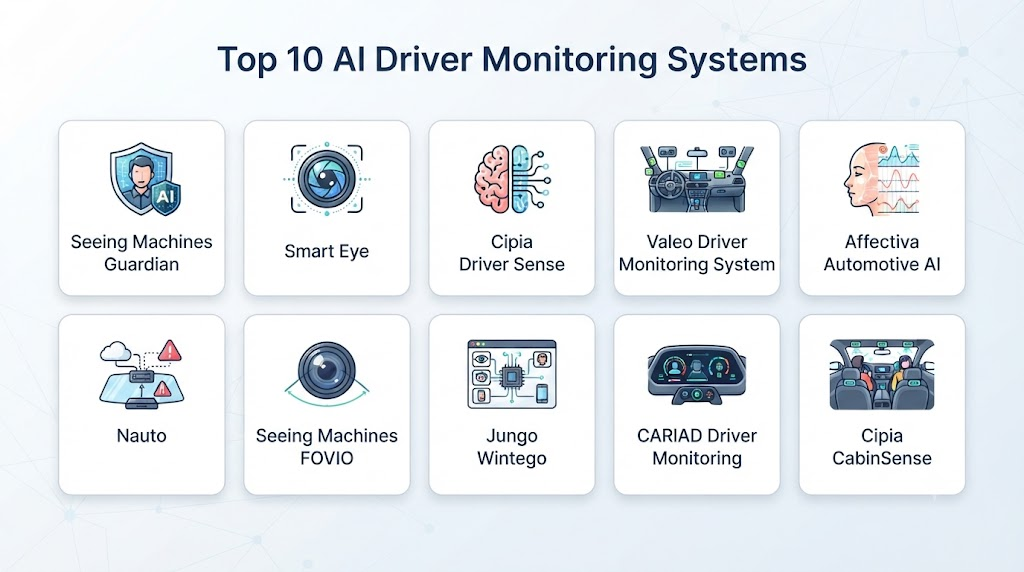
Top 10 AI Driver Monitoring Systems
1 — Smart Eye
One-line verdict: Best for automotive manufacturers developing sophisticated driver and interior-monitoring systems for advanced vehicle platforms.
Short description:
Smart Eye develops AI-based driver monitoring and interior-sensing technologies for automotive applications. Its technology is designed to analyze driver attention and related in-cabin conditions using computer vision and AI.
Standout Capabilities
- Driver monitoring
- Eye tracking
- Gaze estimation
- Drowsiness detection
- Distraction detection
- Interior sensing
- Automotive integration
- ADAS support
AI-Specific Depth
- Model support: Proprietary computer-vision and AI technologies.
- RAG / knowledge integration: N/A.
- Evaluation: Automotive-system testing and validation; exact evaluation methodology varies.
- Guardrails: Safety-oriented decision logic and system constraints vary by implementation.
- Observability: Vehicle and system-level monitoring varies by deployment.
Pros
- Strong automotive specialization.
- Deep expertise in eye and gaze tracking.
- Suitable for advanced driver-monitoring applications.
Cons
- Primarily enterprise and automotive-focused.
- Integration requires automotive engineering expertise.
- Commercial implementation details vary by customer.
Security & Compliance
Security architecture, privacy controls, certifications, data retention, and access management should be verified for the specific deployment.
Deployment & Platforms
- Deployment: Embedded/edge automotive systems.
- Web: Supporting tools vary.
- Self-hosted: Automotive embedded deployment.
- Cloud: Varies by application.
- Mobile: N/A for primary automotive deployment.
Integrations & Ecosystem
Smart Eye technologies can be integrated into automotive sensing and vehicle-computing architectures.
- Vehicle cameras
- ADAS systems
- Automotive ECUs
- Interior sensing
- Vehicle networks
- Development SDKs
- Automotive software platforms
Pricing Model
Enterprise/custom pricing; exact pricing is not publicly standardized.
Best-Fit Scenarios
- Passenger vehicles
- Advanced driver monitoring
- Automotive OEM programs
2 — Seeing Machines
One-line verdict: Best for commercial fleets, transportation companies, and automotive programs requiring continuous driver attention monitoring.
Short description:
Seeing Machines develops computer-vision technology for monitoring driver attention, fatigue, distraction, and related behaviors. Its technology is used across automotive and commercial transportation applications.
Standout Capabilities
- Fatigue monitoring
- Distraction detection
- Driver attention monitoring
- Eye tracking
- Head-pose analysis
- Fleet safety
- Automotive integration
- Real-time alerts
AI-Specific Depth
- Model support: Proprietary computer vision and machine learning.
- RAG / knowledge integration: N/A.
- Evaluation: Safety and driver-monitoring validation varies by application.
- Guardrails: Alert logic and intervention policies can be configured according to deployment.
- Observability: Fleet and driver analytics vary by solution.
Pros
- Strong fatigue-monitoring expertise.
- Suitable for commercial transportation.
- Long-standing specialization in driver monitoring.
Cons
- Primarily enterprise-focused.
- Hardware and installation requirements vary.
- Fleet deployments require careful privacy management.
Security & Compliance
Security, privacy, access control, data retention, and certifications should be verified for the particular product and deployment.
Deployment & Platforms
- Deployment: Edge/vehicle and cloud-connected systems.
- Web: Fleet-management interfaces vary.
- Self-hosted: Varies.
- Hybrid: Possible depending on deployment.
Integrations & Ecosystem
- Fleet-management systems
- Vehicle cameras
- Telematics
- ADAS
- Automotive platforms
- APIs
- Driver-safety systems
Pricing Model
Enterprise/custom pricing.
Best-Fit Scenarios
- Trucking fleets
- Commercial transportation
- Automotive OEM programs
3 — Cipia
One-line verdict: Best for automotive manufacturers seeking embedded AI for driver and occupant monitoring inside production vehicles.
Short description:
Cipia develops computer-vision solutions for in-cabin sensing, including driver monitoring and occupant monitoring. Its technology is designed for integration into automotive vehicle platforms.
Standout Capabilities
- Driver monitoring
- Drowsiness detection
- Distraction detection
- Occupant monitoring
- Gaze estimation
- Facial analysis
- Embedded computer vision
- Automotive integration
AI-Specific Depth
- Model support: Proprietary edge AI/computer-vision models.
- RAG / knowledge integration: N/A.
- Evaluation: Automotive validation varies by deployment.
- Guardrails: Safety and alerting logic varies by OEM integration.
- Observability: Embedded system monitoring varies.
Pros
- Designed specifically for automotive environments.
- Supports both driver and occupant monitoring.
- Edge-oriented deployment can support low latency.
Cons
- Primarily targeted at automotive OEMs.
- Requires integration into vehicle hardware/software.
- Public implementation details vary by program.
Security & Compliance
Security, privacy, certifications, and data-handling practices should be evaluated for each OEM deployment.
Deployment & Platforms
- Deployment: Embedded/edge.
- Cloud: Optional depending on architecture.
- Web: N/A for core embedded functionality.
- Self-hosted: Embedded automotive deployment.
Integrations & Ecosystem
- Automotive cameras
- ADAS
- Vehicle computing platforms
- Infotainment systems
- ECUs
- Automotive SDKs
- In-cabin sensing systems
Pricing Model
Enterprise/custom pricing.
Best-Fit Scenarios
- Production vehicles
- Driver monitoring
- Occupant monitoring
4 — Nauto
One-line verdict: Best for commercial fleets seeking AI-powered driver safety analytics and proactive collision-risk reduction.
Short description:
Nauto provides AI-based fleet safety technology that analyzes driving behavior and vehicle events. Its platform is designed to help fleet operators identify risky driving patterns and improve driver safety.
Standout Capabilities
- Driver monitoring
- Collision-risk detection
- Distracted-driving detection
- Fleet analytics
- Video intelligence
- Driver coaching
- Risk scoring
- Event detection
AI-Specific Depth
- Model support: Proprietary AI and computer vision.
- RAG / knowledge integration: N/A.
- Evaluation: Operational and safety metrics vary by implementation.
- Guardrails: Alert and coaching rules can be configured.
- Observability: Fleet dashboards and event analytics.
Pros
- Strong fleet-management orientation.
- Combines video intelligence with driver behavior.
- Useful for safety programs and coaching.
Cons
- Requires vehicle hardware.
- Primarily aimed at commercial fleets.
- Privacy policies need careful review.
Security & Compliance
Security, encryption, access control, data retention, and compliance details should be verified against the current enterprise offering.
Deployment & Platforms
- Deployment: Vehicle edge + cloud.
- Web: Supported.
- Mobile: Varies.
- Self-hosted: Not publicly stated.
- Hybrid: Varies.
Integrations & Ecosystem
- Fleet-management systems
- Cameras
- Telematics
- GPS
- Safety platforms
- APIs
- Vehicle systems
Pricing Model
Subscription/enterprise pricing; exact pricing varies.
Best-Fit Scenarios
- Commercial fleets
- Driver coaching
- Fleet safety management
5 — MiX by Powerfleet
One-line verdict: Best for organizations combining AI driver monitoring with broader fleet telematics and vehicle-management workflows.
Short description:
MiX provides fleet-management and telematics capabilities, including technologies that can support driver behavior, safety, vehicle monitoring, and operational analytics.
Standout Capabilities
- Fleet telematics
- Driver behavior analysis
- Safety monitoring
- Vehicle tracking
- Video telematics
- Fleet analytics
- Driver coaching
- Operational management
AI-Specific Depth
- Model support: AI and analytics capabilities vary by product.
- RAG / knowledge integration: N/A.
- Evaluation: Operational analytics and safety evaluation vary.
- Guardrails: Driver-alert and fleet policies vary.
- Observability: Fleet dashboards and event monitoring.
Pros
- Broad fleet-management capabilities.
- Useful beyond driver monitoring alone.
- Integrates vehicle and driver data.
Cons
- Driver monitoring is part of a broader ecosystem.
- Features vary by package and market.
- Hardware integration may be required.
Security & Compliance
Security and compliance capabilities should be verified for the selected product and deployment.
Deployment & Platforms
- Deployment: Cloud + vehicle hardware.
- Web: Supported.
- Mobile: Supported depending on product.
- Self-hosted: Varies.
Integrations & Ecosystem
- GPS
- Telematics
- Cameras
- Fleet-management software
- Vehicle systems
- APIs
- Reporting platforms
Pricing Model
Subscription/enterprise pricing.
Best-Fit Scenarios
- Large fleets
- Fleet safety programs
- Integrated telematics
6 — Samsara
One-line verdict: Best for fleets wanting driver monitoring integrated with video telematics, vehicle data, and broader operational management.
Short description:
Samsara provides connected-operations technology for fleets, including video-based safety and driver behavior capabilities. Its platform combines vehicle, camera, and operational data.
Standout Capabilities
- Video telematics
- Driver safety
- Distracted-driving detection
- Fleet management
- Vehicle tracking
- Safety workflows
- Driver coaching
- Operational analytics
AI-Specific Depth
- Model support: Proprietary AI/computer vision capabilities.
- RAG / knowledge integration: N/A.
- Evaluation: Safety-event and model performance monitoring vary.
- Guardrails: Configurable safety policies and workflows.
- Observability: Fleet dashboards, events, and operational analytics.
Pros
- Broad connected-fleet ecosystem.
- Strong video and telematics integration.
- Useful for centralized fleet operations.
Cons
- More than a driver-monitoring system, which may increase complexity.
- Requires compatible hardware.
- Subscription costs depend on fleet requirements.
Security & Compliance
Enterprise security, privacy, administrative controls, and data-handling practices should be reviewed against the current offering.
Deployment & Platforms
- Deployment: Cloud + vehicle hardware.
- Web: Supported.
- Mobile: Supported.
- Self-hosted: Not publicly stated.
Integrations & Ecosystem
- Fleet telematics
- Cameras
- GPS
- Vehicle sensors
- Maintenance systems
- APIs
- Fleet-management software
Pricing Model
Subscription-based enterprise pricing; exact pricing varies.
Best-Fit Scenarios
- Commercial fleets
- Video telematics
- Integrated fleet operations
7 — Lytx
One-line verdict: Best for commercial fleets seeking AI-powered video safety, driver behavior analysis, and risk-management workflows.
Short description:
Lytx provides video-based driver safety technology using AI and computer vision to identify risky driving behavior and support fleet safety programs.
Standout Capabilities
- Driver behavior detection
- Video analytics
- Risk identification
- Driver coaching
- Fleet safety
- Event review
- Telematics
- Safety analytics
AI-Specific Depth
- Model support: Proprietary computer vision and machine learning.
- RAG / knowledge integration: N/A.
- Evaluation: Safety and operational performance metrics vary.
- Guardrails: Safety workflows and review processes provide human oversight.
- Observability: Event and fleet safety analytics.
Pros
- Strong fleet safety specialization.
- Extensive video-based analysis.
- Useful for driver coaching.
Cons
- Enterprise-oriented.
- Hardware deployment is generally required.
- AI detections should be validated for the specific operating environment.
Security & Compliance
Security and data-governance controls should be verified according to the selected service.
Deployment & Platforms
- Deployment: Vehicle edge + cloud.
- Web: Supported.
- Mobile: Varies.
- Self-hosted: Not publicly stated.
Integrations & Ecosystem
- Cameras
- Telematics
- Fleet systems
- Driver-management systems
- APIs
- Safety workflows
Pricing Model
Subscription/enterprise pricing.
Best-Fit Scenarios
- Fleet safety
- Driver coaching
- Video-based risk management
8 — Tobii
One-line verdict: Best for organizations requiring advanced eye tracking and gaze-analysis technologies for driver monitoring applications.
Short description:
Tobii develops eye-tracking and attention-sensing technologies that can support automotive and human-machine interaction applications. Its eye-tracking expertise is particularly relevant to gaze and attention analysis.
Standout Capabilities
- Eye tracking
- Gaze estimation
- Attention analysis
- Human-machine interaction
- Computer vision
- Automotive sensing
- Research tools
- Developer technologies
AI-Specific Depth
- Model support: Proprietary eye-tracking and computer-vision technologies.
- RAG / knowledge integration: N/A.
- Evaluation: Eye-tracking accuracy and application-specific validation.
- Guardrails: Application-dependent.
- Observability: Analytics vary by implementation.
Pros
- Deep eye-tracking expertise.
- Useful for research and advanced sensing.
- Strong technology ecosystem.
Cons
- Not exclusively a fleet-management platform.
- Automotive deployment may require engineering work.
- Application-specific integration is required.
Security & Compliance
Security, privacy, and data-processing requirements depend on the application and deployment.
Deployment & Platforms
- Deployment: Hardware/edge/software.
- Web: Varies.
- Windows: Supported for relevant developer products.
- Self-hosted: Varies.
- Cloud: Product-dependent.
Integrations & Ecosystem
- Eye-tracking hardware
- SDKs
- Automotive systems
- Computer-vision platforms
- Research software
- APIs
- Developer tools
Pricing Model
Product and enterprise pricing varies.
Best-Fit Scenarios
- Eye-tracking applications
- Driver-attention research
- Automotive sensing
9 — Bosch
One-line verdict: Best for automotive manufacturers seeking driver monitoring integrated into broader vehicle safety and electronics architectures.
Short description:
Bosch develops automotive technologies spanning vehicle electronics, sensors, safety systems, and software. Its broader automotive portfolio makes it relevant for integrated driver-monitoring deployments.
Standout Capabilities
- Driver monitoring
- Vehicle safety
- Computer vision
- Automotive sensors
- ADAS integration
- Vehicle electronics
- Embedded software
- Interior sensing
AI-Specific Depth
- Model support: Proprietary AI and automotive software technologies.
- RAG / knowledge integration: N/A.
- Evaluation: Automotive validation varies by system.
- Guardrails: Safety-system constraints vary by implementation.
- Observability: Vehicle-level diagnostics and monitoring vary.
Pros
- Broad automotive engineering expertise.
- Strong vehicle-system integration potential.
- Suitable for large OEM programs.
Cons
- Primarily enterprise/OEM focused.
- Complex procurement and integration.
- Specific driver-monitoring functionality varies by solution.
Security & Compliance
Security and automotive compliance requirements should be verified for the specific product.
Deployment & Platforms
- Deployment: Embedded automotive.
- Cloud: Product-dependent.
- Web: Supporting applications vary.
- Self-hosted: Automotive deployment.
Integrations & Ecosystem
- Automotive ECUs
- Cameras
- ADAS
- Vehicle networks
- Sensors
- Embedded software
- Automotive platforms
Pricing Model
Enterprise/custom pricing.
Best-Fit Scenarios
- Automotive OEMs
- Integrated safety systems
- Advanced vehicle platforms
10 — Valeo
One-line verdict: Best for automotive manufacturers integrating driver monitoring with ADAS, cabin sensing, and broader vehicle technology.
Short description:
Valeo develops automotive technologies across ADAS, sensors, vehicle electronics, and cabin systems. Driver-monitoring capabilities can form part of broader vehicle sensing and safety architectures.
Standout Capabilities
- Driver monitoring
- Interior sensing
- ADAS
- Computer vision
- Vehicle sensors
- Cabin technologies
- Embedded systems
- Automotive electronics
AI-Specific Depth
- Model support: Proprietary AI/computer-vision technologies.
- RAG / knowledge integration: N/A.
- Evaluation: Automotive validation varies by application.
- Guardrails: Safety constraints vary by vehicle implementation.
- Observability: Vehicle diagnostics vary.
Pros
- Broad automotive technology portfolio.
- Strong ADAS integration potential.
- Suitable for production-vehicle programs.
Cons
- Primarily OEM-focused.
- Specific functionality depends on vehicle program.
- Enterprise integration can be complex.
Security & Compliance
Security, privacy, automotive compliance, and certification details should be confirmed for the relevant product.
Deployment & Platforms
- Deployment: Embedded automotive.
- Cloud: Varies.
- Web: N/A for core functionality.
- Self-hosted: Embedded deployment.
Integrations & Ecosystem
- ADAS
- Automotive cameras
- Vehicle ECUs
- Cabin sensors
- Automotive software
- Vehicle networks
- Embedded systems
Pricing Model
Enterprise/custom pricing.
Best-Fit Scenarios
- Automotive OEM programs
- ADAS integration
- Cabin sensing
Comparison Table
| Tool | Best For | Deployment | Model Flexibility | Strength | Watch-Out | Public Rating |
|---|---|---|---|---|---|---|
| Smart Eye | Automotive driver monitoring | Edge/Embedded | Proprietary | Eye and attention tracking | OEM integration | N/A |
| Seeing Machines | Commercial and automotive monitoring | Edge + Cloud | Proprietary | Fatigue monitoring | Enterprise deployment | N/A |
| Cipia | Automotive cabin sensing | Embedded/Edge | Proprietary | Driver + occupant monitoring | OEM focus | N/A |
| Nauto | Fleet safety | Edge + Cloud | Proprietary AI | Risk detection | Hardware requirement | N/A |
| MiX by Powerfleet | Fleet telematics | Cloud + Hardware | AI/Analytics | Integrated fleet management | Broad platform scope | N/A |
| Samsara | Connected fleets | Cloud + Hardware | Proprietary AI | Video telematics | Platform complexity | N/A |
| Lytx | Fleet safety | Edge + Cloud | Proprietary AI | Video safety analytics | Enterprise focus | N/A |
| Tobii | Eye tracking | Hardware/Edge | Proprietary | Gaze analysis | Requires integration | N/A |
| Bosch | Automotive OEMs | Embedded | Proprietary | Vehicle integration | Complex deployment | N/A |
| Valeo | ADAS and cabin sensing | Embedded | Proprietary | Automotive integration | OEM-oriented | N/A |
Scoring & Evaluation
The following scores are comparative editorial assessments rather than official vendor ratings. A high score does not mean that a platform will perform equally well in every vehicle, camera configuration, fleet, or operating environment.
| Tool | Core | Reliability/Eval | Guardrails | Integrations | Ease | Perf/Cost | Security/Admin | Support | Weighted Total |
|---|---|---|---|---|---|---|---|---|---|
| Smart Eye | 10 | 10 | 9 | 10 | 8 | 9 | 9 | 9 | 9.35 |
| Seeing Machines | 10 | 10 | 9 | 10 | 8 | 9 | 9 | 10 | 9.40 |
| Cipia | 9 | 9 | 9 | 10 | 8 | 9 | 9 | 9 | 9.05 |
| Nauto | 9 | 9 | 9 | 9 | 9 | 8 | 9 | 9 | 8.95 |
| MiX by Powerfleet | 9 | 8 | 8 | 10 | 8 | 8 | 9 | 9 | 8.70 |
| Samsara | 9 | 9 | 9 | 10 | 9 | 8 | 9 | 10 | 9.10 |
| Lytx | 9 | 9 | 9 | 9 | 8 | 8 | 9 | 10 | 8.95 |
| Tobii | 8 | 10 | 8 | 9 | 8 | 8 | 8 | 9 | 8.55 |
| Bosch | 10 | 10 | 10 | 10 | 7 | 9 | 10 | 10 | 9.55 |
| Valeo | 10 | 10 | 10 | 10 | 7 | 9 | 10 | 10 | 9.55 |
Top 3 for Enterprise
- Bosch
- Valeo
- Seeing Machines
Top 3 for SMB
- Nauto
- Samsara
- MiX by Powerfleet
Top 3 for Developers
- Tobii
- Smart Eye
- Cipia
Which AI Driver Monitoring System Is Right for You?
Solo / Freelancer
Individual developers and researchers rarely need an enterprise fleet platform.
An eye-tracking SDK, computer-vision framework, or development kit may be more appropriate for experimentation.
Prioritize:
- Camera access
- SDK availability
- Real-time inference
- Documentation
- Local processing
- Data privacy
- Model flexibility
SMB
Small fleets should prioritize simplicity.
Look for:
- Plug-and-play hardware
- Driver-risk alerts
- Video events
- Simple dashboards
- Fleet analytics
- Straightforward deployment
- Predictable subscription costs
A complete automotive-grade DMS may be unnecessary if the goal is simply improving commercial-driver safety.
Mid-Market
Mid-sized fleets should combine driver monitoring with telematics.
The ideal architecture connects:
Camera → AI Detection → Risk Event → Fleet Dashboard → Driver Coaching → Safety Analytics
This creates a continuous improvement loop rather than simply generating alerts.
Enterprise
Large fleets and automotive manufacturers require deeper capabilities.
Prioritize:
- Edge AI
- Low latency
- High reliability
- Large-scale deployment
- ADAS integration
- Fleet APIs
- Data governance
- Model monitoring
- Cybersecurity
- Privacy controls
- OTA updates
- Human escalation workflows
Regulated Industries
Driver-monitoring data can be sensitive, particularly when facial or biometric information is involved.
Organizations should assess:
- Consent requirements
- Data minimization
- Retention policies
- Regional privacy regulations
- Employee monitoring requirements
- Access controls
- Data residency
- Encryption
- Auditability
Budget vs Premium
Budget-oriented fleets should focus on essential safety detections such as distraction, phone use, and drowsiness.
Premium automotive systems may justify additional investment when they must integrate with ADAS, automated-driving functions, vehicle electronics, and advanced cabin sensing.
Build vs Buy
Build when you have specialized computer-vision expertise and need a highly customized research or automotive system.
Buy when safety validation, deployment scale, vehicle integration, and vendor support are more important than owning the entire AI stack.
A hybrid approach can work well: purchase camera hardware and foundational sensing technology while developing proprietary risk-scoring or fleet analytics.
Implementation Playbook
30 Days: Pilot + Success Metrics
- Select representative vehicles.
- Define safety objectives.
- Identify target behaviors.
- Install compatible cameras.
- Establish privacy requirements.
- Test lighting conditions.
- Test different driver positions.
- Establish baseline alert rates.
- Measure false positives.
- Measure false negatives.
- Create initial driver-feedback workflows.
Important metrics include:
- Drowsiness detection accuracy
- Distraction detection accuracy
- False-alert rate
- Detection latency
- Driver acceptance
- System uptime
- Camera availability
60 Days: Harden Security + Evaluation + Rollout
- Test nighttime conditions.
- Test bright sunlight.
- Test sunglasses and partial occlusion.
- Evaluate different driver demographics.
- Test different vehicle cabins.
- Validate alert thresholds.
- Establish data-retention policies.
- Configure administrative access.
- Conduct security testing.
- Create incident-handling procedures.
- Establish model-performance monitoring.
90 Days: Optimize Cost + Latency + Governance
- Optimize edge inference.
- Reduce unnecessary cloud processing.
- Improve camera placement.
- Tune alert thresholds.
- Monitor model drift.
- Review driver feedback.
- Establish governance processes.
- Expand the pilot fleet.
- Integrate telematics.
- Connect safety events with coaching workflows.
Common Mistakes & How to Avoid Them
- Treating driver monitoring as simple face detection: Attention requires multiple signals and contextual interpretation.
- Ignoring false positives: Excessive alerts can lead drivers to ignore legitimate warnings.
- Using only one detection signal: Combine gaze, eye closure, head pose, and contextual vehicle information where appropriate.
- Ignoring camera placement: Poor placement can significantly affect detection performance.
- Failing to test difficult lighting: Night driving and direct sunlight can challenge computer vision.
- Ignoring sunglasses and occlusion: The system should be tested under realistic conditions.
- Sending all video to the cloud: Edge processing can reduce latency and unnecessary data transfer.
- Keeping sensitive footage indefinitely: Establish clear retention and deletion policies.
- Ignoring demographic performance: Evaluate models across relevant populations.
- Over-alerting drivers: Alerts should be meaningful and appropriately prioritized.
- Connecting DMS directly to vehicle control without adequate validation: Safety-critical actions require rigorous engineering and validation.
- Failing to monitor model drift: Vehicle interiors, cameras, software, and driving environments can change.
- Ignoring cybersecurity: Connected cameras and vehicle systems can become attack surfaces.
- Using driver monitoring primarily for punishment: Safety-focused coaching can produce better organizational outcomes than purely punitive workflows.
FAQs
What is an AI driver monitoring system?
It is an AI-powered system that uses cameras and computer vision to assess driver attention, alertness, gaze, head position, and potentially other safety-related behaviors.
How does AI detect driver drowsiness?
Systems can analyze signals such as prolonged eye closure, blinking patterns, gaze behavior, head position, and other indicators. Exact algorithms vary between providers.
Can driver monitoring detect distracted driving?
Yes. Systems can identify behaviors such as prolonged gaze away from the road, phone-related activity, or other attention-diverting behaviors depending on their capabilities.
Does driver monitoring require a camera?
Most modern vision-based systems require an in-cabin camera. Other vehicle signals can complement camera information, but the architecture varies.
Can AI driver monitoring work at night?
Many systems are designed to operate in changing lighting conditions, but performance depends on camera hardware, infrared capability, cabin conditions, and implementation.
Can these systems detect phone use?
Some systems can detect phone-related driver behavior, but exact capabilities vary by vendor and camera configuration.
Is driver-monitoring data private?
It depends on the system architecture and deployment. Organizations should examine what data is collected, where it is processed, how long it is retained, and who can access it.
Can driver-monitoring AI run on the vehicle?
Yes. Edge processing is common in automotive applications because it can provide low latency and reduce the need to transmit raw camera data.
Can driver monitoring integrate with ADAS?
Yes. Driver monitoring can provide information about driver attention that may be relevant when an advanced driving-assistance system requires driver engagement.
Can AI replace human driver-safety managers?
No. AI can automate detection and prioritization, but safety teams remain important for coaching, investigation, policy, and exceptional situations.
What is the difference between driver monitoring and fleet telematics?
Driver monitoring focuses primarily on the driver’s behavior and attention. Telematics generally focuses on vehicle location, movement, diagnostics, and operational data.
Can a driver monitoring system be used for autonomous vehicles?
Yes. Driver monitoring can be particularly important in vehicles where automated-driving functions require the human driver to remain ready to take control.
How should a DMS be evaluated?
Evaluate accuracy, false-positive rates, latency, robustness to lighting and occlusion, demographic performance, privacy, cybersecurity, integration capabilities, and real-world driver acceptance.
Does AI driver monitoring work with glasses?
Performance varies. Systems should be tested with normal glasses, sunglasses, different frames, and other realistic forms of facial occlusion.
How expensive are AI driver monitoring systems?
Pricing varies significantly depending on whether the solution is automotive OEM technology, fleet hardware, software, cloud analytics, or a managed service.
Can small businesses use AI driver monitoring?
Yes. Commercial fleet platforms can provide driver-monitoring capabilities without requiring the business to build its own computer-vision system.
Conclusion
AI Driver Monitoring Systems are becoming an important component of modern vehicle safety. Their value extends beyond detecting tired drivers: advanced systems can analyze attention, distraction, gaze, head position, and other contextual signals while integrating with vehicle, fleet, and ADAS systems.For automotive manufacturers, Smart Eye, Seeing Machines, Cipia, Bosch, and Valeo are particularly relevant to embedded vehicle applications. For commercial fleets, Nauto, Samsara, Lytx, and MiX by Powerfleet provide broader driver-safety and telematics capabilities. Tobii is particularly relevant when advanced eye-tracking capabilities are a core requirement.The best system depends on the environment. A trucking company needs different capabilities from an automotive OEM developing an automated-driving platform. In every case, buyers should evaluate real-world detection performance, false alerts, latency, privacy, cybersecurity, integration, and driver acceptance rather than selecting a system based only on advertised AI capabilities.