Introduction
AI Energy Trading Optimization Systems use artificial intelligence, machine learning, forecasting, optimization, and market analytics to help energy companies make better trading and scheduling decisions. These systems can analyze electricity prices, renewable generation, demand, weather, grid conditions, storage availability, and market signals to identify profitable or lower-risk operating strategies.
Common applications include electricity trading, battery optimization, renewable power trading, demand forecasting, portfolio optimization, virtual power plants, ancillary-services bidding, congestion management, and automated trading Utilities, renewable-energy developers, battery operators, energy retailers, independent power producers, aggregators, trading desks, and large commercial energy consum Small organizations with simple fixed-price energy contracts, companies without sufficient market or operational data, or businesses that do not actively participate in wholesale or flexible energy markets.
What’s Changed in AI Energy Trading Optimization
- AI forecasting is increasingly combining weather, demand, renewable generation, market prices, and grid conditions.
- Battery storage is becoming a major optimization target as operators participate in multiple electricity-market products.
- AI agents can increasingly support workflows involving forecasting, bidding, scheduling, and market monitoring.
- Multi-market optimization can evaluate energy, capacity, balancing, and ancillary-service opportunities together.
- Machine learning models are being combined with mathematical optimization rather than used as standalone predictors.
- Probabilistic forecasting is becoming more important because electricity prices and renewable generation are highly uncertain.
- Real-time optimization is increasingly important as renewable penetration and market volatility increase.
- AI systems can help identify relationships between weather conditions and price volatility.
- Automated decision-support systems increasingly include human approval workflows for high-impact trading decisions.
- Model monitoring is becoming essential as market structures, regulations, generation mixes, and participant behavior change.
- Explainability is increasingly important for traders who need to understand why an algorithm recommends a particular position.
- Data quality and latency can directly affect trading performance.
- Cybersecurity is becoming increasingly important as optimization systems interact with trading platforms, energy-management systems, and operational technology.
- Organizations are increasingly looking for model portability, API access, and reduced dependence on a single AI provider.
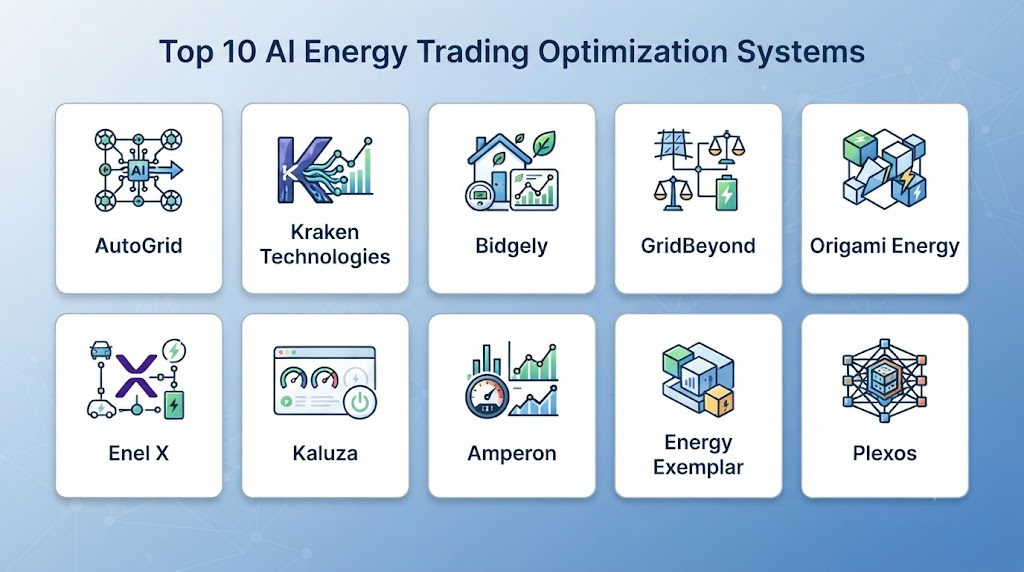
Top 10 AI Energy Trading Optimization Systems
1 — Kraken Technologies
One-line verdict: Best for energy retailers and utilities seeking AI-driven forecasting, flexibility, optimization, and intelligent energy-market operations.
Short description:
Kraken Technologies provides software for energy companies covering customer operations, energy management, flexibility, and utility workflows. Its technology is particularly relevant to organizations operating complex energy portfolios.
Standout Capabilities
- Energy portfolio management
- Demand forecasting
- Flexible-energy management
- Renewable-energy workflows
- Customer energy optimization
- Utility operations
- Automation
- Energy-market integration
AI-Specific Depth
- Model support: Proprietary AI and machine-learning capabilities; exact model architecture is not publicly stated.
- RAG / knowledge integration: N/A.
- Evaluation: Model evaluation varies by application.
- Guardrails: Operational and administrative controls vary by deployment.
- Observability: Operational analytics and performance monitoring vary by product.
Pros
- Strong energy-sector specialization.
- Suitable for complex utility operations.
- Broad platform capabilities beyond pure trading.
Cons
- Primarily oriented toward energy companies rather than individual traders.
- Enterprise implementation can be complex.
- Exact AI architecture is not publicly stated.
Security & Compliance
Enterprise security, access control, data retention, encryption, and certifications should be verified for the specific deployment.
Deployment & Platforms
- Deployment: Cloud/enterprise.
- Web: Supported.
- Self-hosted: Not publicly stated.
- Hybrid: Varies.
- Mobile: Varies by application.
Integrations & Ecosystem
Kraken is designed around energy-sector workflows and can integrate with operational, customer, market, and energy-management systems.
- Energy-management systems
- Utility systems
- Customer platforms
- Market data
- APIs
- Flexibility resources
- Operational databases
Pricing Model
Enterprise/custom pricing; exact pricing is not publicly standardized.
Best-Fit Scenarios
- Utility energy optimization
- Flexible-energy management
- Large energy-retail operations
2 — AutoGrid
One-line verdict: Best for utilities and aggregators optimizing distributed energy resources across increasingly complex electricity markets.
Short description:
AutoGrid provides flexibility and distributed-energy-resource management technology. Its capabilities are relevant to utilities and aggregators managing batteries, solar, demand response, electric vehicles, and other flexible resources.
Standout Capabilities
- Distributed energy resource optimization
- Demand response
- Battery optimization
- Renewable integration
- Virtual power plants
- Flexibility management
- Forecasting
- Grid optimization
AI-Specific Depth
- Model support: Machine-learning and optimization technologies; exact model architecture varies.
- RAG / knowledge integration: N/A.
- Evaluation: Forecast and optimization performance can be assessed through operational outcomes.
- Guardrails: Operational constraints can be incorporated into optimization.
- Observability: Monitoring and analytics vary by implementation.
Pros
- Strong distributed-energy focus.
- Useful for virtual power plants.
- Supports multiple flexible resources.
Cons
- More focused on DER optimization than conventional trading alone.
- Requires integration with energy assets.
- Market capabilities depend on deployment and region.
Security & Compliance
Security controls, certifications, data retention, and access-management capabilities should be verified for the specific implementation.
Deployment & Platforms
- Deployment: Cloud/enterprise.
- Web: Supported.
- Self-hosted: Varies / N/A.
- Hybrid: Varies.
Integrations & Ecosystem
- Batteries
- Solar systems
- EV infrastructure
- Smart meters
- Demand-response systems
- Grid platforms
- APIs
Pricing Model
Enterprise/custom pricing; exact pricing is not publicly standardized.
Best-Fit Scenarios
- Virtual power plants
- Demand-response optimization
- Distributed-energy portfolios
3 — KrakenFlex
One-line verdict: Best for organizations optimizing flexible energy assets such as batteries, EVs, and distributed generation.
Short description:
KrakenFlex focuses on flexibility and optimization across energy assets. It can support organizations seeking to coordinate batteries, electric vehicles, renewable generation, and other flexible resources.
Standout Capabilities
- Battery optimization
- Renewable optimization
- Flexible-energy management
- EV optimization
- Market participation
- Portfolio management
- Forecasting
- Automated optimization
AI-Specific Depth
- Model support: Proprietary optimization and AI capabilities; exact architecture is not publicly stated.
- RAG / knowledge integration: N/A.
- Evaluation: Varies by optimization workflow.
- Guardrails: Operational constraints and trading controls vary.
- Observability: Portfolio and asset analytics.
Pros
- Strong focus on flexibility.
- Useful for storage-heavy portfolios.
- Relevant to evolving energy markets.
Cons
- Most valuable when significant flexible assets are available.
- Requires market and asset integration.
- Detailed model architecture is not publicly stated.
Security & Compliance
Specific security and compliance controls should be verified for the relevant enterprise deployment.
Deployment & Platforms
- Deployment: Cloud.
- Web: Supported.
- Self-hosted: Not publicly stated.
- Hybrid: Varies.
Integrations & Ecosystem
- Batteries
- EVs
- Renewable assets
- Market platforms
- Energy-management systems
- APIs
- Grid systems
Pricing Model
Enterprise/custom pricing; exact pricing is not publicly standardized.
Best-Fit Scenarios
- Battery trading
- EV flexibility
- Renewable-energy optimization
4 — Piclo
One-line verdict: Best for flexibility-market participants connecting distributed energy resources with grid and market opportunities.
Short description:
Piclo provides flexibility-market infrastructure connecting energy-system participants with flexibility opportunities. Its platform is particularly relevant to organizations participating in distributed flexibility markets.
Standout Capabilities
- Flexibility-market management
- DER participation
- Market matching
- Grid flexibility
- Procurement workflows
- Distributed-resource management
- Market analytics
- Flexibility planning
AI-Specific Depth
- Model support: Analytics and optimization capabilities vary; exact AI architecture is not publicly stated.
- RAG / knowledge integration: N/A.
- Evaluation: Varies / N/A.
- Guardrails: Market and operational constraints depend on implementation.
- Observability: Market analytics and reporting.
Pros
- Strong flexibility-market orientation.
- Useful for distributed-energy participants.
- Supports market-based flexibility procurement.
Cons
- Not a traditional proprietary trading platform.
- Market availability varies by geography.
- AI-specific capabilities may not be the primary product focus.
Security & Compliance
Security and compliance details should be verified for the relevant service and market.
Deployment & Platforms
- Deployment: Cloud.
- Web: Supported.
- Self-hosted: Not publicly stated.
- Hybrid: Varies.
Integrations & Ecosystem
- Distribution networks
- DER platforms
- Flexibility providers
- Market systems
- APIs
- Energy-management platforms
Pricing Model
Market/enterprise pricing varies by offering.
Best-Fit Scenarios
- Flexibility markets
- DER aggregation
- Grid-service participation
5 — GridBeyond
One-line verdict: Best for commercial energy users and flexible assets seeking automated energy-market optimization and demand-side participation.
Short description:
GridBeyond provides technology for energy management, flexibility, and market participation. It can help businesses optimize flexible consumption and assets against energy-market conditions.
Standout Capabilities
- Energy optimization
- Demand response
- Flexible load management
- Energy-market participation
- Battery optimization
- Renewable integration
- Forecasting
- Automated decision support
AI-Specific Depth
- Model support: AI and optimization technologies; exact architecture is not publicly stated.
- RAG / knowledge integration: N/A.
- Evaluation: Performance evaluation varies by use case.
- Guardrails: Operational constraints and business rules can be incorporated.
- Observability: Energy and market analytics vary by implementation.
Pros
- Strong commercial-energy focus.
- Useful for flexible demand.
- Connects operational assets with market opportunities.
Cons
- Primarily useful where flexibility is available.
- Market opportunities vary by geography.
- Exact model architecture is not publicly stated.
Security & Compliance
Security and compliance details should be verified for the applicable product and deployment.
Deployment & Platforms
- Deployment: Cloud/enterprise.
- Web: Supported.
- Self-hosted: Not publicly stated.
- Hybrid: Varies.
Integrations & Ecosystem
- Industrial energy systems
- Batteries
- Energy meters
- Market data
- Renewable assets
- Energy-management systems
- APIs
Pricing Model
Enterprise/custom pricing; exact pricing varies.
Best-Fit Scenarios
- Industrial energy optimization
- Demand-side flexibility
- Battery market participation
6 — Next Kraftwerke
One-line verdict: Best for virtual power plant operators coordinating renewable and flexible energy assets for market participation.
Short description:
Next Kraftwerke operates in the virtual power plant and energy-trading ecosystem, coordinating distributed generation and flexible assets for electricity-market participation.
Standout Capabilities
- Virtual power plants
- Renewable integration
- Energy trading
- Asset aggregation
- Dispatch optimization
- Market participation
- Flexibility management
- Grid services
AI-Specific Depth
- Model support: Optimization and forecasting technologies; exact AI architecture is not publicly stated.
- RAG / knowledge integration: N/A.
- Evaluation: Operational performance and forecasting evaluation vary.
- Guardrails: Grid and asset constraints are part of operational optimization.
- Observability: Asset and portfolio monitoring.
Pros
- Strong VPP expertise.
- Suitable for distributed renewable portfolios.
- Integrates asset operation with market participation.
Cons
- Geographic and market availability matters.
- Better suited to substantial energy portfolios.
- AI-specific capabilities are not fully publicly detailed.
Security & Compliance
Specific security, compliance, and certification information should be confirmed for the relevant service.
Deployment & Platforms
- Deployment: Cloud/enterprise.
- Web: Supported.
- Self-hosted: Not publicly stated.
- Hybrid: Varies.
Integrations & Ecosystem
- Renewable generators
- Batteries
- Grid systems
- Trading systems
- Market data
- VPP infrastructure
- APIs
Pricing Model
Enterprise/custom commercial model; exact pricing is not publicly standardized.
Best-Fit Scenarios
- Virtual power plants
- Renewable trading
- Distributed-energy aggregation
7 — Flexitricity
One-line verdict: Best for businesses and flexible assets participating in demand-response and balancing-market opportunities.
Short description:
Flexitricity focuses on flexibility and demand-side energy-market participation. It can help organizations monetize flexible electricity consumption and generation.
Standout Capabilities
- Demand response
- Flexibility management
- Balancing-market participation
- Asset aggregation
- Energy optimization
- Load management
- Market access
- Automated flexibility
AI-Specific Depth
- Model support: Optimization and forecasting technologies; exact AI architecture is not publicly stated.
- RAG / knowledge integration: N/A.
- Evaluation: Varies / N/A.
- Guardrails: Operational constraints and market requirements apply.
- Observability: Energy and flexibility monitoring.
Pros
- Strong flexibility-market expertise.
- Useful for commercial and industrial assets.
- Can monetize demand flexibility.
Cons
- Market participation depends on geography.
- Requires flexible energy resources.
- Not designed primarily as a generic trading workstation.
Security & Compliance
Security and compliance details should be verified for the relevant implementation.
Deployment & Platforms
- Deployment: Cloud/managed service.
- Web: Supported.
- Self-hosted: Not publicly stated.
- Hybrid: Varies.
Integrations & Ecosystem
- Industrial controls
- Energy meters
- Generation assets
- Demand-response systems
- Market platforms
- APIs
Pricing Model
Commercial/managed-service model; exact pricing varies.
Best-Fit Scenarios
- Industrial flexibility
- Demand response
- Balancing-market participation
8 — Energy Exemplar
One-line verdict: Best for sophisticated energy-market simulation, scenario analysis, and optimization before making major trading or investment decisions.
Short description:
Energy Exemplar provides energy-market modeling and simulation software used to analyze electricity systems, markets, assets, and scenarios. Its tools are especially relevant to organizations that need detailed market simulation.
Standout Capabilities
- Energy-market simulation
- Power-system modeling
- Scenario analysis
- Market forecasting
- Generation planning
- Portfolio analysis
- Optimization
- Risk assessment
AI-Specific Depth
- Model support: Mathematical optimization and analytical models; AI/ML capabilities vary.
- RAG / knowledge integration: N/A.
- Evaluation: Extensive scenario and model analysis capabilities.
- Guardrails: Model constraints and assumptions.
- Observability: Simulation results and scenario analytics.
Pros
- Deep energy-market modeling capabilities.
- Useful for complex scenario analysis.
- Supports strategic energy decisions.
Cons
- Requires specialized expertise.
- Can have a substantial learning curve.
- More modeling-oriented than automated trading.
Security & Compliance
Security and enterprise administration should be verified for the specific deployment.
Deployment & Platforms
- Deployment: Cloud/desktop/enterprise depending on product.
- Web: Varies.
- Self-hosted: Varies.
- Hybrid: Varies.
Integrations & Ecosystem
- Market datasets
- Grid models
- Energy assets
- Forecasting systems
- APIs
- Enterprise analytics
- Simulation workflows
Pricing Model
Enterprise licensing; exact pricing is not publicly standardized.
Best-Fit Scenarios
- Energy-market simulation
- Trading strategy analysis
- Long-term energy planning
9 — Aurora Energy Research
One-line verdict: Best for energy-market participants requiring forecasts, market intelligence, scenarios, and investment-oriented analytics.
Short description:
Aurora Energy Research provides energy-market analytics, forecasts, scenarios, and research for companies operating across electricity and energy markets.
Standout Capabilities
- Electricity-market forecasts
- Energy scenarios
- Market analytics
- Renewable-energy analysis
- Investment analysis
- Policy analysis
- Market intelligence
- Scenario modeling
AI-Specific Depth
- Model support: Proprietary energy-market models; exact AI architecture is not publicly stated.
- RAG / knowledge integration: N/A.
- Evaluation: Forecast methodologies vary.
- Guardrails: Analytical governance varies.
- Observability: Market analytics and scenario reporting.
Pros
- Strong energy-market intelligence.
- Useful for strategic decisions.
- Broad coverage of energy-market developments.
Cons
- More analytics and research oriented than automated trading execution.
- Advanced users may require complementary trading infrastructure.
- Exact AI capabilities are not publicly stated.
Security & Compliance
Specific security and compliance capabilities should be confirmed for the applicable offering.
Deployment & Platforms
- Deployment: Cloud.
- Web: Supported.
- API: Varies.
- Self-hosted: Not publicly stated.
- Hybrid: Varies.
Integrations & Ecosystem
- Energy-market data
- Forecasting systems
- Scenario models
- Investment analytics
- Enterprise reporting
- APIs
Pricing Model
Enterprise subscription/custom pricing.
Best-Fit Scenarios
- Energy-market forecasting
- Investment analysis
- Strategic trading research
10 — Pexapark
One-line verdict: Best for renewable-energy market participants managing power-price exposure and commercial optimization.
Short description:
Pexapark focuses on renewable-energy markets, power-price intelligence, and commercial optimization. Its tools are particularly relevant to renewable generators and energy-market participants managing merchant exposure.
Standout Capabilities
- Renewable-energy market analysis
- Power-price analytics
- PPA intelligence
- Market forecasting
- Renewable portfolio analysis
- Price-risk assessment
- Commercial optimization
- Market intelligence
AI-Specific Depth
- Model support: Proprietary analytical and forecasting models; exact AI architecture is not publicly stated.
- RAG / knowledge integration: N/A.
- Evaluation: Forecast methodology varies.
- Guardrails: Business and market constraints vary by implementation.
- Observability: Market and price analytics.
Pros
- Strong renewable-energy specialization.
- Useful for price-risk decisions.
- Relevant to renewable portfolio management.
Cons
- More specialized toward renewable-energy markets.
- Not a complete replacement for a trading execution platform.
- Exact AI capabilities are not publicly stated.
Security & Compliance
Security, access control, retention, and compliance capabilities should be verified for the specific service.
Deployment & Platforms
- Deployment: Cloud.
- Web: Supported.
- Self-hosted: Not publicly stated.
- Hybrid: Varies.
Integrations & Ecosystem
- Renewable portfolios
- Market data
- PPA workflows
- Price analytics
- Trading systems
- APIs
- Enterprise reporting
Pricing Model
Enterprise subscription/custom pricing; exact prices are not publicly standardized.
Best-Fit Scenarios
- Renewable portfolio management
- PPA analysis
- Power-price risk assessment
Comparison Table
| Tool | Best For | Deployment | Model Flexibility | Strength | Watch-Out | Public Rating |
|---|---|---|---|---|---|---|
| Kraken Technologies | Utilities and energy retailers | Cloud | Proprietary/Integrated | Energy operations | Enterprise complexity | N/A |
| AutoGrid | DER and VPP optimization | Cloud | Proprietary/ML | Distributed flexibility | Integration effort | N/A |
| KrakenFlex | Flexible asset optimization | Cloud | Proprietary/ML | Battery and flexibility optimization | Asset requirements | N/A |
| Piclo | Flexibility markets | Cloud | Analytics/Optimization | Market infrastructure | Geographic coverage | N/A |
| GridBeyond | Commercial energy flexibility | Cloud | AI/Optimization | Demand-side optimization | Market dependence | N/A |
| Next Kraftwerke | Virtual power plants | Cloud/Enterprise | Optimization/ML | Renewable aggregation | Market availability | N/A |
| Flexitricity | Demand response | Cloud/Managed | Optimization/Analytics | Flexibility markets | Regional limitations | N/A |
| Energy Exemplar | Market simulation | Cloud/Desktop/Enterprise | Optimization/Modeling | Market simulation | Learning curve | N/A |
| Aurora Energy Research | Market intelligence | Cloud | Proprietary/Analytics | Forecasting and scenarios | Limited execution focus | N/A |
| Pexapark | Renewable trading analysis | Cloud | Proprietary/Analytics | Renewable price intelligence | Specialized scope | N/A |
Scoring & Evaluation
The scores below are comparative editorial assessments, not official vendor scores. They should be treated as a starting point for procurement rather than proof of trading performance.
| Tool | Core | Reliability/Eval | Guardrails | Integrations | Ease | Perf/Cost | Security/Admin | Support | Weighted Total |
|---|---|---|---|---|---|---|---|---|---|
| Kraken Technologies | 9 | 8 | 9 | 10 | 8 | 8 | 9 | 9 | 8.80 |
| AutoGrid | 9 | 9 | 9 | 10 | 8 | 8 | 9 | 9 | 8.95 |
| KrakenFlex | 9 | 9 | 9 | 9 | 8 | 9 | 9 | 9 | 8.95 |
| Piclo | 8 | 8 | 8 | 9 | 9 | 8 | 8 | 9 | 8.35 |
| GridBeyond | 9 | 9 | 9 | 9 | 8 | 9 | 9 | 9 | 8.90 |
| Next Kraftwerke | 9 | 9 | 9 | 9 | 8 | 8 | 9 | 9 | 8.80 |
| Flexitricity | 8 | 8 | 8 | 8 | 9 | 9 | 8 | 9 | 8.35 |
| Energy Exemplar | 10 | 10 | 9 | 9 | 7 | 8 | 9 | 10 | 9.05 |
| Aurora Energy Research | 9 | 9 | 8 | 9 | 9 | 8 | 9 | 10 | 8.95 |
| Pexapark | 8 | 8 | 8 | 8 | 9 | 9 | 8 | 9 | 8.35 |
Top 3 for Enterprise
- Energy Exemplar
- AutoGrid
- KrakenFlex
Top 3 for SMB
- GridBeyond
- Flexitricity
- Pexapark
Top 3 for Developers
- Energy Exemplar
- AutoGrid
- KrakenFlex
Which AI Energy Trading Optimization System Is Right for You?
Solo / Freelancer
Most individual energy traders or consultants do not need a complete enterprise optimization platform.
A practical stack may consist of market-data feeds, Python-based forecasting, optimization libraries, historical datasets, and specialized market-analysis tools.
The priority should be backtesting, forecast quality, data latency, and transparent assumptions.
SMB
Smaller energy companies should prioritize managed solutions rather than building complex trading infrastructure internally.
Look for:
- Simple onboarding
- Market access
- Automated forecasting
- Flexible asset optimization
- Transparent reporting
- Integration with meters and energy systems
- Predictable operating costs
Mid-Market
Mid-market companies should look for platforms that connect forecasting with actual operational decisions.
A good architecture should support:
Forecast → Optimize → Simulate → Approve → Bid → Monitor → Evaluate
This allows organizations to automate repetitive decisions while retaining human oversight.
Enterprise
Large energy companies need deeper integration.
Prioritize:
- Multi-market support
- Portfolio optimization
- Real-time data
- High availability
- APIs
- Model monitoring
- Trading controls
- Audit trails
- RBAC
- Human approval workflows
- Cybersecurity
- Disaster recovery
Regulated Industries
Energy trading operates within highly regulated market environments. Organizations should validate:
- Market-specific compliance
- Trading authorization
- Auditability
- Data lineage
- Model governance
- Access controls
- Change management
- Incident response
- Automated-decision controls
AI should support traders rather than create uncontrolled decision-making pathways.
Budget vs Premium
Budget solutions can work when the organization has a limited number of assets and markets.
Premium platforms become more attractive when there are:
- Large renewable portfolios
- Battery fleets
- Multiple market products
- High-frequency decisions
- Complex bidding constraints
- Significant price exposure
Build vs Buy
Build when your organization has a strong quantitative team, proprietary market data, specialized optimization requirements, and the engineering resources to maintain trading infrastructure.
Buy when speed, reliability, market connectivity, vendor support, and validated energy-market functionality are more important.
A hybrid approach is often practical: use commercial forecasting and market-data services while maintaining proprietary optimization logic.
Implementation Playbook
30 Days: Pilot + Success Metrics
- Identify target markets.
- Define trading objectives.
- Select representative assets.
- Collect historical prices.
- Collect demand and generation data.
- Integrate weather information.
- Establish baseline forecasts.
- Define optimization constraints.
- Build a backtesting environment.
- Establish human approval rules.
Measure:
- Forecast error
- Optimization improvement
- Trading opportunity detection
- Data latency
- Decision latency
- Constraint violations
- Operational reliability
60 Days: Harden Security + Evaluation + Rollout
- Validate forecasting models.
- Test different market conditions.
- Run historical backtests.
- Stress-test extreme price events.
- Test renewable-generation uncertainty.
- Validate battery constraints.
- Implement access controls.
- Create model/version management.
- Establish trading audit trails.
- Conduct cybersecurity testing.
- Add human-in-the-loop approvals.
90 Days: Optimize Cost + Latency + Governance
- Optimize model inference.
- Improve data pipelines.
- Reduce unnecessary model calls.
- Automate forecast retraining where appropriate.
- Monitor model drift.
- Monitor trading performance.
- Establish incident procedures.
- Review automated bidding limits.
- Create executive dashboards.
- Expand asset and market coverage.
Common Mistakes & How to Avoid Them
- Optimizing only for forecast accuracy: A better forecast does not automatically produce better trading results.
- Ignoring transaction and operational constraints: Theoretical opportunities may not be executable.
- Using historical backtests incorrectly: Avoid data leakage and unrealistic assumptions.
- Ignoring extreme market events: Test unusual price and supply conditions.
- Automating every trading decision: Keep humans involved where financial or operational consequences are significant.
- Ignoring data latency: Delayed market information can undermine real-time optimization.
- Using poor-quality weather forecasts: Renewable trading depends heavily on weather inputs.
- Ignoring battery degradation: Storage optimization should account for operational constraints and asset economics.
- Failing to monitor model drift: Market behavior changes over time.
- Ignoring market-rule changes: Trading algorithms need to adapt to regulatory and market-design changes.
- Poor integration with operational systems: Trading recommendations are useless if they cannot be executed reliably.
- No cost controls: Frequent AI inference and optimization can create unexpected infrastructure costs.
- Insufficient cybersecurity: Trading systems can become high-value targets.
- Excessive vendor lock-in: Maintain abstraction around market data, forecasting, and optimization components where practical.
FAQs
What are AI energy trading optimization systems?
They are software systems that use AI, forecasting, analytics, and optimization to help energy companies make better trading, bidding, scheduling, and asset-management decisions.
Can AI automatically trade electricity?
Some systems can support automated or highly automated decisions, but the level of automation depends on the market, system architecture, risk controls, and regulatory requirements.
What data does an AI energy trading system need?
Common inputs include electricity prices, demand, renewable generation, weather, asset availability, market rules, storage status, and historical trading information.
Can these systems optimize batteries?
Yes. Battery optimization is an important application because batteries can potentially participate in energy, balancing, and other flexibility markets.
Can AI predict electricity prices accurately?
AI can improve forecasting, but electricity prices remain difficult to predict because they depend on weather, demand, outages, fuel prices, market behavior, transmission constraints, and other variables.
Do these systems support renewable energy?
Yes. Renewable forecasting and optimization are important applications, particularly for wind and solar portfolios.
Can AI optimize multiple electricity markets?
Some platforms can evaluate multiple market opportunities, but market coverage varies by provider and geography.
Can organizations use their own AI models?
It depends on the platform. Some systems provide APIs or extensibility, while others primarily use proprietary models.
Can energy trading platforms be self-hosted?
Deployment options vary. Many commercial platforms are cloud-based or managed services, while some enterprise solutions may support other deployment architectures.
How important is backtesting?
Extremely important. Historical backtesting can reveal whether a strategy would have performed under different market conditions, although it cannot guarantee future results.
What is human-in-the-loop trading?
It means the AI generates forecasts or recommendations while an authorized person reviews and approves important actions before execution.
How should AI trading models be evaluated?
Evaluate forecasting accuracy, trading performance, risk-adjusted returns, constraint compliance, robustness, latency, data quality, and performance during unusual market conditions.
Are AI energy trading platforms expensive?
Pricing varies substantially. Enterprise solutions are generally customized based on markets, assets, users, integrations, data, and required services.
Can small energy companies use these systems?
Yes. Managed energy-optimization services can be more practical for smaller companies than building proprietary trading infrastructure.
What is the difference between forecasting and optimization?
Forecasting estimates what may happen, such as future electricity prices. Optimization determines what action should be taken based on those forecasts and operational constraints.
Can AI replace energy traders?
AI can automate analysis and repetitive workflows, but human expertise remains important for strategy, risk management, market interpretation, and exceptional events.
What is the biggest challenge when deploying AI for energy trading?
The biggest challenge is usually not the AI model itself. Reliable deployment requires high-quality real-time data, market connectivity, operational constraints, governance, cybersecurity, and rigorous evaluation.
Conclusion
AI Energy Trading Optimization Systems are becoming increasingly important as electricity markets become more dynamic, renewable generation expands, battery storage grows, and flexible energy resources become more valuable.The right solution depends heavily on the organization. Energy Exemplar is particularly relevant for sophisticated market simulation and optimization, while AutoGrid and KrakenFlex are strong choices for distributed and flexible energy resources. GridBeyond and Flexitricity are relevant to demand-side flexibility, while Aurora Energy Research and Pexapark provide valuable market and renewable-energy intelligence.The best platform is not necessarily the one with the most advanced AI model. It is the one that combines reliable forecasting, robust optimization, market connectivity, operational constraints, security, governance, and measurable business