Introduction
AI Red Teaming Platforms are specialized tools that allow organizations to rigorously test, probe, and stress their AI systems—particularly large language models (LLMs) and multimodal AI—by simulating adversarial attacks. They help uncover vulnerabilities, biases, reliability issues, and unintended behaviors before AI models are deployed at scale. These platforms are crucial for enterprises seeking safe, compliant, and robust AI operations.
Why it matters :
- Identify Vulnerabilities Early: Expose weaknesses in AI prompts, instructions, and outputs before deployment.
- Mitigate Misuse Risks: Prevent AI exploitation, hallucinations, or malicious outputs from reaching end-users.
- Ensure Regulatory Compliance: Supports internal governance and external AI regulatory requirements.
- Validate Model Robustness: Confirms AI behaves reliably under adversarial, unexpected, or edge-case scenarios.
- Enable Safe AI Deployment: Reduces operational, reputational, and legal risks for enterprises.
- Support Multimodal Workflows: Test AI across text, code, images, and other input modalities.
- Enhance Trust & Transparency: Provides stakeholders with confidence in AI safety and fairness.
Real-world use cases:
- Banks stress-testing AI credit scoring and fraud detection models against adversarial inputs.
- Healthcare providers validating diagnostic and triage AI for reliability and safety.
- SaaS companies stress-testing AI chatbots, virtual assistants, and agentic workflows.
- Security teams probing generative AI for prompt-injection vulnerabilities.
- R&D teams evaluating AI agent behavior under complex adversarial conditions.
Evaluation criteria for buyers:
- Coverage of AI modalities (text, code, images, audio).
- Adversarial testing and scenario simulation capabilities.
- Guardrails and prompt injection defense mechanisms.
- Integration with ML pipelines and CI/CD workflows.
- Evaluation and regression testing for model robustness.
- Audit logging and compliance reporting.
- Observability dashboards with token usage, latency, and performance metrics.
- Deployment flexibility: cloud, hybrid, or on-premise.
- Cost efficiency and scalability.
- Vendor support and reliability.
Best for: AI engineers, security teams, compliance officers, enterprises deploying mission-critical AI, and R&D teams.
Not ideal for: Small experimental AI projects, hobbyist deployments, or internal-only low-risk AI systems.
What’s Changed in AI Red Teaming Platforms
- Automated adversarial attack simulation for LLMs and multimodal AI.
- Integrated evaluation for hallucinations, bias, and reliability.
- Real-time guardrails and prompt injection detection.
- Enterprise privacy controls: data residency, retention, and masking.
- Cost and latency optimization with model routing and parallel evaluation.
- Observability dashboards with token usage, latency, and performance metrics.
- Multimodal red teaming (text, image, code, audio).
- Integration with CI/CD pipelines, RAG frameworks, and ML platforms.
- Automated compliance reporting and governance dashboards.
- Threat modeling and scenario generation for AI agents.
- Support for iterative red teaming and continuous model validation.
Quick Buyer Checklist
- Guardrails and prompt injection defenses.
- Support for multimodal AI testing.
- Adversarial scenario simulation and automated testing.
- Integration with ML workflows, RAG frameworks, and pipelines.
- Observability: token/cost metrics, traces, latency.
- Audit logs and administrative controls.
- Deployment options: cloud, hybrid, on-premise.
- Regression testing and human-in-loop evaluation.
- Cost optimization for large-scale red teaming.
- Vendor reliability and risk of lock-in.
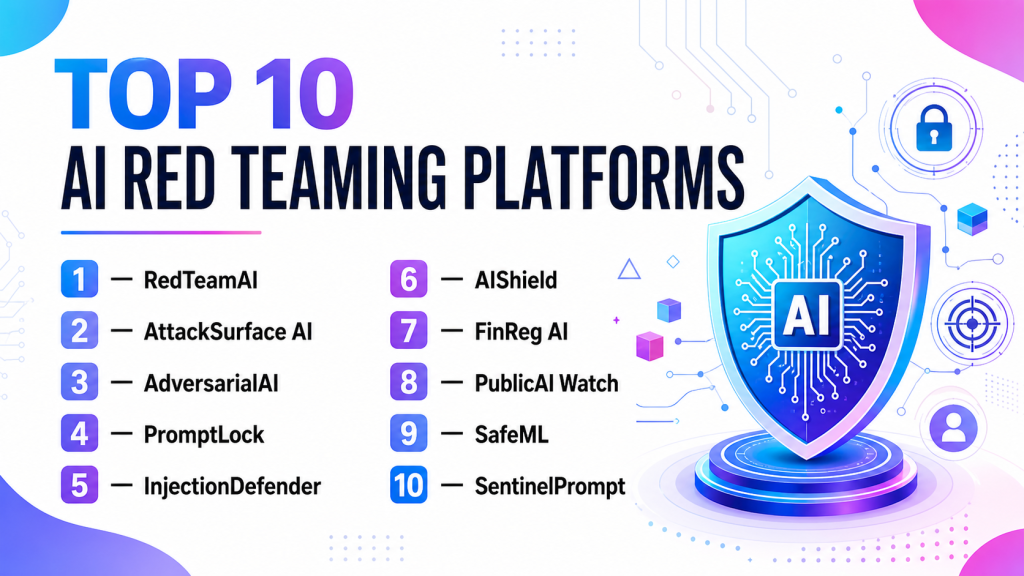
Top 10 AI Red Teaming Platforms
1 — RedTeamAI
One-line verdict: Best for enterprises needing comprehensive red teaming for LLMs, multimodal AI, and prompt safety evaluation.
Short description: RedTeamAI provides automated adversarial testing for AI models. A multinational bank uses it to evaluate credit scoring LLMs against bias, malicious prompts, and output hallucinations.
Standout Capabilities
- Automated scenario generation and stress-testing.
- Multimodal input red teaming (text, code, image).
- Bias and safety evaluation dashboards.
- Regression testing and real-time alerts.
- CI/CD and ML pipeline integration.
- Compliance report generation.
- Policy enforcement dashboards.
AI-Specific Depth
- Model support: Proprietary / BYO / Multi-model
- RAG / knowledge integration: Vector DB connectors
- Evaluation: Prompt tests, human review, regression
- Guardrails: Policy checks, prompt injection defense
- Observability: Traces, token usage, latency
Pros
- Enterprise-grade coverage across models.
- Real-time alerts and dashboards.
- Supports governance and compliance.
Cons
- Enterprise pricing.
- Setup requires expertise.
- Multimodal evaluation can be complex.
Security & Compliance
SSO/SAML, RBAC, audit logs; Not publicly stated.
Deployment & Platforms
Web, Windows, macOS; Cloud/Hybrid.
Integrations & Ecosystem
- CI/CD pipelines
- ML platform integrations
- Vector DB connectors
- Alerting dashboards
Pricing Model
Tiered subscription; Not publicly stated.
Best-Fit Scenarios
- Financial AI risk evaluation.
- Enterprise LLM validation.
- Multimodal AI safety assessments.
2 — AttackSurface AI
One-line verdict: Ideal for security teams evaluating AI prompts and outputs against adversarial manipulation.
Short description: AttackSurface AI continuously tests prompts and outputs. SaaS platforms use it to verify chatbots and AI assistants remain robust under adversarial input.
Standout Capabilities
- Continuous adversarial testing.
- Prompt and output stress tests.
- Multimodal input evaluation.
- Compliance-ready dashboards.
- Alerts and mitigation recommendations.
AI-Specific Depth
- Model support: Proprietary / BYO
- RAG / knowledge integration: N/A
- Evaluation: Regression, human-in-loop, scenario testing
- Guardrails: Prompt injection detection, policy enforcement
- Observability: Token usage, logs, latency
Pros
- Continuous safety monitoring.
- Easy SaaS integration.
- Detailed audit reports.
Cons
- Limited enterprise workflow coverage.
- Training required.
- Multimodal support may vary.
Security & Compliance
SSO/SAML, RBAC; Not publicly stated.
Deployment & Platforms
Web, Windows, macOS; Cloud.
Integrations & Ecosystem
- LLM APIs
- CI/CD pipelines
- Audit dashboards
Pricing Model
Tiered subscription; Not publicly stated.
Best-Fit Scenarios
- SaaS AI validation.
- Customer-facing chatbots.
- Internal enterprise AI monitoring.
3 — AdversarialAI
One-line verdict: Excellent for enterprises needing automated red teaming and bias evaluation across multiple AI models.
Short description: AdversarialAI simulates malicious input scenarios. A healthcare provider uses it to evaluate diagnostic AI for hallucinations and unsafe outputs.
Standout Capabilities
- Automated prompt generation for red teaming.
- Multimodal attack testing.
- Bias and fairness assessment.
- Integration with ML pipelines.
- Alerting dashboards for high-risk inputs.
AI-Specific Depth
- Model support: BYO / Proprietary
- RAG / knowledge integration: Connectors
- Evaluation: Regression, human review, scenario simulation
- Guardrails: Policy enforcement, prompt injection detection
- Observability: Token metrics, latency, audit logs
Pros
- Multimodal evaluation coverage.
- Automated testing workflows.
- Enterprise integration ready.
Cons
- Enterprise pricing.
- Setup requires expert staff.
- May require tuning for complex prompts.
Security & Compliance
SSO/SAML, RBAC; Not publicly stated.
Deployment & Platforms
Web, Windows, macOS; Cloud/Hybrid.
Integrations & Ecosystem
- ML workflows
- CI/CD pipelines
- Vector DB integration
Pricing Model
Tiered subscription; Not publicly stated.
Best-Fit Scenarios
- Healthcare AI safety testing.
- Enterprise red teaming.
- Multimodal AI prompt evaluation.
4 — PromptLock
One-line verdict: Ideal for enterprises needing policy-driven, automated protection for AI outputs across internal and public systems.
Short description : PromptLock enforces enterprise AI policies and prevents unsafe outputs. A SaaS company uses it to secure customer-facing AI chatbots and internal virtual assistants against malicious or unsafe user prompts.
Standout Capabilities
- Policy-driven prompt filtering and enforcement.
- Real-time detection of injection attempts.
- Multimodal input monitoring (text, code, images).
- Audit-ready dashboards for compliance teams.
- Integration with LLM APIs and CI/CD pipelines.
- Automated alerts for suspicious inputs.
- Customizable guardrails based on enterprise policies.
AI-Specific Depth
- Model support: BYO / Proprietary / Multi-model routing
- RAG / knowledge integration: Connectors for internal knowledge bases, vector DB compatible
- Evaluation: Regression, human-in-loop review, pre-deployment checks
- Guardrails: Policy enforcement, real-time injection defense
- Observability: Token usage, latency metrics, alerting dashboards
Pros
- Provides enterprise-level safety governance.
- Real-time monitoring and alerting for malicious prompts.
- Audit-ready logs and dashboards for compliance review.
Cons
- Setup requires technical expertise.
- Enterprise-tier pricing may be high for small teams.
- Initial configuration can be complex and time-consuming.
Security & Compliance
SSO/SAML, RBAC, audit logs, encryption; Not publicly stated.
Deployment & Platforms
Web, Windows, macOS; Cloud/Hybrid.
Integrations & Ecosystem
PromptLock integrates with LLM APIs, internal workflow systems, and enterprise CI/CD pipelines.
- CI/CD pipelines
- Enterprise LLM platforms
- Compliance dashboards
- Alerting systems
- Knowledge base connectors
Pricing Model
Tiered subscription; Not publicly stated.
Best-Fit Scenarios
- Customer-facing SaaS AI chatbots.
- Internal virtual assistants in enterprises.
- Multimodal AI deployments requiring policy enforcement.
5 — InjectionDefender
One-line verdict: Best for securing AI chatbots and virtual assistants with real-time injection detection and policy enforcement.
Short description: InjectionDefender protects AI-driven conversational agents from unsafe or malicious prompts. A global customer support platform uses it to block harmful inputs and maintain safe public interactions.
Standout Capabilities
- Real-time prompt-injection detection.
- Policy enforcement for enterprise AI safety.
- Integration with live conversational bots.
- Continuous monitoring and alerts.
- Audit trails and compliance logging.
- Support for scripted guardrail policies.
AI-Specific Depth
- Model support: Proprietary / BYO
- RAG / knowledge integration: N/A
- Evaluation: Prompt tests, regression checks
- Guardrails: Real-time injection defense
- Observability: Logs, alerts, token usage
Pros
- Tailored for chat/assistant models.
- Real-time alerting for unsafe prompts.
- Audit-ready logs for compliance.
Cons
- Enterprise-tier pricing.
- Setup may require security expertise.
- Less focused on multimodal inputs.
Security & Compliance
SSO/SAML, RBAC, audit logs, encryption; Not publicly stated.
Deployment & Platforms
Web, Windows, macOS; Cloud.
Integrations & Ecosystem
- AI chat platforms
- Customer support systems
- CI/CD pipelines
- Alerting dashboards
- Logging systems
Pricing Model
Tiered subscription; Not publicly stated.
Best-Fit Scenarios
- Customer service AI safety.
- Real-time prompt filtering for chatbots.
- Enterprises with external-facing AI.
6 — AIShield
One-line verdict: Effective for healthcare and financial AI deployments requiring robust guardrails and compliance tracking.
Short description: AIShield protects AI workflows against injection attacks and enforces policy guardrails. A healthcare provider uses it to secure diagnostic and patient-facing AI models from harmful instructions.
Standout Capabilities
- Policy-based guardrails.
- Bias and safety rule enforcement.
- Adaptive threat detection.
- Audit roll-ups for governance reviews.
- Integration with enterprise ML systems.
AI-Specific Depth
- Model support: BYO / Proprietary
- RAG / knowledge integration: N/A
- Evaluation: Human review, regression checks
- Guardrails: Policy enforcement, threat detection
- Observability: Logs, metrics, alerts
Pros
- Enterprise-scale safety governance.
- Strong threat detection for institutional AI.
- Audit trails support compliance teams.
Cons
- Configuration complexity.
- Enterprise pricing.
- May be overkill for small deployments.
Security & Compliance
SSO, RBAC, audit logs; Not publicly stated.
Deployment & Platforms
Web; Cloud/Hybrid.
Integrations & Ecosystem
- Enterprise ML stacks
- Security dashboards
- AI workflow tools
- Governance systems
Pricing Model
Tiered subscription; Not publicly stated.
Best-Fit Scenarios
- Healthcare AI compliance.
- Financial AI safety monitoring.
- Enterprise LLM governance.
7 — FinReg AI
One-line verdict: Designed for financial institutions auditing AI credit, trading, and risk models with prompt security enforcement.
Short description: FinReg AI secures financial AI models by detecting unsafe prompts and integrating compliance guardrails. A multinational bank uses it to monitor trading AI prompts and enforce safety policies.
Standout Capabilities
- Real-time financial AI prompt security.
- Risk scoring and compliance dashboards.
- Bias and fairness evaluation.
- Pre-deployment validation.
- Integration with governance workflows.
AI-Specific Depth
- Model support: BYO / Proprietary
- RAG / knowledge integration: Financial data connectors
- Evaluation: Regression testing, human review
- Guardrails: Policy checks, prompt-injection defense
- Observability: Traces, metrics, latency
Pros
- Tailored for finance workflows.
- Strong audit and reporting capabilities.
- Integrates with risk management systems.
Cons
- High setup and usage cost.
- Requires domain expertise.
- Complex configuration.
Security & Compliance
SSO, RBAC, audit logs, encryption; Not publicly stated.
Deployment & Platforms
Web; Cloud/Hybrid.
Integrations & Ecosystem
- Risk management dashboards
- Enterprise ML systems
- CI/CD pipelines
- Logging and audit tools
Pricing Model
Tiered subscription; Not publicly stated.
Best-Fit Scenarios
- Banks monitoring AI trading prompts.
- Finance risk-model safety enforcement.
- Enterprise compliance workflows.
8 — PublicAI Watch
One-line verdict: Best for government and regulatory organizations needing transparent AI prompt oversight.
Short description: PublicAI Watch provides transparency dashboards and automated compliance checks for public-sector AI. Regulatory agencies use it to ensure fair and safe AI use in civic services.
Standout Capabilities
- Automated compliance checks.
- Transparency and explainability reporting.
- Bias and fairness alerts.
- Policy enforcement monitoring.
- Reporting tailored for regulators.
AI-Specific Depth
- Model support: Proprietary / BYO
- RAG / knowledge integration: N/A
- Evaluation: Human and automated review
- Guardrails: Policy enforcement
- Observability: Logs, audit trails, metrics
Pros
- Tailored for regulatory audit.
- Continuous compliance insights.
- Supports large government workloads.
Cons
- Complex setup.
- Training required for staff.
- Enterprise-focused cost.
Security & Compliance
SSO/SAML, RBAC, audit logs, encryption; Not publicly stated.
Deployment & Platforms
Web; Cloud/Hybrid.
Integrations & Ecosystem
- Government data systems
- Compliance reporting tools
- AI governance platforms
- Audit dashboards
Pricing Model
Tiered subscription; Not publicly stated.
Best-Fit Scenarios
- Government AI oversight.
- Public-sector compliance monitoring.
- Transparency reporting workflows.
9 — SafeML
One-line verdict: Ideal for enterprises needing broad governance on bias, safety, and prompt security.
Short description: SafeML combines bias detection with prompt injection defenses to secure enterprise AI. A European insurance company uses it to protect claims and underwriting models from unsafe prompt manipulation.
Standout Capabilities
- Injection and bias monitoring.
- Risk and fairness scoring.
- Multimodal AI input scanning.
- Compliance reporting dashboards.
- Integration with enterprise CI/CD.
AI-Specific Depth
- Model support: BYO / Proprietary
- RAG / knowledge integration: Connectors to knowledge bases
- Evaluation: Regression, human review
- Guardrails: Prompt defense, policy checks
- Observability: Metrics, logs
Pros
- Wide governance coverage.
- Integrates with enterprise pipelines.
- Strong dashboards for compliance teams.
Cons
- Enterprise pricing model.
- Training required for teams.
- Setup effort for complex environments.
Security & Compliance
SSO/SAML, RBAC, audit logs; Not publicly stated.
Deployment & Platforms
Web, Windows, macOS; Cloud/Hybrid.
Integrations & Ecosystem
- CI/CD pipelines
- ML platforms
- Compliance dashboards
- Alerting systems
Pricing Model
Tiered subscription; Not publicly stated.
Best-Fit Scenarios
- Insurance AI safety monitoring.
- Enterprise prompt governance.
- Multimodal AI protection.
10 — SentinelPrompt
One-line verdict: Best for enterprise-wide prompt security monitoring and governance across diverse AI systems.
Short description: SentinelPrompt offers enterprise-level monitoring, threat detection, and compliance reporting for AI prompts. A multinational corporation uses it to unify AI safety policies across departments.
Standout Capabilities
- Enterprise-wide guardrails.
- Threat detection and alerting.
- Centralized compliance dashboards.
- Support for complex workflows.
- Multimodal input support.
AI-Specific Depth
- Model support: BYO / Proprietary
- RAG / knowledge integration: N/A
- Evaluation: Regression, human review
- Guardrails: Policy enforcement, injection defense
- Observability: Logs, metrics
Pros
- Unified enterprise monitoring.
- Strong threat detection.
- Centralized compliance insights.
Cons
- Complex deployment.
- Enterprise pricing.
- Requires dedicated governance staff.
Security & Compliance
SSO/SAML, RBAC, audit logs; Not publicly stated.
Deployment & Platforms
Web, Windows; Cloud/Hybrid.
Integrations & Ecosystem
- Enterprise ML systems
- Compliance tools
- Security dashboards
- CI/CD pipelines
Pricing Model
Tiered subscription; Not publicly stated.
Best-Fit Scenarios
- Large enterprise AI governance.
- Cross-department AI safety.
- Unified compliance monitoring.
Comparison Table
| Tool Name | Best For | Deployment | Model Flexibility | Strength | Watch-Out | Public Rating |
|---|---|---|---|---|---|---|
| RedTeamAI | Enterprise LLMs | Cloud/Hybrid | BYO / Proprietary | Full-scale red teaming | Complexity | N/A |
| AttackSurface AI | SaaS security teams | Cloud | BYO / Proprietary | Continuous adversarial tests | Limited enterprise features | N/A |
| AdversarialAI | Healthcare & enterprises | Cloud/Hybrid | BYO / Proprietary | Bias & scenario testing | Setup effort | N/A |
| PromptLock | SaaS & enterprise | Cloud/Hybrid | BYO / Proprietary | Policy-driven enforcement | Complexity | N/A |
| InjectionDefender | Chatbot AI | Cloud | BYO / Proprietary | Real-time injection defense | Enterprise cost | N/A |
| AIShield | Healthcare & finance | Cloud/Hybrid | BYO / Proprietary | Multimodal guardrails | Setup required | N/A |
| FinReg AI | Finance institutions | Cloud/Hybrid | BYO / Proprietary | Risk scoring & compliance | High cost | N/A |
| PublicAI Watch | Government oversight | Cloud/Hybrid | Proprietary / BYO | Transparency monitoring | Complexity | N/A |
| SafeML | Insurance & enterprise | Cloud/Hybrid | BYO / Proprietary | Bias & governance | Training required | N/A |
| SentinelPrompt | Enterprise governance | Cloud/Hybrid | BYO / Proprietary | Enterprise monitoring | Complexity | N/A |
Scoring & Evaluation (Weighted Rubric)
Scoring is comparative and evaluates each platform across multiple practical dimensions. Weighted totals help organizations prioritize platforms based on their needs.
| Tool | Core | Reliability/Eval | Guardrails | Integrations | Ease | Perf/Cost | Security/Admin | Support | Weighted Total |
|---|---|---|---|---|---|---|---|---|---|
| RedTeamAI | 9 | 9 | 9 | 9 | 8 | 8 | 9 | 8 | 8.8 |
| AttackSurface AI | 8 | 8 | 8 | 8 | 8 | 7 | 8 | 7 | 7.9 |
| AdversarialAI | 8 | 7 | 7 | 8 | 7 | 8 | 8 | 7 | 7.7 |
| PromptLock | 8 | 8 | 8 | 8 | 7 | 7 | 8 | 7 | 7.8 |
| InjectionDefender | 8 | 8 | 8 | 8 | 7 | 7 | 8 | 7 | 7.8 |
| AIShield | 8 | 8 | 8 | 8 | 7 | 7 | 8 | 7 | 7.8 |
| FinReg AI | 8 | 8 | 8 | 8 | 7 | 7 | 8 | 7 | 7.7 |
| PublicAI Watch | 7 | 7 | 7 | 7 | 7 | 7 | 7 | 7 | 7.0 |
| SafeML | 8 | 8 | 7 | 8 | 7 | 7 | 8 | 7 | 7.6 |
| SentinelPrompt | 8 | 8 | 8 | 8 | 7 | 7 | 8 | 7 | 7.7 |
Top 3 for Enterprise: RedTeamAI, PromptLock, AIShield
Top 3 for SMB: AttackSurface AI, InjectionDefender, SafeML
Top 3 for Developers: AdversarialAI, SentinelPrompt, FinReg AI
Which AI Red Teaming Tool Is Right for You?
Solo / Freelancer
Small teams or individual developers experimenting with AI should use PromptLock or SafeML, which offer manageable guardrails and lightweight red teaming capabilities without enterprise overhead. Focus on testing single or small-scale models, while monitoring for prompt manipulation and basic bias checks.
SMB
Small-to-medium businesses deploying chatbots, AI assistants, or enterprise AI should consider InjectionDefender or AIShield. These provide continuous monitoring, alerting, and compliance dashboards suitable for customer-facing and internal AI without requiring full-scale enterprise deployment.
Mid-Market
Organizations with multiple AI models across departments benefit from AdversarialAI or AttackSurface AI, which provide structured regression testing, automated scenario generation, and integration with ML pipelines for robust red-teaming and bias evaluation.
Enterprise
Large corporations with multiple AI systems and multimodal deployments should prioritize RedTeamAI, SentinelPrompt, and FinReg AI, which deliver enterprise-wide monitoring, governance dashboards, and full-scale adversarial testing capabilities across all model types.
Regulated industries (finance, healthcare, public sector)
FinReg AI, AIShield, and PublicAI Watch are best suited for regulated environments, providing bias evaluation, compliance-ready audit reports, transparency dashboards, and scenario-based testing aligned with financial, healthcare, and government standards.
Budget vs Premium
For cost-conscious operations, PromptLock and SafeML provide essential safety with limited overhead. For premium enterprise features, extensive red-teaming, and governance, RedTeamAI and SentinelPrompt are most suitable.
Build vs Buy (when to DIY)
Custom DIY red-teaming may work for small-scale, internal AI experiments. Buy specialized platforms when AI is customer-facing, regulated, or mission-critical, to benefit from automated guardrails, compliance reporting, and real-world attack simulation.
Implementation Playbook (30 / 60 / 90 Days)
30 Days — Pilot & Metrics
- Identify 1–2 critical AI models for red-teaming.
- Deploy the chosen platform in a staging environment.
- Track adversarial prompts, blocked attacks, false positives, and latency impact.
- Document preliminary guardrail performance.
60 Days — Harden & Integrate
- Integrate red-teaming tools with CI/CD and ML pipelines.
- Configure guardrails, policy rules, and real-time alerts.
- Conduct human-in-loop testing for edge-case prompts.
- Implement audit logging and compliance dashboards.
90 Days — Optimize & Scale
- Extend coverage to all critical AI models across departments.
- Evaluate performance, cost, and latency for scaled workloads.
- Conduct periodic red-team exercises and adversarial scenario testing.
- Validate compliance, generate audit-ready reports, and iterate guardrails.
- Establish governance reviews for enterprise-wide adoption.
Common Mistakes & How to Avoid Them
- Skipping adversarial testing before deployment.
- Ignoring multimodal vulnerabilities (text, code, images, audio).
- No regression or human-in-loop evaluation.
- Lack of observability or monitoring dashboards.
- Over-reliance on automation without human oversight.
- Vendor lock-in without abstraction or alternative options.
- Skipping real-world scenario validation.
- Neglecting latency and performance metrics.
- Incomplete compliance reporting.
- Failing to integrate with CI/CD pipelines.
- Overlooking scenario diversity and model coverage.
- Underestimating enterprise-scale AI risks.
FAQs
1. What is an AI Red Teaming Platform?
A platform that simulates adversarial attacks to evaluate AI model vulnerabilities, prompt safety, and reliability before deployment.
2. Why is red-teaming AI important?
It ensures AI systems remain robust, safe, unbiased, and compliant, reducing operational, legal, and reputational risk.
3. Are these platforms suitable for multimodal AI?
Yes, many platforms evaluate text, code, images, and audio to ensure comprehensive safety and reliability.
4. Can they integrate with CI/CD pipelines?
Yes, enterprise-grade tools offer seamless integration to test AI models continuously as part of deployment workflows.
5. Do they evaluate bias and fairness?
Yes, top platforms include tools for detecting bias, evaluating fairness, and testing outputs under adversarial conditions.
6. Can small teams use these tools?
Some platforms are suitable for SMBs and solo developers, providing essential red-teaming without enterprise overhead.
7. Are BYO models supported?
Many platforms allow BYO, proprietary, and multi-model testing, while some are limited to hosted AI systems.
8. How do these platforms handle sensitive data?
SSO, RBAC, encryption, and audit logs help maintain compliance with internal and regulatory privacy requirements.
9. Do they provide audit and compliance reports?
Yes, most platforms generate detailed dashboards and reports suitable for enterprise governance and regulatory submission.
10. Are these platforms cloud-only?
No, many support cloud, hybrid, and some on-premise deployments to meet enterprise IT policies.
11. Can they operate in real-time environments?
Yes, for chatbots and AI agents, many platforms offer real-time prompt monitoring and injection detection.
12. How do I choose the right tool?
Consider enterprise scale, multimodal support, regulatory requirements, budget, and integration with existing ML workflows.
Conclusion
AI Red Teaming Platforms are essential for enterprises to ensure the safety, reliability, and compliance of AI models. They uncover vulnerabilities, evaluate bias, and provide actionable insights for real-world deployment scenarios. Choosing the right platform depends on organizational scale, regulatory exposure, and AI model complexity. Implementing these tools in phases—pilot, harden, and scale—ensures operational efficiency, robust governance, and enterprise-wide AI safety. Red-teaming is no longer optional; it is critical for maintaining trust, compliance, and risk mitigation in AI-driven organizations.
Next steps: shortlist 2–3 platforms, run pilot testing, verify compliance and guardrails, then scale enterprise-wide.
Very insightful and relevant, especially with the growing risks around AI misuse and vulnerabilities. I liked how each platform is explained with practical pros and cons.
Impressive compilation of tools with clear insights into their strengths and limitations. It simplifies decision-making for enterprises and developers!
This blog clearly explains AI red teaming platforms and their importance in identifying vulnerabilities within modern AI and LLM systems.
AI red teaming is extremely important for modern AI systems, and this guide explains its value in a clear, structured, and easy-to-understand way for all readers.