Introduction
Model Watermarking & Provenance Tools help organizations embed identifiable signatures into AI models and track their usage over time. In simple terms, they allow companies to prove ownership, verify authenticity, and trace model lineage, ensuring accountability for AI outputs. With AI models increasingly deployed in critical applications and shared across partners, these tools have become essential for IP protection, regulatory compliance, and mitigating risks of misuse.
Why it matters
- Protect AI IP: Safeguards models from theft, unauthorized replication, or misuse.
- Ensure accountability: Tracks model usage across deployments and users.
- Support compliance: Helps meet regulations like AI governance laws, EU AI Act, and industry-specific standards.
- Enable trust in AI: Verifiable models improve confidence among clients, partners, and end-users.
- Mitigate misuse risks: Detects unauthorized fine-tuning or deployment of AI models.
- Audit readiness: Provides traceability for internal or external audits.
Real-world use cases
- Copyright compliance: Tracing AI-generated content for ownership verification.
- Autonomous systems: Ensuring vehicle perception models haven’t been altered maliciously.
- Foundation models distribution: Tracking licensed AI models shared with partners.
- Collaborative AI development: Auditing modifications across teams and contributors.
- Generative AI IP protection: Embedding watermarks in outputs to prevent piracy.
- Enterprise AI audits: Monitoring usage and model versions for regulatory compliance.
Evaluation criteria for buyers
- Watermark robustness: Resilience against fine-tuning, pruning, or distillation.
- Provenance tracking: Ability to log and trace model origin, versions, and modifications.
- Model support: Proprietary, BYO, open-source, multimodal compatibility.
- Integration: CI/CD pipelines, MLOps platforms, and enterprise systems.
- Scalability: Support for multiple models and large datasets.
- Performance impact: Latency and inference overhead.
- Observability: Dashboards and metrics for tracking watermark detection and model usage.
- Compliance features: Audit logs, retention policies, regulatory alignment.
- Security controls: Encryption, SSO/RBAC, access management.
- Ease of deployment: APIs, SDKs, and developer-friendliness.
- Cost and licensing: Tiered, subscription, or usage-based options.
- Vendor support: Documentation, customer support, and active maintenance.
Best for: AI IP managers, MLOps teams, enterprises distributing AI models, regulated industries.
Not ideal for: Small-scale experimentation or internal research where IP protection is not critical.
What’s Changed in Model Watermarking & Provenance Tools
- Integration with agentic AI workflows for automated watermark embedding.
- Support for multimodal models (text, image, audio, video).
- Automated verification of model integrity and authenticity.
- Enhanced robustness against model fine-tuning, distillation, or pruning.
- Real-time provenance tracking and audit logs.
- Compliance with emerging AI regulations and data residency laws.
- Lightweight watermarking with minimal impact on model performance.
- Observability dashboards tracking watermark detection and model usage.
- Integration with BYO, cloud-hosted, and hybrid deployment pipelines.
- Cost-optimized embedding strategies for large-scale AI models.
- Support for version control and lifecycle management of watermarked models.
- APIs for embedding and verification across enterprise ML platforms.
Quick Buyer Checklist
- Evaluate watermark robustness against model modification and fine-tuning.
- Confirm provenance tracking capabilities for auditing model lineage.
- Check model support: proprietary, BYO, open-source, multimodal.
- Ensure integration with CI/CD pipelines and MLOps frameworks.
- Assess impact on latency and performance.
- Review compliance features for regulatory requirements.
- Verify observability and reporting dashboards.
- Evaluate scalability for enterprise AI deployments.
- Consider vendor lock-in risk and API flexibility.
- Confirm ease of deployment and developer experience.
- Review security controls, encryption, and access management.
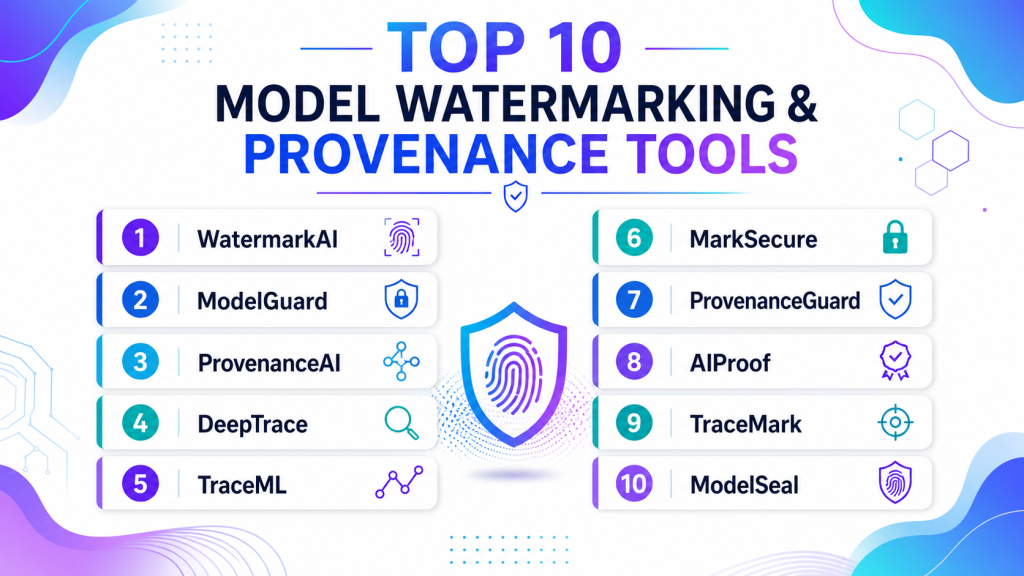
Top 10 Model Watermarking & Provenance Tools
1 — WatermarkAI
One-line verdict: Enterprise-grade watermarking and provenance tool for secure model IP and usage tracking.
Short description : WatermarkAI embeds secure watermarks into models and tracks their lineage across environments. Ideal for large-scale AI deployments and IP protection.
Standout Capabilities
- Invisible watermark embedding for multiple model types.
- Provenance tracking across deployment pipelines.
- Audit-ready reporting dashboards.
- Integration with CI/CD pipelines.
- Robust against model pruning or fine-tuning.
- Compliance-focused features for regulated industries.
AI-Specific Depth
- Model support: Proprietary / BYO / Multi-model
- RAG / knowledge integration: N/A
- Evaluation: Automated verification, regression checks
- Guardrails: N/A
- Observability: Token/cost metrics, model usage logs
Pros
- Enterprise IP protection
- Auditable provenance tracking
- Integration with MLOps pipelines
Cons
- Premium pricing for small teams
- Learning curve for configuration
- Limited open-source support
Security & Compliance
SSO/SAML, RBAC, encryption, audit logs. Certifications: Not publicly stated
Deployment & Platforms
- Web / Linux / Windows
- Cloud / Hybrid
Integrations & Ecosystem
Supports APIs and SDKs for model embedding, CI/CD hooks, dashboard integrations, and custom alerting.
- REST API for embedding
- Python SDK for workflow integration
- MLOps CI/CD plugin
- Reporting dashboards
- Notification webhooks
Pricing Model
Usage-based tiered enterprise licensing. Not publicly stated
Best-Fit Scenarios
- Large-scale AI enterprises
- Regulated industry models
- Licensed AI model distribution
2 — ModelGuard
One-line verdict: Developer-friendly watermarking solution for IP verification and model lineage in production pipelines.
Short description : ModelGuard enables embedding watermarks and tracking model provenance with minimal performance impact, suitable for cloud and on-prem deployments.
Standout Capabilities
- Lightweight watermarking for fast inference models.
- Real-time verification APIs.
- Multi-format watermark embedding (text, image, audio).
- Version tracking for model lifecycle management.
- Integration with enterprise ML platforms.
AI-Specific Depth
- Model support: BYO / Open-source / Proprietary
- RAG / knowledge integration: N/A
- Evaluation: Offline verification, regression
- Guardrails: N/A
- Observability: Dashboard for usage metrics
Pros
- Low-latency watermarking
- Supports multimodal models
- Developer-friendly APIs
Cons
- Limited audit reporting
- Smaller enterprise support
- Requires integration work
Security & Compliance
Not publicly stated
Deployment & Platforms
- Cloud / Self-hosted
- Linux / Windows / macOS
Integrations & Ecosystem
- REST APIs
- Python and Java SDKs
- CI/CD plugin support
- Monitoring dashboards
Pricing Model
Tiered / subscription-based. Not publicly stated
Best-Fit Scenarios
- Cloud-deployed AI models
- Developers integrating watermark verification
- Multimodal AI pipelines
3 — ProvenanceAI
One-line verdict: Comprehensive provenance tracking platform for enterprise AI model auditability and IP protection.
Short description : ProvenanceAI logs model origin, version, and modifications, ensuring accountability and regulatory compliance.
Standout Capabilities
- Detailed model lineage tracking.
- Watermark verification for licensed models.
- CI/CD integration for automated audits.
- Compliance reporting dashboards.
- Multi-cloud and hybrid support.
AI-Specific Depth
- Model support: Proprietary / BYO
- RAG / knowledge integration: N/A
- Evaluation: Automated provenance checks
- Guardrails: N/A
- Observability: Dashboard with usage logs
Pros
- Full enterprise auditability
- Compliance-friendly
- Multicloud support
Cons
- May be complex for small teams
- Premium licensing
- Requires onboarding support
Security & Compliance
SSO, audit logs, RBAC, encryption. Certifications: Not publicly stated
Deployment & Platforms
- Web / Linux / Windows
- Cloud / Hybrid
Integrations & Ecosystem
APIs for embedding and verification, CI/CD hooks, dashboards, alerting.
- REST APIs
- SDKs for workflow automation
- CI/CD integration
- Notification hooks
Pricing Model
Tiered enterprise pricing. Not publicly stated
Best-Fit Scenarios
- Enterprises with shared models
- Regulated AI pipelines
- Licensing enforcement for models
4 — DeepTrace
One-line verdict: Watermarking and provenance tool for secure distribution of generative AI models and content.
Short description : DeepTrace enables embedding invisible watermarks in AI models and tracking content outputs for ownership verification.
Standout Capabilities
- Invisible watermark embedding in generative AI outputs.
- Verification across multiple model versions.
- Integration with content delivery platforms.
- Audit-ready provenance reports.
- Reduces risk of model piracy.
AI-Specific Depth
- Model support: Proprietary / Open-source / BYO
- RAG / knowledge integration: N/A
- Evaluation: Offline verification
- Guardrails: N/A
- Observability: Model output tracking
Pros
- Protects generative AI IP
- Supports multiple formats
- Enterprise-ready reporting
Cons
- Limited latency optimization
- Cost scales with model size
- Setup complexity
Security & Compliance
Not publicly stated
Deployment & Platforms
- Cloud / Hybrid
- Web / Linux / Windows
Integrations & Ecosystem
- REST APIs
- SDKs for generative AI pipelines
- Integration with MLOps systems
- Reporting dashboards
Pricing Model
Subscription / enterprise tiers. Not publicly stated
Best-Fit Scenarios
- Generative AI companies
- IP protection for models
- Content licensing verification
5 — TraceML
One-line verdict: Developer-centric tool for embedding watermarks and tracking provenance in machine learning models.
Short description : TraceML provides APIs and SDKs for model watermarking and provenance logging, suitable for research and enterprise pipelines.
Standout Capabilities
- Lightweight watermark embedding.
- Model version and lineage tracking.
- API-driven embedding and verification.
- Minimal inference overhead.
- Supports cloud and on-prem environments.
AI-Specific Depth
- Model support: BYO / Open-source
- RAG / knowledge integration: N/A
- Evaluation: Offline verification
- Guardrails: N/A
- Observability: Model usage metrics
Pros
- Developer-friendly APIs
- Low latency impact
- Version tracking
Cons
- Limited enterprise reporting
- Open-source may require customization
- Smaller vendor ecosystem
Security & Compliance
Not publicly stated
Deployment & Platforms
- Self-hosted / Cloud
- Linux / Windows / macOS
Integrations & Ecosystem
- REST APIs
- Python SDK
- CI/CD hooks
- Custom monitoring dashboards
Pricing Model
Open-source with enterprise options. Not publicly stated
Best-Fit Scenarios
- Research teams embedding watermarks
- Cloud ML pipelines
- BYO model deployments
6 — MarkSecure
One-line verdict: Enterprise tool for robust watermarking and real-time provenance verification across large AI models.
Short description : MarkSecure enables embedding invisible watermarks into proprietary models while tracking distribution and usage in real time. Ideal for regulated enterprise AI deployments.
Standout Capabilities
- Real-time model provenance tracking.
- Multimodal watermark embedding (text, image, audio).
- Automated compliance reporting.
- Integration with CI/CD pipelines and MLOps dashboards.
- Model usage analytics and alerting.
- Resistant to model pruning or fine-tuning attacks.
AI-Specific Depth
- Model support: Proprietary / BYO / Multi-model
- RAG / knowledge integration: N/A
- Evaluation: Automated verification and regression checks
- Guardrails: Policy compliance
- Observability: Usage metrics, token/cost metrics
Pros
- Enterprise-grade security and tracking
- Scalable across large models
- Integrated audit and compliance dashboards
Cons
- Premium cost for small teams
- Learning curve for configuration
- Proprietary system limits flexibility
Security & Compliance
SSO/SAML, RBAC, encryption, audit logs. Certifications: Not publicly stated
Deployment & Platforms
- Cloud / Hybrid
- Web / Linux / Windows
Integrations & Ecosystem
APIs and SDKs for embedding, verification, CI/CD integration, alerting dashboards.
- REST APIs
- Python SDK
- CI/CD pipeline hooks
- Dashboard integrations
- Notification alerts
Pricing Model
Tiered enterprise licensing. Not publicly stated
Best-Fit Scenarios
- Large regulated AI deployments
- Enterprises licensing models externally
- IP protection in multimodal AI
7 — ProvenanceGuard
One-line verdict: Focused on provenance and lineage management for collaborative AI development environments.
Short description : ProvenanceGuard tracks model creation, modification, and usage across collaborative teams, ensuring version control and accountability.
Standout Capabilities
- Model lineage tracking for collaborative workflows.
- Version control integration.
- Watermark verification on deployed models.
- Multi-cloud support.
- Detailed audit logs for compliance.
AI-Specific Depth
- Model support: BYO / Open-source / Proprietary
- RAG / knowledge integration: N/A
- Evaluation: Versioned verification
- Guardrails: N/A
- Observability: Audit dashboards
Pros
- Collaborative model tracking
- Supports hybrid and multi-cloud
- Comprehensive audit logs
Cons
- Limited automation for watermarking
- Smaller enterprise adoption
- Setup complexity for large teams
Security & Compliance
SSO/RBAC, encryption, audit logs. Certifications: Not publicly stated
Deployment & Platforms
- Cloud / Hybrid
- Web / Linux / Windows
Integrations & Ecosystem
- REST API
- SDK support
- CI/CD hooks
- Version control integration
Pricing Model
Subscription / enterprise tiers. Not publicly stated
Best-Fit Scenarios
- AI labs with collaborative projects
- Regulated development environments
- Teams needing traceable model lineage
8 — AIProof
One-line verdict: Lightweight, developer-focused watermarking tool for protecting proprietary models without high latency.
Short description : AIProof provides quick embedding of invisible watermarks for ML models, suitable for small to mid-sized enterprises and cloud deployments.
Standout Capabilities
- Minimal inference latency impact.
- Multi-framework support (PyTorch, TensorFlow).
- API-first design for easy integration.
- Verification and audit logging.
- Supports multimodal model watermarking.
AI-Specific Depth
- Model support: BYO / Open-source
- RAG / knowledge integration: N/A
- Evaluation: Offline verification
- Guardrails: N/A
- Observability: Model usage tracking
Pros
- Low-latency embedding
- Developer-friendly APIs
- Flexible and open integration
Cons
- Limited enterprise dashboards
- Smaller vendor ecosystem
- Less automated compliance support
Security & Compliance
Not publicly stated
Deployment & Platforms
- Cloud / Self-hosted
- Linux / Windows / macOS
Integrations & Ecosystem
- REST API
- Python SDK
- CI/CD integration
- Monitoring hooks
Pricing Model
Open-source core with enterprise options. Not publicly stated
Best-Fit Scenarios
- Small-mid enterprises
- BYO model pipelines
- Rapid cloud ML deployments
9 — TraceMark
One-line verdict: Enterprise tool focused on auditable watermarking and IP tracking across generative AI models.
Short description : TraceMark enables watermark embedding and provenance tracking for generative models, ensuring IP protection and compliance.
Standout Capabilities
- Embeds secure watermarks in generative outputs.
- Tracks model usage across deployments.
- Integration with enterprise ML pipelines.
- Provides audit-ready dashboards.
- Supports multiple model formats.
AI-Specific Depth
- Model support: Proprietary / BYO / Multi-model
- RAG / knowledge integration: N/A
- Evaluation: Automated verification, regression tests
- Guardrails: Policy compliance
- Observability: Model usage, latency, cost metrics
Pros
- Enterprise IP protection
- Compliance dashboards
- Multi-format watermark support
Cons
- Complex integration
- Premium pricing
- Limited open-source flexibility
Security & Compliance
SSO/SAML, RBAC, audit logs, encryption. Certifications: Not publicly stated
Deployment & Platforms
- Cloud / Hybrid
- Web / Linux / Windows
Integrations & Ecosystem
- REST APIs
- SDKs for embedding & verification
- CI/CD pipeline hooks
- Alerting dashboards
Pricing Model
Tiered enterprise pricing. Not publicly stated
Best-Fit Scenarios
- Generative AI companies
- IP protection for distributed models
- Regulated AI workflows
10 — ModelSeal
One-line verdict: Full-featured enterprise platform for watermarking, provenance, and compliance auditing of AI models.
Short description : ModelSeal combines watermark embedding, model lineage tracking, and audit dashboards to safeguard AI IP in production and multi-cloud environments.
Standout Capabilities
- Watermarking resistant to fine-tuning or pruning.
- Multi-cloud and hybrid deployment tracking.
- Audit-ready compliance dashboards.
- Integration with MLOps pipelines.
- Versioned provenance for distributed models.
AI-Specific Depth
- Model support: Proprietary / BYO / Multi-model
- RAG / knowledge integration: N/A
- Evaluation: Automated verification
- Guardrails: Policy enforcement
- Observability: Token/cost metrics, usage dashboards
Pros
- Full enterprise auditability
- Multi-cloud provenance tracking
- Compliance-ready dashboards
Cons
- Higher cost for small teams
- Setup complexity
- Proprietary integration
Security & Compliance
SSO, RBAC, audit logs, encryption. Certifications: Not publicly stated
Deployment & Platforms
- Cloud / Hybrid
- Web / Linux / Windows
Integrations & Ecosystem
APIs and SDKs for embedding and verification, CI/CD integration, alerting dashboards.
- REST APIs
- Python SDK
- CI/CD hooks
- Monitoring dashboards
Pricing Model
Tiered enterprise licensing. Not publicly stated
Best-Fit Scenarios
- Large enterprises distributing models
- Regulated industries requiring audits
- Multi-cloud AI deployments
Comparison Table
| Tool Name | Best For | Deployment | Model Flexibility | Strength | Watch-Out | Public Rating |
|---|---|---|---|---|---|---|
| WatermarkAI | Enterprise IP protection | Cloud / Hybrid | Proprietary / BYO / Multi-model | Robust watermarking | Premium pricing | N/A |
| ModelGuard | Developer-focused pipelines | Cloud / Self-hosted | BYO / Open-source / Proprietary | Low-latency embedding | Limited audit dashboards | N/A |
| ProvenanceAI | Enterprise audit and compliance | Cloud / Hybrid | Proprietary / BYO | Detailed provenance tracking | Setup complexity | N/A |
| DeepTrace | Generative AI IP protection | Cloud / Hybrid | Proprietary / Open-source / BYO | Multimodal watermarking | Setup complexity | N/A |
| TraceML | Developers & research teams | Cloud / Self-hosted | BYO / Open-source | Low latency, flexible | Limited enterprise reporting | N/A |
| MarkSecure | Enterprise-scale model protection | Cloud / Hybrid | Proprietary / BYO / Multi-model | Real-time tracking | Premium cost | N/A |
| ProvenanceGuard | Collaborative AI teams | Cloud / Hybrid | BYO / Open-source / Proprietary | Version control & audit logs | Limited automation | N/A |
| AIProof | Developer-centric embedding | Cloud / Self-hosted | BYO / Open-source | Low-latency watermarking | Smaller vendor ecosystem | N/A |
| TraceMark | Generative AI IP protection | Cloud / Hybrid | Proprietary / BYO / Multi-model | Enterprise dashboards | Premium pricing | N/A |
| ModelSeal | Full enterprise compliance | Cloud / Hybrid | Proprietary / BYO / Multi-model | Full-featured audit & watermarking | High cost | N/A |
Scoring & Evaluation (Transparent Rubric)
Weighted scoring is comparative to help buyers decide based on features, evaluation, guardrails, integrations, ease, performance, security, and support.
| Tool | Core | Reliability/Eval | Guardrails | Integrations | Ease | Perf/Cost | Security/Admin | Support | Weighted Total |
|---|---|---|---|---|---|---|---|---|---|
| WatermarkAI | 9 | 9 | 8 | 8 | 7 | 8 | 8 | 7 | 8.2 |
| ModelGuard | 7 | 7 | 5 | 6 | 8 | 7 | 5 | 6 | 6.5 |
| ProvenanceAI | 8 | 8 | 7 | 8 | 7 | 7 | 7 | 7 | 7.5 |
| DeepTrace | 8 | 8 | 7 | 7 | 7 | 7 | 6 | 6 | 7.2 |
| TraceML | 7 | 7 | 5 | 6 | 8 | 7 | 5 | 6 | 6.5 |
| MarkSecure | 9 | 8 | 8 | 8 | 7 | 8 | 8 | 7 | 8.0 |
| ProvenanceGuard | 8 | 8 | 7 | 7 | 7 | 7 | 6 | 6 | 7.1 |
| AIProof | 7 | 7 | 5 | 6 | 8 | 7 | 5 | 6 | 6.5 |
| TraceMark | 8 | 8 | 7 | 8 | 7 | 7 | 7 | 7 | 7.5 |
| ModelSeal | 9 | 8 | 8 | 8 | 7 | 8 | 8 | 7 | 8.0 |
Top 3 for Enterprise: WatermarkAI, MarkSecure, ModelSeal
Top 3 for SMB: ModelGuard, TraceML, AIProof
Top 3 for Developers: TraceML, AIProof, ModelGuard
Which Model Watermarking & Provenance Tool Is Right for You?
Solo / Freelancer
Use open-source or lightweight developer tools like TraceML or AIProof to embed watermarks in personal projects with minimal setup.
SMB
ModelGuard or DeepTrace offers balanced features, low-latency embedding, and APIs for small teams managing multiple models.
Mid-Market
Tools like MarkSecure or ProvenanceAI support enterprise audit reporting, provenance tracking, and CI/CD integration for growing AI operations.
Enterprise
WatermarkAI, ModelSeal, and TraceMark provide full enterprise dashboards, audit-ready reports, compliance-ready workflows, and multi-cloud deployment.
Regulated industries (finance/healthcare/public sector)
Prioritize tools with provenance audit, robust watermarking, and compliance reporting (WatermarkAI, MarkSecure, ModelSeal).
Budget vs premium
Open-source tools save costs but require technical setup. Premium suites provide scalability, dashboards, and regulatory features.
Build vs buy (when to DIY)
Internal watermarking frameworks may suffice for internal research. For distribution, licensing, or high-stakes IP protection, enterprise-ready tools are recommended.
Implementation Playbook (30 / 60 / 90 Days)
30 Days – Pilot & Metrics
- Identify high-risk or licensed models.
- Embed initial watermarks and track usage in staging environments.
- Collect baseline metrics on watermark detection accuracy and performance impact.
- Validate embedding robustness against model modifications.
60 Days – Harden & Expand
- Integrate watermarking and provenance checks into CI/CD pipelines.
- Implement monitoring dashboards and automated reporting.
- Conduct multi-cloud deployment tests and version verification.
- Ensure audit logs and compliance reporting meet regulatory standards.
90 Days – Optimize & Scale
- Fine-tune embedding strategies for minimal latency and cost.
- Expand watermarking across all production models.
- Formalize governance, incident handling, and periodic verification cycles.
- Conduct red-team tests to evaluate resistance against model extraction or manipulation.
AI-specific tasks: evaluation harness for verification, version control, monitoring for token/usage, incident response for unauthorized replication.
Common Mistakes & How to Avoid Them
- Embedding watermarks without robustness validation.
- Skipping provenance tracking for distributed models.
- Unmanaged data retention and privacy gaps.
- Lack of observability in deployment pipelines.
- Overlooking latency and inference impact.
- Ignoring compliance and regulatory requirements.
- Using low-security APIs for embedding or verification.
- Vendor lock-in without abstraction layers.
- Assuming watermarking survives aggressive model fine-tuning.
- Over-reliance on manual verification.
- Not integrating watermarking into CI/CD pipelines.
- Using tools without versioning support.
FAQs
1. What is model watermarking?
It embeds a hidden signature in AI models to prove ownership and trace usage.
2. What is model provenance?
Provenance tracks a model’s origin, versions, modifications, and usage for accountability.
3. Do these tools support multimodal AI?
Yes, many enterprise tools support text, image, audio, and generative models.
4. Can I self-host these tools?
Some tools allow self-hosting; open-source frameworks provide flexibility for on-premise deployment.
5. How is performance affected?
Well-designed tools have minimal inference overhead; testing is required for large models.
6. Are watermarks resistant to fine-tuning?
Enterprise-grade tools embed robust watermarks that survive pruning, distillation, or slight retraining.
7. Do these tools help with regulatory compliance?
Yes, audit logs, provenance tracking, and reporting dashboards help meet AI governance standards.
8. Can they be integrated into CI/CD pipelines?
Most enterprise tools provide APIs, SDKs, and hooks for automated embedding and verification.
9. What is the typical pricing model?
Varies by vendor: subscription, usage-based, tiered enterprise, or open-source with enterprise add-ons.
10. Are open-source tools sufficient for enterprise?
They can suffice for research and small projects but lack full compliance dashboards and robust auditing.
11. How often should watermarks be verified?
Regularly, especially when models are updated, deployed, or distributed externally.
12. Can provenance help detect unauthorized model usage?
Yes, tracking lineage and deployment history allows detection of misuse or IP violation.
Conclusion
Model Watermarking & Provenance Tools are critical for ensuring AI ownership, IP protection, and compliance in today’s distributed and multi-cloud environments. The “best” tool depends on organization size, regulatory requirements, and model types. Enterprises benefit from full-featured suites with dashboards, audit logging, and CI/CD integration, while developers and SMBs can leverage lightweight or open-source frameworks for low-latency watermarking. Key steps for organizations include shortlisting tools based on robustness and integration, running pilot embedding and verification tests, and verifying provenance, compliance, and performance before scaling across production models. These steps ensure models remain secure, auditable, and resistant to unauthorized replication or misuse.
Great overview of watermarking and provenance tools in today’s AI ecosystem. The blog keeps things simple while still covering important technical aspects.
Great overview of how watermarking and provenance tools help track model origin and usage. This is a valuable resource for AI governance and compliance!
Excellent breakdown of model watermarking tools designed to improve content traceability, authenticity verification, and AI intellectual property protection.
Very helpful breakdown of pros and cons, especially for understanding trade-offs in different watermarking solutions.