Introduction
Adversarial Robustness Testing Tools are designed to evaluate the resilience of AI models against malicious, unexpected, or edge-case inputs. In simple terms, these tools simulate attacks—like carefully crafted text prompts, images, or data perturbations—to see how models react, helping organizations understand vulnerabilities before they can be exploited. With AI models increasingly integrated into critical business processes, cybersecurity, healthcare diagnostics, financial systems, and autonomous systems, ensuring robustness has become a key requirement for safe deployment.
Why it matters :
- AI models are integral in finance, healthcare, autonomous systems, and enterprise automation.
- Malicious or unintentional adversarial inputs can compromise safety, trust, and compliance.
- Regulatory scrutiny (e.g., EU AI Act, HIPAA, finance regulations) requires demonstrable robustness testing.
- Models are deployed at scale in multi-cloud and hybrid setups, raising cost and observability concerns.
- Multimodal AI (text + images + video) introduces new attack surfaces needing proactive evaluation.
Real-world use cases
- Detecting prompt injection attacks in AI chatbots and virtual assistants.
- Validating autonomous vehicle perception systems against manipulated images or sensor noise.
- Stress-testing fraud detection models in banking and payments.
- Evaluating healthcare AI models for robustness to noisy or adversarial medical imaging.
- Testing enterprise recommendation engines for manipulation or bias exploitation.
- Validating content moderation AI against adversarial inputs to avoid unsafe content slip-through.
Evaluation Criteria for Buyers
- Attack vector coverage: Text, image, audio, and multimodal support.
- Model support: Proprietary, BYO, open-source, or multi-model routing.
- Integration: CI/CD, MLOps pipelines, and monitoring dashboards.
- Evaluation depth: Prompt tests, regression, human review, and automated metrics.
- Guardrails: Prompt-injection defense, policy checks, safety enforcement.
- Observability: Token-level tracing, cost/latency metrics, error analysis.
- Compliance: Data privacy, auditability, regulatory reporting, data retention.
- Scalability: Ability to test large datasets and multiple models.
- Ease of use: GUI dashboards, scripting, automation capabilities.
- Cost and latency optimization: Efficient testing for large-scale deployment.
- Integration with RAG / knowledge bases: Optional, for retrieval-augmented testing.
Best for: AI engineers, MLOps teams, cybersecurity teams, enterprises in regulated sectors, and startups deploying production-grade AI.
Not ideal for: Hobbyist or small-scale experimentation; open-source frameworks may suffice.
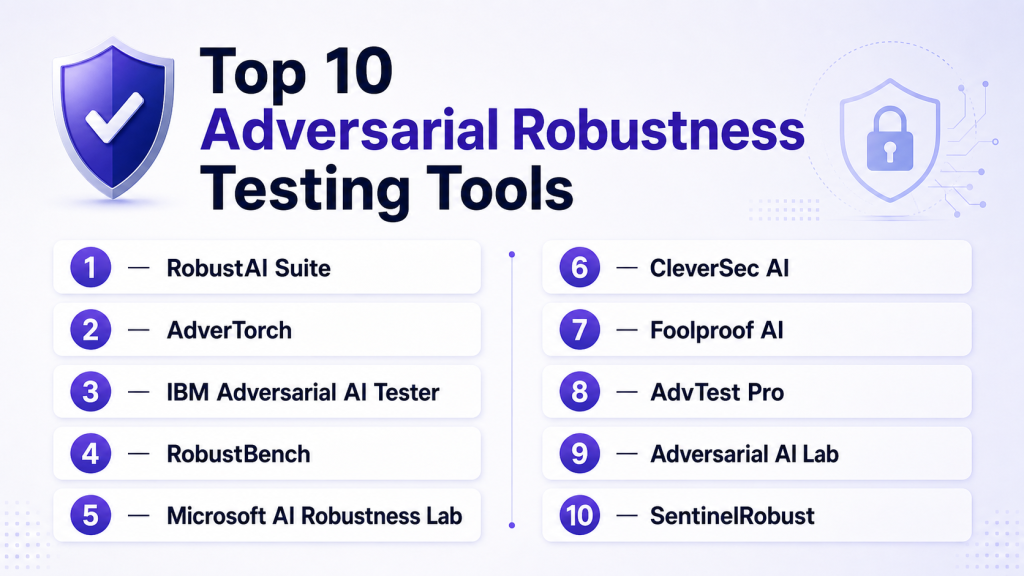
Top 10 Adversarial Robustness Testing Tools
1 — RobustAI Suite
One-line verdict: Enterprise-grade platform for comprehensive adversarial testing across multimodal AI models.
Short description : RobustAI Suite enables simulation of adversarial attacks, stress tests, and regression checks on text, image, and multimodal models. Ideal for enterprises aiming for regulatory compliance.
Standout Capabilities
- End-to-end automated attack generation.
- Multimodal perturbation support.
- Red-teaming workflow integration.
- Model drift detection.
- Continuous evaluation in CI/CD pipelines.
- Real-time reporting dashboards.
- Policy-driven guardrail checks.
AI-Specific Depth
- Model support: Proprietary + open-source + BYO models
- RAG / knowledge integration: Varies / N/A
- Evaluation: Prompt testing, regression, offline eval, human review
- Guardrails: Policy enforcement, prompt-injection detection
- Observability: Tracing, token/cost metrics, latency
Pros
- Enterprise-grade scalability
- Comprehensive multimodal testing
- Compliance-ready reporting
Cons
- Complex setup for smaller teams
- Higher cost for small-scale models
- Steeper learning curve
Security & Compliance
- SSO/SAML, RBAC, audit logs
- Encryption & data retention controls
- Certifications: Not publicly stated
Deployment & Platforms
- Web / Windows / Linux / macOS
- Cloud / On-premises / Hybrid
Integrations & Ecosystem
Robust APIs and SDKs allow integration with MLOps pipelines, CI/CD tools, and data stores.
- REST APIs for attack automation
- Python SDK for custom workflows
- CI/CD plugin support
- Integration with vector DBs and ML registries
- Webhooks for alerting
- Dashboard extensibility
Pricing Model
Usage-based tiering; enterprise licensing available. Not publicly stated.
Best-Fit Scenarios
- Regulated industries needing compliance-ready AI evaluation.
- Enterprises deploying multimodal AI agents.
- Security teams red-teaming proprietary models.
2 — AdverTorch
One-line verdict: Developer-focused open-source framework for adversarial attacks and robustness evaluation.
Short description : AdverTorch provides tools for generating adversarial examples against deep learning models, enabling ML engineers to test model resilience and benchmark vulnerabilities.
Standout Capabilities
- Adversarial image and audio attacks.
- Gradient-based perturbations.
- Supports PyTorch models natively.
- Extensible custom attack modules.
- Batch testing and reporting.
AI-Specific Depth
- Model support: Open-source / BYO
- RAG / knowledge integration: N/A
- Evaluation: Offline tests, regression
- Guardrails: Varies / N/A
- Observability: Basic logging
Pros
- Lightweight and flexible
- Developer-friendly customization
- Community-supported modules
Cons
- Limited enterprise support
- Lacks GUI dashboards
- Requires technical expertise
Security & Compliance
Not publicly stated
Deployment & Platforms
- Linux / Windows / macOS
- Self-hosted
Integrations & Ecosystem
- Python API integration
- Supports PyTorch ecosystem
- Compatible with CI/CD pipelines
- Extensible for custom workflows
Pricing Model
Open-source; free to use.
Best-Fit Scenarios
- Academic research and experimentation
- Startups validating ML models quickly
- Developers integrating adversarial tests into CI pipelines
3 — IBM Adversarial AI Tester
One-line verdict: Enterprise tool integrating adversarial testing with AI governance and compliance frameworks.
Short description : IBM Adversarial AI Tester offers automated attack simulation, risk scoring, and governance reporting for regulated enterprise AI deployments.
Standout Capabilities
- AI risk scoring dashboard
- Compliance-aligned reporting
- Automated scenario generation
- Multimodal attack support
- Red-team workflow integration
- Integration with IBM Watson and ML platforms
AI-Specific Depth
- Model support: Proprietary + BYO
- RAG / knowledge integration: Varies / N/A
- Evaluation: Prompt tests, regression, human review
- Guardrails: Policy checks, prompt injection detection
- Observability: Detailed token and latency metrics
Pros
- Governance and compliance-ready
- Enterprise-scale model coverage
- Integrated reporting
Cons
- Cost-intensive for small teams
- Proprietary model bias
- Setup complexity
Security & Compliance
- SSO/SAML, audit logs, RBAC
- Data retention and residency controls
Deployment & Platforms
- Cloud / Hybrid
- Web / Windows / Linux / macOS
Integrations & Ecosystem
- IBM Watson ML integration
- CI/CD pipeline plugins
- REST APIs for automation
- Enterprise monitoring integration
Pricing Model
Tiered enterprise licensing. Not publicly stated
Best-Fit Scenarios
- Financial institutions
- Healthcare AI deployments
- Large-scale multimodal AI validation
4 — RobustBench
One-line verdict: Benchmark-focused platform for comparing model robustness across adversarial datasets and scenarios.
Short description : RobustBench enables researchers and engineers to benchmark AI models against standardized adversarial datasets, supporting reproducible robustness evaluation.
Standout Capabilities
- Standardized adversarial dataset support
- Model-to-model comparison
- Offline and online testing
- Leaderboard-style evaluation
- Scenario-based simulation
AI-Specific Depth
- Model support: Open-source / BYO
- RAG / knowledge integration: N/A
- Evaluation: Extensive benchmark tests
- Guardrails: Varies / N/A
- Observability: Test metrics tracking
Pros
- Standardized benchmarking
- Transparent evaluation
- Research-oriented datasets
Cons
- Limited enterprise integration
- No automated guardrails
- Dataset-centric, not full workflow
Security & Compliance
Not publicly stated
Deployment & Platforms
- Web / Linux / macOS
- Self-hosted
Integrations & Ecosystem
- Python APIs
- Integration with ML frameworks
- Supports PyTorch, TensorFlow
Pricing Model
Free / open-source
Best-Fit Scenarios
- Academic benchmarking
- Model comparison research
- ML model publication validation
5 — Microsoft AI Robustness Lab
One-line verdict: Enterprise tool integrated with Azure ML for automated adversarial testing and governance insights.
Short description : Provides enterprise-grade simulation of adversarial attacks, automated evaluation, and integration with Azure AI governance frameworks for model risk mitigation.
Standout Capabilities
- Azure-native integration
- Automated scenario and red-team simulation
- Multimodal AI testing
- Compliance reporting and dashboards
- Token-level observability
AI-Specific Depth
- Model support: BYO / Azure models
- RAG / knowledge integration: Varies / N/A
- Evaluation: Prompt and regression tests, human review
- Guardrails: Policy checks, prompt injection detection
- Observability: Token tracing, cost metrics
Pros
- Azure ecosystem synergy
- Enterprise-grade security
- Integrated dashboards
Cons
- Limited to Azure ecosystem
- Cost-intensive for small teams
- Requires Azure expertise
Security & Compliance
SSO, RBAC, encryption, audit logs
Deployment & Platforms
- Cloud / Hybrid
- Web / Windows / Linux
Integrations & Ecosystem
- Azure ML & AI services
- REST API support
- CI/CD Azure DevOps pipelines
- Custom alerting & dashboards
Pricing Model
Tiered enterprise subscription. Not publicly stated
Best-Fit Scenarios
- Enterprises on Azure
- Regulated industry AI deployments
- Multimodal AI robustness testing
6 — CleverSec AI
One-line verdict: Security-focused adversarial testing tool emphasizing prompt-injection and jailbreak detection in AI agents.
Short description : Focused on guarding AI agents from malicious prompts, CleverSec AI simulates injection attacks and tests guardrails for safe deployment.
Standout Capabilities
- Prompt-injection attack simulation
- Guardrail validation
- Multimodal testing
- Human-in-the-loop validation
- Automated reporting
AI-Specific Depth
- Model support: BYO / Hosted
- RAG / knowledge integration: N/A
- Evaluation: Prompt test, regression
- Guardrails: Advanced prompt injection defense
- Observability: Token and cost metrics
Pros
- Strong guardrail focus
- Developer-friendly reporting
- Integration with AI chat agents
Cons
- Limited dataset coverage
- Less suited for image/video AI
- Smaller community
Security & Compliance
Not publicly stated
Deployment & Platforms
- Cloud / Web
- Windows / Linux / macOS
Integrations & Ecosystem
- APIs for AI agent integration
- SDKs for custom workflows
- CI/CD pipeline support
- Human review hooks
Pricing Model
Usage-based licensing. Not publicly stated
Best-Fit Scenarios
- Conversational AI deployment
- Enterprise chatbots
- Guardrail and compliance validation
7 — Foolproof AI
One-line verdict: Tool for automated detection of model vulnerabilities with focus on reliability and regression evaluation.
Short description : Foolproof AI helps AI teams detect brittle behaviors in models and track robustness metrics across versions and deployments.
Standout Capabilities
- Regression testing and version tracking
- Automated adversarial scenario generation
- Multimodal evaluation
- Benchmarking against historical vulnerabilities
- Alerting for model drift
AI-Specific Depth
- Model support: BYO / Multi-model routing
- RAG / knowledge integration: N/A
- Evaluation: Regression tests, scenario evaluation
- Guardrails: Varies / N/A
- Observability: Token-level monitoring
Pros
- Automated regression checks
- Versioned evaluation
- Scalable for enterprise AI
Cons
- Setup complexity
- Limited community examples
- Cost can scale quickly
Security & Compliance
Not publicly stated
Deployment & Platforms
- Cloud / Web / Hybrid
- Windows / Linux / macOS
Integrations & Ecosystem
- REST APIs
- CI/CD pipeline hooks
- Dashboard integrations
- Custom script support
Pricing Model
Tiered / usage-based. Not publicly stated
Best-Fit Scenarios
- Enterprise AI model lifecycle
- Continuous robustness evaluation
- Multimodal AI testing
8 — AdvTest Pro
One-line verdict: Enterprise-focused tool offering large-scale adversarial simulations with analytics dashboards.
Short description : Enables AI teams to simulate attacks at scale and analyze model vulnerabilities with visual dashboards and actionable metrics.
Standout Capabilities
- High-throughput adversarial testing
- Visual analytics dashboards
- Customizable attack scenarios
- Alerting and reporting automation
- Multimodal attack support
AI-Specific Depth
- Model support: Hosted / BYO
- RAG / knowledge integration: Varies / N/A
- Evaluation: Offline eval, prompt tests
- Guardrails: Policy enforcement
- Observability: Token/cost/latency metrics
Pros
- Scalable for large models
- Analytics-focused
- Enterprise reporting
Cons
- High resource requirements
- Learning curve for customization
- Cloud dependency
Security & Compliance
Not publicly stated
Deployment & Platforms
- Cloud / Hybrid
- Web / Windows / Linux
Integrations & Ecosystem
- REST APIs
- SDK support
- Dashboard integration
- CI/CD hooks
Pricing Model
Usage-based enterprise tiers. Not publicly stated
Best-Fit Scenarios
- Large-scale AI deployments
- Enterprise security teams
- Continuous robustness evaluation
9 — Adversarial AI Lab
One-line verdict: Research-oriented framework for experimental adversarial attacks and model robustness studies.
Short description : Focuses on academic and experimental AI research, enabling reproducible attacks and robustness evaluation with flexible tooling.
Standout Capabilities
- Customizable adversarial attack modules
- Multimodal experimental support
- Dataset benchmarking
- Human-in-the-loop testing
- Open extensibility
AI-Specific Depth
- Model support: Open-source / BYO
- RAG / knowledge integration: N/A
- Evaluation: Regression, benchmark tests
- Guardrails: Varies / N/A
- Observability: Test metric logs
Pros
- Flexible for research
- Community-oriented
- Supports novel attack experimentation
Cons
- Limited enterprise support
- Lacks GUI dashboards
- Smaller user community
Security & Compliance
Not publicly stated
Deployment & Platforms
- Self-hosted
- Linux / macOS / Windows
Integrations & Ecosystem
- Python APIs
- Dataset integrations
- ML framework support
Pricing Model
Open-source
Best-Fit Scenarios
- Academic AI research
- Experimentation with new attacks
- Benchmark studies
10 — SentinelRobust
One-line verdict: Automated AI model testing platform with enterprise observability and governance integration.
Short description : SentinelRobust provides automated adversarial testing, risk scoring, and governance dashboards, focusing on enterprise AI model reliability and auditability.
Standout Capabilities
- Automated test scenario generation
- Risk scoring dashboards
- Observability for latency/cost metrics
- Integration with governance workflows
- Multimodal model coverage
AI-Specific Depth
- Model support: Proprietary / BYO / Multi-model
- RAG / knowledge integration: Varies / N/A
- Evaluation: Prompt and regression testing
- Guardrails: Policy enforcement, injection detection
- Observability: Detailed token and cost metrics
Pros
- Enterprise-focused
- Automated reporting
- Governance-friendly
Cons
- Higher cost for small teams
- Complexity of setup
- Proprietary lock-in risk
Security & Compliance
SSO, RBAC, audit logs, encryption. Certifications: Not publicly stated
Deployment & Platforms
- Cloud / Hybrid
- Web / Windows / Linux / macOS
Integrations & Ecosystem
- REST APIs and SDKs
- CI/CD pipeline integration
- Dashboard and alerting tools
- Enterprise ML platform connectors
Pricing Model
Tiered enterprise licensing. Not publicly stated
Best-Fit Scenarios
- Regulated industry AI
- Enterprise model governance
- Multimodal AI agent deployments
Comparison Table
| Tool Name | Best For | Deployment | Model Flexibility | Strength | Watch-Out | Public Rating |
|---|---|---|---|---|---|---|
| RobustAI Suite | Enterprise multimodal AI testing | Cloud / Hybrid | Proprietary / BYO / Multi-model | Comprehensive testing | Steep learning curve | N/A |
| AdverTorch | Developers & researchers | Self-hosted | Open-source / BYO | Developer flexibility | Limited enterprise features | N/A |
| IBM Adversarial AI Tester | Compliance-heavy AI evaluation | Cloud / Hybrid | Proprietary / BYO | Enterprise-grade reporting | Setup complexity | N/A |
| RobustBench | Research benchmarking | Self-hosted | Open-source / BYO | Standardized benchmarks | Limited workflow integration | N/A |
| Microsoft AI Robustness Lab | Azure-based enterprises | Cloud / Hybrid | BYO / Azure models | Azure ecosystem integration | Azure dependency | N/A |
| CleverSec AI | AI agents guardrail testing | Cloud | BYO / Hosted | Prompt-injection defense | Limited modality support | N/A |
| Foolproof AI | Regression & reliability testing | Cloud / Hybrid | BYO / Multi-model routing | Automated regression checks | Setup complexity | N/A |
| AdvTest Pro | Large-scale enterprise testing | Cloud / Hybrid | Hosted / BYO | Analytics dashboards | High resource requirements | N/A |
| Adversarial AI Lab | Research experimentation | Self-hosted | Open-source / BYO | Research flexibility | Small community | N/A |
| SentinelRobust | Enterprise governance & observability | Cloud / Hybrid | Proprietary / BYO / Multi-model | Governance-ready dashboards | Proprietary lock-in risk | N/A |
Scoring & Evaluation
Scoring is comparative: each tool is evaluated against others for features, evaluation, integrations, ease of use, performance, security, and support. Weighted total provides a relative view, not absolute.
| Tool | Core | Reliability/Eval | Guardrails | Integrations | Ease | Perf/Cost | Security/Admin | Support | Weighted Total |
|---|---|---|---|---|---|---|---|---|---|
| RobustAI Suite | 9 | 9 | 8 | 9 | 7 | 8 | 8 | 7 | 8.4 |
| AdverTorch | 7 | 7 | 5 | 6 | 8 | 8 | 5 | 6 | 6.6 |
| IBM Adversarial AI Tester | 8 | 9 | 8 | 8 | 7 | 7 | 8 | 7 | 7.8 |
| RobustBench | 7 | 8 | 5 | 6 | 7 | 7 | 5 | 6 | 6.7 |
| Microsoft AI Robustness Lab | 8 | 8 | 8 | 8 | 7 | 7 | 7 | 6 | 7.5 |
| CleverSec AI | 7 | 7 | 8 | 6 | 7 | 7 | 6 | 6 | 6.8 |
| Foolproof AI | 8 | 8 | 7 | 7 | 7 | 7 | 6 | 6 | 7.2 |
| AdvTest Pro | 8 | 8 | 7 | 8 | 6 | 8 | 7 | 6 | 7.4 |
| Adversarial AI Lab | 7 | 7 | 5 | 6 | 7 | 6 | 5 | 6 | 6.5 |
| SentinelRobust | 8 | 8 | 8 | 8 | 7 | 7 | 7 | 7 | 7.6 |
Top 3 for Enterprise: RobustAI Suite, IBM Adversarial AI Tester, SentinelRobust
Top 3 for SMB: Microsoft AI Robustness Lab, CleverSec AI, Foolproof AI
Top 3 for Developers: AdverTorch, RobustBench, Adversarial AI Lab
Which Adversarial Robustness Testing Tool Is Right for You?
Solo / Freelancer
Focus on open-source tools like AdverTorch or RobustBench. Lightweight setup and flexibility are key; full enterprise suites may be overkill.
SMB
Tools like Microsoft AI Robustness Lab or CleverSec AI provide a balance between usability, cost, and moderate enterprise features.
Mid-Market
Consider platforms like AdvTest Pro or Foolproof AI to support structured evaluation, CI/CD integration, and scalability.
Enterprise
RobustAI Suite, IBM Adversarial AI Tester, and SentinelRobust offer full governance, dashboards, multimodal coverage, and compliance-ready workflows.
Regulated industries (finance/healthcare/public sector)
Prioritize tools with guardrails, compliance reporting, audit logs, and red-teaming capabilities (RobustAI Suite, IBM Adversarial AI Tester).
Budget vs premium
Open-source frameworks are low-cost but require expertise; premium suites provide scalability, automation, and dashboards at higher cost.
Build vs buy (when to DIY)
Small-scale models and research can leverage open-source libraries; production-grade AI across multimodal inputs often benefits from enterprise-ready tools.
Implementation Playbook (30 / 60 / 90 Days)
30 Days – Pilot & Baseline Evaluation
- Identify critical AI models and prioritize based on risk and business impact.
- Run initial adversarial attacks (text, image, or multimodal) to establish baseline vulnerabilities.
- Collect metrics on model failure rates, latency, and performance under adversarial conditions.
- Define success metrics (e.g., maximum tolerated error rate, response deviation thresholds).
- Conduct initial human-in-the-loop verification for edge-case scenarios.
60 Days – Harden Security & Expand Testing
- Integrate adversarial robustness testing into CI/CD pipelines for automated evaluation.
- Implement guardrails: policy enforcement, prompt injection prevention, and automated alerts.
- Conduct red-teaming exercises to simulate advanced attack scenarios.
- Extend coverage to additional models, datasets, and multimodal inputs.
- Begin internal reporting and compliance documentation to satisfy regulatory needs.
90 Days – Optimize & Scale
- Analyze performance and cost metrics; optimize testing pipelines for efficiency.
- Implement observability dashboards for token-level, cost, and latency monitoring.
- Establish continuous governance workflows with audit logs and alerting mechanisms.
- Scale testing to all production models and new model versions.
- Incorporate lessons from pilot and red-team exercises into model development best practices.
- Formalize processes for incident handling, retraining, and ongoing evaluation.
AI-specific tasks:
- Use an evaluation harness to automate prompt, regression, and stress tests.
- Apply red-teaming for advanced adversarial input scenarios.
- Implement prompt/version control for model iterations.
- Set up incident handling protocols for model failures under attack.
Common Mistakes & How to Avoid Them
- Ignoring prompt injection and jailbreak scenarios.
- Not performing continuous evaluation or regression testing.
- Unmanaged data retention and privacy risks.
- Lack of observability or traceability in testing workflows.
- Unexpected cost spikes during large-scale evaluations.
- Over-automation without human oversight.
- Vendor lock-in without abstraction layers.
- Failing to integrate robustness testing into CI/CD.
- Ignoring multimodal and edge-case scenarios.
- Not aligning with compliance or regulatory standards.
- Neglecting red-teaming and adversarial simulations.
- Overlooking versioned model tracking and metrics.
- Assuming open-source tools cover enterprise requirements.
FAQs
1. What is adversarial robustness testing?
It evaluates how AI models respond to malicious or unexpected inputs, ensuring safe deployment.
2. Do these tools handle multimodal AI?
Many modern tools support text, image, audio, and multimodal inputs; always check each tool’s specification.
3. Can I use these tools for open-source models?
Yes, frameworks like AdverTorch and RobustBench are designed for open-source and BYO models.
4. Are enterprise tools compliant with regulations?
Premium platforms often include compliance features and audit logs; open-source tools require manual governance setup.
5. How do guardrails work in these tools?
Guardrails enforce policies to prevent prompt injection, misuse, or unintended outputs during testing.
6. What is RAG/knowledge integration relevance?
Some tools support retrieval-augmented generation evaluation; others focus purely on adversarial inputs.
7. Are there cost considerations?
Cloud-based tools may incur usage fees; open-source frameworks are free but require compute resources.
8. Can I self-host these tools?
Many tools allow self-hosting, especially open-source frameworks and enterprise hybrid deployments.
9. How often should I test models?
Continuous evaluation is recommended, especially for models in production or exposed to user inputs.
10. What is the typical learning curve?
Open-source frameworks require technical expertise; enterprise suites provide GUI dashboards and simplified workflows.
11. Can I integrate these into CI/CD pipelines?
Yes, most modern tools provide APIs, SDKs, or plugins for automated evaluation.
12. Are these tools effective for all AI models?
Effectiveness varies; models with low complexity may need only basic testing, while multimodal or mission-critical models require comprehensive suites.
Conclusion
Adversarial Robustness Testing Tools have become essential for safe AI deployment, particularly in multimodal, enterprise, and regulated contexts. Selecting the right tool depends on scale, model types, budget, and compliance needs. Enterprises benefit from robust, dashboard-driven suites, while developers and SMBs may rely on open-source frameworks for flexibility and experimentation. A structured approach—including pilot tests, guardrail validation, and continuous evaluation—ensures AI systems remain resilient, secure, and reliable. Next steps: shortlist tools suited to your model ecosystem, run pilots with real-world adversarial scenarios, verify guardrails and evaluation results, then scale deployment across production environments.
This blog explains adversarial robustness testing in a very clear and practical way, especially for real-world AI risks. The tool comparison helps in understanding how different solutions handle security challenges.
This post highlights the importance of testing AI models against malicious inputs and edge cases. Very informative and highly relevant in today’s AI landscape!
This article explains adversarial testing technologies in a practical way with useful insights for AI developers and cybersecurity professionals.
This article clearly explains how adversarial robustness testing tools help detect hidden weaknesses in AI models before deployment, which is very important for building safe and reliable systems.